Q1041.A shopkeeper mixes 50 kg of sugar costing ₹60 per kg with a certain quantity of sugar costing ₹90 per kg. If he sells the mixture at ₹84 per kg and makes a 20% profit, find the quantity of the ₹90 per kg sugar.
एक दुकानदार ₹60 प्रति kg वाली 50 kg चीनी में ₹90 प्रति kg वाली कुछ मात्रा मिलाता है। यदि वह मिश्रण ₹84 प्रति kg पर बेचकर 20% लाभ कमाता है, तो ₹90 वाली चीनी की मात्रा ज्ञात कीजिए।
- A30 kg
- B25 kg
- C20 kg
- D15 kg
Show answer
Concept: Find the mixture's cost price first, then use alligation.
- Mixture CP = ₹70 per kg.
- Cheap : costly = .
- 50 kg is 2 parts → 1 part = 25 kg of ₹90 sugar.
Trick: Never apply alligation on selling price — convert SP to CP first.
Answer: (B) 25 kg
अवधारणा: पहले मिश्रण का क्रय मूल्य निकालें, फिर एलीगेशन लगाएँ।
- मिश्रण CP = ₹70 प्रति किग्रा।
- सस्ती : महँगी = ।
- 50 किग्रा = 2 भाग → 1 भाग = 25 किग्रा (₹90 वाली)।
ट्रिक: एलीगेशन हमेशा क्रय मूल्य पर लगाएँ, विक्रय मूल्य पर नहीं।
उत्तर: (B) 25 kg
SSC CGLQuantitative AptitudeAlligation – quantity of second varietySSC CGL 2025 · 14 Sep Shift 1
Q1042.A and B can complete a task together in 24 days, while B and C can finish it in 32 days. After A works on it for 10 days and B for 14 days, C takes the remaining 26 days to finish the work. How many days would it take for C to complete the work alone?
A और B मिलकर एक कार्य 24 दिनों में कर सकते हैं, जबकि B और C उसे 32 दिनों में कर सकते हैं। A ने 10 दिन और B ने 14 दिन काम किया, फिर C ने शेष कार्य 26 दिनों में पूरा किया। C अकेला कार्य कितने दिनों में पूरा करेगा?
- A48 days48 दिन
- B46 days46 दिन
- C40 days40 दिन
- D38 days38 दिन
Show answer
Concept: Split the work so that pairs (A+B) and (B+C) appear.
- .
- .
- .
- C alone takes 48 days.
Trick: Regroup the days into known pairs: 10 days of (A+B), 4 days of (B+C), and C alone for the remaining 22 days.
Answer: (A) 48 days
अवधारणा: कार्य को इस तरह बाँटें कि (A+B) और (B+C) की जोड़ियाँ बनें।
- ।
- ।
- ।
- C अकेला 48 दिन लेगा।
ट्रिक: दिनों को ज्ञात जोड़ियों में बाँटें: 10 दिन (A+B), 4 दिन (B+C), बाकी 22 दिन C अकेला।
उत्तर: (A) 48 दिन
SSC CGLQuantitative AptitudeTime & work – three workersSSC CGL 2025 · 14 Sep Shift 1
Q1043.A cyclist travels from City A to City B at an average speed of 40 km/h and takes 8 hours. If they want to complete the same journey in 5 hours, by what amount (in km/h) must the average speed be increased?
एक साइकिल चालक शहर A से शहर B तक 40 km/h की औसत चाल से 8 घंटे में पहुँचता है। यदि वही यात्रा 5 घंटों में पूरी करनी हो, तो औसत चाल कितनी (km/h) बढ़ानी होगी?
- A24 km/h
- B20 km/h
- C25 km/h
- D18 km/h
Show answer
Concept: Distance stays the same; speed .
- Distance = km.
- New speed = km/h.
- Increase = km/h.
Trick: Time 8 → 5, so speed : → increase 24.
Answer: (A) 24 km/h
अवधारणा: दूरी समान; चाल 1/समय।
- दूरी = किमी।
- नई चाल = किमी/घंटा।
- वृद्धि = किमी/घंटा।
ट्रिक: समय 8 → 5, तो चाल : → वृद्धि 24।
उत्तर: (A) 24 km/h
SSC CGLQuantitative AptitudeSpeed – required increaseSSC CGL 2025 · 14 Sep Shift 1
Q1044.A train leaves Station P at 5:00 AM and travels towards Station Q at a constant speed of 60 km/h. Another train leaves Station Q at 7:00 AM and travels towards Station P at a constant speed of 90 km/h. The distance between the two stations is 540 km. At what time will the two trains meet?
एक रेलगाड़ी स्टेशन P से सुबह 5:00 बजे चलकर 60 km/h की स्थिर चाल से स्टेशन Q की ओर जाती है। दूसरी रेलगाड़ी स्टेशन Q से सुबह 7:00 बजे चलकर 90 km/h की चाल से P की ओर जाती है। दोनों स्टेशनों के बीच की दूरी 540 km है। दोनों रेलगाड़ियाँ किस समय मिलेंगी?
- A12:45 PM
- B10:45 AM
- C11:48 AM
- D9:48 AM
Show answer
Concept: Account for the head start, then use relative speed.
- 5 to 7 AM: first train runs km; gap = km.
- Approaching speed = km/h.
- Time = h = 2 h 48 min → 7:00 + 2:48 = 9:48 AM.
Trick: min — convert decimal hours by multiplying by 60.
Answer: (D) 9:48 AM
अवधारणा: पहले बढ़त की दूरी घटाएँ, फिर सापेक्ष चाल लगाएँ।
- 5 से 7 बजे तक पहली ट्रेन किमी चली; शेष दूरी = 420 किमी।
- आमने-सामने की सापेक्ष चाल = किमी/घंटा।
- समय = घंटे = 2 घंटे 48 मिनट → सुबह 9:48।
ट्रिक: 0.8 घंटा मिनट — दशमलव घंटे को 60 से गुणा करें।
उत्तर: (D) 9:48 AM
SSC CGLQuantitative AptitudeTrains – meeting timeSSC CGL 2025 · 14 Sep Shift 1
Q1045.A circular garden having a diameter of 20 m is surrounded by a concrete path that is 2 m wide. Calculate the percentage increase in area resulting from the addition of the path.
20 m व्यास वाले एक वृत्ताकार उद्यान के चारों ओर 2 m चौड़ा कंक्रीट पथ है। पथ जुड़ने से क्षेत्रफल में प्रतिशत वृद्धि ज्ञात कीजिए।
- A24%
- B20%
- C44%
- D54%
Show answer
Concept: Area , so compare squares of radii.
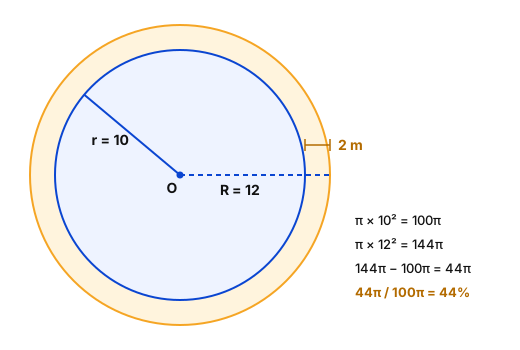
- Inner m; outer m.
- Areas: and .
- Increase = .
Trick: Radius rises 20% → area rises .
Answer: (C) 44%
अवधारणा: क्षेत्रफल , अतः त्रिज्याओं के वर्गों की तुलना करें।
- अंदर मी; बाहर मी।
- क्षेत्रफल: और ।
- वृद्धि = ।
ट्रिक: त्रिज्या 20% बढ़ी → क्षेत्रफल बढ़ा।
उत्तर: (C) 44%
SSC CGLQuantitative AptitudeMensuration – circular pathSSC CGL 2025 · 14 Sep Shift 1
Q1046.A sector of a circle having a radius 14 cm has area 77 cm². Find the angle of the sector.
14 cm त्रिज्या वाले वृत्त के एक त्रिज्यखंड का क्षेत्रफल 77 cm² है। त्रिज्यखंड का कोण ज्ञात कीजिए।
- A90°
- B45°
- C60°
- D180°
Show answer
Concept: Sector area = .
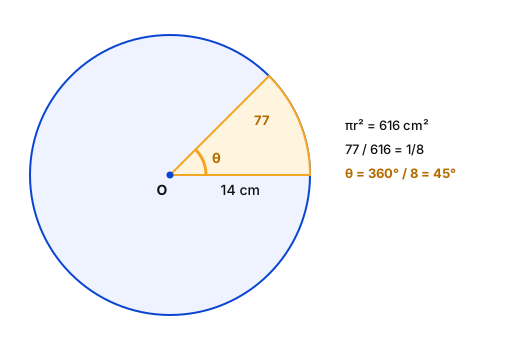
- cm².
- .
- .
Trick: , so the sector is of the circle → 45°.
Answer: (B) 45°
अवधारणा: त्रिज्यखंड क्षेत्रफल = ।
- सेमी²।
- ।
- ।
ट्रिक: , यानी वृत्त का → 45°।
उत्तर: (B) 45°
SSC CGLQuantitative AptitudeMensuration – sector angleSSC CGL 2025 · 14 Sep Shift 1
Q1047.A circular signboard has a radius of 4 m. If painting costs ₹30 per m² and 80% of the board is painted, what is the total painting cost? [use π = 3.14]
एक वृत्ताकार साइनबोर्ड की त्रिज्या 4 m है। यदि पेंटिंग की लागत ₹30 प्रति m² है और बोर्ड का 80% भाग पेंट किया जाता है, तो कुल पेंटिंग लागत क्या होगी? [π = 3.14 लीजिए]
- A₹1658.2
- B₹1205.7
- C₹1206.7
- D₹1681.2
Show answer
Concept: Cost = painted area × rate.
- Full area = m².
- Painted = m².
- Cost = ₹1,205.76 ≈ ₹1,205.7.
Trick: Combine first: → .
Answer: (B) ₹1205.7
अवधारणा: खर्च = रंगा गया क्षेत्रफल × दर।
- पूरा क्षेत्रफल = मी²।
- रंगा भाग = 50.24 का 80% = 40.192 मी²।
- खर्च = ₹1,205.76 ≈ ₹1,205.7।
ट्रिक: पहले → ।
उत्तर: (B) ₹1205.7
SSC CGLQuantitative AptitudeMensuration – painting costSSC CGL 2025 · 14 Sep Shift 1
Q1048.Find the y-intercept of 2x + 3y = 18.
2x + 3y = 18 का y-अंतःखंड ज्ञात कीजिए।
- A3
- B4
- C5
- D6
Show answer
Concept: y-intercept = value of y when .
- Put : .
- .
- The line cuts the y-axis at (0, 6).
Trick: For , y-intercept = ; x-intercept = .
Answer: (D) 6
अवधारणा: y-अंतःखंड = रखने पर y का मान।
- रखें: ।
- ।
- रेखा y-अक्ष को (0, 6) पर काटती है।
ट्रिक: में y-अंतःखंड = ; x-अंतःखंड = ।
उत्तर: (D) 6
SSC CGLQuantitative AptitudeCoordinate geometry – y-interceptSSC CGL 2025 · 14 Sep Shift 1
Q1049.Given, x + = 5, find the value of x³ + .
यदि x + = 5 है, तो x³ + का मान ज्ञात कीजिए।
- A110
- B120
- C100
- D130
Show answer
Concept: .
- .
- ; .
- .
Trick: If , then . For a = 5: .
Answer: (A) 110
अवधारणा: ।
- ।
- ; ।
- ।
ट्रिक: यदि , तो । a = 5 पर ।
उत्तर: (A) 110
SSC CGLQuantitative AptitudeAlgebra – x³ + 1/x³SSC CGL 2025 · 14 Sep Shift 1
Q1050.0.2 + 0.02 + 0.002 = ?
- A0.223
- B0.111
- C0.221
- D0.222
Show answer
Concept: Align decimal points before adding.
- 0.200 + 0.020 + 0.002.
- Thousandths: 200 + 20 + 2 = 222.
- Sum = 0.222.
Trick: Each term puts a 2 in a new place (tenths, hundredths, thousandths) → 0.222.
Answer: (D) 0.222
अवधारणा: जोड़ने से पहले दशमलव बिंदु एक सीध में रखें।
- 0.200 + 0.020 + 0.002।
- हज़ारवें भाग में: 200 + 20 + 2 = 222।
- योग = 0.222।
ट्रिक: हर पद अगले स्थान (दशांश, शतांश, सहस्रांश) पर 2 रखता है → 0.222।
उत्तर: (D) 0.222
SSC CGLQuantitative AptitudeDecimals – additionSSC CGL 2025 · 14 Sep Shift 1
Q1051.If B is 30% more than A, and C is 25% more than B, then what is A : C?
यदि B, A से 30% अधिक है और C, B से 25% अधिक है, तो A : C क्या है?
- A13 : 8
- B8 : 13
- C16 : 25
- D25 : 16
Show answer
Concept: Convert each % increase into a fraction multiplier.
- 30% more ; 25% more .
- Take A = 40 (LCM-friendly): ; .
- A : C = 40 : 65 = 8 : 13.
Trick: A is smaller than C, so the ratio must be "small : big" – only B (8 : 13) and C (16 : 25) qualify; picks B.
Answer: (B) 8 : 13
अवधारणा: हर प्रतिशत वृद्धि को भिन्न-गुणक में बदलें।
हल:
- 30% अधिक ; 25% अधिक ।
- A = 40 मानें: ; ।
- A : C = 40 : 65 = 8 : 13।
ट्रिक: A, C से छोटा है – अनुपात "छोटा : बड़ा" होगा; → 8 : 13।
उत्तर: (B) 8 : 13
SSC CGLQuantitative AptitudePercentage increase chain – ratioSSC CGL 2025 · 13 Sep Shift 3
Q1052.A pipe releases 0.365 liters of water every second. How much does it release in 6 seconds?
एक पाइप प्रत्येक सेकंड 0.365 लीटर पानी छोड़ता है। 6 सेकंड में वह कितना पानी छोड़ेगा?
- A2.19 liters2.19 लीटर
- B2.25 liters2.25 लीटर
- C1.83 liters1.83 लीटर
- D1.90 liters1.90 लीटर
Show answer
Concept: Quantity = rate × time.
- : first .
- Put back 3 decimal places → 2.190 L = 2.19 L.
Trick: Estimate: , – only 2.19 and 2.25 are near; the last digit ends in 0, so 2.190 → 2.19.
Answer: (A) 2.19 liters
अवधारणा: मात्रा = दर × समय।
हल:
- : पहले ।
- 3 दशमलव स्थान वापस लगाएँ → 2.190 L = 2.19 L।
ट्रिक: अनुमान: , – केवल 2.19 और 2.25 पास हैं; गणना से 2.19।
उत्तर: (A) 2.19 लीटर
SSC CGLQuantitative AptitudeDecimal multiplication – rate × timeSSC CGL 2025 · 13 Sep Shift 3
Q1053.A rope is divided in the ratio : : : 1. Total length = 5 m. Find the smallest piece.
एक रस्सी को : : : 1 के अनुपात में बाँटा गया है। कुल लंबाई = 5 m। सबसे छोटा टुकड़ा ज्ञात कीजिए।
- A0.556 m
- B0.889 m
- C1.333 m
- D2.222 m
Show answer
Concept: Clear fractions by multiplying all terms by the LCM of denominators.
- Ratio ; .
- → 8 : 5 : 12 : 20; total = 45 parts.
- Smallest = m m m.
Trick: 45 parts = 5 m, so 1 part = m; smallest share (5 parts) = m.
Answer: (A) 0.556 m
अवधारणा: सभी पदों को हरों के LCM से गुणा करके भिन्न हटाएँ।
हल:
- अनुपात ; ।
- → 8 : 5 : 12 : 20; कुल = 45 भाग।
- सबसे छोटा = m m m।
ट्रिक: 45 भाग = 5 m, यानी 1 भाग = m; सबसे छोटा (5 भाग) = m।
उत्तर: (A) 0.556 m
SSC CGLQuantitative AptitudeDividing in a fractional ratioSSC CGL 2025 · 13 Sep Shift 3
Q1054.A vendor mixes two types of rice — one costing ₹110 per kg and the other costing ₹170 per kg, in the ratio 2 : 3. If he sells the mixed variety at ₹142 per kg, find his gain or loss percent.
एक विक्रेता दो प्रकार के चावल — ₹110 प्रति kg और ₹170 प्रति kg — को 2 : 3 के अनुपात में मिलाता है। यदि वह मिश्रित चावल ₹142 प्रति kg पर बेचता है, तो उसका लाभ या हानि प्रतिशत ज्ञात कीजिए।
- A2.74% loss2.74% हानि
- B2.74% gain2.74% लाभ
- C3.25% Loss3.25% हानि
- D3.25% Gain3.25% लाभ
Show answer
Concept: Find the weighted cost per kg, then compare with selling price.
- Cost of 5 kg = = ₹730 → ₹146/kg.
- SP = ₹142 is less than CP → loss of ₹4 per kg.
- Loss% = .
Trick: SP below CP means "loss" – options B and D go immediately; is just under 3% → 2.74%.
Answer: (A) 2.74% loss
अवधारणा: प्रति kg भारित लागत निकालें और विक्रय मूल्य से तुलना करें।
हल:
- 5 kg की लागत = = ₹730 → ₹146/kg।
- विक्रय मूल्य ₹142 लागत से कम → प्रति kg ₹4 हानि।
- हानि% = ।
ट्रिक: SP, CP से कम होते ही "लाभ" वाले विकल्प B, D हट जाते हैं; लगभग 2.74%।
उत्तर: (A) 2.74% हानि
SSC CGLQuantitative AptitudeMixture – profit/loss on mixed riceSSC CGL 2025 · 13 Sep Shift 3
Q1055.A, B, and C invested ₹30,000, ₹50,000, and ₹90,000 respectively in a business. If the total profit at the end of the year is ₹30,000, what is A's share of the profit?
A, B और C ने क्रमशः ₹30,000, ₹50,000 और ₹90,000 का निवेश किया। यदि वर्ष के अंत में कुल लाभ ₹30,000 है, तो लाभ में A का हिस्सा क्या है?
- A₹8823.53
- B₹5294.12
- C₹15882.35
- D₹9000
Show answer
Concept: With equal time, profit is shared in the ratio of capitals.
- 30,000 : 50,000 : 90,000 = 3 : 5 : 9 (sum 17).
- A = ₹5,294.12.
Trick: of 30,000 ≈ 1,764.7; – only option B is near.
Answer: (B) ₹5294.12
अवधारणा: समय समान हो तो लाभ पूँजी के अनुपात में बँटता है।
हल:
- 30,000 : 50,000 : 90,000 = 3 : 5 : 9 (योग 17)।
- A = ₹5,294.12।
ट्रिक: 30,000 का ≈ 1,764.7; – केवल विकल्प B।
उत्तर: (B) ₹5294.12
SSC CGLQuantitative AptitudePartnership – equal timeSSC CGL 2025 · 13 Sep Shift 3
Q1056.X and Y share a rented field. X utilizes 15 horses for 5 months, while Y uses 25 cows for 4 months and 40 sheep for 5 months. If 2 horses are equivalent to 5 cows, and 3 cows are equal to 9 sheep, what portion of the rent is X to pay?
X और Y एक किराए के मैदान का उपयोग करते हैं। X, 15 घोड़े 5 माह के लिए रखता है, जबकि Y, 25 गायें 4 माह और 40 भेड़ें 5 माह के लिए रखता है। यदि 2 घोड़े = 5 गायें और 3 गायें = 9 भेड़ें, तो किराए का कितना भाग X देगा?
- A
- B
- C
- D
Show answer
Concept: Express every animal in one unit (sheep), then share rent by sheep-months.
- Cow = sheep; horse = cows sheep.
- ; .
- X's share = .
Trick: X's part must be a little over half (562.5 vs 500) and less than 1 – fits; is too big, exceeds 1.
Answer: (D)
अवधारणा: सभी पशुओं को एक इकाई (भेड़) में बदलें, फिर भेड़-माह के अनुपात में किराया बाँटें।
हल:
- गाय = भेड़; घोड़ा = गाय भेड़।
- ; ।
- X का भाग = ।
ट्रिक: X का भाग आधे से थोड़ा अधिक (562.5 बनाम 500) और 1 से कम होगा – ही उपयुक्त।
उत्तर: (D)
SSC CGLQuantitative AptitudeRent sharing – converting animalsSSC CGL 2025 · 13 Sep Shift 3
Q1057.A and B start a business. A invests 2 times more than B. After 6 months, A withdraws half of his capital, and B triples his capital. If the total profit after one year is ₹65,000, find the share of A.
A और B एक व्यवसाय शुरू करते हैं। A, B से 2 गुना अधिक निवेश करता है। 6 माह बाद A अपनी आधी पूंजी निकाल लेता है और B अपनी पूंजी तिगुनी कर देता है। यदि एक वर्ष बाद कुल लाभ ₹65,000 है, तो A का हिस्सा ज्ञात कीजिए।
- A₹30,000
- B₹32413.78
- C₹38,000
- D₹34,411.77
Show answer
Concept: Profit ratio = sum of (capital × months) for each partner.
- "2 times more than B" → A = 3B. Let B = 1, A = 3.
- A: ; B: → 9 : 8.
- A = ₹34,411.8.
Trick: "x times more" = (x + 1) times; with 9 : 8, A gets just over half of 65,000 (32,500) – only D fits.
Answer: (D) ₹34,411.77
अवधारणा: लाभ अनुपात = हर साझेदार का (पूँजी × महीने) का योग।
हल:
- "B से 2 गुना अधिक" → A = 3B। B = 1, A = 3 मानें।
- A: ; B: → 9 : 8।
- A = ₹34,411.8।
ट्रिक: "x गुना अधिक" = (x + 1) गुना; 9 : 8 में A को 32,500 से थोड़ा अधिक मिलेगा – केवल D।
उत्तर: (D) ₹34,411.77
SSC CGLQuantitative AptitudePartnership – capital changed midwaySSC CGL 2025 · 13 Sep Shift 3
Q1058.The average salary of 12 employees is ₹20,000. The average salary of 4 senior staff is ₹30,000. What is the average salary for the other employees?
12 कर्मचारियों का औसत वेतन ₹20,000 है। 4 वरिष्ठ कर्मचारियों का औसत वेतन ₹30,000 है। शेष कर्मचारियों का औसत वेतन क्या है?
- A₹15,000
- B₹16,000
- C₹17,000
- D₹18,000
Show answer
Concept: Total = average × number.
- All 12: = ₹2,40,000; 4 seniors: = ₹1,20,000.
- Other 8: = ₹15,000.
Trick: Deviation method: 4 seniors are +10,000 each = +40,000, shared by 8 others → each −5,000 → .
Answer: (A) ₹15,000
अवधारणा: कुल = औसत × संख्या।
हल:
- सभी 12: = ₹2,40,000; 4 वरिष्ठ: = ₹1,20,000।
- शेष 8: = ₹15,000।
ट्रिक: विचलन विधि: 4 वरिष्ठ हर एक +10,000 = +40,000; यह 8 अन्य पर बँटेगा → हर एक −5,000 → 15,000।
उत्तर: (A) ₹15,000
SSC CGLQuantitative AptitudeAverage of the remaining groupSSC CGL 2025 · 13 Sep Shift 3
Q1059.A cricketer's average in 9 innings is 55. If his highest score is excluded, the average drops to 50. What is his highest score?
एक क्रिकेटर का 9 पारियों का औसत 55 है। यदि उसका सर्वोच्च स्कोर हटा दिया जाए, तो औसत 50 रह जाता है। उसका सर्वोच्च स्कोर क्या है?
- A93
- B92
- C95
- D94
Show answer
Concept: Removed value = old total − new total.
- ; .
- Highest score = .
Trick: Removed value = new avg + (old count × change) .
Answer: (C) 95
अवधारणा: हटाया गया मान = पुराना योग − नया योग।
हल:
- ; ।
- उच्चतम स्कोर = ।
ट्रिक: हटाया मान = नया औसत + (पुरानी संख्या × बदलाव) ।
उत्तर: (C) 95
SSC CGLQuantitative AptitudeAverage – removing one valueSSC CGL 2025 · 13 Sep Shift 3
Q1060.Table — Scores in a Quiz Contest (out of 50)| Team | Round 1 | Round 2 | Round 3 |
| A | 44 | 35 | 41 |
| B | 46 | 50 | 49 |
Which team had a higher average score?
तालिका — क्विज़ प्रतियोगिता के अंक (50 में से)| टीम | राउंड 1 | राउंड 2 | राउंड 3 |
| A | 44 | 35 | 41 |
| B | 46 | 50 | 49 |
किस टीम का औसत स्कोर अधिक रहा?
- ATeam Aटीम A
- BTeam Bटीम B
- CTeam A and Team B are equalटीम A और टीम B बराबर हैं
- DIt cannot be Determinedनिर्धारित नहीं किया जा सकता
Show answer
Concept: With the same number of rounds, compare totals instead of averages.
- Team A: 44 + 35 + 41 = 120 → average 40.
- Team B: 46 + 50 + 49 = 145 → average ≈ 48.33.
Trick: Team B beats A in every single round (46 > 44, 50 > 35, 49 > 41) – no calculation needed.
Answer: (B) Team B
अवधारणा: राउंड की संख्या समान हो तो औसत की जगह योग की तुलना करें।
हल:
- टीम A: 44 + 35 + 41 = 120 → औसत 40।
- टीम B: 46 + 50 + 49 = 145 → औसत ≈ 48.33।
ट्रिक: टीम B हर राउंड में A से आगे है (46 > 44, 50 > 35, 49 > 41) – गणना की ज़रूरत नहीं।
उत्तर: (B) टीम B
SSC CGLQuantitative AptitudeData table – comparing averagesSSC CGL 2025 · 13 Sep Shift 3

