Q1061.In each of the following questions, the second word is coded from the first using a consistent letter substitution pattern (e.g., reverse alphabet cipher, positional shift, etc.). Identify the logic in the first pair and apply the same to find the correct code for the third word.
WRONG : JEBAT :: WRITE : ?
पहले शब्द से एक सुसंगत अक्षर-प्रतिस्थापन पैटर्न से दूसरा शब्द कोड किया गया है। पहले युग्म का तर्क पहचानकर तीसरे शब्द का सही कोड ज्ञात कीजिए।
WRONG : JEBAT :: WRITE : ?
- AJEVGR
- BJEWGR
- CJEUHS
- DJEVGS
Show answer
Concept: Each letter moves 13 places forward (wrapping after Z).
- W(23) + 13 = 36 − 26 = 10 = J; R → E, O → B, N → A, G → T ✓
- WRITE: W → J, R → E, I(9) → 22 = V, T(20) → 33 − 26 = 7 = G, E(5) → 18 = R.
- Code = JEVGR.
Trick: +13 equals −13, so pairs are fixed: A↔N, B↔O … I↔V, T↔G, E↔R.
Answer: (A) JEVGR
अवधारणा: हर अक्षर 13 स्थान आगे जाता है (Z के बाद फिर A से)।
हल:
- W(23) + 13 = 36 − 26 = 10 = J; R → E, O → B, N → A, G → T ✓
- WRITE: W → J, R → E, I(9) → 22 = V, T(20) → 7 = G, E(5) → 18 = R।
- कोड = JEVGR।
ट्रिक: +13 और −13 एक ही है, इसलिए जोड़े तय हैं: A↔N … I↔V, T↔G, E↔R।
उत्तर: (A) JEVGR
SSC CGLGeneral Intelligence & ReasoningCoding – ROT13 shiftSSC CGL 2025 · 13 Sep Shift 3
Q1062.Complete the series.
1, 4, 9, _, 25
शृंखला पूरी कीजिए।
1, 4, 9, _, 25
- A8
- B6
- C16
- D12
Show answer
Concept: The terms are squares of 1, 2, 3, 4, 5.
- .
- Missing: ; next ✓
Trick: Gaps 3, 5, 7, 9 (odd numbers) also give .
Answer: (C) 16
अवधारणा: पद क्रमशः 1, 2, 3, 4, 5 के वर्ग हैं।
हल:
- ।
- लुप्त पद: ; फिर ✓
ट्रिक: अंतर 3, 5, 7, 9 (विषम संख्याएँ) – ।
उत्तर: (C) 16
SSC CGLGeneral Intelligence & ReasoningNumber series – perfect squaresSSC CGL 2025 · 13 Sep Shift 3
Q1063.In each of the following questions, a group of three numbers/symbols is given in each option. Identify the group that does NOT follow the same pattern as the others.
प्रत्येक विकल्प में तीन संख्याओं/प्रतीकों का समूह दिया गया है। वह समूह पहचानिए जो अन्य समूहों के पैटर्न का अनुसरण नहीं करता।
- AA7$ : B8# : C9@
- BX21% : Y22^ : Z23&
- CP11* : Q12( : R13)
- DM10_ : O11@ : P13#
Show answer
Concept: In the regular groups, both the letter and the number rise by exactly 1 each step.
- A: A,B,C with 7,8,9 ✓ B: X,Y,Z with 21,22,23 ✓ C: P,Q,R with 11,12,13 ✓
- D: M → O skips N, and 10, 11, 13 skips 12.
Trick: Ignore the symbols – they are random; check only the letter and number steps.
Answer: (D) M10_ : O11@ : P13#
अवधारणा: नियमित समूहों में अक्षर और संख्या दोनों हर बार 1 बढ़ते हैं।
हल:
- A: A,B,C और 7,8,9 ✓ B: X,Y,Z और 21,22,23 ✓ C: P,Q,R और 11,12,13 ✓
- D: M के बाद N छोड़कर O, और 10, 11 के बाद 12 छोड़कर 13।
ट्रिक: चिह्नों को अनदेखा करें – केवल अक्षर व संख्या का क्रम जाँचें।
उत्तर: (D) M10_ : O11@ : P13#
SSC CGLGeneral Intelligence & ReasoningOdd one out – letter-number groupsSSC CGL 2025 · 13 Sep Shift 3
Q1064.How many diagonals does an octagon have?
एक अष्टभुज में कितने विकर्ण होते हैं?
- A20
- B18
- C16
- D12
Show answer
Concept: Number of diagonals = , where n = number of sides.
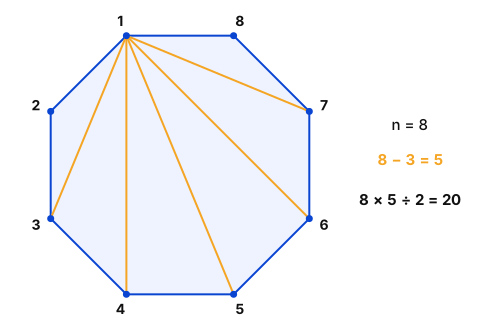
- Octagon: .
- .
Trick: Each vertex joins others by diagonals; halve because each diagonal is counted twice.
Answer: (A) 20
अवधारणा: विकर्णों की संख्या = (n = भुजाओं की संख्या)।
हल:
- अष्टभुज: ।
- ।
ट्रिक: हर शीर्ष से विकर्ण निकलते हैं; हर विकर्ण दो बार गिना जाता है, इसलिए 2 से भाग।
उत्तर: (A) 20
SSC CGLGeneral Intelligence & ReasoningDiagonals of a polygonSSC CGL 2025 · 13 Sep Shift 3
Q1065.If 4 @ 1 = 17, 5 @ 2 = 27, then 6 @ 3 = ?
यदि 4 @ 1 = 17 और 5 @ 2 = 27 है, तो 6 @ 3 = ?
- A36
- B38
- C40
- D39
Show answer
Concept: a @ b .
- ✓; ✓
- 6 @ 3 = .
Trick: 17 and 27 are just above 16 and 25 – a hint that the first number is squared.
Answer: (D) 39
अवधारणा: a @ b ।
हल:
- ✓; ✓
- 6 @ 3 = ।
ट्रिक: 17 और 27, क्रमशः 16 और 25 से थोड़ा अधिक हैं – पहली संख्या का वर्ग होने का संकेत।
उत्तर: (D) 39
SSC CGLGeneral Intelligence & ReasoningSymbol puzzle – a² + bSSC CGL 2025 · 13 Sep Shift 3
Q1066.If 'SPECTOR' is coded as 'HTWFZLI', then how is 'PHANTOM' coded?
यदि 'SPECTOR' का कूट 'HTWFZLI' है, तो 'PHANTOM' का कूट क्या होगा?
- AKLSOZLN
- BKLSOLNZ
- CKLSQZLN
- DKLSQZNL
Show answer
Concept: Each position has its own change; copy the same changes to the new word.
- SPECTOR/HTWFZLI gives the rule: opposite letter (S/H), +4 (P/T), +18 (E/W), +3 (C/F), +6 (T/Z), −3 (O/L), opposite letter (R/I).
- PHANTOM with the same rule: opposite of P is K; H+4 = L; A+18 = S; N+3 = Q; T+6 = Z; O−3 = L; opposite of M is N.
- Code = KLSQZLN.
Trick: Opposite pairs add to 27 (S19 + H8, P16 + K11). Positions 5–6 (T→Z, O→L) are identical in both words, so the code must have ZL there – only A and C; N→Q picks C.
Answer: (C) KLSQZLN
अवधारणा: हर स्थान का अपना बदलाव है; वही बदलाव नए शब्द पर लगाएँ।
हल:
- SPECTOR/HTWFZLI से नियम: विपरीत अक्षर (S/H), +4 (P/T), +18 (E/W), +3 (C/F), +6 (T/Z), −3 (O/L), विपरीत अक्षर (R/I)।
- PHANTOM पर वही नियम: P का विपरीत K; H+4 = L; A+18 = S; N+3 = Q; T+6 = Z; O−3 = L; M का विपरीत N।
- कोड = KLSQZLN।
ट्रिक: विपरीत अक्षरों का योग 27 (S19 + H8)। 5वें-6ठे स्थान पर दोनों शब्दों में T, O हैं, अतः कोड में ZL – केवल A, C; N→Q से C।
उत्तर: (C) KLSQZLN
SSC CGLGeneral Intelligence & ReasoningCoding – mixed position-wise ruleSSC CGL 2025 · 13 Sep Shift 3
Q1067.If STONE is coded as TUPMF, how is PEARL coded?
यदि STONE का कूट TUPMF है, तो PEARL का कूट क्या होगा?
- AQFBIM
- BQFBQM
- CQFCQM
- DQFBMQ
Show answer
Concept: Find the shift at each position and repeat it.
- STONE/TUPMF: first three letters +1, 4th letter −1, 5th letter +1.
- PEARL: P+1 = Q, E+1 = F, A+1 = B, R−1 = Q, L+1 = M.
- Code = QFBQM.
Trick: Only the 4th letter goes back; R − 1 = Q, so the code has Q in 4th place – only B fits.
Answer: (B) QFBQM
अवधारणा: हर स्थान का अंतर निकालकर वही दोहराएँ।
हल:
- STONE/TUPMF: पहले तीन अक्षर +1, चौथा −1, पाँचवाँ +1।
- PEARL: P+1 = Q, E+1 = F, A+1 = B, R−1 = Q, L+1 = M।
- कोड = QFBQM।
ट्रिक: केवल चौथा अक्षर पीछे जाता है; R − 1 = Q – चौथे स्थान पर Q सिर्फ़ विकल्प B में।
उत्तर: (B) QFBQM
SSC CGLGeneral Intelligence & ReasoningCoding – +1 with one −1SSC CGL 2025 · 13 Sep Shift 3
Q1068.A 50 L solution has alcohol and water in 4 : 6 ratio. How much water should be added to make the ratio 4 : 9?
50 L के एक विलयन में ऐल्कोहल और पानी का अनुपात 4 : 6 है। अनुपात 4 : 9 करने के लिए कितना पानी मिलाना चाहिए?
- A15 L
- B18 L
- C20 L
- D22 L
Show answer
Concept: Alcohol stays fixed; only water changes.
- Alcohol = L; water = 30 L.
- New ratio 4 : 9 with alcohol 20 L → water = L.
- Water to add = L.
Trick: Keep the alcohol term the same (4 in both ratios): water units 6 → 9, so add 3 units; 1 unit = L → 15 L.
Answer: (A) 15 L
अवधारणा: एल्कोहॉल की मात्रा स्थिर रहती है, केवल पानी बढ़ता है।
हल:
- एल्कोहॉल = L; पानी = 30 L।
- नया अनुपात 4 : 9 → पानी = L।
- मिलाना है = L।
ट्रिक: दोनों अनुपात में एल्कोहॉल 4 है: पानी 6 से 9 इकाई, यानी 3 इकाई; 1 इकाई = 5 L → 15 L।
उत्तर: (A) 15 L
SSC CGLGeneral Intelligence & ReasoningMixture – adding water to change ratioSSC CGL 2025 · 13 Sep Shift 3
Q1069.If 4 & 3 = 25 and 2 & 5 = 29, then find the value of 3 & 6 = ?
यदि 4 & 3 = 25 और 2 & 5 = 29 है, तो 3 & 6 का मान ज्ञात कीजिए।
- A35
- B55
- C45
- D65
Show answer
Concept: a & b .
- ✓; ✓
- 3 & 6 = .
Trick: is the famous 3-4-5 triple – a strong hint for squares.
Answer: (C) 45
अवधारणा: a & b ।
हल:
- ✓; ✓
- 3 & 6 = ।
ट्रिक: (3-4-5 त्रिक) – वर्गों का योग होने का संकेत।
उत्तर: (C) 45
SSC CGLGeneral Intelligence & ReasoningSymbol puzzle – sum of squaresSSC CGL 2025 · 13 Sep Shift 3
Q1070.Ram introduces a woman: "She is the only daughter of my father's only son." How is the woman related to Ram?
राम एक महिला का परिचय देता है: "वह मेरे पिता के इकलौते पुत्र की इकलौती पुत्री है।" महिला राम से किस प्रकार संबंधित है?
- ASisterबहन
- BSonपुत्र
- CCousinचचेरी बहन
- DDaughterपुत्री
Show answer
Concept: Solve from the innermost phrase outward.
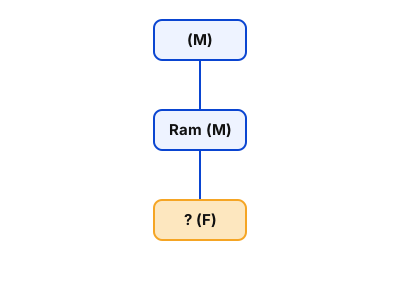
- "My father's only son" = Ram himself.
- "Only daughter of Ram" = Ram's daughter.
Trick: "My father's only son" (spoken by a male) always means the speaker.
Answer: (D) Daughter
अवधारणा: वाक्य को अंदर से बाहर की ओर हल करें।
हल:
- "मेरे पिता का इकलौता बेटा" = राम स्वयं।
- "राम की इकलौती बेटी" = राम की बेटी।
ट्रिक: पुरुष द्वारा कहा गया "मेरे पिता का इकलौता बेटा" हमेशा वह स्वयं होता है।
उत्तर: (D) पुत्री
SSC CGLGeneral Intelligence & ReasoningBlood relation – self referenceSSC CGL 2025 · 13 Sep Shift 3
Q1071.A's brother is B. B is the father of C. C is the sister of D. How is D related to B?
A का भाई B है। B, C का पिता है। C, D की बहन है। D का B से क्या संबंध है?
- ASonपुत्र
- BNephewभतीजा
- CNieceभतीजी
- DCannot be determinedनिर्धारित नहीं किया जा सकता
Show answer
Concept: A relation can be named only if the gender is known.
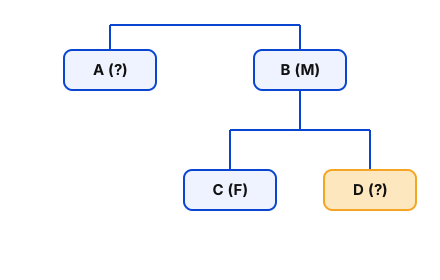
- B is the father of C; C is the sister of D → D is also B's child.
- D's gender is not stated, so D may be son or daughter.
Trick: "Sister of D" tells the gender of C, not of D – a common trap.
Answer: (D) Cannot be determined
अवधारणा: संबंध का नाम तभी तय होता है जब लिंग ज्ञात हो।
हल:
- B, C का पिता है; C, D की बहन है → D भी B की संतान है।
- D का लिंग नहीं बताया, अतः D बेटा या बेटी कुछ भी हो सकता है।
ट्रिक: "D की बहन" से C का लिंग पता चलता है, D का नहीं – यही जाल है।
उत्तर: (D) निर्धारित नहीं किया जा सकता
SSC CGLGeneral Intelligence & ReasoningBlood relation – gender not givenSSC CGL 2025 · 13 Sep Shift 3
Q1072.After interchanging + & × and 3 & 5, which of the following equations will hold true?
'+' और '×' तथा 3 और 5 को आपस में बदलने पर निम्न में से कौन-सा समीकरण सत्य होगा?
- A(3+4)×5=17
- B(5+2)×3=21
- C(3+6)×5=33
- D(5+1)×3=18
Show answer
Concept: Swap + with × and 3 with 5 in each option, then evaluate.
- C: → ✓
- A: ; B: .
- D: .
Trick: Only the left side changes; the result on the right stays as written.
Answer: (C) (3+6)×5=33
अवधारणा: हर विकल्प में + ↔ × और 3 ↔ 5 बदलकर गणना करें।
हल:
- C: → ✓
- A: ; B: ।
- D: ।
ट्रिक: केवल बायाँ भाग बदलें; दाईं ओर का उत्तर जैसा लिखा है वैसा ही रहेगा।
उत्तर: (C) (3+6)×5=33
SSC CGLGeneral Intelligence & ReasoningInterchange of signs and numbersSSC CGL 2025 · 13 Sep Shift 3
Q1073.If 'J' means '+', 'K' means '−', 'L' means '×', and 'M' means '÷', what is the value of the following expression?
20 M 4 L 3 J 5 K 5 = ?
यदि 'J' का अर्थ '+', 'K' का अर्थ '−', 'L' का अर्थ '×' और 'M' का अर्थ '÷' है, तो निम्न व्यंजक का मान क्या होगा?
20 M 4 L 3 J 5 K 5 = ?
- A20
- B18
- C25
- D15
Show answer
Concept: Replace letters with signs, then apply BODMAS.
- 20 M 4 L 3 J 5 K 5 → .
- ; .
- .
Trick: "+5 − 5" cancel out, so the answer is just .
Answer: (D) 15
अवधारणा: अक्षरों की जगह चिह्न रखकर BODMAS लगाएँ।
हल:
- 20 M 4 L 3 J 5 K 5 → ।
- ; ।
- ।
ट्रिक: "+5 − 5" आपस में कट जाते हैं; उत्तर = ।
उत्तर: (D) 15
SSC CGLGeneral Intelligence & ReasoningLetter-to-operator substitutionSSC CGL 2025 · 13 Sep Shift 3
Q1074.If '+' means '÷', '×' means '+' and '−' means '×', then 15 + 5 × 6 − 2 = ?
यदि '+' का अर्थ '÷', '×' का अर्थ '+' और '−' का अर्थ '×' है, तो 15 + 5 × 6 − 2 = ?
- A20
- B15
- C18
- D10
Show answer
Concept: Rewrite the expression with the new meanings and solve by BODMAS.
- → .
- ; .
- .
Trick: Change the signs one by one in pencil before calculating – avoids mixing old and new meanings.
Answer: (B) 15
अवधारणा: नए अर्थ के अनुसार व्यंजक दोबारा लिखें और BODMAS से हल करें।
हल:
- → ।
- ; ।
- ।
ट्रिक: गणना से पहले हर चिह्न बदलकर नया व्यंजक लिख लें – पुराने-नए अर्थ में गड़बड़ नहीं होगी।
उत्तर: (B) 15
SSC CGLGeneral Intelligence & ReasoningSign substitution with BODMASSSC CGL 2025 · 13 Sep Shift 3
Q1075.If the sum of 55 and 22 is multiplied by 5, what is the result?
यदि 55 और 22 के योग को 5 से गुणा किया जाए, तो परिणाम क्या होगा?
- A375
- B385
- C398
- D420
Show answer
Concept: Add first, then multiply.
- .
- .
Trick: : . Also, a multiple of 5 of an odd number ends in 5 – only 375 and 385 qualify.
Answer: (B) 385
अवधारणा: पहले जोड़ें, फिर गुणा करें।
हल:
- ।
- ।
ट्रिक: : । विषम संख्या × 5 का अंतिम अंक 5 होता है – केवल 375 व 385।
उत्तर: (B) 385
SSC CGLGeneral Intelligence & ReasoningBasic arithmetic – sum then productSSC CGL 2025 · 13 Sep Shift 3
Q1076.In the following question, select the related word from the given alternatives.
Chef : Food :: Architect : ?
निम्न प्रश्न में दिए गए विकल्पों में से संबंधित शब्द चुनिए।
Chef : Food :: Architect : ?
- ACookपकाना (Cook)
- BServeपरोसना (Serve)
- CRecipeविधि (Recipe)
- DDesignडिज़ाइन (Design)
Show answer
Concept: The first word is a professional; the second is the thing he creates.
- Chef → prepares Food (his output).
- Architect → prepares a Design/plan of a building.
- Cook and Recipe belong to the chef's world, not the architect's.
Trick: Frame a sentence: 'A ___ makes ___'. Only the word that fits both halves is right.
Answer: (D) Design
अवधारणा: पहला शब्द व्यवसायी है, दूसरा वह चीज़ जो वह बनाता है।
- शेफ → भोजन बनाता है।
- आर्किटेक्ट → इमारत का डिज़ाइन (नक्शा) बनाता है।
- Cook, Recipe शेफ से जुड़े शब्द हैं, आर्किटेक्ट से नहीं।
ट्रिक: वाक्य बनाइए: '___ ___ बनाता है' — जो शब्द दोनों जोड़ों में फिट हो, वही उत्तर।
उत्तर: (D) डिज़ाइन (Design)
SSC CGLGeneral Intelligence & ReasoningAnalogy – maker and productSSC CGL 2025 · 13 Sep Shift 2
Q1077.In the following question, select the related word from the given alternatives.
Deontology : Duty :: Utilitarianism : ?
निम्न प्रश्न में दिए गए विकल्पों में से संबंधित शब्द चुनिए।
Deontology : Duty :: Utilitarianism : ?
- APleasureआनंद (Pleasure)
- BConsequenceपरिणाम (Consequence)
- CBenefitलाभ (Benefit)
- DOutcomeनतीजा (Outcome)
Show answer
Concept: Each ethical school is paired with the yardstick it uses to judge an act.
- Deontology (Kant): an act is right if it follows duty.
- Utilitarianism (Bentham, Mill): an act is right if its result brings the greatest good — it judges by Consequence.
- Pleasure/Benefit are goals, not the test; 'Consequence' is the technical term.
Yaad rakhein: Utilitarianism is also called 'consequentialism' — that name itself gives the answer.
Answer: (B) Consequence
अवधारणा: हर नैतिक सिद्धांत को उस कसौटी से जोड़ा गया है जिससे वह कर्म को परखता है।
- Deontology (कांट): कर्म सही है यदि वह कर्तव्य (Duty) के अनुसार है।
- Utilitarianism (बेंथम, मिल): कर्म का मूल्य उसके परिणाम (Consequence) से तय होता है — अधिकतम लोगों का अधिकतम सुख।
याद रखें: Utilitarianism को 'consequentialism' भी कहते हैं — नाम में ही उत्तर छिपा है।
उत्तर: (B) परिणाम (Consequence)
SSC CGLGeneral Intelligence & ReasoningAnalogy – ethical theory and its basisSSC CGL 2025 · 13 Sep Shift 2
Q1078.Select the letters from among the given options that can replace the question mark (?) in the following series.
I, K, ?, O, Q, ?, U, W
दी गई शृंखला में प्रश्न चिह्न (?) के स्थान पर आने वाले अक्षर चुनिए।
I, K, ?, O, Q, ?, U, W
- AQ, X
- BM, S
- CP, W
- DR, W
Show answer
Concept: Letters advance by a fixed step (skip one letter each time).
- I(9) → K(11): step +2.
- Blank 1: K + 2 = M; check M + 2 = O ✓.
- Blank 2: Q + 2 = S; check S + 2 = U ✓.
Trick: Odd positions I=9, K=11, M=13, O=15… — the series is just odd numbers 9 to 23.
Answer: (B) M, S
अवधारणा: अक्षर हर बार एक अक्षर छोड़कर (+2) आगे बढ़ते हैं।
- I(9) से K(11): +2 का अंतर।
- पहला रिक्त: K + 2 = M, फिर M + 2 = O ✓।
- दूसरा रिक्त: Q + 2 = S, फिर S + 2 = U ✓।
ट्रिक: I=9, K=11, M=13… यह 9 से 23 तक की विषम संख्याओं जैसी श्रृंखला है।
उत्तर: (B) M, S
SSC CGLGeneral Intelligence & ReasoningLetter series – gap of 2SSC CGL 2025 · 13 Sep Shift 2
Q1079.Select the letter-cluster from among the given options that can replace the question mark (?) in the following series.
STU, VWX, YZA, ?
दी गई शृंखला में प्रश्न चिह्न (?) के स्थान पर आने वाला अक्षर-समूह चुनिए।
STU, VWX, YZA, ?
- ABZD
- BACD
- CBCD
- DBCR
Show answer
Concept: Each term is the next block of three alphabet letters, wrapping from Z to A.
- STU → VWX → YZ then A (after Z comes A).
- Next three letters after A: B, C, D.
- So the missing cluster is BCD.
Trick: First letters S, V, Y, B jump +3 each time (Y+3 wraps to B) — only one option starts with B and is consecutive.
Answer: (C) BCD
अवधारणा: हर पद वर्णमाला के अगले तीन अक्षरों का समूह है; Z के बाद फिर A आता है।
- STU → VWX → YZA (Z के बाद A)।
- A के बाद के तीन अक्षर: B, C, D।
- अतः लुप्त समूह BCD है।
ट्रिक: पहले अक्षर S, V, Y, B में +3 का अंतर है; B से शुरू होने वाला लगातार समूह केवल BCD है।
उत्तर: (C) BCD
SSC CGLGeneral Intelligence & ReasoningLetter cluster series – consecutive tripletsSSC CGL 2025 · 13 Sep Shift 2
Q1080.Select the letter-cluster from among the given options that can replace the question mark (?) in the following series.
VJT, SGQ, PDN, MAK, ?
दी गई शृंखला में प्रश्न चिह्न (?) के स्थान पर आने वाला अक्षर-समूह चुनिए।
VJT, SGQ, PDN, MAK, ?
- AJHX
- BJXG
- CKXH
- DJXH
Show answer
Concept: Every letter of a cluster moves 3 places back in the alphabet.
- V→S→P→M: −3 each step, so next first letter M − 3 = J.
- J→G→D→A: next is A − 3 = X (wrap-around).
- T→Q→N→K: next is K − 3 = H.
- Missing term = JXH.
Trick: Use reverse ranks: A−3 means go back past Z: A(1) − 3 → 24 = X.
Answer: (D) JXH
अवधारणा: हर समूह का प्रत्येक अक्षर 3 स्थान पीछे जाता है।
- पहला अक्षर: V, S, P, M → M − 3 = J।
- दूसरा अक्षर: J, G, D, A → A − 3 = X (Z की ओर घूमकर)।
- तीसरा अक्षर: T, Q, N, K → K − 3 = H।
- उत्तर: JXH।
ट्रिक: A से 3 पीछे: 1 − 3 + 26 = 24 = X।
उत्तर: (D) JXH
SSC CGLGeneral Intelligence & ReasoningLetter cluster series – minus 3SSC CGL 2025 · 13 Sep Shift 2

