Q1101.Suppose x = + , y = + 1, and z = 3 + 1; then which of the following is true?
माना x = + , y = + 1 तथा z = 3 + 1 है; तो निम्न में से कौन-सा सत्य है?
- Ax < y < z
- Bz < y < x
- Cy < x < z
- Dx < z < y
Show answer
Concept: Here , , ; compare using approximate roots.
- , .
- .
- .
- So .
Trick: Square x and y: , instantly.
Answer: (A) x < y < z
अवधारणा: यहाँ , , ; लगभग मान लेकर तुलना करें।
- ,
- अतः
ट्रिक: वर्ग करें: , → तुरंत ।
उत्तर: (A) x < y < z
SSC CGLQuantitative AptitudeSurds – comparing valuesSSC CGL 2025 · 13 Sep Shift 1
Q1102.The budget for a construction project is allocated to land acquisition, building materials, and labor in the ratio 4 : 3 : 3. During the project, the cost of land acquisition rose by 8%, building materials rose by 12%, and labor fell by 15%. What is the percent change (increase or decrease) in the total project cost?
एक निर्माण परियोजना का बजट भूमि अधिग्रहण, निर्माण सामग्री और श्रम में 4 : 3 : 3 के अनुपात में बाँटा गया है। परियोजना के दौरान भूमि अधिग्रहण की लागत 8% बढ़ी, सामग्री 12% बढ़ी और श्रम 15% घटा। कुल परियोजना लागत में प्रतिशत परिवर्तन (वृद्धि या कमी) क्या है?
- A1.5% increase1.5% वृद्धि
- B2.3% decrease2.3% कमी
- C2.3% increase2.3% वृद्धि
- D1.5% decrease1.5% कमी
Show answer
Concept: Overall % change = sum of (share × % change of each part).
- Take budget = 100 → parts 40, 30, 30.
- Land: +8% of 40 = +3.2; Materials: +12% of 30 = +3.6; Labour: −15% of 30 = −4.5.
- Net = → 2.3% increase.
Trick: Weighted: .
Answer: (C) 2.3% increase
अवधारणा: कुल % परिवर्तन = हर भाग का (हिस्सा × % परिवर्तन) जोड़ें।
- बजट = 100 → भाग 40, 30, 30
- भूमि: +3.2; सामग्री: +3.6; श्रम: −4.5
- कुल = +2.3 → 2.3% वृद्धि
ट्रिक:
उत्तर: (C) 2.3% वृद्धि
SSC CGLQuantitative AptitudePercentage – weighted change in costSSC CGL 2025 · 13 Sep Shift 1
Q1103.Evaluate:
6 − [ ÷ { + × (1 − ) } ]
मान ज्ञात कीजिए:
6 − [ ÷ { + × (1 − ) } ]
- A
- B
- C
- D
Show answer
Concept: Expression: ; solve brackets from inside out.
- ; .
- .
- .
- .
Trick: Denominator must be 32 (from ) — leaves and ; .
Answer: (C)
अवधारणा: व्यंजक: ; अंदर के कोष्ठक से शुरू करें।
- ;
ट्रिक: हर 32 आएगा — या ; ।
उत्तर: (C)
SSC CGLQuantitative AptitudeSimplification – BODMAS with fractionsSSC CGL 2025 · 13 Sep Shift 1
Q1104.Pankaj, Kuldeep, and Ankit invested ₹25,000, ₹35,000, and ₹40,000 respectively in a business. If the profit at the end of the year was ₹30,000, find Kuldeep's share.
पंकज, कुलदीप और अंकित ने एक व्यवसाय में क्रमशः ₹25,000, ₹35,000 और ₹40,000 निवेश किए। यदि वर्ष के अंत में लाभ ₹30,000 हुआ, तो कुलदीप का हिस्सा ज्ञात कीजिए।
- A₹9,500
- B₹12,000
- C₹11,000
- D₹10,500
Show answer
Concept: Same time period → profit divides in ratio of investments.
- 25000 : 35000 : 40000 = 5 : 7 : 8 (sum 20).
- Kuldeep = ₹10,500.
Trick: 1 part = → 7 parts = 10,500.
Answer: (D) ₹10,500
अवधारणा: समान समय → लाभ निवेश के अनुपात में बँटता है।
- 25000 : 35000 : 40000 = 5 : 7 : 8 (योग 20)
- कुलदीप = ₹10,500
ट्रिक: 1 भाग = → 7 भाग = 10,500
उत्तर: (D) ₹10,500
SSC CGLQuantitative AptitudePartnership – simple profit shareSSC CGL 2025 · 13 Sep Shift 1
Q1105.X and Y started a business by investing ₹48,000 and ₹72,000 respectively. After 6 months, X withdrew half of his capital, while Y increased his capital by ₹24,000. At the end of the year, they earned a total profit of ₹55,000. What is Y's share in the profit?
X और Y ने क्रमशः ₹48,000 और ₹72,000 निवेश कर व्यवसाय आरंभ किया। 6 माह बाद X ने अपनी आधी पूँजी निकाल ली, जबकि Y ने अपनी पूँजी ₹24,000 बढ़ा दी। वर्ष के अंत में कुल लाभ ₹55,000 हुआ। लाभ में Y का हिस्सा क्या है?
- A₹38,000
- B₹27,000
- C₹38,500
- D₹33,000
Show answer
Concept: Profit ratio = capital × months, added for each period.
- X: .
- Y: .
- X : Y = 72 : 168 = 3 : 7.
- Y = ₹38,500.
Trick: Both periods are 6 months, so just add capitals: , .
Answer: (C) ₹38,500
अवधारणा: लाभ अनुपात = पूँजी × महीने (हर अवधि का योग)।
- X:
- Y:
- X : Y = 72 : 168 = 3 : 7
- Y = ₹38,500
ट्रिक: दोनों अवधियाँ 6-6 महीने — केवल पूँजी जोड़ें: 72 और 168।
उत्तर: (C) ₹38,500
SSC CGLQuantitative AptitudePartnership – capital changed mid-yearSSC CGL 2025 · 13 Sep Shift 1
Q1106.Study the following table showing the daily wages (in ₹) of 5 workers over 4 days.| Day | A | B | C | D | E |
| Monday | 200 | 180 | 220 | 160 | 190 |
| Tuesday | 210 | 175 | 230 | 170 | 195 |
| Wednesday | 190 | 185 | 215 | 180 | 200 |
| Thursday | 220 | 190 | 225 | 175 | 205 |
What is the average daily earning of Worker C?
निम्न तालिका देखिए जो 5 श्रमिकों की 4 दिनों की दैनिक मजदूरी (₹ में) दर्शाती है।| दिन | A | B | C | D | E |
| सोमवार | 200 | 180 | 220 | 160 | 190 |
| मंगलवार | 210 | 175 | 230 | 170 | 195 |
| बुधवार | 190 | 185 | 215 | 180 | 200 |
| गुरुवार | 220 | 190 | 225 | 175 | 205 |
श्रमिक C की औसत दैनिक आय क्या है?
- A222.5
- B220
- C232.5
- D230.5
Show answer
Concept: Average = total ÷ number of days.
- Worker C: .
- Average = .
Trick: Deviation from 220: .
Answer: (A) 222.5
अवधारणा: औसत = कुल योग ÷ दिनों की संख्या।
- कर्मचारी C:
- औसत =
ट्रिक: 220 से विचलन:
उत्तर: (A) 222.5
SSC CGLQuantitative AptitudeData table – averageSSC CGL 2025 · 13 Sep Shift 1
Q1107.In a city, the current number of literate people is 25,000. If the number of literate females decreases by 5% and the number of literate males increases by 10%, the total literate population becomes 25,250. What is the present number of literate females in the city?
एक शहर में वर्तमान साक्षर लोगों की संख्या 25,000 है। यदि साक्षर महिलाओं की संख्या 5% घट जाए और साक्षर पुरुषों की संख्या 10% बढ़ जाए, तो कुल साक्षर जनसंख्या 25,250 हो जाती है। शहर में साक्षर महिलाओं की वर्तमान संख्या क्या है?
- A17,500
- B13,000
- C15,000
- D18,000
Show answer
Concept: Form one equation using the new total.
- Let females = F, males .
- Net change = +250: .
- .
Trick: If all were male: +10% = 27,500. Each female reduces by 15%: .
Answer: (C) 15,000
अवधारणा: नए कुल से एक समीकरण बनाएँ।
- महिलाएँ = F, पुरुष
- कुल बदलाव +250:
ट्रिक: सब पुरुष होते तो 27,500; अंतर ।
उत्तर: (C) 15,000
SSC CGLQuantitative AptitudePercentage – population changeSSC CGL 2025 · 13 Sep Shift 1
Q1108.A baker ordered 10 kg of premium flour and some additional kg of standard flour. The price of premium flour per kg was twice that of the standard flour. Due to an ordering error, the quantities of the two types of flour were interchanged. This decreased the total cost by 20%. Find the ratio of the quantity of premium flour to standard flour in the original order.
एक बेकर ने 10 kg प्रीमियम आटा और कुछ kg साधारण आटा ऑर्डर किया। प्रीमियम आटे का प्रति kg मूल्य साधारण आटे का दोगुना था। ऑर्डर की त्रुटि से दोनों की मात्राएँ आपस में बदल गईं, जिससे कुल लागत 20% घट गई। मूल ऑर्डर में प्रीमियम और साधारण आटे की मात्रा का अनुपात ज्ञात कीजिए।
- A2 : 1
- B5 : 2
- C3 : 4
- D4 : 5
Show answer
Concept: Write cost before and after the swap and use the 20% fall.
- Standard price = p, premium = 2p; standard qty = S.
- Original cost = 20p + Sp; after swap = 2Sp + 10p.
- 2S + 10 = 0.8(20 + S) → 1.2S = 6 → S = 5.
- Premium : Standard = 10 : 5 = 2 : 1.
Trick: Test option 2 : 1 → original 20 + 5 = 25, swapped 10 + 10 = 20 → 20% less ✓.
Answer: (A) 2 : 1
अवधारणा: अदला-बदली से पहले और बाद की लागत लिखें, 20% कमी लगाएँ।
- साधारण आटा मूल्य = p, प्रीमियम = 2p; साधारण मात्रा = S
- मूल लागत = 20p + Sp; बाद में = 2Sp + 10p
- 2S + 10 = 0.8(20 + S) → S = 5
- अनुपात = 10 : 5 = 2 : 1
ट्रिक: विकल्प जाँचें: 2 : 1 → 25 से 20, यानी 20% कम ✓
उत्तर: (A) 2 : 1
SSC CGLQuantitative AptitudeRatio – interchanged quantitiesSSC CGL 2025 · 13 Sep Shift 1
Q1109.A shopkeeper sold 15 lunch boxes for ₹3000 and gained a profit of 25%. How many lunch boxes should he sell for ₹2816 to make a profit of 10%?
एक दुकानदार ने 15 लंच बॉक्स ₹3000 में बेचकर 25% लाभ कमाया। 10% लाभ कमाने के लिए उसे ₹2816 में कितने लंच बॉक्स बेचने चाहिए?
- A14
- B16
- C20
- D19
Show answer
Concept: Find CP per item first, then the new SP per item.
- SP per box = ₹200.
- CP = ₹160.
- New SP at 10% = ₹176.
- Boxes = .
Trick: — check unit digit: → ends in 6 ✓.
Answer: (B) 16
अवधारणा: पहले प्रति वस्तु CP, फिर नया SP निकालें।
- प्रति डिब्बा SP = ₹200
- CP = ₹160
- 10% लाभ पर SP = ₹176
- डिब्बे =
ट्रिक: — इकाई अंक 6 × 6 → 6 ✓
उत्तर: (B) 16
SSC CGLQuantitative AptitudeProfit – number of articlesSSC CGL 2025 · 13 Sep Shift 1
Q1110.A trader sells one brand of coffee at ₹150 per kg, incurring a 25% loss. He also sells another brand of coffee at ₹200 per kg, incurring a 20% loss. If he mixes the two brands in equal proportions and sells the mixture at ₹175 per kg, what is his overall profit or loss percentage?
एक व्यापारी एक ब्रांड की कॉफी ₹150 प्रति kg पर बेचकर 25% हानि उठाता है। दूसरी ब्रांड की कॉफी ₹200 प्रति kg पर बेचकर 20% हानि उठाता है। यदि वह दोनों को समान अनुपात में मिलाकर मिश्रण को ₹175 प्रति kg पर बेचे, तो उसका समग्र लाभ या हानि प्रतिशत क्या है?
- ALoss of 22.22%22.22% हानि
- BProfit of 20.20%20.20% लाभ
- CLoss of 20.20%20.20% हानि
- DProfit of 22.22%22.22% लाभ
Show answer
Concept: Get each CP from SP and loss%, then compare average CP with SP.
- Brand 1 CP = ₹200.
- Brand 2 CP = ₹250.
- Equal mix CP = ₹225; SP = ₹175.
- Loss = .
Trick: SP 175 < both CPs → it must be a loss; .
Answer: (A) Loss of 22.22%
अवधारणा: SP और हानि% से हर ब्रांड का CP निकालें, फिर औसत CP से तुलना करें।
- ब्रांड 1 CP = ₹200
- ब्रांड 2 CP = ₹250
- मिश्रण CP = ₹225; SP = ₹175
- हानि =
ट्रिक: SP दोनों CP से कम → हानि ही;
उत्तर: (A) 22.22% हानि
SSC CGLQuantitative AptitudeProfit and loss – mixing two brandsSSC CGL 2025 · 13 Sep Shift 1
Q1111.Manoj and Rahul together can complete a work in 12 days. Rahul and Sandeep together can complete the same work in 15 days. Sandeep and Manoj together can do it in 20 days. In how many days can Manoj alone complete the job?
मनोज और राहुल मिलकर एक कार्य 12 दिनों में पूरा कर सकते हैं। राहुल और संदीप मिलकर वही कार्य 15 दिनों में और संदीप और मनोज मिलकर 20 दिनों में कर सकते हैं। मनोज अकेला कार्य कितने दिनों में पूरा करेगा?
- A30 days30 दिन
- B25 days25 दिन
- C40 days40 दिन
- D35 days35 दिन
Show answer
Concept: Use LCM as total work; add all pair-rates to get combined rate.
- Total work = LCM(12, 15, 20) = 60 units.
- M+R = 5, R+S = 4, S+M = 3 units/day.
- .
- days.
Trick: One person's rate = total trio rate − the pair not containing him.
Answer: (A) 30 days
अवधारणा: LCM को कुल कार्य मानें; सभी जोड़ी-दरें जोड़ें।
- कुल कार्य = LCM(12, 15, 20) = 60 इकाई
- M+R = 5, R+S = 4, S+M = 3 प्रतिदिन
- दिन
ट्रिक: एक व्यक्ति की दर = तीनों की दर − उसके बिना वाली जोड़ी।
उत्तर: (A) 30 दिन
SSC CGLQuantitative AptitudeTime and work – pairsSSC CGL 2025 · 13 Sep Shift 1
Q1112.From a 64-liter container of pure milk, 8 liters are removed and replaced by water. This operation is performed a total of three times. What is the final quantity of milk remaining in the container?
64 लीटर शुद्ध दूध के पात्र से 8 लीटर निकालकर पानी मिला दिया जाता है। यह प्रक्रिया कुल तीन बार की जाती है। पात्र में अंतिम रूप से कितना दूध बचेगा?
- A44.44 liters44.44 लीटर
- B55.45 liters55.45 लीटर
- C40.42 liters40.42 लीटर
- D42.88 liters42.88 लीटर
Show answer
Concept: Milk left = initial × .
- Fraction left each time = .
- After 3 times: .
- L.
Trick: , and has below directly.
Answer: (D) 42.88 liters
अवधारणा: बचा दूध = प्रारंभिक × (1 − निकाला/कुल)
- हर बार बचा भाग =
- 3 बार बाद:
- L
ट्रिक: — सीधे गणना।
उत्तर: (D) 42.88 लीटर
SSC CGLQuantitative AptitudeRepeated replacement of liquidSSC CGL 2025 · 13 Sep Shift 1
Q1113.A juice vendor mixes water with pure mango juice. If he sells the mixture at the cost price of pure mango juice and makes a profit of 20%, what is the ratio of water to pure mango juice in the mixture, respectively?
एक जूस विक्रेता शुद्ध आम के जूस में पानी मिलाता है। यदि वह मिश्रण को शुद्ध जूस के क्रय मूल्य पर बेचकर 20% लाभ कमाता है, तो मिश्रण में पानी और शुद्ध जूस का अनुपात क्रमशः क्या है?
- A3 : 2
- B1 : 5
- C2 : 3
- D5 : 1
Show answer
Concept: When sold at cost price, profit % = .
- Gain comes only from water, which costs nothing.
- Profit 20% → water = 20% of juice.
- Water : juice = 20 : 100 = 1 : 5.
Trick: Profit% = .
Answer: (B) 1 : 5
अवधारणा: क्रय मूल्य पर बेचने पर लाभ % = पानी/जूस
- लाभ केवल मुफ़्त पानी से आता है।
- 20% लाभ → पानी = जूस का 20%।
- पानी : जूस = 1 : 5
ट्रिक: लाभ% = पानी/शुद्ध
उत्तर: (B) 1 : 5
SSC CGLQuantitative AptitudeAdulteration – profit by adding waterSSC CGL 2025 · 13 Sep Shift 1
Q1114.A car covers 50% of a certain distance at a pace of 40 km/h and the remaining distance at a pace of 60 km/h. What is the average speed of the car for the entire journey?
एक कार किसी दूरी का 50% भाग 40 km/h की चाल से और शेष दूरी 60 km/h की चाल से तय करती है। पूरी यात्रा के लिए कार की औसत चाल क्या है?
- A46 km/h
- B48 km/h
- C26 km/h
- D24 km/h
Show answer
Concept: Equal distances at speeds a and b → average = .
- .
- .
- Average = km/h.
Trick: Answer must lie between 40 and 60 and be below 50 (the simple mean) → only 48.
Answer: (B) 48 km/h
अवधारणा: समान दूरी पर चाल a और b → औसत =
- औसत = 48 km/h
ट्रिक: उत्तर 40 और 60 के बीच और 50 से कम — केवल 48।
उत्तर: (B) 48 km/h
SSC CGLQuantitative AptitudeAverage speed – equal distancesSSC CGL 2025 · 13 Sep Shift 1
Q1115.Aditya and Harish are jogging around a park's circular track which has a perimeter of 1.2 km. They start from the same point at 6:00 a.m. and run in opposite directions. Aditya's speed is 5 km/h, and Harish's speed is 7 km/h. At what time will they meet for the fifth time?
आदित्य और हरीश एक पार्क के वृत्ताकार ट्रैक (परिधि 1.2 km) पर जॉगिंग कर रहे हैं। वे सुबह 6:00 बजे एक ही बिंदु से विपरीत दिशाओं में दौड़ना शुरू करते हैं। आदित्य की चाल 5 km/h और हरीश की 7 km/h है। वे पाँचवीं बार किस समय मिलेंगे?
- A6:00 AM
- B6:30 AM
- C6:40 AM
- D7:15 AM
Show answer
Concept: Opposite directions → relative speed = sum; they meet each time they cover one lap together.
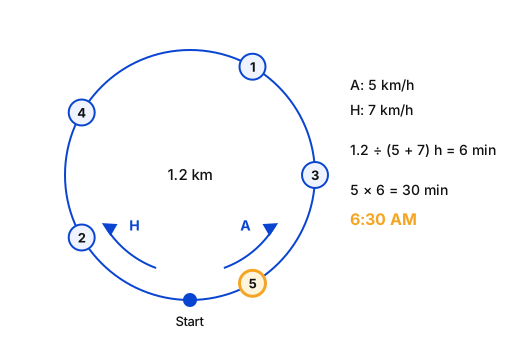
- Relative speed = km/h.
- Time per meeting = min.
- 5th meeting = min → 6:30 AM.
Trick: nth meeting time = .
Answer: (B) 6:30 AM
अवधारणा: विपरीत दिशा → सापेक्ष चाल = योग; हर एक चक्कर (मिलकर) पर मिलते हैं।
- सापेक्ष चाल = 12 km/h
- एक मिलन का समय = मिनट
- 5वाँ मिलन = 30 मिनट बाद → 6:30 AM
ट्रिक: n-वाँ मिलन = n × (ट्रैक लंबाई ÷ सापेक्ष चाल)
उत्तर: (B) 6:30 AM
SSC CGLQuantitative AptitudeCircular track – meetingsSSC CGL 2025 · 13 Sep Shift 1
Q1116.The area of a sector of a circle with radius 21 cm and central angle 180° is:
21 cm त्रिज्या और 180° केंद्रीय कोण वाले वृत्त के त्रिज्यखंड का क्षेत्रफल है:
- A693 cm²
- B715 cm²
- C645 cm²
- D750 cm²
Show answer
Concept: Sector area = ; is a semicircle.
- Semicircle area = .
- .
- = 693 cm².
Trick: for is 1386 — worth remembering; half = 693.
Answer: (A) 693 cm²
अवधारणा: त्रिज्यखंड क्षेत्रफल = ; = अर्धवृत्त।
- अर्धवृत्त =
- = 693 cm²
ट्रिक: पर = 1386; आधा = 693।
उत्तर: (A) 693 cm²
SSC CGLQuantitative AptitudeMensuration – sector areaSSC CGL 2025 · 13 Sep Shift 1
Q1117.What is the radian measure of 135°?
135° का रेडियन माप क्या है?
- A
- B
- C
- D
Show answer
Concept: Radian = degree .
- .
- Divide by 45: .
Trick: , so .
Answer: (C)
अवधारणा: रेडियन = डिग्री
- 45 से भाग:
ट्रिक:
उत्तर: (C)
SSC CGLQuantitative AptitudeDegree to radian conversionSSC CGL 2025 · 13 Sep Shift 1
Q1118.What is the area of a sector with a central angle of 60° and radius 4 cm?
60° केंद्रीय कोण और 4 cm त्रिज्या वाले त्रिज्यखंड का क्षेत्रफल क्या है?
- A cm²
- B cm²
- C cm²
- D cm²
Show answer
Concept: Sector area = .
- .
- Area = .
- .
Trick: sector = one-sixth of the circle: .
Answer: (A) cm²
अवधारणा: त्रिज्यखंड क्षेत्रफल =
- क्षेत्रफल
ट्रिक: = वृत्त का भाग।
उत्तर: (A) cm²
SSC CGLQuantitative AptitudeSector area – 60°SSC CGL 2025 · 13 Sep Shift 1
Q1119.Which of these lines is parallel to 4x − 5y = 10?
इनमें से कौन-सी रेखा 4x − 5y = 10 के समांतर है?
- A5x − 4y = 10
- B4x + 5y = 15
- C4x − 5y = 15
- Dx + y = 10
Show answer
Concept: is parallel to every line (same slope ).
- Slope of is .
- has the same x, y coefficients → slope .
- Only the constant differs → parallel, not the same line.
Trick: Keep the left side same, change only the constant → parallel line.
Answer: (C) 4x − 5y = 15
अवधारणा: के समांतर रेखा होती है (ढाल समान)।
- की ढाल
- में भी वही गुणांक → ढाल
- केवल अचर अलग → समांतर
ट्रिक: बायाँ भाग वही रखें, केवल अचर बदलें → समांतर रेखा।
उत्तर: (C) 4x − 5y = 15
SSC CGLQuantitative AptitudeCoordinate geometry – parallel linesSSC CGL 2025 · 13 Sep Shift 1
Q1120.If cos(90° − x) = sin(2x), then what is x?
यदि cos(90° − x) = sin(2x) है, तो x क्या है?
- A0°
- B30°
- C25°
- D15°
Show answer
Concept: .
- Equation becomes .
- or .
- or ; from the options, .
Trick: Put each option: gives ✓; gives ✗.
Answer: (A) 0°
अवधारणा:
- या ; विकल्पों में
ट्रिक: विकल्प रखकर जाँचें: पर ✓
उत्तर: (A) 0°
SSC CGLQuantitative AptitudeTrigonometry – complementary angleSSC CGL 2025 · 13 Sep Shift 1

