Q1141.A shopkeeper marked an item 20% above its cost price. During a sale, he offered a discount of 10%. What was his profit percentage?
एक दुकानदार ने किसी वस्तु पर क्रय मूल्य से 20% अधिक मूल्य अंकित किया। सेल के दौरान उसने 10% की छूट दी। उसका लाभ प्रतिशत क्या था?
- A10%
- B8%
- C15%
- D17.5%
Show answer
Concept: Net % = markup − discount − .
- Take CP = 100 → MP = 120.
- SP = .
- Profit = 8%.
Trick: .
Answer: (B) 8%
अवधारणा: शुद्ध % = वृद्धि − छूट − (वृद्धि × छूट)।
हल:
- CP = 100 → MP = 120।
- SP = ।
- लाभ = 8%।
ट्रिक: ।
उत्तर: (B) 8%
SSC CGLQuantitative AptitudeMarkup and discountSSC CGL 2025 · 12 Sep Shift 3
Q1142.A shopkeeper marks his goods at 50% above the cost price. He allows a discount of 20% on the marked price. If he also gives an additional cash discount of ₹300, and still makes a profit of 14% on the cost price, what is the cost price of the goods?
एक दुकानदार अपने माल पर क्रय मूल्य से 50% अधिक मूल्य अंकित करता है। वह अंकित मूल्य पर 20% छूट देता है। यदि वह ₹300 की अतिरिक्त नकद छूट भी देता है और फिर भी क्रय मूल्य पर 14% लाभ कमाता है, तो माल का क्रय मूल्य क्या है?
- A₹5500
- B₹5000
- C₹3000
- D₹3500
Show answer
Concept: Write SP in two ways – via MP and via required profit – and equate.
- Let ; ; after 20% off .
- After ₹300 cash discount: .
- This equals ₹5000.
Trick: Gap between 20% and 14% profit = 6% of CP = ₹300 → .
Answer: (B) ₹5000
अवधारणा: SP को दो तरह से लिखें – MP से और वांछित लाभ से – और बराबर करें।
हल:
- ; ; 20% छूट के बाद ।
- ₹300 नकद छूट के बाद: ।
- यह 1.14x के बराबर → 0.06x = 300 → x = ₹5000।
ट्रिक: 20% और 14% लाभ का अंतर = CP का 6% = ₹300 → CP = 5000।
उत्तर: (B) ₹5000
SSC CGLQuantitative AptitudeMarkup, discount and cash rebateSSC CGL 2025 · 12 Sep Shift 3
Q1143.Approximately how many kg of pulses costing ₹45 per kg should be mixed with 24 kg of pulses costing ₹32 per kg so as to make a profit of 15% by selling the mixture at ₹43.70 per kg?
₹45 प्रति kg वाली लगभग कितनी kg दाल को ₹32 प्रति kg वाली 24 kg दाल के साथ मिलाया जाए कि मिश्रण को ₹43.70 प्रति kg पर बेचकर 15% लाभ हो?
- A17.3 kg
- B22.4 kg
- C20.5 kg
- D15.2 kg
Show answer
Concept: Find the mixture's cost price first, then use alligation.
- CP of mixture = ₹38/kg.
- Alligation: cheaper (₹32) : dearer (₹45) = .
- Dearer = kg.
Trick: : since , mixture CP = 38 directly.
Answer: (C) 20.5 kg
अवधारणा: पहले मिश्रण का क्रय मूल्य निकालें, फिर एलिगेशन लगाएँ।
हल:
- मिश्रण CP = ₹38/किग्रा।
- सस्ती (₹32) : महँगी (₹45) = ।
- महँगी दाल = किग्रा।
ट्रिक: , अतः मिश्रण CP = 38।
उत्तर: (C) 20.5 kg
SSC CGLQuantitative AptitudeMixture – alligation with profitSSC CGL 2025 · 12 Sep Shift 3
Q1144.A right circular cone has a diameter of 14 cm and a height of 24 cm. What is the slant height?
एक लंब वृत्तीय शंकु का व्यास 14 cm और ऊँचाई 24 cm है। तिर्यक ऊँचाई क्या है?
- A25 cm
- B30 cm
- C35 cm
- D40 cm
Show answer
Concept: Slant height .
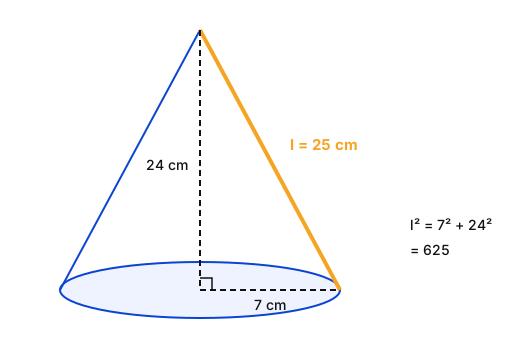
- cm, cm.
- cm.
Trick: 7, 24, 25 is a Pythagorean triplet.
Answer: (A) 25 cm
अवधारणा: तिर्यक ऊँचाई ।
हल:
- सेमी, सेमी।
- सेमी।
ट्रिक: 7, 24, 25 पाइथागोरस त्रिक है।
उत्तर: (A) 25 cm
SSC CGLQuantitative AptitudeCone – slant heightSSC CGL 2025 · 12 Sep Shift 3
Q1145.Sunil lent ₹5,000 to Sudhir for 2 years and ₹3,000 to Vinod for 4 years at the same simple interest rate. In total, he received ₹4,400 as interest from both borrowers. What is the rate of interest per annum?
सुनील ने सुधीर को 2 वर्ष के लिए ₹5,000 और विनोद को 4 वर्ष के लिए ₹3,000 समान साधारण ब्याज दर पर उधार दिए। दोनों से उसे कुल ₹4,400 ब्याज मिला। वार्षिक ब्याज दर क्या है?
- A17%
- B12%
- C15%
- D20%
Show answer
Concept: ; add both interests and solve for R.
- Sudhir: .
- Vinod: .
- .
Trick: Total 'principal-years' = ; .
Answer: (D) 20%
अवधारणा: ; दोनों ब्याज जोड़कर R निकालें।
हल:
- सुधीर: ।
- विनोद: ।
- ।
ट्रिक: कुल 'मूलधन-वर्ष' = 22,000; ।
उत्तर: (D) 20%
SSC CGLQuantitative AptitudeSimple interest – common rateSSC CGL 2025 · 12 Sep Shift 3
Q1146.A triangular prism has a base area of 25 cm². If height is increased by 25%, what is the new volume (original height was 16 cm)?
एक त्रिभुजाकार प्रिज़्म का आधार क्षेत्रफल 25 cm² है। यदि ऊँचाई 25% बढ़ा दी जाए, तो नया आयतन क्या होगा (मूल ऊँचाई 16 cm थी)?
- A550 cm³
- B575 cm³
- C500 cm³
- D225 cm³
Show answer
Concept: Volume of a prism = base area × height.
- New height = cm.
- Volume = cm³.
Trick: Old volume 400 cm³; +25% → 500 cm³.
Answer: (C) 500 cm³
अवधारणा: प्रिज़्म का आयतन = आधार क्षेत्रफल × ऊँचाई।
हल:
- नई ऊँचाई = सेमी।
- आयतन = सेमी³।
ट्रिक: पुराना आयतन 400; 25% बढ़ाकर 500।
उत्तर: (C) 500 cm³
SSC CGLQuantitative AptitudePrism – volumeSSC CGL 2025 · 12 Sep Shift 3
Q1147.A circular disc's radius is decreased by 20%. What is the percentage decrease in its area?
एक वृत्ताकार डिस्क की त्रिज्या 20% घटा दी जाती है। उसके क्षेत्रफल में कितने प्रतिशत की कमी होगी?
- A20%
- B38%
- C36%
- D30%
Show answer
Concept: Area varies as , so use the successive change formula.
- New area factor = .
- Decrease = → 36%.
Trick: .
Answer: (C) 36%
अवधारणा: क्षेत्रफल के अनुपात में बदलता है।
हल:
- नया क्षेत्रफल गुणक = ।
- कमी = → 36%।
ट्रिक: ।
उत्तर: (C) 36%
SSC CGLQuantitative AptitudeArea change when radius changesSSC CGL 2025 · 12 Sep Shift 3
Q1148.A man has 160 m of fencing wire. He can use this wire to enclose a circular garden or a square garden. If he wants to maximize the enclosed area, what is the approximate ratio of the area of the largest possible circular garden to the area of the largest possible square garden, using the entire 160 m of wire?
एक व्यक्ति के पास 160 m बाड़ का तार है। वह इस तार से वृत्ताकार या वर्गाकार बगीचा घेर सकता है। यदि वह घिरा हुआ क्षेत्रफल अधिकतम करना चाहता है, तो पूरे 160 m तार से बने सबसे बड़े वृत्ताकार बगीचे और सबसे बड़े वर्गाकार बगीचे के क्षेत्रफलों का अनुमानित अनुपात क्या होगा?
- A1.3 : 1
- B1.27 : 1
- C1.7 : 1
- D1.6 : 1
Show answer
Concept: For equal perimeter, find each area and compare.
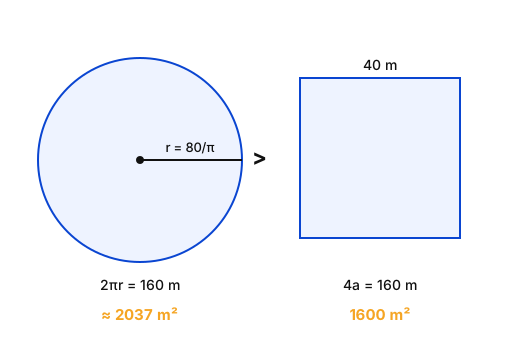
- Circle: → area = m².
- Square: each side m, so its area is m².
- Ratio = .
Trick: For any equal perimeter, circle : square area = .
Answer: (B) 1.27 : 1
अवधारणा: समान परिधि पर दोनों के क्षेत्रफल निकालकर तुलना करें।
हल:
- वृत्त: → क्षेत्रफल = मी²।
- वर्ग: भुजा = 40 मी → क्षेत्रफल = 1600 मी²।
- अनुपात = ।
ट्रिक: समान परिधि पर वृत्त : वर्ग क्षेत्रफल = (हमेशा)।
उत्तर: (B) 1.27 : 1
SSC CGLQuantitative AptitudeSame perimeter – circle vs squareSSC CGL 2025 · 12 Sep Shift 3
Q1149.A vertical cylindrical container is filled with oil. A solid hemispherical stone of radius 6 cm is immersed completely, and the oil level rises by 2.5 cm. What is the radius of the cylindrical container?
एक ऊर्ध्वाधर बेलनाकार बर्तन तेल से भरा है। 6 cm त्रिज्या का एक ठोस अर्धगोलाकार पत्थर पूरी तरह डुबोया जाता है और तेल का स्तर 2.5 cm बढ़ जाता है। बेलनाकार बर्तन की त्रिज्या क्या है?
- A6.29 cm
- B7.59 cm
- C8.79 cm
- D11.41 cm
Show answer
Concept: Volume of the immersed solid = volume of liquid raised.
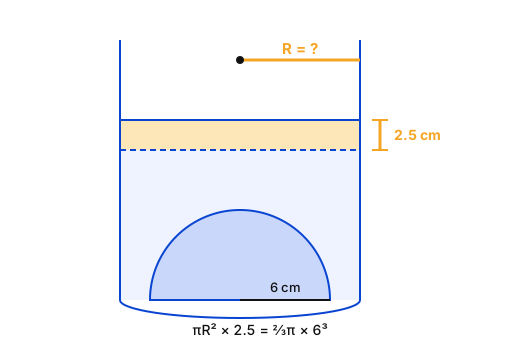
- Hemisphere volume = cm³.
- Raised oil: , so .
- Taking the square root, cm.
Trick: and , so R is just under 7.6 – only 7.59 fits.
Answer: (B) 7.59 cm
अवधारणा: डूबे ठोस का आयतन = उठे हुए द्रव का आयतन।
हल:
- अर्धगोले का आयतन = सेमी³।
- उठा तेल: , अतः ।
- वर्गमूल लेने पर सेमी।
ट्रिक: , → R, 7.6 से थोड़ा कम।
उत्तर: (B) 7.59 cm
SSC CGLQuantitative AptitudeDisplacement – hemisphere in cylinderSSC CGL 2025 · 12 Sep Shift 3
Q1150.A sector of a circle has a central angle of 135° and a radius of 9 cm. Another sector of the same circle has a central angle of radians. What is the ratio of the area of the first sector to the area of the second sector?
एक वृत्त के एक त्रिज्यखंड का केंद्रीय कोण 135° और त्रिज्या 9 cm है। उसी वृत्त के दूसरे त्रिज्यखंड का केंद्रीय कोण रेडियन है। पहले त्रिज्यखंड और दूसरे त्रिज्यखंड के क्षेत्रफलों का अनुपात क्या है?
- A4 : 3
- B5 : 4
- C1 : 1
- D6 : 7
Show answer
Concept: In the same circle, sector area depends only on the central angle.
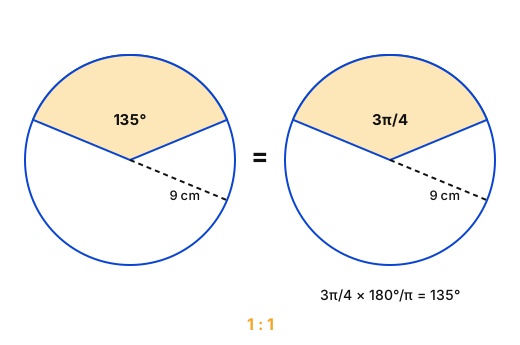
- .
- Both angles are 135° with the same radius.
- Areas are equal → ratio 1 : 1.
Trick: Convert radians to degrees with before comparing.
Answer: (C) 1 : 1
अवधारणा: एक ही वृत्त में त्रिज्यखंड का क्षेत्रफल केवल केंद्रीय कोण पर निर्भर है।
हल:
- रेडियन ।
- दोनों कोण 135° और त्रिज्या समान।
- क्षेत्रफल बराबर → अनुपात 1 : 1।
ट्रिक: रेडियन को डिग्री में बदलने के लिए करें।
उत्तर: (C) 1 : 1
SSC CGLQuantitative AptitudeSectors – degree and radianSSC CGL 2025 · 12 Sep Shift 3
Q1151.Let x = + and y = + . Which is greater?
माना x = + तथा y = + है। कौन बड़ा है?
- Ax = y
- Bx > y
- Cx < y
- DCannot be determinedनिर्धारित नहीं किया जा सकता
Show answer
Concept: Compare sums of square roots term by term.
- , .
- Both share ; compare the rest: vs .
- .
Trick: Cancel the common surd first – no squaring needed.
Answer: (C) x < y
अवधारणा: वर्गमूलों के योग की तुलना पद-दर-पद करें।
हल:
- ,
- दोनों में समान; शेष तुलना: बनाम
ट्रिक: समान करणी पहले हटा दें – वर्ग करने की ज़रूरत नहीं।
उत्तर: (C) x < y
SSC CGLQuantitative AptitudeSurds – comparisonSSC CGL 2025 · 12 Sep Shift 2
Q1152.The number of red, blue, and green marbles in a bag is in the ratio 3 : 4 : 6. If 25 red marbles, 15 blue marbles, and an unknown number of green marbles are added to the bag, the ratio of red, blue, and green marbles becomes 4 : 5 : 9. Determine the number of green marbles added.
एक थैले में लाल, नीली और हरी कंचों की संख्या का अनुपात 3 : 4 : 6 है। यदि थैले में 25 लाल, 15 नीली और अज्ञात संख्या में हरी कंचे मिलाए जाएँ, तो लाल, नीली और हरी कंचों का अनुपात 4 : 5 : 9 हो जाता है। मिलाई गई हरी कंचों की संख्या ज्ञात कीजिए।
- A103
- B110
- C107
- D105
Show answer
Concept: Use the two known additions to find the multiplier, then the third.
- Let red = 3x, blue = 4x, green = 6x.
- .
- New red = 220 = 4 parts ⇒ 1 part = 55; new green = .
- Old green = ; added = .
Trick: Cross-multiply only red–blue; green is found at the end from the new ratio.
Answer: (D) 105
अवधारणा: दो ज्ञात जोड़ों से गुणक निकालें, फिर तीसरा।
हल:
- लाल = 3x, नीला = 4x, हरा = 6x
- नया लाल = 220 = 4 भाग ⇒ 1 भाग = 55; नया हरा = 495
- पुराना हरा = 390; जोड़े = 105
ट्रिक: केवल लाल–नीले से x निकालें; हरा अंत में नए अनुपात से।
उत्तर: (D) 105
SSC CGLQuantitative AptitudeRatio – items addedSSC CGL 2025 · 12 Sep Shift 2
Q1153.Evaluate the continued fraction:
x = 4 + 1/(5 + 1/(6 + 1/2))
सतत भिन्न का मान ज्ञात कीजिए:
x = 4 + 1/(5 + 1/(6 + 1/2))
- A
- B
- C
- D
Show answer
Concept: Simplify from the innermost bracket outwards.
- .
- ⇒ reciprocal = .
- .
Trick: Denominator of the answer = numerator of the second level (67) – matches all options, so just compute .
Answer: (A)
अवधारणा: सबसे भीतर वाले भाग से बाहर की ओर हल करें।
हल:
- ⇒ व्युत्क्रम
- ⇒ व्युत्क्रम
ट्रिक: हर 67 सभी विकल्पों में है, केवल अंश निकालें: ।
उत्तर: (A)
SSC CGLQuantitative AptitudeContinued fractionSSC CGL 2025 · 12 Sep Shift 2
Q1154.A and B invest ₹20,000 and ₹35,000 respectively in a business. What is A's share in a profit of ₹25,000?
A और B एक व्यवसाय में क्रमशः ₹20,000 और ₹35,000 निवेश करते हैं। ₹25,000 के लाभ में A का हिस्सा क्या है?
- A₹8,090
- B₹9,091
- C₹9,250
- D₹9,000
Show answer
Concept: With equal time, profit is shared in the ratio of capitals.
- 20,000 : 35,000 = 4 : 7 (11 parts).
- A's share = ₹9,090.9 ≈ ₹9,091.
Trick: ; .
Answer: (B) ₹9,091
अवधारणा: समय समान हो तो लाभ पूँजी के अनुपात में बँटता है।
हल:
- 20,000 : 35,000 = 4 : 7 (कुल 11 भाग)
- A का हिस्सा = ₹9,091
ट्रिक: ; ।
उत्तर: (B) ₹9,091
SSC CGLQuantitative AptitudePartnership – profit shareSSC CGL 2025 · 12 Sep Shift 2
Q1155.P and Q contribute to a business investment in the ratio 3 : 5. They earn a profit of ₹66,000. P is a working partner and receives 10% of the profit extra. What is P's total share?
P और Q एक व्यावसायिक निवेश में 3 : 5 के अनुपात में योगदान करते हैं। उन्हें ₹66,000 का लाभ होता है। P कार्यशील साझेदार है और लाभ का 10% अतिरिक्त प्राप्त करता है। P का कुल हिस्सा क्या है?
- A₹26,500
- B₹28,875
- C₹38,875
- D₹36,875
Show answer
Concept: First remove the working partner's extra, then split the rest by ratio.
- Extra to P = 10% of 66,000 = ₹6,600.
- Remaining = ₹59,400; P's part = ₹22,275.
- P total = ₹28,875.
Trick: P total = .
Answer: (B) ₹28,875
अवधारणा: पहले कार्यरत साझेदार का अतिरिक्त हिस्सा घटाएँ, फिर शेष अनुपात में बाँटें।
हल:
- P का अतिरिक्त = 66,000 का 10% = ₹6,600
- शेष ₹59,400; P = ₹22,275
- P कुल = ₹28,875
ट्रिक: P कुल = ।
उत्तर: (B) ₹28,875
SSC CGLQuantitative AptitudePartnership – working partnerSSC CGL 2025 · 12 Sep Shift 2
Q1156.In a team of 85 employees, the average monthly sales per employee is ₹2.8 lakh. If 30 junior employees average ₹1.2 lakh each, what is the average monthly sales figure (in ₹ lakh) for the senior employees?
85 कर्मचारियों की एक टीम में प्रति कर्मचारी औसत मासिक बिक्री ₹2.8 लाख है। यदि 30 कनिष्ठ कर्मचारियों का औसत ₹1.2 लाख है, तो वरिष्ठ कर्मचारियों की औसत मासिक बिक्री (₹ लाख में) क्या है?
- A₹3.47 lakh₹3.47 लाख
- B₹3.67 lakh₹3.67 लाख
- C₹3.87 lakh₹3.87 लाख
- D₹3.57 lakh₹3.57 लाख
Show answer
Concept: Total of whole group − total of known group = total of other group.
- Total = lakh.
- Juniors = lakh.
- Seniors (55) = 202 lakh ⇒ average = lakh.
Trick: Deviation method: juniors are 1.6 below average → deficit 48; spread over 55 seniors → .
Answer: (B) ₹3.67 lakh
अवधारणा: पूरे समूह का योग − ज्ञात समूह का योग = दूसरे समूह का योग।
हल:
- कुल = लाख
- जूनियर = लाख
- सीनियर (55) = 202 लाख ⇒ औसत ≈ 3.67 लाख
ट्रिक: विचलन विधि: जूनियर 1.6 कम → कमी 48; 55 पर बाँटें → ।
उत्तर: (B) ₹3.67 लाख
SSC CGLQuantitative AptitudeAverage – two groupsSSC CGL 2025 · 12 Sep Shift 2
Q1157.The price of petrol shot up by 15%. Before the hike, the price was Rs. 82 per litre. A man travels 2,639 km every month and his car gives a mileage of 13 km per litre. What is the increase in the monthly expenditure (to the nearest Rs.) on the man's travel due to the hike in the petrol prices?
पेट्रोल की कीमत 15% बढ़ गई। वृद्धि से पहले कीमत ₹82 प्रति लीटर थी। एक व्यक्ति प्रति माह 2,639 km यात्रा करता है और उसकी कार का माइलेज 13 km प्रति लीटर है। पेट्रोल मूल्य-वृद्धि के कारण उसके मासिक यात्रा-व्यय में वृद्धि (निकटतम ₹ तक) कितनी होगी?
- A₹2,496.9
- B₹2,296.7
- C₹2,596.9
- D₹2,256.9
Show answer
Concept: Extra cost = litres used × increase per litre.
- Petrol per month = L.
- Increase per litre = 15% of 82 = ₹12.30.
- Extra = ₹2,496.90.
Trick: Last digit check: ends in .9 () → narrows options fast.
Answer: (A) ₹2,496.9
अवधारणा: अतिरिक्त खर्च = खपत (लीटर) × प्रति लीटर वृद्धि।
हल:
- मासिक पेट्रोल = लीटर
- प्रति लीटर वृद्धि = 82 का 15% = ₹12.30
- अतिरिक्त = ₹2,496.90
ट्रिक: – सीधे भाग हो जाता है।
उत्तर: (A) ₹2,496.9
SSC CGLQuantitative AptitudePercentage – fuel price hikeSSC CGL 2025 · 12 Sep Shift 2
Q1158.A company ordered 30 mobile phones and a certain number of laptops. The mobile phones cost 4 times as much as the laptops. Due to a mistake, the number of mobile phones and laptops was interchanged during delivery. This increased the total bill by 60%. What was the ratio of the number of mobile phones to laptops in the original order?
एक कंपनी ने 30 मोबाइल फोन और कुछ लैपटॉप ऑर्डर किए। मोबाइल फोन की कीमत लैपटॉप की 4 गुना है। गलती से डिलीवरी के समय मोबाइल और लैपटॉप की संख्याएँ आपस में बदल गईं, जिससे कुल बिल 60% बढ़ गया। मूल ऑर्डर में मोबाइल और लैपटॉप की संख्या का अनुपात क्या था?
- A1 : 2
- B2 : 1
- C9 : 4
- D4 : 9
Show answer
Concept: Write the bill before and after swapping, apply the 60% rise.
- Let laptop price = p, mobile = 4p, laptops ordered = L.
- Original bill = 120p + Lp; after swap = 4Lp + 30p.
- 4L + 30 = 1.6(120 + L) ⇒ 2.4L = 162 ⇒ L = 67.5.
- Mobiles : laptops = 30 : 67.5 = 4 : 9.
Trick: Swapping raised the bill, so the costlier item (mobile) must be fewer originally → ratio < 1 → 1:2 or 4:9; test 4:9.
Answer: (D) 4 : 9
अवधारणा: अदला-बदली से पहले और बाद का बिल लिखें, 60% वृद्धि लगाएँ।
हल:
- लैपटॉप मूल्य p, मोबाइल 4p, लैपटॉप संख्या L
- मूल बिल = 120p + Lp; बाद में = 4Lp + 30p
- 4L + 30 = 1.6(120 + L) ⇒ L = 67.5
- अनुपात = 30 : 67.5 = 4 : 9
ट्रिक: बिल बढ़ा, तो महँगी वस्तु (मोबाइल) पहले कम थी → अनुपात 1 से कम।
उत्तर: (D) 4 : 9
SSC CGLQuantitative AptitudeRatio – interchanged orderSSC CGL 2025 · 12 Sep Shift 2
Q1159.Find the compound interest on ₹6,000 at 12% per annum for 3 years 4 months, compounded annually.
₹6,000 पर 12% वार्षिक दर से 3 वर्ष 4 माह का चक्रवृद्धि ब्याज ज्ञात कीजिए, जबकि चक्रवृद्धि वार्षिक है।
- A₹3,000.76
- B₹2,866.57
- C₹2,766.57
- D₹2,966.57
Show answer
Concept: For the extra months, use simple-interest growth on the amount after full years.
- After 3 years: ₹8,429.57.
- 4 months = year → rate ⇒ .
- Amount ≈ ₹8,766.75 ⇒ CI ≈ ₹2,766.7 → option ₹2,766.57.
Trick: Answer must lie between CI for 3 yrs (2,429.6) and for 4 yrs (3,440.9), and close to 2,429.6 + 4% of 8,429.6 ≈ 2,766.8.
Answer: (C) ₹2,766.57
अवधारणा: बचे महीनों के लिए पूरे वर्षों के बाद की राशि पर साधारण वृद्धि लें।
हल:
- 3 वर्ष बाद: ₹8,429.57
- 4 माह = वर्ष → 4% ⇒
- मिश्रधन ≈ ₹8,766.75 ⇒ CI ≈ ₹2,766.57 (विकल्प)
ट्रिक: 3 वर्ष का CI 2,429.6 + 8,429.6 का 4% ≈ 2,766.8 – निकटतम विकल्प चुनें।
उत्तर: (C) ₹2,766.57
SSC CGLQuantitative AptitudeCompound interest – fractional yearSSC CGL 2025 · 12 Sep Shift 2
Q1160.A candy shop owner buys three kinds of candies: red, yellow, and green. Red candies are purchased at 3 for ₹15, yellow candies at 4 for ₹18, and green candies at 5 for ₹22. He mixes them in the ratio 1 : 1 : 2. He sells all the mixed candies at 3 for ₹20. What is his approximate gain or loss percentage?
एक कैंडी दुकानदार तीन प्रकार की कैंडियाँ खरीदता है: लाल — ₹15 में 3, पीली — ₹18 में 4, और हरी — ₹22 में 5। वह इन्हें 1 : 1 : 2 के अनुपात में मिलाता है और सभी मिश्रित कैंडियाँ ₹20 में 3 की दर से बेचता है। उसका अनुमानित लाभ या हानि प्रतिशत क्या है?
- ALoss of 45.21%45.21% हानि
- BProfit of 45.71%45.71% लाभ
- CProfit of 55.71%55.71% लाभ
- DLoss of 40.51%40.51% हानि
Show answer
Concept: Find cost of a mixed batch and compare with its selling price.
- CP of one: red = ₹5, yellow = ₹4.5, green = ₹4.4.
- Batch of 4 (1:1:2): cost = ₹18.30.
- SP of 4 = ₹26.67; profit = .
Trick: SP per candy ₹6.67 is above every cost price → it must be a profit; drop both loss options.
Answer: (B) Profit of 45.71%
अवधारणा: मिश्रित समूह का क्रय मूल्य निकालकर विक्रय मूल्य से तुलना करें।
हल:
- एक कैंडी का क्रय मूल्य: लाल = ₹5, पीली = ₹4.5, हरी = ₹4.4
- 4 कैंडी (1:1:2): लागत = ₹18.30
- 4 का विक्रय = ₹26.67; लाभ =
ट्रिक: विक्रय मूल्य ₹6.67 हर लागत से अधिक → लाभ ही होगा; हानि वाले विकल्प हटाएँ।
उत्तर: (B) 45.71% लाभ
SSC CGLQuantitative AptitudeProfit & loss – mixtureSSC CGL 2025 · 12 Sep Shift 2

