Q1161.The ratio of boys to girls in a school is 5 : 3. If 10 more boys join the school, the new ratio of boys to girls becomes 2 : 1. What is the total number of students in the school initially?
एक विद्यालय में लड़कों और लड़कियों का अनुपात 5 : 3 है। यदि 10 और लड़के विद्यालय में आ जाएँ, तो नया अनुपात 2 : 1 हो जाता है। प्रारंभ में विद्यालय में कुल कितने विद्यार्थी थे?
- A50
- B80
- C60
- D100
Show answer
Concept: Girls are unchanged; use that to find the multiplier.
- Boys = 5x, girls = 3x.
- .
- Initial total = .
Trick: Total must be a multiple of 8 (5 + 3) – only 80 among options.
Answer: (B) 80
अवधारणा: लड़कियाँ नहीं बदलतीं; इससे गुणक निकालें।
हल:
- लड़के = 5x, लड़कियाँ = 3x
- कुल =
ट्रिक: कुल 8 का गुणज होना चाहिए – विकल्पों में केवल 80।
उत्तर: (B) 80
SSC CGLQuantitative AptitudeRatio – new members joinSSC CGL 2025 · 12 Sep Shift 2
Q1162.P, Q, and R are capable of completing a job in 24, 36, and 72 days, respectively. P works every day, while Q and R join P every third day. How long will it take to finish the task?
P, Q और R एक कार्य को क्रमशः 24, 36 और 72 दिनों में पूरा कर सकते हैं। P प्रतिदिन कार्य करता है, जबकि Q और R प्रत्येक तीसरे दिन P के साथ जुड़ते हैं। कार्य पूरा होने में कितना समय लगेगा?
- A25 days25 दिन
- B18 days18 दिन
- C16 days16 दिन
- D12 days12 दिन
Show answer
Concept: Use LCM as total work and add work done in each 3-day cycle.
- Work = LCM(24, 36, 72) = 72 units; P = 3, Q = 2, R = 1 per day.
- Cycle of 3 days: units.
- cycles = 18 days.
Trick: When the work ends exactly at a cycle end, days = cycles × cycle length.
Answer: (B) 18 days
अवधारणा: LCM को कुल कार्य मानें और हर 3 दिन के चक्र का कार्य जोड़ें।
हल:
- कार्य = 72 इकाई; P = 3, Q = 2, R = 1 प्रतिदिन
- 3 दिन का चक्र: इकाई
- चक्र = 18 दिन
ट्रिक: कार्य ठीक चक्र के अंत में पूरा हो तो दिन = चक्र × चक्र की लंबाई।
उत्तर: (B) 18 दिन
SSC CGLQuantitative AptitudeTime & work – periodic helpSSC CGL 2025 · 12 Sep Shift 2
Q1163.A 200-liter solution contains milk and water in the ratio 3 : 2. Some of this solution is removed and replaced with pure milk. If the final ratio of milk and water becomes 7 : 3, how many liters of solution were replaced?
200 लीटर के एक विलयन में दूध और पानी का अनुपात 3 : 2 है। इस विलयन का कुछ भाग निकालकर शुद्ध दूध मिला दिया जाता है। यदि अंतिम अनुपात 7 : 3 हो जाए, तो कितने लीटर विलयन बदला गया?
- A35 litres35 लीटर
- B25 litres25 लीटर
- C50 litres50 लीटर
- D20 litres20 लीटर
Show answer
Concept: Pure milk is added, so water only decreases by the part removed.
- Water initially = L.
- Final water = L.
- Removed S litres carry water ⇒ L.
Trick: Track the component that is NOT added back (water) – one equation solves it.
Answer: (C) 50 litres
अवधारणा: शुद्ध दूध मिलाया गया, अतः पानी केवल निकाले गए भाग से घटता है।
हल:
- आरंभ में पानी = 80 लीटर
- अंत में पानी = लीटर
- लीटर
ट्रिक: जो घटक वापस नहीं डाला गया (पानी), उसी पर समीकरण बनाएँ।
उत्तर: (C) 50 लीटर
SSC CGLQuantitative AptitudeReplacement – milk and waterSSC CGL 2025 · 12 Sep Shift 2
Q1164.The ratio of the efficiencies of two workers, Ram and Shyam, is 5 : 2. If Ram can complete a project in 20 days, how many days will Shyam take to complete the same project alone?
दो श्रमिकों राम और श्याम की कार्यक्षमताओं का अनुपात 5 : 2 है। यदि राम एक परियोजना 20 दिनों में पूरी कर सकता है, तो श्याम अकेले उसी परियोजना को कितने दिनों में पूरा करेगा?
- A24 days24 दिन
- B50 days50 दिन
- C35 days35 दिन
- D40 days40 दिन
Show answer
Concept: Time is inversely proportional to efficiency.
- Ram : Shyam efficiency = 5 : 2 ⇒ time = 2 : 5.
- 2 parts = 20 days ⇒ 1 part = 10 ⇒ Shyam = 50 days.
Trick: Shyam's time = .
Answer: (B) 50 days
अवधारणा: समय दक्षता के व्युत्क्रमानुपाती होता है।
हल:
- दक्षता 5 : 2 ⇒ समय 2 : 5
- 2 भाग = 20 दिन ⇒ श्याम = दिन
ट्रिक: श्याम का समय = ।
उत्तर: (B) 50 दिन
SSC CGLQuantitative AptitudeEfficiency and timeSSC CGL 2025 · 12 Sep Shift 2
Q1165.A car starts from point P on a circular track and an SUV starts from point Q, which is 800 meters ahead of P in the direction of motion. The car's speed is 20 m/s, and the SUV's speed is 15 m/s. The circumference of the track is 1.5 km. How much distance will the car have traveled when it first overtakes the SUV?
एक कार वृत्ताकार ट्रैक के बिंदु P से और एक SUV बिंदु Q से चलना प्रारंभ करती है, जो गति की दिशा में P से 800 मीटर आगे है। कार की चाल 20 m/s और SUV की 15 m/s है। ट्रैक की परिधि 1.5 km है। जब कार पहली बार SUV को पकड़ेगी, तब तक कार कितनी दूरी तय कर चुकी होगी?
- A2800 m
- B3100 m
- C3000 m
- D3200 m
Show answer
Concept: The faster vehicle must close the initial gap at the relative speed.
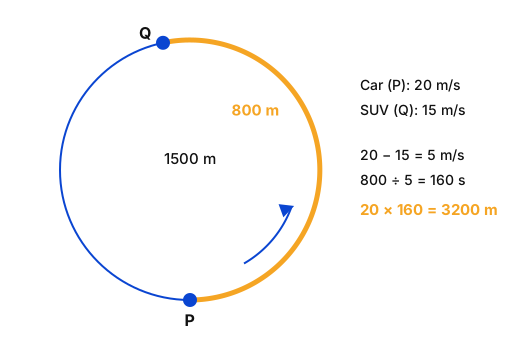
- Gap = 800 m (SUV ahead); relative speed = m/s.
- Time = s.
- Car's distance = m.
Trick: Car distance = gap × (car speed ÷ relative speed) = .
Answer: (D) 3200 m
अवधारणा: तेज़ वाहन को सापेक्ष चाल से शुरुआती अंतर पूरा करना होता है।
हल:
- अंतर = 800 मी; सापेक्ष चाल = 5 मी/से
- समय = से
- कार की दूरी = मी
ट्रिक: कार की दूरी = अंतर × (कार की चाल ÷ सापेक्ष चाल) = ।
उत्तर: (D) 3200 m
SSC CGLQuantitative AptitudeCircular track – first overtakingSSC CGL 2025 · 12 Sep Shift 2
Q1166.A circular park having a radius of 15 m. If a 1.5 m wide path is built around it, what is the approximate area of the path?
15 m त्रिज्या वाला एक वृत्ताकार पार्क है। यदि उसके चारों ओर 1.5 m चौड़ा पथ बनाया जाए, तो पथ का अनुमानित क्षेत्रफल क्या होगा?
- A148.5 m²
- B158.5 m²
- C138.5 m²
- D118.5 m²
Show answer
Concept: Path area = .
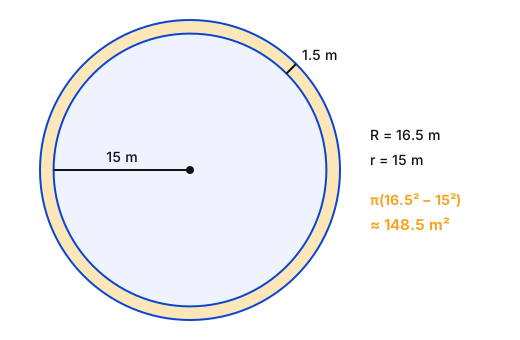
- m, m.
- Area = .
- ≈ m².
Trick: Use instead of squaring decimals.
Answer: (A) 148.5 m²
अवधारणा: पथ का क्षेत्रफल = ।
हल:
- मी, मी
- क्षेत्रफल =
- ≈ 148.5 मी²
ट्रिक: दशमलव का वर्ग करने के बजाय लें।
उत्तर: (A) 148.5 m²
SSC CGLQuantitative AptitudeMensuration – circular pathSSC CGL 2025 · 12 Sep Shift 2
Q1167.What is radians in degrees?
रेडियन कितने अंश (डिग्री) के बराबर है?
- A225°
- B210°
- C240°
- D360°
Show answer
Concept: .
- .
- = .
Trick: , so just multiply by the numerator.
Answer: (B) 210°
अवधारणा: रेडियन ।
हल:
- =
ट्रिक: , बस अंश से गुणा करें।
उत्तर: (B) 210°
SSC CGLQuantitative AptitudeRadian to degreeSSC CGL 2025 · 12 Sep Shift 2
Q1168.The line y = −x + 6 does not pass through which of the following points?
रेखा y = −x + 6 निम्न में से किस बिंदु से नहीं गुजरती?
- A(4, 2)
- B(3, 4)
- C(5, 1)
- D(6, 0)
Show answer
Concept: A point lies on the line if it satisfies the equation.
- y = −x + 6 ⇔ x + y = 6.
- (4,2), (5,1), (6,0) all give 6.
- (3,4): 3 + 4 = 7 ≠ 6 → not on the line.
Trick: Rewrite as x + y = 6 and add coordinates mentally.
Answer: (B) (3, 4)
अवधारणा: जो बिंदु समीकरण को संतुष्ट करे, वही रेखा पर है।
हल:
- y = −x + 6 ⇔ x + y = 6
- (4,2), (5,1), (6,0) – सभी का योग 6
- (3,4): योग 7 ≠ 6 → रेखा पर नहीं
ट्रिक: x + y = 6 रूप में लिखें और निर्देशांक मन में जोड़ें।
उत्तर: (B) (3, 4)
SSC CGLQuantitative AptitudeCoordinate geometry – point on lineSSC CGL 2025 · 12 Sep Shift 2
Q1169.What is the central angle of a sector with an arc length of 20 cm in a circle of radius 10 cm?
10 cm त्रिज्या वाले वृत्त में 20 cm चाप लंबाई वाले त्रिज्यखंड का केंद्रीय कोण क्या है?
- A6 radians6 रेडियन
- B3 radians3 रेडियन
- C2 radians2 रेडियन
- D4 radians4 रेडियन
Show answer
Concept: Arc length , in radians.
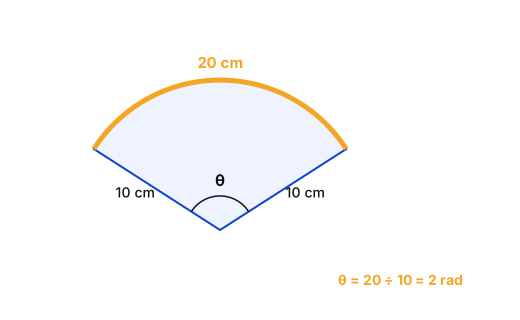
- .
- radians.
Trick: Arc = 2 × radius → angle = 2 rad (≈ ).
Answer: (C) 2 radians
अवधारणा: चाप लंबाई ( रेडियन में)।
हल:
- रेडियन
ट्रिक: चाप = 2 × त्रिज्या → कोण = 2 रेडियन।
उत्तर: (C) 2 रेडियन
SSC CGLQuantitative AptitudeArc length – central angleSSC CGL 2025 · 12 Sep Shift 2
Q1170.If tan(90° − θ) = , what is cos θ?
यदि tan(90° − θ) = है, तो cos θ क्या है?
- A
- B
- C
- D
Show answer
Concept: .
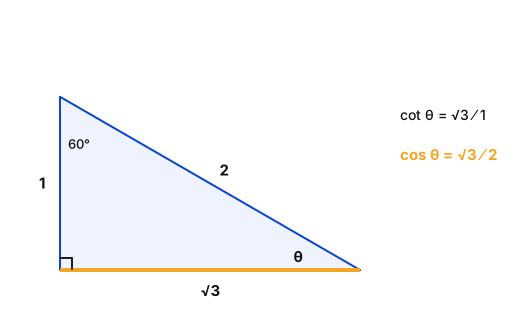
- .
- .
Trick: is the standard value of 30° – recall the table.
Answer: (B)
अवधारणा: ।
हल:
ट्रिक: (मानक सारणी)।
उत्तर: (B)
SSC CGLQuantitative AptitudeTrigonometry – complementary angleSSC CGL 2025 · 12 Sep Shift 2
Q1171.If x = , determine the value of x + .
यदि x = है, तो x + का मान ज्ञात कीजिए।
- A
- B
- C
- D
Show answer
Concept: Add and rationalise the denominator.
- .
- .
- Rationalise: .
Trick: directly.
Answer: (C)
अवधारणा: जोड़कर हर का परिमेयकरण करें।
हल:
- परिमेयकरण:
ट्रिक: सीधे।
उत्तर: (C)
SSC CGLQuantitative AptitudeAlgebra – x + 1/x with surdSSC CGL 2025 · 12 Sep Shift 2
Q1172.Two triangles are similar with sides in the ratio 2 : 5. What is the ratio of their areas?
दो समरूप त्रिभुजों की भुजाओं का अनुपात 2 : 5 है। उनके क्षेत्रफलों का अनुपात क्या है?
- A16 : 25
- B25 : 8
- C4 : 25
- D25 : 9
Show answer
Concept: .
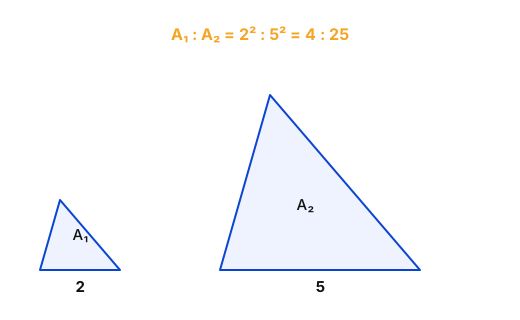
- Sides 2 : 5.
- Areas = .
Trick: Squares of the given ratio – look for 4 and 25.
Answer: (C) 4 : 25
अवधारणा: ।
हल:
- भुजाएँ 2 : 5
- क्षेत्रफल = 4 : 25
ट्रिक: दिए अनुपात का वर्ग – 4 और 25 देखें।
उत्तर: (C) 4 : 25
SSC CGLQuantitative AptitudeSimilar triangles – area ratioSSC CGL 2025 · 12 Sep Shift 2
Q1173.If x = 2 + , then determine the value of x² − x − 7.
यदि x = 2 + है, तो x² − x − 7 का मान ज्ञात कीजिए।
- A−2 + 3
- B2 + 3
- C−3 + 3
- D−5 + 3
Show answer
Concept: Expand and substitute.
- .
- .
- .
Trick: coefficient: ; constant: .
Answer: (A) −2 + 3
अवधारणा: फैलाकर मान रखें।
हल:
ट्रिक: का गुणांक ; अचर ।
उत्तर: (A) −2 + 3
SSC CGLQuantitative AptitudeSurds – value of expressionSSC CGL 2025 · 12 Sep Shift 2
Q1174.The angles of a cyclic quadrilateral are in the ratio 1 : 2 : 4 : 5. What is the measure of the smallest angle?
एक चक्रीय चतुर्भुज के कोण 1 : 2 : 4 : 5 के अनुपात में हैं। सबसे छोटे कोण का मान क्या है?
- A30°
- B36°
- C108°
- D150°
Show answer
Concept: Opposite angles of a cyclic quadrilateral add up to 180°.
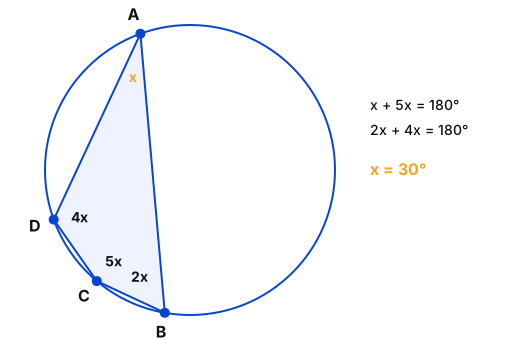
- Total ratio = 12 parts = 360° ⇒ 1 part = 30°.
- Pairs (1 + 5) and (2 + 4) = 6 parts = 180° each ✓.
- Smallest = 30°.
Trick: Any quadrilateral: 360° ÷ sum of ratio = one part.
Answer: (A) 30°
अवधारणा: चक्रीय चतुर्भुज के सम्मुख कोणों का योग 180° होता है।
हल:
- कुल 12 भाग = 360° ⇒ 1 भाग = 30°
- (1 + 5) और (2 + 4) = 180° ✓
- सबसे छोटा = 30°
ट्रिक: 360° ÷ अनुपात का योग = एक भाग।
उत्तर: (A) 30°
SSC CGLQuantitative AptitudeCyclic quadrilateral – anglesSSC CGL 2025 · 12 Sep Shift 2
Q1175.If sec A = and A is acute, find tan A.
यदि sec A = है और A न्यून कोण है, तो tan A ज्ञात कीजिए।
- A
- B
- C
- D
Show answer
Concept: ; use Pythagoras for the third side.
- Hypotenuse = 13, base = 5.
- Perpendicular = .
- .
Trick: 5–12–13 is a Pythagorean triplet – no calculation needed.
Answer: (B)
अवधारणा: कर्ण/आधार; तीसरी भुजा पाइथागोरस से।
हल:
- कर्ण = 13, आधार = 5
- लंब =
ट्रिक: 5–12–13 पाइथागोरस त्रिक है।
उत्तर: (B)
SSC CGLQuantitative AptitudeTrigonometry – sec to tanSSC CGL 2025 · 12 Sep Shift 2
Q1176.Arrange the fractions , , and in ascending order.
भिन्नों , , और को आरोही क्रम में व्यवस्थित कीजिए।
- A, , ,
- B, , ,
- C, , ,
- D, , ,
Show answer
Concept: Compare fractions by converting to decimals or by cross-multiplying.
- , , , .
- Smallest to largest: 0.545, 0.571, 0.600, 0.625.
- Order: , , , .
Trick: Compare each with 'how much short of 1': misses (biggest gap) → smallest; misses (smallest gap) → largest.
Answer: (B) , , ,
अवधारणा: भिन्नों को दशमलव में बदलकर या तिर्यक गुणा से तुलना कीजिए।
- , , , ।
- छोटे से बड़ा: 0.545, 0.571, 0.600, 0.625।
- क्रम: , , , ।
ट्रिक: 1 से कितना कम है, देखिए: में कम (सबसे अधिक) → सबसे छोटा; में कम → सबसे बड़ा।
उत्तर: (B) , , ,
SSC CGLQuantitative AptitudeComparing fractions – ascending orderSSC CGL 2025 · 12 Sep Shift 1
Q1177.Simplify: 3 + 4.5 − 1.9
सरल कीजिए: 3 + 4.5 − 1.9
- A5.2
- B4.3
- C6.1
- D3.2
Show answer
Concept: Change the mixed fraction to a decimal, then add/subtract.
- Whole-number parts: .
- Decimal parts: ( gives 0.5).
- Total = .
Trick: Pair numbers that make whole numbers first () – then only one subtraction is left.
Answer: (C) 6.1
अवधारणा: मिश्र भिन्न को दशमलव में बदलकर जोड़-घटाव कीजिए।
- पूर्णांक भाग: ।
- दशमलव भाग: ( में 0.5)।
- कुल = ।
ट्रिक: पहले ऐसे जोड़े बनाइए जो पूर्णांक दें (), फिर एक ही घटाव बचता है।
उत्तर: (C) 6.1
SSC CGLQuantitative AptitudeSimplification – mixed fraction and decimalsSSC CGL 2025 · 12 Sep Shift 1
Q1178.Evaluate:
27 − [ ÷ { − ( × ( − )) } ]
मूल्यांकन कीजिए:
27 − [ ÷ { − ( × ( − )) } ]
- A−2
- B2
- C1
- D1
Show answer
Concept: Solve brackets from the innermost: ( ) → { } → [ ].
- ; then .
- .
- .
- .
Trick: Dividing by = multiplying by 12 — no need for common denominators there.
Answer: (C) 1
अवधारणा: कोष्ठक सबसे अंदर से हल कीजिए: ( ) → { } → [ ]।
- ; फिर ।
- ।
- ।
- ।
ट्रिक: से भाग = 12 से गुणा — वहाँ LCM की ज़रूरत नहीं।
उत्तर: (C) 1
SSC CGLQuantitative AptitudeBODMAS with fractions and bracketsSSC CGL 2025 · 12 Sep Shift 1
Q1179.From a sample of 230 software engineers, determine the ratio of those proficient in Python to those proficient in Java using the given information:| Category | Number |
| Proficient in Python and Java | 60 |
| Proficient in Python only | 70 |
| Proficient in Java only | 80 |
| Proficient in neither language | 20 |
230 सॉफ्टवेयर इंजीनियरों के एक नमूने से, दी गई जानकारी का प्रयोग कर Python में दक्ष और Java में दक्ष इंजीनियरों का अनुपात ज्ञात कीजिए:| श्रेणी | संख्या |
| Python और Java दोनों में दक्ष | 60 |
| केवल Python में दक्ष | 70 |
| केवल Java में दक्ष | 80 |
| किसी भी भाषा में दक्ष नहीं | 20 |
- A11 : 12
- B13 : 14
- C13 : 11
- D13 : 7
Show answer
Concept: Total in a set = 'only that set' + 'both'.
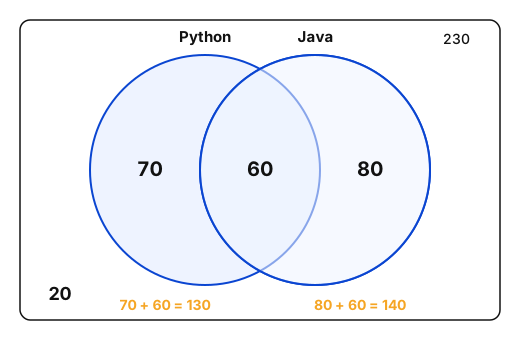
- Python users = 70 (only) + 60 (both) = 130.
- Java users = 80 (only) + 60 (both) = 140.
- Ratio = 130 : 140 = 13 : 14.
Trick: Check total: 60 + 70 + 80 + 20 = 230 ✔ — the 'neither' group plays no role in the ratio.
Answer: (B) 13 : 14
अवधारणा: किसी समूह का कुल = 'केवल वह' + 'दोनों'।
- Python जानने वाले = 70 (केवल) + 60 (दोनों) = 130।
- Java जानने वाले = 80 (केवल) + 60 (दोनों) = 140।
- अनुपात = 130 : 140 = 13 : 14।
ट्रिक: जाँच: 60 + 70 + 80 + 20 = 230 ✔ — 'किसी में नहीं' वाले अनुपात में शामिल नहीं होते।
उत्तर: (B) 13 : 14
SSC CGLQuantitative AptitudeSets – ratio from a Venn-type tableSSC CGL 2025 · 12 Sep Shift 1
Q1180.Sonu started a business by investing ₹40,000. After 4 months, Prem joined with ₹80,000. At the end of 8 months from the start, Alok joined with ₹1,20,000. If the total profit is ₹1,56,000 at the end of the year, find the share of Alok.
सोनू ने ₹40,000 निवेश कर एक व्यवसाय प्रारंभ किया। 4 महीने बाद प्रेम ₹80,000 के साथ जुड़ गया। प्रारंभ से 8 महीने के अंत में आलोक ₹1,20,000 के साथ जुड़ गया। यदि वर्ष के अंत में कुल लाभ ₹1,56,000 है, तो आलोक का हिस्सा ज्ञात कीजिए।
- A₹47,500
- B₹48,000
- C₹47,200
- D₹46,800
Show answer
Concept: Profit is shared in the ratio of capital × months.
- Sonu: ; Prem: ; Alok: .
- In thousands: 480 : 640 : 480 = 3 : 4 : 3 (total 10).
- Alok = ₹46,800.
Trick: Divide capitals by 40,000 first (1 : 2 : 3), then multiply by months (12, 8, 4) → 12 : 16 : 12 = 3 : 4 : 3.
Answer: (D) ₹46,800
अवधारणा: लाभ, पूँजी × महीनों के अनुपात में बँटता है।
- सोनू: ; प्रेम: ; आलोक: ।
- हज़ार में: 480 : 640 : 480 = 3 : 4 : 3 (कुल 10)।
- आलोक = ₹46,800।
ट्रिक: पहले पूँजी को 40,000 से भाग दें (1 : 2 : 3), फिर महीनों (12, 8, 4) से गुणा → 12 : 16 : 12 = 3 : 4 : 3।
उत्तर: (D) ₹46,800
SSC CGLQuantitative AptitudePartnership – partners joining at different timesSSC CGL 2025 · 12 Sep Shift 1

