Q1181.P and Q start a business. P invests ₹40,000 for 9 months, Q invests ₹60,000 for 6 months. What is Q's share of a ₹45,000 profit?
P और Q एक व्यवसाय प्रारंभ करते हैं। P ने 9 महीनों के लिए ₹40,000 और Q ने 6 महीनों के लिए ₹60,000 निवेश किए। ₹45,000 के लाभ में Q का हिस्सा क्या है?
- A₹26,500
- B₹28,000
- C₹36,000
- D₹22,500
Show answer
Concept: Share of profit ∝ investment × time.
- P: .
- Q: .
- Ratio 1 : 1 → Q gets ₹22,500.
Trick: When capital × time is equal, profit is split equally — just halve it.
Answer: (D) ₹22,500
अवधारणा: लाभ का हिस्सा ∝ निवेश × समय।
- P: ।
- Q: ।
- अनुपात 1 : 1 → Q को ₹22,500।
ट्रिक: पूँजी × समय बराबर हो तो लाभ आधा-आधा — सीधे आधा कीजिए।
उत्तर: (D) ₹22,500
SSC CGLQuantitative AptitudePartnership – capital × timeSSC CGL 2025 · 12 Sep Shift 1
Q1182.What is the average of all integers between 100 and 252 that are exactly divisible by 11?
100 और 252 के बीच 11 से पूर्णतः विभाज्य सभी पूर्णांकों का औसत क्या है?
- A176
- B156
- C186
- D136
Show answer
Concept: Numbers in an AP have average = .
- First multiple of 11 after 100: 110 ().
- Last before 252: 242 ().
- Average = .
Trick: Average of … = average of 10…22 = .
Answer: (A) 176
अवधारणा: समांतर श्रेणी का औसत = ।
- 100 के बाद 11 का पहला गुणज: 110 ()।
- 252 से पहले अंतिम: 242 ()।
- औसत = ।
ट्रिक: से का औसत = = ।
उत्तर: (A) 176
SSC CGLQuantitative AptitudeAverage of multiples in a rangeSSC CGL 2025 · 12 Sep Shift 1
Q1183.The average of 15 numbers is 80. The average of the first 6 numbers is 72. The average of the next 6 numbers is 33.33% more than the average of the first 6 numbers. The 13th number is 8 more than the 15th number, and the 14th number is 10 less than the 15th number. What is the average of the 13th and 14th numbers?
15 संख्याओं का औसत 80 है। पहली 6 संख्याओं का औसत 72 है। अगली 6 संख्याओं का औसत, पहली 6 संख्याओं के औसत से 33.33% अधिक है। 13वीं संख्या, 15वीं संख्या से 8 अधिक है और 14वीं संख्या, 15वीं संख्या से 10 कम है। 13वीं और 14वीं संख्याओं का औसत क्या है?
- A63.89
- B85
- C63.67
- D63.65
Show answer
Concept: Convert every average into a sum, then subtract.
- Total = ; first 6 = .
- Next 6 average = () → sum 576.
- So the 13th, 14th and 15th together total 192.
- Call the 15th number x; the 13th is and the 14th is , so the three add up to , giving .
- Average of 13th and 14th = .
Trick: Once you know the 15th number, the pair's average is simply that number minus 1 (because +8 and −10 average to −1).
Answer: (C) 63.67
अवधारणा: हर औसत को योग में बदलकर घटाइए।
- कुल = ; पहले 6 = ।
- अगले 6 का औसत = () → योग 576।
- यानी 13वीं, 14वीं, 15वीं संख्याओं का कुल 192 है।
- 15वीं = x मानें; 13वीं = , 14वीं = ; तीनों का योग → ।
- 13वीं-14वीं का औसत = ।
ट्रिक: +8 और −10 का औसत −1 है, इसलिए जोड़ी का औसत = 15वीं संख्या − 1।
उत्तर: (C) 63.67
SSC CGLQuantitative AptitudeAverage – finding parts from group totalsSSC CGL 2025 · 12 Sep Shift 1
Q1184.A landlord bought a flat for ₹12,00,000. He wants to earn a 9% annual return on his investment after paying ₹2,500 per month for maintenance. What should be the monthly rent he charges?
एक मकान मालिक ने ₹12,00,000 में एक फ्लैट खरीदा। वह ₹2,500 प्रति माह रखरखाव का भुगतान करने के बाद अपने निवेश पर 9% वार्षिक प्रतिफल अर्जित करना चाहता है। उसे प्रति माह कितना किराया लेना चाहिए?
- A₹11,800
- B₹10,500
- C₹11,500
- D₹11,700
Show answer
Concept: Rent must cover the desired return plus expenses.
- Desired return = 9% of 12,00,000 = ₹1,08,000 per year → ₹9,000 per month.
- Maintenance = ₹2,500 per month.
- Monthly rent = ₹11,500.
Trick: Work monthly from the start: , then just add 2,500.
Answer: (C) ₹11,500
अवधारणा: किराया = चाहा गया रिटर्न + खर्च।
- रिटर्न = 12,00,000 का 9% = ₹1,08,000 प्रति वर्ष → ₹9,000 प्रति माह।
- रखरखाव = ₹2,500 प्रति माह।
- मासिक किराया = ₹11,500।
ट्रिक: सीधे मासिक में सोचिए: , फिर 2,500 जोड़िए।
उत्तर: (C) ₹11,500
SSC CGLQuantitative AptitudeRent required for a target returnSSC CGL 2025 · 12 Sep Shift 1
Q1185.An amount is said to double in 10 years with compound interest. How many years will it take for the amount to grow to 8 times its original value?
एक धनराशि चक्रवृद्धि ब्याज पर 10 वर्षों में दोगुनी हो जाती है। उसी राशि को अपने मूल मान का 8 गुना होने में कितने वर्ष लगेंगे?
- A15
- B30
- C31
- D18
Show answer
Concept: Under CI the money multiplies by the same factor in equal time periods.
- 2 times in 10 years.
- → three doublings.
- Time = years.
Trick: If amount becomes k times in T years, it becomes times in nT years. → .
Answer: (B) 30
अवधारणा: चक्रवृद्धि में बराबर समय में धन उतने ही गुना होता है।
- 10 वर्ष में 2 गुना।
- → तीन बार दोगुना।
- समय = वर्ष।
ट्रिक: k गुना T वर्ष में हो तो गुना nT वर्ष में। → ।
उत्तर: (B) 30
SSC CGLQuantitative AptitudeCompound interest – doubling timeSSC CGL 2025 · 12 Sep Shift 1
Q1186.A sum becomes ₹6,600 in 3 years and ₹7,920 in 4 years at compound interest. What is the original principal?
एक धनराशि चक्रवृद्धि ब्याज पर 3 वर्षों में ₹6,600 और 4 वर्षों में ₹7,920 हो जाती है। मूलधन क्या है?
- A₹3,020.44
- B₹3,829.44
- C₹3,819.44
- D₹3,883.44
Show answer
Concept: Consecutive-year CI amounts differ by one year's interest on the earlier amount.
- Rate = .
- Amount after 3 years: → .
- ₹3,819.44.
Trick: , so .
Answer: (C) ₹3,819.44
अवधारणा: लगातार वर्षों के मिश्रधनों का अंतर = पिछले मिश्रधन पर एक वर्ष का ब्याज।
- दर = ।
- 3 वर्ष का मिश्रधन: → ।
- ₹3,819.44।
ट्रिक: , अतः ।
उत्तर: (C) ₹3,819.44
SSC CGLQuantitative AptitudeCompound interest – principal from two amountsSSC CGL 2025 · 12 Sep Shift 1
Q1187.Kusum purchased 22 liters of milk at ₹42 per liter and another 15 liters of milk at ₹50 per liter. She combined both quantities and then sold the entire mixture at ₹48 per liter. What was her total profit or loss?
कुसुम ने ₹42 प्रति लीटर की दर से 22 लीटर दूध और ₹50 प्रति लीटर की दर से 15 लीटर दूध खरीदा। दोनों को मिलाकर उसने पूरा मिश्रण ₹48 प्रति लीटर पर बेच दिया। उसे कुल लाभ या हानि क्या हुई?
- ALoss of ₹102₹102 की हानि
- BProfit of ₹102₹102 का लाभ
- CProfit of ₹51₹51 का लाभ
- DLoss of ₹51₹51 की हानि
Show answer
Concept: Profit = total selling price − total cost.
- Cost = ₹1,674.
- SP = ₹1,776.
- Profit = ₹102.
Trick: Per-litre method: first lot gains → ; second loses 2 → ; net = ₹102 profit.
Answer: (B) Profit of ₹102
अवधारणा: लाभ = कुल विक्रय मूल्य − कुल लागत।
- पहला दूध ₹42 में लेकर ₹48 में बेचा: हर लीटर पर ₹6 लाभ → 22 लीटर पर ₹132।
- दूसरा दूध ₹50 में लेकर ₹48 में बेचा: हर लीटर पर ₹2 हानि → 15 लीटर पर ₹30।
- शुद्ध परिणाम = ₹102 लाभ।
ट्रिक: जाँच: कुल लागत ₹1,674 और कुल बिक्री ₹1,776 — अंतर ₹102।
उत्तर: (B) ₹102 का लाभ
SSC CGLQuantitative AptitudeMixture – profit or loss on saleSSC CGL 2025 · 12 Sep Shift 1
Q1188.A toy manufacturer produced 1200 toy cars at a total cost of ₹91,000. He donated 200 cars to a charity event. For the rest, he announced a 10% discount on the market price of ₹120 per car. He also offered 2 toy cars free for every 8 toy cars purchased. If all 1200 toy cars were distributed, what is his overall gain or loss percentage?
एक खिलौना निर्माता ने कुल ₹91,000 की लागत से 1200 खिलौना कारें बनाईं। उसने 200 कारें एक दान कार्यक्रम में दान कर दीं। शेष के लिए उसने ₹120 प्रति कार के बाज़ार मूल्य पर 10% छूट की घोषणा की। उसने प्रत्येक 8 कारों की खरीद पर 2 कारें मुफ़्त देने की पेशकश भी की। यदि सभी 1200 कारें वितरित हो गईं, तो उसका समग्र लाभ या हानि प्रतिशत क्या है?
- A5.05% loss5.05% हानि
- B5.05% profit5.05% लाभ
- C6.05% loss6.05% हानि
- D6.05% profit6.05% लाभ
Show answer
Concept: Only the cars actually paid for bring revenue; cost covers all 1200.
- donated = 1000 cars to sell.
- Buy 8 get 2 free → in every 10 cars only 8 are paid: paid cars.
- Price per car = ₹108 → revenue = ₹86,400.
- Loss = ₹4,600 → loss.
Trick: Revenue (86,400) is below cost (91,000) → it must be a loss; that removes B and D straight away.
Answer: (A) 5.05% loss
अवधारणा: आय केवल बिकी (भुगतान वाली) कारों से; लागत सभी 1200 की।
- दान = 1000 कारें।
- 8 खरीदने पर 2 मुफ़्त → हर 10 में 8 का भुगतान: ।
- प्रति कार मूल्य = ₹108 → आय = ₹86,400।
- हानि = ₹4,600 → ।
ट्रिक: आय (86,400) लागत (91,000) से कम → हानि ही होगी; B और D तुरंत हटते हैं।
उत्तर: (A) 5.05% हानि
SSC CGLQuantitative AptitudeProfit & loss – donation, discount and free itemsSSC CGL 2025 · 12 Sep Shift 1
Q1189.A retailer marks a car 80% above its cost price. He offers a first discount of 25% on the marked price. During a festive offer, an additional discount of 10% is applied on the already discounted price. If the final selling price is ₹19,440, what is the approximate cost price of the car?
एक खुदरा विक्रेता एक कार पर क्रय मूल्य से 80% अधिक मूल्य अंकित करता है। वह अंकित मूल्य पर 25% की पहली छूट देता है। त्योहारी ऑफर में, पहले से छूट वाले मूल्य पर 10% की अतिरिक्त छूट लागू होती है। यदि अंतिम विक्रय मूल्य ₹19,440 है, तो कार का अनुमानित क्रय मूल्य क्या है?
- A₹16,000
- B₹16,200
- C₹16,800
- D₹18,000
Show answer
Concept: .
- .
- .
- ₹16,000.
Trick: Option check: → 75% = 21,600 → 90% = 19,440 ✔.
Answer: (A) ₹16,000
अवधारणा: विक्रय मूल्य = क्रय मूल्य × (1 + अंकन) × (1 − छूट₁) × (1 − छूट₂)।
- ।
- ।
- ₹16,000।
ट्रिक: विकल्प जाँच: → 75% = 21,600 → 90% = 19,440 ✔।
उत्तर: (A) ₹16,000
SSC CGLQuantitative AptitudeMarkup with successive discounts – find CPSSC CGL 2025 · 12 Sep Shift 1
Q1190.A 80-liter mixture contains Milk and water in the ratio 5 : 3. How much water (in liters) must be added to this mixture to change the ratio of Milk to water to 2 : 3?
80 लीटर के एक मिश्रण में दूध और पानी का अनुपात 5 : 3 है। दूध और पानी का अनुपात 2 : 3 करने के लिए इस मिश्रण में कितना पानी (लीटर में) मिलाना होगा?
- A40 litres40 लीटर
- B45 litres45 लीटर
- C35 litres35 लीटर
- D30 litres30 लीटर
Show answer
Concept: Milk stays fixed when only water is added.
- Milk = L; water = 30 L.
- New ratio 2 : 3 with milk 50 → 2 parts = 50, so water = L.
- Water to add = L.
Trick: Keep the unchanged quantity as the anchor: milk 50 = 2 parts → 1 part = 25.
Answer: (B) 45 litres
अवधारणा: केवल पानी मिलाने पर दूध की मात्रा नहीं बदलती।
- दूध = L; पानी = 30 L।
- नया अनुपात 2 : 3, दूध 50 → 2 भाग = 50, पानी = L।
- मिलाना = L।
ट्रिक: न बदलने वाली मात्रा को आधार बनाइए: दूध 50 = 2 भाग → 1 भाग = 25।
उत्तर: (B) 45 लीटर
SSC CGLQuantitative AptitudeMixture – adding water to change ratioSSC CGL 2025 · 12 Sep Shift 1
Q1191.Uttam is able to complete a task in 15 days, while Deepak takes 20 days to finish the same task. If they collaborate and work together for 5 days, what fraction of the work will still remain?
उत्तम एक कार्य को 15 दिनों में पूरा कर सकता है, जबकि दीपक उसी कार्य को 20 दिनों में पूरा करता है। यदि वे मिलकर 5 दिन कार्य करें, तो कितना कार्य शेष रह जाएगा?
- A
- B
- C
- D
Show answer
Concept: Use LCM of days as total work.
- Total work = units.
- Uttam = 4 units/day, Deepak = 3 units/day → together 7 units/day.
- In 5 days: 35 units; remaining = .
Trick: LCM method avoids fraction addition: = answer.
Answer: (C)
अवधारणा: दिनों के LCM को कुल काम मानिए।
- कुल काम = इकाई।
- उत्तम = 4, दीपक = 3 इकाई/दिन → साथ में 7।
- 5 दिन में 35 इकाई; शेष = ।
ट्रिक: LCM विधि में भिन्न जोड़ने नहीं पड़ते: ।
उत्तर: (C)
SSC CGLQuantitative AptitudeTime & work – remaining workSSC CGL 2025 · 12 Sep Shift 1
Q1192.Two Lentil priced at ₹90 per kg and ₹250 per kg are blended and sold at ₹250 per kg, achieving a profit margin of 25%. What is the ratio of the two Lentil in the mixture?
₹90 प्रति किग्रा और ₹250 प्रति किग्रा मूल्य वाली दो दालों को मिलाकर ₹250 प्रति किग्रा पर बेचा जाता है, जिससे 25% का लाभ प्राप्त होता है। मिश्रण में दोनों दालों का अनुपात क्या है?
- A5 : 11
- B5 : 12
- C5 : 2
- D15 : 1
Show answer
Concept: Find the cost price of the mixture from SP and profit, then apply alligation.
- SP = ₹250 with 25% profit → CP of mixture = ₹200 per kg.
- Alligation: cheaper (₹90) gets ; dearer (₹250) gets .
- Ratio = 50 : 110 = 5 : 11.
Trick: Check: ₹200 per kg.
Answer: (A) 5 : 11
अवधारणा: विक्रय मूल्य व लाभ से मिश्रण का क्रय मूल्य निकालें, फिर एलीगेशन लगाएँ।
- विक्रय मूल्य ₹250, लाभ 25% → मिश्रण का क्रय मूल्य = ₹200 प्रति kg।
- एलीगेशन: सस्ती (₹90) को ; महँगी (₹250) को ।
- अनुपात = 50 : 110 = 5 : 11।
ट्रिक: जाँच: ₹200 प्रति kg।
उत्तर: (A) 5 : 11
SSC CGLQuantitative AptitudeAlligation – blending with profitSSC CGL 2025 · 12 Sep Shift 1
Q1193.Three pipes, P, Q, and R are capable of filling a tank in 12, 15, and 24 hours, respectively. When all three pipes are opened together, they operate for 1.5 hours before pipe R is closed. How much additional time will it take to completely fill the tank after that?
तीन पाइप P, Q और R एक टंकी को क्रमशः 12, 15 और 24 घंटों में भर सकते हैं। तीनों पाइप एक साथ खोले जाते हैं और 1.5 घंटे चलने के बाद पाइप R बंद कर दिया जाता है। इसके बाद टंकी को पूरी तरह भरने में और कितना समय लगेगा?
- A4 hours4 घंटे
- B4 hours4 घंटे
- C4 hours4 घंटे
- D4 hours4 घंटे
Show answer
Concept: Take tank capacity as LCM of the times.
- Hourly filling: of the tank.
- 1.5 hours of all three: filled, so is still empty.
- P + Q alone = per hour → time = hours.
Trick: Take the tank as 120 units (LCM) to avoid fractions: P, Q, R fill 10, 8, 5 units an hour.
Answer: (A) 4 hours
अवधारणा: टंकी की क्षमता = समयों का LCM।
- प्रति घंटा तीनों मिलकर: टंकी।
- डेढ़ घंटे में: भरी, खाली।
- केवल P + Q = प्रति घंटा → समय = घंटे।
ट्रिक: टंकी को 120 इकाई (LCM) मानें तो P, Q, R प्रति घंटा 10, 8, 5 इकाई भरते हैं — भिन्न नहीं आते।
उत्तर: (A) 4 घंटे
SSC CGLQuantitative AptitudePipes & cisterns – one pipe closedSSC CGL 2025 · 12 Sep Shift 1
Q1194.A bullet train covers a fixed distance in 30 minutes at an average speed of 360 km/h. Due to track maintenance, it needs to be diverted, increasing the distance by 25%. If the train needs to arrive at its destination on time (i.e., in 30 minutes), what should its new average speed be in km/h?
एक बुलेट ट्रेन 360 km/h की औसत चाल से एक निश्चित दूरी 30 मिनट में तय करती है। ट्रैक रखरखाव के कारण उसे मोड़ना पड़ता है, जिससे दूरी 25% बढ़ जाती है। यदि ट्रेन को समय पर (अर्थात 30 मिनट में) गंतव्य पहुँचना है, तो उसकी नई औसत चाल (km/h में) क्या होनी चाहिए?
- A560 km/h
- B450 km/h
- C620 km/h
- D520 km/h
Show answer
Concept: At constant time, speed is proportional to distance.
- Distance = km.
- New distance = km.
- Speed = km/h.
Trick: Distance up 25% in the same time → speed up 25%: directly.
Answer: (B) 450 km/h
अवधारणा: समय समान हो तो चाल दूरी के समानुपाती।
- दूरी = km।
- नई दूरी = km।
- चाल = km/h।
ट्रिक: दूरी 25% बढ़ी, समय वही → चाल भी 25% बढ़ेगी: ।
उत्तर: (B) 450 km/h
SSC CGLQuantitative AptitudeSpeed – same time, longer distanceSSC CGL 2025 · 12 Sep Shift 1
Q1195.Two cars, X and Y, start from points 320 km apart and travel at constant speeds. If they move towards each other, they meet in 8 hours. If they move in the same direction, they meet in 16 hours. What is the speed of car X? (Assume X is the faster car).
दो कारें X और Y, 320 km दूर स्थित बिंदुओं से नियत चाल से चलती हैं। यदि वे एक-दूसरे की ओर चलें, तो 8 घंटे में मिलती हैं। यदि वे एक ही दिशा में चलें, तो 16 घंटे में मिलती हैं। कार X की चाल क्या है? (मानिए X तेज़ कार है।)
- A30 km/h
- B35 km/h
- C45 km/h
- D90 km/h
Show answer
Concept: Opposite directions → add speeds; same direction → subtract.
- km/h.
- km/h.
- km/h ().
Trick: Faster speed = = .
Answer: (A) 30 km/h
अवधारणा: विपरीत दिशा → चालें जोड़ें; समान दिशा → घटाएँ।
- km/h।
- km/h।
- km/h ()।
ट्रिक: तेज़ चाल = = ।
उत्तर: (A) 30 km/h
SSC CGLQuantitative AptitudeRelative speed – towards vs same directionSSC CGL 2025 · 12 Sep Shift 1
Q1196.A circular pizza having a radius of 21 cm. If 80% of it is eaten, what is the area of pizza remaining?
21 cm त्रिज्या वाला एक गोलाकार पिज़्ज़ा है। यदि उसका 80% खा लिया जाए, तो शेष पिज़्ज़े का क्षेत्रफल क्या होगा?
- A240.42 cm²
- B356.2 cm²
- C277.2 cm²
- D266.2 cm²
Show answer
Concept: Area = ; remaining = the uneaten percentage of it.
- Area = cm².
- Eaten 80% → left 20%.
- 20% of 1386 = 277.2 cm².
Trick: with always gives 1386 — a number worth remembering.
Answer: (C) 277.2 cm²
अवधारणा: क्षेत्रफल = ; शेष = बचा हुआ प्रतिशत।
- क्षेत्रफल = cm²।
- 80% खाया → 20% बचा।
- 1386 का 20% = 277.2 cm²।
ट्रिक: और पर क्षेत्रफल हमेशा 1386 — याद रखने लायक।
उत्तर: (C) 277.2 cm²
SSC CGLQuantitative AptitudeArea of circle – remaining partSSC CGL 2025 · 12 Sep Shift 1
Q1197.A ring-shaped disc has outer radius 10 cm and inner radius 8 cm. What is the approximate ratio of the ring's area to the whole outer circle?
एक वलयाकार (ring) डिस्क की बाहरी त्रिज्या 10 cm और भीतरी त्रिज्या 8 cm है। वलय के क्षेत्रफल और पूरे बाहरी वृत्त के क्षेत्रफल का लगभग अनुपात क्या है?
- A9 : 25
- B6 : 25
- C9 : 20
- D3 : 15
Show answer
Concept: Ring area = .
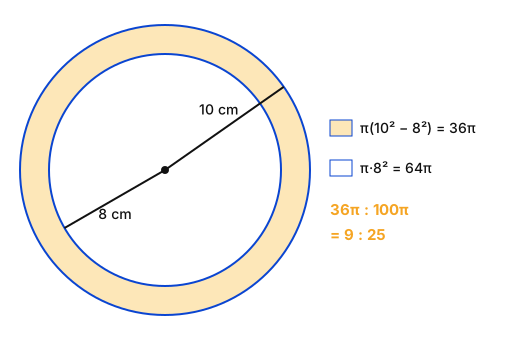
- Ring = .
- Outer circle = .
- Ratio = 36 : 100 = 9 : 25.
Trick: π cancels — just compare with .
Answer: (A) 9 : 25
अवधारणा: वलय का क्षेत्रफल = ।
- वलय = ।
- बाहरी वृत्त = ।
- अनुपात = 36 : 100 = 9 : 25।
ट्रिक: π कट जाता है — केवल और की तुलना कीजिए।
उत्तर: (A) 9 : 25
SSC CGLQuantitative AptitudeAnnulus (ring) – area ratioSSC CGL 2025 · 12 Sep Shift 1
Q1198.A truck wheel having a radius of 42 cm. What percentage of its circumference is covered in a quarter turn? (Use π = )
एक ट्रक के पहिए की त्रिज्या 42 cm है। एक चौथाई चक्कर (quarter turn) में उसकी परिधि का कितना प्रतिशत तय होता है? (π = लीजिए)
- A35%
- B25%
- C40%
- D45%
Show answer
Concept: One full turn covers the whole circumference.
- A quarter turn = of a revolution.
- Distance = × circumference = 25% of it.
- Radius and π () don't matter for the percentage.
Trick: Ignore extra data: percentage of a turn = percentage of circumference.
Answer: (B) 25%
अवधारणा: एक पूरा चक्कर = पूरी परिधि।
- चौथाई चक्कर = परिक्रमा।
- दूरी = परिधि का = 25%।
- त्रिज्या और π () प्रतिशत पर असर नहीं डालते।
ट्रिक: फालतू आँकड़े छोड़िए: चक्कर का प्रतिशत = परिधि का प्रतिशत।
उत्तर: (B) 25%
SSC CGLQuantitative AptitudeCircumference – fraction of a turnSSC CGL 2025 · 12 Sep Shift 1
Q1199.The line y = mx + 7 passes through (2, 9). Find m.
रेखा y = mx + 7 बिंदु (2, 9) से गुज़रती है। m ज्ञात कीजिए।
- A4
- B3
- C1
- D2
Show answer
Concept: A point on a line satisfies its equation.
- Put x = 2, y = 9 in y = mx + 7.
- 9 = 2m + 7 → 2m = 2.
- m = 1.
Trick: 7 is the y-intercept; from (0, 7) to (2, 9) y rises 2 for x rising 2 → slope 1.
Answer: (C) 1
अवधारणा: रेखा पर स्थित बिंदु उसके समीकरण को संतुष्ट करता है।
- y = mx + 7 में x = 2, y = 9 रखिए।
- 9 = 2m + 7 → 2m = 2।
- m = 1।
ट्रिक: (0, 7) से (2, 9): y में 2 वृद्धि, x में 2 वृद्धि → ढाल 1।
उत्तर: (C) 1
SSC CGLQuantitative AptitudeStraight line – slope from a pointSSC CGL 2025 · 12 Sep Shift 1
Q1200. + − + 250 is equal to:
+ − + 250 का मान है:
- A−6582
- B−6482
- C−6682
- D−5482
Show answer
Concept: Find each cube and combine carefully with signs.
- ; ; .
- .
- .
Yaad rakhein: ( ends in 125/375/625/875); — learn cubes up to 35.
Answer: (B) −6482
अवधारणा: हर घन निकालकर चिह्नों के साथ जोड़िए।
- ; ; ।
- ।
- ।
याद रखें: ; — 35 तक के घन याद रखिए।
उत्तर: (B) −6482
SSC CGLQuantitative AptitudeEvaluating cubesSSC CGL 2025 · 12 Sep Shift 1

