Q121.What is the radian measure of 160°?
160° का रेडियन माप क्या है?
- A
- B
- C
- D
Show answer
Concept: Radian = degree .
- .
- .
Trick: , and .
Answer: (A)
अवधारणा: रेडियन = डिग्री ।
- ।
- = ।
ट्रिक: ; ।
उत्तर: (A)
SSC CGLQuantitative AptitudeDegree to radian conversionSSC CGL 2025 · 26 Sep Shift 2
Q122.If tan x = cot y and cot x = tan y, then x + y equals:
यदि tan x = cot y और cot x = tan y है, तो x + y किसके बराबर होगा?
- A45°
- B60°
- C90°
- D180°
Show answer
Concept: tan θ = cot(90° − θ).
- tan x = cot y = tan(90° − y).
- So x = 90° − y.
- x + y = 90°.
Trick: Whenever tan of one = cot of the other (acute angles), they add to 90°.
Answer: (C) 90°
अवधारणा: tan θ = cot(90° − θ)।
- tan x = cot y = tan(90° − y)।
- x = 90° − y।
- x + y = 90°।
ट्रिक: एक का tan = दूसरे का cot हो तो दोनों का योग 90°।
उत्तर: (C) 90°
SSC CGLQuantitative AptitudeComplementary angles – tan & cotSSC CGL 2025 · 26 Sep Shift 2
Q123.A triangle has a perimeter of 40 cm and an inradius of 2 cm. What is its area?
एक त्रिभुज का परिमाप 40 cm और अंतःत्रिज्या 2 cm है। उसका क्षेत्रफल क्या है?
- A10 cm²
- B20 cm²
- C30 cm²
- D40 cm²
Show answer
Concept: Area = , where s = semi-perimeter.
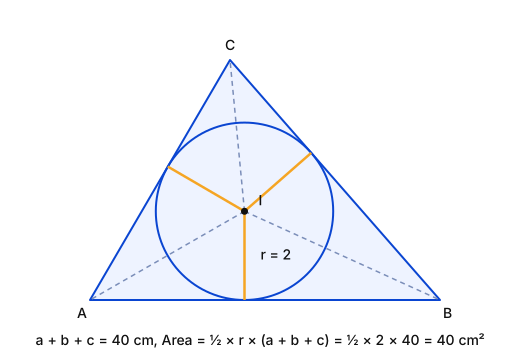
- s = cm.
- Area = cm².
Trick: Area = – works for every triangle.
Answer: (D) 40 cm²
अवधारणा: क्षेत्रफल = , s = अर्धपरिमाप।
- s = cm।
- क्षेत्रफल = cm²।
ट्रिक: क्षेत्रफल = r × परिमाप/2 – हर त्रिभुज पर लागू।
उत्तर: (D) 40 cm²
SSC CGLQuantitative AptitudeTriangle area from inradiusSSC CGL 2025 · 26 Sep Shift 2
Q124.In a circle, there is a chord measuring 18 cm that is located 13 cm away from the centre. What is the approximate radius of the circle?
एक वृत्त में 18 cm लंबी जीवा केंद्र से 13 cm की दूरी पर है। वृत्त की लगभग त्रिज्या क्या है?
- A10 cm
- B18 cm
- C16 cm
- D25 cm
Show answer
Concept: Perpendicular from centre bisects the chord: .
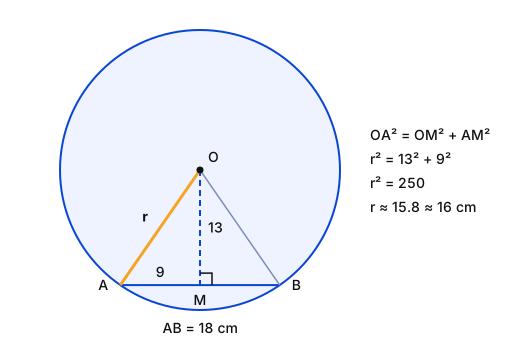
- Half chord = 9 cm.
- .
- cm.
Trick: r must exceed 13 (distance) and 9 (half chord) but be less than – only 16 and 18 fit; .
Answer: (C) 16 cm
अवधारणा: केंद्र से लंब जीवा को समद्विभाजित करता है: = (आधी जीवा) + ।
- आधी जीवा = 9 cm।
- ।
- cm।
ट्रिक: , इसलिए लगभग 16।
उत्तर: (C) 16 cm
SSC CGLQuantitative AptitudeCircle – radius from chord & distanceSSC CGL 2025 · 26 Sep Shift 2
Q125.A tangent is drawn to a circle with a radius of 8 cm. At the point of tangency, what is the angle between the tangent and the radius?
8 cm त्रिज्या वाले वृत्त पर एक स्पर्श रेखा खींची गई है। स्पर्श बिंदु पर स्पर्श रेखा और त्रिज्या के बीच का कोण क्या होगा?
- A45°
- B60°
- C90°
- D180°
Show answer
Concept: Tangent at any point is perpendicular to the radius at that point.
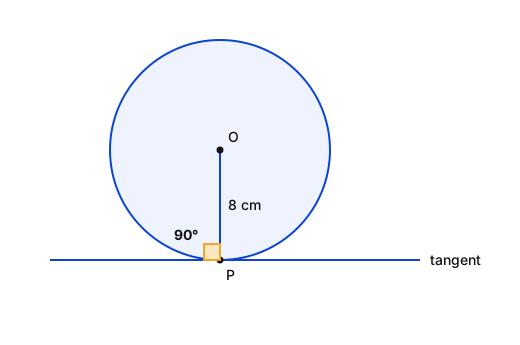
- Radius to the point of contact ⟂ tangent.
- Angle = 90°, whatever the radius (8 cm is extra data).
Yaad rakhein: Two tangents from an external point are equal in length.
Answer: (C) 90°
अवधारणा: किसी बिंदु पर स्पर्शरेखा उस बिंदु की त्रिज्या पर लंब होती है।
- स्पर्श बिंदु की त्रिज्या ⟂ स्पर्शरेखा।
- कोण = 90°; 8 cm अनावश्यक जानकारी है।
याद रखें: बाहरी बिंदु से खींची दोनों स्पर्शरेखाएँ बराबर होती हैं।
उत्तर: (C) 90°
SSC CGLQuantitative AptitudeTangent–radius angleSSC CGL 2025 · 26 Sep Shift 2
Q126.If the radius of a cylinder is doubled, what happens to its volume (assuming the height remains constant)?
यदि किसी बेलन की त्रिज्या दोगुनी कर दी जाए (ऊँचाई अपरिवर्तित रहे), तो उसके आयतन का क्या होगा?
- AVolume is halvedआयतन आधा हो जाएगा
- BVolume is doubledआयतन दोगुना हो जाएगा
- CVolume becomes four timesआयतन चार गुना हो जाएगा
- DVolume remains the sameआयतन अपरिवर्तित रहेगा
Show answer
Concept: , so with fixed height .
- New radius = 2r → new .
- Ratio new : old = 4 : 1.
Trick: Volume follows the square of the radius: ×2 radius → ×4 volume; ×3 radius → ×9 volume.
Answer: (C) Volume becomes four times
अवधारणा: , ऊँचाई स्थिर हो तो ।
- नई त्रिज्या = 2r → नया ।
- नया : पुराना = 4 : 1।
ट्रिक: त्रिज्या ×2 → आयतन ×4; त्रिज्या ×3 → आयतन ×9 (वर्ग के अनुपात में)।
उत्तर: (C) आयतन चार गुना हो जाएगा
SSC CGLQuantitative AptitudeCylinder – effect of radius on volumeSSC CGL 2025 · 26 Sep Shift 1
Q127.What is the least square number that is divisible by 6, 9 and 15?
वह छोटी से छोटी वर्ग संख्या कौन-सी है जो 6, 9 और 15 से विभाज्य हो?
- A1800
- B900
- C400
- D1600
Show answer
Concept: Take the LCM, then multiply by primes having odd powers.
- LCM of 6, 9, 15 =
- 2 and 5 have odd powers → multiply by
- Least square =
Trick: Check options from smallest: 400 is not divisible by 9; ✓ and 900 is a square.
Answer: (B) 900
अवधारणा: पहले LCM लें, फिर विषम घात वाले अभाज्य से गुणा करें।
- 6, 9, 15 का LCM =
- 2 और 5 की घात विषम → से गुणा
- सबसे छोटा वर्ग =
ट्रिक: छोटे विकल्प से जाँचें: 400, 9 से विभाज्य नहीं; ✓ और 900 पूर्ण वर्ग है।
उत्तर: (B) 900
SSC CGLQuantitative AptitudeLCM – least perfect square multipleSSC CGL 2025 · 26 Sep Shift 1
Q128.If the amount is ₹700 and the principal is ₹500, compounded yearly for 1 year, calculate the rate of interest.
यदि राशि ₹700 और मूलधन ₹500 है, तथा ब्याज 1 वर्ष के लिए वार्षिक रूप से संयोजित है, तो ब्याज दर ज्ञात कीजिए।
- A40%
- B35%
- C33.33%
- D25%
Show answer
Concept: For one year compounded yearly, CI = SI, so .
- Interest = ₹700 − ₹500 = ₹200
- Rate =
Trick: Amount/Principal = → growth of 0.4 = 40% in one year.
Answer: (A) 40%
अवधारणा: वार्षिक चक्रवृद्धि में 1 वर्ष का CI = SI, अतः R = (ब्याज/मूलधन) × 100।
- ब्याज = ₹700 − ₹500 = ₹200
- दर =
ट्रिक: मिश्रधन/मूलधन = → एक वर्ष में 0.4 यानी 40% वृद्धि।
उत्तर: (A) 40%
SSC CGLQuantitative AptitudeCompound interest – one year rateSSC CGL 2025 · 26 Sep Shift 1
Q129.If P = ₹2,500, R = 11.5% and T = 2.5 years, find the simple interest.
यदि P = ₹2,500, R = 11.5% और T = 2.5 वर्ष है, तो साधारण ब्याज ज्ञात कीजिए।
- A₹775
- B₹715
- C₹718.75
- D₹700.75
Show answer
Concept: .
- Rate for 2.5 years =
- SI = 28.75% of ₹2,500 = ₹718.75
Trick: Combine first (total %), then take that % of P – 1% of 2500 is 25, so .
Answer: (C) ₹718.75
अवधारणा: ।
- 2.5 वर्ष की कुल दर =
- SI = ₹2,500 का 28.75% = ₹718.75
ट्रिक: पहले (कुल %) निकालें, फिर P का उतना %: 2500 का 1% = 25, अतः ।
उत्तर: (C) ₹718.75
SSC CGLQuantitative AptitudeSimple interest – formulaSSC CGL 2025 · 26 Sep Shift 1
Q130.A person crosses a 600 m long street in 8 minutes. What is his speed in km per hour?
एक व्यक्ति 600 मीटर लंबी सड़क 8 मिनट में पार करता है। उसकी चाल किलोमीटर प्रति घंटा में क्या है?
- A7.3 km/h
- B4.5 km/h
- C6 km/h
- D5.4 km/h
Show answer
Concept: Speed in m/s = speed in km/h.
- Time = 8 min = 480 s
- Speed = m/s
- km/h
Trick: Metres per minute = km/h: m/min → .
Answer: (B) 4.5 km/h
अवधारणा: m/s में चाल = km/h में चाल।
- समय = 8 मिनट = 480 s
- चाल = m/s
- km/h
ट्रिक: मीटर/मिनट = km/h: m/min → ।
उत्तर: (B) 4.5 km/h
SSC CGLQuantitative AptitudeSpeed – unit conversionSSC CGL 2025 · 26 Sep Shift 1
Q131.A hollow rectangular parallelepiped has external dimensions 8 cm × 6 cm × 5 cm and a thickness of 0.5 cm. Find the volume of the material in it.
एक खोखले आयताकार समांतर षट्फलक की बाहरी विमाएँ 8 cm × 6 cm × 5 cm और मोटाई 0.5 cm है। उसमें प्रयुक्त सामग्री का आयतन ज्ञात कीजिए।
- A100 cm³
- B120 cm³
- C160 cm³
- D240 cm³
Show answer
Concept: Material volume = outer volume − inner volume; each inner side = outer side − 2 × thickness.
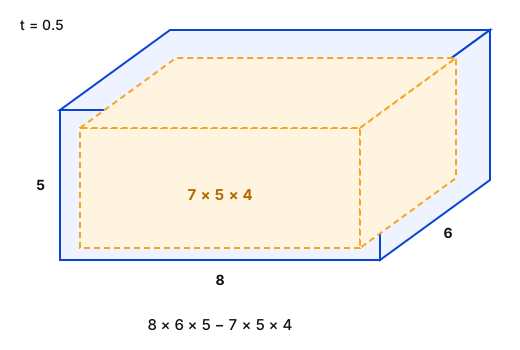
- Outer: cm³
- Inner sides: → cm³
- Material = cm³
Trick: Thickness is on both walls, so subtract 2t (here 1 cm) from every dimension – not just t.
Answer: (A) 100 cm³
अवधारणा: पदार्थ का आयतन = बाहरी आयतन − आंतरिक आयतन; हर आंतरिक भुजा = बाहरी − 2 × मोटाई।
- बाहरी: cm³
- आंतरिक भुजाएँ: → cm³
- पदार्थ = cm³
ट्रिक: मोटाई दोनों दीवारों पर होती है, इसलिए हर माप से 2t (यहाँ 1 cm) घटाएँ, केवल t नहीं।
उत्तर: (A) 100 cm³
SSC CGLQuantitative AptitudeMensuration – hollow cuboidSSC CGL 2025 · 26 Sep Shift 1
Q132.A sector of radius 7 cm has an area of 38.5 cm². Find the angle of the sector.
7 cm त्रिज्या वाले एक त्रिज्यखंड का क्षेत्रफल 38.5 cm² है। त्रिज्यखंड का कोण ज्ञात कीजिए।
- A90°
- B60°
- C30°
- D75°
Show answer
Concept: Sector area = .
- Full circle area = cm²
- Fraction =
Trick: – the sector is a quarter-circle, so the angle is a right angle.
Answer: (A) 90°
अवधारणा: त्रिज्यखंड क्षेत्रफल = ।
- पूरे वृत्त का क्षेत्रफल = cm²
- भाग =
ट्रिक: – यह चौथाई वृत्त है, अतः कोण 90°।
उत्तर: (A) 90°
SSC CGLQuantitative AptitudeCircle – sector angle from areaSSC CGL 2025 · 26 Sep Shift 1
Q133.The difference between 30% of a number and 15% of the same number is 90. What is the number?
किसी संख्या के 30% और उसी संख्या के 15% का अंतर 90 है। संख्या क्या है?
- A600
- B800
- C1000
- D1200
Show answer
Concept: Difference of percentages of the same number = (difference %) of that number.
- = 15% of the number = 90
Trick: Find 1% first, then scale to 100% – avoids fractions.
Answer: (A) 600
अवधारणा: एक ही संख्या के दो प्रतिशतों का अंतर = संख्या का (अंतर)%।
- = संख्या का 15% = 90
ट्रिक: पहले 1% निकालें, फिर 100% – भिन्न की ज़रूरत नहीं।
उत्तर: (A) 600
SSC CGLQuantitative AptitudePercentage – difference of two percentsSSC CGL 2025 · 26 Sep Shift 1
Q134.The average age of 5 students in a class increases by 2 years when a 40-year-old teacher joins them. What was the original average age of the students?
एक कक्षा के 5 विद्यार्थियों की औसत आयु 40 वर्ष के शिक्षक के जुड़ने पर 2 वर्ष बढ़ जाती है। विद्यार्थियों की मूल औसत आयु क्या थी?
- A24
- B26
- C28
- D30
Show answer
Concept: New member's age = old average + (new count × increase).
- Let old average = a. Teacher =
- years
Trick: Teacher gives 2 extra years to each of 6 people (12 years) beyond the old average: .
Answer: (C) 28
अवधारणा: नए सदस्य की आयु = पुराना औसत + (नई संख्या × वृद्धि)।
- माना पुराना औसत = a। शिक्षक =
- वर्ष
ट्रिक: शिक्षक ने 6 लोगों में हर एक को 2 वर्ष दिए (कुल 12): ।
उत्तर: (C) 28
SSC CGLQuantitative AptitudeAverage – new member joinsSSC CGL 2025 · 26 Sep Shift 1
Q135.A buyer gets two successive discounts of 20% and 10% on a ₹800 item. What is the price paid?
एक खरीदार को ₹800 की वस्तु पर 20% और 10% की दो क्रमिक छूट मिलती है। उसे कितना देना होगा?
- A₹500
- B₹420
- C₹540
- D₹576
Show answer
Concept: Two discounts a% and b% equal a single discount of .
- Net discount =
- Price paid = 72% of ₹800 = ₹576
Trick: Multiply the 'pay' parts: → .
Answer: (D) ₹576
अवधारणा: a% और b% की दो छूट = एकल छूट ।
- कुल छूट =
- भुगतान = ₹800 का 72% = ₹576
ट्रिक: 'देय' भाग गुणा करें: → ।
उत्तर: (D) ₹576
SSC CGLQuantitative AptitudeSuccessive discountsSSC CGL 2025 · 26 Sep Shift 1
Q136.A container has 100 litres of a mixture of acid and water in the ratio 3 : 2. 10% of the mixture is taken out and replaced with water. This operation is repeated once more. What is the final percentage of acid in the mixture?
एक पात्र में 100 लीटर अम्ल-जल मिश्रण 3 : 2 के अनुपात में है। मिश्रण का 10% निकालकर उतना पानी मिलाया जाता है। यह क्रिया एक बार और दोहराई जाती है। अंत में अम्ल का प्रतिशत क्या होगा?
- A54.8%
- B41.2%
- C43.7%
- D48.6%
Show answer
Concept: After n replacements, remaining acid = initial acid .
- Initial acid = of 100 L = 60 L
- Each operation keeps 90% of the acid: L
- Volume stays 100 L → acid = 48.6%
Trick: Acid % directly: – no need to track litres.
Answer: (D) 48.6%
अवधारणा: n बार प्रतिस्थापन के बाद बचा अम्ल = आरंभिक अम्ल ।
- आरंभिक अम्ल = 100 L का = 60 L
- हर बार 90% अम्ल बचता है: L
- कुल आयतन 100 L ही रहता है → अम्ल = 48.6%
ट्रिक: सीधे प्रतिशत में: – लीटर गिनने की ज़रूरत नहीं।
उत्तर: (D) 48.6%
SSC CGLQuantitative AptitudeMixture – repeated replacementSSC CGL 2025 · 26 Sep Shift 1
Q137.The efficiencies of Ashish, Navin and Harish are in the ratio 2 : 3 : 5. Ashish alone can complete the work in 40 days. All three worked together for 5 days and then Harish left. In how many days can Ashish and Navin together complete the remaining work?
आशीष, नवीन और हरीश की कार्यक्षमताएँ 2 : 3 : 5 के अनुपात में हैं। आशीष अकेला कार्य 40 दिन में पूरा करता है। तीनों ने 5 दिन साथ काम किया, फिर हरीश चला गया। शेष कार्य आशीष और नवीन मिलकर कितने दिनों में पूरा करेंगे?
- A4 days4 दिन
- B12 days12 दिन
- C8 days8 दिन
- D6 days6 दिन
Show answer
Concept: Total work = efficiency × days; use efficiencies as units per day.
- Ashish: 2 units/day for 40 days → total = 80 units
- All three: units/day → 5 days = 50 units; left = 30
- Ashish + Navin: 5 units/day → days
Trick: Take the efficiency ratio itself as daily units – the whole problem becomes simple division.
Answer: (D) 6 days
अवधारणा: कुल कार्य = दक्षता × दिन; दक्षता को प्रतिदिन की इकाइयाँ मानें।
- आशीष: 2 इकाई/दिन × 40 दिन → कुल = 80 इकाई
- तीनों: इकाई/दिन → 5 दिन में 50; बचा = 30
- आशीष + नवीन: 5 इकाई/दिन → दिन
ट्रिक: दक्षता अनुपात को ही प्रतिदिन का काम मान लें – पूरा प्रश्न सीधे भाग से हल।
उत्तर: (D) 6 दिन
SSC CGLQuantitative AptitudeTime and work – efficiency ratioSSC CGL 2025 · 26 Sep Shift 1
Q138.A triangular prism has base side lengths 3 cm, 4 cm and 5 cm and height 8 cm. What is its lateral surface area?
एक त्रिभुजाकार प्रिज़्म के आधार की भुजाएँ 3 cm, 4 cm और 5 cm तथा ऊँचाई 8 cm है। उसका पार्श्व पृष्ठीय क्षेत्रफल क्या है?
- A84 cm²
- B90 cm²
- C96 cm²
- D100 cm²
Show answer
Concept: Lateral surface area of a prism = base perimeter × height.
- Base perimeter = cm
- LSA = cm²
Trick: Lateral faces are three rectangles: . Base area (6 cm² each) is not included.
Answer: (C) 96 cm²
अवधारणा: प्रिज़्म का पार्श्व पृष्ठीय क्षेत्रफल = आधार परिमाप × ऊँचाई।
- आधार परिमाप = cm
- LSA = cm²
ट्रिक: तीन आयताकार फलक: ; आधार (6 cm² प्रत्येक) नहीं जोड़ते।
उत्तर: (C) 96 cm²
SSC CGLQuantitative AptitudePrism – lateral surface areaSSC CGL 2025 · 26 Sep Shift 1
Q139.A cone of radius 6 cm and height 9 cm is cut into two parts by a plane parallel to its base, at a height of 6 cm from the vertex. Find the volume of the frustum formed.
6 cm त्रिज्या और 9 cm ऊँचाई वाले शंकु को आधार के समांतर तल द्वारा शीर्ष से 6 cm की ऊँचाई पर दो भागों में काटा जाता है। बने छिन्नक का आयतन ज्ञात कीजिए।
- A43π cm³
- B76π cm³
- C68π cm³
- D72π cm³
Show answer
Concept: Frustum volume = big cone − small (similar) cone cut from the top.
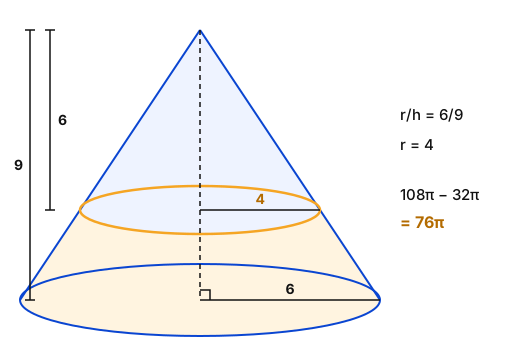
- Similar cones: r/h same → small cone radius = cm, height 6 cm
- Big cone = ; small cone =
- Frustum = cm³
Trick: Volumes of similar cones scale as : → frustum = .
Answer: (B) 76π cm³
अवधारणा: छिन्नक का आयतन = बड़ा शंकु − ऊपर से कटा छोटा (समरूप) शंकु।
- समरूप शंकु: छोटे की त्रिज्या = cm, ऊँचाई 6 cm
- बड़ा शंकु = ; छोटा =
- छिन्नक = cm³
ट्रिक: समरूप शंकुओं के आयतन में: → छिन्नक = ।
उत्तर: (B) 76π cm³
SSC CGLQuantitative AptitudeFrustum of a coneSSC CGL 2025 · 26 Sep Shift 1
Q140.If 4 tanA = 3, then find the value of (3 sinA − 4 cosA).
यदि 4 tanA = 3 है, तो (3 sinA − 4 cosA) का मान ज्ञात कीजिए।
- A−
- B−
- C
- D
Show answer
Concept: ; complete the triangle with Pythagoras.
- → sides 3, 4, hypotenuse 5
- ,
Trick: Divide by : .
Answer: (A) −
अवधारणा: ; पाइथागोरस से त्रिभुज पूरा करें।
- → भुजाएँ 3, 4, कर्ण 5
- ,
ट्रिक: बाहर निकालें: ।
उत्तर: (A) −
SSC CGLQuantitative AptitudeTrigonometry – ratios from tanSSC CGL 2025 · 26 Sep Shift 1

