Q161.Read the following statements carefully and identify the conclusion that follows.
Statements:
All doctors are skilled.
No skilled person is allowed.
Conclusions:
I. All doctors are allowed.
II. Some skilled are allowed.
निम्न कथनों को ध्यानपूर्वक पढ़कर अनुसरण करने वाला निष्कर्ष पहचानिए।
कथन:
सभी डॉक्टर कुशल हैं।
कोई कुशल व्यक्ति अनुमत नहीं है।
निष्कर्ष:
I. सभी डॉक्टर अनुमत हैं।
II. कुछ कुशल अनुमत हैं।
- AOnly I followsकेवल I अनुसरण करता है
- BOnly II followsकेवल II अनुसरण करता है
- CBoth I and II followI और II दोनों अनुसरण करते हैं
- DNeither I nor II followsन I न II अनुसरण करता है
Show answer
Concept: All A are B + No B is C ⇒ No A is C.
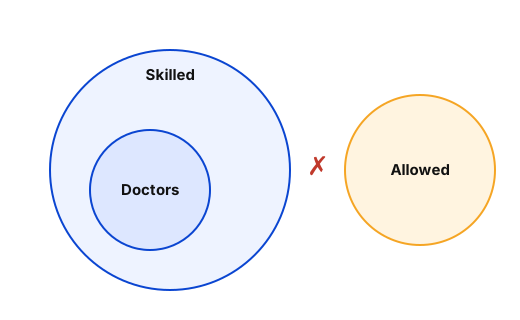
- All doctors are skilled; no skilled is allowed ⇒ no doctor is allowed.
- I (All doctors are allowed) contradicts this ✗.
- II (Some skilled are allowed) contradicts 'No skilled is allowed' ✗.
Trick: A conclusion that directly opposes a definite 'No' statement can never follow.
Answer: (D) Neither I nor II follows
अवधारणा: All A are B + No B is C ⇒ No A is C।
- सभी डॉक्टर कुशल हैं; कोई कुशल अनुमत नहीं ⇒ कोई डॉक्टर अनुमत नहीं।
- I (सभी डॉक्टर अनुमत) इसके उलट है ✗।
- II (कुछ कुशल अनुमत) 'कोई कुशल अनुमत नहीं' के उलट है ✗।
ट्रिक: जो निष्कर्ष किसी निश्चित 'No' कथन का सीधा विरोध करे, वह कभी अनुसरण नहीं करता।
उत्तर: (D) न I न II अनुसरण करता है
SSC CGLGeneral Intelligence & ReasoningSyllogism – All + NoSSC CGL 2025 · 25 Sep Shift 3
Q162.Read the following statements carefully and identify the conclusion that follows.
Statements:
All books are paper.
Some papers are red.
No red is wood.
Conclusions:
I. Some books are not wood.
II. All wood are paper.
निम्न कथनों को ध्यानपूर्वक पढ़कर अनुसरण करने वाला निष्कर्ष पहचानिए।
कथन:
सभी पुस्तकें काग़ज़ हैं।
कुछ काग़ज़ लाल हैं।
कोई लाल लकड़ी नहीं है।
निष्कर्ष:
I. कुछ पुस्तकें लकड़ी नहीं हैं।
II. सभी लकड़ी काग़ज़ हैं।
- AOnly I followsकेवल I अनुसरण करता है
- BOnly II followsकेवल II अनुसरण करता है
- CBoth I and II followI और II दोनों अनुसरण करते हैं
- DNeither I nor II followsन I न II अनुसरण करता है
Show answer
Concept: A conclusion follows only if it is true in every possible diagram.
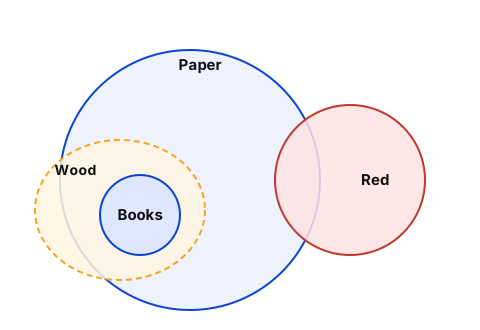
- Books ⊂ Paper; red overlaps only some paper; red and wood are separate.
- Books and wood have no direct link – books can be fully inside wood (if they don't touch red). So I is not certain ✗.
- Nothing relates wood to paper, so II is not certain ✗.
Trick: Draw one 'worst case' diagram: put all books inside wood – if a conclusion breaks, reject it.
Answer: (D) Neither I nor II follows
अवधारणा: निष्कर्ष तभी सही है जब हर संभव आरेख में सत्य हो।
- Books ⊂ Paper; red केवल कुछ paper से जुड़ा है; red और wood अलग हैं।
- Books और wood का कोई सीधा संबंध नहीं – सभी books, wood के अंदर भी हो सकती हैं। अतः I निश्चित नहीं ✗।
- Wood और paper का कोई संबंध नहीं दिया, अतः II भी निश्चित नहीं ✗।
ट्रिक: एक 'उल्टा' आरेख बनाएँ: सभी books को wood के अंदर रखें – निष्कर्ष टूटे तो वह गलत।
उत्तर: (D) न I न II अनुसरण करता है
SSC CGLGeneral Intelligence & ReasoningSyllogism – possibility checkSSC CGL 2025 · 25 Sep Shift 3
Q163.If "RAMAN" = "QZLZM", then "BHABHA" = ?
यदि "RAMAN" = "QZLZM" है, तो "BHABHA" = ?
- AAGZAGZ
- BCIBIBI
- CAGZAAG
- DZGYZGY
Show answer
Concept: Each letter is replaced by the letter just before it (A → Z).
- RAMAN → QZLZM: R→Q, A→Z, M→L, N→M ✓.
- BHABHA: B→A, H→G, A→Z, repeated → AGZAGZ.
Trick: BHABHA is 'BHA' twice, so its code must also repeat in two equal halves – only (A) and (D) do; (D) starts with Z ✗.
Answer: (A) AGZAGZ
अवधारणा: हर अक्षर को उससे ठीक पहले वाले अक्षर से बदला गया है (A → Z)।
- RAMAN → QZLZM: R→Q, A→Z, M→L, N→M ✓।
- BHABHA: B→A, H→G, A→Z, दोबारा वही → AGZAGZ।
ट्रिक: BHABHA में 'BHA' दो बार है, तो कोड भी दो बराबर हिस्सों में दोहराएगा – (A) और (D); (D) Z से शुरू है ✗।
उत्तर: (A) AGZAGZ
SSC CGLGeneral Intelligence & ReasoningLetter coding – each letter −1SSC CGL 2025 · 25 Sep Shift 3
Q164.Which pair does NOT belong to the following sequence?
D7, F9, H11, J13, L17
निम्न शृंखला में कौन-सा युग्म नहीं आता?
D7, F9, H11, J13, L17
- AJ7
- BD9
- CF11
- DL17
Show answer
Concept: Both letters and numbers rise by a fixed step; spot the term breaking it.
- Letters: D, F, H, J, L (+2 each) ✓.
- Numbers: 7, 9, 11, 13 (+2 each) → next should be 15.
- L17 breaks the pattern (should be L15).
Trick: Just read the number gaps: 2, 2, 2, then 4 – the last term is the misfit.
Answer: (D) L17
अवधारणा: अक्षर और संख्याएँ दोनों एक तय अंतर से बढ़ती हैं; जो पद नियम तोड़े वही गलत।
- अक्षर: D, F, H, J, L (+2) ✓।
- संख्याएँ: 7, 9, 11, 13 (+2) → अगली 15 होनी चाहिए।
- L17 नियम तोड़ता है (सही L15)।
ट्रिक: केवल अंतर देखें: 2, 2, 2, फिर 4 – आखिरी पद गड़बड़ है।
उत्तर: (D) L17
SSC CGLGeneral Intelligence & ReasoningLetter–number series – wrong termSSC CGL 2025 · 25 Sep Shift 3
Q165.Complete the series.
8, 27, 64, ?
शृंखला पूरी कीजिए।
8, 27, 64, ?
- A125
- B100
- C144
- D169
Show answer
Concept: Terms are cubes of consecutive natural numbers.
- , , .
- Next = .
Yaad rakhein: Remember cubes 1–10: 1, 8, 27, 64, 125, 216, 343, 512, 729, 1000.
Answer: (A) 125
अवधारणा: पद क्रमागत प्राकृत संख्याओं के घन हैं।
- , , ।
- अगला = ।
याद रखें: 1 से 10 तक घन: 1, 8, 27, 64, 125, 216, 343, 512, 729, 1000।
उत्तर: (A) 125
SSC CGLGeneral Intelligence & ReasoningNumber series – cubesSSC CGL 2025 · 25 Sep Shift 3
Q166.Find the ODD one out.
Ganga, Godavari, Krishna, Nile, Yamuna
असंगत चुनिए।
गंगा, गोदावरी, कृष्णा, नील, यमुना
- AGangaगंगा
- BGodavariगोदावरी
- CNileनील
- DKrishnaकृष्णा
Show answer
Concept: Classify the rivers by country/continent.
- Ganga, Godavari, Krishna, Yamuna are Indian rivers.
- Nile flows in Africa (into the Mediterranean Sea) – odd one.
Yaad rakhein: Nile is generally regarded as the world's longest river.
Answer: (C) Nile
अवधारणा: नदियों को देश/महाद्वीप के आधार पर बाँटें।
- गंगा, गोदावरी, कृष्णा, यमुना भारत की नदियाँ हैं।
- नील नदी अफ्रीका में बहती है (भूमध्य सागर में गिरती है) – यही अलग है।
याद रखें: नील को सामान्यतः विश्व की सबसे लंबी नदी माना जाता है।
उत्तर: (C) नील
SSC CGLGeneral Intelligence & ReasoningOdd one out – riversSSC CGL 2025 · 25 Sep Shift 3
Q167.What comes next?
CY, EX, GW, IV, ?
आगे क्या आएगा?
CY, EX, GW, IV, ?
- AKT
- BLU
- CLS
- DKU
Show answer
Concept: Track first and second letters separately.
- First letters: C, E, G, I (+2) → K.
- Second letters: Y, X, W, V (−1) → U.
- Next pair = KU.
Trick: Once the first letter is K, only (A) and (D) remain; V − 1 = U picks (D).
Answer: (D) KU
अवधारणा: पहले और दूसरे अक्षर अलग-अलग देखें।
- पहले अक्षर: C, E, G, I (+2) → K।
- दूसरे अक्षर: Y, X, W, V (−1) → U।
- अगला युग्म = KU।
ट्रिक: पहला अक्षर K होने से (A) और (D) बचते हैं; V − 1 = U से (D)।
उत्तर: (D) KU
SSC CGLGeneral Intelligence & ReasoningLetter pair seriesSSC CGL 2025 · 25 Sep Shift 3
Q168.What should come at the place of the question mark?
15, 18, 36, 39, 78, ?
प्रश्न चिह्न के स्थान पर क्या आना चाहिए?
15, 18, 36, 39, 78, ?
- A81
- B161
- C164
- D82
Show answer
Concept: Two operations repeat alternately.
- Check the steps: , , , .
- So the pattern is +3, ×2, +3, ×2 …
- Next comes +3: .
Trick: Small jumps (+3) and doubling jumps alternate – after a doubling comes +3.
Answer: (A) 81
अवधारणा: दो संक्रियाएँ बारी-बारी दोहराई जाती हैं।
- अंतर/अनुपात देखें: , , , ।
- नियम: +3, ×2, +3, ×2 …
- अब +3 की बारी: ।
ट्रिक: छोटी छलांग (+3) और दोगुनी छलांग बारी-बारी – दोगुने के बाद +3 आता है।
उत्तर: (A) 81
SSC CGLGeneral Intelligence & ReasoningNumber series – alternate +3, ×2SSC CGL 2025 · 25 Sep Shift 3
Q169.An amount of ₹8,000 is invested at a compound interest rate of 10% per annum for a period of 2 years. What will be the total amount (principal + interest) received at the end of the 2-year period?
₹8,000 की राशि 10% वार्षिक चक्रवृद्धि ब्याज पर 2 वर्ष के लिए निवेश की जाती है। 2 वर्ष बाद कुल राशि (मूलधन + ब्याज) कितनी मिलेगी?
- A₹9,680
- B₹9,780
- C₹10,000
- D₹9,726
Show answer
Concept: .
- .
- ₹9,680.
Trick: 10% for 2 years = 21% effective: of .
Answer: (A) ₹9,680
अवधारणा: ।
- ।
- ₹9,680।
ट्रिक: 10% पर 2 वर्ष = 21% प्रभावी: ।
उत्तर: (A) ₹9,680
SSC CGLGeneral Intelligence & ReasoningCompound interest – amountSSC CGL 2025 · 25 Sep Shift 3
Q170.If BRAVE is coded as ASBWD, how is FIGHT coded?
यदि BRAVE का कूट ASBWD है, तो FIGHT का कूट क्या होगा?
- AEJGIS
- BEJHJS
- CEJHIS
- DFKIGS
Show answer
Concept: Find the shift of each position from BRAVE → ASBWD.
- B→A (−1), R→S (+1), A→B (+1), V→W (+1), E→D (−1).
- Pattern: −1, +1, +1, +1, −1.
- FIGHT: F→E, I→J, G→H, H→I, T→S = EJHIS.
Trick: End letters −1, middle three +1. The 4th letter H+1 = I separates (C) from (B).
Answer: (C) EJHIS
अवधारणा: BRAVE → ASBWD में हर स्थान का खिसकाव देखें।
- B→A (−1), R→S (+1), A→B (+1), V→W (+1), E→D (−1)।
- नियम: −1, +1, +1, +1, −1।
- FIGHT: F→E, I→J, G→H, H→I, T→S = EJHIS।
ट्रिक: किनारे वाले अक्षर −1, बीच के तीन +1। चौथा अक्षर H+1 = I, (B) और (C) में अंतर करता है।
उत्तर: (C) EJHIS
SSC CGLGeneral Intelligence & ReasoningLetter coding – position-wise shiftSSC CGL 2025 · 25 Sep Shift 3
Q171.A number is divisible by both 3 and 7. Which of the following could it be?
कोई संख्या 3 और 7 दोनों से विभाज्य है। निम्न में से वह कौन-सी हो सकती है?
- A36
- B42
- C49
- D50
Show answer
Concept: Divisible by both 3 and 7 ⇒ divisible by their LCM 21.
- Multiples of 21: 21, 42, 63 …
- ✓; 36, 49, 50 are not multiples of 21.
Trick: Co-prime divisors: just check divisibility by their product.
Answer: (B) 42
अवधारणा: 3 और 7 दोनों से विभाज्य ⇒ LCM 21 से विभाज्य।
- 21 के गुणज: 21, 42, 63 …
- ✓; 36, 49, 50 21 के गुणज नहीं।
ट्रिक: सह-अभाज्य भाजकों के लिए उनके गुणनफल से भाग जाँचें।
उत्तर: (B) 42
SSC CGLGeneral Intelligence & ReasoningDivisibility by 3 and 7SSC CGL 2025 · 25 Sep Shift 3
Q172.If "COUNTRY" is coded as 3-15-21-14-20-18-25, how will "YURCTNO" be coded?
यदि "COUNTRY" का कूट 3-15-21-14-20-18-25 है, तो "YURCTNO" का कूट क्या होगा?
- A25-21-18-3-20-14-15
- B3-15-21-14-20-18-25
- C25-18-21-3-14-20-15
- D15-14-20-3-18-21-25
Show answer
Concept: Each letter is coded by its place in the alphabet.
- From COUNTRY: C(3), O(15), U(21), N(14), T(20), R(18), Y(25) – each is the alphabet place value.
- YURCTNO uses the same letters, just rearranged; write their values in the new order.
- Result: 25-21-18-3-20-14-15.
Trick: Only (A) and (C) start with 25; second letter U = 21 selects (A).
Answer: (A) 25-21-18-3-20-14-15
अवधारणा: हर अक्षर को उसके वर्णमाला क्रमांक से लिखा गया है।
- COUNTRY से: C(3), O(15), U(21), N(14), T(20), R(18), Y(25) – हर संख्या अक्षर का क्रमांक है।
- YURCTNO में वही अक्षर नए क्रम में हैं; उनके मान उसी क्रम में लिखें।
- परिणाम: 25-21-18-3-20-14-15।
ट्रिक: 25 से शुरू केवल (A) और (C); दूसरा अक्षर U = 21 से (A)।
उत्तर: (A) 25-21-18-3-20-14-15
SSC CGLGeneral Intelligence & ReasoningCoding – alphabet positionsSSC CGL 2025 · 25 Sep Shift 3
Q173.Pointing to a photograph, Rohit said, "He is the only son of my father’s only daughter." How is the person in the photograph related to Rohit?
एक तस्वीर की ओर इशारा करते हुए रोहित ने कहा, "यह मेरे पिता की इकलौती पुत्री का इकलौता पुत्र है।" तस्वीर वाला व्यक्ति रोहित से किस प्रकार संबंधित है?
- ABrotherभाई
- BNephewभांजा
- CCousinचचेरा भाई
- DRohit himselfस्वयं रोहित
Show answer
Concept: Decode the statement from the end, step by step.
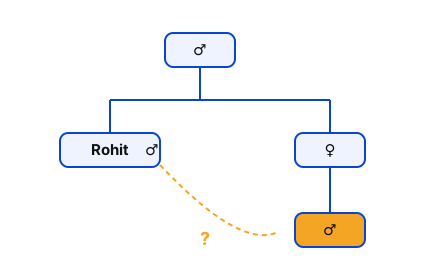
- Father's only daughter = Rohit's sister.
- Her only son = sister's son.
- Sister's son = nephew (भांजा).
Trick: 'My father's only daughter' (said by a male) is always his sister.
Answer: (B) Nephew
अवधारणा: कथन को पीछे से एक-एक कदम खोलें।
- पिता की इकलौती बेटी = रोहित की बहन।
- उसका इकलौता बेटा = बहन का बेटा।
- बहन का बेटा = भांजा (Nephew)।
ट्रिक: पुरुष कहे 'मेरे पिता की इकलौती बेटी' तो वह उसकी बहन ही है।
उत्तर: (B) भांजा
SSC CGLGeneral Intelligence & ReasoningBlood relation – photographSSC CGL 2025 · 25 Sep Shift 3
Q174.If NBSLFU is coded as MARKET, how is MARKET coded?
यदि NBSLFU का कूट MARKET है, तो MARKET का कूट क्या होगा?
- ALZQJDS
- BBNSLFU
- CCNULVF
- DMBSKDU
Show answer
Concept: NBSLFU → MARKET is a −1 shift; use the same rule to code MARKET.
- N→M, B→A, S→R, L→K, F→E, U→T (each −1).
- MARKET: M→L, A→Z, R→Q, K→J, E→D, T→S.
- Code = LZQJDS.
Trick: A → Z under −1; only (A) has Z in 2nd place.
Answer: (A) LZQJDS
अवधारणा: NBSLFU → MARKET में हर अक्षर −1 है; MARKET पर भी यही नियम लगाएँ।
- N→M, B→A, S→R, L→K, F→E, U→T (−1)।
- MARKET: M→L, A→Z, R→Q, K→J, E→D, T→S।
- कोड = LZQJDS।
ट्रिक: −1 में A → Z; दूसरे स्थान पर Z केवल (A) में है।
उत्तर: (A) LZQJDS
SSC CGLGeneral Intelligence & ReasoningLetter coding – reverse ruleSSC CGL 2025 · 25 Sep Shift 3
Q175.What comes next?
13, 17, 19, 23, 29, ?
आगे क्या आएगा?
13, 17, 19, 23, 29, ?
- A37
- B31
- C43
- D41
Show answer
Concept: Terms are consecutive prime numbers.
- 13, 17, 19, 23, 29 are primes in order.
- Next prime after 29 is 31.
Yaad rakhein: Primes between 1 and 50: 2, 3, 5, 7, 11, 13, 17, 19, 23, 29, 31, 37, 41, 43, 47 (15 primes).
Answer: (B) 31
अवधारणा: पद क्रमागत अभाज्य संख्याएँ हैं।
- 13, 17, 19, 23, 29 क्रम से अभाज्य हैं।
- 29 के बाद अगला अभाज्य 31 है।
याद रखें: 1 से 50 तक अभाज्य: 2, 3, 5, 7, 11, 13, 17, 19, 23, 29, 31, 37, 41, 43, 47 (कुल 15)।
उत्तर: (B) 31
SSC CGLGeneral Intelligence & ReasoningSeries – consecutive primesSSC CGL 2025 · 25 Sep Shift 3
Q176.A north-east development forum met in Lucknow on 10th April and in Bengaluru three days after. What was Bengaluru's date?
एक पूर्वोत्तर विकास मंच की बैठक लखनऊ में 10 अप्रैल को और बेंगलुरु में उसके तीन दिन बाद हुई। बेंगलुरु की तिथि क्या थी?
- A12th April12 अप्रैल
- B13th April13 अप्रैल
- C7th April7 अप्रैल
- D10th April10 अप्रैल
Show answer
Concept: A date 'n days after' is found by simply adding n to the day number (within the same month).
- Lucknow meeting: 10 April.
- Bengaluru meeting = 10 + 3 = 13 April (April has 30 days, so no month change).
Trick: 'After' means add, 'before' means subtract — just check the month does not overflow.
Answer: (B) 13th April
अवधारणा: किसी तारीख के 'n दिन बाद' की तारीख = दिन संख्या + n (महीना न बदले तो)।
हल:
- लखनऊ बैठक: 10 अप्रैल।
- बेंगलुरु बैठक = 10 + 3 = 13 अप्रैल (अप्रैल में 30 दिन, महीना नहीं बदलता)।
ट्रिक: 'बाद' = जोड़ें, 'पहले' = घटाएँ; बस महीने की अंतिम तारीख पर ध्यान दें।
उत्तर: (B) 13 अप्रैल
SSC CGLGeneral Intelligence & ReasoningCalendar – counting days forwardSSC CGL 2025 · 25 Sep Shift 2
Q177.Choose the address that is the same as the one given below.
203, Orchid Towers, Viman Nagar, Pune, Maharashtra - 411014
नीचे दिए गए पते के समान पता चुनिए।
203, Orchid Towers, Viman Nagar, Pune, Maharashtra - 411014
- A203, Orchid Tower, Viman Nagar, Pune, Maharashtra - 411014
- B203, Orchid Towers, Viman Nagar, Pune, Maharashtra - 411014
- C203, Orchid Towers, Viman Nagar, Puna, Maharashtra - 411014
- D203, Orchid Towers, Viman Nagar, Pune, Maharastra - 411014
Show answer
Concept: Compare the given address part by part (number, building, area, city, state, PIN) with each option.
- (A) 'Tower' – the final s is missing.
- (C) 'Puna' instead of Pune; (D) 'Maharastra' – letter h missing.
- (B) agrees with the original in every part.
Trick: Check the longest words first (state, building name) — spelling slips usually hide there.
Answer: (B) 203, Orchid Towers, Viman Nagar, Pune, Maharashtra - 411014
अवधारणा: दिए गए पते को हिस्सों में (नंबर, बिल्डिंग, क्षेत्र, शहर, राज्य, पिन) हर विकल्प से मिलाएँ।
हल:
- (A) में 'Tower' – अंत का s गायब।
- (C) में Pune की जगह 'Puna'; (D) में 'Maharastra' – h गायब।
- (B) हर हिस्से में मूल पते जैसा है।
ट्रिक: लंबे शब्द (राज्य, बिल्डिंग का नाम) पहले जाँचें — गलती अक्सर वहीं छिपी होती है।
उत्तर: (B) 203, Orchid Towers, Viman Nagar, Pune, Maharashtra - 411014
SSC CGLGeneral Intelligence & ReasoningAddress matching – spot the differenceSSC CGL 2025 · 25 Sep Shift 2
Q178.What should come in place of the question mark '?' in the following number series?
6, 0, −6, −12, ?, −24
निम्न संख्या शृंखला में प्रश्न चिह्न के स्थान पर क्या आना चाहिए?
6, 0, −6, −12, ?, −24
- A−16
- B−18
- C−21
- D−24
Show answer
Concept: When consecutive terms differ by the same amount, the series is an AP.
- Differences: , , .
- Missing term = .
- Check: ✓ (matches the last term).
Trick: Use the last given term to verify: the blank must sit exactly midway between −12 and −24, i.e. −18.
Answer: (B) −18
अवधारणा: जब लगातार पदों का अंतर एक-सा हो, तो श्रेणी AP होती है।
हल:
- अंतर: , , ।
- लुप्त पद = ।
- जाँच: ✓
ट्रिक: रिक्त स्थान −12 और −24 के ठीक बीच होगा: ।
उत्तर: (B) −18
SSC CGLGeneral Intelligence & ReasoningNumber series – constant differenceSSC CGL 2025 · 25 Sep Shift 2
Q179.If 4 * 3 = 19, 5 * 6 = 31 and 7 * 4 = 53, then 6 * 3 = ?
यदि 4 * 3 = 19, 5 * 6 = 31 और 7 * 4 = 53 है, तो 6 * 3 = ?
- A32
- B41
- C37
- D39
Show answer
Concept: Find one rule linking the two numbers that fits every example, then apply it.
- 4 * 3: ✓
- 5 * 6: ✓; 7 * 4: ✓ → rule is .
- 6 * 3 = .
Trick: Results 19, 31, 53 sit just above 16, 25, 49 (squares of the first numbers) — the gap is the second number.
Answer: (D) 39
अवधारणा: ऐसा एक नियम खोजें जो सभी उदाहरणों पर लागू हो, फिर उसे प्रश्न पर लगाएँ।
हल:
- 4 * 3: ✓
- 5 * 6: ✓; 7 * 4: ✓ → नियम: (पहली संख्या)² + दूसरी।
- 6 * 3 = ।
ट्रिक: 19, 31, 53 पहली संख्या के वर्ग (16, 25, 49) से थोड़ा बड़े हैं — अंतर ठीक दूसरी संख्या है।
उत्तर: (D) 39
SSC CGLGeneral Intelligence & ReasoningSymbol operation – a² + bSSC CGL 2025 · 25 Sep Shift 2
Q180.A statement is given followed by two conclusions. Find which conclusion is FALSE based on the given statement.
Statement: A ≥ E; B = C ≥ F; G ≥ C > D; E ≥ B
Conclusions:
I. G ≥ B
II. A > D
एक कथन और उसके बाद दो निष्कर्ष दिए गए हैं। बताइए कौन-सा निष्कर्ष असत्य है।
कथन: A ≥ E; B = C ≥ F; G ≥ C > D; E ≥ B
निष्कर्ष:
I. G ≥ B
II. A > D
- AEither I or IIया तो I या II
- BOnly Iकेवल I
- CNeither I nor IIन I न II
- DOnly IIकेवल II
Show answer
Concept: Join the statements into one chain; a conclusion is true only if the chain links the two letters in that direction.
- Chain: G ≥ C = B ≤ E ≤ A and C > D.
- I: G ≥ C = B ⇒ G ≥ B — true.
- II: A ≥ E ≥ B = C > D ⇒ A > D (one strict sign makes the result strict) — true.
- No conclusion is false.
Trick: Read the question word — here it asks for FALSE. Both are true, so the answer is 'Neither'.
Answer: (C) Neither I nor II
अवधारणा: सभी कथनों को एक श्रृंखला में जोड़ें; निष्कर्ष तभी सत्य है जब श्रृंखला दोनों अक्षरों को सही दिशा में जोड़े।
हल:
- श्रृंखला: A ≥ E ≥ B = C ≤ G तथा C > D।
- I: G ≥ C = B ⇒ G ≥ B — सत्य।
- II: A ≥ E ≥ B = C > D ⇒ A > D (एक भी '>' हो तो परिणाम '>') — सत्य।
- कोई भी निष्कर्ष असत्य नहीं।
ट्रिक: प्रश्न 'FALSE' पूछ रहा है — दोनों सत्य हैं, इसलिए उत्तर 'न तो I न II'।
उत्तर: (C) न I न II
SSC CGLGeneral Intelligence & ReasoningInequality – finding the false conclusionSSC CGL 2025 · 25 Sep Shift 2

