Q161.Due to an error, a shopkeeper increases the selling price of a ₹400 item by 12.5% instead of decreasing it by 12.5%. What is the percentage increase in the price due to this error?
एक भूल के कारण दुकानदार ₹400 की वस्तु का मूल्य 12.5% घटाने के बजाय 12.5% बढ़ा देता है। इस भूल से मूल्य में कितने प्रतिशत की वृद्धि हुई?
- A18.22%
- B24.22%
- C25.22%
- D28.57%
Show answer
Concept: Error % is measured on the correct (intended) price.
- Correct price = ₹350.
- Wrong price = ₹450.
- Error = .
Trick: Ratio of factors: (price itself is not needed).
Answer: (D) 28.57%
अवधारणा: त्रुटि % सही (इच्छित) मूल्य पर निकाली जाती है।
- सही मूल्य = ₹350।
- गलत मूल्य = ₹450।
- त्रुटि = ।
ट्रिक: गुणकों का अनुपात: (मूल्य की ज़रूरत नहीं)।
उत्तर: (D) 28.57%
SSC CGLQuantitative AptitudePercentage error – increase vs decreaseSSC CGL 2025 · 25 Sep Shift 3
Q162.A man buys 10 shirts for ₹5,000 and sells 8 of them for ₹4,900. If he discards the remaining 2 shirts, what is his overall gain or loss?
एक व्यक्ति 10 कमीज़ें ₹5,000 में खरीदता है और उनमें से 8 को ₹4,900 में बेच देता है। शेष 2 कमीज़ें वह फेंक देता है। उसे कुल कितना लाभ या हानि हुई?
- A₹100 loss₹100 हानि
- B₹50 loss₹50 हानि
- C₹100 profit₹100 लाभ
- D₹50 profit₹50 लाभ
Show answer
Concept: Overall result = total revenue − total cost.
- Cost of 10 shirts = ₹5,000.
- Revenue = ₹4,900 (the 2 discarded shirts earn nothing).
- Loss = 5,000 − 4,900 = ₹100.
Trick: Don't compute per-shirt prices; compare only the totals.
Answer: (A) ₹100 loss
अवधारणा: कुल परिणाम = कुल आय − कुल लागत।
- 10 शर्ट की लागत = ₹5,000।
- आय = ₹4,900 (फेंकी गई 2 शर्ट से कुछ नहीं)।
- हानि = 5,000 − 4,900 = ₹100।
ट्रिक: प्रति शर्ट भाव निकालने की ज़रूरत नहीं; केवल कुल राशियाँ मिलाएँ।
उत्तर: (A) ₹100 हानि
SSC CGLQuantitative AptitudeProfit & loss – unsold itemsSSC CGL 2025 · 25 Sep Shift 3
Q163.The average of 10 numbers is 64. If two of them are removed and the new average becomes 62, what is the average of the two removed numbers?
10 संख्याओं का औसत 64 है। यदि उनमें से दो हटा दी जाएँ और नया औसत 62 हो जाए, तो हटाई गई दो संख्याओं का औसत क्या है?
- A70
- B71
- C72
- D73
Show answer
Concept: Sum = average × count.
- Sum of 10 = 640; sum of 8 = 496.
- Removed sum = 144; average = .
Trick: Deviation method: 8 numbers each lost 2 ⇒ 16 extra; removed avg = .
Answer: (C) 72
अवधारणा: योग = औसत × संख्या।
- 10 का योग = 640; 8 का योग = 496।
- हटाई गई संख्याओं का योग = 144; औसत = 72।
ट्रिक: विचलन विधि: 8 संख्याओं में 2-2 की कमी = 16; हटाई गई का औसत = ।
उत्तर: (C) 72
SSC CGLQuantitative AptitudeAverage – numbers removedSSC CGL 2025 · 25 Sep Shift 3
Q164.A large storage box in the shape of a right prism with a square base is 2 m tall. If the box holds 720 L of water, what is the side of the base (in cm)?
वर्गाकार आधार वाले लंब प्रिज़्म के आकार का एक बड़ा भंडारण बक्सा 2 m ऊँचा है। यदि उसमें 720 लीटर पानी आता है, तो आधार की भुजा (cm में) कितनी है?
- A40 cm
- B45 cm
- C60 cm
- D50 cm
Show answer
Concept: ; volume = base area × height.
- ; height = 200 cm.
- Base area = .
- Side = cm.
Trick: In metres: gives base , whose root is 0.6 m – the same 60 cm.
Answer: (C) 60 cm
अवधारणा: ; आयतन = आधार क्षेत्रफल × ऊँचाई।
- ।
- आधार = ।
- भुजा = m cm।
ट्रिक: m में: → भुजा 0.6 m = 60 cm।
उत्तर: (C) 60 cm
SSC CGLQuantitative AptitudePrism – volume in litresSSC CGL 2025 · 25 Sep Shift 3
Q165.A departmental store marked up the price of an electronic gadget by 40% above its cost price. During a clearance sale it offered two successive discounts of 20% and 10%. If the final selling price was ₹2,520, what was the cost price of the gadget?
एक डिपार्टमेंटल स्टोर ने एक इलेक्ट्रॉनिक उपकरण का मूल्य क्रय मूल्य से 40% अधिक अंकित किया। क्लीयरेंस सेल में उसने 20% और 10% की दो क्रमिक छूट दीं। यदि अंतिम विक्रय मूल्य ₹2,520 था, तो उपकरण का क्रय मूल्य क्या था?
- A₹2,000
- B₹2,250
- C₹2,180
- D₹2,500
Show answer
Concept: SP = .
- Use fractions: .
- of ₹2,500.
Trick: Net effect is +0.8%, so CP is just below 2520 – check ✓.
Answer: (D) ₹2,500
अवधारणा: विक्रय मूल्य = ।
- भिन्न में: ।
- ₹2,500।
ट्रिक: कुल प्रभाव +0.8% है, तो CP 2520 से थोड़ा कम – ✓।
उत्तर: (D) ₹2,500
SSC CGLQuantitative AptitudeMarkup with successive discountsSSC CGL 2025 · 25 Sep Shift 3
Q166.A class of 50 students has an average score of 65. If 10 new students are added and the class average decreases by 1, what is the average score of the 10 new students?
50 विद्यार्थियों की एक कक्षा का औसत अंक 65 है। यदि 10 नए विद्यार्थी जुड़ जाएँ और कक्षा का औसत 1 घट जाए, तो नए 10 विद्यार्थियों का औसत अंक क्या है?
- A59
- B60
- C58
- D62
Show answer
Concept: Total = average × number; new total − old total = newcomers' sum.
- Old total = .
- New total = .
- New students' sum = 590; average = 59.
Trick: Deviation: new avg 64; old 50 each 1 above ⇒ +50 surplus, so newcomers avg = .
Answer: (A) 59
अवधारणा: योग = औसत × संख्या; नया योग − पुराना योग = नए छात्रों का योग।
- पुराना योग = ।
- नया योग = ।
- नए छात्रों का योग = 590; औसत = 59।
ट्रिक: विचलन: नया औसत 64; पुराने 50 छात्र 1-1 अधिक ⇒ +50; नए का औसत = ।
उत्तर: (A) 59
SSC CGLQuantitative AptitudeAverage – new students addedSSC CGL 2025 · 25 Sep Shift 3
Q167.If secA − cosA = 2, then find the value of cosA.
यदि secA − cosA = 2 है, तो cosA का मान ज्ञात कीजिए।
- A−1 +
- B3 +
- C + 2
- DNo real valueकोई वास्तविक मान नहीं
Show answer
Concept: Write and solve; keep .
- Let : .
- .
- is impossible, so .
Yaad rakhein: Reject any root outside – cos can never be below −1.
Answer: (A) −1 +
अवधारणा: लिखकर हल करें; रखें।
- : ।
- ।
- असंभव, अतः ।
याद रखें: जो मूल से बाहर हो उसे छोड़ दें – cos कभी −1 से कम नहीं होता।
उत्तर: (A) −1 +
SSC CGLQuantitative AptitudeTrigonometry – quadratic in cos ASSC CGL 2025 · 25 Sep Shift 3
Q168.If cosθ = − and θ lies in the 3rd quadrant, find sinθ.
यदि cosθ = − है और θ तीसरे चतुर्थांश में है, तो sinθ ज्ञात कीजिए।
- A−
- B
- C
- D−
Show answer
Concept: ; the quadrant decides the sign.
- 8, 15, 17 is a Pythagorean triplet ⇒ .
- In the 3rd quadrant sin and cos are both negative.
- .
Trick: ASTC (All–Sin–Tan–Cos): 3rd quadrant → only Tan (and cot) positive.
Answer: (A) −
अवधारणा: ; चिह्न चतुर्थांश से तय होता है।
- 8, 15, 17 पाइथागोरस त्रिक ⇒ ।
- तीसरे चतुर्थांश में sin और cos दोनों ऋणात्मक।
- ।
ट्रिक: ASTC (All–Sin–Tan–Cos): तीसरे चतुर्थांश में केवल tan (और cot) धनात्मक।
उत्तर: (A) −
SSC CGLQuantitative AptitudeTrigonometry – sign in 3rd quadrantSSC CGL 2025 · 25 Sep Shift 3
Q169.If an angle θ = 3 radians, what percentage of the full circle does it represent?
यदि कोण θ = 3 रेडियन है, तो वह पूरे वृत्त का कितना प्रतिशत है?
- A45.74%
- B47.74%
- C50.8%
- D46.83%
Show answer
Concept: Full circle = radians.
- Fraction = .
- Percentage ≈ 47.74%.
Trick: 1 radian ≈ 57.3°; 3 rad ≈ 171.9°, and .
Answer: (B) 47.74%
अवधारणा: पूरा वृत्त = रेडियन।
- भाग = ।
- प्रतिशत ≈ 47.74%।
ट्रिक: 1 रेडियन ≈ 57.3°; 3 रेडियन ≈ 171.9°, और ।
उत्तर: (B) 47.74%
SSC CGLQuantitative AptitudeRadian measure – fraction of circleSSC CGL 2025 · 25 Sep Shift 3
Q170.If cosθ = and θ is acute, then find the value of cotθ × tan(90° − θ).
यदि cosθ = है और θ न्यून कोण है, तो cotθ × tan(90° − θ) का मान ज्ञात कीजिए।
- A1
- B
- C
- D
Show answer
Concept: .
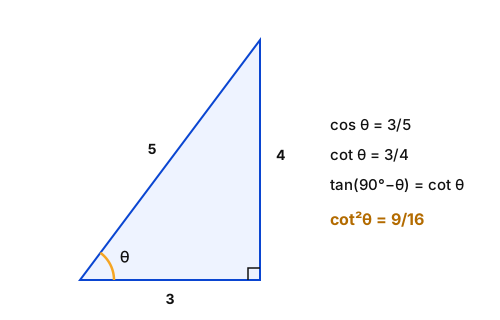
- Expression = .
- ⇒ triplet 3-4-5, , .
- .
Trick: Change to at once – the product becomes a square.
Answer: (B)
अवधारणा: ।
- व्यंजक = ।
- ⇒ त्रिक 3-4-5, , ।
- ।
ट्रिक: को तुरंत लिखें – गुणनफल वर्ग बन जाता है।
उत्तर: (B)
SSC CGLQuantitative AptitudeTrigonometry – complementary angleSSC CGL 2025 · 25 Sep Shift 3
Q171.Two circles of radii 5 cm and 3 cm are such that the distance between their centres is 8 cm. How many common tangents can be drawn?
5 cm और 3 cm त्रिज्या वाले दो वृत्तों के केंद्रों के बीच की दूरी 8 cm है। कितनी उभयनिष्ठ स्पर्श रेखाएँ खींची जा सकती हैं?
- A1
- B0
- C2
- D3
Show answer
Concept: Compare distance d between centres with r₁ + r₂ and r₁ − r₂.
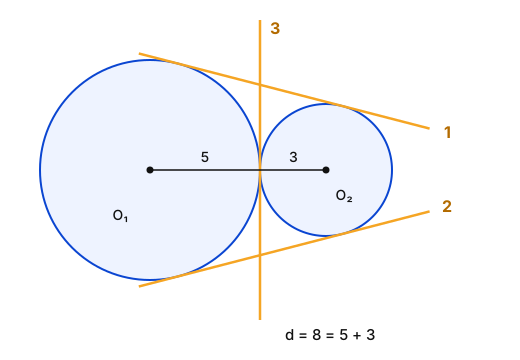
- r₁ + r₂ = 5 + 3 = 8 = d ⇒ circles touch externally.
- Externally touching circles have 2 direct tangents + 1 at the contact point = 3.
Trick: d > r₁ + r₂ → 4; d = r₁ + r₂ → 3; intersecting → 2; internal touch → 1; one inside other → 0.
Answer: (D) 3
अवधारणा: केंद्रों की दूरी d की तुलना r₁ + r₂ व r₁ − r₂ से करें।
- r₁ + r₂ = 5 + 3 = 8 = d ⇒ वृत्त बाहर से स्पर्श करते हैं।
- बाह्य स्पर्श में 2 सीधी + 1 स्पर्श बिंदु पर = 3 स्पर्श रेखाएँ।
ट्रिक: d > r₁ + r₂ → 4; d = r₁ + r₂ → 3; प्रतिच्छेद → 2; आंतरिक स्पर्श → 1; एक अंदर → 0।
उत्तर: (D) 3
SSC CGLQuantitative AptitudeCircles – number of common tangentsSSC CGL 2025 · 25 Sep Shift 3
Q172.A circle has a radius of 12 cm, and a chord makes a 60° angle at the centre. What is the length of that chord?
एक वृत्त की त्रिज्या 12 cm है और एक जीवा केंद्र पर 60° का कोण बनाती है। उस जीवा की लंबाई क्या है?
- A6 cm
- B12 cm
- C12 cm
- D12 cm
Show answer
Concept: Chord length = .
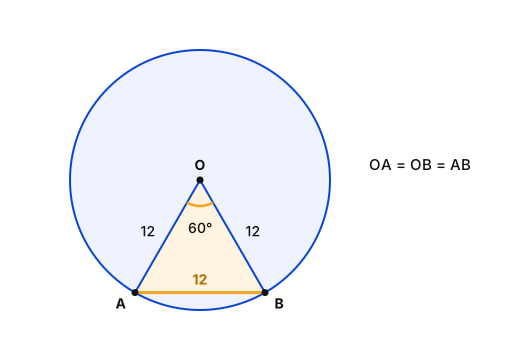
- Chord = cm.
- (The two radii and chord form an equilateral triangle.)
Trick: A central angle always gives chord = radius.
Answer: (B) 12 cm
अवधारणा: जीवा की लंबाई = ।
- जीवा = cm।
- (दोनों त्रिज्याएँ व जीवा समबाहु त्रिभुज बनाती हैं।)
ट्रिक: केंद्र पर कोण हो तो जीवा = त्रिज्या।
उत्तर: (B) 12 cm
SSC CGLQuantitative AptitudeCircle – chord at 60° angleSSC CGL 2025 · 25 Sep Shift 3
Q173.Points P, Q, R and S are located on the circumference of a circle. If ∠RPS = 50° and ∠PQS = 70°, what is the measure of ∠PRS?
बिंदु P, Q, R और S एक वृत्त की परिधि पर स्थित हैं। यदi ∠RPS = 50° और ∠PQS = 70° है, तो ∠PRS का माप क्या है?
- A60°
- B90°
- C50°
- D70°
Show answer
Concept: Angles subtended by the same chord on the same side are equal.
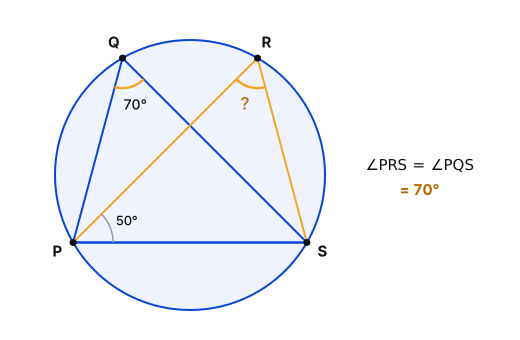
- ∠PQS and ∠PRS both stand on chord PS.
- So ∠PRS = ∠PQS = 70° (∠RPS = 50° is extra data).
Trick: Read the end letters: P_S in both ∠PQS and ∠PRS ⇒ same chord PS ⇒ equal.
Answer: (D) 70°
अवधारणा: किसी जीवा के एक ही तरफ़ परिधि पर बनने वाले सभी कोण समान होते हैं।
- Q और R दोनों बिंदुओं से जीवा PS देखी जा रही है (∠PQS, ∠PRS)।
- अतः ∠PRS = ∠PQS = 70° (∠RPS = 50° अतिरिक्त जानकारी है)।
ट्रिक: सिरे के अक्षर देखें: दोनों में P_S ⇒ एक ही जीवा PS ⇒ बराबर।
उत्तर: (D) 70°
SSC CGLQuantitative AptitudeCircle – angles in the same segmentSSC CGL 2025 · 25 Sep Shift 3
Q174.In a circle, points P, Q, R and S lie on the circumference such that chords PR and QS intersect at the centre, and both ∠RPQ and ∠RSQ are subtended by the same arc RQ. If ∠RPQ = 70°, what is the measure of ∠RSQ?
एक वृत्त में बिंदु P, Q, R और S परिधि पर इस प्रकार हैं कि जीवाएँ PR और QS केंद्र पर प्रतिच्छेद करती हैं, तथा ∠RPQ और ∠RSQ दोनों एक ही चाप RQ द्वारा बनते हैं। यदि ∠RPQ = 70° है, तो ∠RSQ का माप क्या है?
- A80°
- B70°
- C100°
- D110°
Show answer
Concept: Inscribed angles standing on the same arc are equal.
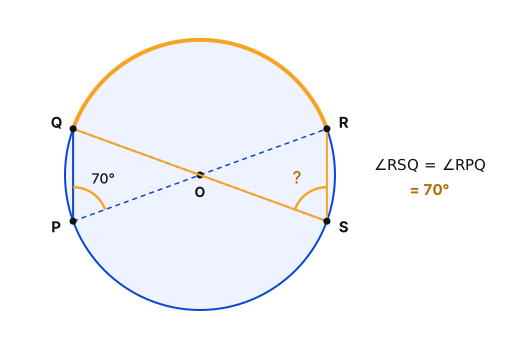
- ∠RPQ and ∠RSQ both stand on arc RQ.
- ∠RSQ = ∠RPQ = 70°.
Trick: Since PR and QS are diameters, PQRS is a rectangle-type figure – but just the 'same arc' rule is enough.
Answer: (B) 70°
अवधारणा: परिधि पर बने जो कोण समान चाप को अंतरित करते हैं, वे आपस में समान होते हैं।
- P और S दोनों से चाप RQ अंतरित हो रहा है।
- इसलिए ∠RSQ भी ∠RPQ जितना = 70°।
ट्रिक: PR और QS व्यास होने से PQRS आयत बनता है – पर 'एक ही चाप' नियम ही काफ़ी है।
उत्तर: (B) 70°
SSC CGLQuantitative AptitudeCircle – angles on the same arcSSC CGL 2025 · 25 Sep Shift 3
Q175.A circle with radius r has a tangent line at a point P on the circle. The distance along the tangent from P to the external point Q is 13 cm. The distance from the centre of the circle to point Q is 15 cm. Find the radius of the circle.
r त्रिज्या वाले एक वृत्त की बिंदु P पर स्पर्श रेखा है। P से बाहरी बिंदु Q तक स्पर्श रेखा की लंबाई 13 cm है। वृत्त के केंद्र से बिंदु Q की दूरी 15 cm है। वृत्त की त्रिज्या ज्ञात कीजिए।
- A cm
- B cm
- C cm
- D cm
Show answer
Concept: Radius ⊥ tangent at point of contact ⇒ OPQ is right-angled at P.
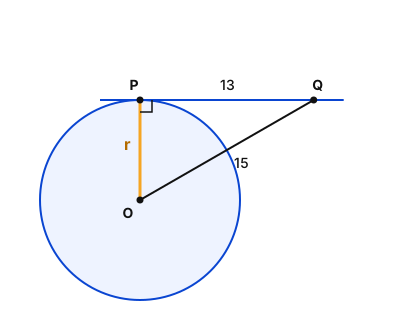
- .
- cm.
Trick: Difference of squares: .
Answer: (A) cm
अवधारणा: स्पर्श बिंदु पर त्रिज्या ⊥ स्पर्श रेखा ⇒ OPQ, P पर समकोण।
- ।
- cm।
ट्रिक: वर्गों का अंतर: ।
उत्तर: (A) cm
SSC CGLQuantitative AptitudeTangent – radius perpendicularSSC CGL 2025 · 25 Sep Shift 3
Q176.Solve: ( − ) ×
हल कीजिए: ( − ) ×
- A9.875
- B8.875
- C7.25
- D6.685
Show answer
Concept: Find each square root separately, subtract, then multiply by .
- ().
- ().
- .
Trick: A number ending in .25 has a square root ending in .5; 1260.25 lies between and → 35.5.
Answer: (C) 7.25
अवधारणा: हर वर्गमूल अलग निकालें, घटाएँ, फिर से गुणा करें।
हल:
- ()।
- ()।
- ।
ट्रिक: .25 पर समाप्त संख्या का वर्गमूल .5 पर समाप्त होता है; 1260.25, (1225) व (1296) के बीच → 35.5।
उत्तर: (C) 7.25
SSC CGLQuantitative AptitudeSquare roots – simplificationSSC CGL 2025 · 25 Sep Shift 2
Q177.A certain sum amounts to ₹1,800 in two years and to ₹2,160 in three years at compound interest, compounded annually. Find the rate of interest.
चक्रवृद्धि ब्याज पर कोई राशि 2 वर्ष में ₹1,800 और 3 वर्ष में ₹2,160 हो जाती है। ब्याज दर ज्ञात कीजिए।
- A18%
- B16%
- C25%
- D20%
Show answer
Concept: Under annual compounding, each year's amount = previous amount .
- Amount after 2 yrs = ₹1,800; after 3 yrs = ₹2,160.
- Interest in 3rd year = ₹360 (earned on ₹1,800).
- .
Trick: Ratio method: ⇒ rate = 20% in one glance.
Answer: (D) 20%
अवधारणा: वार्षिक चक्रवृद्धि में हर वर्ष का मिश्रधन = पिछला मिश्रधन ।
हल:
- 2 वर्ष बाद ₹1,800; 3 वर्ष बाद ₹2,160।
- तीसरे वर्ष का ब्याज = ₹360 (₹1,800 पर)।
- ।
ट्रिक: अनुपात: ⇒ दर 20%।
उत्तर: (D) 20%
SSC CGLQuantitative AptitudeCompound interest – rate from consecutive amountsSSC CGL 2025 · 25 Sep Shift 2
Q178.Evaluate the following statements to determine if the information provided is sufficient to answer the question.
Question: If Sachin, Naveen and Ashish work together, how many days will they take to complete a project?
Statement I: Naveen and Ashish together can complete the project in 10 days.
Statement II: Sachin and Ashish together can complete the project in 15 days.
नीचे दिए कथनों का मूल्यांकन कर बताइए कि दी गई सूचना प्रश्न का उत्तर देने हेतु पर्याप्त है या नहीं।
प्रश्न: यदि सचिन, नवीन और आशीष मिलकर काम करें, तो परियोजना कितने दिनों में पूरी होगी?
कथन I: नवीन और आशीष मिलकर परियोजना 10 दिनों में पूरी कर सकते हैं।
कथन II: सचिन और आशीष मिलकर परियोजना 15 दिनों में पूरी कर सकते हैं।
- AStatement I alone provides enough information, but Statement II alone does notकेवल कथन I पर्याप्त है, कथन II अकेला नहीं
- BStatement II alone provides enough information, but Statement I alone does notकेवल कथन II पर्याप्त है, कथन I अकेला नहीं
- CBoth Statements combined are needed, as neither on its own is sufficientदोनों कथन मिलकर आवश्यक हैं, अकेला कोई पर्याप्त नहीं
- DEven when combined, the information in both Statements is not enoughदोनों मिलकर भी सूचना पर्याप्त नहीं है
Show answer
Concept: To get the time for , we need the combined one-day work of all three.
- I: per day. II: per day.
- Adding gives — Ashish is counted twice; his share is unknown.
- Two equations, three unknowns ⇒ cannot be found.
Trick: When both statements contain the same person, adding them double-counts that person — data is usually insufficient.
Answer: (D) Even when combined, the information in both Statements is not enough
अवधारणा: का समय जानने के लिए तीनों का संयुक्त एक दिन का काम चाहिए।
हल:
- I: प्रतिदिन। II: प्रतिदिन।
- जोड़ने पर — आशीष दो बार गिना गया, उसका हिस्सा अज्ञात।
- दो समीकरण, तीन अज्ञात ⇒ नहीं निकलेगा।
ट्रिक: दोनों कथनों में एक ही व्यक्ति हो तो जोड़ने पर वह दो बार गिना जाता है — डेटा प्रायः अपर्याप्त।
उत्तर: (D) दोनों मिलकर भी सूचना पर्याप्त नहीं है
SSC CGLQuantitative AptitudeData sufficiency – time and workSSC CGL 2025 · 25 Sep Shift 2
Q179.A 100-litre container of pure milk undergoes a 10-litre removal and 10-litre water replacement process, repeated 3 times. Approximately how much original milk remains?
100 लीटर शुद्ध दूध के पात्र से 10 लीटर निकालकर 10 लीटर पानी मिलाने की प्रक्रिया 3 बार दोहराई जाती है। लगभग कितना मूल दूध शेष रहेगा?
- A15 litres15 लीटर
- B17 litres17 लीटर
- C8 litres8 लीटर
- D72 litres72 लीटर
Show answer
Concept: After n replacements: milk left = initial × .
- L, L, .
- Milk = L.
- litres ≈ 72.9 L.
Trick: Each step keeps 90%: 100 → 90 → 81 → 72.9. Just take 10% off three times.
Answer: (D) 72 litres
अवधारणा: n बार प्रतिस्थापन के बाद शेष दूध = प्रारंभिक × ।
हल:
- L, L, ।
- दूध = L।
- लीटर ≈ 72.9 L।
ट्रिक: हर बार 90% बचता है: 100 → 90 → 81 → 72.9।
उत्तर: (D) 72 लीटर
SSC CGLQuantitative AptitudeMixture – repeated replacementSSC CGL 2025 · 25 Sep Shift 2
Q180.A donor deposits ₹10,00,000 in a trust that earns 8% simple interest annually. The interest is used to distribute three annual awards. If the second and third awards are ₹30,000 and ₹15,000 respectively, what is the value of the first award?
एक दानदाता ट्रस्ट में ₹10,00,000 जमा करता है जिस पर 8% वार्षिक साधारण ब्याज मिलता है। इस ब्याज से तीन वार्षिक पुरस्कार दिए जाते हैं। यदि दूसरा और तीसरा पुरस्कार क्रमशः ₹30,000 और ₹15,000 है, तो पहला पुरस्कार कितने का है?
- A₹45,000
- B₹20,000
- C₹35,000
- D₹25,000
Show answer
Concept: The yearly SI is fully shared among the three awards.
- Yearly SI = ₹80,000.
- Second + third awards = ₹45,000.
- First award = ₹80,000 − ₹45,000 = ₹35,000.
Trick: 8% of 10 lakh = 80 thousand — just shift the decimal; then subtract the known awards.
Answer: (C) ₹35,000
अवधारणा: वार्षिक साधारण ब्याज पूरा तीनों पुरस्कारों में बँटता है।
हल:
- वार्षिक ब्याज = ₹80,000।
- पहला पुरस्कार = ₹35,000।
ट्रिक: 10 लाख का 8% = 80 हज़ार; फिर ज्ञात पुरस्कार घटा दें।
उत्तर: (C) ₹35,000
SSC CGLQuantitative AptitudeSimple interest – awards from yearly interestSSC CGL 2025 · 25 Sep Shift 2

