Directions (Qs. 17-21): Read the following passage carefully and answer the questions that follow.
Uttarakhand, celebrated for its scenic landscapes and rich ecological heritage, is currently facing a severe phase of environmental deterioration. Unchecked deforestation, driven by rapid infrastructure development and increasing tourist inflow, exacerbates the fragile ecosystem's vulnerability, leading to a significant loss of biodiversity. Forests that once functioned as crucial carbon absorbers and shelters for diverse species are now increasingly fragmented, disturbing the natural equilibrium.
The excessive exploitation of natural resources, particularly minerals and freshwater, along with unpredictable climatic variations linked to global warming, further weakens the ecosystem. Rampant construction along riverbanks and mountainous terrains has resulted in soil degradation and a rising incidence of landslides, posing serious threats to local communities and wildlife. Moreover, careless disposal of waste, especially non-biodegradable materials, in environmentally sensitive areas amplifies pollution and endangers aquatic ecosystems.
A major contributor to this environmental decline is the lack of effective environmental regulations and their proper implementation. Despite public awareness initiatives, administrative bodies often prioritise economic development over ecological
preservation. This imbalance between progress and environmental responsibility jeopardises the region's ecological sanctity, calling for urgent corrective action.
In conclusion, Uttarakhand's environmental challenges stem from human activities combined with climatic changes. Coordinated efforts involving policy enhancement, public participation, and scientific solutions are essential to restore the state's ecological balance.
Q221.According to the passage, which factor does NOT contribute to environmental degradation?
- AUnchecked deforestation
- BCareless disposal of waste
- CExcessive construction activities
- DStrict implementation of environmental regulations
Show answer
Concept: NOT-type question: match each option with the causes listed in the passage.
- Deforestation (para 1), construction along riverbanks (para 2), careless waste disposal (para 2) are all named as causes.
- The passage blames the lack of effective regulations; strict implementation would protect, not damage.
Trick: In 'NOT' questions, the option that sounds like a solution, not a problem, is usually the answer.
Answer: (D) Strict implementation of environmental regulations
अवधारणा: 'NOT' वाला प्रश्न: हर विकल्प को गद्यांश में बताए कारणों से मिलाएँ।
- वनों की कटाई (अनु. 1), नदी किनारे निर्माण और कचरे का लापरवाह निपटान (अनु. 2) – सब कारण बताए गए हैं।
- गद्यांश नियमों के प्रभावी पालन की कमी को दोष देता है; सख्त पालन तो बचाव करेगा।
ट्रिक: 'NOT' प्रश्न में जो विकल्प समस्या नहीं बल्कि समाधान लगे, वही प्रायः उत्तर होता है।
उत्तर: (D) Strict implementation of environmental regulations
SSC CHSL Tier-1English LanguageReading comprehension – factor not responsibleSSC CHSL Tier-1 2025 · 30 Nov Shift 1
Q222.Rearrange the following sentences to form a meaningful and grammatically correct paragraph:
P. The coffee machine hissed, its steam a fragrant cloud in the morning air.
Q. He placed a filter in the dripper, pouring the hot water over the dark grounds.
R. A swirl of cream clouded the liquid, turning it a rich hazelnut colour.
S. With the first bold sip, the day felt a little easier to manage.
- AP, Q, R, S
- BS, Q, R, P
- CQ, S, P, R
- DR, Q, P, S
Show answer
Concept: Follow the natural sequence of making and drinking coffee.
- P: machine hisses – sets the morning scene (start).
- Q: water poured over grounds – brewing.
- R: cream added – after brewing.
- S: first sip – the end.
Trick: S ('first sip') must be last – only option (A) ends with S and starts logically.
Answer: (A) P, Q, R, S
अवधारणा: कॉफ़ी बनाने और पीने के स्वाभाविक क्रम का पालन करें।
- P: मशीन की आवाज़ – सुबह का दृश्य (शुरुआत)।
- Q: पानी डालकर कॉफ़ी बनाना।
- R: उसमें क्रीम मिलाना।
- S: पहला घूँट – अंत।
ट्रिक: 'first sip' वाला S आख़िर में ही आएगा – केवल (A) S पर खत्म होता है और सही शुरू होता है।
उत्तर: (A) P, Q, R, S
SSC CHSL Tier-1English LanguageSentence rearrangement – process orderSSC CHSL Tier-1 2025 · 30 Nov Shift 1
Q223.Rearrange the following sentence parts to form a meaningful and grammatically correct paragraph:
P. The medical team enrolled a large group of eligible patients for the clinical trial.
Q. At the end of the study, they evaluated the findings to determine the new medicine's safety and effectiveness.
R. The doctors closely monitored the health and recovery of all the patients for several weeks.
S. Half the patients were given the new medicine, while the remaining half received the old one.
- AR, S, Q, P
- BP, S, R, Q
- CQ, S, R, P
- DR, S, P, Q
Show answer
Concept: Arrange the trial in the order it actually happens.
- P: patients enrolled – introduces 'a large group' (first).
- S: split into new-medicine and old-medicine groups.
- R: monitoring for several weeks.
- Q: 'At the end of the study' – evaluation (last).
Trick: 'a group' (new info) opens; 'At the end' closes → P…Q; only (B) fits.
Answer: (B) P, S, R, Q
अवधारणा: ट्रायल जिस क्रम में होता है, उसी क्रम में वाक्य रखें।
- P: मरीज़ों का चयन – 'a large group' पहली बार आता है (शुरुआत)।
- S: आधे को नई, आधे को पुरानी दवा।
- R: कई हफ़्ते निगरानी।
- Q: 'At the end of the study' – मूल्यांकन (अंत)।
ट्रिक: 'a group' से शुरुआत, 'At the end' पर अंत → P…Q; ऐसा केवल (B) में है।
उत्तर: (B) P, S, R, Q
SSC CHSL Tier-1English LanguageSentence rearrangement – clinical trial stepsSSC CHSL Tier-1 2025 · 30 Nov Shift 1
Q224.Which word is nearest in meaning to attentively ?
The guards were carefully watching the entrance throughout the night.
- ACarelessly
- BIntently
- CCasually
- DNegligently
Show answer
Concept: Attentively = with full, close attention.
- Intently = with concentrated attention – same meaning; fits guards watching all night.
- Carelessly, Casually, Negligently all mean without proper attention – opposites.
Trick: Three options share the 'careless' idea; the lone different word is the synonym.
Answer: (B) Intently
अवधारणा: Attentively = पूरे ध्यान से।
- Intently = एकाग्र होकर, ध्यान से – रात भर निगरानी करते पहरेदारों पर फिट।
- Carelessly, Casually, Negligently – सब लापरवाही दिखाते हैं (उल्टे अर्थ)।
ट्रिक: तीन विकल्प 'लापरवाही' वाले हैं; अकेला अलग शब्द ही पर्यायवाची है।
उत्तर: (B) Intently
SSC CHSL Tier-1English LanguageSynonym in context – attentivelySSC CHSL Tier-1 2025 · 30 Nov Shift 1
Q225.Which term refers to a form of government with elected representatives.
- ATheocracy
- BDemocracy
- CRepublic
- DUtopia
Show answer
Concept: A state where power rests with the people's elected representatives and the head is elected, not hereditary = republic.
- Theocracy = rule by religious authority; Utopia = an imagined perfect society.
- Democracy = rule by the people in general; the term specifically tied to elected representatives and an elected head is republic (keyed answer).
Yaad rakhein: India is a 'Sovereign, Socialist, Secular, Democratic Republic' – republic because the President is elected.
Answer: (C) Republic
अवधारणा: जहाँ सत्ता जनता के चुने प्रतिनिधियों के पास हो और राष्ट्राध्यक्ष चुना जाए, वंशानुगत न हो = republic (गणतंत्र)।
- Theocracy = धर्मगुरुओं का शासन; Utopia = काल्पनिक आदर्श समाज।
- Democracy = जनता का शासन (सामान्य); चुने हुए प्रतिनिधि व निर्वाचित प्रमुख वाली व्यवस्था के लिए republic उत्तर है।
याद रखें: भारत 'सम्प्रभु, समाजवादी, पंथनिरपेक्ष, लोकतांत्रिक गणराज्य' है – गणराज्य क्योंकि राष्ट्रपति चुना जाता है।
उत्तर: (C) Republic
SSC CHSL Tier-1English LanguageOne-word substitution – RepublicSSC CHSL Tier-1 2025 · 30 Nov Shift 1
Q226.Each item describes a situation and is followed by four possible responses. Indicate the response you find most appropriate. Choose only one response for each item. The responses will be evaluated based on the level of appropriateness for the given situation. An online education platform has a new course ready, but some errors have been found in its content. The company can either launch the course on the scheduled time or delay it for some time to make improvements. What would be the most sensible decision?
प्रत्येक प्रश्न में एक परिस्थिति दी गई है और उसके बाद चार संभावित प्रतिक्रियाएँ दी गई हैं। जो प्रतिक्रिया आपको सर्वाधिक उपयुक्त लगती है, उसे बताइए। प्रत्येक प्रश्न के लिए केवल एक ही प्रतिक्रिया चुनिए। प्रतिक्रियाओं का मूल्यांकन दी गई परिस्थिति के लिए उनकी उपयुक्तता के स्तर के आधार पर किया जाएगा। एक ऑनलाइन शिक्षा मंच का एक नया पाठ्यक्रम तैयार है, किंतु उसकी विषय-वस्तु में कुछ त्रुटियाँ पाई गई हैं। कंपनी या तो पाठ्यक्रम को निर्धारित समय पर आरंभ कर सकती है या सुधार करने के लिए उसे कुछ समय के लिए स्थगित कर सकती है। सबसे विवेकपूर्ण निर्णय क्या होगा?
- ALaunch the course on time and make corrections laterपाठ्यक्रम को समय पर आरंभ कर दें और सुधार बाद में करें
- BCancel the course completelyपाठ्यक्रम को पूरी तरह रद्द कर दें
- CRelease the course to all users without making any improvementsबिना कोई सुधार किए पाठ्यक्रम को सभी उपयोगकर्ताओं के लिए जारी कर दें
- DDelay the launch and ensure the quality of the contentआरंभ को स्थगित करें और विषय-वस्तु की गुणवत्ता सुनिश्चित करें
Show answer
Concept: The best response solves the real problem with the least harm.
- Problem: the course content has errors. Learners would study wrong material.
- A short delay to fix errors protects learners and the platform's reputation.
- (A) and (C) release faulty content; (B) wastes a course that only needs correction.
Trick: Reject extremes (cancel everything / ignore the problem); choose the option that fixes the issue responsibly.
Answer: (D) Delay the launch and ensure the quality of the content
अवधारणा: सबसे अच्छा जवाब वह है जो असली समस्या को कम से कम नुकसान में हल करे।
- समस्या: कोर्स में गलतियाँ हैं, छात्र गलत चीज़ सीखेंगे।
- थोड़ी देर करके गलतियाँ सुधारने से छात्रों और कंपनी की साख दोनों बचते हैं।
- (A), (C) गलत सामग्री जारी करते हैं; (B) पूरा कोर्स ही बेकार कर देता है।
ट्रिक: अति वाले विकल्प (सब रद्द करना / समस्या अनदेखी करना) हटाएँ; ज़िम्मेदारी से सुधार वाला चुनें।
उत्तर: (D) आरंभ को स्थगित करें और विषय-वस्तु की गुणवत्ता सुनिश्चित करें
SSC CHSL Tier-1General IntelligenceSituational judgement – quality vs deadlineSSC CHSL Tier-1 2025 · 30 Nov Shift 1
Q227.The Latin root 'dict' means:
लैटिन मूल 'dict' का अर्थ है:
- ATo hearसुनना
- BTo writeलिखना
- CTo sayकहना
- DTo readपढ़ना
Show answer
Concept: Find the root's meaning from common words that contain it.
- dictate (say aloud), predict (say before), contradict (say against), diction (way of speaking).
- Common idea = to say/speak (Latin dicere).
- Hear = aud; write = scrib/script; read = leg/lect.
Trick: A 'dict-ionary' tells you how words are said.
Answer: (C) To say
अवधारणा: मूल वाले जाने-पहचाने शब्दों से उसका अर्थ निकालें।
- dictate (बोलकर लिखवाना), predict (पहले से कहना), contradict (विरोध में कहना)।
- सबमें साझा भाव = कहना/बोलना (लैटिन dicere)।
- सुनना = aud; लिखना = scrib/script; पढ़ना = leg/lect।
ट्रिक: 'dict-ionary' बताती है कि शब्द कैसे बोले/कहे जाते हैं।
उत्तर: (C) कहना
SSC CHSL Tier-1General IntelligenceWord roots – Latin 'dict'SSC CHSL Tier-1 2025 · 30 Nov Shift 1
Q228.Read the following statement carefully and identify the inference that follows.
Statement:
The government has announced a new environmental fee on private vehicles.
Inference:
I. The government is trying to reduce air pollution.
II. This fee will generate additional revenue for the government.
III. This fee will be implemented in only one city.
निम्नलिखित कथन को ध्यानपूर्वक पढ़िए और उससे निकलने वाले अनुमान की पहचान कीजिए।
कथन:
सरकार ने निजी वाहनों पर एक नया पर्यावरण शुल्क लगाने की घोषणा की है।
अनुमान:
I. सरकार वायु प्रदूषण कम करने का प्रयास कर रही है।
II. इस शुल्क से सरकार को अतिरिक्त राजस्व प्राप्त होगा।
III. यह शुल्क केवल एक ही शहर में लागू किया जाएगा।
- AIf only I followsयदि केवल I अनुसरण करता है
- BIf only II followsयदि केवल II अनुसरण करता है
- CIf both I and II followयदि I और II दोनों अनुसरण करते हैं
- DIf both II and III followयदि II और III दोनों अनुसरण करते हैं
Show answer
Concept: An inference must be reasonably implied by the statement; no new details may be added.
- I: an 'environmental' fee on vehicles aims at less pollution – follows.
- II: any fee collected adds to government income – follows.
- III: no city or area is mentioned – does not follow.
Trick: Reject any inference that brings in a fact (place, number, time) the statement never mentions.
Answer: (C) If both I and II follow
अवधारणा: निष्कर्ष वही जो कथन से उचित रूप से निकले; नई बात जोड़ना मना है।
- I: वाहनों पर 'पर्यावरण' शुल्क का उद्देश्य प्रदूषण कम करना – निकलता है।
- II: शुल्क से सरकार की आय बढ़ेगी – निकलता है।
- III: किसी शहर का ज़िक्र ही नहीं – नहीं निकलता।
ट्रिक: जो निष्कर्ष कथन से बाहर की जानकारी (जगह, संख्या, समय) लाए, उसे हटा दें।
उत्तर: (C) यदि I और II दोनों अनुसरण करते हैं
SSC CHSL Tier-1General IntelligenceStatement and inferenceSSC CHSL Tier-1 2025 · 30 Nov Shift 1
Q229.Few of the letters are given followed by a question mark (?) these letters are following a specific pattern you have to give the correct option which can replace question mark.
Which letter replaces the question mark: Y, U, Q, M, ?
कुछ अक्षर दिए गए हैं जिनके बाद एक प्रश्नवाचक चिह्न (?) है; ये अक्षर एक निश्चित पैटर्न का अनुसरण कर रहे हैं। आपको वह सही विकल्प चुनना है जो प्रश्नवाचक चिह्न के स्थान पर आ सके।
प्रश्नवाचक चिह्न के स्थान पर कौन-सा अक्षर आएगा: Y, U, Q, M, ?
- AI
- BJ
- CK
- DL
Show answer
Concept: Convert letters to alphabet positions and find the gap.
- Y = 25, U = 21, Q = 17, M = 13 → each step −4.
- Next = 13 − 4 = 9 → I.
Trick: Skip-count: between Y and U are 3 letters (X, W, V); skip 3 after M too → L, K, J, then I.
Answer: (A) I
अवधारणा: अक्षरों को वर्णमाला क्रमांक में बदलकर अंतर देखें।
- Y = 25, U = 21, Q = 17, M = 13 → हर बार −4।
- अगला = 13 − 4 = 9 → I।
ट्रिक: Y और U के बीच 3 अक्षर छूटे हैं; M के बाद भी उल्टे 3 छोड़ें (L, K, J) → I।
उत्तर: (A) I
SSC CHSL Tier-1General IntelligenceLetter series – constant gapSSC CHSL Tier-1 2025 · 30 Nov Shift 1
Q230.Find the next element that replaces the ? Logically
30, 70, 150, 310 ?
तर्कसंगत रूप से ? के स्थान पर आने वाला अगला पद ज्ञात कीजिए।
30, 70, 150, 310 ?
- A635
- B625
- C630
- D640
Show answer
Concept: Terms roughly double → test 'multiply by 2 and add a constant'.
- ; ; .
- Next = 630.
Trick: Differences 40, 80, 160 double → next difference 320; .
Answer: (C) 630
अवधारणा: पद लगभग दोगुने हो रहे हैं → '×2 + स्थिर संख्या' जाँचें।
- ; ; ।
- अगला = 630।
ट्रिक: अंतर 40, 80, 160 दोगुने → अगला अंतर 320; ।
उत्तर: (C) 630
SSC CHSL Tier-1General IntelligenceNumber series – ×2 + 10SSC CHSL Tier-1 2025 · 30 Nov Shift 1
Q231.Find the next element that replace the ? Logically
64, 136, 280, 568, ?
तर्कसंगत रूप से ? के स्थान पर आने वाला अगला पद ज्ञात कीजिए।
64, 136, 280, 568, ?
- A1,206
- B1,145
- C1,344
- D1,144
Show answer
Concept: Each term ≈ double the previous → find the fixed add-on.
- , ; ; .
- Next = 1144.
Trick: Differences 72, 144, 288 double → 576; . Also the last digit: → ends in 4, only (D) and (C) end in 4, and only 1144 fits.
Answer: (D) 1,144
अवधारणा: हर पद पिछले का लगभग दोगुना → जोड़ी गई स्थिर संख्या खोजें।
- ; ; ।
- अगला = 1144।
ट्रिक: अंतर 72, 144, 288 दोगुने → 576; ।
उत्तर: (D) 1,144
SSC CHSL Tier-1General IntelligenceNumber series – ×2 + 8SSC CHSL Tier-1 2025 · 30 Nov Shift 1
Q232.In each of the following question, there is a certain relationship between two given numbers on one side of (::) and one number is given on another side of (:) where another number is to be found from the given alternatives, having the same relationship with this number as the numbers of the given pair bear. Choose the best alternative.
7:3::8:?
निम्नलिखित प्रत्येक प्रश्न में, (::) के एक ओर दी गई दो संख्याओं के बीच एक निश्चित संबंध है तथा (:) के दूसरी ओर एक संख्या दी गई है, जिसके लिए दिए गए विकल्पों में से वह संख्या ज्ञात करनी है जिसका इस संख्या के साथ वही संबंध हो जो दिए गए युग्म की संख्याओं के बीच है। सर्वोत्तम विकल्प चुनिए।
7:3::8:?
- A6
- B4
- C3
- D19
Show answer
Concept: Find the simplest operation linking the given pair.
- 7 → 3: .
- Same rule: 4.
Trick: In one-pair analogies, try subtraction/addition first, then ×/÷, then squares.
Answer: (B) 4
अवधारणा: दिए गए जोड़े में सबसे सरल संबंध खोजें।
- 7 → 3: ।
- इसी नियम से: 4।
ट्रिक: एक जोड़े वाले प्रश्न में पहले घटाना/जोड़ना, फिर ×/÷, फिर वर्ग आज़माएँ।
उत्तर: (B) 4
SSC CHSL Tier-1General IntelligenceNumber analogy – differenceSSC CHSL Tier-1 2025 · 30 Nov Shift 1
Q233.Find the missing number pair in the following series.
(2, 5), (3, 10), (5, 26), (7, 50), (11, 122), ?,
निम्नलिखित शृंखला में लुप्त संख्या-युग्म ज्ञात कीजिए।
(2, 5), (3, 10), (5, 26), (7, 50), (11, 122), ?,
- A
- B
- C
- D
Show answer
Concept: Study the first numbers and the link inside each pair separately.
- First numbers 2, 3, 5, 7, 11, ?, 17 = consecutive primes → missing = 13.
- Second = : , , .
- → (13, 170).
Trick: 12, 14, 15 are not prime – options (A), (C), (D) fail instantly.
Answer: (B)
अवधारणा: पहली संख्याओं और हर जोड़े के अंदर के संबंध को अलग-अलग देखें।
- पहली संख्याएँ 2, 3, 5, 7, 11, ?, 17 = लगातार अभाज्य → लुप्त = 13।
- दूसरी = : , , ।
- → (13, 170)।
ट्रिक: 12, 14, 15 अभाज्य नहीं – (A), (C), (D) तुरंत बाहर।
उत्तर: (B)
SSC CHSL Tier-1General IntelligenceNumber-pair series – primes and n² + 1SSC CHSL Tier-1 2025 · 30 Nov Shift 1
Q234.Which of the following is the odd one out based on origin ?
उत्पत्ति के आधार पर निम्नलिखित में से कौन-सा विषम है?
- AMountainपर्वत
- BValleyघाटी
- CDamबाँध
- DPlateauपठार
Show answer
Concept: Classify by origin: natural landform or human-made structure.
- Mountain, valley, plateau are formed by natural processes (earth movements, erosion).
- A dam is constructed by humans across a river.
Yaad rakhein: India's highest dam is Tehri (Uttarakhand); the longest is Hirakud (Odisha).
Answer: (C) Dam
अवधारणा: उत्पत्ति के आधार पर बाँटें – प्राकृतिक स्थलरूप या मानव-निर्मित ढाँचा।
- पर्वत, घाटी, पठार प्राकृतिक प्रक्रियाओं (भू-हलचल, अपरदन) से बनते हैं।
- बाँध (Dam) मनुष्य नदी पर बनाता है।
याद रखें: भारत का सबसे ऊँचा बाँध टिहरी (उत्तराखंड), सबसे लंबा हीराकुंड (ओडिशा)।
उत्तर: (C) बाँध
SSC CHSL Tier-1General IntelligenceOdd one out – natural vs man-madeSSC CHSL Tier-1 2025 · 30 Nov Shift 1
Q235.In this question, four words have been given, out of which choose the odd one out.
Windows, Android, MS Word, Linux
इस प्रश्न में चार शब्द दिए गए हैं, जिनमें से विषम शब्द चुनिए।
Windows, Android, MS Word, Linux
- AWindows
- BAndroid
- CMS Word
- DLinux
Show answer
Concept: Group the software by type.
- Windows, Android, Linux = operating systems (run the device).
- MS Word = application software (word processor) that runs on an OS.
Yaad rakhein: Other OS: macOS, iOS, Unix; other applications: Excel, PowerPoint, Chrome.
Answer: (C) MS Word
अवधारणा: सॉफ़्टवेयर को उसके प्रकार से समूह में रखें।
- Windows, Android, Linux = ऑपरेटिंग सिस्टम (डिवाइस चलाते हैं)।
- MS Word = एप्लिकेशन सॉफ़्टवेयर (वर्ड प्रोसेसर), जो OS पर चलता है।
याद रखें: अन्य OS: macOS, iOS, Unix; अन्य एप्लिकेशन: Excel, PowerPoint, Chrome।
उत्तर: (C) MS Word
SSC CHSL Tier-1General IntelligenceOdd one out – operating system vs applicationSSC CHSL Tier-1 2025 · 30 Nov Shift 1
Q236.Select the correct options from the given alternatives 3151, 3192, 3233, 3274 ?
दिए गए विकल्पों में से सही विकल्प चुनिए। 3151, 3192, 3233, 3274 ?
- A3313
- B3315
- C3316
- D3317
Show answer
Concept: Equal gaps → arithmetic progression.
- 3192 − 3151 = 41, 3233 − 3192 = 41, 3274 − 3233 = 41.
- Next = 3274 + 41 = 3315.
Trick: Last digits 1, 2, 3, 4 rise by 1 → next ends in 5; only 3315 fits.
Answer: (B) 3315
अवधारणा: बराबर अंतर → समांतर श्रेणी।
- 3192 − 3151 = 41, 3233 − 3192 = 41, 3274 − 3233 = 41।
- अगला = 3274 + 41 = 3315।
ट्रिक: अंतिम अंक 1, 2, 3, 4 → अगला 5 पर खत्म; केवल 3315।
उत्तर: (B) 3315
SSC CHSL Tier-1General IntelligenceNumber series – constant differenceSSC CHSL Tier-1 2025 · 30 Nov Shift 1
Q237.Pick the correct options from below.
26, 217, 50, 513, ?
नीचे दिए गए विकल्पों में से सही विकल्प चुनिए।
26, 217, 50, 513, ?
- A729
- B82
- C101
- D125
Show answer
Concept: Big jumps up and down → read odd and even positions separately.
- , , , .
- Base runs 5, 6, 7, 8, 9; odd places are squared, even places cubed.
- 5th term = 82.
Trick: Subtract 1 from every term: 25, 216, 49, 512 – familiar squares/cubes jump out at once.
Answer: (B) 82
अवधारणा: पद ऊपर-नीचे कूदें तो विषम और सम स्थानों को अलग पढ़ें।
- , , , ।
- आधार 5, 6, 7, 8, 9; विषम स्थान पर वर्ग, सम स्थान पर घन।
- 5वाँ पद = 82।
ट्रिक: हर पद से 1 घटाएँ: 25, 216, 49, 512 – वर्ग/घन तुरंत दिख जाते हैं।
उत्तर: (B) 82
SSC CHSL Tier-1General IntelligenceAlternate series – squares and cubes + 1SSC CHSL Tier-1 2025 · 30 Nov Shift 1
Q238.In the question below there are three statements followed by two conclusions I and II. You have to take the given statements to be true even if they seem to be at variance from commonly known facts and then decide which of the given conclusions logically follows from the three statements disregarding commonly known facts.
Statements:
Only Truck are Vehicle.
Some Truck are Bulky.
All Metal are Bulky.
Conclusions:
I. Some Vehicle are not Metal.
II. Some Metal are Truck .
नीचे दिए गए प्रश्न में तीन कथन दिए गए हैं जिनके बाद दो निष्कर्ष I और II दिए गए हैं। आपको दिए गए कथनों को सत्य मानना है, चाहे वे सर्वज्ञात तथ्यों से भिन्न प्रतीत होते हों, और फिर यह निर्णय करना है कि सर्वज्ञात तथ्यों की उपेक्षा करते हुए दिए गए निष्कर्षों में से कौन-सा निष्कर्ष तीनों कथनों से तार्किक रूप से निकलता है।
कथन:
केवल Truck ही Vehicle हैं।
कुछ Truck, Bulky हैं।
सभी Metal, Bulky हैं।
निष्कर्ष:
I. कुछ Vehicle, Metal नहीं हैं।
II. कुछ Metal, Truck हैं।
- ABoth conclusions I and II followनिष्कर्ष I और II दोनों अनुसरण करते हैं
- BOnly conclusion II followsकेवल निष्कर्ष II अनुसरण करता है
- COnly conclusion I followsकेवल निष्कर्ष I अनुसरण करता है
- DNeither conclusion I nor II followsन तो निष्कर्ष I और न ही निष्कर्ष II अनुसरण करता है
Show answer
Concept: 'Only A are B' = 'All B are A'. A conclusion follows only if it is true in every possible diagram.
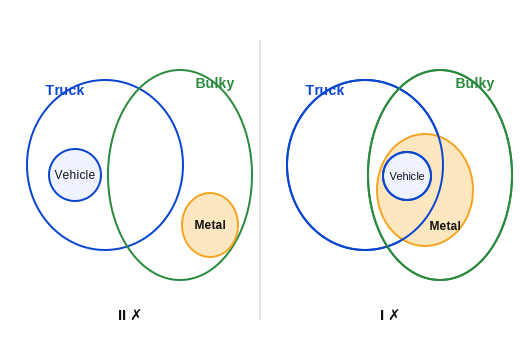
- All Vehicle are Truck; Some Truck are Bulky; All Metal are Bulky.
- Metal touches only Bulky – no fixed link with Truck or Vehicle.
- II fails: Metal can lie in the non-truck part of Bulky.
- I fails: all Vehicles may lie inside Metal (and Bulky) without breaking any statement.
Trick: Two classes linked only through a 'Some' middle term give no definite conclusion – just possibilities.
Answer: (D) Neither conclusion I nor II follows
अवधारणा: 'Only A are B' = 'All B are A'। निष्कर्ष तभी निकलता है जब हर संभव आरेख में सत्य हो।
- सभी Vehicle, Truck हैं; कुछ Truck, Bulky; सभी Metal, Bulky।
- Metal का सीधा संबंध केवल Bulky से है – Truck/Vehicle से कोई निश्चित संबंध नहीं।
- II गलत: Metal, Bulky के उस हिस्से में हो सकता है जहाँ Truck नहीं।
- I गलत: सारे Vehicle, Metal के अंदर भी हो सकते हैं, कोई कथन नहीं टूटता।
ट्रिक: जो दो वर्ग केवल 'Some' वाले बीच के पद से जुड़े हों, उनमें निश्चित निष्कर्ष नहीं, केवल संभावना होती है।
उत्तर: (D) न तो निष्कर्ष I और न ही निष्कर्ष II अनुसरण करता है
SSC CHSL Tier-1General IntelligenceSyllogism – 'only' statementSSC CHSL Tier-1 2025 · 30 Nov Shift 1
Q239.What comes next in the following series ?
M15, ?, S45, V60, Y75
निम्नलिखित शृंखला में आगे क्या आएगा?
M15, ?, S45, V60, Y75
- AP30
- B031
- CQ30
- DR29
Show answer
Concept: Treat letters and numbers as two separate series.
- Letters: S → V → Y move 3 steps each (S is 19th, Y is 25th). Going back 3 from S gives P; and P is exactly 3 after M. Missing letter = P.
- Numbers: 15, ?, 45, 60, 75 → +15 each → missing = 30.
Trick: Number part 30 leaves (A) and (C); M + 3 = P, not Q.
Answer: (A) P30
अवधारणा: अक्षर और संख्या को दो अलग श्रेणी मानें।
- अक्षर: S → V → Y हर बार 3 आगे। S से 3 पीछे P है, और P, M से ठीक 3 आगे है। लुप्त अक्षर = P।
- संख्या: 15, ?, 45, 60, 75 → हर बार +15 → लुप्त = 30।
ट्रिक: 30 से (A), (C) बचते हैं; M + 3 = P, Q नहीं।
उत्तर: (A) P30
SSC CHSL Tier-1General IntelligenceAlphanumeric series – letter +3, number +15SSC CHSL Tier-1 2025 · 30 Nov Shift 1
Q240.Which of the following is the odd one out in the given series?
3Y, 5X, 7W, 9V, 11U,
दी गई शृंखला में निम्नलिखित में से कौन-सा विषम है?
3Y, 5X, 7W, 9V, 11U,
- A3Y
- B7 W
- C5 X
- D9V
Show answer
Concept: When the obvious pattern is regular for all, test number properties.
- Letters Y, X, W, V, U go back by 1 – all regular.
- Numbers 3, 5, 7, 11 are prime; is not.
Trick: Odd-number lists hiding 9, 15, 21, 25 are usually 'prime' traps.
Answer: (D) 9V
अवधारणा: जब सामान्य पैटर्न सब पर फिट हो, तब संख्या के गुण (अभाज्य आदि) जाँचें।
- अक्षर Y, X, W, V, U एक-एक घटते हैं – सब नियमित।
- 3, 5, 7, 11 अभाज्य हैं; अभाज्य नहीं।
ट्रिक: विषम संख्याओं की सूची में 9, 15, 21, 25 दिखे तो 'अभाज्य' वाला जाल समझें।
उत्तर: (D) 9V
SSC CHSL Tier-1General IntelligenceOdd one out – prime numbers in termsSSC CHSL Tier-1 2025 · 30 Nov Shift 1

