Q2541.Find the next number in the sequence.
3, 6, 12, 15, 30, 33, ?
अनुक्रम में अगली संख्या ज्ञात कीजिए।
3, 6, 12, 15, 30, 33, ?
- A60
- B63
- C66
- D69
Show answer
Concept: Look for two operations used alternately.
- 3 +3 = 6, ×2 = 12, +3 = 15, ×2 = 30, +3 = 33.
- Next step is ×2: .
Trick: Alternate pattern: note which operation came last (+3), so the next is the other one (×2).
Answer: (C) 66
अवधारणा: दो संक्रियाएँ बारी-बारी से प्रयोग हो रही हैं।
हल:
- 3 +3 = 6, ×2 = 12, +3 = 15, ×2 = 30, +3 = 33।
- अगला ×2: ।
ट्रिक: अंतिम संक्रिया +3 थी, तो अगली ×2 होगी।
उत्तर: (C) 66
SSC CHSL Tier-1General IntelligenceNumber series – alternate +3, ×2SSC CHSL Tier-1 2025 · 21 Nov Shift 2
Q2542.Find the next number in the sequence.
80, 20, 5, 1.25, ?
अनुक्रम में अगली संख्या ज्ञात कीजिए।
80, 20, 5, 1.25, ?
- A0.3215
- B0.3125
- C0.3025
- D0.3155
Show answer
Concept: Each term is a fixed fraction of the previous one.
- 80 → 20 → 5 → 1.25: each term is one-quarter of the one before.
- .
Trick: , and → .
Answer: (B) 0.3125
अवधारणा: हर पद पिछले पद का एक निश्चित भाग है।
हल:
- ।
- ।
ट्रिक: ; → ।
उत्तर: (B) 0.3125
SSC CHSL Tier-1General IntelligenceNumber series – ÷4SSC CHSL Tier-1 2025 · 21 Nov Shift 2
Q2543.8 girls P, Q, R, S, T, U, V, and W are sitting in a row facing South (not necessarily in the same order). P and W are at the extreme ends of the row. T and U are immediate neighbours of S. R is fourth to the left of is to the immediate left of P. V is not the immediate neighbour of T. Who is sitting second to the right of V ?
8 लड़कियाँ P, Q, R, S, T, U, V और W एक पंक्ति में दक्षिण की ओर मुख करके बैठी हैं (आवश्यक नहीं कि इसी क्रम में)। P और W पंक्ति के अंतिम छोरों पर हैं। T और U, S के निकटतम पड़ोसी हैं। R, के बाईं ओर चौथे स्थान पर है, जो P के तत्काल बाईं ओर है। V, T का निकटतम पड़ोसी नहीं है। V के दाईं ओर दूसरे स्थान पर कौन बैठी है?
- AS
- BU
- CQ
- DT
Show answer
Concept: They face South; label seats 1–8 starting at the end that is on the girls' left.
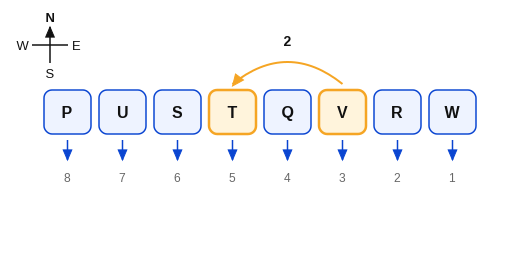
- U is immediately left of P → P can't be at seat 1 → P = 8, U = 7, W = 1.
- S is between T and U → S = 6, T = 5.
- R is 4th left of S → R = 2.
- Seats 3, 4: V can't be next to T → V = 3, Q = 4.
- Second right of V (3) = seat 5 = T.
Trick: Order: W R V Q T S U P (from their left). For South-facing rows, 'their right' is your left on paper – fix it once and stick to it.
Answer: (D) T
अवधारणा: दक्षिण की ओर मुख है; सीटें लड़कियों के अपने बाएँ से दाएँ 1–8 मानें।
हल:
- U, P के ठीक बाएँ → P = 8, U = 7, W = 1।
- S के दोनों ओर T और U → S = 6, T = 5।
- R, S से चौथा बाएँ → R = 2।
- सीट 3, 4: V, T के पास नहीं → V = 3, Q = 4।
- V (3) से दूसरा दाएँ = सीट 5 = T।
ट्रिक: क्रम: W R V Q T S U P। दक्षिणमुखी पंक्ति में उनका दायाँ कागज़ पर आपका बायाँ होता है – एक बार तय करें।
उत्तर: (D) T
SSC CHSL Tier-1General IntelligenceLinear seating – facing SouthSSC CHSL Tier-1 2025 · 21 Nov Shift 2
Q2544.Rahul started walking straight from his school to his house. During his journey, he turned 15 times left and 14 times right. He is finally walking towards the West to reach his house. In which direction did he start walking?
राहुल अपने विद्यालय से अपने घर की ओर सीधा चलना आरंभ करता है। अपनी यात्रा के दौरान वह 15 बार बाएँ और 14 बार दाएँ मुड़ता है। अंत में वह अपने घर पहुँचने के लिए पश्चिम की ओर चल रहा है। उसने किस दिशा में चलना आरंभ किया था?
- ASouthदक्षिण
- BNorthउत्तर
- CEastपूर्व
- DWestपश्चिम
Show answer
Concept: One left and one right cancel; only the net turns matter.
- Net = 15 left − 14 right = 1 left turn.
- Start → (turn left) → West, so start was the direction whose left is West.
- Left of North is West → he started towards North.
Trick: Work backwards: undo the final left turn by turning right from West → North.
Answer: (B) North
अवधारणा: एक बायाँ और एक दायाँ मोड़ एक-दूसरे को काट देते हैं।
हल:
- शुद्ध = 15 बाएँ − 14 दाएँ = 1 बायाँ मोड़।
- प्रारंभिक दिशा से बाएँ मुड़कर पश्चिम मिला।
- उत्तर की ओर मुख हो तो बायाँ = पश्चिम → शुरुआत उत्तर से।
ट्रिक: उल्टा चलें: पश्चिम से एक दायाँ मोड़ = उत्तर।
उत्तर: (B) उत्तर
SSC CHSL Tier-1General IntelligenceDirection – net turnsSSC CHSL Tier-1 2025 · 21 Nov Shift 2
Q2545.M walks 50 km towards the North. He turns right and walks 75 km. He again turns right and walks 50 km. How far (in km) and in which direction is he now from the starting point?
M उत्तर की ओर 50 km चलता है। वह दाएँ मुड़कर 75 km चलता है। वह पुनः दाएँ मुड़कर 50 km चलता है। अब वह प्रारंभिक बिंदु से कितनी दूर (km में) तथा किस दिशा में है?
- A75 , West75 , पश्चिम
- B50, East50, पूर्व
- C75 , East75 , पूर्व
- D50, West50, पश्चिम
Show answer
Concept: Track the facing direction after each turn and cancel opposite moves.
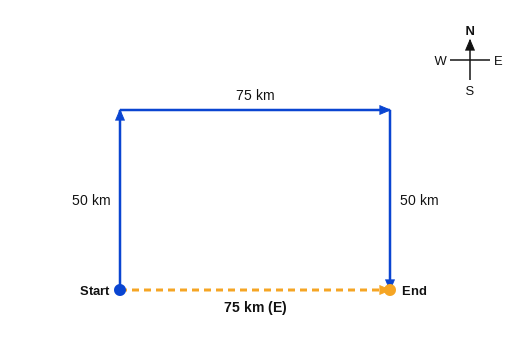
- North 50 km → right turn = East 75 km → right turn = South 50 km.
- North 50 and South 50 cancel.
- Left: 75 km East.
Trick: Two right turns = U-turn, so the 1st and 3rd legs (both 50) cancel – the middle leg is the answer.
Answer: (C) 75 , East
अवधारणा: हर मोड़ के बाद दिशा देखें और विपरीत चालें काटें।
हल:
- उत्तर 50 km → दाएँ = पूर्व 75 km → दाएँ = दक्षिण 50 km।
- उत्तर 50 और दक्षिण 50 कट गए।
- बचा 75 km पूर्व।
ट्रिक: दो दाएँ मोड़ = U-turn; पहला और तीसरा भाग कट जाते हैं, बीच वाला ही उत्तर।
उत्तर: (C) 75 , पूर्व
SSC CHSL Tier-1General IntelligenceDirection – distance and directionSSC CHSL Tier-1 2025 · 21 Nov Shift 2
Q2546.Assuming that the data given in the statement are definitely true, which of the following conclusions can be logically deducted?
Statement: All applicants who have a master's degree are shortlisted for the job.
Fact: Suman was shortlisted for the job. Which conclusion is valid?
यह मानते हुए कि कथन में दी गई जानकारी निश्चित रूप से सत्य है, निम्नलिखित में से कौन-सा निष्कर्ष तार्किक रूप से निकाला जा सकता है?
कथन: वे सभी आवेदक जिनके पास स्नातकोत्तर उपाधि है, नौकरी के लिए शॉर्टलिस्ट कर लिए जाते हैं।
तथ्य: सुमन को नौकरी के लिए शॉर्टलिस्ट किया गया था। कौन-सा निष्कर्ष वैध है?
- ASuman has a master's degree.सुमन के पास स्नातकोत्तर उपाधि है।
- BSuman might have a master's degree.सुमन के पास स्नातकोत्तर उपाधि हो सकती है।
- COnly applicants with a master's degree are shortlisted.केवल स्नातकोत्तर उपाधि वाले आवेदक ही शॉर्टलिस्ट किए जाते हैं।
- DSuman is the only applicant shortlisted.सुमन ही एकमात्र शॉर्टलिस्ट किया गया आवेदक है।
Show answer
Concept: 'All A are B' does not mean 'All B are A'.
- Master's holders ⊂ shortlisted group; others may also be shortlisted.
- Suman is shortlisted → she may or may not have the degree.
- So only 'might have' is valid; (A), (C), (D) claim too much.
Trick: From B back to A you can only say 'possible' – never 'definite'.
Answer: (B) Suman might have a master's degree.
अवधारणा: 'All A are B' का अर्थ 'All B are A' नहीं होता।
हल:
- मास्टर डिग्री वाले, चयनित समूह का हिस्सा हैं; दूसरे भी चयनित हो सकते हैं।
- सुमन चयनित है → डिग्री हो भी सकती है, नहीं भी।
- इसलिए केवल 'might have' सही; बाकी अधिक दावा करते हैं।
ट्रिक: B से A की ओर केवल 'संभव' कह सकते हैं, 'निश्चित' नहीं।
उत्तर: (B) सुमन के पास स्नातकोत्तर उपाधि हो सकती है।
SSC CHSL Tier-1General IntelligenceStatement and conclusion – 'All' is one-waySSC CHSL Tier-1 2025 · 21 Nov Shift 2
Q2547.By interchanging the given two numbers (not digits), which of the following equations will NOT be correct? 5 and 10 l. ll.
दी गई दो संख्याओं (अंकों को नहीं) को परस्पर बदलने पर, निम्नलिखित में से कौन-सा समीकरण सही नहीं होगा? 5 तथा 10 l. ll.
- AOnly Iकेवल I
- BOnly IIकेवल II
- CBoth I and III और II दोनों
- DNeither I nor IIन तो I और न ही II
Show answer
Concept: Swap 5 and 10 everywhere, then solve using BODMAS.
- I: ✓ (correct).
- II: ✗.
- So only II is not correct.
Trick: Do ÷ and × left to right before + and −; don't do first in II.
Answer: (B) Only II
अवधारणा: 5 और 10 को हर जगह आपस में बदलें, फिर BODMAS से हल करें।
हल:
- I: ✓
- II: ✗
- केवल II गलत है।
ट्रिक: ÷ और × बाएँ से दाएँ पहले करें; II में पहले न करें।
उत्तर: (B) केवल II
SSC CHSL Tier-1General IntelligenceInterchange of numbers – BODMASSSC CHSL Tier-1 2025 · 21 Nov Shift 2
Q2548.The average of 12 numbers is 35 . If one number is excluded, the average becomes 33. Find the excluded number.
12 संख्याओं का औसत 35 है। यदि एक संख्या हटा दी जाए, तो औसत 33 हो जाता है। हटाई गई संख्या ज्ञात कीजिए।
- A55
- B57
- C59
- D61
Show answer
Concept: Sum = average × count.
- Sum of 12 = .
- Sum of 11 = .
- Removed = .
Trick: Removed = new avg + (old count × drop) = .
Answer: (B) 57
अवधारणा: योग = औसत × संख्या।
हल:
- 12 संख्याओं का योग = ।
- 11 संख्याओं का योग = ।
- हटाई गई = ।
ट्रिक: हटाई गई = नया औसत + (पुरानी संख्या × कमी) = ।
उत्तर: (B) 57
SSC CHSL Tier-1Quantitative AptitudeAverage – removed numberSSC CHSL Tier-1 2025 · 21 Nov Shift 2
Q2549.If , find the value of .
यदि , तो का मान ज्ञात कीजिए।
- A1.1832
- B1.2832
- C1.0832
- D1.1916
Show answer
Concept: Make the denominator a perfect square so the given root appears.
- .
- .
Trick: – always multiply inside by the denominator.
Answer: (A) 1.1832
अवधारणा: हर (denominator) को पूर्ण वर्ग बनाएँ ताकि दिया गया आ जाए।
हल:
- ।
- ।
ट्रिक: – अंदर हर से गुणा करें।
उत्तर: (A) 1.1832
SSC CHSL Tier-1Quantitative AptitudeSurds – √(7/5) using √35SSC CHSL Tier-1 2025 · 21 Nov Shift 2
Q2550.If .
find the value of .
यदि ।
तो का मान ज्ञात कीजिए।
- A96
- B98
- C100
- D102
Show answer
Concept: , y = its reciprocal, so ; use .
- .
- → .
- .
Trick: When : . With .
Answer: (B) 98
अवधारणा: और y उसका व्युत्क्रम है, इसलिए ; सूत्र ।
हल:
- ।
- → ।
- ।
ट्रिक: हो तो ।
उत्तर: (B) 98
SSC CHSL Tier-1Quantitative AptitudeRationalisation – x² + y²SSC CHSL Tier-1 2025 · 21 Nov Shift 2
Q2551., and R invest money in a business in the ratio . If the total profit at the end of the year is ₹45,000, find Q's share.
, तथा R एक व्यवसाय में के अनुपात में धन निवेश करते हैं। यदि वर्ष के अंत में कुल लाभ ₹45,000 है, तो Q का हिस्सा ज्ञात कीजिए।
- A₹9,000
- B₹15,000
- C₹21,000
- D₹12,000
Show answer
Concept: Profit is divided in the ratio of investment (same time).
- Total parts = .
- 1 part = ₹3,000.
- ₹15,000.
Trick: Q's 5 parts out of 15 = of profit → 15,000.
Answer: (B) ₹15,000
अवधारणा: समान समय हो तो लाभ निवेश के अनुपात में बँटता है।
हल:
- कुल भाग = ।
- 1 भाग = ₹3,000।
- ₹15,000।
ट्रिक: → 45000 का 15,000।
उत्तर: (B) ₹15,000
SSC CHSL Tier-1Quantitative AptitudePartnership – share from ratioSSC CHSL Tier-1 2025 · 21 Nov Shift 2
Q2552.X, Y, and Z invest money in the ratio . If the total profit is ₹60,000, find X's share.
X, Y तथा Z, के अनुपात में धन निवेश करते हैं। यदि कुल लाभ ₹60,000 है, तो X का हिस्सा ज्ञात कीजिए।
- A₹16,000
- B₹20,000
- C₹24,000
- D₹18,000
Show answer
Concept: Divide the profit in the investment ratio 4 : 5 : 6.
- Total parts = 15.
- 1 part = ₹4,000.
- ₹16,000.
Trick: X gets ; is a quick mental step → ×4.
Answer: (A) ₹16,000
अवधारणा: लाभ को 4 : 5 : 6 में बाँटें।
हल:
- कुल भाग = 15।
- 1 भाग = ₹4,000।
- ₹16,000।
ट्रिक: X का हिस्सा ; → ×4।
उत्तर: (A) ₹16,000
SSC CHSL Tier-1Quantitative AptitudePartnership – share from ratioSSC CHSL Tier-1 2025 · 21 Nov Shift 2
Q2553.If and , then what is ?
यदि तथा , तो क्या है?
- A
- B3 : 4 : 6
- C15 : 20 : 22
- D12 : 20 : 24
Show answer
Concept: Make the common term Q equal in both ratios.
- P : Q = 3 : 4 → ×5 → 15 : 20.
- Q : R = 5 : 6 → ×4 → 20 : 24.
- P : Q : R = 15 : 20 : 24.
Trick: Cross method: → 15 : 20 : 24.
Answer: (A)
अवधारणा: उभयनिष्ठ पद Q को दोनों अनुपातों में बराबर करें।
हल:
- P : Q = 3 : 4 → ×5 → 15 : 20।
- Q : R = 5 : 6 → ×4 → 20 : 24।
- P : Q : R = 15 : 20 : 24।
ट्रिक: सीधा तरीका: ।
उत्तर: (A)
SSC CHSL Tier-1Quantitative AptitudeRatio – combining P:Q and Q:RSSC CHSL Tier-1 2025 · 21 Nov Shift 2
Q2554.If the average of , and 23 is 18 , find the value of x.
यदि तथा 23 का औसत 18 है, तो x का मान ज्ञात कीजिए।
- A22
- B20
- C24
- D26
Show answer
Concept: Sum = average × number of terms.
- Total = .
- .
- .
Trick: Deviation method: 11 (−7), 14 (−4), 23 (+5) → net −6, so .
Answer: (C) 24
अवधारणा: योग = औसत × पदों की संख्या।
हल:
- कुल = ।
- ।
- ।
ट्रिक: विचलन विधि: −7, −4, +5 = −6 → ।
उत्तर: (C) 24
SSC CHSL Tier-1Quantitative AptitudeAverage – missing valueSSC CHSL Tier-1 2025 · 21 Nov Shift 2
Q2555.The average of four numbers is 30 . The average of the first and second is 25 , and that of the third and fourth is 35 . What is the second number if the first is 20?
चार संख्याओं का औसत 30 है। पहली तथा दूसरी संख्या का औसत 25 है और तीसरी तथा चौथी संख्या का औसत 35 है। यदि पहली संख्या 20 है, तो दूसरी संख्या क्या है?
- A25
- B28
- C30
- D32
Show answer
Concept: Convert each average into a sum.
- First + second = .
- First = 20 → second = .
- (Check: 3rd + 4th = 70, total ✓)
Trick: Only the pair containing the asked number matters – ignore the rest.
Answer: (C) 30
अवधारणा: हर औसत को योग में बदलें।
हल:
- पहली + दूसरी = ।
- पहली = 20 → दूसरी = ।
- (जाँच: ✓)
ट्रिक: केवल उसी जोड़ी का उपयोग करें जिसमें पूछी गई संख्या है।
उत्तर: (C) 30
SSC CHSL Tier-1Quantitative AptitudeAverage – grouped numbersSSC CHSL Tier-1 2025 · 21 Nov Shift 2
Q2556.A student scored 84 marks in a test. If this was 70% of the total, what were the maximum marks?
एक विद्यार्थी ने एक परीक्षा में 84 अंक प्राप्त किए। यदि यह कुल अंकों का 70% था, तो अधिकतम अंक कितने थे?
- A110
- B120
- C130
- D140
Show answer
Concept: If 70% = 84, find 100%.
- 1% = .
- 100% = .
Trick: 70% → 84 means 7 → 8.4, so 10 → 12; scale ×10 → 120.
Answer: (B) 120
अवधारणा: 70% = 84 है, तो 100% कितना?
हल:
- 1% = ।
- 100% = 120।
ट्रिक: 7 → 8.4, तो 10 → 12; ×10 → 120।
उत्तर: (B) 120
SSC CHSL Tier-1Quantitative AptitudePercentage – finding the totalSSC CHSL Tier-1 2025 · 21 Nov Shift 2
Q2557.A shopkeeper buys an article for Rs. 400 and sells it for Rs. 500. What is the profit percentage?
एक दुकानदार एक वस्तु Rs. 400 में खरीदता है और उसे Rs. 500 में बेचता है। लाभ प्रतिशत क्या है?
- A20%
- B
- C25%
- D30%
Show answer
Concept: .
- Profit = ₹100.
- .
Trick: 100 on 400 = . Always divide by CP, not SP ( is the trap).
Answer: (C) 25%
अवधारणा: ।
हल:
- लाभ = ₹100।
- ।
ट्रिक: हमेशा CP से भाग दें; SP से भाग (20%) जाल है।
उत्तर: (C) 25%
SSC CHSL Tier-1Quantitative AptitudeProfit percentageSSC CHSL Tier-1 2025 · 21 Nov Shift 2
Q2558.An item bought for Rs. 800 is sold at Rs. 960 . Find the profit percentage.
Rs. 800 में खरीदी गई एक वस्तु Rs. 960 में बेची जाती है। लाभ प्रतिशत ज्ञात कीजिए।
- A15%
- B18%
- C
- D25%
Show answer
Concept: .
- Profit = ₹160.
- .
Trick: → 20% profit in one step.
Answer: (C)
अवधारणा: ।
हल:
- लाभ = ₹160।
- ।
ट्रिक: → सीधा 20% लाभ।
उत्तर: (C)
SSC CHSL Tier-1Quantitative AptitudeProfit percentageSSC CHSL Tier-1 2025 · 21 Nov Shift 2
Q2559.A shopkeeper provides two consecutive discounts of and on an item. Calculate the single discount rate that is equivalent to these successive discounts.
एक दुकानदार किसी वस्तु पर और की दो क्रमिक छूट देता है। इन क्रमिक छूटों के तुल्य एकल छूट दर की गणना कीजिए।
- A40%
- B
- C
- D44%
Show answer
Concept: Equivalent discount = .
- .
Trick: Multiply the 'paid' parts: → paid 56%, discount 44%.
Answer: (D) 44%
अवधारणा: समतुल्य छूट = ।
हल:
- ।
ट्रिक: भुगतान वाले भाग गुणा करें: → छूट 44%।
उत्तर: (D) 44%
SSC CHSL Tier-1Quantitative AptitudeSuccessive discounts – equivalentSSC CHSL Tier-1 2025 · 21 Nov Shift 2
Q2560.In what ratio must a salt solution be mixed with a 60% salt solution to obtain a salt solution ?
नमक के घोल को 60% नमक के घोल के साथ किस अनुपात में मिलाया जाए कि नमक का घोल प्राप्त हो?
- A
- B
- C3 : 1
- D
Show answer
Concept: Cheaper : Dearer = (Dearer − Mean) : (Mean − Cheaper).
- 20% and 60%, mean 50%.
- 20% part : 60% part = (60 − 50) : (50 − 20) = 10 : 30 = 1 : 3.
Trick: The mean (50) is closer to 60, so more of the 60% solution is needed – only (D) fits.
Answer: (D)
अवधारणा: कम : अधिक = (अधिक − माध्य) : (माध्य − कम)।
हल:
- घोल 20% और 60%, माध्य 50%।
- अनुपात = (60 − 50) : (50 − 20) = 10 : 30 = 1 : 3।
ट्रिक: माध्य 50, 60 के पास है → 60% वाला घोल अधिक लगेगा।
उत्तर: (D)
SSC CHSL Tier-1Quantitative AptitudeAlligation – salt solutionsSSC CHSL Tier-1 2025 · 21 Nov Shift 2

