Q2741.In the following figure series, select the figure which can be placed at the sign of question mark (?) from the given alternatives.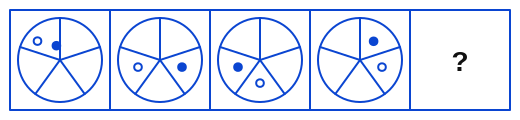
निम्नलिखित आकृति-शृंखला में, दिए गए विकल्पों में से उस आकृति का चयन कीजिए जिसे प्रश्नवाचक चिह्न (?) के स्थान पर रखा जा सकता है। - A

- B

- C

- D

Show answer
Concept: Track each mark separately in the 5-sector circle.
- Shaded dot: moves 2 sectors clockwise each step.
- Hollow circle: moves 1 sector anticlockwise each step.
- From figure 4: shaded dot upper-right → bottom; hollow circle right → upper-right.
- Option B shows this.
Trick: Follow one mark at a time; when two marks move, they usually move in opposite directions or by different steps.
Answer: (B) Option B
अवधारणा: 5 खंडों वाले वृत्त में हर चिह्न को अलग-अलग देखें।
हल:
- भरा बिंदु: हर बार 2 खंड दक्षिणावर्त।
- खाली वृत्त: हर बार 1 खंड वामावर्त।
- चौथी आकृति से: भरा बिंदु ऊपर-दाएँ → नीचे; खाली वृत्त दाएँ → ऊपर-दाएँ।
- विकल्प B में यही है।
ट्रिक: एक समय में एक ही चिह्न देखें; दो चिह्न प्रायः अलग दिशा या अलग कदमों से चलते हैं।
उत्तर: (B) Option B
SSC CHSL Tier-1General IntelligenceFigure series – moving dots in sectorsSSC CHSL Tier-1 2025 · 20 Nov Shift 3
Q2742.In the following question, four number pairs are given. In each pair the number on left side of is related to the number of the right side of (-) with some Logic/Rule/Relation. Three pairs are similar on the basis of same Logic/Rule/Relation. Select the odd one out from the given alternatives.
(NOTE: Operations should be performed on the whole numbers, without breaking down the number into its constituent digits. E.g. 13 - Operations on 13 such as adding /subtracting /multiplying etc. to 13 can be performed. Breaking down 13 into 1 and 3 and then performing mathematical operations on 1 and 3 is not allowed)
निम्नलिखित प्रश्न में, चार संख्या-युग्म दिए गए हैं। प्रत्येक युग्म में के बाईं ओर की संख्या किसी तर्क/नियम/संबंध द्वारा (-) के दाईं ओर की संख्या से संबंधित है। तीन युग्म समान तर्क/नियम/संबंध के आधार पर एक जैसे हैं। दिए गए विकल्पों में से विषम युग्म का चयन कीजिए।
(नोट: संक्रियाएँ पूर्ण संख्याओं पर की जानी चाहिए, संख्या को उसके अंकों में तोड़े बिना। उदाहरण के लिए 13 - 13 पर जोड़ना/घटाना/गुणा करना आदि संक्रियाएँ की जा सकती हैं। 13 को 1 और 3 में तोड़कर 1 और 3 पर गणितीय संक्रियाएँ करने की अनुमति नहीं है।)
- A14-256
- B12-196
- C16-324
- D18-420
Show answer
Concept: Right number = .
- 14 → ✓; 12 → ✓; 16 → ✓.
- 18 → , but given 420 ✗.
Trick: Perfect squares end in 0, 1, 4, 5, 6, 9; 420 is not a square at all – it stands out instantly.
Answer: (D) 18-420
अवधारणा: दाईं संख्या = ।
हल:
- 14 → ✓; 12 → ✓; 16 → ✓।
- 18 → , पर दिया है 420 ✗।
ट्रिक: 256, 196, 324 पूर्ण वर्ग हैं; 420 पूर्ण वर्ग नहीं है – तुरंत अलग।
उत्तर: (D) 18-420
SSC CHSL Tier-1General IntelligenceOdd pair – (n + 2)²SSC CHSL Tier-1 2025 · 20 Nov Shift 3
Q2743.In a certain coded language 'SPPU' is coded as 'NJKO' and 'GBOT' is coded as 'BVJN'. How will 'KBNT' be coded in the same code language?
एक निश्चित कूट भाषा में 'SPPU' को 'NJKO' के रूप में तथा 'GBOT' को 'BVJN' के रूप में कूटबद्ध किया जाता है। उसी कूट भाषा में 'KBNT' को किस प्रकार कूटबद्ध किया जाएगा?
- AHTJL
- BDTHN
- CGTGN
- DFVIN
Show answer
Concept: Find the shift of each letter position.
- SPPU → NJKO: S−5, P−6, P−5, U−6.
- GBOT → BVJN: same −5, −6, −5, −6 (B−6 wraps to V).
- Apply to KBNT: K→F (back 5), B→V (back 6), N→I (back 5), T→N (back 6) → FVIN.
Trick: Second letter B−6 = V; only option D has V in second place.
Answer: (D) FVIN
अवधारणा: हर स्थान के अक्षर का खिसकाव निकालें।
हल:
- SPPU → NJKO: S−5, P−6, P−5, U−6।
- GBOT → BVJN: वही −5, −6, −5, −6 (B−6 घूमकर V)।
- KBNT पर लागू: K→F (5 पीछे), B→V (6 पीछे), N→I (5 पीछे), T→N (6 पीछे) → FVIN।
ट्रिक: दूसरा अक्षर B−6 = V; केवल विकल्प D में दूसरे स्थान पर V है।
उत्तर: (D) FVIN
SSC CHSL Tier-1General IntelligenceCoding – alternate −5, −6 shiftSSC CHSL Tier-1 2025 · 20 Nov Shift 3
Q2744.In a certain code language, 'bring the light' is coded as 'db eb nq', 'light bring happiness' is coded as 'eb mj no', 'happiness produced joy' is coded as 'mj qp ub'. How will 'bring happiness' be coded in that code language ?
एक निश्चित कूट भाषा में, 'bring the light' को 'db eb nq', 'light bring happiness' को 'eb mj no' तथा 'happiness produced joy' को 'mj qp ub' के रूप में कूटबद्ध किया जाता है। उसी कूट भाषा में 'bring happiness' को किस प्रकार कूटबद्ध किया जाएगा?
- Aeb ub
- Bmj eb
- Cmj no
- Deb qp
Show answer
Concept: A word appearing in two sentences has the code common to both.
- (ii) & (iii): common word 'happiness', common code 'mj'.
- 'bring' is in (i) and (ii); the only code present in both is 'eb' → bring = eb.
- 'bring happiness' = eb + mj.
Trick: Find 'happiness' = mj first; then only options with both mj and eb survive – B.
Answer: (B) mj eb
अवधारणा: जो शब्द दो वाक्यों में आए, उसका कोड भी दोनों में सामान्य होगा।
हल:
- (ii) और (iii): सामान्य शब्द 'happiness', सामान्य कोड 'mj'।
- 'bring' (i) और (ii) दोनों में है; दोनों में सामान्य कोड केवल 'eb' → bring = eb।
- 'bring happiness' = eb + mj।
ट्रिक: पहले happiness = mj निकालें; mj और eb दोनों वाला विकल्प – B।
उत्तर: (B) mj eb
SSC CHSL Tier-1General IntelligenceCoding – common word, common codeSSC CHSL Tier-1 2025 · 20 Nov Shift 3
Q2745.In a certain code language, 'apple is very sweet' is coded as 'kp lm qr st', 'sweet fruit is mango' is coded as 'qr mn Im xy', 'very mango fruit apple' is coded as 'kp st xy mn', 'fruit very is tasty' is coded as 'mn st Im ab'. How will 'very sweet fruit' be coded in that code language ?
एक निश्चित कूट भाषा में, 'apple is very sweet' को 'kp lm qr st', 'sweet fruit is mango' को 'qr mn Im xy', 'very mango fruit apple' को 'kp st xy mn' तथा 'fruit very is tasty' को 'mn st Im ab' के रूप में कूटबद्ध किया जाता है। उसी कूट भाषा में 'very sweet fruit' को किस प्रकार कूटबद्ध किया जाएगा?
- Akp qr mn
- Bst Im mn
- Cqr mn st
- Dkp Im qr
Show answer
Concept: Compare pairs of sentences to fix codes one by one.
- 'very' occurs in (i), (iii), (iv); 'st' is in all three → very = st.
- (i) & (iii) share apple, very → kp, st → apple = kp. (i) & (iv) share is → lm.
- Left in (i): sweet = qr.
- 'fruit' in (ii), (iii), (iv); common code 'mn' → fruit = mn.
- very sweet fruit = st qr mn → order-free match: qr mn st.
Trick: Code order is not fixed; just check the set {st, qr, mn} in the options.
Answer: (C) qr mn st
अवधारणा: वाक्यों के जोड़ों की तुलना से एक-एक कोड तय करें।
हल:
- 'very' (i), (iii), (iv) में; 'st' तीनों में → very = st।
- (i) व (iii) में apple, very → apple = kp; (i) व (iv) से is = lm।
- (i) में बचा: sweet = qr।
- 'fruit' (ii), (iii), (iv) में; सामान्य कोड 'mn' → fruit = mn।
- very sweet fruit = {st, qr, mn} → qr mn st।
ट्रिक: कोड का क्रम तय नहीं; बस विकल्पों में {st, qr, mn} समूह देखें।
उत्तर: (C) qr mn st
SSC CHSL Tier-1General IntelligenceCoding – four-sentence word codesSSC CHSL Tier-1 2025 · 20 Nov Shift 3
Q2746.A word has been given in the question. This word CAN be formed by using the letters of the word given in one of the alternatives only. Select that alternative.
LIGHT
प्रश्न में एक शब्द दिया गया है। यह शब्द केवल एक विकल्प में दिए गए शब्द के अक्षरों का प्रयोग करके बनाया जा सकता है। उस विकल्प का चयन कीजिए।
LIGHT
- ALITHOTOMY
- BHOLLOWING
- CLIGHTER
- DHOLOGRAPH
Show answer
Concept: All letters of LIGHT (L, I, G, H, T) must be present in the option.
- LITHOTOMY: no G. HOLLOWING: no T. HOLOGRAPH: no I, no T.
- LIGHTER contains L, I, G, H, T.
Trick: Check the rare letters first (G and T) – they eliminate three options in seconds.
Answer: (C) LIGHTER
अवधारणा: LIGHT के सभी अक्षर (L, I, G, H, T) विकल्प में होने चाहिए।
हल:
- LITHOTOMY: G नहीं। HOLLOWING: T नहीं। HOLOGRAPH: I और T नहीं।
- LIGHTER में L, I, G, H, T सब हैं।
ट्रिक: पहले कम आने वाले अक्षर (G, T) जाँचें – तीन विकल्प तुरंत हटते हैं।
उत्तर: (C) LIGHTER
SSC CHSL Tier-1General IntelligenceWord formation – LIGHTSSC CHSL Tier-1 2025 · 20 Nov Shift 3
Q2747.Select the option that is related to the fifth letter cluster in the same way as the second letter cluster is related to the first letter cluster and fourth letter cluster is related to third letter cluster.
QPSU : VTQR :: GXOE : FPYH :: HCSJ : ?
उस विकल्प का चयन कीजिए जो पाँचवें अक्षर-समूह से उसी प्रकार संबंधित है, जिस प्रकार दूसरा अक्षर-समूह पहले अक्षर-समूह से तथा चौथा अक्षर-समूह तीसरे अक्षर-समूह से संबंधित है।
QPSU : VTQR :: GXOE : FPYH :: HCSJ : ?
- AKSEJ
- BKTDI
- CLSEI
- DLTEJ
Show answer
Concept: Reverse the cluster, then move each letter one step forward.
- QPSU → reverse USPQ → +1 → VTQR ✓.
- GXOE → reverse EOXG → +1 → FPYH ✓.
- HCSJ → reverse JSCH → +1 → KTDI.
Trick: Last letter of answer = first letter + 1: H + 1 = I; only options B and C end in I, and second letter S+1 = T leaves B.
Answer: (B) KTDI
अवधारणा: क्लस्टर को उलटा लिखें, फिर हर अक्षर +1।
हल:
- QPSU → उलटा USPQ → +1 → VTQR ✓।
- GXOE → उलटा EOXG → +1 → FPYH ✓।
- HCSJ → उलटा JSCH → +1 → KTDI।
ट्रिक: उत्तर का अंतिम अक्षर = पहला अक्षर + 1: H+1 = I; B, C बचे, दूसरा अक्षर S+1 = T → B।
उत्तर: (B) KTDI
SSC CHSL Tier-1General IntelligenceLetter analogy – reverse and +1SSC CHSL Tier-1 2025 · 20 Nov Shift 3
Q2748.If the square of 27 is 729 , then find the square of 175 .
यदि 27 का वर्ग 729 है, तो 175 का वर्ग ज्ञात कीजिए।
- A30625
- B34625
- C35625
- D36625
Show answer
Concept: For n5, followed by 25.
- 175 → , .
- .
- Write 25 after it → .
Trick: Units digit of the square must be 25 and → only 30625 fits.
Answer: (A) 30625
अवधारणा: 5 पर समाप्त संख्या n5 का वर्ग = के बाद 25।
हल:
- 175 → , ।
- ।
- पीछे 25 लगाएँ → ।
ट्रिक: – इससे छोटा विकल्प केवल 30625 है।
उत्तर: (A) 30625
SSC CHSL Tier-1Quantitative AptitudeSquares – number ending in 5SSC CHSL Tier-1 2025 · 20 Nov Shift 3
Q2749.Find the value of .
का मान ज्ञात कीजिए।
- A
- B
- C
- D
Show answer
Concept: Substitute standard trigonometric values.
- .
- .
- .
- Sum = .
Trick: Notice the last two terms are both – just double it.
Answer: (B)
अवधारणा: मानक त्रिकोणमितीय मान रखें।
हल:
- ।
- ।
- ।
- योग = ।
ट्रिक: अंतिम दोनों पद हैं – सीधे दोगुना करें।
उत्तर: (B)
SSC CHSL Tier-1Quantitative AptitudeTrigonometric values – standard anglesSSC CHSL Tier-1 2025 · 20 Nov Shift 3
Q2750.From the top of a hill 300 metres high, the angles of depression of the top and bottom of a pole are 30° and 60°, respectively. The difference (in metres) between the height of the pole and its distance from the hill is:
300 मीटर ऊँची एक पहाड़ी के शिखर से एक खंभे के शीर्ष तथा तल के अवनमन कोण क्रमशः 30° और 60° हैं। खंभे की ऊँचाई तथा पहाड़ी से उसकी दूरी के बीच का अंतर (मीटर में) कितना है?
- A
- B
- C
- D
Show answer
Concept: Use tan in the right triangles formed from the hilltop.
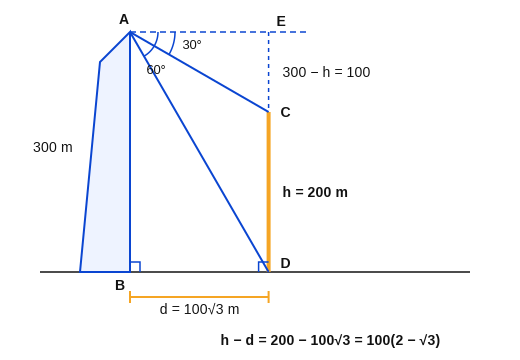
- Foot of pole at 60°: m.
- Top of pole at 30°: m.
- m.
Trick: With 60° and 30° from the same point, the vertical drops are in ratio 3 : 1 → directly.
Answer: (D)
अवधारणा: पहाड़ी की चोटी से बने समकोण त्रिभुजों में tan लगाएँ।
हल:
- खंभे का आधार 60° पर: m।
- खंभे का शीर्ष 30° पर: m।
- m।
ट्रिक: एक ही बिंदु से 60° और 30° हों तो ऊर्ध्व गिरावट 3 : 1 के अनुपात में → ।
उत्तर: (D)
SSC CHSL Tier-1Quantitative AptitudeHeights and distances – angles of depressionSSC CHSL Tier-1 2025 · 20 Nov Shift 3
Q2751.A cube-shaped container with a side length of 12 cm is filled with water. A solid metal sphere with a radius of 6 cm is then submerged into the container. How much water, in cubic centimeters, will overflow ?
12 सेमी भुजा वाला एक घनाकार पात्र पानी से भरा हुआ है। फिर 6 सेमी त्रिज्या वाला एक ठोस धातु का गोला उस पात्र में डुबोया जाता है। कितना पानी (घन सेंटीमीटर में) बाहर बह जाएगा?
- A
- B
- C
- D
Show answer
Concept: Water overflow = volume of the solid immersed.
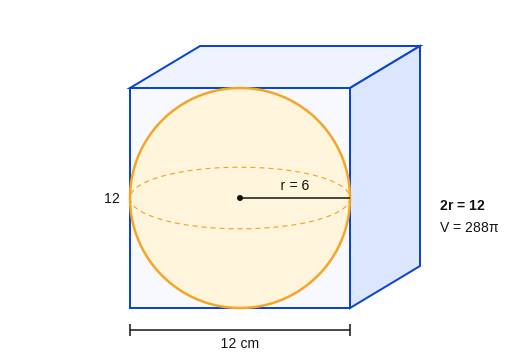
- Sphere diameter = 12 cm = cube side, so it fits fully.
- Volume = .
Trick: Don't subtract from the cube volume – overflow equals the sphere's volume itself.
Answer: (A)
अवधारणा: बाहर निकला पानी = डुबोई गई ठोस वस्तु का आयतन।
हल:
- गोले का व्यास = 12 cm = घन की भुजा, अतः पूरा अंदर आ जाता है।
- आयतन = ।
ट्रिक: घन के आयतन से घटाना नहीं है – बहा पानी = गोले का आयतन।
उत्तर: (A)
SSC CHSL Tier-1Quantitative AptitudeMensuration – sphere in a full cubeSSC CHSL Tier-1 2025 · 20 Nov Shift 3
Q2752.In triangle , side lengths are , and . Let M be the midpoint of side CA . Find the length of BM.
त्रिभुज में भुजाओं की लंबाइयाँ , तथा हैं। माना कि M भुजा CA का मध्य-बिंदु है। BM की लंबाई ज्ञात कीजिए।
- A53.5 cm53.5 सेमी
- B72.5 cm72.5 सेमी
- C66.5 cm66.5 सेमी
- D89.2 cm89.2 सेमी
Show answer
Concept: In a right triangle the median to the hypotenuse = half the hypotenuse.
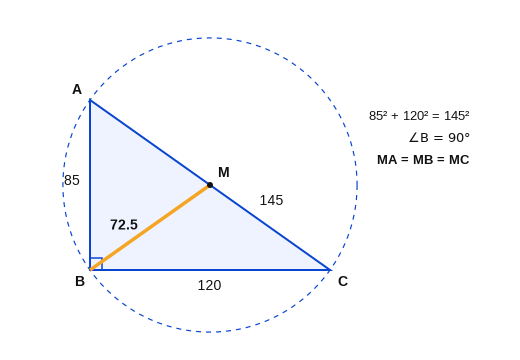
- Check: → right angle at B.
- M is the midpoint of hypotenuse CA.
- cm.
Trick: 85 : 120 : 145 = 17 : 24 : 29 (×5) – a known triplet, so spot the right angle instantly.
Answer: (B) 72.5 cm
अवधारणा: समकोण त्रिभुज में कर्ण पर माध्यिका = कर्ण का आधा।
हल:
- जाँच: → B पर समकोण।
- M कर्ण CA का मध्य-बिंदु है।
- cm।
ट्रिक: 85 : 120 : 145 = 17 : 24 : 29 (×5) – पहचाना हुआ त्रिक, समकोण तुरंत दिखता है।
उत्तर: (B) 72.5 सेमी
SSC CHSL Tier-1Quantitative AptitudeRight triangle – median to hypotenuseSSC CHSL Tier-1 2025 · 20 Nov Shift 3
Q2753.What is the degree measure of radians ?
रेडियन का डिग्री माप क्या है?
- A-240°0'0"
- B200°0'0'
- C-180°0'0*
- D-100°0'0"
Show answer
Concept: .
- .
- Written as .
Trick: ; so and keep the minus sign.
Answer: (A) -240°0'0"
अवधारणा: ।
हल:
- ।
- अर्थात ।
ट्रिक: ; अतः , ऋण चिह्न बना रहेगा।
उत्तर: (A) -240°0'0"
SSC CHSL Tier-1Quantitative AptitudeRadian to degree conversionSSC CHSL Tier-1 2025 · 20 Nov Shift 3
Q2754.Which of the following set can never form the sides of a triangle ?
निम्नलिखित में से कौन-सा समुच्चय कभी भी किसी त्रिभुज की भुजाएँ नहीं बना सकता?
- A2 cm, 4 cm, 5 cm2 सेमी, 4 सेमी, 5 सेमी
- B6 cm, 6 cm, 6 cm6 सेमी, 6 सेमी, 6 सेमी
- C
- D
Show answer
Concept: Sum of the two smaller sides must exceed the largest side.
- A: 2 + 4 = 6 > 5 ✓; B: 6 + 6 > 6 ✓; D: 6 + 8 = 14 > 11 ✓.
- C: 3 + 2 = 5 < 7 ✗ – cannot form a triangle.
Trick: Only test the two smallest sides against the largest – one check per option.
Answer: (C)
अवधारणा: त्रिभुज तभी बनेगा जब छोटी दो भुजाएँ मिलकर तीसरी (सबसे लंबी) से बड़ी हों।
हल:
- A: 2 + 4 = 6 > 5 ✓; B: 6 + 6 > 6 ✓; D: 6 + 8 = 14 > 11 ✓।
- C: 3 + 2 = 5 < 7 ✗ – त्रिभुज नहीं बनेगा।
ट्रिक: केवल दो छोटी भुजाओं का योग सबसे बड़ी से मिलाएँ – हर विकल्प में एक ही जाँच।
उत्तर: (C)
SSC CHSL Tier-1Quantitative AptitudeTriangle inequalitySSC CHSL Tier-1 2025 · 20 Nov Shift 3
Q2755.How many diagonals does a regular heptagon have ?
एक सम सप्तभुज में कितने विकर्ण होते हैं?
- A7
- B14
- C10
- D18
Show answer
Concept: Diagonals of an n-gon = .
- Heptagon: .
- .
Trick: Alternative: (all joining lines minus sides).
Answer: (B) 14
अवधारणा: n भुजाओं वाले बहुभुज के विकर्ण = ।
हल:
- सप्तभुज: ।
- ।
ट्रिक: दूसरा तरीका: (सभी रेखाएँ − भुजाएँ)।
उत्तर: (B) 14
SSC CHSL Tier-1Quantitative AptitudePolygon – number of diagonalsSSC CHSL Tier-1 2025 · 20 Nov Shift 3
Q2756.At a specific rate of simple interest, a sum of money becomes ₹20,500 after four years and ₹21,800 after six. Calculate the simple interest rate at 10% annually for five years on the same amount.
साधारण ब्याज की एक निश्चित दर पर, कोई धनराशि चार वर्ष बाद ₹20,500 तथा छह वर्ष बाद ₹21,800 हो जाती है। उसी धनराशि पर 10% वार्षिक की दर से पाँच वर्ष का साधारण ब्याज ज्ञात कीजिए।
- A₹9,540
- B₹7,140
- C₹8,950
- D₹8,440
Show answer
Concept: Under SI, the amount grows by a fixed interest each year.
- 2 years' SI = ₹1300 → 1 year = ₹650.
- 4 years' SI = ₹2600 → ₹17,900.
- SI at 10% for 5 years = ₹8,950.
Trick: 10% for 5 years = 50% of P → half of 17,900 = ₹8,950.
Answer: (C) ₹8,950
अवधारणा: साधारण ब्याज में हर साल बराबर ब्याज जुड़ता है।
हल:
- 2 वर्ष का ब्याज = ₹1300 → 1 वर्ष = ₹650।
- 4 वर्ष का ब्याज = ₹2600 → ₹17,900।
- 10% पर 5 वर्ष का SI = ₹8,950।
ट्रिक: 10% × 5 वर्ष = P का 50% → 17,900 का आधा = ₹8,950।
उत्तर: (C) ₹8,950
SSC CHSL Tier-1Quantitative AptitudeSimple interest – principal from two amountsSSC CHSL Tier-1 2025 · 20 Nov Shift 3
Q2757.A specific amount of principal is invested by an individual. The annual simple interest rate is 7% for the first two years, 10% for the following four, and for the remaining time. The total interest earned after nine years is ₹8,100. How much was invested initially?
एक व्यक्ति द्वारा एक निश्चित मूलधन निवेश किया जाता है। वार्षिक साधारण ब्याज की दर पहले दो वर्षों के लिए 7%, अगले चार वर्षों के लिए 10% तथा शेष अवधि के लिए है। नौ वर्षों बाद अर्जित कुल ब्याज ₹8,100 है। आरंभ में कितनी धनराशि निवेश की गई थी?
- A₹9,500
- B₹8,000
- C₹9,000
- D₹9,800
Show answer
Concept: Total SI% = sum of (rate × years) for each period.
- Periods: 2 yrs @7%, 4 yrs @10%, 3 yrs @12%.
- Total % = 14 + 40 + 36 = 90% of P.
- 90% of P = ₹8100 → P = ₹9,000.
Trick: Add 'rate × time' blocks first; one division gives the principal.
Answer: (C) ₹9,000
अवधारणा: कुल SI% = हर अवधि के (दर × वर्ष) का योग।
हल:
- अवधियाँ: 2 वर्ष @7%, 4 वर्ष @10%, 3 वर्ष @12%।
- कुल % = 14 + 40 + 36 = P का 90%।
- P का 90% = ₹8100 → P = ₹9,000।
ट्रिक: पहले 'दर × समय' जोड़ें; एक ही भाग से मूलधन मिल जाता है।
उत्तर: (C) ₹9,000
SSC CHSL Tier-1Quantitative AptitudeSimple interest – changing ratesSSC CHSL Tier-1 2025 · 20 Nov Shift 3
Q2758.A person takes a loan of ₹45,000 for 3 years at a rate of interest of 10%. What will be the total amount to be paid after 3 years?
एक व्यक्ति 10% की ब्याज दर पर 3 वर्षों के लिए ₹45,000 का ऋण लेता है। 3 वर्ष बाद चुकाई जाने वाली कुल राशि कितनी होगी?
- A₹58,500
- B₹58,000
- C₹59,000
- D₹50,000
Show answer
Concept: , .
- ₹13,500.
- Amount = ₹58,500.
Trick: Amount = ₹58,500.
Answer: (A) ₹58,500
अवधारणा: , ।
हल:
- ₹13,500।
- मिश्रधन = ₹58,500।
ट्रिक: मिश्रधन = ₹58,500।
उत्तर: (A) ₹58,500
SSC CHSL Tier-1Quantitative AptitudeSimple interest – amountSSC CHSL Tier-1 2025 · 20 Nov Shift 3
Q2759.In two concentric circles, the radius of circle is less than the radius of circle . If PQ is a chord of circle of length 20 cm , touching circle at point M , find the length of MQ .
दो संकेंद्रीय वृत्तों में, वृत्त की त्रिज्या वृत्त की त्रिज्या से कम है। यदि PQ, वृत्त की 20 cm लंबी एक जीवा है, जो वृत्त को बिंदु M पर स्पर्श करती है, तो MQ की लंबाई ज्ञात कीजिए।
- A40 cm
- B15 cm
- C10 cm
- D8 cm
Show answer
Concept: Radius ⊥ tangent; perpendicular from centre bisects a chord.
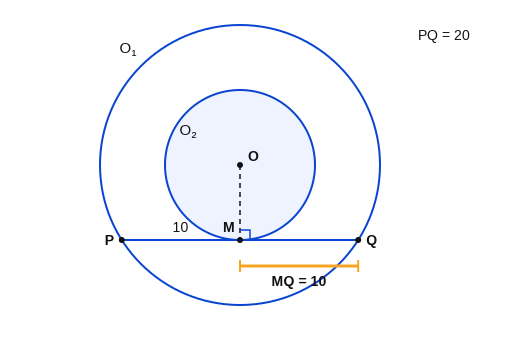
- (OM is radius of the small circle at the point of contact).
- For the big circle, OM is the perpendicular from centre to chord PQ → M is its midpoint.
- cm.
Trick: Point of contact = midpoint of the chord – always, in concentric circles.
Answer: (C) 10 cm
अवधारणा: त्रिज्या स्पर्श रेखा पर लंब होती है; केंद्र से जीवा पर लंब उसे समद्विभाजित करता है।
हल:
- (स्पर्श बिंदु पर छोटे वृत्त की त्रिज्या)।
- बड़े वृत्त में OM केंद्र से जीवा PQ पर लंब है → M मध्य-बिंदु।
- cm।
ट्रिक: संकेंद्रीय वृत्तों में स्पर्श बिंदु हमेशा जीवा का मध्य-बिंदु होता है।
उत्तर: (C) 10 cm
SSC CHSL Tier-1Quantitative AptitudeConcentric circles – chord tangent to inner circleSSC CHSL Tier-1 2025 · 20 Nov Shift 3
Q2760.In a circle, there are two parallel chords of lengths 16 cm and 30 cm. Both chords are situated on the same side of the center. If the distance between them is 7 cm , find the area of the circle.
एक वृत्त में 16 cm और 30 cm लंबाई की दो समांतर जीवाएँ हैं। दोनों जीवाएँ केंद्र के एक ही ओर स्थित हैं। यदि उनके बीच की दूरी 7 cm है, तो वृत्त का क्षेत्रफल ज्ञात कीजिए।
- A square cm वर्ग cm
- B square cm वर्ग cm
- C square cm वर्ग cm
- D square cm वर्ग cm
Show answer
Concept: .
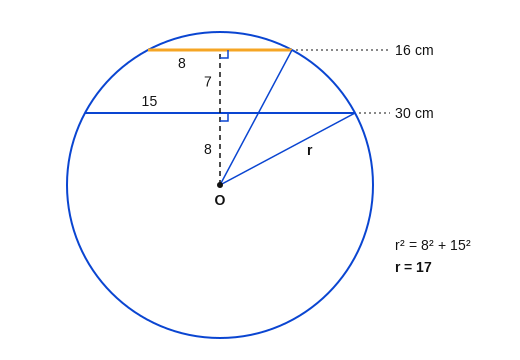
- Half chords: 15 and 8. Let distances be d (30 cm chord) and d + 7 (16 cm chord).
- .
- → area = .
Trick: 8–15–17 triplet: directly once .
Answer: (A) square cm
अवधारणा: ।
हल:
- आधी जीवाएँ: 15 और 8; दूरियाँ d (30 cm जीवा) और d + 7 (16 cm जीवा)।
- ।
- → क्षेत्रफल = ।
ट्रिक: 8–15–17 त्रिक: मिलते ही ।
उत्तर: (A) वर्ग cm
SSC CHSL Tier-1Quantitative AptitudeCircle – parallel chords on same sideSSC CHSL Tier-1 2025 · 20 Nov Shift 3

