Q2821.Which of the following pairs of homophones can be used to fill in the blanks most suitably?
The legal offered valuable to the members during the emergency meeting.
- Acounsel, council
- Bcouncil, counsel
- Ccounsel, counsel
- Dcouncil, council
Show answer
Concept: Council = a body/group of people; counsel = advice (or a lawyer).
- Blank 1: 'The legal ___ offered' – the group that met → council.
- Blank 2: offered valuable ___ to members → advice → counsel.
Trick: counCil = Committee; counSel = Suggestion.
Answer: (B) council, counsel
अवधारणा: Council = परिषद/समिति; counsel = सलाह (या वकील)।
- पहला: 'The legal ___ offered' – बैठक करने वाला समूह → council।
- दूसरा: members को valuable ___ दी गई → सलाह → counsel।
ट्रिक: counCil = Committee; counSel = Suggestion (सलाह)।
उत्तर: (B) council, counsel
SSC CHSL Tier-1English LanguageHomophones – council / counselSSC CHSL Tier-1 2025 · 20 Nov Shift 2
Q2822.Which of the following words refers to a gentle feeling of fondness or liking?
- AAffection
- BAversion
- CAdmiration
- DCompassion
Show answer
Concept: Find the word for a gentle feeling of fondness/liking.
- Affection = tender fondness or love. ✔
- Aversion = strong dislike; admiration = respect/approval; compassion = pity for suffering.
Yaad rakhein: Aversion is the direct opposite of affection – a common antonym pair.
Answer: (A) Affection
अवधारणा: कोमल लगाव/पसंद की भावना वाला शब्द चाहिए।
- Affection = स्नेह, प्यार भरा लगाव। ✔
- Aversion = तीव्र नापसंद; Admiration = प्रशंसा/सम्मान; Compassion = दुखी के प्रति करुणा।
याद रखें: Affection ↔ Aversion – विलोम जोड़ी के रूप में भी पूछा जाता है।
उत्तर: (A) Affection
SSC CHSL Tier-1English LanguageVocabulary – AffectionSSC CHSL Tier-1 2025 · 20 Nov Shift 2
Q2823.Sunita's daughter's son's sister's mother's husband is Anil. How is Anil related to Sunita?
सुनीता की पुत्री के पुत्र की बहन की माता का पति अनिल है। अनिल, सुनीता से किस प्रकार संबंधित है?
- AHusbandपति
- BBrotherभाई
- CFatherपिता
- DSon-in-lawदामाद
Show answer
Concept: Decode the chain from the end nearest to Sunita, one link at a time.
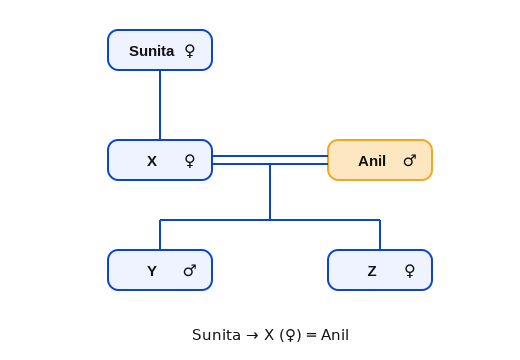
- Daughter's son's sister = another child of Sunita's daughter.
- Her mother = Sunita's daughter herself.
- Mother's husband (Anil) = husband of Sunita's daughter → son-in-law.
Trick: 'X's son's sister's mother' always cancels back to X – skip the loop.
Answer: (D) Son-in-law
अवधारणा: Sunita से शुरू करके एक-एक कड़ी खोलें।
- बेटी के बेटे की बहन = Sunita की बेटी की ही दूसरी संतान।
- उसकी माँ = Sunita की बेटी।
- उस माँ का पति (Anil) = Sunita की बेटी का पति → दामाद।
ट्रिक: 'X के बेटे की बहन की माँ' = X ही; यह घेरा सीधे काट दें।
उत्तर: (D) दामाद
SSC CHSL Tier-1General IntelligenceBlood relation – chain from SunitaSSC CHSL Tier-1 2025 · 20 Nov Shift 2
Q2824.In a family, K is the son of L. M is the brother of K. N is the mother of M. O is the father of N . How is L related to O ?
एक परिवार में, K, L का पुत्र है। M, K का भाई है। N, M की माता है। O, N का पिता है। L, O से किस प्रकार संबंधित है?
- ADaughterपुत्री
- BSon-in-lawदामाद
- CSonपुत्र
- DDaughter-in-lawपुत्रवधू
Show answer
Concept: Build the tree: identify each parent's gender first.
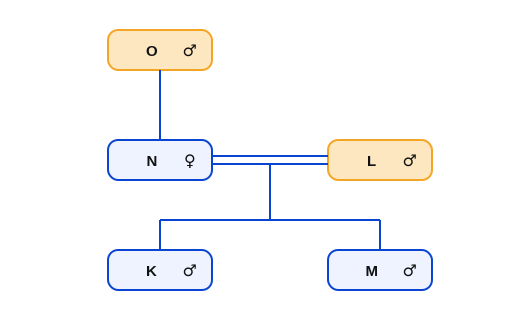
- K and M are brothers; L is a parent of K; N is the mother of M (and K).
- So L must be the father → husband of N.
- O is N's father; N's husband L is O's son-in-law.
Trick: Two parents of the same child: one is mother (N) → the other (L) is male.
Answer: (B) Son-in-law
अवधारणा: परिवार वृक्ष बनाएँ और पहले लिंग तय करें।
- K और M भाई हैं; L, K का माता/पिता है; N, M (और K) की माँ है।
- अतः L पिता है → N का पति।
- O, N का पिता है; इसलिए L, O का दामाद है।
ट्रिक: एक बच्चे के दो माता-पिता में N माँ है → L पुरुष (पिता)।
उत्तर: (B) दामाद
SSC CHSL Tier-1General IntelligenceBlood relation – family treeSSC CHSL Tier-1 2025 · 20 Nov Shift 2
Q2825.A company's profit in the first quarter was ₹1,50,000. In the second quarter, the profit decreased by 20%. What was the profit in the second quarter?
एक कंपनी का प्रथम तिमाही में लाभ ₹1,50,000 था। दूसरी तिमाही में लाभ 20% घट गया। दूसरी तिमाही में लाभ कितना था?
- A₹1,20,000
- B₹1,10,000
- C₹1,12,000
- D₹1,15,000
Show answer
Concept: After a 20% fall, 80% of the original remains.
- Profit = 80% of ₹1,50,000 = .
- = ₹1,20,000.
Trick: 10% of 1,50,000 = 15,000 → 20% = 30,000; .
Answer: (A) ₹1,20,000
अवधारणा: 20% कमी के बाद मूल का 80% बचता है।
- लाभ = 1,50,000 का 80% = ।
- = ₹1,20,000।
ट्रिक: 10% = 15,000 → 20% = 30,000; ।
उत्तर: (A) ₹1,20,000
SSC CHSL Tier-1General IntelligencePercentage – decreaseSSC CHSL Tier-1 2025 · 20 Nov Shift 2
Q2826.The ratio of men to boys in a room is . If there are 25 men, what is the total number of people in the room?
एक कमरे में पुरुषों और लड़कों का अनुपात है। यदि वहाँ 25 पुरुष हैं, तो कमरे में कुल कितने लोग हैं?
- A24
- B40
- C36
- D30
Show answer
Concept: Men : Boys = 5 : 3, total parts = 8.
- 5 parts = 25 men → 1 part = 5.
- Total = .
Trick: Total = in one line.
Answer: (B) 40
अवधारणा: पुरुष : लड़के = 5 : 3, कुल भाग = 8।
- 5 भाग = 25 → 1 भाग = 5।
- कुल = ।
ट्रिक: एक लाइन में: कुल = ।
उत्तर: (B) 40
SSC CHSL Tier-1General IntelligenceRatio – total from one partSSC CHSL Tier-1 2025 · 20 Nov Shift 2
Q2827.P can complete a work in 20 days, and Q can complete the same work in 30 days. If they work together, how many days will they take to complete the work?
P एक कार्य को 20 दिनों में पूरा कर सकता है और Q उसी कार्य को 30 दिनों में पूरा कर सकता है। यदि वे एक साथ कार्य करें, तो कार्य पूरा करने में उन्हें कितने दिन लगेंगे?
- A6 days6 दिन
- B8 days8 दिन
- C12 days12 दिन
- D5 days5 दिन
Show answer
Concept: Together time = for two people.
- .
- = 12 days.
Trick: LCM method: work = 60 units; P = 3/day, Q = 2/day; .
Answer: (C) 12 days
अवधारणा: दो व्यक्तियों का साथ का समय = ।
- ।
- = 12 दिन।
ट्रिक: LCM विधि: कुल काम = 60 इकाई; P = 3, Q = 2 प्रतिदिन; ।
उत्तर: (C) 12 दिन
SSC CHSL Tier-1General IntelligenceTime and work – working togetherSSC CHSL Tier-1 2025 · 20 Nov Shift 2
Q2828.Few of the letters are given followed by a question mark (?) these letters are following a specific pattern you have to give the correct option which can replace question mark.
What letter comes next: C, G, K, O, ?
कुछ अक्षर दिए गए हैं जिनके बाद एक प्रश्नवाचक चिह्न (?) है; ये अक्षर एक निश्चित प्रतिरूप का अनुसरण कर रहे हैं। आपको वह सही विकल्प चुनना है जो प्रश्नवाचक चिह्न के स्थान पर आ सके।
अगला अक्षर कौन-सा आएगा: C, G, K, O, ?
- AS
- BT
- CQ
- DU
Show answer
Concept: Convert letters to positions: C=3, G=7, K=11, O=15.
- Each step adds 4.
- Next = 15 + 4 = 19 = S.
Trick: Skip 3 letters each time: C (DEF) G (HIJ) K (LMN) O (PQR) S.
Answer: (A) S
अवधारणा: अक्षरों के स्थान: C=3, G=7, K=11, O=15।
- हर बार +4।
- अगला = 15 + 4 = 19 = S।
ट्रिक: हर बार 3 अक्षर छोड़ें: C (DEF) G (HIJ) K (LMN) O (PQR) S।
उत्तर: (A) S
SSC CHSL Tier-1General IntelligenceLetter series – +4SSC CHSL Tier-1 2025 · 20 Nov Shift 2
Q2829.In this type of questions, a question is provided with some issues/disputes/problem, followed by few methods to resolve the problem in statement choosing the appropriate problem solving method that can be implemented.
A school is facing frequent delays in morning assembly due to overcrowding at entry gates. What is the most immediate and practical step to resolve the problem?
इस प्रकार के प्रश्नों में कोई मुद्दा/विवाद/समस्या दी जाती है, जिसके बाद उस समस्या के समाधान की कुछ विधियाँ दी जाती हैं; इनमें से वह उपयुक्त समस्या-समाधान विधि चुननी है जिसे क्रियान्वित किया जा सके।
एक विद्यालय में प्रवेश द्वारों पर अत्यधिक भीड़ के कारण प्रातःकालीन सभा में बार-बार विलंब हो रहा है। इस समस्या के समाधान के लिए सबसे तात्कालिक और व्यावहारिक कदम क्या है?
- AIncrease school fees to reduce admissionsप्रवेश कम करने के लिए विद्यालय शुल्क बढ़ा दिया जाए
- BCancel the morning assembly permanentlyप्रातःकालीन सभा स्थायी रूप से बंद कर दी जाए
- CConstruct a new school building immediatelyतत्काल एक नया विद्यालय भवन बनाया जाए
- DStagger entry timings for different classesविभिन्न कक्षाओं के लिए प्रवेश का समय अलग-अलग कर दिया जाए
Show answer
Concept: The best course must be immediate, cheap and must attack the actual cause.
- Cause: all students arrive at the gate together.
- Staggered entry timings spread out arrivals – can start tomorrow at no cost. ✔
- Fee hike, cancelling assembly or a new building are harsh, avoid the issue or take too long.
Trick: Reject options that are extreme, costly or remove the activity itself.
Answer: (D) Stagger entry timings for different classes
अवधारणा: सही कदम तुरंत लागू होने वाला, सस्ता और असली कारण पर चोट करने वाला हो।
- कारण: सभी छात्र एक ही समय गेट पर पहुँचते हैं।
- कक्षाओं का अलग-अलग प्रवेश समय भीड़ बाँट देता है – कल से ही, बिना खर्च। ✔
- फीस बढ़ाना, सभा रद्द करना या नई इमारत – कठोर, टालने वाले या बहुत लंबे उपाय।
ट्रिक: अतिवादी, महँगे या गतिविधि ही खत्म करने वाले विकल्प हटा दें।
उत्तर: (D) विभिन्न कक्षाओं के लिए प्रवेश का समय अलग-अलग कर दिया जाए
SSC CHSL Tier-1General IntelligenceProblem solving – practical actionSSC CHSL Tier-1 2025 · 20 Nov Shift 2
Q2830.By interchanging which two signs the equation will be correct ?
किन दो चिह्नों को आपस में बदल देने पर समीकरण सही हो जाएगा?
- A- and - और
- B- and +- और +
- C+ and + और
- D÷ and ×÷ और ×
Show answer
Concept: Swap the two signs everywhere, then solve by BODMAS.
- Swap − and ÷: .
- ✔.
Trick: Target is a small number (8) – try swaps that create a division first.
Answer: (A) - and
अवधारणा: दोनों चिह्न हर जगह बदलें, फिर BODMAS से हल करें।
- − और ÷ बदलने पर: ।
- ✔।
ट्रिक: उत्तर छोटा (8) है – पहले वे विकल्प जाँचें जिनसे भाग (÷) बड़ी संख्या पर लगे।
उत्तर: (A) - और
SSC CHSL Tier-1General IntelligenceMathematical operations – interchange signsSSC CHSL Tier-1 2025 · 20 Nov Shift 2
Q2831.Pick the correct options from the given alternatives
3 : 9 : 27 :: 4 :16: 64 :: ?
दिए गए विकल्पों में से सही विकल्प चुनिए।
3 : 9 : 27 :: 4 :16: 64 :: ?
- A
- B8 : 64 : 48
- C6 : 36 : 648
- D7 : 49 : 343
Show answer
Concept: Pattern: first, its square, its cube.
- 3 : 9 : 27 and 4 : 16 : 64 follow .
- , → 7 : 49 : 343 ✔.
Trick: Check only the last term: , , – only 343 matches .
Answer: (D) 7 : 49 : 343
अवधारणा: नियम: संख्या, उसका वर्ग, उसका घन।
- 3 : 9 : 27 और 4 : 16 : 64 दोनों हैं।
- , → 7 : 49 : 343 ✔।
ट्रिक: सिर्फ़ अंतिम पद जाँचें: , , – केवल मेल खाता है।
उत्तर: (D) 7 : 49 : 343
SSC CHSL Tier-1General IntelligenceNumber analogy – n : n² : n³SSC CHSL Tier-1 2025 · 20 Nov Shift 2
Q2832.Find out the missing number in the following sequence.
31, 37, 41, 43, 47, ?, 59
निम्नलिखित शृंखला में लुप्त संख्या ज्ञात कीजिए।
31, 37, 41, 43, 47, ?, 59
- A50
- B53
- C52
- D57
Show answer
Concept: All terms are prime numbers in order.
- Primes after 31: 37, 41, 43, 47, 53, 59.
- 50, 52 are even; – not prime.
Trick: Irregular gaps (6, 4, 2, 4) in a series → test for primes.
Answer: (B) 53
अवधारणा: सभी पद क्रम से अभाज्य (prime) संख्याएँ हैं।
- 31 के बाद: 37, 41, 43, 47, 53, 59।
- 50, 52 सम हैं; – अभाज्य नहीं।
ट्रिक: अंतर अनियमित हों (6, 4, 2, 4) तो अभाज्य संख्याएँ जाँचें।
उत्तर: (B) 53
SSC CHSL Tier-1General IntelligenceNumber series – consecutive primesSSC CHSL Tier-1 2025 · 20 Nov Shift 2
Q2833.Select the related letter from the given alternatives
HLCF : INBH :: KOTX : ?
दिए गए विकल्पों में से संबंधित अक्षर-समूह चुनिए।
HLCF : INBH :: KOTX : ?
- ALQSZ
- BLSQZ
- CLOSZ
- DLZQS
Show answer
Concept: Find the shift for each position in HLCF → INBH.
- H+1=I, L+2=N, C−1=B, F+2=H → (+1, +2, −1, +2).
- Apply to KOTX: K→L (+1), O→Q (+2), T→S (−1), X→Z (+2) = LQSZ.
Trick: Check only the 2nd letter: O+2 = Q → only (A) and (D) start 'LQ/LZ'; 3rd letter S picks (A).
Answer: (A) LQSZ
अवधारणा: HLCF → INBH में हर स्थान का अंतर निकालें।
- H+1=I, L+2=N, C−1=B, F+2=H → (+1, +2, −1, +2)।
- KOTX पर: K→L (+1), O→Q (+2), T→S (−1), X→Z (+2) = LQSZ।
ट्रिक: दूसरा अक्षर O+2 = Q – यह केवल (A) में दूसरे स्थान पर है।
उत्तर: (A) LQSZ
SSC CHSL Tier-1General IntelligenceLetter analogy – position shiftsSSC CHSL Tier-1 2025 · 20 Nov Shift 2
Q2834.Select the related letter from the given alternatives
GUJRATI : IGUJRAT :: ENGLISH: ?
दिए गए विकल्पों में से संबंधित अक्षर-समूह चुनिए।
GUJRATI : IGUJRAT :: ENGLISH: ?
- AEHNGLIS
- BENGLHIS
- CHENGLIS
- DEHMGLIS
Show answer
Concept: GUJRATI → IGUJRAT: last letter moved to the front, rest unchanged.
- ENGLISH: last letter H, rest ENGLIS.
- H + ENGLIS = HENGLIS.
Trick: Only one option starts with H – done in 2 seconds.
Answer: (C) HENGLIS
अवधारणा: GUJRATI → IGUJRAT: अंतिम अक्षर सबसे आगे, बाकी क्रम वही।
- ENGLISH: अंतिम अक्षर H, बाकी ENGLIS।
- H + ENGLIS = HENGLIS।
ट्रिक: केवल एक विकल्प H से शुरू होता है – 2 सेकंड में उत्तर।
उत्तर: (C) HENGLIS
SSC CHSL Tier-1General IntelligenceWord analogy – last letter to frontSSC CHSL Tier-1 2025 · 20 Nov Shift 2
Q2835.In the question below there are three statements followed by two conclusions I and II. You have to take the three given statements to be true even if they seem to be at variance from commonly known facts and then decide which of the given conclusions logically follows from the three statements disregarding commonly known facts.
Statements :
three given statements to be true even if they seem to be at variance from commonly known facts and then decide which of the given conclusions logically follows from the three statements disregarding commonly known facts.
Statements :
All dogs are cats.
No cat is a rat.
Conclusions :
I. Some rats are cats.
II. Some dogs are rats.
नीचे दिए गए प्रश्न में तीन कथन दिए गए हैं जिनके बाद दो निष्कर्ष I और II दिए गए हैं। आपको दिए गए तीनों कथनों को सत्य मानना है, चाहे वे सर्वज्ञात तथ्यों से भिन्न प्रतीत होते हों, और फिर यह तय करना है कि सर्वज्ञात तथ्यों की उपेक्षा करते हुए दिए गए निष्कर्षों में से कौन-सा तीनों कथनों से तार्किक रूप से निकलता है।
कथन :
तीनों कथनों को सत्य मानना है, चाहे वे सर्वज्ञात तथ्यों से भिन्न प्रतीत होते हों, और फिर यह तय करना है कि सर्वज्ञात तथ्यों की उपेक्षा करते हुए दिए गए निष्कर्षों में से कौन-सा तीनों कथनों से तार्किक रूप से निकलता है।
कथन :
सभी कुत्ते बिल्लियाँ हैं।
कोई बिल्ली चूहा नहीं है।
निष्कर्ष :
I. कुछ चूहे बिल्लियाँ हैं।
II. कुछ कुत्ते चूहे हैं।
- ANeither conclusion I nor II followsन तो निष्कर्ष I और न ही II निकलता है
- BOnly conclusion I follows.केवल निष्कर्ष I निकलता है।
- CBoth conclusions I and II follow.निष्कर्ष I और II दोनों निकलते हैं।
- DOnly conclusion II follows.केवल निष्कर्ष II निकलता है।
Show answer
Concept: 'All A are B' + 'No B is C' ⇒ 'No A is C'.
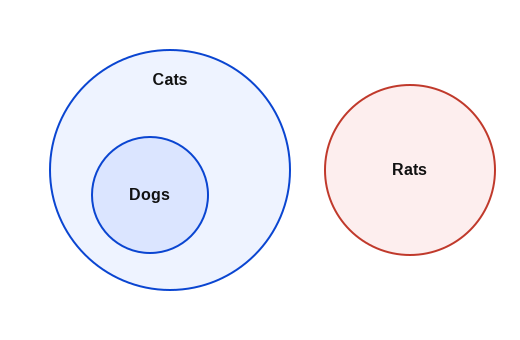
- Dogs ⊂ Cats, Cats ∩ Rats = ∅.
- I: 'Some rats are cats' contradicts 'No cat is a rat' ✘.
- II: Dogs are inside cats, so no dog is a rat ✘.
Trick: All + No = No (definite conclusion) – any 'some' between those two sets is false.
Answer: (A) Neither conclusion I nor II follows
अवधारणा: 'All A are B' + 'No B is C' ⇒ 'No A is C'।
- Dogs, Cats के अंदर; Cats और Rats अलग।
- I: 'Some rats are cats' – 'No cat is a rat' के विपरीत ✘।
- II: सभी dogs, cats में हैं, इसलिए कोई dog, rat नहीं ✘।
ट्रिक: All + No = No; उन दोनों समूहों के बीच 'some' वाला निष्कर्ष गलत होगा।
उत्तर: (A) न तो निष्कर्ष I और न ही II निकलता है
SSC CHSL Tier-1General IntelligenceSyllogism – all / noSSC CHSL Tier-1 2025 · 20 Nov Shift 2
Q2836.Carefully examine the Reference Statement. Then, identify the single option among the four alternatives (a, b, c, d) that is an EXACT AND COMPLETE REPLICATION of the Reference Statement. Pay exceptionally close attention to every character, number, symbol, space, and punctuation mark.
Reference: New Jersey, USA: November 20th, 2010.
संदर्भ कथन का ध्यानपूर्वक परीक्षण कीजिए। इसके बाद चार विकल्पों (a, b, c, d) में से वह एक विकल्प पहचानिए जो संदर्भ कथन की पूर्णतः यथावत प्रतिकृति है। प्रत्येक अक्षर, अंक, चिह्न, रिक्त स्थान तथा विराम-चिह्न पर अत्यंत सावधानी से ध्यान दीजिए।
संदर्भ: New Jersey, USA: November 20th, 2010.
- ANew Jersei, USA: November 20th, 2010.
- BNew Jersey, USA: November 30th, 2010.
- CNew Jersey, USA: November 20th, 2020.
- DNew Jersey, USA: November 20th, 2010.
Show answer
Concept: Compare word, date and year separately.
- (A) 'Jersei' – spelling changed.
- (B) 30th instead of 20th; (C) 2020 instead of 2010.
- (D) matches every character ✔.
Trick: Check numbers first – they are the quickest changes to spot.
Answer: (D) New Jersey, USA: November 20th, 2010.
अवधारणा: शब्द, तारीख और वर्ष अलग-अलग मिलाएँ।
- (A) 'Jersei' – वर्तनी बदली।
- (B) में 20th की जगह 30th; (C) में 2010 की जगह 2020।
- (D) हर अक्षर में मेल खाता है ✔।
ट्रिक: पहले अंक जाँचें – बदलाव सबसे जल्दी वहीं दिखता है।
उत्तर: (D) New Jersey, USA: November 20th, 2010.
SSC CHSL Tier-1General IntelligenceExact replication – detail checkSSC CHSL Tier-1 2025 · 20 Nov Shift 2
Q2837.Select the letter cluster from among the given options that can replace the question mark (?) in the following series.
YGP, DJU, IMZ, SSJ
दिए गए विकल्पों में से वह अक्षर-समूह चुनिए जो निम्नलिखित शृंखला में प्रश्नवाचक चिह्न (?) के स्थान पर आ सकता है।
YGP, DJU, IMZ, SSJ
- AOBV
- BNCV
- CNPE
- DNBV
Show answer
Concept: Treat 1st, 2nd and 3rd letters as separate series.
- 1st: Y, D, I, ?, S → +5 each → I + 5 = N.
- 2nd: G, J, M, ?, S → +3 → M + 3 = P.
- 3rd: P, U, Z, ?, J → +5 → Z + 5 = E (wrap after Z).
Trick: All options begin with N/O; the 2nd letter P alone settles it – NPE.
Answer: (C) NPE
अवधारणा: पहले, दूसरे, तीसरे अक्षर की अलग-अलग श्रृंखला बनाएँ।
- पहला: Y, D, I, ?, S → +5 → I + 5 = N।
- दूसरा: G, J, M, ?, S → +3 → M + 3 = P।
- तीसरा: P, U, Z, ?, J → +5 → Z + 5 = E (Z के बाद फिर A से)।
ट्रिक: दूसरा अक्षर P सिर्फ़ एक विकल्प में है – NPE।
उत्तर: (C) NPE
SSC CHSL Tier-1General IntelligenceLetter cluster series – three positionsSSC CHSL Tier-1 2025 · 20 Nov Shift 2
Q2838.5 persons and T are sitting around a circular table facing towards the centre (not necessarily in the same order). Q is sitting second to the right of S. P is sitting second to the right of is not an immediate neighbour of . Who is sitting third to the right of ?
5 व्यक्ति तथा T एक वृत्ताकार मेज़ के चारों ओर केंद्र की ओर मुख करके बैठे हैं (आवश्यक नहीं कि इसी क्रम में हों)। Q, S के दाईं ओर दूसरे स्थान पर बैठा है। P, के दाईं ओर दूसरे स्थान पर बैठा है, का निकटतम पड़ोसी नहीं है। के दाईं ओर तीसरे स्थान पर कौन बैठा है?
- AQ
- BP
- CS
- DT
Show answer
Concept: Facing centre: right = anti-clockwise.
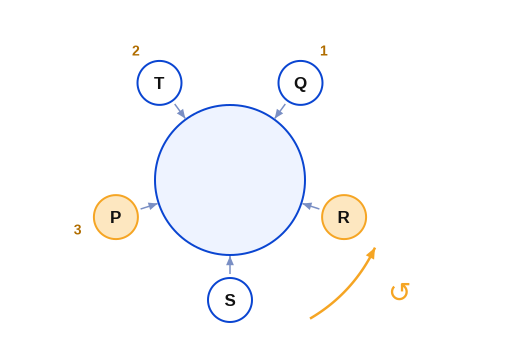
- Fix S; Q is 2 seats anti-clockwise from S; P is 2 more seats from Q.
- Two seats left: R can't be beside P, so R sits between S and Q; T sits between Q and P.
- From R, count 3 anti-clockwise: Q → T → P.
Trick: In a 5-seat circle, '3rd to the right' = '2nd to the left' – count the shorter way.
Answer: (B) P
अवधारणा: केंद्र की ओर मुख: दायाँ = वामावर्त (anti-clockwise)।
- S तय करें; Q उससे 2 सीट वामावर्त, P, Q से 2 सीट आगे।
- बची दो सीटें: R, P के पास नहीं, इसलिए R, S और Q के बीच; T, Q और P के बीच।
- R से 3 सीट वामावर्त गिनें: Q → T → P।
ट्रिक: 5 लोगों के घेरे में 'तीसरा दाएँ' = 'दूसरा बाएँ' – छोटा रास्ता गिनें।
उत्तर: (B) P
SSC CHSL Tier-1General IntelligenceCircular seating – facing centreSSC CHSL Tier-1 2025 · 20 Nov Shift 2
Q2839.A man is facing towards the east. He then turns 45° anti-clockwise, again 180° anti-clockwise and then clockwise. In which direction is he facing now ?
एक व्यक्ति का मुख पूर्व दिशा की ओर है। वह पहले 45° वामावर्त घूमता है, फिर 180° वामावर्त और उसके बाद दक्षिणावर्त घूमता है। अब उसका मुख किस दिशा में है?
- AWestपश्चिम
- BNorthउत्तर
- CSouthदक्षिण
- DEastपूर्व
Show answer
Concept: Take clockwise as +, anti-clockwise as −.
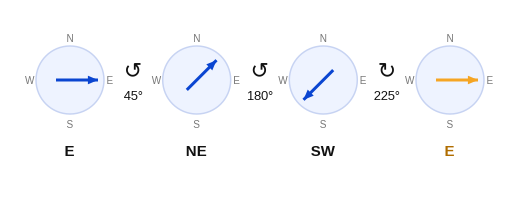
- Net = −45° − 180° + 225° = 0°.
- Zero net turn → same direction as start = East.
Trick: Add the angles first; if the result is 0° or 360°, the facing direction is unchanged.
Answer: (D) East
अवधारणा: दक्षिणावर्त को +, वामावर्त को − मानें।
- कुल = −45° − 180° + 225° = 0°।
- कुल घुमाव शून्य → प्रारंभिक दिशा = पूर्व।
ट्रिक: पहले कोण जोड़ें; परिणाम 0° या 360° हो तो दिशा वही रहती है।
उत्तर: (D) पूर्व
SSC CHSL Tier-1General IntelligenceDirection – net rotationSSC CHSL Tier-1 2025 · 20 Nov Shift 2
Q2840.Arjun starts moving in the east direction. After running 50 meters, he turns left and walks 15 meters straight. Then, from there, he turns to his left and walks 30 meters straight. He again turns 15 meters to his left. How far is he from the starting point?
अर्जुन पूर्व दिशा में चलना आरंभ करता है। 50 मीटर दौड़ने के बाद वह बाईं ओर मुड़कर 15 मीटर सीधा चलता है। फिर वहाँ से वह अपनी बाईं ओर मुड़कर 30 मीटर सीधा चलता है। वह पुनः अपनी बाईं ओर मुड़कर 15 मीटर चलता है। वह आरंभिक बिंदु से कितनी दूर है?
- A10 m10 मीटर
- B40 m40 मीटर
- C20 m20 मीटर
- D30 m30 मीटर
Show answer
Concept: Track each leg: left of East = North, then West, then South.
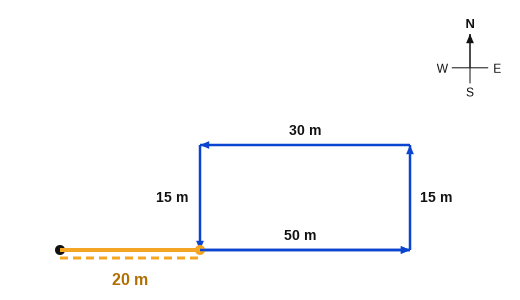
- Legs: 50 E, 15 N, 30 W, 15 S.
- N and S cancel (15 − 15 = 0).
- East−West: 50 − 30 = 20 m.
Trick: Cancel equal opposite legs first; only the leftover is the distance.
Answer: (C) 20 m
अवधारणा: हर चरण की दिशा: पूर्व से बाएँ = उत्तर, फिर पश्चिम, फिर दक्षिण।
- चरण: 50 पूर्व, 15 उत्तर, 30 पश्चिम, 15 दक्षिण।
- उत्तर और दक्षिण कट जाते हैं (15 − 15 = 0)।
- पूर्व − पश्चिम: 50 − 30 = 20 मीटर।
ट्रिक: बराबर और विपरीत चरण पहले काटें; जो बचे वही दूरी।
उत्तर: (C) 20 मीटर
SSC CHSL Tier-1General IntelligenceDirection – distance from startSSC CHSL Tier-1 2025 · 20 Nov Shift 2

