SSC CHSL Tier-1 · 4,996 questions

SSC CHSL Tier-1 2025 PYQs

Real previous year questions, subject-wise. Try the question, then open the answer and the explanation in Hindi & English – free, no login.

Courses – airGurukul

4,996 questions.

Q3541.
Based on the statement(s) given below, choose the best possible conclusion(s) that follows:
Statements:
Only those students who score 60% or more marks in Mathematics will be given admission to the Science
Conclusions:
I. Mathematics is a compulsory subject to get admission to the Science stream.
II. A student who scores 55% marks in Mathematics will not be given admission to the Science stream.
नीचे दिए गए कथन(नों) के आधार पर सर्वोत्तम संभावित निष्कर्ष चुनिए:
कथन:
केवल वे ही विद्यार्थी जो गणित में 60% या उससे अधिक अंक प्राप्त करते हैं, उन्हें विज्ञान में प्रवेश दिया जाएगा निष्कर्ष:
I. विज्ञान संकाय में प्रवेश पाने के लिए गणित एक अनिवार्य विषय है।
II. गणित में 55% अंक प्राप्त करने वाले विद्यार्थी को विज्ञान संकाय में प्रवेश नहीं दिया जाएगा।
  1. AOnly conclusion I followsकेवल निष्कर्ष I अनुसरण करता है
  2. BOnly conclusion II followsकेवल निष्कर्ष II अनुसरण करता है
  3. CBoth conclusion I and II followनिष्कर्ष I और II दोनों अनुसरण करते हैं
  4. DNeither conclusion I nor II followsन तो निष्कर्ष I और न ही निष्कर्ष II अनुसरण करता है
Show answer

Concept: 'Only those who…' makes the condition necessary.

  1. Admission needs ≥ 60% in Mathematics → Maths is compulsory for Science → I follows.
  2. 55% < 60% → no admission → II follows.

Trick: With 'only', anyone failing the condition is surely out — direct follow.

Answer: (C) Both conclusion I and II follow

अवधारणा: 'Only those who…' शर्त को अनिवार्य बना देता है।

  1. प्रवेश के लिए गणित में ≥ 60% चाहिए → गणित अनिवार्य → I अनुसरण करता है।
  2. 55% < 60% → प्रवेश नहीं → II भी अनुसरण करता है।

ट्रिक: 'only' हो तो शर्त पूरी न करने वाला निश्चित रूप से बाहर।

उत्तर: (C) निष्कर्ष I और II दोनों अनुसरण करते हैं
SSC CHSL Tier-1General IntelligenceStatement and conclusions – 'only'SSC CHSL Tier-1 2025 · 18 Nov Shift 1
Q3542.
Carefully examine the Reference Statement. Then, identify the single option among the four alternatives (a, b, c, d) that is an EXACT AND COMPLETE REPLICATION of the Reference Statement. Pay exceptionally close attention to every character, number, symbol, space, and punctuation mark.
Reference: New Delhi, 26/11/2008, 09:30 PM.
संदर्भ कथन की सावधानीपूर्वक जाँच कीजिए। इसके पश्चात् चार विकल्पों (a, b, c, d) में से उस एक विकल्प की पहचान कीजिए जो संदर्भ कथन की पूर्णतः सटीक एवं संपूर्ण प्रतिकृति है। प्रत्येक अक्षर, अंक, चिह्न, रिक्त स्थान तथा विराम-चिह्न पर अत्यंत सावधानी से ध्यान दीजिए।
संदर्भ: New Delhi, 26/11/2008, 09:30 PM.
  1. ANew Delhi, 26/11/2008, 09:30 AM.
  2. BNew Delhi, 26/11/2008, 09:30 PM.
  3. CNew Delhi, 26/11/2008, 9:30 PM.
  4. DNew Delhi, 26/11/2008, 09:25 PM.
Show answer

Concept: Compare every character with the reference.

  1. (A) AM instead of PM ✗.
  2. (C) 9:30 (leading zero missing) ✗.
  3. (D) 09:25 ✗.
  4. (B) matches fully ✓.

Trick: Check only the parts that can change — numbers and AM/PM — first.

Answer: (B) New Delhi, 26/11/2008, 09:30 PM.

अवधारणा: हर अक्षर/अंक संदर्भ से मिलाएँ।

  1. (A) PM की जगह AM ✗।
  2. (C) 9:30 (शुरुआती 0 गायब) ✗।
  3. (D) 09:25 ✗।
  4. (B) पूरा मेल ✓।

ट्रिक: पहले बदलने वाले हिस्से — अंक और AM/PM — मिलाएँ।

उत्तर: (B) New Delhi, 26/11/2008, 09:30 PM.

SSC CHSL Tier-1General IntelligenceExact replication – date and timeSSC CHSL Tier-1 2025 · 18 Nov Shift 1
Q3543.
For the question below, carefully examine the Reference Statement. Then, identify the single option among the four alternatives (a, b, c, d) that is an EXACT AND COMPLETE REPLICATION of the Reference Statement. Pay exceptionally close attention to every character, number, symbol, space, and punctuation mark.
Reference: 3rd Flr., Sunrise Bus. Tower,Plot 18,Sec. 62, Noida - 201309, UP, India
नीचे दिए गए प्रश्न के लिए संदर्भ कथन की सावधानीपूर्वक जाँच कीजिए। इसके पश्चात् चार विकल्पों (a, b, c, d) में से उस एक विकल्प की पहचान कीजिए जो संदर्भ कथन की पूर्णतः सटीक एवं संपूर्ण प्रतिकृति है। प्रत्येक अक्षर, अंक, चिह्न, रिक्त स्थान तथा विराम-चिह्न पर अत्यंत सावधानी से ध्यान दीजिए।
संदर्भ: 3rd Flr., Sunrise Bus. Tower,Plot 18,Sec. 62, Noida - 201309, UP, India
  1. A3rd Flr., Sunrise Bus. Tower,Plot 19,Sec. 62, Noida - 201309, UP, India
  2. B3rd Flr., Sunrise Bus. Tower,Plot 18,Sec. 62, Noida - 201309, UP, India
  3. C3rd Flr., Sunrise Bus. Tower,Plot 18,Sec. 63, Noida - 201309, UP, India
  4. D3rd Flr., Sunrise Bus. Tower,Plot 18,Sec. 62, Noida - 201319, UP, India
Show answer

Concept: Match numbers digit by digit.

  1. (A) Plot 19 ✗.
  2. (C) Sec. 63 ✗.
  3. (D) PIN 201319 ✗.
  4. (B) Plot 18, Sec. 62, 201309 — exact ✓.

Trick: List the reference numbers (18, 62, 201309) and tick them in each option.

Answer: (B) 3rd Flr., Sunrise Bus. Tower,Plot 18,Sec. 62, Noida - 201309, UP, India

अवधारणा: अंकों को एक-एक करके मिलाएँ।

  1. (A) Plot 19 ✗।
  2. (C) Sec. 63 ✗।
  3. (D) PIN 201319 ✗।
  4. (B) Plot 18, Sec. 62, 201309 — हूबहू ✓।

ट्रिक: संदर्भ के अंक (18, 62, 201309) लिखें और हर विकल्प में टिक करें।

उत्तर: (B) 3rd Flr., Sunrise Bus. Tower,Plot 18,Sec. 62, Noida - 201309, UP, India

SSC CHSL Tier-1General IntelligenceExact replication – addressSSC CHSL Tier-1 2025 · 18 Nov Shift 1
Q3544.
For the question below, carefully examine the Reference Statement. Then, identify the single option among the four alternatives (a, b, c, d) that is an EXACT AND COMPLETE REPLICATION of the Reference Statement. Pay exceptionally close attention to every character, number, symbol, space, and punctuation mark.
Reference: Oxford: 15th March, 1892
नीचे दिए गए प्रश्न के लिए संदर्भ कथन की सावधानीपूर्वक जाँच कीजिए। इसके पश्चात् चार विकल्पों (a, b, c, d) में से उस एक विकल्प की पहचान कीजिए जो संदर्भ कथन की पूर्णतः सटीक एवं संपूर्ण प्रतिकृति है। प्रत्येक अक्षर, अंक, चिह्न, रिक्त स्थान तथा विराम-चिह्न पर अत्यंत सावधानी से ध्यान दीजिए।
संदर्भ: Oxford: 15th March, 1892
  1. AOxford: 15th March, 1893
  2. BOxford: 16th March, 1892
  3. COxford: 15th March, 1892
  4. DOxford: 15th March, 1992
Show answer

Concept: Compare day, month and year.

  1. (A) 1893 ✗.
  2. (B) 16th ✗.
  3. (D) 1992 ✗.
  4. (C) 15th March, 1892 ✓.

Trick: Two options differ in the year — eliminate by the last digits first.

Answer: (C) Oxford: 15th March, 1892

अवधारणा: दिन, महीना और वर्ष मिलाएँ।

  1. (A) 1893 ✗।
  2. (B) 16th ✗।
  3. (D) 1992 ✗।
  4. (C) 15th March, 1892 ✓।

ट्रिक: दो विकल्प वर्ष में अलग हैं — अंतिम अंकों से जल्दी हटाएँ।

उत्तर: (C) Oxford: 15th March, 1892

SSC CHSL Tier-1General IntelligenceExact replication – place and dateSSC CHSL Tier-1 2025 · 18 Nov Shift 1
Q3545.
In the following question, select the number which can be placed at the sign of question mark (?) from the given alternatives.
निम्नलिखित प्रश्न में, दिए गए विकल्पों में से वह संख्या चुनिए जिसे प्रश्नवाचक चिह्न (?) के स्थान पर रखा जा सकता है।
  1. A83
  2. B85
  3. C87
  4. D89
Show answer

Concept: Bottom number of each column = (product of the three numbers above) − 1.

  1. Column 1: 4×5×6−1=119.
  2. Column 2: 3×5×7−1=104.
  3. Column 3: 6×3×5−1=90−1 = 89.

Trick: Product 90 is near all options; just check which option + 1 = 90.

Answer: (D) 89

अवधारणा: हर स्तंभ की नीचे वाली संख्या = (ऊपर की तीन संख्याओं का गुणनफल) − 1।

  1. स्तंभ 1: 4×5×6−1=119।
  2. स्तंभ 2: 3×5×7−1=104।
  3. स्तंभ 3: 6×3×5−1=90−1 = 89।

ट्रिक: गुणनफल 90 आया; जिस विकल्प में 1 जोड़कर 90 बने वही उत्तर।

उत्तर: (D) 89

SSC CHSL Tier-1General IntelligenceNumber matrix – product minus 1SSC CHSL Tier-1 2025 · 18 Nov Shift 1
Q3546.
In the following question, select the number which can be placed at the sign of question mark (?) from the given alternatives.
Matrix:
निम्नलिखित प्रश्न में, दिए गए विकल्पों में से वह संख्या चुनिए जिसे प्रश्नवाचक चिह्न (?) के स्थान पर रखा जा सकता है।
आव्यूह:
  1. A191
  2. B185
  3. C190
  4. D187
Show answer

Concept: Same rule: (product of the three numbers in a column) − 1.

  1. Column 1: 4×6×7−1=167.
  2. Column 2: 7×5×4−1=139.
  3. Column 3: 8×4×6−1=192−1 = 191.

Trick: Verify the rule on two columns before applying it to the third.

Answer: (A) 191

अवधारणा: नियम: (स्तंभ की तीन संख्याओं का गुणनफल) − 1।

  1. स्तंभ 1: 4×6×7−1=167।
  2. स्तंभ 2: 7×5×4−1=139।
  3. स्तंभ 3: 8×4×6−1=192−1 = 191।

ट्रिक: तीसरे स्तंभ पर लगाने से पहले नियम दो स्तंभों पर जाँच लें।

उत्तर: (A) 191

SSC CHSL Tier-1General IntelligenceNumber matrix – product minus 1SSC CHSL Tier-1 2025 · 18 Nov Shift 1
Q3547.
The intersection of Natural numbers and Whole numbers is:
प्राकृत संख्याओं तथा पूर्ण संख्याओं का सर्वनिष्ठ (प्रतिच्छेदन) है:
  1. ANaturalप्राकृत
  2. BWholeपूर्ण
  3. CIntegersपूर्णांक
  4. DEmptyरिक्त
Show answer

Concept: Intersection = elements common to both sets.

  1. N = {1, 2, 3, …}; W = {0, 1, 2, 3, …}.
  2. N is a subset of W (W only adds 0).
  3. Common part = N itself → Natural numbers.

Trick: If A ⊂ B, then A ∩ B = A (smaller set) and A ∪ B = B (bigger set).

Answer: (A) Natural

अवधारणा: Intersection = दोनों समुच्चयों के उभयनिष्ठ अवयव।

  1. N = {1, 2, 3, …}; W = {0, 1, 2, 3, …}।
  2. N, W का उपसमुच्चय है (W में केवल 0 अतिरिक्त)।
  3. उभयनिष्ठ भाग = N → प्राकृत संख्याएँ।

ट्रिक: A ⊂ B हो तो A ∩ B = A (छोटा समुच्चय) और A ∪ B = B (बड़ा समुच्चय)।

उत्तर: (A) प्राकृत

SSC CHSL Tier-1Quantitative AptitudeNumber sets – N ∩ WSSC CHSL Tier-1 2025 · 18 Nov Shift 1
Q3548.
Which number is NOT real ?
कौन-सी संख्या वास्तविक नहीं है?
  1. A8
  2. B−8
  3. C18
  4. D−8
Show answer

Concept: The square root of a negative number is not real (it is imaginary).

  1. 8, −8 and 18 are irrational but still real.
  2. −8: no real number squared gives −8 → −8=22i (imaginary).
  3. So the non-real number is −8.

Trick: Minus sign inside the √ → not real; minus sign outside the √ → still real.

Answer: (B) −8

अवधारणा: ऋणात्मक संख्या का वर्गमूल वास्तविक नहीं होता (काल्पनिक होता है)।

  1. 8, −8 और 18 अपरिमेय हैं, पर वास्तविक हैं।
  2. −8: किसी वास्तविक संख्या का वर्ग −8 नहीं होता → −8=22i (काल्पनिक)।
  3. अतः अवास्तविक संख्या −8 है।

ट्रिक: √ के अंदर ऋण चिह्न → अवास्तविक; √ के बाहर ऋण → वास्तविक।

उत्तर: (B) −8

SSC CHSL Tier-1Quantitative AptitudeReal vs non-real numbersSSC CHSL Tier-1 2025 · 18 Nov Shift 1
Q3549.
The number of irrational numbers between any two rational numbers is:
किन्हीं दो परिमेय संख्याओं के बीच अपरिमेय संख्याओं की संख्या होती है:
  1. A0
  2. B1
  3. CFiniteपरिमित
  4. DInfiniteअनंत
Show answer

Concept: Between any two distinct real numbers lie infinitely many rationals and irrationals.

  1. Example: between 1 and 2 → 2, 3, 1+210, 1+2100, …
  2. Such numbers can be produced endlessly → infinite.

Yaad rakhein: The real number line has no gaps: rationals and irrationals are both 'dense'.

Answer: (D) Infinite

अवधारणा: किन्हीं दो भिन्न वास्तविक संख्याओं के बीच अनंत परिमेय और अपरिमेय संख्याएँ होती हैं।

  1. उदाहरण: 1 और 2 के बीच → 2, 3, 1+210, 1+2100, …
  2. ऐसी संख्याएँ लगातार बनाई जा सकती हैं → अनंत।

याद रखें: संख्या रेखा पर कोई खाली जगह नहीं — परिमेय और अपरिमेय दोनों 'सघन' हैं।

उत्तर: (D) अनंत

SSC CHSL Tier-1Quantitative AptitudeDensity of irrational numbersSSC CHSL Tier-1 2025 · 18 Nov Shift 1
Q3550.
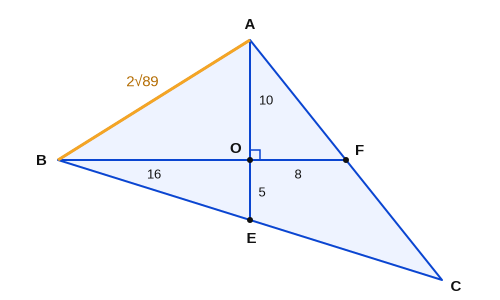
In triangle ABC, two medians, AE and BF, intersect each other at 0 at right angles. If AE=15cm and BF=24cm, then find the length of AB.
त्रिभुज ABC में, दो माध्यिकाएँ AE तथा BF एक-दूसरे को O पर समकोण पर प्रतिच्छेद करती हैं। यदि AE=15cm तथा BF=24cm हो, तो AB की लंबाई ज्ञात कीजिए।
  1. A289cm
  2. B89cm
  3. C489cm
  4. D389cm
Show answer

Concept: Centroid divides each median 2:1 from the vertex.

  1. AO=23×15=10 cm; BO=23×24=16 cm.
  2. ∠AOB=90∘ → AB2=102+162=100+256=356.
  3. AB=356=4×89 = 289 cm.

Trick: Take 23 of both medians first, then apply Pythagoras on the two vertex parts.

Answer: (A) 289cm

अवधारणा: केन्द्रक प्रत्येक माध्यिका को शीर्ष से 2:1 में बाँटता है।

  1. AO=23×15=10 cm; BO=23×24=16 cm।
  2. ∠AOB=90∘ → AB2=102+162=100+256=356।
  3. AB=356=4×89 = 289 cm।

ट्रिक: पहले दोनों माध्यिकाओं का 23 लें, फिर पाइथागोरस लगाएँ।

उत्तर: (A) 289cm

SSC CHSL Tier-1Quantitative AptitudeMedians at right angles – centroidSSC CHSL Tier-1 2025 · 18 Nov Shift 1
Q3551.
If 18 men can do a piece of work in 25 days, the time taken by 15 men to do the same piece of work will be:
यदि 18 पुरुष किसी कार्य को 25 दिनों में कर सकते हैं, तो उसी कार्य को 15 पुरुषों द्वारा करने में लगने वाला समय होगा:
  1. A25 days25 दिन
  2. B28 days28 दिन
  3. C26 days26 दिन
  4. D30 days30 दिन
Show answer

Concept: M1D1=M2D2 for the same work.

  1. Work = 18×25=450 man-days.
  2. Days for 15 men = 450÷15 = 30 days.

Trick: Days = 25×1815=25×65=30 (fewer men → bigger fraction).

Answer: (D) 30 days

अवधारणा: एक ही काम के लिए M1D1=M2D2।

  1. कुल काम = 18×25=450 मानव-दिवस।
  2. 15 व्यक्तियों को दिन = 450÷15 = 30 दिन।

ट्रिक: दिन = 25×1815=25×65=30 (कम व्यक्ति → बड़ा भिन्न)।

उत्तर: (D) 30 दिन

SSC CHSL Tier-1Quantitative AptitudeMen and days – inverse proportionSSC CHSL Tier-1 2025 · 18 Nov Shift 1
Q3552.
A does 70% of the work in 14 days. He then calls in B, and they together finish the remaining work in 3 days. How long would B alone take to do the whole work ?
A किसी कार्य का 70% भाग 14 दिनों में करता है। इसके बाद वह B को बुला लेता है और दोनों मिलकर शेष कार्य 3 दिनों में पूरा कर लेते हैं। B अकेला संपूर्ण कार्य कितने दिनों में करेगा?
  1. A22 days22 दिन
  2. B20 days20 दिन
  3. C28 days28 दिन
  4. D25 days25 दिन
Show answer

Concept: Find A's rate from partial work, then B's rate from joint work.

  1. 70% in 14 days → 100% in 20 days → A does 5% per day.
  2. Remaining 30% done by A + B in 3 days → 10% per day.
  3. B = 10%−5%=5% per day → whole work in 20 days.

Trick: Work in percentages: per-day % of B = 303−7014=10−5=5% → 1005=20.

Answer: (B) 20 days

अवधारणा: आंशिक कार्य से A की दर, फिर संयुक्त कार्य से B की दर निकालें।

  1. 14 दिन में 70% → 20 दिन में 100% → A प्रतिदिन 5%।
  2. बचा 30%, A + B ने 3 दिन में → प्रतिदिन 10%।
  3. B = 10%−5%=5% प्रतिदिन → पूरा काम 20 दिन में।

ट्रिक: प्रतिशत में सोचें: B = 303−7014=10−5=5% → 1005=20।

उत्तर: (B) 20 दिन

SSC CHSL Tier-1Quantitative AptitudeTime and work – finding B's timeSSC CHSL Tier-1 2025 · 18 Nov Shift 1
Q3553.
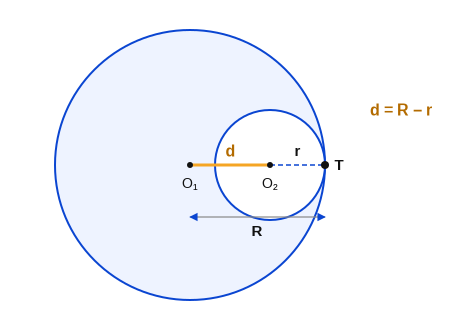
If the difference of the radii of two circles is equal to the distance between their centres, then:
यदि दो वृत्तों की त्रिज्याओं का अंतर उनके केंद्रों के बीच की दूरी के बराबर हो, तो:
  1. Athe circles are concentricवृत्त संकेंद्रीय हैं
  2. Bthe circles touch externallyवृत्त बाह्यतः स्पर्श करते हैं
  3. Cthe circles touch internallyवृत्त अंतःतः स्पर्श करते हैं
  4. Dthe circles intersect each otherवृत्त एक-दूसरे को प्रतिच्छेद करते हैं
Show answer

Concept: Compare distance between centres (d) with R + r and R − r.

  1. d = R + r → touch externally.
  2. d = R − r → touch internally.
  3. d = 0 → concentric; R − r < d < R + r → intersect.

Trick: 'Difference' of radii ↔ 'internal'; 'sum' of radii ↔ 'external'.

Answer: (C) the circles touch internally

अवधारणा: केंद्रों की दूरी (d) की तुलना R + r और R − r से करें।

  1. d = R + r → बाह्य स्पर्श।
  2. d = R − r → अन्तःस्पर्श।
  3. d = 0 → संकेंद्रीय; R − r < d < R + r → प्रतिच्छेद।

ट्रिक: त्रिज्याओं का 'अंतर' ↔ 'अंदर से' स्पर्श; 'योग' ↔ 'बाहर से' स्पर्श।

उत्तर: (C) वृत्त अंतःतः स्पर्श करते हैं

SSC CHSL Tier-1Quantitative AptitudeTwo circles – internal touchingSSC CHSL Tier-1 2025 · 18 Nov Shift 1
Q3554.
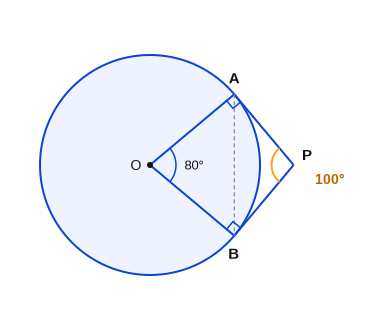
In a circle, chord AB subtends 80° at the center. The angle between the tangents at A and B is:
एक वृत्त में जीवा AB केंद्र पर 80° का कोण अंतरित करती है। A तथा B पर खींची गई स्पर्श रेखाओं के बीच का कोण है:
  1. A70°
  2. B100°
  3. C140°
  4. D130°
Show answer

Concept: Radius ⊥ tangent; angle at centre + angle between tangents = 180°.

  1. In quadrilateral OAPB: ∠A = ∠B = 90°.
  2. ∠P = 360° − 90° − 90° − 80° = 100°.

Trick: Angle between tangents = 180° − central angle = 180° − 80° = 100°.

Answer: (B) 100°

अवधारणा: त्रिज्या ⊥ स्पर्श रेखा; केंद्र पर कोण + स्पर्श रेखाओं के बीच कोण = 180°।

  1. चतुर्भुज OAPB में ∠A = ∠B = 90°।
  2. ∠P = 360° − 90° − 90° − 80° = 100°।

ट्रिक: स्पर्श रेखाओं के बीच कोण = 180° − केंद्रीय कोण = 100°।

उत्तर: (B) 100°

SSC CHSL Tier-1Quantitative AptitudeAngle between two tangentsSSC CHSL Tier-1 2025 · 18 Nov Shift 1
Q3555.
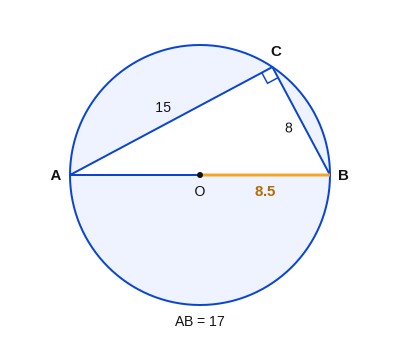
The radius of the circle passing through the vertices of a triangle with sides 8cm,15cm, and 17 cm is:
उस वृत्त की त्रिज्या ज्ञात कीजिए जो 8cm,15cm तथा 17 cm भुजाओं वाले त्रिभुज के शीर्षों से होकर जाता है:
  1. A7.5 cm
  2. B8 cm
  3. C7.8 cm
  4. D8.5 cm
Show answer

Concept: In a right triangle, circumradius=hypotenuse÷2.

  1. 82+152=64+225=289=172 → right triangle.
  2. R=17÷2 = 8.5 cm.

Trick: Spot the triplet (8, 15, 17) — then just halve the largest side.

Answer: (D) 8.5 cm

अवधारणा: समकोण त्रिभुज में परित्रिज्या=कर्ण÷2।

  1. 82+152=64+225=289=172 → समकोण त्रिभुज।
  2. R=17÷2 = 8.5 cm।

ट्रिक: त्रिक (8, 15, 17) पहचानें — सबसे बड़ी भुजा का आधा = उत्तर।

उत्तर: (D) 8.5 cm

SSC CHSL Tier-1Quantitative AptitudeCircumradius of a right triangleSSC CHSL Tier-1 2025 · 18 Nov Shift 1
Q3556.
The circumference of a circle is 154 cm . The radius of the given circle is equal to the radius of a cone having height 14 cm . Find the approximate volume of the cone. (Take π=227 )
एक वृत्त की परिधि 154 cm है। दिए गए वृत्त की त्रिज्या, 14 cm ऊँचाई वाले एक शंकु की त्रिज्या के बराबर है। शंकु का लगभग आयतन ज्ञात कीजिए। (π=227 लीजिए)
  1. A8803cm3
  2. B8083cm3
  3. C8830cm3
  4. D8863cm3
Show answer

Concept: r=C2π; V=13πr2h.

  1. 2πr=154⇒r=154×744=24.5 cm.
  2. V=13×227×24.5×24.5×14.
  3. =22×24.5×24.5×2÷3=26411÷3≈ 8803 cm³.

Trick: h=14 cancels the 7 of π – always cancel 7 first, then multiply.

Answer: (A) 8803cm3

अवधारणा: r=C2π; V=13πr2h।

  1. 2πr=154⇒r=154×744=24.5 cm।
  2. V=13×227×24.5×24.5×14।
  3. =22×24.5×24.5×2÷3=26411÷3≈ 8803 cm³।

ट्रिक: h=14 से π का 7 कट जाता है — पहले 7 काटें, फिर गुणा करें।

उत्तर: (A) 8803cm3

SSC CHSL Tier-1Quantitative AptitudeVolume of a coneSSC CHSL Tier-1 2025 · 18 Nov Shift 1
Q3557.
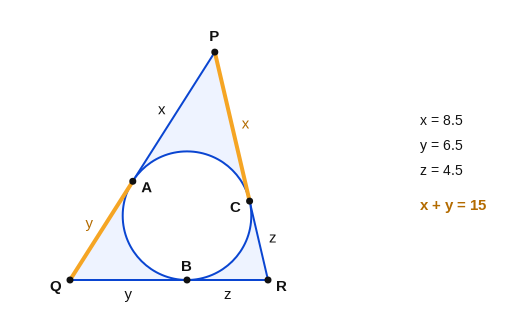
A circle is inscribed in △PQR, touching PQ,QR and PR at the points A , B and C, respectively. If PQ−QR=4cm, PQ−PR=2cm and the perimeter of △PQR=39cm, then AQ+PC (in cm) is:
एक वृत्त △PQR में अंतर्निहित है, जो PQ,QR तथा PR को क्रमशः बिंदु A , B तथा C पर स्पर्श करता है। यदि PQ−QR=4cm, PQ−PR=2cm तथा परिमाप △PQR=39cm हो, तो AQ+PC (cm में) कितना होगा?
  1. A13
  2. B11
  3. C16
  4. D15
Show answer

Concept: Tangents from one external point are equal: PA = PC = x, QA = QB = y, RB = RC = z.

  1. PQ = x + y, QR = y + z, PR = x + z; 2(x + y + z) = 39 → x + y + z = 19.5.
  2. PQ − QR = x − z = 4; PQ − PR = y − z = 2.
  3. 3z + 6 = 19.5 → z = 4.5; x = 8.5, y = 6.5.
  4. AQ + PC = y + x = 15 cm.

Trick: AQ + PC = x + y = semi-perimeter − z = 19.5 − 4.5 = 15.

Answer: (D) 15

अवधारणा: एक बाहरी बिंदु से खींची स्पर्श रेखाएँ बराबर: PA = PC = x, QA = QB = y, RB = RC = z।

  1. PQ = x + y, QR = y + z, PR = x + z; 2(x + y + z) = 39 → x + y + z = 19.5।
  2. PQ − QR = x − z = 4; PQ − PR = y − z = 2।
  3. 3z + 6 = 19.5 → z = 4.5; x = 8.5, y = 6.5।
  4. AQ + PC = y + x = 15 cm।

ट्रिक: AQ + PC = x + y = अर्धपरिमाप − z = 19.5 − 4.5 = 15।

उत्तर: (D) 15

SSC CHSL Tier-1Quantitative AptitudeIncircle – equal tangent lengthsSSC CHSL Tier-1 2025 · 18 Nov Shift 1
Q3558.
A man lends out a sum of money by putting 30% of it at 7.5% p.a. simple interest and the remaining 70% at 11.25% p.a. simple interest. After 212 years ( 2.5 years) his total interest income is ₹7,825. What was the original sum (principal) he lent?
एक व्यक्ति अपनी धनराशि का 30% भाग 7.5% वार्षिक साधारण ब्याज पर तथा शेष 70% भाग 11.25% वार्षिक साधारण ब्याज पर उधार देता है। 212 वर्ष (2.5 वर्ष) के बाद उसकी कुल ब्याज आय ₹7,825 है। उसने मूल रूप से कितनी धनराशि (मूलधन) उधार दी थी?
  1. ARs. 30,913.58
  2. BRs. 34,916 . 63
  3. CRs. 30,619.73
  4. DRs. 30 , 916 . 36
Show answer

Concept: Find one average rate for the whole sum, then SI=P×R×T100.

  1. Average rate = 0.3×7.5+0.7×11.25=2.25+7.875=10.125%.
  2. For 2.5 years: 10.125×2.5=25.3125% of P = ₹7825.
  3. P = 7825÷0.253125=7825×32081 ≈ ₹30,913.58.

Trick: Weighted rate: 70% of the sum is at 11.25%, so the average rate lies nearer 11.25 (≈ 10.1%).

Answer: (A) Rs. 30,913.58

अवधारणा: पूरे धन के लिए एक औसत दर निकालें, फिर SI=P×R×T100।

  1. औसत दर = 0.3×7.5+0.7×11.25=2.25+7.875=10.125%।
  2. 2.5 वर्ष के लिए: 10.125×2.5 = P का 25.3125% = ₹7825।
  3. P = 7825÷0.253125=7825×32081 ≈ ₹30,913.58।

ट्रिक: भारित दर: 70% भाग 11.25% पर है, इसलिए औसत दर 11.25 के करीब (≈10.1%)।

उत्तर: (A) Rs. 30,913.58

SSC CHSL Tier-1Quantitative AptitudeSimple interest – sum split at two ratesSSC CHSL Tier-1 2025 · 18 Nov Shift 1
Q3559.
Ankush spends 85% of his income, whereas Ankit spends 70% of his income. Both of them save Rs. 9,000 each. The income of Mohit is one-third of the sum of the income of Ankush and Ankit . If Mohit spends (79) th of his income, then find his savings.
अंकुश अपनी आय का 85% खर्च करता है, जबकि अंकित अपनी आय का 70% खर्च करता है। उनमें से प्रत्येक Rs. 9,000 की बचत करता है। मोहित की आय, अंकुश और अंकित की आय के योग की एक-तिहाई है। यदि मोहित अपनी आय का (79) वाँ भाग खर्च करता है, तो उसकी बचत ज्ञात कीजिए।
  1. ARs. 6666.67
  2. BRs. 8676.67
  3. CRs. 7666.67
  4. DRs. 7665.67
Show answer

Concept: Savings % = 100 − expenditure %.

  1. Ankush saves 15%=9000 → income = 9000×10015 = ₹60,000.
  2. Ankit saves 30%=9000 → income = ₹30,000.
  3. Mohit's income = 60,000+30,0003 = ₹30,000.
  4. Mohit saves 1−79=29 → 29×30,000 = ₹6666.67.

Trick: Answer must be a multiple of 19 of 30,000 (= 3333.33) → only 6666.67 fits.

Answer: (A) Rs. 6666.67

अवधारणा: बचत % = 100 − व्यय %।

  1. अंकुश 15% बचाता है = 9000 → आय = 9000×10015 = ₹60,000।
  2. अंकित 30% बचाता है = 9000 → आय = ₹30,000।
  3. मोहित की आय = 60,000+30,0003 = ₹30,000।
  4. मोहित की बचत = 1−79=29 → 29×30,000 = ₹6666.67।

ट्रिक: उत्तर 30,000 के 19 (3333.33) का गुणज होना चाहिए → केवल 6666.67।

उत्तर: (A) Rs. 6666.67

SSC CHSL Tier-1Quantitative AptitudeIncome, expenditure and savingsSSC CHSL Tier-1 2025 · 18 Nov Shift 1
Q3560.
In a partnership, the capital ratio between P and Q is 8:6. If P invested Rs 80,000 , how much did Q invest ?
एक साझेदारी में P और Q की पूँजी का अनुपात 8:6 है। यदि P ने Rs 80,000 निवेश किए, तो Q ने कितना निवेश किया?
  1. ARs 60,000
  2. BRs 67,000
  3. CRs 85,000
  4. DRs 65,000
Show answer

Concept: Use the given ratio as a proportion.

  1. P : Q = 8:6=4:3.
  2. 8 parts = 80,000 → 1 part = 10,000.
  3. Q = 6×10,000 = ₹60,000.

Trick: P is 8 units = 80,000, so each unit is 10,000 — read Q directly: 60,000.

Answer: (A) Rs 60,000

अवधारणा: दिए अनुपात को समानुपात की तरह प्रयोग करें।

  1. P : Q = 8:6=4:3।
  2. 8 भाग = 80,000 → 1 भाग = 10,000।
  3. Q = 6×10,000 = ₹60,000।

ट्रिक: 8 इकाई = 80,000 → 1 इकाई = 10,000 → Q = 60,000 सीधे।

उत्तर: (A) Rs 60,000

SSC CHSL Tier-1Quantitative AptitudePartnership – capital ratioSSC CHSL Tier-1 2025 · 18 Nov Shift 1