Q641.In the following figure series, select the figure which can be placed at the sign of question mark (?) from the given alternatives.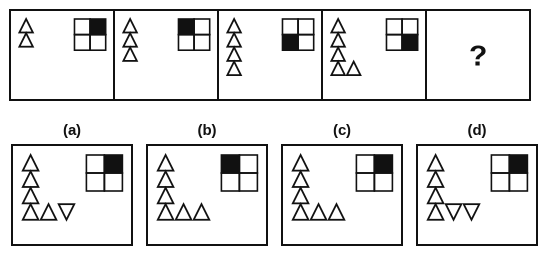
निम्नलिखित आकृति शृंखला में, दिए गए विकल्पों में से उस आकृति का चयन कीजिए जिसे प्रश्नवाचक चिह्न (?) के स्थान पर रखा जा सकता है। - A(a)
- B(b)
- C(c)
- D(d)
Show answer
Concept: Track two changes separately: number of triangles and position of the shaded cell.
Solution:
- Triangles: 2, 3, 4, 5 → next = 6 (all pointing up).
- Shaded cell moves one corner anticlockwise each step: TR → TL → BL → BR → next TR.
- Figure with 6 triangles and top-right shaded = option C.
Trick: Split a figure series into independent parts – solve each, then match both.
Answer: (C) Option C
अवधारणा: दो बदलाव अलग-अलग देखें: त्रिभुजों की संख्या और छायांकित खाने की स्थिति।
हल:
- त्रिभुज: 2, 3, 4, 5 → अगला 6।
- छायांकित खाना हर बार एक कोना वामावर्त: ऊपर-दाएँ → ऊपर-बाएँ → नीचे-बाएँ → नीचे-दाएँ → फिर ऊपर-दाएँ।
- 6 त्रिभुज + ऊपर-दाएँ छायांकित = विकल्प C।
ट्रिक: श्रृंखला को अलग-अलग भागों में तोड़ें, फिर दोनों मिलाएँ।
उत्तर: (C) विकल्प C
SSC CHSL Tier-1General IntelligenceFigure series – count and rotationSSC CHSL Tier-1 2025 · 28 Nov Shift 3
Q642.If ' - means ' ', '+' means '×', '÷' means ' 4 ' and ' ' means ' + ', then ?
यदि ' - का अर्थ ' ' है, '+' का अर्थ '×' है, '÷' का अर्थ ' 4 ' है और ' ' का अर्थ ' + ' है, तो ?
- A20
- B16
- C18
- D22
Show answer
Concept: Replace signs first, then apply BODMAS. (Here '÷' stands for '−'.)
Solution:
- Swap: − → ÷, + → ×, ÷ → −, × → +.
- Converted:
- 18.
Trick: Write the new expression on paper before calculating – most mistakes come from solving with old signs.
Answer: (C) 18
अवधारणा: पहले चिह्न बदलें, फिर BODMAS लगाएँ ('÷' का अर्थ '−' है)।
हल:
- बदला हुआ रूप:
- 18।
ट्रिक: पहले नया व्यंजक लिख लें, तभी हल करें।
उत्तर: (C) 18
SSC CHSL Tier-1General IntelligenceSymbol substitution – BODMASSSC CHSL Tier-1 2025 · 28 Nov Shift 3
Q643.Select the correct combination of mathematical signs to replace (*) signs sequentially and to balance the given equation.
दिए गए समीकरण को संतुलित करने के लिए (*) चिह्नों को क्रमिक रूप से प्रतिस्थापित करने वाले गणितीय चिह्नों के सही संयोजन का चयन कीजिए।
- A
- B
- C,
- D×, - +,+
Show answer
Concept: Insert each option's signs in order and simplify with BODMAS.
Solution:
- Option B: .
- .
- = 23 ✔
Trick: RHS 23 is small and odd → the last sign is likely '−5' or '+5'; test those options first.
Answer: (B)
अवधारणा: हर विकल्प के चिह्न क्रम से लगाकर BODMAS से हल करें।
हल:
- विकल्प B: ।
- ।
- = 23 ✔
ट्रिक: अंतिम चिह्न से शुरुआत कर विकल्प जल्दी छाँटें।
उत्तर: (B)
SSC CHSL Tier-1General IntelligenceBalancing equation – sign combinationSSC CHSL Tier-1 2025 · 28 Nov Shift 3
Q644.In the following question, select the odd letter-number cluster from the given alternatives.
(NOTE: Operations should be performed on the whole numbers, without breaking down the number into its constituent digits. E.g. 13 - Operations on 13 such as adding /subtracting /multiplying etc. to 13 can be performed. Breaking down 13 into 1 and 3 and then performing mathematical operations on 1 and 3 is not allowed)
निम्नलिखित प्रश्न में, दिए गए विकल्पों में से विषम अक्षर-संख्या समूह का चयन कीजिए।
(नोट: संक्रियाएँ पूर्ण संख्याओं पर की जानी चाहिए, संख्या को उसके अंकों में विभाजित किए बिना। उदाहरण: 13 - 13 पर जोड़ने/घटाने/गुणा करने आदि जैसी संक्रियाएँ की जा सकती हैं। 13 को 1 और 3 में विभाजित करके 1 और 3 पर गणितीय संक्रियाएँ करने की अनुमति नहीं है।)
- AJKMN48
- BUVXY92
- CCDGH21
- DFGIJ32
Show answer
Concept: Number = sum of the alphabet positions of the four letters.
Solution:
- JKMN: 10 + 11 + 13 + 14 = 48 ✔; UVXY: 21 + 22 + 24 + 25 = 92 ✔
- FGIJ: 6 + 7 + 9 + 10 = 32 ✔
- CDGH: 3 + 4 + 7 + 8 = 22, but 21 is given ✘
Trick: Use EJOTY (5, 10, 15, 20, 25) to get letter positions instantly.
Answer: (C) CDGH21
अवधारणा: संख्या = चारों अक्षरों के स्थानीय मान का योग।
हल:
- JKMN = 48 ✔, UVXY = 92 ✔, FGIJ = 32 ✔
- CDGH: 3 + 4 + 7 + 8 = 22, पर दिया 21 ✘
ट्रिक: EJOTY (5, 10, 15, 20, 25) से अक्षरों का स्थान तुरंत निकालें।
उत्तर: (C) CDGH21
SSC CHSL Tier-1General IntelligenceOdd one – letter positions sumSSC CHSL Tier-1 2025 · 28 Nov Shift 3
Q645.In the following question, four letter-number pairs are given. The letter-number on the left side of ( - ) is related to the letter-number on the right side of ( - ) with some
Logic/Rule/Relation. Three pairs are similar on the basis of same Logic/Rule/Relation. Select the odd one out from the given alternatives.
(NOTE: Operations should be performed on the whole numbers, without breaking down the number into its constituent digits. E.g. 13 - Operations on 13 such as adding /subtracting /multiplying etc. to 13 can be performed. Breaking down 13 into 1 and 3 and then performing mathematical operations on 1 and 3 is not allowed)
निम्नलिखित प्रश्न में, चार अक्षर-संख्या युग्म दिए गए हैं। ( - ) के बाईं ओर की अक्षर-संख्या किसी तर्क/नियम/संबंध से ( - ) के दाईं ओर की अक्षर-संख्या से संबंधित है। तीन युग्म समान तर्क/नियम/संबंध के आधार पर एक जैसे हैं। दिए गए विकल्पों में से विषम युग्म का चयन कीजिए।
(नोट: संक्रियाएँ पूर्ण संख्याओं पर की जानी चाहिए, संख्या को उसके अंकों में विभाजित किए बिना। उदाहरण: 13 - 13 पर जोड़ने/घटाने/गुणा करने आदि जैसी संक्रियाएँ की जा सकती हैं। 13 को 1 और 3 में विभाजित करके 1 और 3 पर गणितीय संक्रियाएँ करने की अनुमति नहीं है।)
- ABC500 - DE350
- BIJ725 - KL575
- CFG890 - HI740
- DNO660 - PQ500
Show answer
Concept: Letters move +2 in all pairs, so compare the numbers.
Solution:
- 500 − 350 = 150; 725 − 575 = 150; 890 − 740 = 150.
- 660 − 500 = 160 ✘ – different.
Trick: When the letter rule is the same everywhere, the odd one hides in the numbers.
Answer: (D) NO660 - PQ500
अवधारणा: सभी युग्मों में अक्षर +2 खिसकते हैं, इसलिए संख्याओं की तुलना करें।
हल:
- 500 − 350, 725 − 575, 890 − 740 = 150 हर बार।
- 660 − 500 = 160 ✘।
ट्रिक: अक्षरों का नियम समान हो तो अंतर संख्याओं में ढूँढें।
उत्तर: (D) NO660 - PQ500
SSC CHSL Tier-1General IntelligenceOdd pair – letter shift and number fallSSC CHSL Tier-1 2025 · 28 Nov Shift 3
Q646.In the following question, four number pairs are given. In each pair the number on left side of ( - ) is related to the number of the right side of (-) with some Logic/Rule/Relation. Three pairs are similar on the basis of same Logic/Rule/Relation. Select the odd one out from the given alternatives.
(NOTE: Operations should be performed on the whole numbers, without breaking down the number into its constituent digits. E.g. 13 - Operations on 13 such as adding /subtracting /multiplying etc. to 13 can be performed. Breaking down 13 into 1 and 3 and then performing mathematical operations on 1 and 3 is not allowed)
निम्नलिखित प्रश्न में, चार संख्या युग्म दिए गए हैं। प्रत्येक युग्म में ( - ) के बाईं ओर की संख्या किसी तर्क/नियम/संबंध से (-) के दाईं ओर की संख्या से संबंधित है। तीन युग्म समान तर्क/नियम/संबंध के आधार पर एक जैसे हैं। दिए गए विकल्पों में से विषम युग्म का चयन कीजिए।
(नोट: संक्रियाएँ पूर्ण संख्याओं पर की जानी चाहिए, संख्या को उसके अंकों में विभाजित किए बिना। उदाहरण: 13 - 13 पर जोड़ने/घटाने/गुणा करने आदि जैसी संक्रियाएँ की जा सकती हैं। 13 को 1 और 3 में विभाजित करके 1 और 3 पर गणितीय संक्रियाएँ करने की अनुमति नहीं है।)
- A441-21
- B529-23
- C600-24
- D676-26
Show answer
Concept: .
Solution:
- ✔, ✔, ✔
- , not 600 ✘
Trick: 600 does not end in a square-ending pattern with a perfect root () – spot it without calculating others.
Answer: (C) 600-24
अवधारणा: बाईं संख्या = दाईं संख्या का वर्ग।
हल:
- ✔, ✔, ✔
- , 600 नहीं ✘
ट्रिक: – पूर्ण वर्ग नहीं, इसलिए सीधे विषम।
उत्तर: (C) 600-24
SSC CHSL Tier-1General IntelligenceOdd pair – perfect squaresSSC CHSL Tier-1 2025 · 28 Nov Shift 3
Q647.In the following question, in each alternative a group of numbers is given. The numbers of each group are related to the numbers of the same group by some Logic/Rule/Relation. Select that group of numbers in which numbers are not related by that same Logic/Rule/Relation.
(NOTE: Operations should be performed on the whole numbers, without breaking down the number into its constituent digits. E.g. 13 - Operations on 13 such as adding /subtracting /multiplying etc. to 13 can be performed. Breaking down 13 into 1 and 3 and then performing mathematical operations on 1 and 3 is not allowed)
निम्नलिखित प्रश्न में, प्रत्येक विकल्प में संख्याओं का एक समूह दिया गया है। प्रत्येक समूह की संख्याएँ उसी समूह की संख्याओं से किसी तर्क/नियम/संबंध द्वारा संबंधित हैं। उस संख्या समूह का चयन कीजिए जिसमें संख्याएँ उसी तर्क/नियम/संबंध से संबंधित नहीं हैं।
(नोट: संक्रियाएँ पूर्ण संख्याओं पर की जानी चाहिए, संख्या को उसके अंकों में विभाजित किए बिना। उदाहरण: 13 - 13 पर जोड़ने/घटाने/गुणा करने आदि जैसी संक्रियाएँ की जा सकती हैं। 13 को 1 और 3 में विभाजित करके 1 और 3 पर गणितीय संक्रियाएँ करने की अनुमति नहीं है।)
- A(142, 485, 7)
- B(215, 1215, 10)
- C
- D
Show answer
Concept: .
Solution:
- ✔; ✔; ✔
- ✘
Trick: Unit-digit check: ( ends in 7) = 7, but 2370 ends in 0 → odd one at once.
Answer: (D)
अवधारणा: बीच की संख्या = पहली संख्या + तीसरी का घन।
हल:
- ✔; ✔; ✔
- ✘
ट्रिक: इकाई अंक: का अंतिम अंक 7, 180 + … का अंतिम अंक 7 होना चाहिए, पर 2370 में 0 है।
उत्तर: (D)
SSC CHSL Tier-1General IntelligenceOdd group – first + cube of thirdSSC CHSL Tier-1 2025 · 28 Nov Shift 3
Q648.Select the option that is related to the sixth letter-number cluster in the same way as the first letter-number cluster is related to the second letter-number cluster and third letter-number cluster is related to fourth letter-number cluster.
(NOTE: Operations should be performed on the whole numbers, without breaking down the number into its constituent digits. E.g. 13 - Operations on 13 such as adding /subtracting /multiplying etc. to 13 can be performed. Breaking down 13 into 1 and 3 and then performing mathematical operations on 1 and 3 is not allowed) PR500 : QQ250 :: BL120 : CK60 :: ? : DG200
उस विकल्प का चयन कीजिए जो छठे अक्षर-संख्या समूह से उसी प्रकार संबंधित है जिस प्रकार पहला अक्षर-संख्या समूह दूसरे अक्षर-संख्या समूह से तथा तीसरा अक्षर-संख्या समूह चौथे अक्षर-संख्या समूह से संबंधित है।
(नोट: संक्रियाएँ पूर्ण संख्याओं पर की जानी चाहिए, संख्या को उसके अंकों में विभाजित किए बिना। उदाहरण: 13 - 13 पर जोड़ने/घटाने/गुणा करने आदि जैसी संक्रियाएँ की जा सकती हैं। 13 को 1 और 3 में विभाजित करके 1 और 3 पर गणितीय संक्रियाएँ करने की अनुमति नहीं है।) PR500 : QQ250 :: BL120 : CK60 :: ? : DG200
- ACI400
- BCH400
- CDH400
- DCG200
Show answer
Concept: Rule: 1st letter +1, 2nd letter −1, number ÷ 2. The blank is the first term, so reverse it.
Solution:
- PR500 → QQ250 and BL120 → CK60 confirm the rule.
- Reverse from DG200: D − 1 = C, G + 1 = H, .
- Missing cluster = CH400.
Trick: When '?' is on the left, apply the opposite operations (+ ↔ −, × ↔ ÷).
Answer: (B) CH400
अवधारणा: नियम: पहला अक्षर +1, दूसरा −1, संख्या ÷ 2। '?' पहले पद में है, इसलिए उल्टा करें।
हल:
- PR500 → QQ250, BL120 → CK60 से नियम पक्का।
- DG200 से उल्टा: D − 1 = C, G + 1 = H, ।
- उत्तर = CH400।
ट्रिक: '?' बाईं ओर हो तो उल्टी संक्रियाएँ लगाएँ।
उत्तर: (B) CH400
SSC CHSL Tier-1General IntelligenceLetter-number analogy – reverse workingSSC CHSL Tier-1 2025 · 28 Nov Shift 3
Q649.Select the option that is related to the fifth letter-number cluster in the same way as the second letter-number cluster is related to the first letter-number cluster and fourth letter-number cluster is related to third letter-number cluster.
(NOTE: Operations should be performed on the whole numbers, without breaking down the number into its constituent digits. E.g. 13 - Operations on 13 such as adding /subtracting /multiplying etc. to 13 can be performed. Breaking down 13 into 1 and 3 and then performing mathematical operations on 1 and 3 is not allowed)
RJ10 : VN105 :: DL12 : HP149 :: GK14 : ?
उस विकल्प का चयन कीजिए जो पाँचवें अक्षर-संख्या समूह से उसी प्रकार संबंधित है जिस प्रकार दूसरा अक्षर-संख्या समूह पहले अक्षर-संख्या समूह से तथा चौथा अक्षर-संख्या समूह तीसरे अक्षर-संख्या समूह से संबंधित है।
(नोट: संक्रियाएँ पूर्ण संख्याओं पर की जानी चाहिए, संख्या को उसके अंकों में विभाजित किए बिना। उदाहरण: 13 - 13 पर जोड़ने/घटाने/गुणा करने आदि जैसी संक्रियाएँ की जा सकती हैं। 13 को 1 और 3 में विभाजित करके 1 और 3 पर गणितीय संक्रियाएँ करने की अनुमति नहीं है।)
RJ10 : VN105 :: DL12 : HP149 :: GK14 : ?
- AKO201
- BKP201
- CKO199
- DL0205
Show answer
Concept: Letters move +4; number becomes .
Solution:
- RJ10 → VN105: R+4 = V, J+4 = N, ✔; DL12 → HP149 ✔ (144 + 5).
- GK14 → G+4 = K, K+4 = O, .
- Answer = KO201.
Trick: Option letters decide quickly: K+4 = O removes KP and L0 options; 201 removes 199.
Answer: (A) KO201
अवधारणा: अक्षर +4 खिसकते हैं; संख्या = ।
हल:
- ✔, ✔।
- GK14 → K, O और ।
- उत्तर = KO201।
ट्रिक: K + 4 = O से KP और L0 विकल्प तुरंत हटते हैं।
उत्तर: (A) KO201
SSC CHSL Tier-1General IntelligenceLetter-number analogy – +4 letters, n² + 5SSC CHSL Tier-1 2025 · 28 Nov Shift 3
Q650.A shopkeeper sells a product at Rs. 240 after losing . What is the cost price?
एक दुकानदार की हानि पर एक वस्तु Rs. 240 में बेचता है। क्रय मूल्य क्या है?
- ARs. 280
- BRs. 300
- CRs. 320
- DRs. 350
Show answer
Concept: At x% loss, .
Solution:
- 20% loss → .
- = ₹300.
Trick: 20% loss means SP is 4 parts out of CP's 5 → 1 part = , CP = .
Answer: (B) Rs. 300
अवधारणा: x% हानि पर ।
हल:
- 20% हानि → ।
- = ₹300।
ट्रिक: SP = 4 भाग, CP = 5 भाग → 1 भाग = 60, CP = 300।
उत्तर: (B) Rs. 300
SSC CHSL Tier-1Quantitative AptitudeProfit & loss – CP from SP and loss %SSC CHSL Tier-1 2025 · 28 Nov Shift 3
Q651.A shopkeeper mixes 3 kg of rice at ₹60/kg with 2 kg of rice at ₹70/kg. What is the price per kg of the mixture?
एक दुकानदार ₹60/kg वाले 3 kg चावल को ₹70/kg वाले 2 kg चावल के साथ मिलाता है। मिश्रण का प्रति kg मूल्य क्या है?
- A₹62
- B₹64
- C₹65
- D₹66
Show answer
Concept: .
Solution:
- Cost: = ₹320.
- Quantity = 5 kg → = ₹64/kg.
Trick: Weighted average: (base price + share of the extra ₹10).
Answer: (B) ₹64
अवधारणा: ।
हल:
- लागत: = ₹320; मात्रा = 5 kg।
- = ₹64 प्रति kg।
ट्रिक: भारित औसत: ।
उत्तर: (B) ₹64
SSC CHSL Tier-1Quantitative AptitudeMixture – average price per kgSSC CHSL Tier-1 2025 · 28 Nov Shift 3
Q652.A car travels 240 km at . Time taken?
एक कार की चाल से 240 km चलती है। लिया गया समय कितना है?
- A3 hours3 घंटे
- B3.5 hours3.5 घंटे
- C4 hours4 घंटे
- D5 hours5 घंटे
Show answer
Concept: .
Solution:
- = 4 hours.
Yaad rakhein: Units must match: km with km/h gives hours directly.
Answer: (C) 4 hours
अवधारणा: ।
हल:
- = 4 घंटे।
याद रखें: km और km/h से उत्तर सीधे घंटों में आता है।
उत्तर: (C) 4 घंटे
SSC CHSL Tier-1Quantitative AptitudeSpeed, time & distance – timeSSC CHSL Tier-1 2025 · 28 Nov Shift 3
Q653.P is twice as efficient as Q.P and together can complete a piece of work in 18 days. In how many days can P alone complete the work?
P, Q से दोगुना कार्यकुशल है। P और मिलकर एक कार्य 18 दिनों में पूरा कर सकते हैं। P अकेला उस कार्य को कितने दिनों में पूरा कर सकता है?
- A24 days24 दिन
- B27 days27 दिन
- C36 days36 दिन
- D54 days54 दिन
Show answer
Concept: Take efficiencies as units of work per day.
Solution:
- P : Q = 2 : 1 → together 3 units/day.
- Total work = units.
- P alone = = 27 days.
Trick: .
Answer: (B) 27 days
अवधारणा: दक्षता को प्रति दिन कार्य-इकाई मानें।
हल:
- P : Q = 2 : 1 → साथ में 3 इकाई/दिन।
- कुल कार्य = इकाई।
- P अकेला = = 27 दिन।
ट्रिक: – एक पंक्ति में।
उत्तर: (B) 27 दिन
SSC CHSL Tier-1Quantitative AptitudeTime & work – efficiency ratioSSC CHSL Tier-1 2025 · 28 Nov Shift 3
Q654.What is the selling price if the marked price is Rs. 1200 and the discount is 15%?
यदि अंकित मूल्य Rs. 1200 है और छूट 15% है, तो विक्रय मूल्य क्या होगा?
- ARs. 1080
- BRs. 1020
- CRs. 1100
- DRs. 1050
Show answer
Concept: .
Solution:
- = ₹1020.
Trick: 10% of 1200 = 120, 5% = 60 → discount 180 → .
Answer: (B) Rs. 1020
अवधारणा: ।
हल:
- = ₹1020।
ट्रिक: 1200 का 10% = 120, 5% = 60 → छूट 180 → 1020।
उत्तर: (B) Rs. 1020
SSC CHSL Tier-1Quantitative AptitudeDiscount – SP from MPSSC CHSL Tier-1 2025 · 28 Nov Shift 3
Q655.A solid metallic cuboid with dimensions is melted and recast into small solid cubes of side 2 cm each. How many such cubes can be formed?
विमाओं वाले एक ठोस धात्विक घनाभ को पिघलाकर 2 cm भुजा वाले छोटे ठोस घनों में ढाला जाता है। ऐसे कितने घन बनाए जा सकते हैं?
- A2000
- B2500
- C3000
- D5000
Show answer
Concept: Volume stays the same on melting; .
Solution:
- Cuboid = .
- One cube = .
- Cubes = = 2500.
Trick: Divide each side by 2 directly: .
Answer: (B) 2500
अवधारणा: पिघलाने पर आयतन नहीं बदलता; ।
हल:
- घनाभ = ; एक घन = 8 cm³।
- संख्या = = 2500।
ट्रिक: हर भुजा को 2 से भाग दें: ।
उत्तर: (B) 2500
SSC CHSL Tier-1Quantitative AptitudeMensuration – recasting cuboid into cubesSSC CHSL Tier-1 2025 · 28 Nov Shift 3
Q656.Two triangular garden plots are measured. It is found that the three sides of the first plot are exactly equal in length to the corresponding three sides of the second plot. Are these two plots congruent?
दो त्रिभुजाकार बगीचों की माप ली जाती है। यह पाया जाता है कि पहले भूखंड की तीनों भुजाएँ दूसरे भूखंड की संगत तीनों भुजाओं के ठीक बराबर हैं। क्या ये दोनों भूखंड सर्वांगसम हैं?
- AYes, by SSSहाँ, SSS द्वारा
- BNoनहीं
- CYes, by SASहाँ, SAS द्वारा
- DCannot sayकह नहीं सकते
Show answer
Concept: Two triangles with all three corresponding sides equal are congruent (SSS rule).
Solution:
- All three sides of plot 1 = the matching sides of plot 2 → SSS holds.
- SAS needs an included angle, which is not given.
Yaad rakhein: Valid congruence rules: SSS, SAS, ASA, AAS, RHS. AAA and SSA are NOT rules.
Answer: (A) Yes, by SSS
अवधारणा: जिन दो त्रिभुजों की तीनों संगत भुजाएँ बराबर हों, वे सर्वांगसम होते हैं (SSS)।
हल:
- दोनों भूखंडों की तीनों भुजाएँ बराबर → SSS लागू।
- SAS के लिए बीच का कोण चाहिए, जो दिया नहीं है।
याद रखें: मान्य नियम: SSS, SAS, ASA, AAS, RHS; AAA और SSA नियम नहीं हैं।
उत्तर: (A) हाँ, SSS द्वारा
SSC CHSL Tier-1Quantitative AptitudeGeometry – SSS congruenceSSC CHSL Tier-1 2025 · 28 Nov Shift 3
Q657.A right prism has a volume of 2400 and a height of 30 cm. What is the area of its base?
एक लम्ब प्रिज्म का आयतन 2400 तथा ऊँचाई 30 cm है। इसके आधार का क्षेत्रफल क्या है?
- A
- B
- C
- D
Show answer
Concept: .
Solution:
- Base area = = 80 cm².
Yaad rakhein: Same formula works for every prism and cylinder: .
Answer: (C)
अवधारणा: ।
हल:
- आधार क्षेत्रफल = = 80 cm²।
याद रखें: यही सूत्र हर प्रिज्म और बेलन पर लागू: ।
उत्तर: (C)
SSC CHSL Tier-1Quantitative AptitudeMensuration – base area of prismSSC CHSL Tier-1 2025 · 28 Nov Shift 3
Q658.An 80-liter mixture contains milk and water in the ratio . If 10 liters of water is added to the mixture, what will be the new ratio of milk to water?
80 लीटर के एक मिश्रण में दूध और पानी के अनुपात में हैं। यदि मिश्रण में 10 लीटर पानी मिला दिया जाए, तो दूध और पानी का नया अनुपात क्या होगा?
- A3 : 2
- B3 : 1
- C5 : 3
- D2 : 1
Show answer
Concept: Split the mixture by ratio; only water changes when water is added.
Solution:
- Milk = = 60 L, water = 20 L.
- After adding 10 L water: water = 30 L.
- Milk : water = 60 : 30 = 2 : 1.
Trick: Milk stays fixed – just compare milk with new water.
Answer: (D) 2 : 1
अवधारणा: अनुपात से मात्रा बाँटें; पानी मिलाने पर केवल पानी बदलता है।
हल:
- दूध = 80 का = 60 L, पानी = 20 L।
- 10 L पानी मिलाने पर पानी = 30 L।
- दूध : पानी = 60 : 30 = 2 : 1।
ट्रिक: दूध स्थिर रहता है – सिर्फ नए पानी से तुलना करें।
उत्तर: (D) 2 : 1
SSC CHSL Tier-1Quantitative AptitudeMixture – adding water changes ratioSSC CHSL Tier-1 2025 · 28 Nov Shift 3
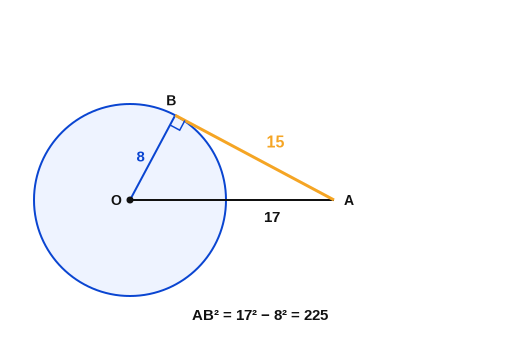
Q659.A circle has a radius of 8 cm. From an external point A , which is 17 cm away from the center of the circle, a tangent is drawn touching the circle at point B. What is the length of the tangent segment AB?
एक वृत्त की त्रिज्या 8 cm है। वृत्त के केंद्र से 17 cm दूर स्थित एक बाह्य बिंदु A से एक स्पर्श रेखा खींची जाती है जो वृत्त को बिंदु B पर स्पर्श करती है। स्पर्श रेखा खंड AB की लंबाई क्या है?
- A25 cm
- B9 cm
- C15 cm
- D12 cm
Show answer
Concept: Radius ⟂ tangent at the point of contact, so use Pythagoras.
Solution:
- .
- = 15 cm.
Trick: 8, 15, 17 is a Pythagorean triplet – answer is instant.
Answer: (C) 15 cm
अवधारणा: स्पर्श बिंदु पर त्रिज्या स्पर्शरेखा पर लंब होती है; पाइथागोरस लगाएँ।
हल:
- ।
- AB = 15 cm।
ट्रिक: 8, 15, 17 पाइथागोरस त्रिक है।
उत्तर: (C) 15 cm
SSC CHSL Tier-1Quantitative AptitudeCircle – length of tangentSSC CHSL Tier-1 2025 · 28 Nov Shift 3
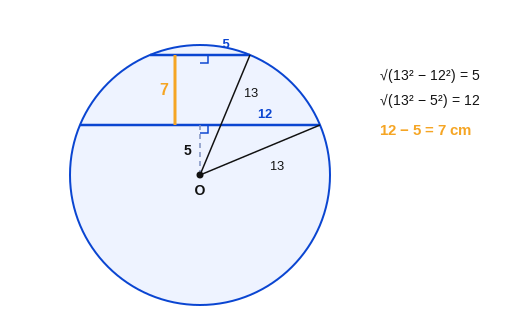
Q660.In a circle of radius 13 cm , two parallel chords of lengths 10 cm and 24 cm are drawn on the same side of the center. What is the distance between them?
13 cm त्रिज्या वाले एक वृत्त में, 10 cm और 24 cm लंबाई की दो समांतर जीवाएँ केंद्र के एक ही ओर खींची गई हैं। उनके बीच की दूरी कितनी है?
- A17 cm
- B7 cm
- C5 cm
- D12 cm
Show answer
Concept: . Same side → subtract.
Solution:
- Chord 24: half = 12 → = 5 cm.
- Chord 10: half = 5 → = 12 cm.
- Same side: = 7 cm.
Trick: Use triplet 5-12-13 twice. Opposite sides would give (a trap option).
Answer: (B) 7 cm
अवधारणा: । एक ही ओर हों तो घटाएँ।
हल:
- 24 cm जीवा: = 5 cm।
- 10 cm जीवा: = 12 cm।
- एक ही ओर: = 7 cm।
ट्रिक: 5-12-13 त्रिक दो बार। विपरीत ओर होतीं तो 17 (जाल विकल्प)।
उत्तर: (B) 7 cm
SSC CHSL Tier-1Quantitative AptitudeCircle – distance between parallel chordsSSC CHSL Tier-1 2025 · 28 Nov Shift 3

