Q641.Find the next number in the sequence.
3, 6, 12, 15, 30, 33, ?
अनुक्रम में अगली संख्या ज्ञात कीजिए।
3, 6, 12, 15, 30, 33, ?
- A60
- B63
- C66
- D69
Show answer
Concept: Look for two operations used alternately.
- 3 +3 = 6, ×2 = 12, +3 = 15, ×2 = 30, +3 = 33.
- Next step is ×2: .
Trick: Alternate pattern: note which operation came last (+3), so the next is the other one (×2).
Answer: (C) 66
अवधारणा: दो संक्रियाएँ बारी-बारी से प्रयोग हो रही हैं।
हल:
- 3 +3 = 6, ×2 = 12, +3 = 15, ×2 = 30, +3 = 33।
- अगला ×2: ।
ट्रिक: अंतिम संक्रिया +3 थी, तो अगली ×2 होगी।
उत्तर: (C) 66
SSC CHSL Tier-1General IntelligenceNumber series – alternate +3, ×2SSC CHSL Tier-1 2025 · 21 Nov Shift 2
Q642.Find the next number in the sequence.
80, 20, 5, 1.25, ?
अनुक्रम में अगली संख्या ज्ञात कीजिए।
80, 20, 5, 1.25, ?
- A0.3215
- B0.3125
- C0.3025
- D0.3155
Show answer
Concept: Each term is a fixed fraction of the previous one.
- 80 → 20 → 5 → 1.25: each term is one-quarter of the one before.
- .
Trick: , and → .
Answer: (B) 0.3125
अवधारणा: हर पद पिछले पद का एक निश्चित भाग है।
हल:
- ।
- ।
ट्रिक: ; → ।
उत्तर: (B) 0.3125
SSC CHSL Tier-1General IntelligenceNumber series – ÷4SSC CHSL Tier-1 2025 · 21 Nov Shift 2
Q643.8 girls P, Q, R, S, T, U, V, and W are sitting in a row facing South (not necessarily in the same order). P and W are at the extreme ends of the row. T and U are immediate neighbours of S. R is fourth to the left of is to the immediate left of P. V is not the immediate neighbour of T. Who is sitting second to the right of V ?
8 लड़कियाँ P, Q, R, S, T, U, V और W एक पंक्ति में दक्षिण की ओर मुख करके बैठी हैं (आवश्यक नहीं कि इसी क्रम में)। P और W पंक्ति के अंतिम छोरों पर हैं। T और U, S के निकटतम पड़ोसी हैं। R, के बाईं ओर चौथे स्थान पर है, जो P के तत्काल बाईं ओर है। V, T का निकटतम पड़ोसी नहीं है। V के दाईं ओर दूसरे स्थान पर कौन बैठी है?
- AS
- BU
- CQ
- DT
Show answer
Concept: They face South; label seats 1–8 starting at the end that is on the girls' left.
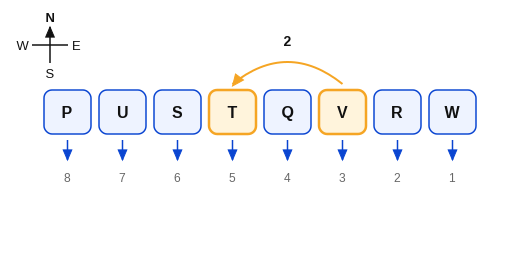
- U is immediately left of P → P can't be at seat 1 → P = 8, U = 7, W = 1.
- S is between T and U → S = 6, T = 5.
- R is 4th left of S → R = 2.
- Seats 3, 4: V can't be next to T → V = 3, Q = 4.
- Second right of V (3) = seat 5 = T.
Trick: Order: W R V Q T S U P (from their left). For South-facing rows, 'their right' is your left on paper – fix it once and stick to it.
Answer: (D) T
अवधारणा: दक्षिण की ओर मुख है; सीटें लड़कियों के अपने बाएँ से दाएँ 1–8 मानें।
हल:
- U, P के ठीक बाएँ → P = 8, U = 7, W = 1।
- S के दोनों ओर T और U → S = 6, T = 5।
- R, S से चौथा बाएँ → R = 2।
- सीट 3, 4: V, T के पास नहीं → V = 3, Q = 4।
- V (3) से दूसरा दाएँ = सीट 5 = T।
ट्रिक: क्रम: W R V Q T S U P। दक्षिणमुखी पंक्ति में उनका दायाँ कागज़ पर आपका बायाँ होता है – एक बार तय करें।
उत्तर: (D) T
SSC CHSL Tier-1General IntelligenceLinear seating – facing SouthSSC CHSL Tier-1 2025 · 21 Nov Shift 2
Q644.Rahul started walking straight from his school to his house. During his journey, he turned 15 times left and 14 times right. He is finally walking towards the West to reach his house. In which direction did he start walking?
राहुल अपने विद्यालय से अपने घर की ओर सीधा चलना आरंभ करता है। अपनी यात्रा के दौरान वह 15 बार बाएँ और 14 बार दाएँ मुड़ता है। अंत में वह अपने घर पहुँचने के लिए पश्चिम की ओर चल रहा है। उसने किस दिशा में चलना आरंभ किया था?
- ASouthदक्षिण
- BNorthउत्तर
- CEastपूर्व
- DWestपश्चिम
Show answer
Concept: One left and one right cancel; only the net turns matter.
- Net = 15 left − 14 right = 1 left turn.
- Start → (turn left) → West, so start was the direction whose left is West.
- Left of North is West → he started towards North.
Trick: Work backwards: undo the final left turn by turning right from West → North.
Answer: (B) North
अवधारणा: एक बायाँ और एक दायाँ मोड़ एक-दूसरे को काट देते हैं।
हल:
- शुद्ध = 15 बाएँ − 14 दाएँ = 1 बायाँ मोड़।
- प्रारंभिक दिशा से बाएँ मुड़कर पश्चिम मिला।
- उत्तर की ओर मुख हो तो बायाँ = पश्चिम → शुरुआत उत्तर से।
ट्रिक: उल्टा चलें: पश्चिम से एक दायाँ मोड़ = उत्तर।
उत्तर: (B) उत्तर
SSC CHSL Tier-1General IntelligenceDirection – net turnsSSC CHSL Tier-1 2025 · 21 Nov Shift 2
Q645.M walks 50 km towards the North. He turns right and walks 75 km. He again turns right and walks 50 km. How far (in km) and in which direction is he now from the starting point?
M उत्तर की ओर 50 km चलता है। वह दाएँ मुड़कर 75 km चलता है। वह पुनः दाएँ मुड़कर 50 km चलता है। अब वह प्रारंभिक बिंदु से कितनी दूर (km में) तथा किस दिशा में है?
- A75 , West75 , पश्चिम
- B50, East50, पूर्व
- C75 , East75 , पूर्व
- D50, West50, पश्चिम
Show answer
Concept: Track the facing direction after each turn and cancel opposite moves.
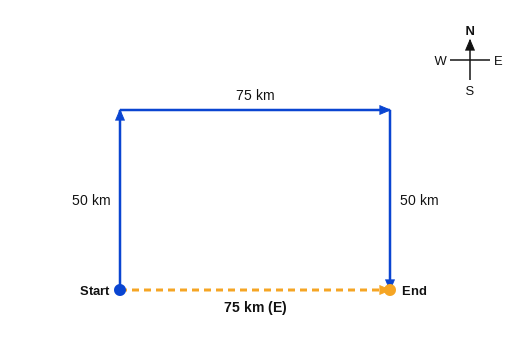
- North 50 km → right turn = East 75 km → right turn = South 50 km.
- North 50 and South 50 cancel.
- Left: 75 km East.
Trick: Two right turns = U-turn, so the 1st and 3rd legs (both 50) cancel – the middle leg is the answer.
Answer: (C) 75 , East
अवधारणा: हर मोड़ के बाद दिशा देखें और विपरीत चालें काटें।
हल:
- उत्तर 50 km → दाएँ = पूर्व 75 km → दाएँ = दक्षिण 50 km।
- उत्तर 50 और दक्षिण 50 कट गए।
- बचा 75 km पूर्व।
ट्रिक: दो दाएँ मोड़ = U-turn; पहला और तीसरा भाग कट जाते हैं, बीच वाला ही उत्तर।
उत्तर: (C) 75 , पूर्व
SSC CHSL Tier-1General IntelligenceDirection – distance and directionSSC CHSL Tier-1 2025 · 21 Nov Shift 2
Q646.Assuming that the data given in the statement are definitely true, which of the following conclusions can be logically deducted?
Statement: All applicants who have a master's degree are shortlisted for the job.
Fact: Suman was shortlisted for the job. Which conclusion is valid?
यह मानते हुए कि कथन में दी गई जानकारी निश्चित रूप से सत्य है, निम्नलिखित में से कौन-सा निष्कर्ष तार्किक रूप से निकाला जा सकता है?
कथन: वे सभी आवेदक जिनके पास स्नातकोत्तर उपाधि है, नौकरी के लिए शॉर्टलिस्ट कर लिए जाते हैं।
तथ्य: सुमन को नौकरी के लिए शॉर्टलिस्ट किया गया था। कौन-सा निष्कर्ष वैध है?
- ASuman has a master's degree.सुमन के पास स्नातकोत्तर उपाधि है।
- BSuman might have a master's degree.सुमन के पास स्नातकोत्तर उपाधि हो सकती है।
- COnly applicants with a master's degree are shortlisted.केवल स्नातकोत्तर उपाधि वाले आवेदक ही शॉर्टलिस्ट किए जाते हैं।
- DSuman is the only applicant shortlisted.सुमन ही एकमात्र शॉर्टलिस्ट किया गया आवेदक है।
Show answer
Concept: 'All A are B' does not mean 'All B are A'.
- Master's holders ⊂ shortlisted group; others may also be shortlisted.
- Suman is shortlisted → she may or may not have the degree.
- So only 'might have' is valid; (A), (C), (D) claim too much.
Trick: From B back to A you can only say 'possible' – never 'definite'.
Answer: (B) Suman might have a master's degree.
अवधारणा: 'All A are B' का अर्थ 'All B are A' नहीं होता।
हल:
- मास्टर डिग्री वाले, चयनित समूह का हिस्सा हैं; दूसरे भी चयनित हो सकते हैं।
- सुमन चयनित है → डिग्री हो भी सकती है, नहीं भी।
- इसलिए केवल 'might have' सही; बाकी अधिक दावा करते हैं।
ट्रिक: B से A की ओर केवल 'संभव' कह सकते हैं, 'निश्चित' नहीं।
उत्तर: (B) सुमन के पास स्नातकोत्तर उपाधि हो सकती है।
SSC CHSL Tier-1General IntelligenceStatement and conclusion – 'All' is one-waySSC CHSL Tier-1 2025 · 21 Nov Shift 2
Q647.By interchanging the given two numbers (not digits), which of the following equations will NOT be correct? 5 and 10 l. ll.
दी गई दो संख्याओं (अंकों को नहीं) को परस्पर बदलने पर, निम्नलिखित में से कौन-सा समीकरण सही नहीं होगा? 5 तथा 10 l. ll.
- AOnly Iकेवल I
- BOnly IIकेवल II
- CBoth I and III और II दोनों
- DNeither I nor IIन तो I और न ही II
Show answer
Concept: Swap 5 and 10 everywhere, then solve using BODMAS.
- I: ✓ (correct).
- II: ✗.
- So only II is not correct.
Trick: Do ÷ and × left to right before + and −; don't do first in II.
Answer: (B) Only II
अवधारणा: 5 और 10 को हर जगह आपस में बदलें, फिर BODMAS से हल करें।
हल:
- I: ✓
- II: ✗
- केवल II गलत है।
ट्रिक: ÷ और × बाएँ से दाएँ पहले करें; II में पहले न करें।
उत्तर: (B) केवल II
SSC CHSL Tier-1General IntelligenceInterchange of numbers – BODMASSSC CHSL Tier-1 2025 · 21 Nov Shift 2
Q648.You're giving a presentation, and a few students in the back are yawning, looking at the ceiling, and sometimes looking at their phones. What nonverbal signals are they giving, and what decisions should you consider?
आप एक प्रस्तुति दे रहे हैं और पीछे बैठे कुछ विद्यार्थी जँभाई ले रहे हैं, छत की ओर देख रहे हैं तथा बीच-बीच में अपने फ़ोन देख रहे हैं। वे कौन-से अशाब्दिक संकेत दे रहे हैं और आपको किन निर्णयों पर विचार करना चाहिए?
- AThey are concentrating deeply; Keep going like this.वे गहन एकाग्रता में हैं; इसी प्रकार आगे बढ़ते रहें।
- Bthey are bored or have no interaction; Try to engage them back into the conversation by asking questions or through conversation.वे ऊब गए हैं अथवा उनकी कोई सहभागिता नहीं है; प्रश्न पूछकर अथवा बातचीत के माध्यम से उन्हें पुनः चर्चा में सम्मिलित करने का प्रयास करें।
- CThey are just tired; Ignore their behavior.वे केवल थके हुए हैं; उनके व्यवहार की उपेक्षा करें।
- DThey are busy; turn a blind eye.वे व्यस्त हैं; अनदेखा कर दें।
Show answer
Concept: Yawning, looking away and checking phones = loss of interest; a good speaker reacts, not ignores.
- Signals → audience is bored / disengaged.
- Right action → re-involve them: ask a question, invite views, change pace.
- A misreads the signs; C and D read them but do nothing.
Trick: In decision questions, reject "ignore / turn a blind eye" options first.
Answer: (B) they are bored or have no interaction; Try to engage them back into the conversation by asking questions or through conversation.
अवधारणा: उबासी, इधर-उधर देखना, फ़ोन देखना = रुचि खत्म होना; अच्छा वक्ता इसे अनदेखा नहीं करता।
- संकेत → श्रोता ऊब चुके / जुड़े नहीं हैं।
- सही कदम → प्रश्न पूछकर या बातचीत से उन्हें फिर जोड़ना।
- A संकेत गलत पढ़ता है; C, D कुछ करते ही नहीं।
ट्रिक: निर्णय वाले प्रश्नों में "ignore / अनदेखा करो" वाले option पहले हटाएँ।
उत्तर: (B) वे ऊब गए हैं अथवा उनकी कोई सहभागिता नहीं है; प्रश्न पूछकर अथवा बातचीत के माध्यम से उन्हें पुनः चर्चा में सम्मिलित करने का प्रयास करें।
SSC CHSL Tier-1General IntelligenceSituational reasoning – reading body languageSSC CHSL Tier-1 2025 · 21 Nov Shift 1
Q649.A train traveling at a constant speed enters a 300 - meter tunnel. It takes 20 seconds for the entire train to pass through the tunnel. If the train is
400 meters long, what is the speed of the train in meters per second?
नियत चाल से चल रही एक रेलगाड़ी 300 मीटर लंबी सुरंग में प्रवेश करती है। पूरी रेलगाड़ी को सुरंग पार करने में 20 सेकंड लगते हैं। यदि रेलगाड़ी की लंबाई 400 मीटर है, तो रेलगाड़ी की चाल मीटर प्रति सेकंड में कितनी है?
- A25 m/s
- B
- C55 m/s
- D
Show answer
Concept: To fully cross a tunnel, a train covers (train length + tunnel length).
- Distance = m
- Time = 20 s
- Speed = 35 m/s
Trick: Crossing a pole → only train length; crossing a platform/tunnel/bridge → add both lengths.
Answer: (B)
अवधारणा: सुरंग पूरी पार करने में ट्रेन (ट्रेन की लंबाई + सुरंग की लंबाई) तय करती है।
- दूरी = m
- समय = 20 s
- चाल = 35 m/s
ट्रिक: खंभा पार करना → केवल ट्रेन की लंबाई; प्लेटफ़ॉर्म/सुरंग/पुल → दोनों लंबाइयाँ जोड़ें।
उत्तर: (B)
SSC CHSL Tier-1General IntelligenceTrain crossing a tunnel – speedSSC CHSL Tier-1 2025 · 21 Nov Shift 1
Q650.In a row, is 10th from the left and B is 15th from the right. If they interchange their positions, A becomes 20th from the left. How many people are there in total in the row?
एक पंक्ति में, बाईं ओर से 10वें स्थान पर है और B दाईं ओर से 15वें स्थान पर है। यदि वे आपस में अपने स्थान बदल लेते हैं, तो A बाईं ओर से 20वें स्थान पर आ जाता है। पंक्ति में कुल कितने व्यक्ति हैं?
- A35
- B36
- C34
- D33
Show answer
Concept: After a swap, A sits in B's old seat; total = left rank + right rank − 1.
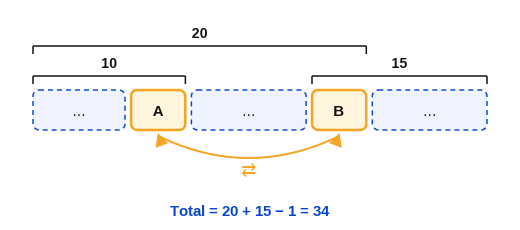
- A becomes 20th from left → B was originally 20th from left.
- B is also 15th from right.
- Total = 20 + 15 − 1 = 34
Trick: Use the new position of one person with the old position of the other from the opposite side.
Answer: (C) 34
अवधारणा: अदला-बदली के बाद A, B की पुरानी जगह पर आता है; कुल = बाएँ से स्थान + दाएँ से स्थान − 1।
- A बाएँ से 20वाँ हो गया → B मूल रूप से बाएँ से 20वाँ था।
- B दाएँ से 15वाँ है।
- कुल = 20 + 15 − 1 = 34
ट्रिक: एक व्यक्ति की नई स्थिति को दूसरे की पुरानी स्थिति (विपरीत छोर से) के साथ जोड़ें।
उत्तर: (C) 34
SSC CHSL Tier-1General IntelligenceRanking – after interchangeSSC CHSL Tier-1 2025 · 21 Nov Shift 1
Q651.In a row of students, is 8th from the left and B is 10th from the right. If there are 5 students between them, find the maximum number of students in the row.
विद्यार्थियों की एक पंक्ति में, बाईं ओर से 8वें स्थान पर है और B दाईं ओर से 10वें स्थान पर है। यदि उनके बीच 5 विद्यार्थी हैं, तो पंक्ति में विद्यार्थियों की अधिकतम संख्या ज्ञात कीजिए।
- A22
- B23
- C24
- D25
Show answer
Concept: Maximum when the two counts do not overlap: A … gap … B.
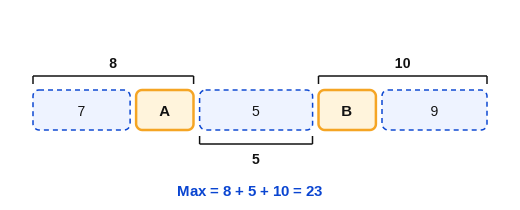
- Left block up to A = 8
- Students between = 5
- Right block from B = 10
- Maximum = 8 + 5 + 10 = 23
Trick: Maximum = sum of both ranks + people between; minimum comes from the overlapping case.
Answer: (B) 23
अवधारणा: अधिकतम तब होगा जब दोनों गिनतियाँ एक-दूसरे पर न चढ़ें: A … बीच वाले … B।
- A तक बायाँ हिस्सा = 8
- बीच में = 5
- B से दायाँ हिस्सा = 10
- अधिकतम = 8 + 5 + 10 = 23
ट्रिक: अधिकतम = दोनों रैंक + बीच के लोग; न्यूनतम overlap वाली स्थिति से निकलता है।
उत्तर: (B) 23
SSC CHSL Tier-1General IntelligenceRanking – maximum students in rowSSC CHSL Tier-1 2025 · 21 Nov Shift 1
Q652.In a row of 50 persons, Akash is 20th from the left and Vikas is 18th from the right. How many persons are there between them?
50 व्यक्तियों की एक पंक्ति में, आकाश बाईं ओर से 20वें स्थान पर है और विकास दाईं ओर से 18वें स्थान पर है। उन दोनों के बीच कितने व्यक्ति हैं?
- A13
- B14
- C15
- D12
Show answer
Concept: Bring both ranks to the same side, then between = difference − 1.
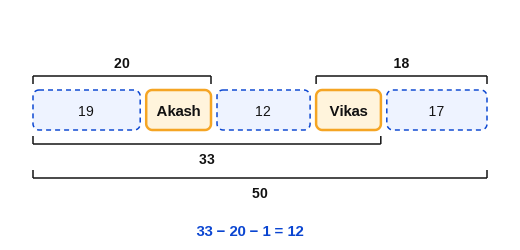
- Vikas from left = 50 − 18 + 1 = 33
- Akash from left = 20
- Between = 33 − 20 − 1 = 12
Trick: Direct formula: Between = Total − (left rank + right rank) = 50 − 38 = 12.
Answer: (D) 12
अवधारणा: दोनों रैंक एक ही ओर से लें, फिर बीच वाले = अंतर − 1।
- Vikas बाएँ से = 50 − 18 + 1 = 33
- Akash बाएँ से = 20
- बीच में = 33 − 20 − 1 = 12
ट्रिक: सीधा सूत्र: बीच वाले = कुल − (बाएँ रैंक + दाएँ रैंक) = 50 − 38 = 12।
उत्तर: (D) 12
SSC CHSL Tier-1General IntelligenceRanking – persons between two peopleSSC CHSL Tier-1 2025 · 21 Nov Shift 1
Q653.Read the following statement carefully and identify the conclusion that follows.
Statement :
All teachers are scholars.
All scholars are intelligent.
Conclusion :
I. All teachers are intelligent.
II. All are intelligent teachers.
निम्नलिखित कथन को ध्यानपूर्वक पढ़िए और उस निष्कर्ष की पहचान कीजिए जो इसका अनुसरण करता है।
कथन :
सभी शिक्षक विद्वान हैं।
सभी विद्वान बुद्धिमान हैं।
निष्कर्ष :
I. सभी शिक्षक बुद्धिमान हैं।
II. सभी बुद्धिमान शिक्षक हैं।
- AOnly conclusion I follows.केवल निष्कर्ष I अनुसरण करता है।
- BOnly conclusion II follows.केवल निष्कर्ष II अनुसरण करता है।
- CEither conclusion I or II follows.या तो निष्कर्ष I अथवा II अनुसरण करता है।
- DNeither conclusion I nor II follows.न तो निष्कर्ष I और न ही निष्कर्ष II अनुसरण करता है।
Show answer
Concept: All A are B + All B are C ⇒ All A are C (the reverse need not be true).
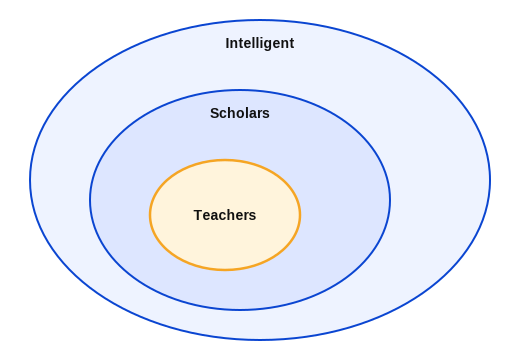
- Teachers ⊂ Scholars ⊂ Intelligent.
- I: All teachers are intelligent ✔
- II: "All are intelligent teachers" says every intelligent being is a teacher – not proven ✘
Trick: "All" can never be reversed: All A are C does not give All C are A.
Answer: (A) Only conclusion I follows.
अवधारणा: All A are B + All B are C ⇒ All A are C (उल्टा ज़रूरी नहीं)।
- Teachers ⊂ Scholars ⊂ Intelligent।
- I: सभी teachers intelligent हैं ✔
- II: हर intelligent व्यक्ति teacher है – सिद्ध नहीं ✘
ट्रिक: "All" को कभी उल्टा नहीं कर सकते: All A are C से All C are A नहीं बनता।
उत्तर: (A) केवल निष्कर्ष I अनुसरण करता है।
SSC CHSL Tier-1General IntelligenceSyllogism – chain of "All"SSC CHSL Tier-1 2025 · 21 Nov Shift 1
Q654.Read the following statement carefully and identify the inference that follows it.
Statement: The Municipal Corporation has announced a complete ban on plastic bags in the city.
Estimate:
I. The Municipal Corporation is serious about environmental protection.
II. Plastic bags cause harm to the environment.
III. People will now use cloth or paper bags.
निम्नलिखित कथन को ध्यानपूर्वक पढ़िए और उससे निकलने वाले अनुमान की पहचान कीजिए।
कथन: नगर निगम ने शहर में प्लास्टिक की थैलियों पर पूर्ण प्रतिबंध की घोषणा की है।
अनुमान:
I. नगर निगम पर्यावरण संरक्षण के प्रति गंभीर है।
II. प्लास्टिक की थैलियाँ पर्यावरण को हानि पहुँचाती हैं।
III. लोग अब कपड़े अथवा कागज़ की थैलियों का उपयोग करेंगे।
- AIf only I followsयदि केवल I अनुसरण करता है
- BIf only II followsयदि केवल II अनुसरण करता है
- CIf both I and II followयदि I और II दोनों अनुसरण करते हैं
- DIf both I and III followयदि I और III दोनों अनुसरण करते हैं
Show answer
Concept: An inference must follow almost certainly from the statement; a guess about the future is not enough.
- A total ban is a serious step → body cares for the environment: I ✔
- A ban needs a reason → plastic bags are harmful: II ✔
- People "will now use cloth/paper bags" is only a prediction: III ✘
Trick: Statements about future public behaviour ("people will…") usually do not follow.
Answer: (C) If both I and II follow
अवधारणा: निष्कर्ष कथन से लगभग निश्चित रूप से निकलना चाहिए; भविष्य का अनुमान पर्याप्त नहीं।
- पूर्ण प्रतिबंध गंभीर कदम है → निगम पर्यावरण को लेकर गंभीर: I ✔
- प्रतिबंध का कारण होता है → प्लास्टिक बैग हानिकारक: II ✔
- "लोग अब कपड़े/कागज़ के बैग लेंगे" – केवल अनुमान: III ✘
ट्रिक: "लोग आगे ऐसा करेंगे" जैसे निष्कर्ष प्रायः नहीं निकलते।
उत्तर: (C) यदि I और II दोनों अनुसरण करते हैं
SSC CHSL Tier-1General IntelligenceStatement and inferenceSSC CHSL Tier-1 2025 · 21 Nov Shift 1
Q655.In this question some of the words sequence is given which follows some logical pattern of word find the next word that can be logically replace the ? In each sequence.
Foundation, Walls, Roof, ?
इस प्रश्न में शब्दों का एक क्रम दिया गया है जो शब्दों के किसी तार्किक प्रतिरूप का अनुसरण करता है। वह अगला शब्द ज्ञात कीजिए जो प्रत्येक क्रम में ? के स्थान पर तार्किक रूप से आ सके।
Foundation, Walls, Roof, ?
- ABrick
- BFloor
- CPaint
- DHouse
Show answer
Concept: Words follow the order of construction.
- Foundation → Walls → Roof: the stages of building.
- After the roof, the result is a complete House.
- Brick/paint are materials; floor is not the final outcome.
Trick: In such sequences the last word is usually the final product of the process.
Answer: (D) House
अवधारणा: शब्द निर्माण के क्रम में हैं।
- नींव → दीवारें → छत: भवन बनने के चरण।
- छत के बाद पूरा बनता है घर (House)।
- ईंट/पेंट सामग्री हैं; फर्श अंतिम परिणाम नहीं।
ट्रिक: ऐसे क्रम में अंतिम शब्द अक्सर प्रक्रिया का अंतिम उत्पाद होता है।
उत्तर: (D) House
SSC CHSL Tier-1General IntelligenceLogical sequence of words – building stagesSSC CHSL Tier-1 2025 · 21 Nov Shift 1
Q656.Choose the related word from the given alternatives.
Thermometer : Temperature :: Barometer :?
दिए गए विकल्पों में से संबंधित शब्द चुनिए।
Thermometer : Temperature :: Barometer :?
- AWind
- BPressure
- CRain
- DThickness
Show answer
Concept: Thermometer measures temperature; find what a barometer measures.
- Barometer → atmospheric pressure ✔
- Wind speed → anemometer; rainfall → rain gauge.
Yaad rakhein: Hygrometer – humidity; Altimeter – altitude; Seismograph – earthquakes.
Answer: (B) Pressure
अवधारणा: Thermometer तापमान मापता है; barometer क्या मापता है?
- Barometer → वायुमंडलीय दाब ✔
- हवा की गति → anemometer; वर्षा → rain gauge।
याद रखें: Hygrometer – आर्द्रता; Altimeter – ऊँचाई; Seismograph – भूकंप।
उत्तर: (B) Pressure
SSC CHSL Tier-1General IntelligenceAnalogy – instrument : quantity measuredSSC CHSL Tier-1 2025 · 21 Nov Shift 1
Q657.Choose the related word from the given alternatives.
Voltmeter : Voltage :: Viscometer : ?
दिए गए विकल्पों में से संबंधित शब्द चुनिए।
Voltmeter : Voltage :: Viscometer : ?
- AVelocity
- BViscosity
- CPressure
- DMagnetic field
Show answer
Concept: Voltmeter measures voltage; the instrument name hints at the quantity.
- Viscometer → viscosity (resistance of a fluid to flow) ✔
- Velocity → speedometer; pressure → manometer; magnetic field → magnetometer.
Trick: Drop "-meter" and match the root: Visco-meter → Visco-sity.
Answer: (B) Viscosity
अवधारणा: Voltmeter वोल्टेज मापता है; उपकरण का नाम ही राशि बताता है।
- Viscometer → श्यानता (viscosity) – द्रव के बहाव का प्रतिरोध ✔
- वेग → speedometer; दाब → manometer; चुंबकीय क्षेत्र → magnetometer।
ट्रिक: "-meter" हटाकर मूल शब्द मिलाएँ: Visco-meter → Visco-sity।
उत्तर: (B) Viscosity
SSC CHSL Tier-1General IntelligenceAnalogy – instrument : quantity measuredSSC CHSL Tier-1 2025 · 21 Nov Shift 1
Q658.Pick the correct options from the given alternatives.
CAT : DCW :: DOG : ?
दिए गए विकल्पों में से सही विकल्प चुनिए।
CAT : DCW :: DOG : ?
- AEQJ
- BEPH
- CFRK
- DGQL
Show answer
Concept: Find the shift for each letter position.
- C→D (+1), A→C (+2), T→W (+3).
- Apply to DOG: first letter → E, second → Q (O + 2), third → J (G + 3).
- Answer = EQJ
Trick: Only first letter needed often: D+1 = E removes C and D options; then O+2 = Q settles it.
Answer: (A) EQJ
अवधारणा: हर स्थान के अक्षर का अंतर निकालें।
- C→D (+1), A→C (+2), T→W (+3)।
- DOG पर लगाएँ: पहला → E, दूसरा → Q (O + 2), तीसरा → J (G + 3)।
- उत्तर = EQJ
ट्रिक: पहला अक्षर D+1 = E से C, D हटते हैं; फिर O+2 = Q से उत्तर तय।
उत्तर: (A) EQJ
SSC CHSL Tier-1General IntelligenceLetter analogy – increasing shiftsSSC CHSL Tier-1 2025 · 21 Nov Shift 1
Q659.Choose the odd one out from the following:
निम्नलिखित में से विषम (असंगत) को चुनिए:
- ABananaकेला
- BMangoआम
- CAppleसेब
- DPotatoआलू
Show answer
Concept: Group by category.
- Banana, mango, apple – fruits.
- Potato – a vegetable (modified underground stem / tuber) → odd.
Yaad rakhein: Potato is a stem (it has "eyes"/buds); sweet potato and carrot are roots.
Answer: (D) Potato
अवधारणा: श्रेणी के आधार पर समूह बनाएँ।
- केला, आम, सेब – फल।
- आलू – सब्ज़ी (भूमिगत रूपांतरित तना/कंद) → विषम।
याद रखें: आलू तना है (इसमें "आँखें"/कलियाँ होती हैं); शकरकंद और गाजर जड़ें हैं।
उत्तर: (D) आलू
SSC CHSL Tier-1General IntelligenceOdd one out – fruits vs vegetableSSC CHSL Tier-1 2025 · 21 Nov Shift 1
Q660.Select the related letter from the given alternatives.
POWER : UTZGT :: LIGHT : ?
दिए गए विकल्पों में से संबंधित अक्षर-समूह चुनिए।
POWER : UTZGT :: LIGHT : ?
- AQMKIV
- BQNJJV
- CROKLW
- DPMJHU
Show answer
Concept: Compare each letter of POWER with UTZGT.
- P→U +5, O→T +5, W→Z +3, E→G +2, R→T +2.
- For LIGHT: L→Q, I→N (both +5); G→J (+3); H→J and T→V (both +2).
- Code = QNJJV
Trick: After L+5 = Q and I+5 = N, only option B starts with "QN".
Answer: (B) QNJJV
अवधारणा: POWER के हर अक्षर की तुलना UTZGT से करें।
- P→U +5, O→T +5, W→Z +3, E→G +2, R→T +2।
- LIGHT के लिए: L→Q, I→N (दोनों +5); G→J (+3); H→J और T→V (दोनों +2)।
- कोड = QNJJV
ट्रिक: L+5 = Q और I+5 = N के बाद केवल B ही "QN" से शुरू होता है।
उत्तर: (B) QNJJV
SSC CHSL Tier-1General IntelligenceLetter coding – position-wise shiftsSSC CHSL Tier-1 2025 · 21 Nov Shift 1

