Q121.Select the option that expresses the given sentence in direct voice.
The manager asked the employees whether they had submitted their reports.
- AThe manager said to the employees, "Have you submitted your reports?"
- BThe manager said to the employees, "Did you submit your reports?"
- CThe manager said to the employees, "Have you submitted their reports?"
- DThe manager said to the employees, "Had you submitted your reports?"
Show answer
Concept: 'asked … whether' signals a yes/no question; past perfect in indirect → present perfect in direct.
- 'asked' → 'said to'; question form with '?'.
- 'they had submitted' → 'Have you submitted'.
- 'their reports' → 'your reports' (employees addressed directly).
- (b) uses wrong tense, (c) keeps 'their', (d) keeps 'had'.
Trick: Reverse the backshift: had + V3 → have/has + V3.
Answer: (A) The manager said to the employees, "Have you submitted your reports?"
अवधारणा: 'asked … whether' से पता चलता है कि यह yes/no प्रश्न है; indirect का past perfect → direct में present perfect।
- 'asked' → 'said to', अंत में प्रश्नवाचक चिह्न।
- 'they had submitted' → 'Have you submitted'।
- 'their reports' → 'your reports'।
- (b) का काल गलत, (c) में 'their' रह गया, (d) में 'had' रह गया।
ट्रिक: Backshift उलटिए: had + V3 → have/has + V3।
उत्तर: (A) The manager said to the employees, "Have you submitted your reports?"
SSC CHSL Tier-1English LanguageDirect speech – yes/no questionSSC CHSL Tier-1 2025 · 30 Nov Shift 2
Q122.Choose the correct passive voice transformation of the sentence: They must have transported the delicate paintings from the gallery's storage room very carefully.
- AThe delicate paintings had to be transported very carefully from the gallery's storage room.
- BThe delicate paintings must have been transported very carefully from the gallery's storage room.
- CIt must have been the delicate paintings that were transported from the gallery's storage room very carefully.
- DThe delicate paintings should have been transported from the gallery's storage room very carefully.
Show answer
Concept: Active 'modal + have + V3' → Passive 'modal + have been + V3'; the modal stays the same.
- Object 'the delicate paintings' becomes the subject.
- 'must have transported' → 'must have been transported'.
- (a) changes to 'had to', (d) to 'should' – meaning changes; (c) is a cleft sentence, not the plain passive.
Trick: Never change the modal – 'must' stays 'must'.
Answer: (B) The delicate paintings must have been transported very carefully from the gallery's storage room.
अवधारणा: Active 'modal + have + V3' → Passive 'modal + have been + V3'; modal वही रहता है।
- Object 'the delicate paintings' subject बनेगा।
- 'must have transported' → 'must have been transported'।
- (a) में 'had to', (d) में 'should' – अर्थ बदल गया; (c) सीधा passive नहीं है।
ट्रिक: Modal कभी न बदलें – 'must' 'must' ही रहेगा।
उत्तर: (B) The delicate paintings must have been transported very carefully from the gallery's storage room.
SSC CHSL Tier-1English LanguagePassive voice – must have + V3SSC CHSL Tier-1 2025 · 30 Nov Shift 2
Q123.Choose the most suitable option to fill in the blanks.
The researcher made sure to credible studies and visit the official
for additional information.
- Acouncil, counsel
- Bcite, site
- Cprincipal, principle
- Daural, oral
Show answer
Concept: First blank needs a verb (quote as evidence), second a noun (place/website).
- 'to ___ credible studies' → cite = to quote/refer to a source.
- 'visit the official ___' → site = a place or website.
- Other pairs (council/counsel, principal/principle, aural/oral) do not fit the meaning.
Trick: cite = quote, site = spot, sight = see.
Answer: (B) cite, site
अवधारणा: पहले रिक्त में verb (स्रोत का हवाला देना), दूसरे में noun (स्थान/वेबसाइट) चाहिए।
- 'to ___ credible studies' → cite = हवाला देना।
- 'visit the official ___' → site = स्थान/वेबसाइट।
- बाकी जोड़े (council/counsel, principal/principle, aural/oral) अर्थ में फिट नहीं।
ट्रिक: cite = उद्धृत करना, site = स्थान, sight = दृष्टि।
उत्तर: (B) cite, site
SSC CHSL Tier-1English LanguageHomophones – cite / siteSSC CHSL Tier-1 2025 · 30 Nov Shift 2
Q124.Which word is closest in meaning to serious?
He spoke in a serious tone during the meeting.
- ACasual
- BGrim
- CCheerful
- DPlayful
Show answer
Concept: Find the word that conveys a solemn, stern manner.
- Serious tone = solemn, not joking.
- Grim = stern, gloomy, serious-looking.
- Casual, cheerful, playful all express a light mood – opposite.
Trick: Three options are 'happy/light'; the odd one out (grim) is the answer.
Answer: (B) Grim
अवधारणा: गंभीर, कठोर भाव वाला शब्द चुनें।
- Serious tone = गंभीर लहजा, मज़ाक नहीं।
- Grim = कठोर, उदास, गंभीर।
- Casual, cheerful, playful सब हल्के-फुल्के भाव के हैं – विपरीत।
ट्रिक: तीन विकल्प 'हल्के मूड' वाले हैं; अलग पड़ने वाला (grim) ही उत्तर है।
उत्तर: (B) Grim
SSC CHSL Tier-1English LanguageSynonym – seriousSSC CHSL Tier-1 2025 · 30 Nov Shift 2
Q125.What does the word "Accused" refer to?
- AA person who reports a crime
- BA person who is charged with an offence
- CA person who investigates offences
- DA person who proves someone's innocence
Show answer
Concept: In law, the accused is the person formally charged with a crime.
- Accused = person charged with an offence and facing trial.
- One who reports a crime = complainant; one who investigates = investigator.
- One who establishes innocence = defence counsel.
Trick: accuse → accused (the one blamed); accuser (the one who blames).
Answer: (B) A person who is charged with an offence
अवधारणा: कानून में 'accused' वह व्यक्ति है जिस पर औपचारिक रूप से अपराध का आरोप हो।
- Accused = अभियुक्त, जिस पर अपराध का आरोप लगा हो।
- अपराध की सूचना देने वाला = complainant (शिकायतकर्ता); जाँच करने वाला = investigator।
- निर्दोषता सिद्ध करने वाला = बचाव पक्ष का वकील।
ट्रिक: accused = जिस पर आरोप; accuser = आरोप लगाने वाला।
उत्तर: (B) A person who is charged with an offence
SSC CHSL Tier-1English LanguageVocabulary – accusedSSC CHSL Tier-1 2025 · 30 Nov Shift 2
Q126.You are organizing an educational seminar. You have two options-either conduct the seminar with a high registration fee and limited participants, or organize it with a low registration fee and a larger number of participants. Your objective is to maximize the total revenue collected.
Which of the following decisions is the most appropriate?
आप एक शैक्षिक संगोष्ठी का आयोजन कर रहे हैं। आपके पास दो विकल्प हैं—या तो उच्च पंजीकरण शुल्क और सीमित प्रतिभागियों के साथ संगोष्ठी आयोजित करें, या कम पंजीकरण शुल्क और अधिक संख्या में प्रतिभागियों के साथ इसका आयोजन करें। आपका उद्देश्य कुल एकत्रित राजस्व को अधिकतम करना है।
निम्नलिखित में से कौन-सा निर्णय सर्वाधिक उपयुक्त है?
- AHigh registration fee, fewer Participants.उच्च पंजीकरण शुल्क, कम प्रतिभागी।
- BLow registration fee, more participants.कम पंजीकरण शुल्क, अधिक प्रतिभागी।
- CCarefully analyze the registration fee versus the expected number of participants and make a balanced decision.पंजीकरण शुल्क तथा प्रतिभागियों की अपेक्षित संख्या का सावधानीपूर्वक विश्लेषण कीजिए और संतुलित निर्णय लीजिए।
- DConduct the seminar free of charge and rely on sponsorships.संगोष्ठी नि:शुल्क आयोजित कीजिए और प्रायोजन पर निर्भर रहिए।
Show answer
Concept: Revenue = fee × number of participants; we must maximise the product, not one factor.
- A very high fee cuts attendance; a very low fee earns little per head – either extreme may give a small product.
- Best approach: estimate turnout at each fee level and pick the fee that gives the highest fee × turnout.
- (d) gives up fee income and depends on uncertain sponsors – against the objective.
Trick: In decision questions, extreme one-sided choices are usually wrong; the analytical, balanced option wins.
Answer: (C) Carefully analyze the registration fee versus the expected number of participants and make a balanced decision.
अवधारणा: आय = शुल्क × प्रतिभागियों की संख्या; गुणनफल अधिकतम करना है, केवल एक भाग नहीं।
- बहुत ऊँचा शुल्क → कम लोग; बहुत कम शुल्क → प्रति व्यक्ति कम आय। दोनों चरम स्थितियों में गुणनफल छोटा हो सकता है।
- सही तरीका: हर शुल्क पर अनुमानित संख्या देखकर वह शुल्क चुनें जिससे शुल्क × संख्या सबसे अधिक हो।
- (d) में शुल्क की आय ही छोड़ दी गई – उद्देश्य के विरुद्ध।
ट्रिक: निर्णय वाले प्रश्नों में एकतरफ़ा चरम विकल्प प्रायः गलत होते हैं; विश्लेषण वाला संतुलित विकल्प सही रहता है।
उत्तर: (C) पंजीकरण शुल्क तथा प्रतिभागियों की अपेक्षित संख्या का सावधानीपूर्वक विश्लेषण कीजिए और संतुलित निर्णय लीजिए।
SSC CHSL Tier-1General IntelligenceDecision making – maximising revenueSSC CHSL Tier-1 2025 · 30 Nov Shift 2
Q127.Read the following statement carefully and identify the inference that follows.
Statement: A study shows that people who regularly eat breakfast tend to have lower rates of obesity and other health problems.
Inference:
I. Skipping breakfast causes obesity and other health problems.
II. Eating breakfast regularly can prevent obesity and other health problems.
III. People who are obese should stop eating breakfast.
निम्नलिखित कथन को ध्यानपूर्वक पढ़िए और उससे निकलने वाले निष्कर्ष की पहचान कीजिए।
कथन: एक अध्ययन दर्शाता है कि जो लोग नियमित रूप से नाश्ता करते हैं, उनमें मोटापे तथा अन्य स्वास्थ्य समस्याओं की दर कम पाई जाती है।
निष्कर्ष:
I. नाश्ता छोड़ना मोटापे तथा अन्य स्वास्थ्य समस्याओं का कारण बनता है।
II. नियमित रूप से नाश्ता करने से मोटापे तथा अन्य स्वास्थ्य समस्याओं को रोका जा सकता है।
III. जो लोग मोटापे से ग्रस्त हैं, उन्हें नाश्ता करना बंद कर देना चाहिए।
- AIf only I followsयदि केवल I अनुसरण करता है
- BIf only II followsयदि केवल II अनुसरण करता है
- CIf both I and II followयदि I और II दोनों अनुसरण करते हैं
- DIf both II and III followयदि II और III दोनों अनुसरण करते हैं
Show answer
Concept: A study showing a link (correlation) does not prove a definite cause.
- Fact given: regular breakfast-eaters have lower obesity rates.
- II says breakfast can prevent obesity – a soft claim in line with the finding → follows.
- I states skipping breakfast causes obesity – too strong → does not follow.
- III advises obese people to skip breakfast – opposite of the finding → does not follow.
Trick: Words like 'can / may' usually survive; 'causes / always / should stop' usually fail.
Answer: (B) If only II follows
अवधारणा: किसी अध्ययन से केवल संबंध दिखता है, निश्चित कारण सिद्ध नहीं होता।
- तथ्य: नियमित नाश्ता करने वालों में मोटापा कम पाया गया।
- II – नाश्ता मोटापे को रोक सकता है – नरम दावा, कथन से मेल → अनुसरण करता है।
- I – नाश्ता छोड़ना मोटापे का कारण है – बहुत कठोर दावा → नहीं।
- III – मोटे लोग नाश्ता बंद करें – कथन के उलट → नहीं।
ट्रिक: 'can / may' वाले निष्कर्ष प्रायः सही; 'causes / always / should stop' वाले प्रायः गलत।
उत्तर: (B) यदि केवल II अनुसरण करता है
SSC CHSL Tier-1General IntelligenceStatement & inference – correlation vs causeSSC CHSL Tier-1 2025 · 30 Nov Shift 2
Q128.Read the following statement carefully and identify the inference that follows.
Statement: The government has announced a significant increase in import duty on imported foreign fruits and premium chocolates.
Assumptions:
I. The government wants people to completely stop consuming foreign food items.
II. The government aims to generate additional revenue for the government treasury through this tax hike.
III. The government is trying to reduce dependency on imports, promote domestic products, and improve trade balance.
निम्नलिखित कथन को ध्यानपूर्वक पढ़िए और उससे निकलने वाले निष्कर्ष की पहचान कीजिए।
कथन: सरकार ने आयातित विदेशी फलों तथा प्रीमियम चॉकलेट पर आयात शुल्क में उल्लेखनीय वृद्धि की घोषणा की है।
पूर्वधारणाएँ:
I. सरकार चाहती है कि लोग विदेशी खाद्य पदार्थों का उपभोग पूर्णतः बंद कर दें।
II. सरकार इस कर-वृद्धि के माध्यम से राजकोष के लिए अतिरिक्त राजस्व जुटाना चाहती है।
III. सरकार आयात पर निर्भरता घटाने, घरेलू उत्पादों को बढ़ावा देने तथा व्यापार संतुलन सुधारने का प्रयास कर रही है।
- AIf only I followsयदि केवल I अनुसरण करता है
- BIf only II followsयदि केवल II अनुसरण करता है
- CIf both I and II followयदि I और II दोनों अनुसरण करते हैं
- DIf both II and III followयदि II और III दोनों अनुसरण करते हैं
Show answer
Concept: An assumption is what the decision-maker takes for granted while acting.
- II: higher duty on continuing imports brings more tax money → implicit.
- III: costlier imports push buyers to Indian products and cut the import bill → implicit.
- I: a duty makes goods costlier, not banned; 'completely stop' is an extreme reading → not implicit.
Trick: Reject assumptions with extreme words like 'completely', 'only', 'never'.
Answer: (D) If both II and III follow
अवधारणा: पूर्वधारणा वह बात है जिसे निर्णय लेते समय पहले से मान लिया गया हो।
- II: आयात जारी रहने पर अधिक शुल्क से सरकार की आय बढ़ेगी → निहित है।
- III: आयातित सामान महँगा होगा, लोग देशी उत्पाद लेंगे, व्यापार संतुलन सुधरेगा → निहित है।
- I: शुल्क से सामान महँगा होता है, प्रतिबंधित नहीं; 'पूरी तरह बंद' अतिशयोक्ति है → निहित नहीं।
ट्रिक: 'completely, only, never' जैसे चरम शब्दों वाली पूर्वधारणा को प्रायः हटा दें।
उत्तर: (D) यदि II और III दोनों अनुसरण करते हैं
SSC CHSL Tier-1General IntelligenceStatement & assumption – import duty hikeSSC CHSL Tier-1 2025 · 30 Nov Shift 2
Q129.Few of the letters are given followed by a question mark (?) these letters are following a specific pattern you have to give the correct option which can replace question mark.
What is next: W, U, S, Q, ?
कुछ अक्षर दिए गए हैं जिनके बाद एक प्रश्नवाचक चिह्न (?) है; ये अक्षर एक निश्चित पैटर्न का अनुसरण कर रहे हैं। आपको वह सही विकल्प चुनना है जो प्रश्नवाचक चिह्न के स्थान पर आ सके।
आगे क्या आएगा: W, U, S, Q, ?
- AN
- BO
- CP
- DQ
Show answer
Concept: Convert letters to alphabet positions and find the gap.
- W = 23, U = 21, S = 19, Q = 17 → each step −2.
- Next = 17 − 2 = 15 = O.
Trick: Skip one letter going backwards: W (v) U (t) S (r) Q (p) O.
Answer: (B) O
अवधारणा: अक्षरों को उनके क्रमांक में बदलकर अंतर देखें।
- W = 23, U = 21, S = 19, Q = 17 → हर बार −2।
- अगला = 17 − 2 = 15 = O।
ट्रिक: उल्टे क्रम में एक-एक अक्षर छोड़ते जाएँ: W (v) U (t) S (r) Q (p) O।
उत्तर: (B) O
SSC CHSL Tier-1General IntelligenceLetter series – backward by 2SSC CHSL Tier-1 2025 · 30 Nov Shift 2
Q130.The symbols @, ©, $, % and * are used with different meanings as follows:
'A © B' means 'A is either greater than or equal to
'A $ B' means 'A is either smaller than or equal to
'A % B' means 'A is neither greater than nor smaller than
' * ' means ' is greater than '
'A @ B' means 'A is smaller than B'
In each of the following questions assuming the given statements to be true, find out which of the following of the two conclusions I and II given below them is/are definitely true. Given answer
Statements:
D @ J. J $ P, P % H
Conclusions:
I. H © J
II. P * D
प्रतीक @, ©, $, % और * का प्रयोग नीचे दिए गए भिन्न-भिन्न अर्थों में किया गया है:
'A © B' का अर्थ है 'A या तो बड़ा है या बराबर है
'A $ B' का अर्थ है 'A या तो छोटा है या बराबर है
'A % B' का अर्थ है 'A न तो बड़ा है और न ही छोटा है
' * ' का अर्थ है ' , से बड़ा है '
'A @ B' का अर्थ है 'A, B से छोटा है' निम्नलिखित प्रत्येक प्रश्न में दिए गए कथनों को सत्य मानते हुए ज्ञात कीजिए कि उनके नीचे दिए गए दो निष्कर्षों I और II में से कौन-सा/से निश्चित रूप से सत्य है/हैं। उत्तर दीजिए कथन:
D @ J. J $ P, P % H
निष्कर्ष:
I. H © J
II. P * D
- AIf only conclusion I is trueयदि केवल निष्कर्ष I सत्य है
- BIf only conclusion II is trueयदि केवल निष्कर्ष II सत्य है
- CIf either conclusion I or conclusion II is trueयदि या तो निष्कर्ष I या निष्कर्ष II सत्य है
- DIf both conclusion I and II are trueयदि निष्कर्ष I और II दोनों सत्य हैं
Show answer
Concept: Decode symbols: @ = <, $ = ≤, % = =, © = ≥, * = >.
- Statements: D < J, J ≤ P, P = H → chain D < J ≤ P = H.
- I: H © J means H ≥ J. From chain J ≤ P = H → true.
- II: P * D means P > D. D < J ≤ P → true.
Trick: If any '<' appears between two terms in the chain, the overall relation is strict '>'.
Answer: (D) If both conclusion I and II are true
अवधारणा: पहले चिह्नों को बदलें: @ = <, $ = ≤, % = =, © = ≥, * = >।
- कथन: D < J, J ≤ P, P = H → श्रृंखला D < J ≤ P = H।
- I: H © J यानी H ≥ J। J ≤ P = H → सत्य।
- II: P * D यानी P > D। D < J ≤ P → सत्य।
ट्रिक: श्रृंखला में बीच में कहीं भी '<' हो तो दोनों छोरों का संबंध कड़ा (>) होता है।
उत्तर: (D) यदि निष्कर्ष I और II दोनों सत्य हैं
SSC CHSL Tier-1General IntelligenceCoded inequalitySSC CHSL Tier-1 2025 · 30 Nov Shift 2
Q131.Find the next element that replace the ? Logically.55, 70, 87, 106, ?
तर्कसंगत रूप से ? के स्थान पर आने वाला अगला पद ज्ञात कीजिए। 55, 70, 87, 106, ?
- A127
- B125
- C129
- D135
Show answer
Concept: Check the first differences.
- Differences: 15, 17, 19 (odd numbers rising by 2).
- Next difference = 21 → .
Trick: Also: → , , , , .
Answer: (A) 127
अवधारणा: पहले क्रमागत अंतर निकालें।
- अंतर: 15, 17, 19 (2-2 बढ़ते विषम अंक)।
- अगला अंतर = 21 → ।
ट्रिक: दूसरा तरीका: → … ।
उत्तर: (A) 127
SSC CHSL Tier-1General IntelligenceNumber series – differences +2SSC CHSL Tier-1 2025 · 30 Nov Shift 2
Q132.Find the next element that replace the ? Logically.
7, 13, 25, 49, ?
तर्कसंगत रूप से ? के स्थान पर आने वाला अगला पद ज्ञात कीजिए।
7, 13, 25, 49, ?
- A110
- B97
- C89
- D98
Show answer
Concept: .
- Double and drop one: 7 → 14 → 13, 13 → 26 → 25, 25 → 50 → 49.
- Next = .
Trick: Differences 6, 12, 24 double → next difference 48: .
Answer: (B) 97
अवधारणा: ।
- दोगुना करके 1 घटाएँ: 7 → 14 → 13, 13 → 26 → 25, 25 → 50 → 49।
- अगला = ।
ट्रिक: अंतर 6, 12, 24 दोगुने हो रहे हैं → अगला अंतर 48: ।
उत्तर: (B) 97
SSC CHSL Tier-1General IntelligenceNumber series – ×2 − 1SSC CHSL Tier-1 2025 · 30 Nov Shift 2
Q133.Find the next element that replace the ? Logically.
6, 24, 114, 564, ?
तर्कसंगत रूप से ? के स्थान पर आने वाला अगला पद ज्ञात कीजिए।
6, 24, 114, 564, ?
- A2884
- B2870
- C2856
- D2814
Show answer
Concept: Terms grow about 5 times, so test ×5 with a fixed adjustment.
- ; ; .
- Next = .
Trick: Unit-digit check: ends in 0, minus 6 ends in 4 → only 2814 qualifies.
Answer: (D) 2814
अवधारणा: पद लगभग 5 गुना बढ़ रहे हैं, इसलिए ×5 के साथ एक निश्चित घटाव जाँचें।
- ; ; ।
- अगला = ।
ट्रिक: इकाई अंक: का अंत 0, उसमें से 6 घटाने पर अंत 4 → केवल 2814।
उत्तर: (D) 2814
SSC CHSL Tier-1General IntelligenceNumber series – ×5 − 6SSC CHSL Tier-1 2025 · 30 Nov Shift 2
Q134.Among four given words, three are alike in some way, but one stands out. Determine the odd one.
दिए गए चार शब्दों में से तीन किसी न किसी प्रकार से एक-समान हैं, किंतु एक भिन्न है। भिन्न शब्द ज्ञात कीजिए।
- AHovercraftहोवरक्राफ्ट
- BMotorboatमोटरबोट
- CFerryफेरी
- DSubmersibleसबमर्सिबल
Show answer
Concept: Group by where the vehicle operates.
- Hovercraft, motorboat and ferry move on the water surface.
- A submersible is designed to travel underwater.
- So 'Submersible' is the odd one.
Trick: Submersible = 'sub' (under) + merge (dive) – the name itself says underwater.
Answer: (D) Submersible
अवधारणा: वाहन कहाँ चलता है, इसके आधार पर वर्गीकरण करें।
- Hovercraft, motorboat और ferry पानी की सतह पर चलते हैं।
- Submersible पानी के अंदर चलने वाला वाहन है।
- अतः 'Submersible' अलग है।
ट्रिक: 'Sub' = नीचे – नाम ही बताता है कि यह पानी के नीचे चलता है।
उत्तर: (D) सबमर्सिबल
SSC CHSL Tier-1General IntelligenceOdd one out – water vehiclesSSC CHSL Tier-1 2025 · 30 Nov Shift 2
Q135.Pick the odd one out from the given options.
दिए गए विकल्पों में से विषम को चुनिए।
- AAnthraciteएन्थ्रेसाइट
- BBituminousबिटुमिनस
- CLigniteलिग्नाइट
- DGraphiteग्रेफाइट
Show answer
Concept: Anthracite, bituminous and lignite are grades of coal.
- Coal grades by carbon: peat < lignite < bituminous < anthracite (≈ 90%+).
- Graphite is a crystalline allotrope of carbon, not a coal; used in pencils and as a lubricant.
- So graphite is the odd one.
Trick: Carbon order mnemonic: P-L-B-A – 'Please Leave Bad Attitude'.
Answer: (D) Graphite
अवधारणा: Anthracite, bituminous और lignite कोयले के प्रकार हैं।
- कार्बन मात्रा क्रम: पीट < लिग्नाइट < बिटुमिनस < एन्थ्रेसाइट (लगभग 90%+)।
- ग्रेफाइट कार्बन का क्रिस्टलीय अपररूप है, कोयला नहीं; पेंसिल व स्नेहक में प्रयोग।
- अतः ग्रेफाइट विषम है।
ट्रिक: कार्बन क्रम याद रखें: P-L-B-A (पीट → लिग्नाइट → बिटुमिनस → एन्थ्रेसाइट)।
उत्तर: (D) ग्रेफाइट
SSC CHSL Tier-1General IntelligenceOdd one out – types of coalSSC CHSL Tier-1 2025 · 30 Nov Shift 2
Q136.Select the correct options from the given alternatives 59, 49, 58, 48, 57, ?
दिए गए विकल्पों में से सही विकल्प चुनिए। 59, 49, 58, 48, 57, ?
- A48
- B47
- C46
- D52
Show answer
Concept: Two series are mixed – odd places and even places.
- Odd places: 59, 58, 57 (−1 each).
- Even places: 49, 48, ? → next = 47.
Trick: Pattern of operations: −10, +9, −10, +9, −10 → 57 − 10 = 47.
Answer: (B) 47
अवधारणा: दो श्रृंखलाएँ मिली हुई हैं – विषम स्थान और सम स्थान।
- विषम स्थान: 59, 58, 57 (हर बार −1)।
- सम स्थान: 49, 48, ? → अगला = 47।
ट्रिक: संक्रिया क्रम: −10, +9, −10, +9, −10 → 57 − 10 = 47।
उत्तर: (B) 47
SSC CHSL Tier-1General IntelligenceAlternating seriesSSC CHSL Tier-1 2025 · 30 Nov Shift 2
Q137.In the question below there are three statements followed by two conclusions I and II. You have to take the three given statements to be true even if they seem to be at variance from commonly known facts and then decide which of the given conclusions logically follows from the three statements disregarding commonly known facts.
Statements:
40% of Hit are Hop
Some Hop are Pop
Some Pop are Rock
Conclusions:
I. Some Hit are Rock
II. No Hop is Rock
नीचे दिए गए प्रश्न में तीन कथन दिए गए हैं जिनके बाद दो निष्कर्ष I और II दिए गए हैं। आपको तीनों कथनों को सत्य मानना है, भले ही वे सर्वज्ञात तथ्यों से भिन्न प्रतीत होते हों, और फिर सर्वज्ञात तथ्यों की उपेक्षा करते हुए यह निर्णय करना है कि दिए गए निष्कर्षों में से कौन-सा निष्कर्ष तीनों कथनों से तार्किक रूप से निकलता है।
कथन:
40% Hit, Hop हैं
कुछ Hop, Pop हैं
कुछ Pop, Rock हैं
निष्कर्ष:
I. कुछ Hit, Rock हैं
II. कोई Hop, Rock नहीं है
- AOnly conclusion I followsकेवल निष्कर्ष I अनुसरण करता है
- BOnly conclusion II followsकेवल निष्कर्ष II अनुसरण करता है
- CBoth conclusions I and II followनिष्कर्ष I और II दोनों अनुसरण करते हैं
- DNeither conclusion I nor conclusion II followsन तो निष्कर्ष I और न ही निष्कर्ष II अनुसरण करता है
Show answer
Concept: '40% of Hit are Hop' = 'Some Hit are Hop'. Two particular ('some') statements give no definite conclusion.
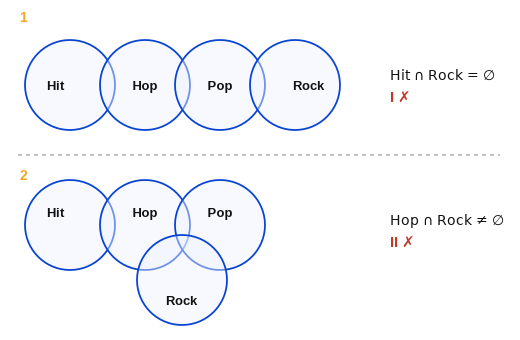
- Hit–Hop (some), Hop–Pop (some), Pop–Rock (some): no definite link between Hit and Rock → I fails.
- Hop and Rock may or may not overlap → 'No Hop is Rock' is not certain → II fails.
- I and II are about different pairs, so no 'either–or' case.
Trick: Some + Some = No conclusion. Either-or needs the same two terms in both conclusions.
Answer: (D) Neither conclusion I nor conclusion II follows
अवधारणा: '40% of Hit are Hop' = 'कुछ Hit, Hop हैं'। दो 'some' कथनों से कोई निश्चित निष्कर्ष नहीं निकलता।
- Hit–Hop, Hop–Pop, Pop–Rock सब 'some' → Hit और Rock में निश्चित संबंध नहीं → I गलत।
- Hop और Rock मिल भी सकते हैं, नहीं भी → 'No Hop is Rock' निश्चित नहीं → II गलत।
- I और II अलग-अलग पदों के बारे में हैं, इसलिए either–or भी नहीं।
ट्रिक: Some + Some = कोई निष्कर्ष नहीं। Either-or के लिए दोनों निष्कर्षों में एक ही दो पद चाहिए।
उत्तर: (D) न तो निष्कर्ष I और न ही निष्कर्ष II अनुसरण करता है
SSC CHSL Tier-1General IntelligenceSyllogism – chain of 'some'SSC CHSL Tier-1 2025 · 30 Nov Shift 2
Q138.Complete the following series from the given options.
xy_zxyy__yy_
निम्नलिखित शृंखला को दिए गए विकल्पों की सहायता से पूर्ण कीजिए।
xy_zxyy__yy_
- Axzyz
- Byzxz
- Cyxxz
- Dyyxz
Show answer
Concept: 12 places = 3 blocks of 4 letters.
- Try block 'xyyz': xyyz | xyyz | xyyz.
- Given: xy_z | xyy_ | _yy_ → blanks = y, z, x, z.
- Every printed letter matches the block.
Trick: Count total length first – it hints at the block size (12 = 3 × 4).
Answer: (B) yzxz
अवधारणा: कुल 12 स्थान = 4-4 अक्षरों के 3 खंड।
- खंड 'xyyz' मानें: xyyz | xyyz | xyyz।
- दिया है: xy_z | xyy_ | _yy_ → रिक्त = y, z, x, z।
- सभी छपे अक्षर इस खंड से मेल खाते हैं।
ट्रिक: पहले कुल लंबाई गिनें – खंड का आकार पता चल जाता है (12 = 3 × 4)।
उत्तर: (B) yzxz
SSC CHSL Tier-1General IntelligenceMissing letters – repeating blockSSC CHSL Tier-1 2025 · 30 Nov Shift 2
Q139.What should come next in the following series?
Y8, W64, U216, S512, ?
निम्नलिखित शृंखला में आगे क्या आना चाहिए?
Y8, W64, U216, S512, ?
- AR729
- BQ729
- CQ1000
- DT729
Show answer
Concept: Solve the letter part and the number part separately.
- Letters: Y(25), W(23), U(21), S(19) → next 17 = Q.
- Numbers: → next .
- Term = Q1000.
Trick: Letter part alone leaves Q729 and Q1000; (odd) breaks the even-cube pattern.
Answer: (C) Q1000
अवधारणा: अक्षर और संख्या को अलग-अलग हल करें।
- अक्षर: Y(25), W(23), U(21), S(19) → अगला 17 = Q।
- संख्या: → अगला ।
- पद = Q1000।
ट्रिक: अक्षर से Q729 और Q1000 बचते हैं; विषम है, इसलिए 1000।
उत्तर: (C) Q1000
SSC CHSL Tier-1General IntelligenceAlpha-numeric series – letters −2, even cubesSSC CHSL Tier-1 2025 · 30 Nov Shift 2
Q140.Select the combination of letters that, when placed sequentially in the blanks of the given series, will complete the series.
F K J RO TFR JT
उस अक्षर-संयोजन का चयन कीजिए, जिसे दी गई शृंखला के रिक्त स्थानों में क्रमानुसार रखने पर शृंखला पूर्ण हो जाएगी।
F K J RO TFR JT
- AO, R, T, F, K, J, O, K
- BR, O, T, K, F, J, O, K
- CR, O, T, F, K, J, O, K
- DR, O, K, F, T, J, O, K
Show answer
Concept: 10 printed + 8 blanks = 18 letters = 3 blocks of 6.
- Block = F R O K J T.
- Write the block three times and match it with the printed letters, position by position.
- Blanks fill as R O, T F, K J, O K.
Trick: Options (b) and (c) differ only in 'T, K, F' vs 'T, F, K' – checking the 6th–7th blanks settles it.
Answer: (C) R, O, T, F, K, J, O, K
अवधारणा: 10 छपे अक्षर + 8 रिक्त = 18 अक्षर = 6-6 के 3 खंड।
- खंड = F R O K J T।
- खंड को तीन बार लिखकर छपे अक्षरों से स्थान-दर-स्थान मिलाएँ।
- रिक्त स्थान: R O, T F, K J, O K।
ट्रिक: (b) और (c) में केवल 'T, K, F' बनाम 'T, F, K' का अंतर है – तीसरे-चौथे रिक्त जाँचकर तुरंत उत्तर।
उत्तर: (C) R, O, T, F, K, J, O, K
SSC CHSL Tier-1General IntelligenceLetter series – repeating 6-letter blockSSC CHSL Tier-1 2025 · 30 Nov Shift 2

