Q181.Which one of the following is TRUE about terminating decimals?
सांत दशमलव संख्याओं के विषय में निम्नलिखित में से कौन-सा कथन सत्य है?
- AAlways irrationalसदैव अपरिमेय
- BNever rationalकभी परिमेय नहीं
- CAlways rationalसदैव परिमेय
- DAlways whole numbersसदैव पूर्ण संख्याएँ
Show answer
Concept: A number expressible as is rational.
- → .
- Every terminating decimal can be written over a power of 10 → rational.
- Not always whole (0.75); never irrational.
Yaad rakhein: Terminating or repeating decimal → rational; non-terminating non-repeating → irrational.
Answer: (C) Always rational
अवधारणा: जो संख्या रूप में लिखी जा सके, वह परिमेय है।
- → ।
- हर सांत दशमलव को 10 की घात के ऊपर लिख सकते हैं → परिमेय।
- हमेशा पूर्ण संख्या नहीं (0.75); अपरिमेय कभी नहीं।
याद रखें: सांत या आवर्ती दशमलव → परिमेय; असांत अनावर्ती → अपरिमेय।
उत्तर: (C) सदैव परिमेय
SSC CHSLQuantitative AptitudeTerminating decimalsSSC CHSL 2025 · 28 Nov Shift 2
Q182.A hollow pipe is 1.5 meters long and has an inner radius of 5 cm and outer radius of 7 cm . Find the volume of material used in the pipe.
एक खोखला पाइप 1.5 मीटर लंबा है तथा उसकी आंतरिक त्रिज्या 5 cm और बाह्य त्रिज्या 7 cm है। पाइप में प्रयुक्त पदार्थ का आयतन ज्ञात कीजिए।
- A
- B
- C
- D
Show answer
Concept: .
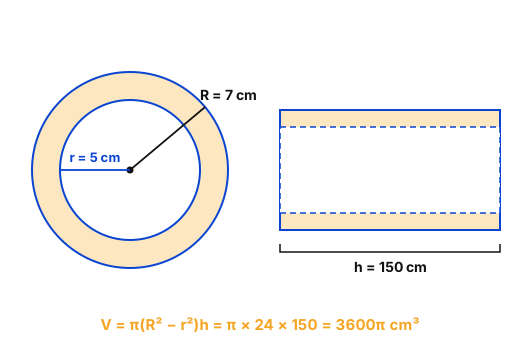
- .
- .
- .
Trick: – quick.
Answer: (C)
अवधारणा: ।
- ।
- ।
- ।
ट्रिक: ।
उत्तर: (C)
SSC CHSLQuantitative AptitudeVolume of hollow cylinderSSC CHSL 2025 · 28 Nov Shift 2
Q183.A gift box has an equilateral triangular base of side 10 cm and a height of 20 cm . If 30 such boxes are packed in a crate, find the total surface area of each box, including its top and bottom. (Use )
एक उपहार-बॉक्स का आधार 10 cm भुजा वाला समबाहु त्रिभुज है तथा उसकी ऊँचाई 20 cm है। यदि ऐसे 30 बॉक्स एक क्रेट में पैक किए जाएँ, तो प्रत्येक बॉक्स का कुल पृष्ठीय क्षेत्रफल ज्ञात कीजिए, जिसमें उसके ऊपरी तथा निचले फलक भी सम्मिलित हों। ( का प्रयोग कीजिए)
- A
- B
- C
- D
Show answer
Concept: .
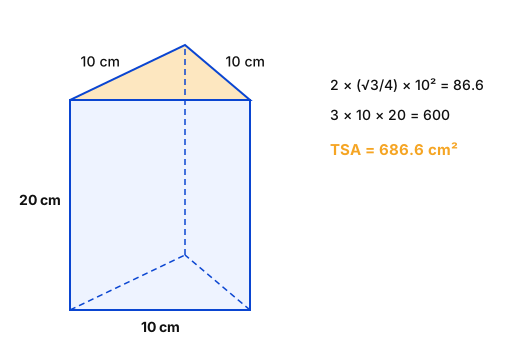
- cm²; two faces = 86.6 cm².
- cm².
- 686.6 cm².
Yaad rakhein: .
Answer: (C)
अवधारणा: ।
- cm²; दोनों = 86.6 cm²।
- cm²।
- 686.6 cm²।
याद रखें: ।
उत्तर: (C)
SSC CHSLQuantitative AptitudeTSA of triangular prismSSC CHSL 2025 · 28 Nov Shift 2
Q184.A hemisphere and a cylinder have the same base radius and the same height. Find the ratio of their volumes.
एक अर्धगोले और एक बेलन की आधार-त्रिज्या समान है तथा ऊँचाई भी समान है। उनके आयतनों का अनुपात ज्ञात कीजिए।
- A1 : 2
- B
- C2 : 3
- D5 : 3
Show answer
Concept: A hemisphere's height equals its radius r.
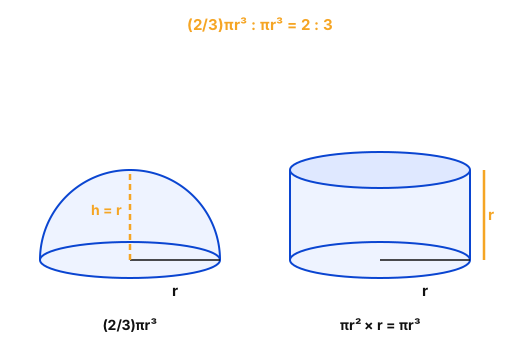
- .
- Cylinder (radius r, height r) .
- 2 : 3.
Yaad rakhein: Cone : Hemisphere : Cylinder (same r, ) = 1 : 2 : 3.
Answer: (C) 2 : 3
अवधारणा: अर्धगोले की ऊँचाई = उसकी त्रिज्या r।
- ।
- बेलन (त्रिज्या r, ऊँचाई r) ।
- 2 : 3।
याद रखें: शंकु : अर्धगोला : बेलन (समान r, ) = 1 : 2 : 3।
उत्तर: (C) 2 : 3
SSC CHSLQuantitative AptitudeRatio of volumes – hemisphere : cylinderSSC CHSL 2025 · 28 Nov Shift 2
Q185.A parallelogram has sides of 18 cm and 12 cm . The angle between them is 30°. Find the exact area of the parallelogram and the height corresponding to the longer side.
एक समांतर चतुर्भुज की भुजाएँ 18 cm और 12 cm हैं। उनके बीच का कोण 30° है। समांतर चतुर्भुज का यथार्थ क्षेत्रफल तथा लंबी भुजा के संगत ऊँचाई ज्ञात कीजिए।
- A
- B
- C
- D
Show answer
Concept: .
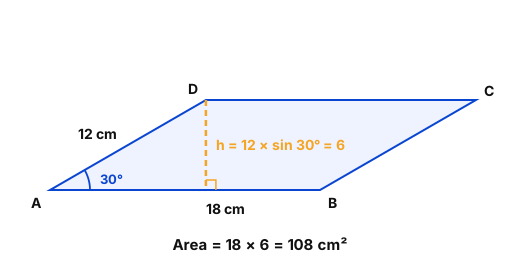
- .
- Height on 18 cm side = cm.
- Answer: 108 cm², 6 cm.
Trick: .
Answer: (C)
अवधारणा: ।
- ।
- 18 cm भुजा पर ऊँचाई = cm।
- उत्तर: 108 cm², 6 cm।
ट्रिक: ।
उत्तर: (C)
SSC CHSLQuantitative AptitudeArea of parallelogram – ab sin θSSC CHSL 2025 · 28 Nov Shift 2
Q186.A spherical ball of radius 14 cm is melted and recast into identical hemispheres, each having a radius of 7 cm.Determine the combined curved surface area of all the hemispheres formed.
14 सेमी त्रिज्या वाली एक गोलाकार गेंद को पिघलाकर एकसमान अर्धगोलों में ढाला जाता है, जिनमें से प्रत्येक की त्रिज्या 7 सेमी है। इस प्रकार बने सभी अर्धगोलों का कुल वक्र पृष्ठीय क्षेत्रफल ज्ञात कीजिए।
- A
- B
- C
- D
Show answer
Concept: Volume stays the same on melting; count pieces, then add CSA.
- .
- .
- 4928 cm².
Trick: Radius halves → volume ÷ 8; hemisphere is half a sphere → pieces.
Answer: (D)
अवधारणा: पिघलाने पर आयतन वही रहता है; पहले संख्या, फिर वक्र पृष्ठ जोड़ें।
- ।
- ।
- 4928 cm²।
ट्रिक: त्रिज्या आधी → ; अर्धगोला आधा → टुकड़े।
उत्तर: (D)
SSC CHSLQuantitative AptitudeRecasting – sphere to hemispheresSSC CHSL 2025 · 28 Nov Shift 2
Q187.If the square root of 25 plus the square root of equals 8 , find the value of .
यदि 25 के वर्गमूल और के वर्गमूल का योग 8 के बराबर है, तो का मान ज्ञात कीजिए।
- A0
- B3
- C5
- D7
Show answer
Concept: Isolate the root, then square both sides.
- .
- Square: .
- .
Trick: already → y² must add nothing, so .
Answer: (A) 0
अवधारणा: वर्गमूल अलग करें, फिर दोनों ओर वर्ग करें।
- ।
- वर्ग करने पर: ।
- ।
ट्रिक: पहले से 3 है → ही होगा।
उत्तर: (A) 0
SSC CHSLQuantitative AptitudeEquation with square rootsSSC CHSL 2025 · 28 Nov Shift 2
Q188.Chirag invested Rs. 8,000 for 9 months, and Sahil invested Rs. 9,000 for 4 months. If the total profit of the business is Rs. 21,000, how much will Chirag receive?
चिराग ने ₹8,000 का निवेश 9 महीनों के लिए किया और साहिल ने ₹9,000 का निवेश 4 महीनों के लिए किया। यदि व्यवसाय का कुल लाभ ₹21,000 है, तो चिराग को कितनी राशि प्राप्त होगी?
- A₹15,000
- B₹14,000
- C₹ 7000
- D₹12000
Show answer
Concept: Profit is shared in the ratio of (investment × months).
- Chirag: ; Sahil: .
- Ratio = 2 : 1.
- Chirag = ₹14,000.
Trick: Cancel thousands: .
Answer: (B) ₹14,000
अवधारणा: लाभ (पूँजी × महीने) के अनुपात में बँटता है।
- चिराग: ; साहिल: ।
- अनुपात = 2 : 1।
- चिराग = ₹14,000।
ट्रिक: हज़ार हटाकर: ।
उत्तर: (B) ₹14,000
SSC CHSLQuantitative AptitudePartnership – capital × timeSSC CHSL 2025 · 28 Nov Shift 2
Q189.If , find .
यदि , तो का मान ज्ञात कीजिए।
- A
- B
- C
- D1
Show answer
Concept: .
- .
- .
- = .
Trick: .
Answer: (B)
अवधारणा: ।
- ।
- ।
- = ।
ट्रिक: , जहाँ ।
उत्तर: (B)
SSC CHSLQuantitative AptitudeTrigonometric values – 45°SSC CHSL 2025 · 28 Nov Shift 2
Q190.If and is in Quadrant IV, what is the value of ?
यदि है और चतुर्थ चतुर्थांश में है, तो का मान क्या है?
- A
- B
- C
- D
Show answer
Concept: In Quadrant IV only cos and sec are positive.
- → base 4, hypotenuse 5 → perpendicular 3.
- in size.
- Quadrant IV → tan negative → .
Yaad rakhein: ASTC: All (I), Sin (II), Tan (III), Cos (IV) are positive.
Answer: (C)
अवधारणा: चतुर्थ चतुर्थांश में केवल cos और sec धनात्मक।
- → आधार 4, कर्ण 5 → लंब 3।
- tan x का मान ।
- चतुर्थ चतुर्थांश → tan ऋणात्मक → ।
याद रखें: ASTC: I में सभी, II में sin, III में tan, IV में cos धनात्मक।
उत्तर: (C)
SSC CHSLQuantitative AptitudeTrig ratio – sign in Quadrant IVSSC CHSL 2025 · 28 Nov Shift 2
Q191.Two pipes of length 1.8 meters and 1.2 meters are to be cut into equal pieces without leaving any extra length. What is the greatest length of pieces of the same size that can be cut from both pipes?
1.8 मीटर और 1.2 मीटर लंबाई के दो पाइपों को बिना कोई अतिरिक्त लंबाई छोड़े बराबर टुकड़ों में काटा जाना है। दोनों पाइपों से काटे जा सकने वाले समान माप के टुकड़ों की अधिकतम लंबाई कितनी है?
- A0.3 meter0.3 मीटर
- B0.6 meter0.6 मीटर
- C0.2 meter0.2 मीटर
- D0.4 meter0.4 मीटर
Show answer
Concept: Greatest piece dividing both lengths = HCF.
- 1.8 m = 180 cm, 1.2 m = 120 cm.
- HCF(180, 120) = 60 cm.
- = 0.6 m.
Trick: 180 − 120 = 60, and 60 divides both → HCF = 60.
Answer: (B) 0.6 meter
अवधारणा: दोनों लंबाइयों को पूरा काटने वाला सबसे बड़ा टुकड़ा = HCF।
- 1.8 m = 180 cm, 1.2 m = 120 cm।
- HCF(180, 120) = 60 cm।
- = 0.6 m।
ट्रिक: 180 − 120 = 60, और 60 दोनों को काटता है → HCF = 60।
उत्तर: (B) 0.6 मीटर
SSC CHSLQuantitative AptitudeHCF – greatest equal lengthSSC CHSL 2025 · 28 Nov Shift 2
Q192.A 50 -litre solution contains 20% salt.How many litres of water must be evaporated so that the concentration of salt becomes 25%?
50 लीटर के एक घोल में 20% नमक है। नमक की सांद्रता 25% हो जाए, इसके लिए कितने लीटर पानी वाष्पित करना होगा?
- A10 L
- B12 L
- C15 L
- D18 L
Show answer
Concept: Only water evaporates; salt quantity stays fixed.
- L.
- 10 L must be 25% → new total = L.
- 10 L.
Trick: Salt fixed: 20% → 25% means L.
Answer: (A) 10 L
अवधारणा: केवल पानी उड़ता है; नमक की मात्रा वही रहती है।
- L।
- 10 L = 25% → नया कुल = 40 L।
- 10 L।
ट्रिक: नमक स्थिर: L।
उत्तर: (A) 10 L
SSC CHSLQuantitative AptitudeMixture – evaporationSSC CHSL 2025 · 28 Nov Shift 2
Q193.A caterer prepares a juice mixture using orange juice, pineapple juice, and soda water in the ratio . If the total quantity of the mixture is 20 liters, how many liters of soda water are used?
एक खानसामा संतरे के रस, अनानास के रस और सोडा वाटर को के अनुपात में मिलाकर एक जूस मिश्रण तैयार करता है। यदि मिश्रण की कुल मात्रा 20 लीटर है, तो इसमें कितने लीटर सोडा वाटर प्रयोग किया गया है?
- A2
- B5
- C4
- D3
Show answer
Concept: .
- .
- .
- = 4 L.
Trick: → soda 2 parts = 4 L.
Answer: (C) 4
अवधारणा: ।
- ।
- ।
- = 4 L।
ट्रिक: 1 भाग = 2 L → सोडा 2 भाग = 4 L।
उत्तर: (C) 4
SSC CHSLQuantitative AptitudeRatio – share of a partSSC CHSL 2025 · 28 Nov Shift 2
Q194.Three containers A, B and C have liquids in the ratio 2 : 3 : 5 respectively. In container A, the ratio of milk to water is 1 :1;in container B, it is 2 : 1; and in container C , it is 3 : 2.If the contents of all three containers are mixed together, what will be the ratio of milk to water in the final mixture?
तीन पात्रों A, B और C में द्रव क्रमशः 2 : 3 : 5 के अनुपात में हैं। पात्र A में दूध और पानी का अनुपात 1 : 1 है; पात्र B में यह 2 : 1 है; और पात्र C में यह 3 : 2 है। यदि तीनों पात्रों की सामग्री को एक साथ मिला दिया जाए, तो अंतिम मिश्रण में दूध और पानी का अनुपात क्या होगा?
- A
- B
- C1 : 2
- D3 : 2
Show answer
Concept: Split each container into milk and water, then add.
- A (2 units, 1:1): milk 1, water 1.
- B (3 units, 2:1): milk 2, water 1; C (5 units, 3:2): milk 3, water 2.
- Milk 6, water 4 → 3 : 2.
Trick: Each container's ratio-sum equals its share (2, 3, 5) – no LCM needed.
Answer: (D) 3 : 2
अवधारणा: हर पात्र को दूध और पानी में बाँटें, फिर जोड़ें।
- A (2 भाग, 1:1): दूध 1, पानी 1।
- B (3 भाग, 2:1): दूध 2, पानी 1; C (5 भाग, 3:2): दूध 3, पानी 2।
- दूध 6, पानी 4 → 3 : 2।
ट्रिक: हर पात्र के अनुपात का योग उसके हिस्से (2, 3, 5) के बराबर – LCM की ज़रूरत नहीं।
उत्तर: (D) 3 : 2
SSC CHSLQuantitative AptitudeMixture of three containersSSC CHSL 2025 · 28 Nov Shift 2
Q195.A person travels from city to city B. They cover of the journey by bike, of the remaining journey by foot, and the rest 12 km by bus. What is the total distance between city A and city B ?
एक व्यक्ति शहर से शहर B तक यात्रा करता है। वह यात्रा का भाग बाइक से, शेष यात्रा का भाग पैदल तथा अंतिम 12 किमी बस से तय करता है। शहर A और शहर B के बीच कुल दूरी कितनी है?
- A45 km45 किमी
- B35 km35 किमी
- C40 km40 किमी
- D30 km30 किमी
Show answer
Concept: Work on the remaining part after each stage.
- .
- .
- 45 km.
Trick: Total must be a multiple of 15 → only 45 among options works.
Answer: (A) 45 km
अवधारणा: हर चरण के बाद बचे भाग पर काम करें।
- ।
- ।
- 45 किमी।
ट्रिक: कुल दूरी 15 का गुणज होगी → विकल्पों में केवल 45।
उत्तर: (A) 45 किमी
SSC CHSLQuantitative AptitudeFractions of a journeySSC CHSL 2025 · 28 Nov Shift 2
Q196.If sin
यदि , तो कोण और कोण B के बीच क्या संबंध है?
- A=cos
- B, what is the relationship between angle and angle B?
- C
- D (c) (d) A = BA = B
Show answer
Concept: .
- .
- Given .
- So .
Trick: Test ✔
Answer: (A) =cos
अवधारणा: ।
- ।
- दिया → ।
- अतः ।
ट्रिक: रखकर जाँचें: ✔
उत्तर: (A)
SSC CHSLQuantitative AptitudeComplementary angles – sin A = cos BSSC CHSL 2025 · 28 Nov Shift 2
- A3
- B5
- C4
- D2
Show answer
Concept: .
- .
- .
- = 4.
Trick: Conjugate pairs always remove the root in one step.
Answer: (C) 4
अवधारणा: ।
- ।
- ।
- = 4।
ट्रिक: Conjugate जोड़ी गुणा करते ही करणी हट जाती है।
उत्तर: (C) 4
SSC CHSLQuantitative AptitudeSurds – (a + b)(a − b)SSC CHSL 2025 · 28 Nov Shift 2
Q198.If and , then what is the value of ?
यदि और है, तो का मान क्या है?
- A150
- B140
- C180
- D130
Show answer
Concept: Solve for by adding/subtracting.
- .
- Add: ; subtract: .
- 130.
Trick: .
Answer: (D) 130
अवधारणा: जोड़-घटाकर निकालें।
- ।
- जोड़ें: ; घटाएँ: ।
- 130।
ट्रिक: ।
उत्तर: (D) 130
SSC CHSLQuantitative AptitudeSurd equations – √x, √ySSC CHSL 2025 · 28 Nov Shift 2
Q199.The difference between simple interest on a certain sum at the annual rate of 12 percent for 3 years and 4 years is Rs. 72. What is the sum?
किसी निश्चित धनराशि पर 12 प्रतिशत वार्षिक दर से 3 वर्ष और 4 वर्ष के साधारण ब्याज का अंतर ₹72 है। वह धनराशि कितनी है?
- ARs. 600₹600
- BRs. 650₹650
- CRs. 580₹580
- DRs. 540₹540
Show answer
Concept: .
- One year's SI = 12% of P = ₹72.
- .
- = ₹600.
Trick: 12% → 72, so 1% → 6, 100% → 600.
Answer: (A) Rs. 600
अवधारणा: ।
- 1 वर्ष का SI = P का 12% = ₹72।
- ।
- = ₹600।
ट्रिक: 12% → 72, तो 1% → 6, 100% → 600।
उत्तर: (A) ₹600
SSC CHSLQuantitative AptitudeSimple interest – difference of yearsSSC CHSL 2025 · 28 Nov Shift 2
Q200.There are 4 numbers M1, M2, M3 and M4. Average of M1, M2 and M3 is 40. Average of M2, M3 and M4 is 34. Value of M1 is 36. What is the value of M4?
चार संख्याएँ M1, M2, M3 और M4 हैं। M1, M2 और M3 का औसत 40 है। M2, M3 और M4 का औसत 34 है। M1 का मान 36 है। M4 का मान क्या है?
- A20
- B16
- C17
- D18
Show answer
Concept: Sum = average × count; subtract overlapping sums.
- M1 + M2 + M3 = 120; M2 + M3 + M4 = 102.
- Subtract: M1 − M4 = 18.
- M4 = 36 − 18 = 18.
Trick: M1 − M4 = 3 × (40 − 34) = 18 → M4 = 36 − 18.
Answer: (D) 18
अवधारणा: योग = औसत × संख्या; साझा भाग घटाएँ।
- M1 + M2 + M3 = 120; M2 + M3 + M4 = 102।
- घटाने पर: M1 − M4 = 18।
- M4 = 36 − 18 = 18।
ट्रिक: M1 − M4 = 3 × (40 − 34) = 18 → M4 = 18।
उत्तर: (D) 18
SSC CHSLQuantitative AptitudeAverage – find missing numberSSC CHSL 2025 · 28 Nov Shift 2

