Q261.If 650 & and 820 & 35 , then what is the value of 945 & 6 $ 8?
यदि 650 & और 820 & 35 , तो 945 & 6 $ 8 का मान क्या है?
- A890
- B897
- C900
- D905
Show answer
Concept: Rule: first number minus product of the other two.
- and 650 − 60 gives 590 ✓
- ; subtracting from 820 gives −55 ✓
- ; .
Trick: A negative result (−55) hints that something big is subtracted – try .
Answer: (B) 897
अवधारणा: नियम: पहली संख्या − बाकी दो का गुणनफल।
- , और 650 में से घटाने पर 590 ✓
- ; 820 में से घटाने पर −55 ✓
- ; ।
ट्रिक: ऋणात्मक परिणाम (−55) बताता है कि बड़ी संख्या घटाई गई – आज़माएँ।
उत्तर: (B) 897
SSC CHSLGeneral IntelligenceSymbol operation – a − b×cSSC CHSL 2025 · 27 Nov Shift 2
Q262.In the questions given below, there are three statements followed by two conclusions I and II. You have to take the three given statements to be true even if they seem to be at variance from commonly known facts. Read all the conclusions and then decide which of the given conclusions logically follows from the three statements disregarding commonly known facts.
Statements:
Only some engineers are scientists
Some scientists are artists
All artists are intelligent.
Conclusion:
I. Some engineers are not intelligent.
II. Some intelligent are scientists.
नीचे दिए गए प्रश्नों में तीन कथन दिए गए हैं जिनके बाद दो निष्कर्ष I और II दिए गए हैं। आपको तीनों दिए गए कथनों को सत्य मानना है, भले ही वे सर्वज्ञात तथ्यों से भिन्न प्रतीत हों। सभी निष्कर्षों को पढ़िए और फिर निर्णय कीजिए कि सर्वज्ञात तथ्यों की उपेक्षा करते हुए दिए गए निष्कर्षों में से कौन-सा निष्कर्ष तीनों कथनों का तार्किक रूप से अनुसरण करता है।
कथन:
केवल कुछ इंजीनियर वैज्ञानिक हैं कुछ वैज्ञानिक कलाकार हैं सभी कलाकार बुद्धिमान हैं।
निष्कर्ष:
I. कुछ इंजीनियर बुद्धिमान नहीं हैं।
II. कुछ बुद्धिमान वैज्ञानिक हैं।
- ABoth conclusions I and II followनिष्कर्ष I और II दोनों अनुसरण करते हैं
- BOnly conclusion I followsकेवल निष्कर्ष I अनुसरण करता है
- COnly conclusion II followsकेवल निष्कर्ष II अनुसरण करता है
- DNeither conclusion I nor II followsन तो निष्कर्ष I और न ही निष्कर्ष II अनुसरण करता है
Show answer
Concept: 'Only some A are B' = some A are B AND some A are not B.
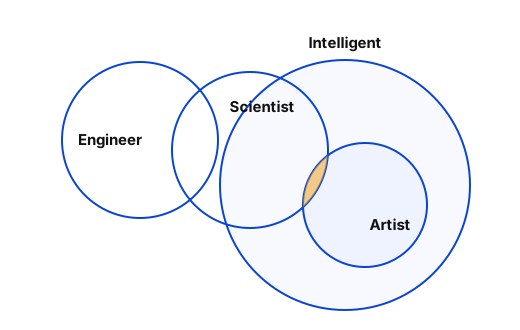
- Scientists–artists overlap, and all artists are intelligent → some scientists are intelligent → 'Some intelligent are scientists' follows (II).
- Non-scientist engineers may or may not be intelligent → I is only a possibility.
- So only II follows.
Trick: Some + All → Some (conclusion converts: some scientists are intelligent = some intelligent are scientists).
Answer: (C) Only conclusion II follows
अवधारणा: 'Only some A are B' = कुछ A, B हैं और कुछ A, B नहीं हैं।
- कुछ वैज्ञानिक कलाकार हैं, सभी कलाकार बुद्धिमान → कुछ वैज्ञानिक बुद्धिमान → II सही।
- जो इंजीनियर वैज्ञानिक नहीं, वे बुद्धिमान हों या न हों – I केवल संभावना।
- अतः केवल II।
ट्रिक: Some + All = Some; 'कुछ X, Y हैं' उलटकर 'कुछ Y, X हैं' भी सही।
उत्तर: (C) केवल निष्कर्ष II अनुसरण करता है
SSC CHSLGeneral IntelligenceSyllogism – only someSSC CHSL 2025 · 27 Nov Shift 2
Q263.Six persons M, N, O, P, Q and R lived in a building with 6 floors. Only one person lived on each floor. N lived just above P. 2 persons lived between P and R. P lived on one of the floors above R. M lived just above 0 who did not live on a floor second from the bottom. How many persons lived below Q ?
छह व्यक्ति M, N, O, P, Q और R एक इमारत में रहते हैं जिसमें 6 मंज़िलें हैं। प्रत्येक मंज़िल पर केवल एक ही व्यक्ति रहता है। N, P के ठीक ऊपर रहता है। P और R के बीच 2 व्यक्ति रहते हैं। P, R के ऊपर की किसी एक मंज़िल पर रहता है। M, 0 के ठीक ऊपर रहता है, जो नीचे से दूसरी मंज़िल पर नहीं रहता। Q के नीचे कितने व्यक्ति रहते हैं?
- ANoneकोई नहीं
- BOneएक
- CTwoदो
- DThreeतीन
Show answer
Concept: Fix the P–R gap first, then place pairs.
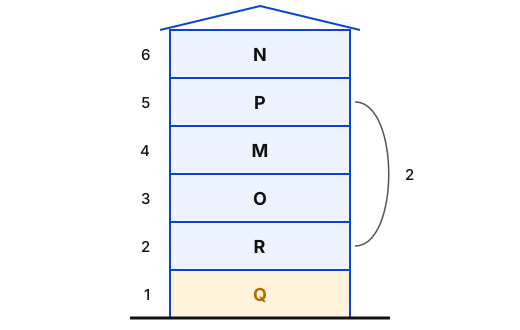
- P is 3 floors above R and N is just above P → (R1, P4, N5) or (R2, P5, N6).
- Case R1: only O2–M3 fits for M just above O, but O can't be on floor 2 → rejected.
- Case R2: P5, N6; M–O must be O3, M4 → Q on floor 1. Nobody lives below Q.
Trick: Floor 1 person always has 'none' below – once Q lands on 1, stop.
Answer: (A) None
अवधारणा: पहले P–R का अंतर तय करें, फिर जोड़ियाँ रखें।
- P, R से 3 मंज़िल ऊपर और N, P के ठीक ऊपर → (R1, P4, N5) या (R2, P5, N6)।
- R1 वाले केस में O2–M3 ही बचता, पर O दूसरी मंज़िल पर नहीं → गलत।
- R2: P5, N6; O3, M4 → Q पहली मंज़िल पर; उसके नीचे कोई नहीं।
ट्रिक: सबसे निचली मंज़िल वाले के नीचे कोई नहीं होता।
उत्तर: (A) कोई नहीं
SSC CHSLGeneral IntelligenceFloor puzzle – six floorsSSC CHSL 2025 · 27 Nov Shift 2
Q264.Price of 5 cups A, B, C, D and E is compared. Price of no two cups is same. Price of D is more than E but less than B and C . Price of A is highest. If the price of is less than , then the price of how many cups is more than ?
5 कपों A, B, C, D और E के मूल्यों की तुलना की जाती है। किन्हीं दो कपों का मूल्य समान नहीं है। D का मूल्य E से अधिक किंतु B और C से कम है। A का मूल्य सबसे अधिक है। यदि का मूल्य से कम है, तो कितने कपों का मूल्य से अधिक है?
- A2
- B3
- C1
- D0
Show answer
Concept: Combine inequalities into one chain.
- E < D < B and D < C; A is the highest.
- B < C → A > C > B > D > E.
- Cups costlier than B: A and C = 2.
Trick: Write a single chain left to right (high→low) and just count.
Answer: (A) 2
अवधारणा: सभी असमानताओं को एक श्रृंखला में जोड़ें।
- E < D < B और D < C; A सबसे महँगा।
- B < C → A > C > B > D > E।
- B से महँगे: A और C = 2।
ट्रिक: ऊँचे से नीचे एक ही पंक्ति लिखें और गिन लें।
उत्तर: (A) 2
SSC CHSLGeneral IntelligenceOrdering – pricesSSC CHSL 2025 · 27 Nov Shift 2
Q265.Six players P, Q, R, S, T, and U are compared on the basis of their heights. No two players have the same height. P's height is the second tallest. U's height is greater than that of and but less than that of S and T. T's height is not the maximum. Which player has the maximum height?
छह खिलाड़ियों P, Q, R, S, T और U की तुलना उनकी लंबाई के आधार पर की जाती है। किन्हीं दो खिलाड़ियों की लंबाई समान नहीं है। P की लंबाई दूसरे स्थान पर सबसे अधिक है। U की लंबाई और से अधिक है किंतु S और T से कम है। T की लंबाई सर्वाधिक नहीं है। किस खिलाड़ी की लंबाई सर्वाधिक है?
- AP
- BS
- CQ
- DT
Show answer
Concept: Eliminate who cannot be first.
- S and T are taller than U; U > R, Q → tallest is S or T (or P).
- P holds 2nd place and T is ruled out for 1st.
- Only S remains for the top: S > P > T > U > (R, Q).
Trick: Strike out each name ruled out for the top spot – one remains.
Answer: (B) S
अवधारणा: जो सबसे लंबा नहीं हो सकता, उसे हटाते जाएँ।
- S और T, U से लंबे; U, R और Q से लंबा।
- P दूसरे स्थान पर, T सबसे लंबा नहीं।
- अतः S सबसे लंबा: S > P > T > U > (R, Q)।
ट्रिक: शीर्ष स्थान से नाम काटते जाएँ – जो बचे वही उत्तर।
उत्तर: (B) S
SSC CHSLGeneral IntelligenceOrdering – heightsSSC CHSL 2025 · 27 Nov Shift 2
Q266.8 boys S, T, U, V, W, X, Y and Z are sitting around a circular table facing towards the centre (not necessarily in the same order). Z is to the immediate right of S. Z is not the immediate neighbour of W or V. X is to the immediate left of T. Y is the immediate neighbour of W. U is the immediate neighbour of W and Z. Who is sitting second to the right of Z ?
8 लड़के S, T, U, V, W, X, Y तथा Z एक वृत्ताकार मेज़ के चारों ओर केंद्र की ओर मुख करके बैठे हैं (आवश्यक नहीं कि इसी क्रम में)। Z, S के ठीक दाईं ओर है। Z, W अथवा V का निकटतम पड़ोसी नहीं है। X, T के ठीक बाईं ओर है। Y, W का निकटतम पड़ोसी है। U, W तथा Z का निकटतम पड़ोसी है। Z के दाईं ओर दूसरे स्थान पर कौन बैठा है?
- AU
- BW
- CV
- DT
Show answer
Concept: Facing centre: right = anticlockwise, left = clockwise.
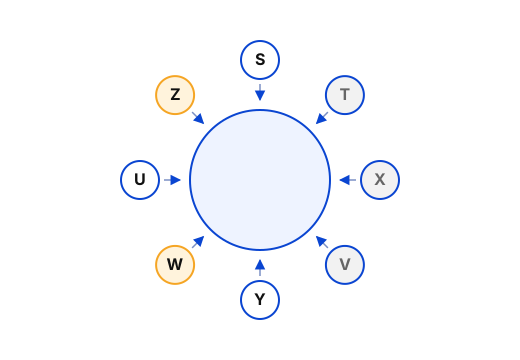
- U sits between W and Z, and Y is next to W → block Z–U–W–Y.
- Z is to the immediate right of S, so S is on Z's left and U must be on Z's right.
- Going right from Z: U (1st), W (2nd), Y (3rd); V, X, T fill the remaining seats (X to the left of T).
Trick: Build the blocks first (S–Z–U–W–Y and X–T), then read off the seats.
Answer: (B) W
अवधारणा: केंद्र की ओर मुख: दायाँ = वामावर्त, बायाँ = दक्षिणावर्त।
- U, W और Z के बीच है तथा Y, W के पास है → ब्लॉक Z–U–W–Y।
- Z, S के ठीक दाईं ओर है, अतः S, Z के बाईं ओर और U, Z के दाईं ओर।
- Z से दाएँ: U (पहला), W (दूसरा), Y (तीसरा); शेष स्थानों पर V, X, T (X, T के बाईं ओर)।
ट्रिक: पहले ब्लॉक बनाएँ (S–Z–U–W–Y और X–T), फिर स्थान पढ़ें।
उत्तर: (B) W
SSC CHSLGeneral IntelligenceCircular seating – facing centreSSC CHSL 2025 · 27 Nov Shift 2
Q267.Some conditional data is provided to you in form of statement you have to check which of the following statement are logically inference from given statement.
Statement : Employees who complete their projects before the deadline are given a bonus. Rahul completed his project this month before the deadline. What can we infer?
आपको कथन के रूप में कुछ सशर्त सूचना दी गई है। आपको यह जाँचना है कि निम्नलिखित में से कौन-सा कथन दिए गए कथन से तार्किक रूप से निष्कर्षित होता है।
कथन : जो कर्मचारी अपनी परियोजनाएँ समय-सीमा से पहले पूरी कर लेते हैं, उन्हें बोनस दिया जाता है। Rahul ने इस माह अपनी परियोजना समय-सीमा से पहले पूरी कर ली। हम क्या निष्कर्ष निकाल सकते हैं?
- ARahul received a bonus this monthRahul को इस माह बोनस मिला
- BRahul always completes work before the deadlineRahul सदैव समय-सीमा से पहले कार्य पूरा करता है
- CRahul needed extra leaveRahul को अतिरिक्त अवकाश की आवश्यकता थी
- DRahul is a hardworking employeeRahul एक परिश्रमी कर्मचारी है
Show answer
Concept: If the condition of a rule is met, its result must follow.
- Rule: finish before deadline → get bonus.
- Rahul finished before the deadline this month.
- So he got the bonus this month; habits/leave/nature are not stated.
Trick: Pick the option that only uses facts in the statement – 'always' and character judgements go beyond it.
Answer: (A) Rahul received a bonus this month
अवधारणा: नियम की शर्त पूरी हो तो उसका परिणाम निश्चित है।
- नियम: समय-सीमा से पहले काम → बोनस।
- Rahul ने इस माह समय से पहले काम पूरा किया।
- अतः उसे इस माह बोनस मिला; आदत/अवकाश/स्वभाव का उल्लेख नहीं।
ट्रिक: 'सदैव' या स्वभाव वाले विकल्प कथन से आगे जाते हैं – हटा दें।
उत्तर: (A) Rahul को इस माह बोनस मिला
SSC CHSLGeneral IntelligenceLogical inference – conditional ruleSSC CHSL 2025 · 27 Nov Shift 2
Q268.In this type of questions, question is provided with substitutes for various mathematical symbols, followed by a question involving calculation of an expression or choosing the correct/incorrect equation. You have to put the real signs in the given equation and then solve the questions as required. If '#' stands for '÷', '%' stands for '-', '$' stands for ' + ', ' stands for ' ', then find the value of: ?
इस प्रकार के प्रश्नों में विभिन्न गणितीय चिह्नों के स्थान पर प्रतिस्थापित चिह्न दिए जाते हैं, तत्पश्चात् किसी व्यंजक का मान ज्ञात करने अथवा सही/गलत समीकरण चुनने से संबंधित प्रश्न पूछा जाता है। आपको दिए गए समीकरण में वास्तविक चिह्न रखकर प्रश्न को हल करना है। यदि '#' का अर्थ '÷' है, '%' का अर्थ '-' है, '$' का अर्थ ' + ' है, ' का अर्थ ' ' है, तो का मान ज्ञात कीजिए?
- A424
- B423
- C421
- D422
Show answer
Concept: Replace symbols with real signs, then apply BODMAS.
- ∼ = ×, $ = + → .
- .
- .
Trick: Unit digit check: ends in 0, +3 → ends in 3 → only 423.
Answer: (B) 423
अवधारणा: चिह्न बदलें, फिर BODMAS लगाएँ।
- ∼ = ×, $ = + → ।
- ।
- ।
ट्रिक: इकाई अंक: → केवल 423।
उत्तर: (B) 423
SSC CHSLGeneral IntelligenceSymbol substitution – BODMASSSC CHSL 2025 · 27 Nov Shift 2
Q269.After interchanging the given two signs, what will be the value of the given equation ?
× and -
?
दिए गए दो चिह्नों को आपस में बदलने पर दिए गए समीकरण का मान क्या होगा?
× तथा -
?
- A22
- B-20
- C-18
- D-14
Show answer
Concept: Swap the two signs everywhere, then use BODMAS.
- .
- .
- .
Trick: Do ÷ first () to keep numbers small.
Answer: (C) -18
अवधारणा: दोनों चिह्न हर जगह बदलें, फिर BODMAS।
- ।
- ।
- ।
ट्रिक: पहले भाग () करें – संख्याएँ छोटी रहेंगी।
उत्तर: (C) -18
SSC CHSLGeneral IntelligenceSign interchange – × and −SSC CHSL 2025 · 27 Nov Shift 2
Q270.By interchanging the given two numbers (not digits) which of the following equation will NOT be correct?
4 and 6
l.
II.
दी गई दो संख्याओं (अंकों को नहीं) को आपस में बदलने पर निम्नलिखित में से कौन-सा समीकरण सही नहीं होगा?
4 तथा 6
l.
II.
- AOnly Iकेवल I
- BOnly IIकेवल II
- CBoth I and III तथा II दोनों
- DNeither I nor IIन तो I और न ही II
Show answer
Concept: Swap the numbers 4 and 6 (not digits inside 10, 12), then evaluate.
- I becomes ; 3×4 is 12 and 10÷2 is 5, so ✓
- II becomes ; 8×4 is 32 and 12÷3 is 4, so total = 34, not 18 ✗
- So only II is not correct.
Trick: Quick estimate: in II, 8×4 alone is 32, already far above 18.
Answer: (B) Only II
अवधारणा: 4 और 6 संख्याएँ बदलें (10, 12 के अंक नहीं), फिर हल करें।
- I बनता है ; , , तो ✓
- II बनता है ; , , कुल = 34, 18 नहीं ✗
- अतः केवल II गलत।
ट्रिक: II में केवल ही 18 से बहुत बड़ा है।
उत्तर: (B) केवल II
SSC CHSLGeneral IntelligenceNumber interchange – checking equationsSSC CHSL 2025 · 27 Nov Shift 2
Q271.In a certain coded language 'CPET' is coded as 'IWKA' and 'TLJQ' is coded as 'ZSPX'. How will 'CPXM' be coded in the same code language?
एक निश्चित कूट भाषा में 'CPET' को 'IWKA' तथा 'TLJQ' को 'ZSPX' लिखा जाता है। उसी कूट भाषा में 'CPXM' को किस प्रकार लिखा जाएगा?
- AGXDU
- BIWDT
- CHWCS
- DHYCT
Show answer
Concept: Compare letter positions of word and code.
- C→I (+6), P→W (+7), E→K (+6), T→A (+7); TLJQ→ZSPX same.
- In CPXM, C and P give I and W (as in CPET); X is 24, add 6 → 30, minus 26 → 4th letter D; M is 13, add 7 → 20th letter T.
- Code = IWDT.
Trick: First two letters of CPXM equal CPET → code must start 'IW' → only option B.
Answer: (B) IWDT
अवधारणा: शब्द और कोड के अक्षरों की स्थिति-संख्या मिलाएँ।
- C→I (+6), P→W (+7), E→K (+6), T→A (+7); TLJQ में भी यही।
- CPXM में C, P से I, W (CPET जैसा); X = 24, +6 → 30, −26 → 4 = D; M = 13, +7 → 20 = T।
- कोड = IWDT।
ट्रिक: CPXM के पहले दो अक्षर CPET जैसे → कोड 'IW' से शुरू → केवल B।
उत्तर: (B) IWDT
SSC CHSLGeneral IntelligenceCoding – +6, +7 alternatingSSC CHSL 2025 · 27 Nov Shift 2
Q272.In a certain coded language 'RSNV' is coded as 'NNJQ' and 'GDHQ' is coded as 'CYDL'. How will 'ONRG' be coded in the same code language?
एक निश्चित कूट भाषा में 'RSNV' को 'NNJQ' तथा 'GDHQ' को 'CYDL' लिखा जाता है। उसी कूट भाषा में 'ONRG' को किस प्रकार लिखा जाएगा?
- AMHOC
- BKINB
- CLJOZ
- DIKPA
Show answer
Concept: Each letter moves back 4, then 5, alternately.
- R→N (−4), S→N (−5), N→J (−4), V→Q (−5); GDHQ→CYDL confirms.
- ONRG: O(15)−4 = K, N(14)−5 = I, R(18)−4 = N, G(7)−5 = B.
- Code = KINB.
Trick: Find only the first letter: O − 4 = K → only option B starts with K.
Answer: (B) KINB
अवधारणा: अक्षर बारी-बारी 4 और 5 पीछे जाते हैं।
- R→N (−4), S→N (−5), N→J (−4), V→Q (−5); GDHQ→CYDL से पुष्टि।
- ONRG: O−4 = K, N−5 = I, R−4 = N, G−5 = B।
- कोड = KINB।
ट्रिक: पहला अक्षर ही काफ़ी: O − 4 = K → केवल B।
उत्तर: (B) KINB
SSC CHSLGeneral IntelligenceCoding – −4, −5 alternatingSSC CHSL 2025 · 27 Nov Shift 2
Q273.Which following group of letters, when sequentially placed from left to right will complete the given series?
t_pp_kpptkp_tk_p
निम्नलिखित में से अक्षरों का कौन-सा समूह बाएँ से दाएँ क्रमानुसार रखने पर दी गई शृंखला को पूर्ण करेगा?
t_pp_kpptkp_tk_p
- Ak k t p
- Bktpp
- Ckttt
- Dkttp
Show answer
Concept: Split the 16-letter string into equal repeating blocks.
- Blocks of 4: t_pp | _kpp | tkp_ | tk_p.
- Each block = tkpp.
- Blanks in order: k, t, p, p.
Trick: Length 16 → try blocks of 4; fill one block fully and copy.
Answer: (B) ktpp
अवधारणा: 16 अक्षरों को बराबर दोहराते समूहों में बाँटें।
- 4-4 के समूह: t_pp | _kpp | tkp_ | tk_p।
- हर समूह = tkpp।
- रिक्त क्रम से: k, t, p, p।
ट्रिक: लंबाई 16 → 4 के समूह आज़माएँ; एक समूह पूरा करके दोहराएँ।
उत्तर: (B) ktpp
SSC CHSLGeneral IntelligenceMissing letters – repeating blockSSC CHSL 2025 · 27 Nov Shift 2
Q274.A series is given with one term missing. Select the correct alternative from the given ones that will complete the series.
OK34, JF136, EA544, ZV2176, ?
एक शृंखला दी गई है जिसमें एक पद लुप्त है। दिए गए विकल्पों में से वह सही विकल्प चुनिए जो शृंखला को पूर्ण करेगा।
OK34, JF136, EA544, ZV2176, ?
- AUR8934
- BTQ8604
- CUQ8704
- DTR8814
Show answer
Concept: Treat letters and numbers as separate series.
- Letters step back by 5: O→J→E→Z→U and K→F→A→V→Q.
- Numbers ×4: 34→136→544→2176→8704.
- Term = UQ8704.
Trick: Number part alone: → only option C has it.
Answer: (C) UQ8704
अवधारणा: अक्षर और संख्या को अलग-अलग शृंखला मानें।
- अक्षर 5 पीछे: O→J→E→Z→U तथा K→F→A→V→Q।
- संख्या ×4: 34→136→544→2176→8704।
- पद = UQ8704।
ट्रिक: सिर्फ़ संख्या: → केवल C।
उत्तर: (C) UQ8704
SSC CHSLGeneral IntelligenceAlphanumeric series – letters −5, number ×4SSC CHSL 2025 · 27 Nov Shift 2
Q275.A series is given with one term missing. Select the correct alternative from the given ones that will complete the series.
NX32, QT97, TP292, WL877, ?
एक शृंखला दी गई है जिसमें एक पद लुप्त है। दिए गए विकल्पों में से वह सही विकल्प चुनिए जो शृंखला को पूर्ण करेगा।
NX32, QT97, TP292, WL877, ?
- AYH2882
- BZH2632
- CZG2462
- DYG2742
Show answer
Concept: First letter, second letter and number each have their own rule.
- 1st letter +3: N→Q→T→W→Z.
- 2nd letter −4: X→T→P→L→H.
- Number ×3+1: → ZH2632.
Trick: Number check is enough: , → option B.
Answer: (B) ZH2632
अवधारणा: पहला अक्षर, दूसरा अक्षर और संख्या – तीनों के अलग नियम।
- पहला अक्षर +3: N→Q→T→W→Z।
- दूसरा अक्षर −4: X→T→P→L→H।
- संख्या ×3+1: → ZH2632।
ट्रिक: सिर्फ़ संख्या: → विकल्प B।
उत्तर: (B) ZH2632
SSC CHSLGeneral IntelligenceAlphanumeric series – +3, −4, ×3+1SSC CHSL 2025 · 27 Nov Shift 2
Q276.In this type of questions, question is provided with substitutes for various mathematical symbols, followed by a question involving calculation of an expression or choosing the correct/incorrect equation. You have to put the real signs in the given equation and then solve the questions as required. If '&' stands for '+', '"' stands for '-, ' stands for ' ', '' stands for ' ', then find the value of: ?
इस प्रकार के प्रश्नों में विभिन्न गणितीय चिह्नों के स्थान पर प्रतीक दिए जाते हैं तथा उसके बाद किसी व्यंजक का मान ज्ञात करने अथवा सही/गलत समीकरण चुनने से संबंधित प्रश्न पूछा जाता है। आपको दिए गए समीकरण में वास्तविक चिह्न रखकर प्रश्न को हल करना है। यदि '&' का अर्थ '+' है, '"' का अर्थ '-' है, ' का अर्थ ' ' है, '' का अर्थ ' ' है, तो निम्नलिखित का मान ज्ञात कीजिए: ?
- A
- B
- C
- D
Show answer
Concept: Decode the symbols, then solve with BODMAS (division before subtraction).
- Decoded:
- → (printed as −103)
Trick: Sign check: 7 − 9 − (positive) must be a little below −2, so only fits.
Answer: (B)
अवधारणा: चिह्न बदलकर BODMAS से हल करें (पहले भाग, फिर घटाव)।
- नया व्यंजक:
- (option में −103 छपा है)
ट्रिक: , उसमें से थोड़ा और घटेगा – उत्तर −3 के आसपास, यानी ।
उत्तर: (B)
SSC CHSLGeneral IntelligenceSymbol substitution – BODMASSSC CHSL 2025 · 27 Nov Shift 1
Q277.There are 60 soldiers standing in a parade line. Soldier A is 18th from the front and Soldier B is 22nd from the back. Find the number of soldiers between A and B.
एक परेड पंक्ति में 60 सैनिक खड़े हैं। सैनिक A आगे से 18वें स्थान पर है तथा सैनिक B पीछे से 22वें स्थान पर है। A और B के बीच कितने सैनिक हैं, ज्ञात कीजिए।
- A18
- B19
- C20
- D21
Show answer
Concept: Convert both positions to the same end, then between = difference − 1.
- B from front = 60 − 22 + 1 = 39
- A from front = 18
- Between = 39 − 18 − 1 = 20
Trick: If positions don't overlap: Between = Total − (front rank + back rank) = 60 − 40 = 20.
Answer: (C) 20
अवधारणा: दोनों स्थान एक ही छोर से लें; बीच में = अंतर − 1।
- B आगे से = 60 − 22 + 1 = 39
- A आगे से = 18
- बीच में = 39 − 18 − 1 = 20
ट्रिक: बीच में = कुल − (आगे से स्थान + पीछे से स्थान) = 60 − (18 + 22) = 20।
उत्तर: (C) 20
SSC CHSLGeneral IntelligenceRanking – persons between twoSSC CHSL 2025 · 27 Nov Shift 1
Q278.In a row, 15 candles are arranged. A red candle is 6th from the left.How many candles are to its right?
एक पंक्ति में 15 मोमबत्तियाँ रखी गई हैं। एक लाल मोमबत्ती बाएँ से छठे स्थान पर है। उसके दाईं ओर कितनी मोमबत्तियाँ हैं?
- A7
- B8
- C9
- D10
Show answer
Concept: Items on one side = Total − position from the other side.
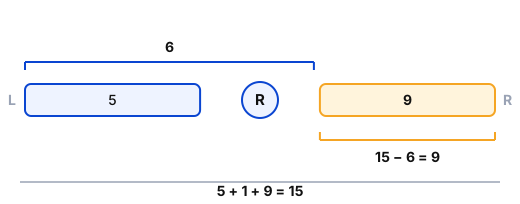
- Red candle is 6th from left → 6 candles counted (including it).
- To its right = 15 − 6 = 9
Yaad rakhein: Position from right = 15 − 6 + 1 = 10th; candles to its right = 10 − 1 = 9.
Answer: (C) 9
अवधारणा: एक ओर की वस्तुएँ = कुल − दूसरी ओर से स्थान।
- लाल मोमबत्ती बाएँ से 6वीं है।
- दाईं ओर = 15 − 6 = 9
याद रखें: दाएँ से स्थान = 15 − 6 + 1 = 10वाँ; उसके दाएँ = 10 − 1 = 9।
उत्तर: (C) 9
SSC CHSLGeneral IntelligenceRanking – items to the rightSSC CHSL 2025 · 27 Nov Shift 1
Q279.A series is given with one term missing. Select the correct alternative from the given ones that will complete the series.
-512,-508,-500,?,-472,-452,-428
एक शृंखला दी गई है जिसमें एक पद लुप्त है। दिए गए विकल्पों में से उस सही विकल्प का चयन कीजिए जो शृंखला को पूर्ण करेगा।
-512,-508,-500,?,-472,-452,-428
- A-490
- B-492
- C-495
- D-488
Show answer
Concept: Check the gaps between terms.
- Gaps: +4, +8, … and at the end +20, +24.
- Gaps rise by 4: +4, +8, +12, +16, +20, +24.
- Missing = −500 + 12 = −488; check −488 + 16 = −472 ✓
Trick: Differences form the 4-table – fill the middle gap (12) directly.
Answer: (D) -488
अवधारणा: पदों के बीच का अंतर देखें।
- अंतर: +4, +8, … अंत में +20, +24।
- अंतर हर बार 4 बढ़ता है, इसलिए बीच वाला अंतर 12 होगा।
- लुप्त पद = −500 + 12 = −488; जाँच: −488 + 16 = −472 ✓
ट्रिक: अंतर 4 के पहाड़े में हैं – बीच का अंतर 12 सीधे जोड़ें।
उत्तर: (D) -488
SSC CHSLGeneral IntelligenceNumber series – increasing differencesSSC CHSL 2025 · 27 Nov Shift 1
Q280.A series is given with one term missing. Select the correct alternative from the given ones that will complete the series.
एक शृंखला दी गई है जिसमें एक पद लुप्त है। दिए गए विकल्पों में से उस सही विकल्प का चयन कीजिए जो शृंखला को पूर्ण करेगा।
- A-90
- B-135
- C-125
- D-335
Show answer
Concept: Each term is 3 times the previous one.
- ,
- Missing = −135
- Check: ✓
Trick: Big jumps in a series → test ratio first, not difference.
Answer: (B) -135
अवधारणा: हर पद पिछले पद का 3 गुना है।
- ,
- लुप्त पद = −135
- जाँच: ✓
ट्रिक: तेज़ी से बढ़ती श्रृंखला में पहले अनुपात (ratio) जाँचें।
उत्तर: (B) -135
SSC CHSLGeneral IntelligenceNumber series – geometric (×3)SSC CHSL 2025 · 27 Nov Shift 1

