Q321.Select the correct combination of mathematical signs to replace (*) signs sequentially and to balance the given equation.
दिए गए समीकरण को संतुलित करने के लिए (*) चिह्नों के स्थान पर क्रमिक रूप से रखे जाने वाले गणितीय चिह्नों का सही संयोजन चुनिए।
- A
- B
- C
- D
Show answer
Concept: Insert each option's signs in order and check with BODMAS.
- Option (A):
- ✓
- Option (B): ✗
Trick: is a clean start; then you need +24 from 7, 5, 11 → .
Answer: (A)
अवधारणा: हर विकल्प के चिह्न क्रम से लगाकर BODMAS से जाँचें।
हल:
- विकल्प (A):
- ✓
- विकल्प (B): ✗
ट्रिक: ; बाकी 7, 5, 11 से +24 चाहिए → ।
उत्तर: (A)
SSC CHSLGeneral IntelligenceBalancing an equation with signsSSC CHSL 2025 · 26 Nov Shift 3
Q322.In the following question, four letter-number pairs are given. The letter-number on the left side of (-) is related to the letter-number on the right side of (-) with some Logic/Rule/Relation. Three pairs are similar on the basis of same Logic/Rule/Relation. Select the odd one out from the given alternatives.
(NOTE: Operations should be performed on the whole numbers, without breaking down the number into its constituent digits. E.g. 13 Operations on 13 such as adding /subtracting /multiplying etc, to 13 can be performed. Breaking down 13 into 1 and 3 and then performing mathematical operations on 1 and 3 is not allowed)
निम्नलिखित प्रश्न में चार अक्षर-संख्या युग्म दिए गए हैं। (-) के बाईं ओर का अक्षर-संख्या किसी तर्क/नियम/संबंध के आधार पर (-) के दाईं ओर के अक्षर-संख्या से संबंधित है। तीन युग्म समान तर्क/नियम/संबंध के आधार पर एक जैसे हैं। दिए गए विकल्पों में से असंगत युग्म चुनिए।
(नोट: संक्रियाएँ पूर्ण संख्याओं पर की जानी चाहिए, संख्या को उसके अंकों में तोड़े बिना। उदाहरणतः 13 पर संक्रियाएँ जैसे 13 में जोड़ना/घटाना/गुणा करना आदि की जा सकती हैं। 13 को 1 और 3 में तोड़कर 1 और 3 पर गणितीय संक्रियाएँ करना मान्य नहीं है।)
- ABW78 - CZ156
- BUD94 - VG198
- CME108 - NH216
- DNJ136 - OM272
Show answer
Concept: Find the common rule for letters and number; the pair breaking it is odd.
- Rule: 1st letter +1, 2nd letter +3, number × 2.
- B→C, W→Z, ✓; M→N, E→H, ✓; N→O, J→M, ✓
- U→V, D→G fine, but ✗
Trick: Check the numbers first — doubling is fastest; ends in 8, not 98.
Answer: (B) UD94 - VG198
अवधारणा: अक्षर और संख्या का साझा नियम खोजें; जो युग्म नियम तोड़े वही विषम।
हल:
- नियम: पहला अक्षर +1, दूसरा +3, संख्या × 2
- BW78 → CZ156 ✓, ME108 → NH216 ✓, NJ136 → OM272 ✓
- UD94: अक्षर ठीक, पर ✗
ट्रिक: पहले संख्याएँ जाँचें — दोगुना करना सबसे तेज़ है।
उत्तर: (B) UD94 - VG198
SSC CHSLGeneral IntelligenceOdd letter-number pairSSC CHSL 2025 · 26 Nov Shift 3
Q323.In a certain coded language 'TABLE' is coded as 'ZGWWP' and 'CHAIR' is coded as 'MDVDY'. How will 'PIANO' be coded in the same code language?
एक निश्चित कूट भाषा में 'TABLE' को 'ZGWWP' लिखा जाता है और 'CHAIR' को 'MDVDY' लिखा जाता है। उसी कूट भाषा में 'PIANO' को कैसे लिखा जाएगा?
- AKHUFM
- BJIVEL
- CIJUDK
- DJIWEM
Show answer
Concept: Reverse the word, then move letters back: first three −5, last two −4.
- TABLE → ELBAT; (E, L, B) − 5 = Z, G, W and (A, T) − 4 = W, P → ZGWWP ✓
- CHAIR → RIAHC → M D V D Y ✓
- PIANO → ONAIP; shift O, N, A back by 5 → J, I, V; shift I, P back by 4 → E, L; code = JIVEL
Trick: First code letter = last letter of word − 5: O − 5 = J → only (B) and (D) start with J; third letter V settles it.
Answer: (B) JIVEL
अवधारणा: शब्द उलटा करें, फिर अक्षर पीछे खिसकाएँ: पहले तीन −5, आखिरी दो −4।
हल:
- TABLE → ELBAT → Z G W W P ✓
- CHAIR → RIAHC → M D V D Y ✓
- PIANO → ONAIP; O, N, A को 5 पीछे → J, I, V; I, P को 4 पीछे → E, L; कोड = JIVEL
ट्रिक: कोड का पहला अक्षर = शब्द का अंतिम अक्षर − 5: O − 5 = J; तीसरा अक्षर V से (B) तय।
उत्तर: (B) JIVEL
SSC CHSLGeneral IntelligenceCoding – reverse then shiftSSC CHSL 2025 · 26 Nov Shift 3
Q324.In a certain coded language 'FRIEND' is coded as 'AKBFOC' and 'GLOBAL' is coded as 'IXYLID'. How will 'MODERN' be coded in the same code language?
एक निश्चित कूट भाषा में 'FRIEND' को 'AKBFOC' लिखा जाता है और 'GLOBAL' को 'IXYLID' लिखा जाता है। उसी कूट भाषा में 'MODERN' को कैसे लिखा जाएगा?
- ALPCMKI
- BKOBALJ
- CJNAZKI
- DKOBCMK
Show answer
Concept: Write the word backwards and shift every letter 3 places back.
- FRIEND → DNEIRF → −3 each → AKBFOC ✓
- GLOBAL → LABOLG → IXYLID ✓
- MODERN → NREDOM → K O B A L J
Trick: Last code letter = first letter of word − 3: M − 3 = J → only (B) ends in J.
Answer: (B) KOBALJ
अवधारणा: शब्द उलटा लिखकर हर अक्षर 3 स्थान पीछे करें।
हल:
- FRIEND → DNEIRF → हर अक्षर −3 → AKBFOC ✓
- GLOBAL → LABOLG → IXYLID ✓
- MODERN → NREDOM → K O B A L J
ट्रिक: कोड का अंतिम अक्षर = शब्द का पहला अक्षर − 3: M − 3 = J → केवल (B)।
उत्तर: (B) KOBALJ
SSC CHSLGeneral IntelligenceCoding – reverse and −3SSC CHSL 2025 · 26 Nov Shift 3
Q325.A series is given with one term missing. Select the correct alternative from the given ones that will complete the series.
MV186, NX206, OZ226, ?, QD266
एक शृंखला दी गई है जिसमें एक पद लुप्त है। दिए गए विकल्पों में से वह सही विकल्प चुनिए जो शृंखला को पूर्ण करे।
MV186, NX206, OZ226, ?, QD266
- APB246
- BPA236
- CPF246
- DPF256
Show answer
Concept: Track first letter, second letter and number separately.
- 1st letters: M, N, O, P, Q (+1).
- 2nd letters: V, X, Z, B, D (+2, wrapping Z → B).
- Numbers: 186, 206, 226, 246, 266 (+20).
Trick: Number 246 removes (B) and (D); the letter after Z by +2 is B → (A).
Answer: (A) PB246
अवधारणा: पहला अक्षर, दूसरा अक्षर और संख्या अलग-अलग देखें।
हल:
- पहला अक्षर: M, N, O, P, Q (+1)
- दूसरा अक्षर: V, X, Z, B, D (+2, Z के बाद B)
- संख्या: 186, 206, 226, 246, 266 (+20)
ट्रिक: 246 से (B), (D) हटते हैं; Z + 2 = B → (A)।
उत्तर: (A) PB246
SSC CHSLGeneral IntelligenceAlphanumeric seriesSSC CHSL 2025 · 26 Nov Shift 3
Q326.In a row, if is 15th from the left and 18th from the right, how many people are there in the row?
एक पंक्ति में, यदि बाएँ से 15वें स्थान पर तथा दाएँ से 18वें स्थान पर है, तो पंक्ति में कुल कितने व्यक्ति हैं?
- A31
- B32
- C33
- D34
Show answer
Concept: When one person's rank is known from both ends, he is counted twice.
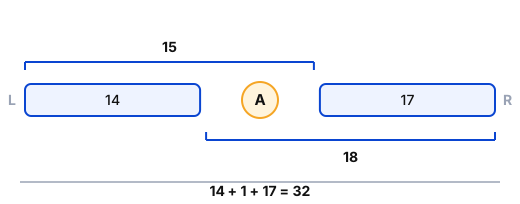
- Total = left rank + right rank − 1.
- = 15 + 18 − 1 = 32.
Trick: Add both ranks and just drop 1 – no diagram needed.
Answer: (B) 32
अवधारणा: एक ही व्यक्ति का स्थान दोनों सिरों से दिया हो तो वह दो बार गिना जाता है।
हल:
- कुल = बाएँ से स्थान + दाएँ से स्थान − 1
- = 15 + 18 − 1 = 32
ट्रिक: दोनों स्थान जोड़ें और 1 घटा दें।
उत्तर: (B) 32
SSC CHSLGeneral IntelligenceRow position – total peopleSSC CHSL 2025 · 26 Nov Shift 2
Q327.Introducing a man, a woman said, "His wife is the only daughter of my father." How is the man related to the woman?
एक पुरुष का परिचय देते हुए, एक महिला ने कहा, "उसकी पत्नी मेरे पिता की एकमात्र पुत्री है।" वह पुरुष उस महिला से किस प्रकार संबंधित है?
- ABrotherभाई
- BHusbandपति
- CFatherपिता
- DUncleचाचा
Show answer
Concept: 'Only daughter of my father' (said by a woman) = the woman herself.
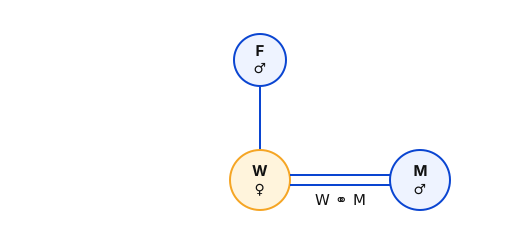
- The woman is her father's only daughter → she is the man's wife.
- Wife's relation to him = wife, so he is her husband.
Trick: Whenever a female speaker says 'only daughter of my father/mother', replace it with 'me'.
Answer: (B) Husband
अवधारणा: महिला कहे 'मेरे पिता की इकलौती बेटी' = वह स्वयं।
हल:
- अतः उस आदमी की पत्नी यही महिला है।
- इसलिए आदमी उसका पति है।
ट्रिक: महिला वक्ता के 'only daughter of my father' को सीधे 'मैं' से बदल दें।
उत्तर: (B) पति
SSC CHSLGeneral IntelligenceBlood relation – 'only daughter of my father'SSC CHSL 2025 · 26 Nov Shift 2
Q328.Read the following statements carefully and identify the conclusion that follows.
Statements:
Some books are notebooks.
All notebooks are files.
Conclusions:
I. Some books are files.
II. No book is a file.
निम्नलिखित कथनों को ध्यानपूर्वक पढ़िए और उस निष्कर्ष की पहचान कीजिए जो उनका अनुसरण करता है।
कथन:
कुछ पुस्तकें, कॉपियाँ हैं।
सभी कॉपियाँ, फाइलें हैं।
निष्कर्ष:
I. कुछ पुस्तकें, फाइलें हैं।
II. कोई पुस्तक फाइल नहीं है।
- AOnly conclusion I follows.केवल निष्कर्ष I अनुसरण करता है।
- BOnly conclusion II follows.केवल निष्कर्ष II अनुसरण करता है।
- CBoth conclusions I and II follow.निष्कर्ष I और II दोनों अनुसरण करते हैं।
- DNeither conclusion I nor II follows.न तो निष्कर्ष I और न ही II अनुसरण करता है।
Show answer
Concept: Some A are B + All B are C ⇒ Some A are C.
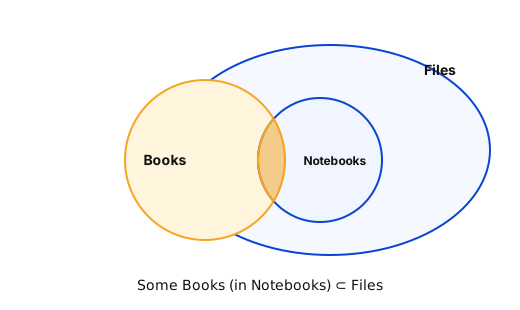
- Some books are notebooks; every notebook is a file.
- So the books that are notebooks are surely files → I follows.
- II ('No book is a file') is the opposite of a proven fact → does not follow.
Trick: 'Some + All' (in this order) always gives a 'Some' conclusion.
Answer: (A) Only conclusion I follows.
अवधारणा: Some A are B + All B are C ⇒ Some A are C।
हल:
- कुछ books, notebooks हैं और सभी notebooks, files हैं।
- तो वे books निश्चित ही files हैं → I सही।
- II इसका उल्टा कहता है → गलत।
ट्रिक: 'Some + All' क्रम में हो तो निष्कर्ष 'Some' वाला निकलता है।
उत्तर: (A) केवल निष्कर्ष I अनुसरण करता है।
SSC CHSLGeneral IntelligenceSyllogism – some + allSSC CHSL 2025 · 26 Nov Shift 2
Q329.In a line of 35 bicycles, Bicycle P is 12th from the left and Bicycle Q is 15th from the right. How many bicycles are there between P and Q ?
35 साइकिलों की एक पंक्ति में, साइकिल P बाएँ से 12वें स्थान पर है और साइकिल Q दाएँ से 15वें स्थान पर है। P और Q के बीच कितनी साइकिलें हैं ?
- A6
- B7
- C8
- D9
Show answer
Concept: Convert both positions to the same end, then gap = difference − 1.
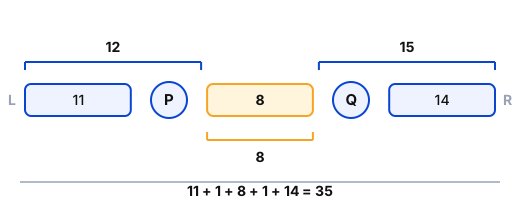
- Q from left = 35 − 15 + 1 = 21.
- P is 12th from left.
- Between = 21 − 12 − 1 = 8.
Trick: Shortcut: Between = Total − (left + right) = 35 − 27 = 8 (valid when they don't cross).
Answer: (C) 8
अवधारणा: दोनों स्थानों को एक ही सिरे से बदलें, फिर बीच = अंतर − 1।
हल:
- Q बाएँ से = 35 − 15 + 1 = 21
- P बाएँ से 12वाँ
- बीच में = 21 − 12 − 1 = 8
ट्रिक: शॉर्टकट: बीच = कुल − (बाएँ + दाएँ) = 35 − 27 = 8 (जब दोनों एक-दूसरे को पार न करें)।
उत्तर: (C) 8
SSC CHSLGeneral IntelligenceRow – objects between two positionsSSC CHSL 2025 · 26 Nov Shift 2
Q330.There are 70 books arranged in a row on a shelf. Book A is 24th from the left and Book B is 21st from the right.How many books are there between A and B ?
एक शेल्फ पर एक पंक्ति में 70 पुस्तकें रखी गई हैं। पुस्तक A बाएँ से 24वें स्थान पर है और पुस्तक B दाएँ से 21वें स्थान पर है। A और B के बीच कितनी पुस्तकें हैं ?
- A23
- B24
- C25
- D26
Show answer
Concept: Bring both ranks to one end; objects between = difference − 1.
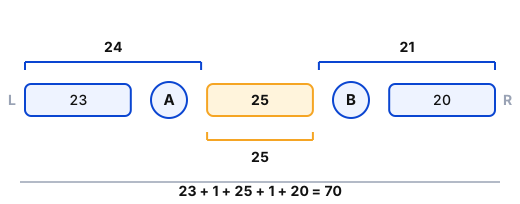
- B from left = 70 − 21 + 1 = 50.
- A from left = 24.
- Between = 50 − 24 − 1 = 25.
Trick: Total − (left rank + right rank) = 70 − 45 = 25 directly.
Answer: (C) 25
अवधारणा: दोनों स्थान एक सिरे से लें; बीच = अंतर − 1।
हल:
- B बाएँ से = 70 − 21 + 1 = 50
- A बाएँ से = 24
- बीच = 50 − 24 − 1 = 25
ट्रिक: सीधे: कुल − (24 + 21) = 70 − 45 = 25।
उत्तर: (C) 25
SSC CHSLGeneral IntelligenceRow – books between A and BSSC CHSL 2025 · 26 Nov Shift 2
Q331.A series is given with one term missing. Select the correct alternative from the given ones that will complete the series.
8, ?, 36, 75, 154, 313
एक शृंखला दी गई है जिसमें एक पद लुप्त है। दिए गए विकल्पों में से वह सही विकल्प चुनिए जो शृंखला को पूर्ण करेगा।
8, ?, 36, 75, 154, 313
- A15
- B16
- C17
- D18
Show answer
Concept: Each term = previous × 2 + n, where n goes 1, 2, 3, 4, 5.
- 17.
- ; .
- ; ✔.
Trick: Terms nearly double → test '×2 + something' first.
Answer: (C) 17
अवधारणा: हर पद = पिछला × 2 + n, जहाँ n = 1, 2, 3, 4, 5।
हल:
- 17
- ;
- ; ✔
ट्रिक: पद लगभग दुगुने हो रहे हों तो पहले '×2 + कुछ' जाँचें।
उत्तर: (C) 17
SSC CHSLGeneral IntelligenceNumber series – ×2 + increasing numberSSC CHSL 2025 · 26 Nov Shift 2
Q332.A series is given with one term missing. Select the correct alternative from the given ones that will complete the series.
एक शृंखला दी गई है जिसमें एक पद लुप्त है। दिए गए विकल्पों में से वह सही विकल्प चुनिए जो शृंखला को पूर्ण करेगा।
- A-132
- B-130
- C-128
- D-135
Show answer
Concept: Look at successive differences; here they form an AP.
- Differences: −4, −10, −16, −22 (each 6 more negative).
- Next difference = −28 → −102 − 28 = −130.
- Check: −130 − 34 = −164, −164 − 40 = −204 ✔.
Trick: Second difference constant (−6) → just extend the difference row.
Answer: (B) -130
अवधारणा: क्रमागत अंतर देखें; यहाँ वे समांतर श्रेणी में हैं।
हल:
- अंतर: −4, −10, −16, −22 (हर बार 6 कम)
- अगला अंतर −28 → −102 − 28 = −130
- जाँच: −130 − 34 = −164, −164 − 40 = −204 ✔
ट्रिक: दूसरा अंतर स्थिर (−6) हो तो अंतर की पंक्ति आगे बढ़ा दें।
उत्तर: (B) -130
SSC CHSLGeneral IntelligenceNumber series – differences change by 6SSC CHSL 2025 · 26 Nov Shift 2
Q333.A series is given with one term missing. Select the correct alternative from the given ones that will complete the series.
12, 29, 64, 135, 275, 556, ?
एक शृंखला दी गई है जिसमें एक पद लुप्त है। दिए गए विकल्पों में से वह सही विकल्प चुनिए जो शृंखला को पूर्ण करेगा।
12, 29, 64, 135, 275, 556, ?
- A1112
- B1119
- C1120
- D1124
Show answer
Concept: Term = previous × 2 + k, with k repeating 5, 6, 7.
- , , .
- , .
- Next: 1119.
Trick: exactly; answer must be a bit more than 1112 – only 1119 fits the +7 step.
Answer: (B) 1119
अवधारणा: पद = पिछला × 2 + k, जहाँ k = 5, 6, 7 बार-बार।
हल:
- , ,
- ,
- अगला: 1119
ट्रिक: ; अब +7 जोड़ना है – 1119।
उत्तर: (B) 1119
SSC CHSLGeneral IntelligenceNumber series – ×2 + cyclic 5, 6, 7SSC CHSL 2025 · 26 Nov Shift 2
Q334.If and , then what is the value of 20 # 9 ?
यदि तथा है, तो 20 # 9 का मान क्या है ?
- A850
- B900
- C800
- D950
Show answer
Concept: Find the hidden rule using the given pairs.
- and .
- and ✔ → a # b = 5ab.
- 20 # 9 = 900.
Trick: Divide the result by the product – a constant ratio (5) reveals the rule instantly.
Answer: (B) 900
अवधारणा: दिए गए उदाहरणों से छिपा नियम निकालें।
हल:
- , और
- , और ✔ → a # b = 5ab
- 20 # 9 = 900
ट्रिक: परिणाम ÷ गुणनफल = स्थिर (5) – नियम तुरंत मिल जाता है।
उत्तर: (B) 900
SSC CHSLGeneral IntelligenceSymbol operation – a # bSSC CHSL 2025 · 26 Nov Shift 2
Q335.If and , then what is the value of 745 $ 336; 14 ?
यदि तथा है, तो 745 $ 336; 14 का मान क्या है ?
- A711
- B721
- C731
- D715
Show answer
Concept: Rule: a $ b ; c = .
- ✔.
- ✔.
- 721.
Trick: Results are slightly less than the first number → think 'subtract something small' ().
Answer: (B) 721
अवधारणा: नियम: a $ b ; c = ।
हल:
- ✔
- ✔
- 721
ट्रिक: परिणाम पहली संख्या से थोड़ा कम है → कोई छोटी संख्या () घटाई गई है।
उत्तर: (B) 721
SSC CHSLGeneral IntelligenceSymbol operation – a $ b ; cSSC CHSL 2025 · 26 Nov Shift 2
Q336.In this type of questions, question is provided with substitutes for various mathematical symbols, followed by a question involving calculation of an expression or choosing the correct/incorrect equation. You have to put the real signs in the given equation and then solve the questions as required. If '%' stands for '÷', '! stands for '+', '?' stands for ' - ', '#' stands for ' ', then find the value of:
16 # 4 % 2 ! 7 = ?
इस प्रकार के प्रश्नों में विभिन्न गणितीय चिह्नों के लिए प्रतिस्थापन दिए जाते हैं, जिसके बाद एक प्रश्न दिया जाता है जिसमें किसी व्यंजक की गणना करनी होती है अथवा सही/गलत समीकरण चुनना होता है। आपको दिए गए समीकरण में वास्तविक चिह्न रखकर आवश्यकतानुसार प्रश्न हल करना होता है। यदि '%' का अर्थ '÷' है, '!' का अर्थ '+' है, '?' का अर्थ ' - ' है, '#' का अर्थ ' ' है, तो निम्नलिखित का मान ज्ञात कीजिए:
16 # 4 % 2 ! 7 = ?
- A36
- B38
- C37
- D39
Show answer
Concept: Replace the symbols with real signs, then apply BODMAS.
- 16 # 4 % 2 ! 7 → .
- , .
- 39.
Trick: – cancel first, then add.
Answer: (D) 39
अवधारणा: चिह्नों को असली चिह्नों से बदलें, फिर BODMAS लगाएँ।
हल:
- 16 # 4 % 2 ! 7 →
- ,
- 39
ट्रिक: – पहले काटें, फिर जोड़ें।
उत्तर: (D) 39
SSC CHSLGeneral IntelligenceSymbol substitution with BODMASSSC CHSL 2025 · 26 Nov Shift 2
Q337.In the question below there are three statements followed by two conclusions I and II. You have to take the three given statements to be true even if they seem to be at variance from commonly known facts and then decide which of the given conclusions logically follows from the three statements disregarding commonly known facts.
Statements:
All Flowers are Beautiful.
Some Flowers are Red.
No Red is Artificial.
Conclusions:
I. Some Beautiful are Red.
II. Some Flowers are not Artificial.
नीचे दिए गए प्रश्न में तीन कथन दिए गए हैं जिनके बाद दो निष्कर्ष I और II दिए गए हैं। आपको दिए गए तीनों कथनों को सत्य मानना है, चाहे वे सर्वज्ञात तथ्यों से भिन्न प्रतीत होते हों, और फिर यह निर्णय करना है कि सर्वज्ञात तथ्यों की उपेक्षा करते हुए दिए गए निष्कर्षों में से कौन-सा तीनों कथनों से तार्किक रूप से निकलता है।
कथन:
सभी फूल सुंदर हैं।
कुछ फूल लाल हैं।
कोई लाल कृत्रिम नहीं है।
निष्कर्ष:
I. कुछ सुंदर लाल हैं।
II. कुछ फूल कृत्रिम नहीं हैं।
- AOnly conclusion I followsकेवल निष्कर्ष I अनुसरण करता है
- BOnly conclusion II followsकेवल निष्कर्ष II अनुसरण करता है
- CBoth conclusions I and II followनिष्कर्ष I और II दोनों अनुसरण करते हैं
- DNeither conclusion I nor conclusion II followsन तो निष्कर्ष I और न ही निष्कर्ष II अनुसरण करता है
Show answer
Concept: A 'Some' link combined with 'All'/'No' can give definite 'Some' conclusions.
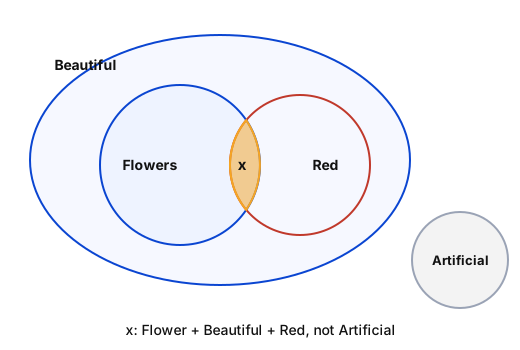
- Some Flowers are Red, and all Flowers are Beautiful → those red flowers are beautiful: Some Beautiful are Red. I ✔.
- Those red flowers can't be Artificial (No Red is Artificial) → Some Flowers are not Artificial. II ✔.
Trick: Some A are B + No B is C ⇒ Some A are not C (a standard pattern).
Answer: (C) Both conclusions I and II follow
अवधारणा: 'Some' वाला कथन 'All' या 'No' के साथ मिलकर निश्चित 'Some' निष्कर्ष देता है।
हल:
- कुछ Flowers लाल हैं और सभी Flowers सुंदर हैं → वे लाल फूल सुंदर भी हैं: I ✔
- वे लाल फूल Artificial नहीं हो सकते → कुछ Flowers Artificial नहीं हैं: II ✔
ट्रिक: Some A are B + No B is C ⇒ Some A are not C (मानक नियम)।
उत्तर: (C) निष्कर्ष I और II दोनों अनुसरण करते हैं
SSC CHSLGeneral IntelligenceSyllogism – three statementsSSC CHSL 2025 · 26 Nov Shift 2
Q338.Six boxes A, B, C, D, E, and F are stacked one above the other (the bottom box is 1 and the top box is 6 ). Three boxes are placed between A and B. B is placed immediately below C , and C is not the top box. is placed immediately above E, and F is placed below E. How many boxes are placed between A and C?
छह बक्से A, B, C, D, E और F एक के ऊपर एक रखे गए हैं (सबसे नीचे वाला बक्सा 1 है तथा सबसे ऊपर वाला बक्सा 6 है)। A और B के बीच तीन बक्से रखे गए हैं। B, C के ठीक नीचे रखा गया है तथा C सबसे ऊपर वाला बक्सा नहीं है। , E के ठीक ऊपर रखा गया है तथा F, E के नीचे रखा गया है। A और C के बीच कितने बक्से रखे गए हैं?
- A1
- B2
- C3
- D0
Show answer
Concept: Fix the boxes with most restrictions first; test the possible cases.
- A, B with 3 boxes between → positions (1,5) or (2,6). C = B + 1 and C ≠ 6, so B ≠ 5.
- B = 1 case: C = 2, A = 5; D just above E leaves E = 3, D = 4, F = 6 – but F must be below E ✘.
- B = 2: C = 3, A = 6; E = 4, D = 5, F = 1 ✔.
- Between A (6) and C (3): positions 4, 5 → 2 boxes.
Trick: Test only the two A–B cases; one fails on 'F below E'.
Answer: (B) 2
अवधारणा: सबसे ज़्यादा शर्तों वाले डिब्बे पहले रखें, फिर संभावित स्थितियाँ जाँचें।
हल:
- A, B के बीच 3 डिब्बे → स्थान (1,5) या (2,6)। C = B + 1 और C ऊपर नहीं, अतः B ≠ 5।
- B = 1: C = 2, A = 5; तब E = 3, D = 4, F = 6 – पर F को E से नीचे होना है ✘
- B = 2: C = 3, A = 6; E = 4, D = 5, F = 1 ✔
- A (6) और C (3) के बीच: 4, 5 → 2 डिब्बे
ट्रिक: केवल A–B की दो स्थितियाँ जाँचें; एक 'F, E से नीचे' पर फेल होती है।
उत्तर: (B) 2
SSC CHSLGeneral IntelligenceBox stacking – positionsSSC CHSL 2025 · 26 Nov Shift 2
Q339.Select the letter cluster from among the given options that can replace the question mark (?) in the following series.
GZM, JXR, ?, PTB, SRG
दिए गए विकल्पों में से उस अक्षर-समूह का चयन कीजिए जो निम्नलिखित शृंखला में प्रश्नवाचक चिह्न (?) के स्थान पर आ सकता है।
GZM, JXR, ?, PTB, SRG
- AMVW
- BMUW
- CNVW
- DMVX
Show answer
Concept: Track the 1st, 2nd and 3rd letters separately.
- 1st: G, J, M, P, S (+3).
- 2nd: Z, X, V, T, R (−2).
- 3rd: M, R, W, B, G (+5, wrapping after Z).
Trick: Getting 'M' and 'V' already leaves only MVW and MVX; +5 from R gives W.
Answer: (A) MVW
अवधारणा: पहले, दूसरे, तीसरे अक्षर की चाल अलग-अलग देखें।
हल:
- पहला: G, J, M, P, S (+3)
- दूसरा: Z, X, V, T, R (−2)
- तीसरा: M, R, W, B, G (+5, Z के बाद फिर A से)
ट्रिक: M और V से केवल MVW, MVX बचते हैं; R + 5 = W।
उत्तर: (A) MVW
SSC CHSLGeneral IntelligenceLetter cluster seriesSSC CHSL 2025 · 26 Nov Shift 2
Q340.The weights of 5 boxes A, B, C, D, and E are compared. No two boxes have the same weight. C is heavier than only 3 boxes. A and B are lighter than D. E is heavier than D. If C weighs 50 kg, what is the possible weight of ?
5 बक्सों A, B, C, D और E के भार की तुलना की जाती है। किन्हीं दो बक्सों का भार समान नहीं है। C केवल 3 बक्सों से भारी है। A और B, D से हल्के हैं। E, D से भारी है। यदि C का भार 50 kg है, तो का संभावित भार क्या है ?
- A60 kg
- B55 kg
- C42 kg
- D65 kg
Show answer
Concept: 'Heavier than only 3' out of 5 means 2nd heaviest.
- C is 2nd heaviest.
- E > D > A, B, so only E can be above C.
- Order: E > C > D > A, B → D is lighter than 50 kg; only 42 kg qualifies.
Trick: Once D is below C, pick the only option under 50.
Answer: (C) 42 kg
अवधारणा: 5 में से 'केवल 3 से भारी' = दूसरा सबसे भारी।
हल:
- C दूसरे स्थान पर है।
- E > D > A, B; अतः C से ऊपर केवल E।
- क्रम: E > C > D > A, B → D का भार 50 kg से कम; केवल 42 kg।
ट्रिक: D, C से हल्का है – 50 से कम वाला एक ही विकल्प है।
उत्तर: (C) 42 kg
SSC CHSLGeneral IntelligenceRanking – weight comparisonSSC CHSL 2025 · 26 Nov Shift 2

