Q361.A jar holds red and blue marbles in a ratio of . After removing 12 blue marbles, the ratio of red to blue marbles changes to 7 : 4 . How many red marbles are there in the jar ?
एक जार में लाल और नीले कंचे के अनुपात में हैं। 12 नीले कंचे निकाल लेने के बाद लाल और नीले कंचों का अनुपात 7 : 4 हो जाता है। जार में लाल कंचे कितने हैं ?
- A84
- B96
- C74
- D36
Show answer
Concept: If one quantity is unchanged, keep its ratio term equal in both ratios.
- Red 7 : Blue 5 → after removal 7 : 4 (red term already same)
- Blue drops 5 → 4, i.e. 1 part = 12
- Red =
Trick: Red is a multiple of 7 – among options only 84 is ().
Answer: (A) 84
अवधारणा: जो मात्रा न बदले, उसका अनुपात-पद दोनों में समान रखें।
- लाल 7 : नीला 5 → बाद में 7 : 4
- नीला 1 भाग घटा = 12
- लाल =
ट्रिक: लाल 7 का गुणज होगा — विकल्पों में केवल 84।
उत्तर: (A) 84
SSC CHSLQuantitative AptitudeRatio – change after removalSSC CHSL 2025 · 26 Nov Shift 1
Q362.An amount of ₹12,000 is invested at compound interest. What will be the amount after 3 years?
₹12,000 की राशि चक्रवृद्धि ब्याज पर निवेश की जाती है। 3 वर्ष बाद मिश्रधन कितना होगा?
- A₹26,159.13
- B₹16,859.13
- C₹36,255
- D₹24,859
Show answer
Concept: .
- (₹)
Trick: Estimate: SI for 3 years = 4320 → amount just above 16,320; only ₹16,859 is near.
Answer: (B) ₹16,859.13
अवधारणा: ।
- A ≈ ₹16,859.13
ट्रिक: अनुमान: 3 वर्ष का SI = 4320 → राशि 16,320 से थोड़ी अधिक; केवल ₹16,859 पास है।
उत्तर: (B) ₹16,859.13
SSC CHSLQuantitative AptitudeCompound interest – amountSSC CHSL 2025 · 26 Nov Shift 1
Q363.The savings of Arjun and Karan are in the ratio 5 : 4. If both save ₹6,000 more, the ratio changes to . What is Karan's saving?
अर्जुन और करण की बचत का अनुपात 5 : 4 है। यदि दोनों ₹6,000 और बचाते हैं, तो यह अनुपात हो जाता है। करण की बचत कितनी है?
- A₹19,000
- B₹12,000
- C₹16,000
- D₹17,000
Show answer
Concept: Adding the same amount keeps the difference unchanged.
- 5 : 4 (difference 1) and 7 : 6 (difference 1) → parts match directly.
- Karan = (₹)
Trick: Difference same → parts = 6000.
Answer: (B) ₹12,000
अवधारणा: दोनों में बराबर जोड़ने से अंतर नहीं बदलता।
- 5 : 4 और 7 : 6 दोनों में अंतर 1 → भाग सीधे मिलते हैं।
- 2 भाग = 6000 → 1 भाग = 3000
- Karan = (₹)
ट्रिक: अंतर समान → भाग = 6000।
उत्तर: (B) ₹12,000
SSC CHSLQuantitative AptitudeRatio – equal additionSSC CHSL 2025 · 26 Nov Shift 1
Q364.Which of the following is the least number that is divisible by each of the numbers 15,20 , and 25 is:
निम्नलिखित में से वह न्यूनतम संख्या कौन-सी है जो 15, 20 और 25 में से प्रत्येक संख्या से विभाज्य है:
- A1500
- B3000
- C6400
- D12500
Show answer
Concept: Any number divisible by all = multiple of their LCM.
- , ,
- Among options, the smallest multiple of 300 is 1500.
Trick: 6400 and 12500 fail divisibility by 3 (digit sum); then pick the smaller of 1500 and 3000.
Answer: (A) 1500
अवधारणा: सबसे विभाज्य संख्या = उनके LCM का गुणज।
- , ,
- LCM = 300
- विकल्पों में 300 का सबसे छोटा गुणज = 1500।
ट्रिक: 6400 और 12500, 3 से विभाज्य नहीं; बचे में छोटा 1500।
उत्तर: (A) 1500
SSC CHSLQuantitative AptitudeLCM – common multipleSSC CHSL 2025 · 26 Nov Shift 1
Q365.A man travels 80 km at and returns the same distance at 16 . What is his average speed for the whole journey?
एक व्यक्ति 80 km की दूरी की चाल से तय करता है और उतनी ही दूरी वापसी में 16 की चाल से तय करता है। पूरी यात्रा के लिए उसकी औसत चाल कितनी है?
- A
- B
- C
- D
Show answer
Concept: For equal distances, average speed = .
- km/h ≈ 17.7
Trick: Average must lie between 16 and 20 – only 17.7 qualifies.
Answer: (C)
अवधारणा: समान दूरी के लिए औसत चाल = ।
- km/h
ट्रिक: औसत 16 और 20 के बीच होगा — केवल 17.7।
उत्तर: (C)
SSC CHSLQuantitative AptitudeAverage speed – equal distancesSSC CHSL 2025 · 26 Nov Shift 1
Q366.Find the smallest number which when divided by 8, 12 and 20 leaves remainders 3, 7 and 15 respectively.
वह न्यूनतम संख्या ज्ञात कीजिए जिसे 8, 12 और 20 से विभाजित करने पर क्रमशः 3, 7 और 15 शेष बचे।
- A394
- B115
- C205
- D225
Show answer
Concept: If (divisor − remainder) is the same k for all, .
- LCM(8, 12, 20) = 120
- Smallest =
Trick: Check: leaves 15 ✓ – the other options fail this single test.
Answer: (B) 115
अवधारणा: यदि (भाजक − शेष) सबके लिए समान k हो, ।
- LCM = 120
- सबसे छोटी =
ट्रिक: जाँच: का शेष 15 ✓।
उत्तर: (B) 115
SSC CHSLQuantitative AptitudeLCM – constant difference in remaindersSSC CHSL 2025 · 26 Nov Shift 1
Q367.The average of 15 numbers is 30 . If 5 is added to 40% of the numbers and 3 is subtracted from the remaining 60% of the numbers, what will be the new average?
15 संख्याओं का औसत 30 है। यदि 40% संख्याओं में 5 जोड़ दिया जाए और शेष 60% संख्याओं में से 3 घटा दिया जाए, तो नया औसत क्या होगा?
- A24.2
- B26.4
- C30.2
- D27.6
Show answer
Concept: New average = old average + (net change in total ÷ count).
- 40% of 15 = 6 numbers → +5 each = +30
- 60% = 9 numbers → −3 each = −27
- Net +3 → new average =
Trick: Only net change matters: .
Answer: (C) 30.2
अवधारणा: नया औसत = पुराना + (कुल बदलाव ÷ संख्या)।
- 15 का 40% = 6 → +30
- 60% = 9 → −27
- शुद्ध +3 → नया औसत =
ट्रिक: सीधे: ।
उत्तर: (C) 30.2
SSC CHSLQuantitative AptitudeAverage – partial changesSSC CHSL 2025 · 26 Nov Shift 1
Q368.Two cars, one from City M and another from City N, which are 550 km apart, start moving towards each other. The first car travels at a speed of 65 , and the second car travels at a speed of . If they start at the same time, how far from City M will they meet?
दो कारें, एक शहर M से और दूसरी शहर N से, जो 550 km की दूरी पर हैं, एक-दूसरे की ओर चलना आरंभ करती हैं। पहली कार की चाल 65 है और दूसरी कार की चाल है। यदि वे एक ही समय पर चलना आरंभ करती हैं, तो वे शहर M से कितनी दूर मिलेंगी?
- A350 km
- B410 km
- C325 km
- D260 km
Show answer
Concept: Moving towards each other, distances are in the ratio of speeds.
- Speeds 65 : 45 = 13 : 9 (total 22)
- Distance from M =
- km
Trick: Time = h → .
Answer: (C) 325 km
अवधारणा: आमने-सामने चलने पर दूरी चाल के अनुपात में बँटती है।
- चाल 65 : 45 = 13 : 9 (कुल 22)
- M से दूरी =
- = 325 km
ट्रिक: समय = घंटे → ।
उत्तर: (C) 325 km
SSC CHSLQuantitative AptitudeSpeed – meeting pointSSC CHSL 2025 · 26 Nov Shift 1
Q369.A and B can complete a work in 28 days, B and C can complete the same work in 20 days. A, B, and C together can complete the work in 10 days. How long will it take for and together to complete the work?
A और B किसी कार्य को 28 दिनों में पूरा कर सकते हैं, B और C उसी कार्य को 20 दिनों में पूरा कर सकते हैं। A, B और C मिलकर उस कार्य को 10 दिनों में पूरा कर सकते हैं। और मिलकर उस कार्य को कितने समय में पूरा करेंगे?
- A days दिन
- B days दिन
- C days दिन
- D days दिन
Show answer
Concept: Use total work = LCM and find individual daily rates.
- Work = 140; , , per day
- , →
- Time = days
Trick: units/day.
Answer: (B) days
अवधारणा: कुल कार्य = LCM लेकर दैनिक दर निकालें।
- कार्य = 140; , ,
- C = 9, A = 7 →
- समय = दिन
ट्रिक: ।
उत्तर: (B) दिन
SSC CHSLQuantitative AptitudeTime & work – pair ratesSSC CHSL 2025 · 26 Nov Shift 1
Q370.A can do a work in 20 days and B in 30 days. They work together for 3 days, then A leaves. In how many more days will finish the work?
A किसी कार्य को 20 दिनों में और B उसे 30 दिनों में कर सकता है। वे 3 दिन तक साथ मिलकर कार्य करते हैं, फिर A कार्य छोड़ देता है। शेष कार्य पूरा करने में को और कितने दिन लगेंगे?
- A24 days24 दिन
- B days दिन
- C days दिन
- D22.5 days22.5 दिन
Show answer
Concept: Work done together first; remaining work by the one who stays.
- Work = 60; A = 3/day, B = 2/day
- 3 days together = → left 45
- B: days
Trick: Together per day → 3 days = done; B does .
Answer: (D) 22.5 days
अवधारणा: पहले साथ में किया काम घटाएँ, बचा काम रुकने वाला करेगा।
- कार्य = 60; A = 3, B = 2 प्रति दिन
- 3 दिन साथ = 15 → बचा 45
- B: दिन
ट्रिक: साथ में प्रति दिन → 3 दिन में ; B: ।
उत्तर: (D) 22.5 दिन
SSC CHSLQuantitative AptitudeTime & work – one leavesSSC CHSL 2025 · 26 Nov Shift 1
Q371.A microwave oven has a marked price of ₹9,000. It sells for ₹7,200 during the sale season. What is the offered percentage discount?
एक माइक्रोवेव ओवन का अंकित मूल्य ₹9,000 है। सेल के मौसम में यह ₹7,200 में बिकता है। दी गई छूट का प्रतिशत कितना है?
- A22%
- B25%
- C
- D20%
Show answer
Concept: .
- Discount = (₹)
Trick: → 20% off.
Answer: (D) 20%
अवधारणा: ।
- छूट = (₹)
ट्रिक: → 20% छूट।
उत्तर: (D) 20%
SSC CHSLQuantitative AptitudeDiscount percentageSSC CHSL 2025 · 26 Nov Shift 1
Q372.The simple interest on a certain sum of money for 3 years at per annum is ₹4,800. What is the sum of money?
किसी धनराशि पर 3 वर्षों के लिए वार्षिक की दर से साधारण ब्याज ₹4,800 है। वह धनराशि कितनी है?
- A₹26,000
- B₹22,000
- C₹24,000
- D₹20,000
Show answer
Concept: .
- P = ₹20,000
Trick: 24% of P = 4800 → 1% = 200 → P = 20,000.
Answer: (D) ₹20,000
अवधारणा: ।
- P = ₹20,000
ट्रिक: P का 24% = 4800 → 1% = 200 → P = 20,000।
उत्तर: (D) ₹20,000
SSC CHSLQuantitative AptitudeSimple interest – find principalSSC CHSL 2025 · 26 Nov Shift 1
Q373.If the sum of money amounts to ₹3000 at the end of 3 years and ₹3500 at the end of 5 years at simple interest, what is the rate of interest?
यदि कोई धनराशि साधारण ब्याज पर 3 वर्ष के अंत में ₹3000 और 5 वर्ष के अंत में ₹3500 हो जाती है, तो ब्याज की दर क्या है?
- A14.28%
- B
- C
- D10%
Show answer
Concept: Difference of amounts = SI for the difference of years.
- SI for 2 years = → 250/year
Trick: → .
Answer: (B)
अवधारणा: मिश्रधनों का अंतर = वर्षों के अंतर का SI।
- 2 वर्ष का SI = 500 → 250 प्रति वर्ष
ट्रिक: ।
उत्तर: (B)
SSC CHSLQuantitative AptitudeSimple interest – two amountsSSC CHSL 2025 · 26 Nov Shift 1
Q374.A vessel contains 50 liters of milk-water mixture in the ratio 3 : 2. From this, 10 liters of mixture is taken out and 10 liters of pure water is added. What will be the new ratio?
एक बर्तन में 50 लीटर दूध-पानी का मिश्रण 3 : 2 के अनुपात में है। इसमें से 10 लीटर मिश्रण निकाल लिया जाता है और 10 लीटर शुद्ध पानी मिला दिया जाता है। नया अनुपात क्या होगा?
- A
- B12 : 13
- C17 : 15
- D12 : 17
Show answer
Concept: Removed mixture carries both liquids in the same ratio.
- Milk 30 L, water 20 L
- Remove 10 L (6 milk, 4 water) → 24 : 16
- Add 10 L water → 24 : 26 = 12 : 13
Trick: Milk = directly; water = .
Answer: (B) 12 : 13
अवधारणा: निकाला गया मिश्रण दोनों द्रवों को उसी अनुपात में ले जाता है।
- दूध 30 L, पानी 20 L
- 10 L निकालें (6 दूध, 4 पानी) → 24 : 16
- 10 L पानी मिलाएँ → 24 : 26 = 12 : 13
ट्रिक: दूध = ; पानी = ।
उत्तर: (B) 12 : 13
SSC CHSLQuantitative AptitudeMixture – removal and replacementSSC CHSL 2025 · 26 Nov Shift 1
Q375.From an external point A to a circle, a tangent AB and a secant ACD are drawn such that , and . Given that point lies between points A and D, find the value of y such that the secant intersects the circle at points C and D .
किसी वृत्त के बाहर स्थित बिंदु A से एक स्पर्श रेखा AB तथा एक छेदक रेखा ACD इस प्रकार खींची जाती है कि तथा है। दिया गया है कि बिंदु , बिंदुओं A और D के बीच स्थित है; y का वह मान ज्ञात कीजिए जिसके लिए छेदक रेखा वृत्त को बिंदुओं C और D पर काटती है।
- A10 cm
- B15 cm
- C18 cm
- D20 cm
Show answer
Concept: : .
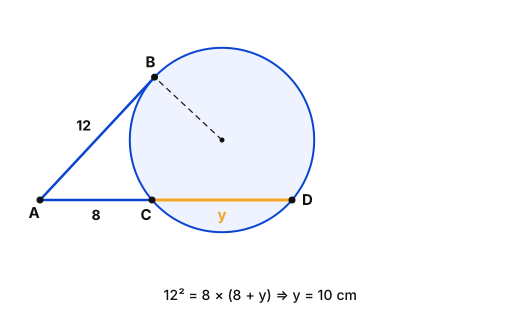
- AD = 18 cm
- cm
Trick: .
Answer: (A) 10 cm
अवधारणा: : ।
- AD = 18 cm
- cm
ट्रिक: ।
उत्तर: (A) 10 cm
SSC CHSLQuantitative AptitudeCircles – tangent–secant theoremSSC CHSL 2025 · 26 Nov Shift 1
Q376.An article sold for Rs. 960 after a discount of . What was the marked price?
एक वस्तु की छूट के बाद Rs. 960 में बेची गई। उसका अंकित मूल्य क्या था?
- ARs. 1250
- BRs. 1100
- CRs. 1200
- DRs. 1000
Show answer
Concept: After d% discount, SP = (100 − d)% of MP.
- 20% off → SP is 80% of MP.
- 80% of MP = ₹960.
- MP = ₹1200.
Trick: off in one line.
Answer: (C) Rs. 1200
अवधारणा: d% छूट के बाद विक्रय मूल्य = अंकित मूल्य का (100 − d)%।
हल:
- 20% छूट → SP = MP का 80%
- MP का 80% = ₹960
- MP = ₹1200
ट्रिक: MP का ।
उत्तर: (C) Rs. 1200
SSC CHSLQuantitative AptitudeMarked price from discountSSC CHSL 2025 · 25 Nov Shift 3
Q377.In a warehouse, 9 crates of goods have an average weight of 94.5 kg . One of the crates, weighing 89.2 kg , is replaced by a new crate. As a result, the average weight becomes 97.1 kg . Later, 5 more crates are added, each weighing 101.3 kg . What is the weight of the new crate that replaced the old one ?
एक गोदाम में सामान के 9 क्रेटों का औसत भार 94.5 kg है। इनमें से 89.2 kg भार वाले एक क्रेट को एक नए क्रेट से बदल दिया जाता है। परिणामस्वरूप औसत भार 97.1 kg हो जाता है। बाद में 101.3 kg भार वाले 5 और क्रेट जोड़ दिए जाते हैं। पुराने क्रेट के स्थान पर रखे गए नए क्रेट का भार कितना है?
- A116.8 kg
- B118.1 kg
- C112.6 kg
- D115.7 kg
Show answer
Concept: If n items stay n, .
- Average rises by kg over 9 crates.
- Extra weight brought in = kg.
- Weight of the replacing crate: 23.4 more than 89.2, i.e. 112.6 kg. Ignore the 5 crates added later – they come after the swap.
Trick: — no need to find the totals.
Answer: (C) 112.6 kg
अवधारणा: वस्तुओं की संख्या वही रहे तो ।
हल:
- औसत में वृद्धि = kg, 9 टोकरों पर
- कुल बढ़ा भार = kg
- नया टोकरा = kg (बाद में जोड़े 5 टोकरे अनावश्यक जानकारी हैं)
ट्रिक: – कुल योग निकालने की ज़रूरत नहीं।
उत्तर: (C) 112.6 kg
SSC CHSLQuantitative AptitudeAverage – replacementSSC CHSL 2025 · 25 Nov Shift 3
Q378.A right circular cone has a height of 15 cm and a radius of 8 cm . Find its slant height and curved surface area.
एक लंब वृत्तीय शंकु की ऊँचाई 15 cm तथा त्रिज्या 8 cm है। इसकी तिर्यक ऊँचाई और वक्र पृष्ठीय क्षेत्रफल ज्ञात कीजिए।
- A17 cm and 17 cm तथा
- B12 cm and 12 cm तथा
- C18 cm and 18 cm तथा
- D17 cm and 17 cm तथा
Show answer
Concept: ; .
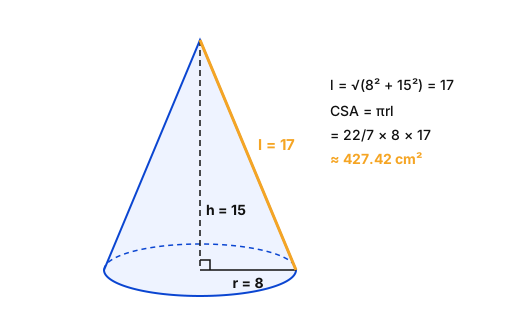
- cm.
- cm².
Trick: (8, 15, 17) is a Pythagorean triplet – l = 17 without calculation; only (A) and (D) have 17, and .
Answer: (A) 17 cm and
अवधारणा: ; ।
हल:
- cm
- cm²
ट्रिक: (8, 15, 17) पाइथागोरस त्रिक है – l = 17 तुरंत; 17 वाले (A), (D) में से → (A)।
उत्तर: (A) 17 cm तथा
SSC CHSLQuantitative AptitudeCone – slant height & CSASSC CHSL 2025 · 25 Nov Shift 3
Q379.If in a right-angled triangle, , find the value of .
यदि एक समकोण त्रिभुज में है, तो का मान ज्ञात कीजिए।
- A
- B
- C
- D
Show answer
Concept: Build the triangle from , find the base, then the other ratios.
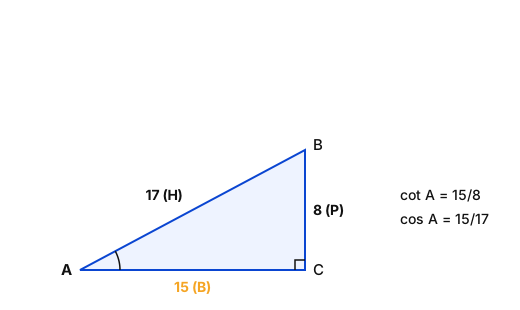
- P = 8, H = 17 → .
- , .
- .
Trick: Take 15 common: – saves a step.
Answer: (D)
अवधारणा: से त्रिभुज बनाएँ, आधार निकालें, फिर बाकी अनुपात।
हल:
- लंब = 8, कर्ण = 17 →
- ,
ट्रिक: 15 को common लें: – एक कदम बचता है।
उत्तर: (D)
SSC CHSLQuantitative AptitudeTrigonometric ratios from sinSSC CHSL 2025 · 25 Nov Shift 3
Q380.Two circles with centers and have radii and , respectively. The distance between their centers is 13 cm . A common internal tangent touches the circles at points and . What is the length of the segment ?
केंद्र तथा वाले दो वृत्तों की त्रिज्याएँ क्रमशः तथा हैं। उनके केंद्रों के बीच की दूरी 13 cm है। एक उभयनिष्ठ आंतरिक स्पर्श रेखा वृत्तों को तथा बिंदुओं पर स्पर्श करती है। रेखाखंड की लंबाई कितनी है?
- A6 cm
- B4 cm
- C5 cm
- D7 cm
Show answer
Concept: Internal (transverse) tangent length = .
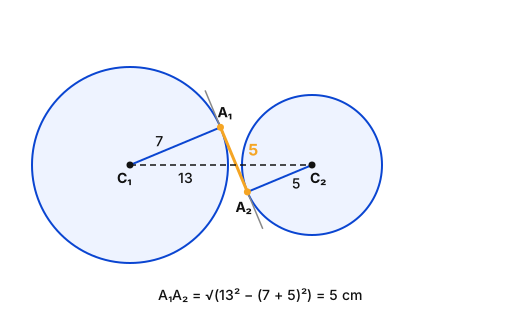
- , .
- Length = cm.
Trick: Internal → , external → . Here 5-12-13 triplet gives 5 instantly.
Answer: (C) 5 cm
अवधारणा: अनुप्रस्थ (internal) स्पर्शरेखा की लंबाई = ।
हल:
- ,
- लंबाई = cm
ट्रिक: Internal में , external में । 5-12-13 त्रिक से तुरंत 5।
उत्तर: (C) 5 cm
SSC CHSLQuantitative AptitudeCommon internal tangentSSC CHSL 2025 · 25 Nov Shift 3

