Q381.From point ' ' on the ground, a long metallic cable is laid to the top of a cliff, making an angle of with the ground such that the length of the cable laid is metres. Find the distance between point ' ' and the foot of the cliff.
ज़मीन पर स्थित बिंदु ' ' से एक चट्टान की चोटी तक एक लंबी धातु की केबल इस प्रकार डाली गई है कि वह ज़मीन के साथ का कोण बनाती है और डाली गई केबल की लंबाई मीटर है। बिंदु ' ' तथा चट्टान के पाद के बीच की दूरी ज्ञात कीजिए।
- A metres मीटर
- B metres मीटर
- C metres मीटर
- D metres मीटर
Show answer
Concept: The cable is the hypotenuse; .
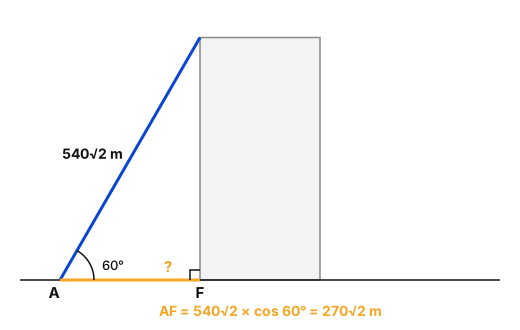
- Hypotenuse = m, angle with ground = 60°.
- .
- Distance = m.
Trick: In a 30-60-90 triangle, the side next to 60° is always half the hypotenuse.
Answer: (C) metres
अवधारणा: केबल कर्ण है; ।
हल:
- कर्ण = m, ज़मीन से कोण 60°
- दूरी = m
ट्रिक: 30-60-90 त्रिभुज में 60° के पास वाली भुजा = कर्ण का आधा।
उत्तर: (C) मीटर
SSC CHSLQuantitative AptitudeHeights & distances – cos 60°SSC CHSL 2025 · 25 Nov Shift 3
Q382.The ratio of gold to copper in a bracelet is . If the price of copper is th the price of gold, find the cost of the bracelet if the cost of copper in the bracelet is 32000 rupees.
एक कंगन में सोने और ताँबे का अनुपात है। यदि ताँबे का मूल्य सोने के मूल्य का वाँ भाग है, तो कंगन की लागत ज्ञात कीजिए, जबकि कंगन में लगे ताँबे की लागत 32000 रुपये है।
- ARs. 280000
- BRs. 290000
- CRs. 272000
- DRs. 278000
Show answer
Concept: ; combine the quantity ratio with the price ratio.
- Quantity gold : copper = 5 : 8; price gold : copper = 12 : 1.
- Cost ratio = .
- Copper's 2 parts = ₹32000 → 1 part = 16000; total 17 parts = ₹272000.
Trick: Multiply the two ratios term by term to get the cost ratio directly.
Answer: (C) Rs. 272000
अवधारणा: ; दोनों अनुपातों को गुणा करें।
हल:
- मात्रा सोना : ताँबा = 5 : 8; मूल्य सोना : ताँबा = 12 : 1
- लागत अनुपात = 60 : 8 = 15 : 2
- ताँबे के 2 भाग = ₹32000 → 1 भाग = 16000; कुल 17 भाग = ₹272000
ट्रिक: दोनों अनुपातों को पद-दर-पद गुणा करके सीधा लागत अनुपात पाएँ।
उत्तर: (C) Rs. 272000
SSC CHSLQuantitative AptitudeRatio – cost of alloySSC CHSL 2025 · 25 Nov Shift 3
Q383.Rice worth Rs. 140 per kg and Rs. 150 per kg are mixed with a third variety in the ratio . If the mixture is worth Rs. 160 per kg, what is the price of the third variety per kg?
Rs. 140 प्रति kg तथा Rs. 150 प्रति kg मूल्य के चावल को एक तीसरी किस्म के साथ के अनुपात में मिलाया जाता है। यदि मिश्रण का मूल्य Rs. 160 प्रति kg है, तो तीसरी किस्म का मूल्य प्रति kg कितना है?
- A180
- B185
- C175
- D190
Show answer
Concept: Total value of parts = value of the mixture.
- Take 2 kg, 2 kg, 3 kg (total 7 kg).
- Value at ₹160: (₹).
- First two: (₹) → third 3 kg = 540 → ₹180 per kg.
Trick: Deviation method: ; third must offset +60 over 3 kg → +20 → ₹180.
Answer: (A) 180
अवधारणा: सभी भागों का कुल मूल्य = मिश्रण का मूल्य।
हल:
- मात्राएँ 2 kg, 2 kg, 3 kg (कुल 7 kg)
- मिश्रण का मूल्य = (₹)
- पहले दो का = (₹) → तीसरे 3 kg = 540 → ₹180/kg
ट्रिक: विचलन विधि: ; तीसरे को 3 kg में +60 पूरा करना है → +20 → ₹180।
उत्तर: (A) 180
SSC CHSLQuantitative AptitudeMixture – unknown priceSSC CHSL 2025 · 25 Nov Shift 3
Q384.Ajay is thrice as good a workman as Vipin and therefore can finish a job in 40 days less than Vipin. How many days are required to complete the job if working together ?
अजय, विपिन से तीन गुना अच्छा कारीगर है और इसलिए वह एक काम को विपिन से 40 दिन कम में पूरा कर सकता है। यदि दोनों साथ मिलकर काम करें, तो उस काम को पूरा करने में कितने दिन लगेंगे?
- A13 days13 दिन
- B22 days22 दिन
- C15 days15 दिन
- D26 days26 दिन
Show answer
Concept: Time is inversely proportional to efficiency.
- Efficiency Ajay : Vipin = 3 : 1 → time = 1 : 3.
- Difference 2 parts = 40 days → Ajay 20 days, Vipin 60 days.
- Together = days.
Trick: .
Answer: (C) 15 days
अवधारणा: समय, दक्षता के व्युत्क्रमानुपाती होता है।
हल:
- दक्षता Ajay : Vipin = 3 : 1 → समय = 1 : 3
- अंतर 2 भाग = 40 दिन → Ajay 20 दिन, Vipin 60 दिन
- साथ में = दिन
ट्रिक: ।
उत्तर: (C) 15 दिन
SSC CHSLQuantitative AptitudeTime & work – efficiency ratioSSC CHSL 2025 · 25 Nov Shift 3
Q385.If , and is an acute angle, find the value of .
यदि है तथा एक न्यून कोण है, तो का मान ज्ञात कीजिए।
- A60
- B61
- C62
- D63
Show answer
Concept: , so .
- Square: .
- .
- .
Trick: If , then → .
Answer: (C) 62
अवधारणा: , इसलिए ।
हल:
- दोनों ओर वर्ग: 64
ट्रिक: हो तो → ।
उत्तर: (C) 62
SSC CHSLQuantitative AptitudeTrig identity – squaringSSC CHSL 2025 · 25 Nov Shift 3
Q386.A person covers some distance by car, travelling at 65 km/h in 6.6 hours, and the remaining distance by bus, travelling at 57.5 km/h in 6.2 hours. Find the total distance travelled by the person.
एक व्यक्ति कुछ दूरी कार से 65 km/h की चाल से 6.6 घंटे में तय करता है, और शेष दूरी बस से 57.5 km/h की चाल से 6.2 घंटे में तय करता है। व्यक्ति द्वारा तय की गई कुल दूरी ज्ञात कीजिए।
- A772.5 km
- B788 km
- C767 km
- D785.5 km
Show answer
Concept: Find each part's distance and add.
- Car: km.
- Bus: km.
- Total = 785.5 km.
Trick: Last-digit check: , so the total ends in 5.5 – only 785.5 does.
Answer: (D) 785.5 km
अवधारणा: हर भाग की दूरी अलग निकालकर जोड़ें।
हल:
- कार: km
- बस: km
- कुल = 785.5 km
ट्रिक: अंतिम अंक जाँचें: 9 + 6.5 = …5.5 → केवल 785.5 मेल खाता है।
उत्तर: (D) 785.5 km
SSC CHSLQuantitative AptitudeDistance = speed × timeSSC CHSL 2025 · 25 Nov Shift 3
Q387.In a circle with center is a chord. OM is perpendicular to PQ , and M is the midpoint of PQ . If the angle , and the radius of the circle is 12 cm , what is the length of the chord PQ ?
एक वृत्त में, केंद्र एक जीवा है। OM, PQ पर लंब है, और M, PQ का मध्यबिंदु है। यदि कोण है, तथा वृत्त की त्रिज्या 12 cm है, तो जीवा PQ की लंबाई कितनी है?
- A
- B
- C12 cm
- D
Show answer
Concept: Two radii with a 60° angle between them make an equilateral triangle.
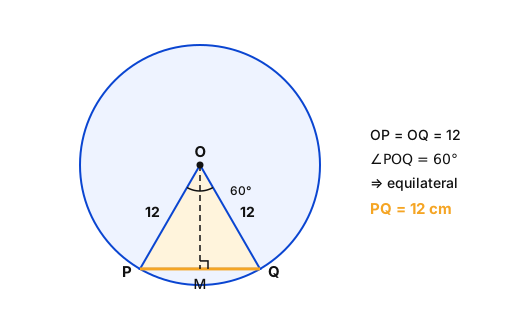
- OP = OQ = 12 cm (radii) → base angles equal.
- Each base angle = → △POQ is equilateral.
- PQ = 12 cm.
Trick: Central angle 60° ⇒ chord = radius. (90° ⇒ , 120° ⇒ .)
Answer: (C) 12 cm
अवधारणा: 60° कोण बनाती दो त्रिज्याएँ समबाहु त्रिभुज बनाती हैं।
हल:
- OP = OQ = 12 cm → आधार कोण बराबर
- प्रत्येक = → समबाहु त्रिभुज
- PQ = 12 cm
ट्रिक: केंद्रीय कोण 60° ⇒ जीवा = त्रिज्या; 90° ⇒ ; 120° ⇒ ।
उत्तर: (C) 12 cm
SSC CHSLQuantitative AptitudeChord & central angleSSC CHSL 2025 · 25 Nov Shift 3
Q388.A solid metallic sphere of radius R is heated so that its radius increases by . Find the approximate percentage increase in its volume.
त्रिज्या R वाले एक ठोस धात्विक गोले को गर्म किया जाता है, जिससे उसकी त्रिज्या बढ़ जाती है। उसके आयतन में लगभग कितने प्रतिशत की वृद्धि होगी, ज्ञात कीजिए।
- A70%
- B72.8 %
- C71%
- D75%
Show answer
Concept: Volume ∝ , so multiply the growth factor three times.
- Radius factor = 1.2.
- Volume factor = .
- Increase = 0.728 → 72.8%.
Trick: Use twice: 20 and 20 → 44%; then 44 and 20 → .
Answer: (B) 72.8 %
अवधारणा: आयतन ∝ , इसलिए वृद्धि गुणक को तीन बार गुणा करें।
हल:
- त्रिज्या गुणक = 1.2
- आयतन गुणक =
- वृद्धि = 0.728 → 72.8%
ट्रिक: दो बार: 20, 20 → 44%; फिर 44, 20 → 72.8%।
उत्तर: (B) 72.8 %
SSC CHSLQuantitative AptitudeSphere – % change in volumeSSC CHSL 2025 · 25 Nov Shift 3
Q389.In a parallelogram, the diagonals are 34 cm and 16 cm and intersect at right angles. Find the side length and the area of the parallelogram.
एक समांतर चतुर्भुज में, विकर्ण 34 cm और 16 cm हैं तथा वे परस्पर समकोण पर प्रतिच्छेद करते हैं। समांतर चतुर्भुज की भुजा की लंबाई और क्षेत्रफल ज्ञात कीजिए।
- A and और
- B and और
- C and और
- D and और
Show answer
Concept: Perpendicular diagonals in a parallelogram ⇒ rhombus: side = , area = .
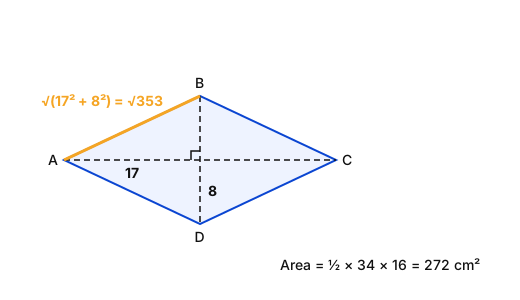
- Half diagonals: 17 and 8.
- Side = cm.
- Area = cm².
Trick: Area 272 leaves (A) and (B); confirms (A).
Answer: (A) and
अवधारणा: समांतर चतुर्भुज के विकर्ण लंबवत हों तो वह समचतुर्भुज है: भुजा = , क्षेत्रफल = ।
हल:
- आधे विकर्ण: 17 और 8
- भुजा = cm
- क्षेत्रफल = cm²
ट्रिक: क्षेत्रफल 272 से (A), (B) बचते हैं; से (A)।
उत्तर: (A) और
SSC CHSLQuantitative AptitudeRhombus – side & area from diagonalsSSC CHSL 2025 · 25 Nov Shift 3
Q390.A trader marks up an article by 20% on its cost price. He then offers two successive discounts: 10% followed by on the marked price. If the cost price (CP) is ₹520, what is the final profit or loss percent ?
एक व्यापारी किसी वस्तु पर उसके क्रय मूल्य से 20% अधिक अंकित मूल्य रखता है। इसके बाद वह अंकित मूल्य पर दो क्रमिक छूट देता है: पहले 10% और फिर । यदि क्रय मूल्य (CP) ₹520 है, तो अंतिम लाभ या हानि प्रतिशत क्या है?
- A2.6%Profit2.6% लाभ
- B Loss हानि
- C Loss हानि
- D3.6% Profit3.6% लाभ
Show answer
Concept: Net % = combine +20%, −10%, −5% successively (CP value not needed).
- +20% then −10%: .
- +8% then −5%: .
- Check: (₹) → profit ₹13.52 = 2.6%.
Trick: Use step by step; the cost price ₹520 is not even needed for a % answer.
Answer: (A) 2.6%Profit
अवधारणा: +20%, −10%, −5% को क्रमिक रूप से जोड़ें (CP की ज़रूरत नहीं)।
हल:
- +20% और −10%:
- +8% और −5%:
- जाँच: (₹) → लाभ ₹13.52 = 2.6%
ट्रिक: क्रम से लगाएँ; % उत्तर के लिए ₹520 की ज़रूरत ही नहीं।
उत्तर: (A) 2.6% लाभ
SSC CHSLQuantitative AptitudeMarkup & successive discountsSSC CHSL 2025 · 25 Nov Shift 3
Q391.Shivan and Balram enter into a partnership with capitals in the ratio 3 : 5. If the total profit is Rs 16,000 , what will Shivan share be ?
शिवन और बलराम 3 : 5 के अनुपात में पूँजी लगाकर एक साझेदारी में प्रवेश करते हैं। यदि कुल लाभ Rs 16,000 है, तो शिवन का हिस्सा कितना होगा?
- ARs 3,600
- BRs 4,000
- CRs 4,500
- DRs 6,000
Show answer
Concept: Same time period ⇒ profit is shared in the ratio of capitals.
- Ratio 3 : 5 → 8 parts.
- 1 part = (₹).
- Shivan = (₹).
Trick: Total must divide by 8; Shivan's share must be a multiple of – only 6000 works.
Answer: (D) Rs 6,000
अवधारणा: समय समान हो तो लाभ पूँजी के अनुपात में बँटता है।
हल:
- अनुपात 3 : 5 → कुल 8 भाग
- 1 भाग = (₹)
- Shivan = (₹)
ट्रिक: पहले 1 भाग निकालें (₹2000), फिर गुणा – सबसे तेज़ तरीका।
उत्तर: (D) Rs 6,000
SSC CHSLQuantitative AptitudePartnership – profit shareSSC CHSL 2025 · 25 Nov Shift 3
Q392.The ratio of the length to the width of a rectangle is . If its perimeter is 104 cm , what is its area ?
एक आयत की लंबाई और चौड़ाई का अनुपात है। यदि उसका परिमाप 104 cm है, तो उसका क्षेत्रफल क्या है?
- A
- B
- C
- D
Show answer
Concept: ; use the ratio to split .
- .
- Ratio 8 : 5 → 13 parts → 1 part = 4.
- , → area = 640 cm².
Trick: .
Answer: (A)
अवधारणा: ; अनुपात से को बाँटें।
हल:
- 8 : 5 → 13 भाग → 1 भाग = 4
- , → क्षेत्रफल = 640 cm²
ट्रिक: ।
उत्तर: (A)
SSC CHSLQuantitative AptitudeRectangle – ratio & perimeterSSC CHSL 2025 · 25 Nov Shift 3
Q393.Aman's daily water intake for 5 days was 2.5 L, 3 L, 2 L, 3.5 L, and 3 L. On the 6th day, he forgot to note his intake. If the average intake for 6 days is 3 L , how much water did he drink on the 6th day?
अमन का 5 दिनों का दैनिक जल-सेवन 2.5 L, 3 L, 2 L, 3.5 L और 3 L रहा। छठे दिन वह अपना सेवन नोट करना भूल गया। यदि 6 दिनों का औसत सेवन 3 L है, तो उसने छठे दिन कितना पानी पिया?
- A2.5 L
- B3 L
- C4 L
- D3.5 L
Show answer
Concept: .
- Needed total for 6 days = L.
- Known 5 days = 14 L.
- 6th day = 4 L.
Trick: Deviation from 3: −0.5, 0, −1, +0.5, 0 = −1 → 6th day must be L.
Answer: (C) 4 L
अवधारणा: ।
हल:
- 6 दिनों का कुल = L
- पहले 5 दिन = 14 L
- छठा दिन = 4 L
ट्रिक: 3 से विचलन: −0.5, 0, −1, +0.5, 0 = −1 → छठा दिन L।
उत्तर: (C) 4 L
SSC CHSLQuantitative AptitudeAverage – missing valueSSC CHSL 2025 · 25 Nov Shift 3
Q394.In a circle with a radius of 30 cm , a chord measures 36 cm in length. Find the perpendicular distance from the center of the circle to this chord.
30 cm त्रिज्या वाले एक वृत्त में, एक जीवा की लंबाई 36 cm है। वृत्त के केंद्र से इस जीवा पर लंब दूरी ज्ञात कीजिए।
- A20 cm
- B24 cm
- C36 cm
- D40 cm
Show answer
Concept: Perpendicular from the centre bisects the chord: .
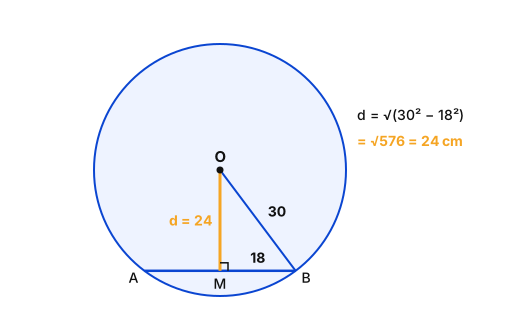
- Half chord = 18 cm.
- cm.
Trick: 18-24-30 = 6 × (3-4-5) → d = 24 instantly.
Answer: (B) 24 cm
अवधारणा: केंद्र से जीवा पर लंब उसे समद्विभाजित करता है: ।
हल:
- आधी जीवा = 18 cm
- cm
ट्रिक: 18-24-30 = 6 × (3-4-5) → d = 24 तुरंत।
उत्तर: (B) 24 cm
SSC CHSLQuantitative AptitudeChord distance from centreSSC CHSL 2025 · 25 Nov Shift 3
Q395.Two chords, AB and CD , cross at point inside a circle. Segments , and have lengths of , and 5 cm, respectively. How long is the chord CD in total ?
दो जीवाएँ, AB और CD, एक वृत्त के भीतर बिंदु पर एक-दूसरे को काटती हैं। खंड , और की लंबाइयाँ क्रमशः , और 5 cm हैं। जीवा CD की कुल लंबाई कितनी है?
- A12.6 cm
- B17.6 cm
- C18.6 cm
- D14.7 cm
Show answer
Concept: for chords crossing inside a circle.
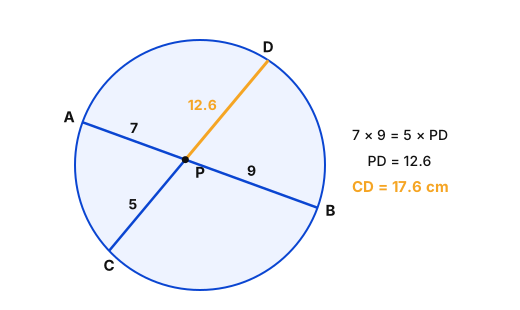
- → cm.
- cm.
Trick: Don't stop at PD (12.6 is a trap option) – the question asks for the whole chord.
Answer: (B) 17.6 cm
अवधारणा: वृत्त के भीतर कटती जीवाओं में ।
हल:
- → cm
- cm
ट्रिक: PD (12.6) पर न रुकें – वह जाल विकल्प है; पूछी गई पूरी जीवा है।
उत्तर: (B) 17.6 cm
SSC CHSLQuantitative AptitudeIntersecting chords theoremSSC CHSL 2025 · 25 Nov Shift 3
Q396.What is the -intercept of the line given by ?
-अंतःखंड क्या होगा, यदि रेखा का समीकरण है?
- A- 4
- B4
- C5
- D6
Show answer
Concept: On the x-axis .
- Put : .
- .
Trick: For : x-intercept = , y-intercept = → .
Answer: (B) 4
अवधारणा: x-अक्ष पर होता है।
हल:
- रखें:
ट्रिक: में x-अंतःखंड = , y-अंतःखंड = → ।
उत्तर: (B) 4
SSC CHSLQuantitative Aptitudex-intercept of a lineSSC CHSL 2025 · 25 Nov Shift 3
Q397.P is 25% more than Q. Q is 20% less than R. R is 10% more than S. S is 40% less than . By how much percentage is P more or less than T?
P, Q से 25% अधिक है। Q, R से 20% कम है। R, S से 10% अधिक है। S, से 40% कम है। P, T से कितने प्रतिशत अधिक या कम है?
- A24% more24% अधिक
- B34% less34% कम
- C26% less26% कम
- D34% more34% अधिक
Show answer
Concept: Assume T = 100 and apply each change in turn.
- S = 60% of 100 = 60.
- ; .
- → 34 less than T = 34% less.
Trick: −20% then +25% cancel out (), so P = R = 66 directly.
Answer: (B) 34% less
अवधारणा: T = 100 मानकर हर बदलाव क्रम से लगाएँ।
हल:
- S = 100 का 60% = 60
- R = 66;
- → T से 34% कम
ट्रिक: −20% और +25% एक-दूसरे को रद्द करते हैं (), इसलिए P = R = 66।
उत्तर: (B) 34% कम
SSC CHSLQuantitative AptitudeChain percentagesSSC CHSL 2025 · 25 Nov Shift 3
Q398.If a certain sum of money becomes triple of itself in 7 years 6 months at simple interest, then what will be the annual rate of interest (approximate)?
यदि कोई धनराशि साधारण ब्याज पर 7 वर्ष 6 माह में स्वयं की तीन गुनी हो जाती है, तो वार्षिक ब्याज दर (लगभग) क्या होगी?
- A20.09 percent20.09 प्रतिशत
- B21.11 percent21.11 प्रतिशत
- C26.66 percent26.66 प्रतिशत
- D26.50 percent26.50 प्रतिशत
Show answer
Concept: If money becomes n times in T years at SI, .
- Triple → .
- T = 7.5 years.
- .
Trick: → .
Answer: (C) 26.66 percent
अवधारणा: SI पर राशि T वर्षों में n गुना हो तो ।
हल:
- तीन गुना → ब्याज = 2P
- T = 7.5 वर्ष
ट्रिक: → ।
उत्तर: (C) 26.66 प्रतिशत
SSC CHSLQuantitative AptitudeSimple interest – rateSSC CHSL 2025 · 25 Nov Shift 3
Q399.The difference between simple interest on a certain sum at the annual rate of 15 percent for 10 years and 12 years is Rs. 120. What is the sum ?
किसी निश्चित धनराशि पर 15 प्रतिशत वार्षिक दर से 10 वर्ष और 12 वर्ष के साधारण ब्याज का अंतर Rs. 120 है। वह धनराशि क्या है?
- ARs. 620
- BRs. 400
- CRs. 450
- DRs. 600
Show answer
Concept: SI is the same every year, so the difference = interest for the extra years.
- Extra time = years.
- 2 years at 15% = 30% of P = ₹120.
- (₹).
Trick: 30% = 120 → 10% = 40 → 100% = 400.
Answer: (B) Rs. 400
अवधारणा: SI हर वर्ष बराबर होता है, इसलिए अंतर = अतिरिक्त वर्षों का ब्याज।
हल:
- अतिरिक्त समय = 2 वर्ष
- 2 वर्ष × 15% = मूलधन का 30% = ₹120
- मूलधन = (₹)
ट्रिक: 30% = 120 → 10% = 40 → 100% = 400।
उत्तर: (B) Rs. 400
SSC CHSLQuantitative AptitudeSimple interest – difference of yearsSSC CHSL 2025 · 25 Nov Shift 3
Q400.Pipe P and Q together can fill a tank in 20 minutes. Pipe and together can fill the same tank in 24 minutes. Pipe and together can fill the same tank in 28 minutes. Firstly pipe is opened. After ' ' minutes, pipes and Q both are also opened. Remaining tank got filled in 8 minutes. What is the value of M ?
पाइप P और Q मिलकर एक टंकी को 20 मिनट में भर सकते हैं। पाइप और मिलकर उसी टंकी को 24 मिनट में भर सकते हैं। पाइप और मिलकर उसी टंकी को 28 मिनट में भर सकते हैं। सबसे पहले पाइप खोला जाता है। ' ' मिनट बाद, पाइप और Q दोनों भी खोल दिए जाते हैं। शेष टंकी 8 मिनट में भर जाती है। M का मान क्या है?
- A
- B
- C
- D
Show answer
Concept: Take tank = LCM of times; add the three pair-rates to get .
- Tank = 840 units. , , per min.
- → .
- Last 8 min all three fill units.
- R alone filled → .
Trick: Rate of one pipe = (sum of all three) − (rate of the other two together).
Answer: (D)
अवधारणा: टंकी = समयों का LCM; तीनों जोड़ी-दरों का योग = ।
हल:
- टंकी = 840 इकाई; , , प्रति मिनट
- →
- अंतिम 8 मिनट में तीनों ने 428 इकाई भरी
- R ने अकेले 412 →
ट्रिक: एक पाइप की दर = तीनों का योग − बाकी दो की संयुक्त दर।
उत्तर: (D)
SSC CHSLQuantitative AptitudePipes – pairwise ratesSSC CHSL 2025 · 25 Nov Shift 3

