Q461.The least number which is divisible by each of the numbers 7,11 , and 13 is:
वह न्यूनतम संख्या कौन-सी है जो 7,11 , और 13 में से प्रत्येक से विभाज्य है:
- A1100
- B1000
- C1001
- D1002
Show answer
Concept: Least number divisible by each = LCM; for primes, LCM = product.
- 7, 11, 13 are primes.
- 1001
Yaad rakhein: is a classic – it also explains why abcabc is always divisible by 7, 11 and 13.
Answer: (C) 1001
अवधारणा: प्रत्येक से विभाज्य सबसे छोटी संख्या = LCM; अभाज्य संख्याओं का LCM = गुणनफल।
- 7, 11, 13 अभाज्य हैं।
- 1001
याद रखें: – इसीलिए abcabc जैसी संख्या 7, 11, 13 से सदा विभाज्य होती है।
उत्तर: (C) 1001
SSC CHSLQuantitative AptitudeLCM of primesSSC CHSL 2025 · 24 Nov Shift 3
Q462.In a college, there are 800 faculty members, out of which are females. The average height of males is 150cm, and the average height of females is 170 cm . What is the average height of the entire faculty ?
एक महाविद्यालय में 800 संकाय सदस्य हैं, जिनमें से महिलाएँ हैं। पुरुषों की औसत ऊँचाई 150cm है और महिलाओं की औसत ऊँचाई 170 cm है। सम्पूर्ण संकाय की औसत ऊँचाई कितनी है ?
- A164 cm
- B166 cm
- C169 cm
- D162 cm
Show answer
Concept: Group average = when shares are known.
- Females 60%, males 40%.
- Average
- = 162 cm
Trick: Start from 150 and add 60% of the gap (20): . Total 800 is not needed.
Answer: (D) 162 cm
अवधारणा: भार (प्रतिशत) ज्ञात हों तो औसत = ।
- महिलाएँ 60%, पुरुष 40%।
- औसत
- = 162 cm
ट्रिक: 150 से शुरू करें और अंतर (20) का 60% जोड़ें: । कुल 800 की ज़रूरत नहीं।
उत्तर: (D) 162 cm
SSC CHSLQuantitative AptitudeWeighted averageSSC CHSL 2025 · 24 Nov Shift 3
Q463.Two buses start from two different cities that are 600 km apart and travel towards each other. The first bus's speed is , and the second bus's speed is . What is the time taken for them to meet?
दो बसें दो अलग-अलग शहरों से चलना प्रारंभ करती हैं, जो 600 km की दूरी पर हैं, और एक-दूसरे की ओर चलती हैं। पहली बस की चाल है और दूसरी बस की चाल है। उनके मिलने में कितना समय लगेगा?
- A4 hours4 घंटे
- B5 hours5 घंटे
- C6 hours6 घंटे
- D7 hours7 घंटे
Show answer
Concept: Moving towards each other, relative speed = sum of speeds.
- Relative speed km/h
- Time 5 hours
Trick: Towards each other → add speeds; same direction → subtract.
Answer: (B) 5 hours
अवधारणा: एक-दूसरे की ओर चलें तो सापेक्ष चाल = चालों का योग।
- सापेक्ष चाल km/h
- समय 5 घंटे
ट्रिक: आमने-सामने → चालें जोड़ें; एक ही दिशा → घटाएँ।
उत्तर: (B) 5 घंटे
SSC CHSLQuantitative AptitudeRelative speed – opposite directionsSSC CHSL 2025 · 24 Nov Shift 3
Q464.Three friends start a mobile app company. Arjun invests 1,50,000, Beena invests 80,000 , and Charu invests . After one year, they earn a profit of 105,000. What will Beena's share of the profit be ?
तीन मित्र मिलकर एक मोबाइल ऐप कंपनी प्रारंभ करते हैं। अर्जुन 1,50,000 निवेश करता है, बीना 80,000 निवेश करती है और चारु निवेश करती है। एक वर्ष बाद उन्हें 105,000 का लाभ प्राप्त होता है। लाभ में बीना का हिस्सा कितना होगा ?
- A18,000
- B21,000
- C24,000
- D27,000
Show answer
Concept: Same time period → profit is shared in the ratio of investments.
- (total 35)
- Beena
- = 24,000
Trick: per part – then multiply by Beena's 8 parts.
Answer: (C) 24,000
अवधारणा: समान अवधि हो तो लाभ निवेश के अनुपात में बँटता है।
- (योग 35)
- बीना
- = 24,000
ट्रिक: प्रति भाग – फिर बीना के 8 भाग से गुणा करें।
उत्तर: (C) 24,000
SSC CHSLQuantitative AptitudePartnership – profit shareSSC CHSL 2025 · 24 Nov Shift 3
Q465.What is the square root of 8464 ?
8464 का वर्गमूल क्या है ?
- A90
- B91
- C94
- D92
Show answer
Concept: Use the unit digit and nearby squares to locate the root.
- Unit digit 4 → root ends in 2 or 8.
- 8464 is between (8100) and (9025) → root is 92.
- Check: ✓ → 92
Trick: Options 90, 91, 94 give unit digits 0, 1, 6 when squared – only 92 gives 4.
Answer: (D) 92
अवधारणा: इकाई अंक और पास के वर्गों से वर्गमूल पहचानें।
- इकाई अंक 4 → वर्गमूल का अंत 2 या 8।
- 8464, (8100) और (9025) के बीच है → वर्गमूल 92।
- जाँच: ✓ → 92
ट्रिक: 90, 91, 94 के वर्ग का इकाई अंक 0, 1, 6 होगा – केवल 92 से 4 आता है।
उत्तर: (D) 92
SSC CHSLQuantitative AptitudeSquare root – perfect squareSSC CHSL 2025 · 24 Nov Shift 3
Q466.A 80 litre container holds a mixture of milk and water in the ratio 7 : 3. If 16 litres of this mixture is taken out and replaced with 16 litres of pure milk, what is the new ratio of milk to water ?
80 लीटर के एक पात्र में दूध और पानी का मिश्रण 7 : 3 के अनुपात में है। यदि इस मिश्रण में से 16 लीटर निकालकर उसके स्थान पर 16 लीटर शुद्ध दूध मिला दिया जाए, तो दूध और पानी का नया अनुपात क्या होगा ?
- A19 : 6
- B
- C
- D
Show answer
Concept: Removing part of a mixture keeps the ratio; then add the new milk.
- Milk = 56 L, water = 24 L.
- 16 L removed () → milk 44.8 L, water 19.2 L.
- Add 16 L milk → 60.8 : 19.2 = 19 : 6
Trick: Only water stays fixed: water left ; milk (total stays 80).
Answer: (A) 19 : 6
अवधारणा: मिश्रण का हिस्सा निकालने पर अनुपात वही रहता है; फिर नया दूध जोड़ें।
- दूध = 56 L, पानी = 24 L।
- 16 L () निकाला → दूध 44.8 L, पानी 19.2 L।
- 16 L दूध मिलाया → 60.8 : 19.2 = 19 : 6
ट्रिक: केवल पानी देखें: बचा पानी ; कुल 80 ही रहता है, तो दूध = 60.8।
उत्तर: (A) 19 : 6
SSC CHSLQuantitative AptitudeMixture – removal and replacementSSC CHSL 2025 · 24 Nov Shift 3
Q467.In , the angle bisectors intersect at the incenter I . If and , what is the measure of ?
में, कोण समद्विभाजक अंतःकेंद्र I पर प्रतिच्छेद करते हैं। यदि और है, तो की माप क्या है ?
- A105°
- B
- C115°
- D120°
Show answer
Concept: At the incentre I, .
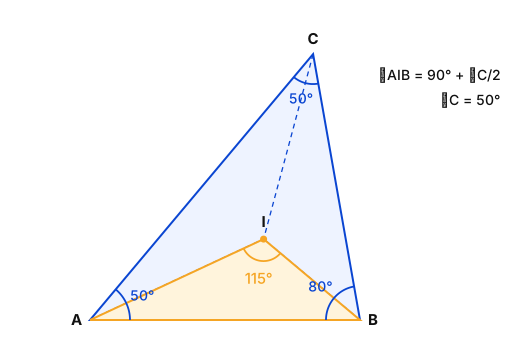
- 115°
Trick: Incentre: 90° + half the opposite angle; excentre: 90° − half.
Answer: (C) 115°
अवधारणा: अंतःकेंद्र I पर ।
- 115°
ट्रिक: अंतःकेंद्र: 90° + सामने वाले कोण का आधा; बहिःकेंद्र: 90° − आधा।
उत्तर: (C) 115°
SSC CHSLQuantitative AptitudeIncentre – angle AIBSSC CHSL 2025 · 24 Nov Shift 3
Q468.Which of the following represents a line perpendicular to the line 16?
निम्नलिखित में से कौन-सा, रेखा 16 पर लंब रेखा को निरूपित करता है?
- A
- B
- C
- D
Show answer
Concept: Perpendicular lines: .
- .
- Required slope .
- Only has slope .
Trick: For , a perpendicular line is – swap the coefficients and change one sign ().
Answer: (C)
अवधारणा: लंबवत रेखाएँ: ।
- ।
- अपेक्षित ढाल ।
- केवल की ढाल है।
ट्रिक: की लंब रेखा होती है – गुणांक बदलें और एक चिह्न उलटें।
उत्तर: (C)
SSC CHSLQuantitative AptitudeCoordinate geometry – perpendicular slopeSSC CHSL 2025 · 24 Nov Shift 3
Q469.Two circles with radii 10 cm and 3 cm are separated by a distance of 15 cm between their centers. From the center of the smaller circle, a tangent is drawn to the larger circle. What is the length of this tangent segment ?
10 cm और 3 cm त्रिज्या वाले दो वृत्तों के केंद्रों के बीच की दूरी 15 cm है। छोटे वृत्त के केंद्र से बड़े वृत्त पर एक स्पर्श रेखा खींची जाती है। इस स्पर्श रेखा खंड की लंबाई क्या है ?
- A
- B
- C
- D
Show answer
Concept: Tangent from external point = , d = distance to centre.
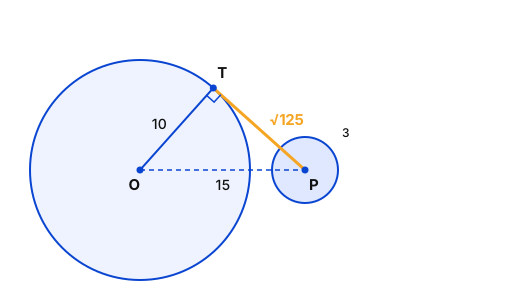
- Point = centre of small circle, , .
- Length cm ().
- Small circle's radius 3 cm is not used.
Trick: Ignore data not on the right triangle – here only 15 and 10 form the triangle with the tangent.
Answer: (C)
अवधारणा: बाहरी बिंदु से स्पर्श रेखा = , d = केंद्र से दूरी।
- बिंदु = छोटे वृत्त का केंद्र, , ।
- लंबाई cm ()।
- छोटे वृत्त की त्रिज्या 3 cm काम नहीं आती।
ट्रिक: जो आँकड़ा समकोण त्रिभुज में नहीं आता, उसे छोड़ दें – यहाँ केवल 15 और 10।
उत्तर: (C)
SSC CHSLQuantitative AptitudeTangent length – from external pointSSC CHSL 2025 · 24 Nov Shift 3
Q470.The sum of and is 100 percent more than the sum of and is 20 percent more than Q . If X is 200 percent more than and , then what is the value of ?
और का योग, और के योग से 100 प्रतिशत अधिक है तथा यह Q से 20 प्रतिशत अधिक है। यदि X, से 200 प्रतिशत अधिक है और है, तो का मान क्या है ?
- A1200
- B1650
- C1700
- D1450
Show answer
Concept: 'k% more than' means multiply by .
- (100% more = double)
- (200% more) 1650
Trick: 200% more = 3 times, 100% more = 2 times – convert to multipliers first. ('A' in the question means X.)
Answer: (B) 1650
अवधारणा: 'k% अधिक' का अर्थ से गुणा।
- (100% अधिक = दोगुना)
- (200% अधिक) 1650
ट्रिक: 200% अधिक = 3 गुना, 100% अधिक = 2 गुना – पहले गुणक बनाएँ। (प्रश्न में 'A' का अर्थ X है।)
उत्तर: (B) 1650
SSC CHSLQuantitative AptitudePercentage relationsSSC CHSL 2025 · 24 Nov Shift 3
Q471.The amount received on a certain sum at the same annual rate of interest after 2 years and 4 years on compound interest (compounding annually) is Rs. 10648 and Rs. 12884.08 respectively. What is that sum ?
एक निश्चित धनराशि पर समान वार्षिक ब्याज दर से चक्रवृद्धि ब्याज (वार्षिक संयोजन) पर 2 वर्ष और 4 वर्ष बाद प्राप्त मिश्रधन क्रमशः Rs. 10648 और Rs. 12884.08 है। वह धनराशि कितनी है ?
- ARs. 10000
- BRs. 12000
- CRs. 8800
- DRs. 9000
Show answer
Concept: , which removes P.
- ₹8800
Trick: and → quickly.
Answer: (C) Rs. 8800
अवधारणा: , इससे P हट जाता है।
- ₹8800
ट्रिक: और → ।
उत्तर: (C) Rs. 8800
SSC CHSLQuantitative AptitudeCompound interest – amounts after 2 and 4 yearsSSC CHSL 2025 · 24 Nov Shift 3
Q472.The difference between simple interest on a certain sum at the annual rate of 10 percent for 8 years and 12 years is Rs. 80. What is the sum ?
एक निश्चित धनराशि पर 10 प्रतिशत की वार्षिक दर से 8 वर्ष और 12 वर्ष के साधारण ब्याज का अंतर Rs. 80 है। वह धनराशि कितनी है ?
- ARs. 200
- BRs. 160
- CRs. 180
- DRs. 150
Show answer
Concept: SI difference for 12 and 8 years = SI for 4 years.
- ₹200
Trick: 4 years at 10% = 40% of P = 80 → .
Answer: (A) Rs. 200
अवधारणा: 12 और 8 वर्ष के SI का अंतर = 4 वर्ष का SI।
- ₹200
ट्रिक: ।
उत्तर: (A) Rs. 200
SSC CHSLQuantitative AptitudeSimple interest – difference of periodsSSC CHSL 2025 · 24 Nov Shift 3
Q473.Selling price of an article is 150 percent more than the value of discount. Selling price is what percent of the marked price ?
किसी वस्तु का विक्रय मूल्य, छूट के मान से 150 प्रतिशत अधिक है। विक्रय मूल्य, अंकित मूल्य का कितने प्रतिशत है ?
- A71.42 percent71.42 प्रतिशत
- B71.58 percent71.58 प्रतिशत
- C71.50 percent71.50 प्रतिशत
- D70.75 percent70.75 प्रतिशत
Show answer
Concept: Take discount = 100; .
- 71.42%
Trick: SP : D = 5 : 2 → ().
Answer: (A) 71.42 percent
अवधारणा: छूट = 100 मानें; ।
- 71.42%
ट्रिक: SP : छूट = 5 : 2 → ()।
उत्तर: (A) 71.42 प्रतिशत
SSC CHSLQuantitative AptitudeDiscount – SP as % of MPSSC CHSL 2025 · 24 Nov Shift 3
Q474.A and B together can complete a work in 24 days. They started the work together but after 8 days A left the work. Remaining work is completed by B in 20 more days. A alone can complete this entire work in how many days ?
A और B मिलकर एक कार्य को 24 दिनों में पूरा कर सकते हैं। उन्होंने कार्य साथ मिलकर प्रारंभ किया, परंतु 8 दिनों बाद A ने कार्य छोड़ दिया। शेष कार्य B ने 20 और दिनों में पूरा किया। A अकेला इस सम्पूर्ण कार्य को कितने दिनों में पूरा कर सकता है ?
- A110
- B120
- C130
- D100
Show answer
Concept: Use total work = LCM-type units and find each one's daily rate.
- Work = 24 units; A + B = 1 unit/day. In 8 days → 8 units.
- B does remaining 16 units in 20 days → 0.8 unit/day.
- unit/day 120 days
Trick: B alone would take days; then .
Answer: (B) 120
अवधारणा: कुल कार्य को इकाइयों में लें और प्रत्येक की दैनिक दर निकालें।
- कार्य = 24 इकाई; A + B = 1 इकाई/दिन। 8 दिन में 8 इकाई।
- शेष 16 इकाई B ने 20 दिन में → 0.8 इकाई/दिन।
- इकाई/दिन 120 दिन
ट्रिक: B अकेला दिन लेगा; ।
उत्तर: (B) 120
SSC CHSLQuantitative AptitudeTime and work – one leavesSSC CHSL 2025 · 24 Nov Shift 3
Q475.P and Q working alone can complete a work in 24 days and 48 days respectively. They work on alternate days one at a time. P works on the first day. In how many days the whole work will be completed?
P और Q अकेले कार्य करते हुए एक कार्य को क्रमशः 24 दिनों और 48 दिनों में पूरा कर सकते हैं। वे एक-एक करके एकांतर दिनों में कार्य करते हैं। पहले दिन P कार्य करता है। सम्पूर्ण कार्य कितने दिनों में पूरा होगा?
- A40
- B32
- C20
- D42
Show answer
Concept: Find work done in one 2-day cycle, then count cycles.
- Work = 48 units; P = 2/day, Q = 1/day.
- One cycle (P then Q) = 3 units in 2 days.
- cycles 32 days
Trick: If total ÷ cycle-work is exact, ; otherwise check the leftover on the next P-day.
Answer: (B) 32
अवधारणा: 2 दिन के एक चक्र का कार्य निकालें, फिर चक्र गिनें।
- कार्य = 48 इकाई; P = 2/दिन, Q = 1/दिन।
- एक चक्र (पहले P फिर Q) = 2 दिन में 3 इकाई।
- चक्र 32 दिन
ट्रिक: कुल ÷ चक्र-कार्य पूरा बँट जाए तो ; वरना बचा कार्य अगले P-दिन पर देखें।
उत्तर: (B) 32
SSC CHSLQuantitative AptitudeTime and work – alternate daysSSC CHSL 2025 · 24 Nov Shift 3
Q476.Find the mean proportion between 9 and 25.
9 और 25 के बीच मध्यानुपाती ज्ञात कीजिए।
- A15
- B225
- C17
- D8
Show answer
Concept: Mean proportional of a and b = , since a : x = x : b.
- .
- .
- Check: 9 : 15 = 15 : 25 = 3 : 5 ✓.
Trick: For two perfect squares: .
Answer: (A) 15
अवधारणा: a और b का मध्यानुपाती = , क्योंकि a : x = x : b।
हल:
- ।
- ।
- जाँच: 9 : 15 = 15 : 25 = 3 : 5 ✓।
ट्रिक: दोनों पूर्ण वर्ग हों तो: .
उत्तर: (A) 15
SSC CHSLQuantitative AptitudeMean proportionalSSC CHSL 2025 · 24 Nov Shift 2
Q477.The average of 10 consecutive even numbers starting from 14 is:
14 से आरंभ होने वाली 10 क्रमागत सम संख्याओं का औसत ज्ञात कीजिए:
- A22
- B23
- C24
- D25
Show answer
Concept: For numbers in AP, average = .
- 10 even numbers from 14: last .
- Average = .
Trick: Average of n consecutive even numbers starting at a = .
Answer: (B) 23
अवधारणा: समांतर श्रेणी में औसत = ।
हल:
- 14 से 10 सम संख्याएँ: अंतिम ।
- औसत = ।
ट्रिक: a से शुरू n क्रमागत सम संख्याओं का औसत = .
उत्तर: (B) 23
SSC CHSLQuantitative AptitudeAverage of consecutive even numbersSSC CHSL 2025 · 24 Nov Shift 2
Q478.A number is first increased by 15% and then decreased by 15%. What is the overall percentage change in the number?
एक संख्या में पहले 15% की वृद्धि की जाती है और फिर 15% की कमी की जाती है। संख्या में कुल प्रतिशत परिवर्तन क्या है?
- A0%
- B decrease की कमी
- C increase की वृद्धि
- D5% decrease5% की कमी
Show answer
Concept: Net change for x% and y% = .
- .
- Net = .
- Check: 100 → 115 → .
Trick: Same % up then down (or down then up) = always a loss of → .
Answer: (B) decrease
अवधारणा: x% और y% के क्रमिक परिवर्तन का कुल प्रभाव = ।
हल:
- ।
- कुल = ।
- जाँच: 100 → 115 → 97.75।
ट्रिक: समान % वृद्धि फिर कमी = हमेशा की कमी → 2.25%.
उत्तर: (B) की कमी
SSC CHSLQuantitative AptitudeSuccessive percentage change – equal rise and fallSSC CHSL 2025 · 24 Nov Shift 2
Q479.A number is first increased by 25% and then decreased by 25%. What is the net percentage change?
एक संख्या में पहले 25% की वृद्धि की जाती है और फिर 25% की कमी की जाती है। कुल प्रतिशत परिवर्तन क्या है?
- A6.25% decrease6.25% की कमी
- B increase की वृद्धि
- C0%
- D12.5% decrease12.5% की कमी
Show answer
Concept: Equal % increase and decrease gives a net decrease of .
- .
- Check: 100 → 125 → → 6.25% less.
Trick: Never 0%: the decrease is taken on a bigger base, so the loss is always more.
Answer: (A) 6.25% decrease
अवधारणा: बराबर % वृद्धि और कमी से कुल की कमी होती है।
हल:
- ।
- जाँच: 100 → 125 → → 6.25% कम।
ट्रिक: उत्तर कभी 0% नहीं – कमी बड़े आधार पर लगती है।
उत्तर: (A) 6.25% की कमी
SSC CHSLQuantitative AptitudeSuccessive percentage change – 25% up and downSSC CHSL 2025 · 24 Nov Shift 2
Q480.A product marked at Rs. 1,800 is sold for Rs. 1,440. Find the discount percentage.
Rs. 1,800 अंकित मूल्य वाला एक उत्पाद Rs. 1,440 में बेचा जाता है। छूट प्रतिशत ज्ञात कीजिए।
- A15%
- B18%
- C20%
- D25%
Show answer
Concept: .
- Discount = ₹360.
- Discount % = .
Trick: → discount = 20%.
Answer: (C) 20%
अवधारणा: ।
हल:
- छूट = ₹360।
- छूट % = ।
ट्रिक: → छूट 20%.
उत्तर: (C) 20%
SSC CHSLQuantitative AptitudeDiscount percentageSSC CHSL 2025 · 24 Nov Shift 2

