Q681.What is the degree measure of radians ?
रेडियन का डिग्री माप क्या है?
- A-240°0'0"
- B200°0'0'
- C-180°0'0*
- D-100°0'0"
Show answer
Concept: .
- .
- Written as .
Trick: ; so and keep the minus sign.
Answer: (A) -240°0'0"
अवधारणा: ।
हल:
- ।
- अर्थात ।
ट्रिक: ; अतः , ऋण चिह्न बना रहेगा।
उत्तर: (A) -240°0'0"
SSC CHSLQuantitative AptitudeRadian to degree conversionSSC CHSL 2025 · 20 Nov Shift 3
Q682.Which of the following set can never form the sides of a triangle ?
निम्नलिखित में से कौन-सा समुच्चय कभी भी किसी त्रिभुज की भुजाएँ नहीं बना सकता?
- A2 cm, 4 cm, 5 cm2 सेमी, 4 सेमी, 5 सेमी
- B6 cm, 6 cm, 6 cm6 सेमी, 6 सेमी, 6 सेमी
- C
- D
Show answer
Concept: Sum of the two smaller sides must exceed the largest side.
- A: 2 + 4 = 6 > 5 ✓; B: 6 + 6 > 6 ✓; D: 6 + 8 = 14 > 11 ✓.
- C: 3 + 2 = 5 < 7 ✗ – cannot form a triangle.
Trick: Only test the two smallest sides against the largest – one check per option.
Answer: (C)
अवधारणा: त्रिभुज तभी बनेगा जब छोटी दो भुजाएँ मिलकर तीसरी (सबसे लंबी) से बड़ी हों।
हल:
- A: 2 + 4 = 6 > 5 ✓; B: 6 + 6 > 6 ✓; D: 6 + 8 = 14 > 11 ✓।
- C: 3 + 2 = 5 < 7 ✗ – त्रिभुज नहीं बनेगा।
ट्रिक: केवल दो छोटी भुजाओं का योग सबसे बड़ी से मिलाएँ – हर विकल्प में एक ही जाँच।
उत्तर: (C)
SSC CHSLQuantitative AptitudeTriangle inequalitySSC CHSL 2025 · 20 Nov Shift 3
Q683.How many diagonals does a regular heptagon have ?
एक सम सप्तभुज में कितने विकर्ण होते हैं?
- A7
- B14
- C10
- D18
Show answer
Concept: Diagonals of an n-gon = .
- Heptagon: .
- .
Trick: Alternative: (all joining lines minus sides).
Answer: (B) 14
अवधारणा: n भुजाओं वाले बहुभुज के विकर्ण = ।
हल:
- सप्तभुज: ।
- ।
ट्रिक: दूसरा तरीका: (सभी रेखाएँ − भुजाएँ)।
उत्तर: (B) 14
SSC CHSLQuantitative AptitudePolygon – number of diagonalsSSC CHSL 2025 · 20 Nov Shift 3
Q684.At a specific rate of simple interest, a sum of money becomes ₹20,500 after four years and ₹21,800 after six. Calculate the simple interest rate at 10% annually for five years on the same amount.
साधारण ब्याज की एक निश्चित दर पर, कोई धनराशि चार वर्ष बाद ₹20,500 तथा छह वर्ष बाद ₹21,800 हो जाती है। उसी धनराशि पर 10% वार्षिक की दर से पाँच वर्ष का साधारण ब्याज ज्ञात कीजिए।
- A₹9,540
- B₹7,140
- C₹8,950
- D₹8,440
Show answer
Concept: Under SI, the amount grows by a fixed interest each year.
- 2 years' SI = ₹1300 → 1 year = ₹650.
- 4 years' SI = ₹2600 → ₹17,900.
- SI at 10% for 5 years = ₹8,950.
Trick: 10% for 5 years = 50% of P → half of 17,900 = ₹8,950.
Answer: (C) ₹8,950
अवधारणा: साधारण ब्याज में हर साल बराबर ब्याज जुड़ता है।
हल:
- 2 वर्ष का ब्याज = ₹1300 → 1 वर्ष = ₹650।
- 4 वर्ष का ब्याज = ₹2600 → ₹17,900।
- 10% पर 5 वर्ष का SI = ₹8,950।
ट्रिक: 10% × 5 वर्ष = P का 50% → 17,900 का आधा = ₹8,950।
उत्तर: (C) ₹8,950
SSC CHSLQuantitative AptitudeSimple interest – principal from two amountsSSC CHSL 2025 · 20 Nov Shift 3
Q685.A specific amount of principal is invested by an individual. The annual simple interest rate is 7% for the first two years, 10% for the following four, and for the remaining time. The total interest earned after nine years is ₹8,100. How much was invested initially?
एक व्यक्ति द्वारा एक निश्चित मूलधन निवेश किया जाता है। वार्षिक साधारण ब्याज की दर पहले दो वर्षों के लिए 7%, अगले चार वर्षों के लिए 10% तथा शेष अवधि के लिए है। नौ वर्षों बाद अर्जित कुल ब्याज ₹8,100 है। आरंभ में कितनी धनराशि निवेश की गई थी?
- A₹9,500
- B₹8,000
- C₹9,000
- D₹9,800
Show answer
Concept: Total SI% = sum of (rate × years) for each period.
- Periods: 2 yrs @7%, 4 yrs @10%, 3 yrs @12%.
- Total % = 14 + 40 + 36 = 90% of P.
- 90% of P = ₹8100 → P = ₹9,000.
Trick: Add 'rate × time' blocks first; one division gives the principal.
Answer: (C) ₹9,000
अवधारणा: कुल SI% = हर अवधि के (दर × वर्ष) का योग।
हल:
- अवधियाँ: 2 वर्ष @7%, 4 वर्ष @10%, 3 वर्ष @12%।
- कुल % = 14 + 40 + 36 = P का 90%।
- P का 90% = ₹8100 → P = ₹9,000।
ट्रिक: पहले 'दर × समय' जोड़ें; एक ही भाग से मूलधन मिल जाता है।
उत्तर: (C) ₹9,000
SSC CHSLQuantitative AptitudeSimple interest – changing ratesSSC CHSL 2025 · 20 Nov Shift 3
Q686.A person takes a loan of ₹45,000 for 3 years at a rate of interest of 10%. What will be the total amount to be paid after 3 years?
एक व्यक्ति 10% की ब्याज दर पर 3 वर्षों के लिए ₹45,000 का ऋण लेता है। 3 वर्ष बाद चुकाई जाने वाली कुल राशि कितनी होगी?
- A₹58,500
- B₹58,000
- C₹59,000
- D₹50,000
Show answer
Concept: , .
- ₹13,500.
- Amount = ₹58,500.
Trick: Amount = ₹58,500.
Answer: (A) ₹58,500
अवधारणा: , ।
हल:
- ₹13,500।
- मिश्रधन = ₹58,500।
ट्रिक: मिश्रधन = ₹58,500।
उत्तर: (A) ₹58,500
SSC CHSLQuantitative AptitudeSimple interest – amountSSC CHSL 2025 · 20 Nov Shift 3
Q687.In two concentric circles, the radius of circle is less than the radius of circle . If PQ is a chord of circle of length 20 cm , touching circle at point M , find the length of MQ .
दो संकेंद्रीय वृत्तों में, वृत्त की त्रिज्या वृत्त की त्रिज्या से कम है। यदि PQ, वृत्त की 20 cm लंबी एक जीवा है, जो वृत्त को बिंदु M पर स्पर्श करती है, तो MQ की लंबाई ज्ञात कीजिए।
- A40 cm
- B15 cm
- C10 cm
- D8 cm
Show answer
Concept: Radius ⊥ tangent; perpendicular from centre bisects a chord.
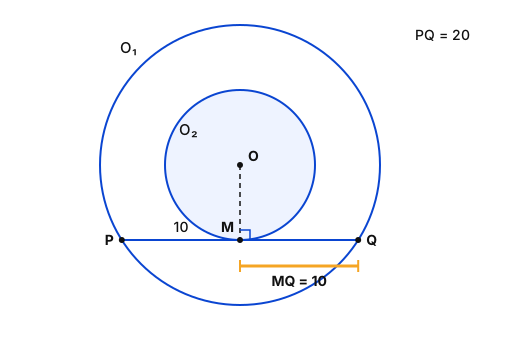
- (OM is radius of the small circle at the point of contact).
- For the big circle, OM is the perpendicular from centre to chord PQ → M is its midpoint.
- cm.
Trick: Point of contact = midpoint of the chord – always, in concentric circles.
Answer: (C) 10 cm
अवधारणा: त्रिज्या स्पर्श रेखा पर लंब होती है; केंद्र से जीवा पर लंब उसे समद्विभाजित करता है।
हल:
- (स्पर्श बिंदु पर छोटे वृत्त की त्रिज्या)।
- बड़े वृत्त में OM केंद्र से जीवा PQ पर लंब है → M मध्य-बिंदु।
- cm।
ट्रिक: संकेंद्रीय वृत्तों में स्पर्श बिंदु हमेशा जीवा का मध्य-बिंदु होता है।
उत्तर: (C) 10 cm
SSC CHSLQuantitative AptitudeConcentric circles – chord tangent to inner circleSSC CHSL 2025 · 20 Nov Shift 3
Q688.In a circle, there are two parallel chords of lengths 16 cm and 30 cm. Both chords are situated on the same side of the center. If the distance between them is 7 cm , find the area of the circle.
एक वृत्त में 16 cm और 30 cm लंबाई की दो समांतर जीवाएँ हैं। दोनों जीवाएँ केंद्र के एक ही ओर स्थित हैं। यदि उनके बीच की दूरी 7 cm है, तो वृत्त का क्षेत्रफल ज्ञात कीजिए।
- A square cm वर्ग cm
- B square cm वर्ग cm
- C square cm वर्ग cm
- D square cm वर्ग cm
Show answer
Concept: .
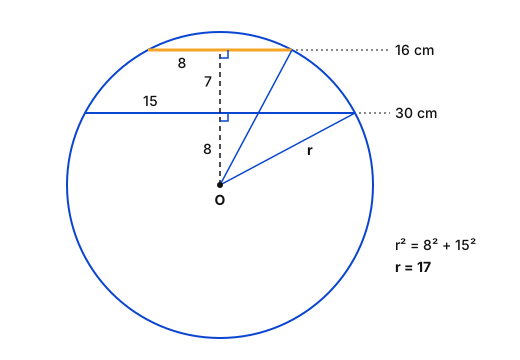
- Half chords: 15 and 8. Let distances be d (30 cm chord) and d + 7 (16 cm chord).
- .
- → area = .
Trick: 8–15–17 triplet: directly once .
Answer: (A) square cm
अवधारणा: ।
हल:
- आधी जीवाएँ: 15 और 8; दूरियाँ d (30 cm जीवा) और d + 7 (16 cm जीवा)।
- ।
- → क्षेत्रफल = ।
ट्रिक: 8–15–17 त्रिक: मिलते ही ।
उत्तर: (A) वर्ग cm
SSC CHSLQuantitative AptitudeCircle – parallel chords on same sideSSC CHSL 2025 · 20 Nov Shift 3
Q689.When the radius of a hemisphere is increased by 14 cm , its surface area increases by . Find the volume (in ) of the original hemisphere. (Take )
जब एक अर्धगोले की त्रिज्या 14 cm बढ़ा दी जाती है, तो उसका पृष्ठीय क्षेत्रफल बढ़ जाता है। मूल अर्धगोले का आयतन ( में) ज्ञात कीजिए। ( लीजिए)
- A
- B
- C
- D
Show answer
Concept: Total surface area of a solid hemisphere = ; volume = .
- .
- cm.
- Volume = .
Trick: Volume must be a multiple of 22 with ; check last digits: ends in 4 → 19404.
Answer: (C)
अवधारणा: ठोस अर्धगोले का कुल पृष्ठीय क्षेत्रफल = ; आयतन = ।
हल:
- ।
- cm।
- आयतन = ।
ट्रिक: से गणना छोटी हो जाती है: ।
उत्तर: (C)
SSC CHSLQuantitative AptitudeHemisphere – surface area and volumeSSC CHSL 2025 · 20 Nov Shift 3
Q690.A rope is cut into two pieces. The first piece is of the total length. The second piece is 10 meters long. What was the original length of the rope?
एक रस्सी को दो टुकड़ों में काटा जाता है। पहला टुकड़ा कुल लंबाई का है। दूसरा टुकड़ा 10 मीटर लंबा है। रस्सी की मूल लंबाई कितनी थी?
- A45 meters45 मीटर
- B25 meters25 मीटर
- C50 meters50 मीटर
- D35 meters35 मीटर
Show answer
Concept: Remaining fraction × total = known length.
- First piece = → second piece = of the rope.
- m.
Trick: 2 parts = 10 m → 1 part = 5 m → 7 parts = 35 m.
Answer: (D) 35 meters
अवधारणा: शेष भिन्न × कुल = ज्ञात लंबाई।
हल:
- पहला टुकड़ा = → दूसरा = ।
- m।
ट्रिक: 2 भाग = 10 m → 1 भाग = 5 m → 7 भाग = 35 m।
उत्तर: (D) 35 मीटर
SSC CHSLQuantitative AptitudeFractions – remaining partSSC CHSL 2025 · 20 Nov Shift 3
Q691.Triangle has an area of 13 . A similar triangle, , has a perimeter that is twice the perimeter of Triangle ABC. What is the area of Triangle ?
त्रिभुज का क्षेत्रफल 13 है। एक समरूप त्रिभुज का परिमाप, त्रिभुज ABC के परिमाप का दोगुना है। त्रिभुज का क्षेत्रफल क्या है?
- A
- B
- C
- D
Show answer
Concept: .
- Perimeter ratio = 2 : 1.
- Area ratio = 4 : 1.
- Area of A′B′C′ = .
Trick: Double the size → four times the area.
Answer: (C)
अवधारणा: ।
हल:
- परिमाप अनुपात = 2 : 1।
- क्षेत्रफल अनुपात = 4 : 1।
- A′B′C′ का क्षेत्रफल = ।
ट्रिक: आकार दोगुना → क्षेत्रफल चार गुना।
उत्तर: (C)
SSC CHSLQuantitative AptitudeSimilar triangles – area ratioSSC CHSL 2025 · 20 Nov Shift 3
Q692.In a circle with radius of 15 cm, a chord forms a central angle of . What is the length of the chord?
15 cm त्रिज्या वाले एक वृत्त में, एक जीवा केंद्र पर का कोण बनाती है। जीवा की लंबाई क्या है?
- A10 cm
- B15 cm
- C13 cm
- D16 cm
Show answer
Concept: .
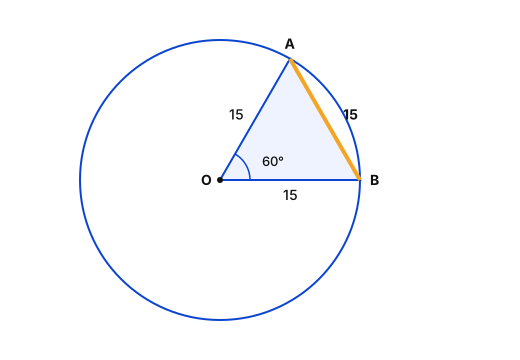
- cm.
- Also: and make triangle OAB equilateral.
Trick: 60° at the centre → , always.
Answer: (B) 15 cm
अवधारणा: ।
हल:
- cm।
- और → त्रिभुज OAB समबाहु।
ट्रिक: केंद्र पर 60° हो तो , हमेशा।
उत्तर: (B) 15 cm
SSC CHSLQuantitative AptitudeCircle – chord with 60° central angleSSC CHSL 2025 · 20 Nov Shift 3
Q693.In a circle with center O, points P, Q, and R are on the circumference. If the angle , what is the measure of the angle ?
केंद्र O वाले एक वृत्त में, बिंदु P, Q और R परिधि पर स्थित हैं। यदि कोण है, तो कोण का माप क्या है?
- A50°
- B55*
- C60°
- D45°
Show answer
Concept: Angle at centre = 2 × angle at the circumference on the same arc.
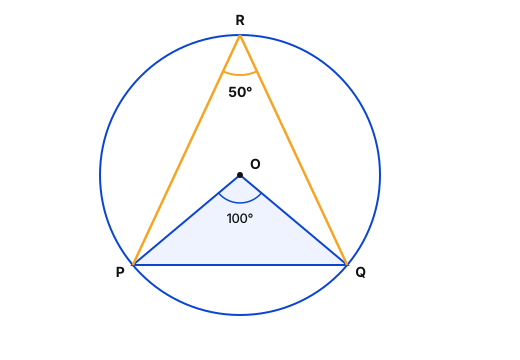
- .
Trick: Halve the central angle (R on the major arc).
Answer: (A) 50°
अवधारणा: एक ही चाप पर केंद्र का कोण = परिधि के कोण का दोगुना।
हल:
- ।
ट्रिक: केंद्रीय कोण का आधा लें (R दीर्घ चाप पर)।
उत्तर: (A) 50°
SSC CHSLQuantitative AptitudeCircle – angle at centre vs circumferenceSSC CHSL 2025 · 20 Nov Shift 3
Q694.If two circles touch each other internally, what is the number of internal common tangents that can be drawn ?
यदि दो वृत्त एक-दूसरे को आंतरिक रूप से स्पर्श करते हैं, तो कितनी आंतरिक उभयनिष्ठ स्पर्श रेखाएँ खींची जा सकती हैं?
- A3
- B4
- C1
- D0
Show answer
Concept: Internal (transverse) tangents need a gap between the circles.
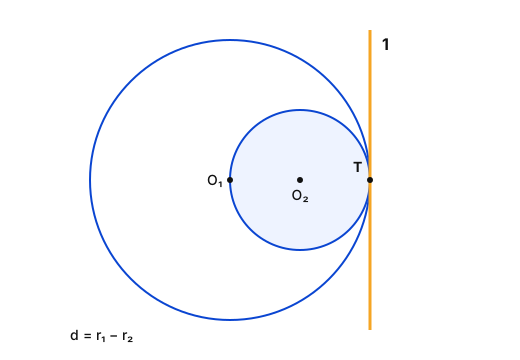
- Internally touching → small circle lies inside the bigger one.
- No line can pass between them → 0 internal tangents.
- Only 1 common tangent exists in total (at the contact point).
Trick: Common tangents: separate 4, touch externally 3, intersect 2, touch internally 1, one inside other 0.
Answer: (D) 0
अवधारणा: आंतरिक (अनुप्रस्थ) स्पर्श रेखा के लिए वृत्तों के बीच जगह चाहिए।
हल:
- अंतःस्पर्श → छोटा वृत्त बड़े के अंदर।
- बीच से कोई रेखा नहीं गुजर सकती → 0 आंतरिक स्पर्श रेखाएँ।
- कुल केवल 1 उभयनिष्ठ स्पर्श रेखा (स्पर्श बिंदु पर)।
ट्रिक: उभयनिष्ठ स्पर्श रेखाएँ: अलग 4, बाह्यस्पर्श 3, प्रतिच्छेद 2, अंतःस्पर्श 1, एक-दूसरे के अंदर 0।
उत्तर: (D) 0
SSC CHSLQuantitative AptitudeCommon tangents – internal touchingSSC CHSL 2025 · 20 Nov Shift 3
Q695.How many common tangents do two circles have when the distance between their centers equals the sum of their radii ?
जब दो वृत्तों के केंद्रों के बीच की दूरी उनकी त्रिज्याओं के योग के बराबर होती है, तो उनकी कितनी उभयनिष्ठ स्पर्श रेखाएँ होती हैं?
- A4
- B1
- C5
- D3
Show answer
Concept: d = r₁ + r₂ means the circles touch externally.
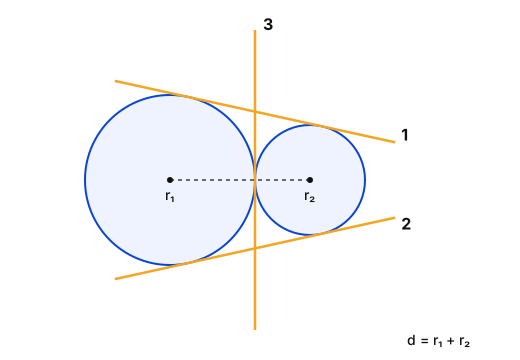
- 2 direct (external) common tangents.
- 1 transverse tangent at the point of contact.
- Total = 3.
Trick: 4 → 3 → 2 → 1 → 0 as the circles move from separate to one inside the other.
Answer: (D) 3
अवधारणा: d = r₁ + r₂ का अर्थ है वृत्त बाहर से स्पर्श करते हैं।
हल:
- 2 सीधी (बाह्य) उभयनिष्ठ स्पर्श रेखाएँ।
- स्पर्श बिंदु पर 1 अनुप्रस्थ स्पर्श रेखा।
- कुल = 3।
ट्रिक: वृत्त अलग से अंदर की ओर जाएँ तो संख्या 4 → 3 → 2 → 1 → 0।
उत्तर: (D) 3
SSC CHSLQuantitative AptitudeCommon tangents – external touchingSSC CHSL 2025 · 20 Nov Shift 3
Q696.Two circles with radii of 3 cm and 5 cm have a distance of 17 cm between their centers. What is the length of the common internal tangent between the two circles?
3 cm और 5 cm त्रिज्या वाले दो वृत्तों के केंद्रों के बीच की दूरी 17 cm है। दोनों वृत्तों की उभयनिष्ठ आंतरिक स्पर्श रेखा की लंबाई क्या है?
- A12cm
- B16 cm
- C15 cm
- D13 cm
Show answer
Concept: Internal tangent = .
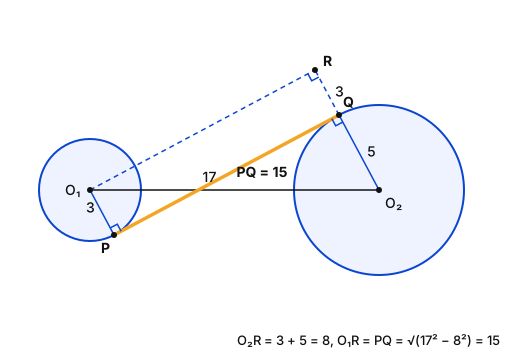
- , .
- cm.
Trick: 8–15–17 is a Pythagorean triplet – answer at sight.
Answer: (C) 15 cm
अवधारणा: आंतरिक स्पर्श रेखा = ।
हल:
- , ।
- cm।
ट्रिक: 8–15–17 पाइथागोरस त्रिक है – उत्तर तुरंत।
उत्तर: (C) 15 cm
SSC CHSLQuantitative AptitudeLength of internal common tangentSSC CHSL 2025 · 20 Nov Shift 3
Q697.Two circles have radii 10 cm and 8 cm . The distance between their centers is 20 cm . What is the length of their common internal tangent segment?
दो वृत्तों की त्रिज्याएँ 10 cm और 8 cm हैं। उनके केंद्रों के बीच की दूरी 20 cm है। उनकी उभयनिष्ठ आंतरिक स्पर्श रेखा खंड की लंबाई क्या है?
- A
- B
- C19 cm
- D
Show answer
Concept: Internal tangent = .
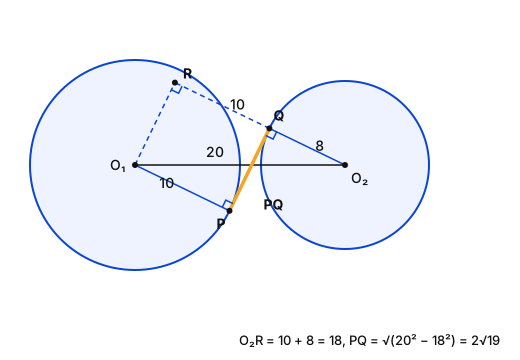
- , .
- cm.
Trick: – quicker than squaring.
Answer: (A)
अवधारणा: आंतरिक स्पर्श रेखा = ।
हल:
- , ।
- cm।
ट्रिक: – वर्ग करने से तेज़।
उत्तर: (A)
SSC CHSLQuantitative AptitudeLength of internal common tangentSSC CHSL 2025 · 20 Nov Shift 3
Q698.The lengths of a common external tangent and a common internal tangent to two circles are 12 cm and 5 cm , respectively. If the distance between the centers of the circles is 13 cm , find the radii of the two circles.
दो वृत्तों की एक उभयनिष्ठ बाह्य स्पर्श रेखा और एक उभयनिष्ठ आंतरिक स्पर्श रेखा की लंबाइयाँ क्रमशः 12 cm और 5 cm हैं। यदि वृत्तों के केंद्रों के बीच की दूरी 13 cm है, तो दोनों वृत्तों की त्रिज्याएँ ज्ञात कीजिए।
- A5.5 cm and 3.5 cm5.5 cm और 3.5 cm
- B7.5 cm and 1.5 cm7.5 cm और 1.5 cm
- C8 cm and 4 cm8 cm और 4 cm
- D8.5 cm and 3.5 cm8.5 cm और 3.5 cm
Show answer
Concept: , .
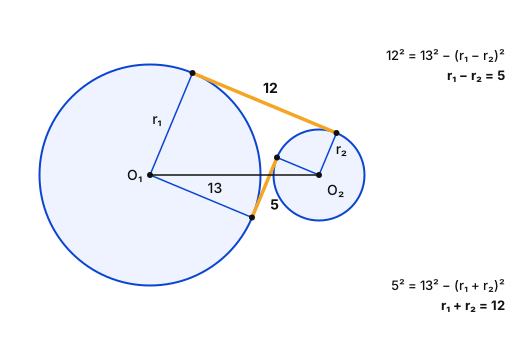
- .
- .
- cm, cm.
Trick: Check options: need sum 12 and difference 5 → only 8.5 and 3.5.
Answer: (D) 8.5 cm and 3.5 cm
अवधारणा: , ।
हल:
- ।
- ।
- cm, cm।
ट्रिक: विकल्प जाँचें: योग 12 और अंतर 5 – केवल 8.5 और 3.5।
उत्तर: (D) 8.5 cm और 3.5 cm
SSC CHSLQuantitative AptitudeRadii from external and internal tangentsSSC CHSL 2025 · 20 Nov Shift 3
Q699.A person walks at 7 km/h. If he increases his speed to , he takes 36 minutes less to cover a distance. What is the distance?
एक व्यक्ति 7 km/h की चाल से चलता है। यदि वह अपनी चाल बढ़ाकर कर देता है, तो एक निश्चित दूरी तय करने में उसे 36 मिनट कम लगते हैं। वह दूरी कितनी है?
- A2.0 km
- B2.4 km
- C14 km
- D3.5 km
Show answer
Concept: .
- .
- km.
Trick: km.
Answer: (C) 14 km
अवधारणा: ।
- ।
- km।
ट्रिक: km।
उत्तर: (C) 14 km
SSC CHSLQuantitative AptitudeSpeed–time – time savedSSC CHSL 2025 · 20 Nov Shift 3
Q700.A 5 : 3 mixture of juice and soda is contained in a vessel. The ratio of juice to soda becomes when 8 litres of the mixture is removed and the same volume of soda is added to the vessel.How much juice was there in the vessel at the beginning ?
एक बर्तन में जूस और सोडा का 5 : 3 का मिश्रण है। जब 8 लीटर मिश्रण निकाल लिया जाता है और उतनी ही मात्रा में सोडा बर्तन में मिला दिया जाता है, तो जूस और सोडा का अनुपात हो जाता है। आरंभ में बर्तन में कितना जूस था?
- A12 litres12 लीटर
- B15 litres15 लीटर
- C18 litres18 लीटर
- D20 litres20 लीटर
Show answer
Concept: Removed mixture takes juice and soda in the original ratio.
- Juice 5x, soda 3x. 8 L removed = 5 L juice + 3 L soda.
- After adding 8 L soda: (5x − 5) : (3x + 5) = 5 : 7.
- 35x − 35 = 15x + 25 → x = 3 → juice = 15 L.
Trick: Test options: juice 15 → x = 3, total 24; after step juice 10, soda 14 → 5 : 7 ✓.
Answer: (B) 15 litres
अवधारणा: निकाला गया मिश्रण मूल अनुपात में जूस और सोडा ले जाता है।
हल:
- जूस 5x, सोडा 3x; 8 L निकालने पर 5 L जूस + 3 L सोडा गया।
- 8 L सोडा मिलाने पर: (5x − 5) : (3x + 5) = 5 : 7।
- 35x − 35 = 15x + 25 → x = 3 → जूस = 15 L।
ट्रिक: विकल्प जाँचें: जूस 15 → x = 3; बाद में जूस 10, सोडा 14 → 5 : 7 ✓।
उत्तर: (B) 15 लीटर
SSC CHSLQuantitative AptitudeMixture – removal and replacementSSC CHSL 2025 · 20 Nov Shift 3

