Q741.If a sum Triple itself in 10 years under simple interest, what is the annual rate of interest?
यदि कोई धनराशि साधारण ब्याज पर 10 वर्षों में स्वयं की तिगुनी हो जाती है, तो ब्याज की वार्षिक दर क्या है?
- A18%
- B25%
- C20%
- D22%
Show answer
Concept: .
- Triple →
Trick: .
Answer: (C) 20%
अवधारणा: ।
- तिगुना →
ट्रिक: ।
उत्तर: (C) 20%
SSC CHSLQuantitative AptitudeSimple interest – rate when sum triplesSSC CHSL 2025 · 20 Nov Shift 1
Q742.A rice seller mixes two types of rice, one costing ₹170 per kilogram and the other ₹210 per kilogram. He sells this mixture at ₹225 per kilogram and earns a profit on the total cost. In what ratio (by weight) must the two types of rice be mixed to achieve the desired selling price and profit?
एक चावल विक्रेता दो प्रकार के चावल मिलाता है, जिनमें एक का मूल्य ₹170 प्रति किलोग्राम और दूसरे का ₹210 प्रति किलोग्राम है। वह इस मिश्रण को ₹225 प्रति किलोग्राम की दर से बेचता है और कुल लागत पर का लाभ अर्जित करता है। अभीष्ट विक्रय मूल्य तथा लाभ प्राप्त करने के लिए दोनों प्रकार के चावल को किस अनुपात में (भार के अनुसार) मिलाया जाना चाहिए?
- A4 : 3
- B3 : 7
- C5 : 2
- D3 : 1
Show answer
Concept: First get the cost price of the mixture, then use alligation.
- CP of mixture = ₹180/kg
- Gap from ₹210 = 30; gap from ₹170 = 10
- Quantity of ₹170 rice : ₹210 rice = 30 : 10 = 3 : 1
Trick: 180 is much closer to 170 → more of the cheap rice; only 3 : 1 fits.
Answer: (D) 3 : 1
अवधारणा: पहले मिश्रण का क्रय मूल्य निकालें, फिर alligation लगाएँ।
- मिश्रण का CP = ₹180/kg
- ₹210 से अंतर = 30; ₹170 से अंतर = 10
- ₹170 वाला : ₹210 वाला = 30 : 10 = 3 : 1
ट्रिक: 180, 170 के बहुत पास है → सस्ता चावल ज़्यादा; केवल 3 : 1 बैठता है।
उत्तर: (D) 3 : 1
SSC CHSLQuantitative AptitudeAlligation – mixture with profitSSC CHSL 2025 · 20 Nov Shift 1
Q743.A vessel contains a mixture of milk and water in the ratio liters of mixture is taken out from the vessel and pure water is added. Now the ratio of milk and water has become 5 : 4. What was the quantity of milk initially in the vessel?
एक बर्तन में दूध और पानी का मिश्रण लीटर मिश्रण बर्तन में से निकाल लिया जाता है और उसमें उतना ही शुद्ध पानी मिला दिया जाता है। अब दूध और पानी का अनुपात 5 : 4 हो जाता है। आरंभ में बर्तन में दूध की मात्रा कितनी थी?
- A42 litres42 लीटर
- B38 litres38 लीटर
- C45 litres45 लीटर
- D41 litres41 लीटर
Show answer
Concept: Removing mixture keeps the ratio; adding water changes only water.
- Let milk = 5k, water = 3k. 8 L removed = 5 L milk + 3 L water.
- Now milk = , water =
- Initial milk = L
Trick: Check option: 45 milk, 27 water → after: 40 : 32 = 5 : 4 ✓
Answer: (C) 45 litres
अवधारणा: मिश्रण निकालने पर अनुपात वही रहता है; पानी मिलाने से केवल पानी बदलता है।
- दूध = 5k, पानी = 3k; 8 L निकाला = 5 L दूध + 3 L पानी।
- अब दूध = , पानी =
- प्रारंभिक दूध = 45 L
ट्रिक: विकल्प जाँचें: 45 : 27 → 40 : 32 = 5 : 4 ✓
उत्तर: (C) 45 लीटर
SSC CHSLQuantitative AptitudeMixture – replacement with waterSSC CHSL 2025 · 20 Nov Shift 1
Q744.In a circle with a radius of 13 cm, a chord with a length of 10 cm is drawn. What is the minimum distance from this chord to another parallel chord of length 24 cm?
13 cm त्रिज्या वाले एक वृत्त में 10 cm लंबाई की एक जीवा खींची गई है। इस जीवा से 24 cm लंबाई वाली एक अन्य समांतर जीवा की न्यूनतम दूरी कितनी है?
- A11 cm
- B9 cm
- C7 cm
- D6 cm
Show answer
Concept: Distance of chord from centre = .
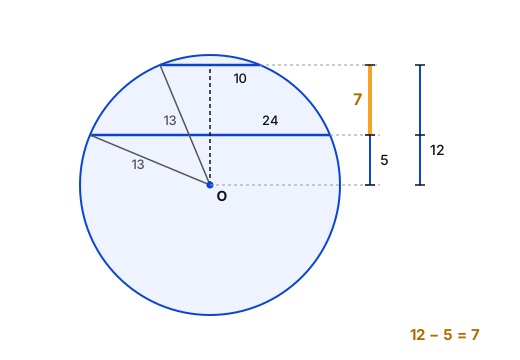
- 10 cm chord: cm
- 24 cm chord: cm
- Same side → cm (minimum); opposite → 17 cm
Trick: Triplets 5-12-13 give both distances instantly.
Answer: (C) 7 cm
अवधारणा: केंद्र से जीवा की दूरी = ।
- 10 cm जीवा: cm
- 24 cm जीवा: cm
- एक ही ओर → cm (न्यूनतम); विपरीत ओर → 17 cm
ट्रिक: 5-12-13 त्रिक से दोनों दूरियाँ तुरंत।
उत्तर: (C) 7 cm
SSC CHSLQuantitative AptitudeCircle – distance between parallel chordsSSC CHSL 2025 · 20 Nov Shift 1
Q745.A trapezoid is circumscribed around a circle. The lengths of the non-parallel sides are given as 9 cm and 11 cm . Determine the perimeter of the trapezoid.
एक समलंब चतुर्भुज एक वृत्त के परिगत खींचा गया है। उसकी असमांतर भुजाओं की लंबाइयाँ 9 cm तथा 11 cm दी गई हैं। समलंब का परिमाप ज्ञात कीजिए।
- A44 cm
- B48 cm
- C40 cm
- D46 cm
Show answer
Concept: For a quadrilateral around a circle, sums of opposite sides are equal (equal tangents).
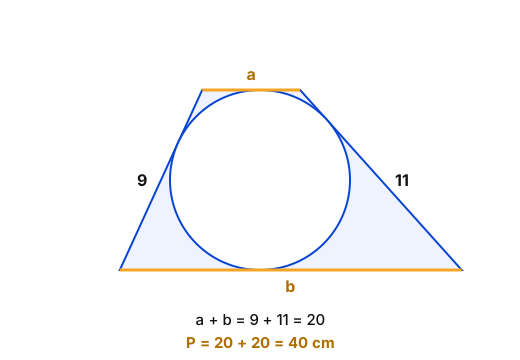
- Sum of parallel sides = sum of non-parallel sides = 9 + 11 = 20 cm
- Perimeter = 20 + 20 = 40 cm
Trick: Perimeter = 2 × (sum of any pair of opposite sides).
Answer: (C) 40 cm
अवधारणा: वृत्त के बाहर बने चतुर्भुज में आमने-सामने की भुजाओं का योग बराबर होता है।
- समांतर भुजाओं का योग = असमांतर भुजाओं का योग = 20 cm
- परिमाप = 20 + 20 = 40 cm
ट्रिक: परिमाप = 2 × (सम्मुख भुजाओं के किसी एक जोड़े का योग)।
उत्तर: (C) 40 cm
SSC CHSLQuantitative AptitudeTangential quadrilateral – perimeterSSC CHSL 2025 · 20 Nov Shift 1
Q746.The equation of a line is . What is the slope of the line?
एक रेखा का समीकरण है। इस रेखा की प्रवणता (ढाल) क्या है?
- A
- B
- C
- D
Show answer
Concept: For , slope = .
Trick: Or rewrite as ; coefficient of x is the slope.
Answer: (C)
अवधारणा: के लिए slope = ।
ट्रिक: लिखें; x का गुणांक ही slope है।
उत्तर: (C)
SSC CHSLQuantitative AptitudeCoordinate geometry – slopeSSC CHSL 2025 · 20 Nov Shift 1
Q747.Two similar triangles, Triangle M and Triangle N, have perimeters of 48 cm and 60 cm , respectively. If the area of Triangle M is , what is the area of Triangle N?
दो समरूप त्रिभुजों, त्रिभुज M और त्रिभुज N, के परिमाप क्रमशः 48 cm तथा 60 cm हैं। यदि त्रिभुज M का क्षेत्रफल है, तो त्रिभुज N का क्षेत्रफल क्या है?
- A
- B
- C
- D
Show answer
Concept: .
- Perimeter ratio = 48 : 60 = 4 : 5
- Area ratio = 16 : 25
- Area of N =
Trick: , then .
Answer: (C)
अवधारणा: ।
- परिमाप अनुपात = 4 : 5
- क्षेत्रफल अनुपात = 16 : 25
- N का क्षेत्रफल =
ट्रिक: , फिर ।
उत्तर: (C)
SSC CHSLQuantitative AptitudeSimilar triangles – area from perimeterSSC CHSL 2025 · 20 Nov Shift 1
Q748.Triangle is similar to Triangle DEF. If the area of Triangle ABC is 9 times the area of Triangle DEF, what is the ratio of their perimeters?
त्रिभुज त्रिभुज DEF के समरूप है। यदि त्रिभुज ABC का क्षेत्रफल त्रिभुज DEF के क्षेत्रफल का 9 गुना है, तो उनके परिमापों का अनुपात क्या है?
- A4 : 5
- B7 : 9
- C3 : 1
- D5 : 7
Show answer
Concept: .
- Area ratio = 9 : 1
- Perimeter ratio =
Trick: Sides, perimeters, heights, medians – all follow the same ratio = .
Answer: (C) 3 : 1
अवधारणा: ।
- क्षेत्रफल अनुपात = 9 : 1
- परिमाप अनुपात = 3 : 1
ट्रिक: भुजा, परिमाप, ऊँचाई, माध्यिका – सबका अनुपात ।
उत्तर: (C) 3 : 1
SSC CHSLQuantitative AptitudeSimilar triangles – perimeter from areaSSC CHSL 2025 · 20 Nov Shift 1
Q749.If two circles touch externally, how many common tangents can be drawn between them?
यदि दो वृत्त एक-दूसरे को बाह्य रूप से स्पर्श करते हैं, तो उनके बीच कितनी उभयनिष्ठ स्पर्श रेखाएँ खींची जा सकती हैं?
- A2
- B3
- C4
- D5
Show answer
Concept: Number of common tangents depends on circle positions.
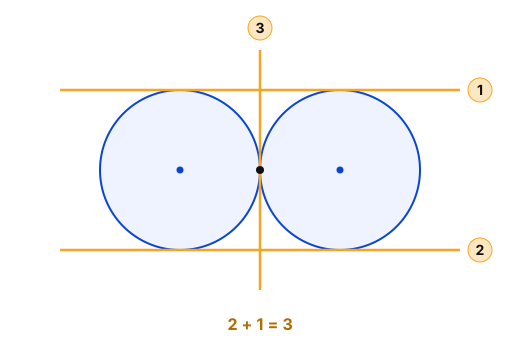
- Touching externally: 2 direct tangents + 1 at the contact point = 3.
Trick: Separate 4, touch outside 3, intersect 2, touch inside 1, one inside other 0 – count falls by one at each step.
Answer: (B) 3
अवधारणा: उभयनिष्ठ स्पर्श रेखाओं की संख्या वृत्तों की स्थिति पर निर्भर है।
- बाहर से स्पर्श: 2 सीधी + 1 स्पर्श बिंदु पर = 3।
ट्रिक: अलग 4, बाहरी स्पर्श 3, प्रतिच्छेद 2, आंतरिक स्पर्श 1, अंदर 0 – हर चरण में एक कम।
उत्तर: (B) 3
SSC CHSLQuantitative AptitudeCircles – common tangentsSSC CHSL 2025 · 20 Nov Shift 1
Q750.A car was sold for rs at a profit. For what price should the car be sold to gain a profit ?
एक कार rs में लाभ पर बेची गई। लाभ प्राप्त करने के लिए कार को किस मूल्य पर बेचा जाना चाहिए?
- A3,91,000
- B3,96,000
- C
- D3,90,000
Show answer
Concept: CP stays fixed; scale SP by .
- ₹3,00,000
- New SP = ₹3,90,000
Trick: Direct: .
Answer: (D) 3,90,000
अवधारणा: CP वही रहता है; SP को से गुणा करें।
- ₹3,00,000
- नया SP = ₹3,90,000
ट्रिक: सीधे: ।
उत्तर: (D) 3,90,000
SSC CHSLQuantitative AptitudeProfit – new SP for new profit %SSC CHSL 2025 · 20 Nov Shift 1
Q751. is the incentre of triangle . If angle , find angle ABC .
, त्रिभुज का अंतःकेंद्र है। यदि कोण है, तो कोण ABC ज्ञात कीजिए।
- A70°
- B140°
- C130°
- D150°
Show answer
Concept: At the incentre O: .
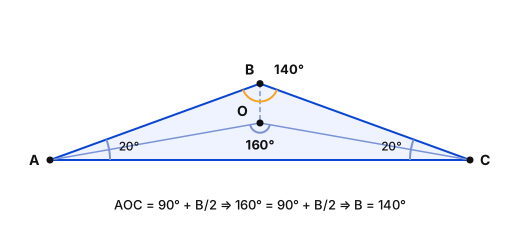
- .
- 140°.
- Check: , so ✔.
Trick: Quick: .
Answer: (B) 140°
अवधारणा: अंतःकेंद्र O पर: ।
हल:
- ।
- 140°।
- जाँच: , तो ✔।
ट्रिक: सीधा: ।
उत्तर: (B) 140°
SSC CHSLQuantitative AptitudeIncentre – angle at incentreSSC CHSL 2025 · 19 Nov Shift 3
Q752.The length and breadth of a rectangle are in the ratio 22 : 7, respectively, and the perimeter of the rectangle is 174 cm . If the area of the rectangle is equal to the area of the top surface of a solid cylinder, then find the curved surface area of the cylinder given that its radius is 84% of its height.
एक आयत की लंबाई और चौड़ाई क्रमशः 22 : 7 के अनुपात में हैं तथा आयत का परिमाप 174 cm है। यदि आयत का क्षेत्रफल एक ठोस बेलन के ऊपरी पृष्ठ के क्षेत्रफल के बराबर है, तो बेलन का वक्र पृष्ठीय क्षेत्रफल ज्ञात कीजिए, जबकि उसकी त्रिज्या उसकी ऊँचाई का 84% है।
- A
- B
- C
- D
Show answer
Concept: Top of a cylinder is a circle (); .
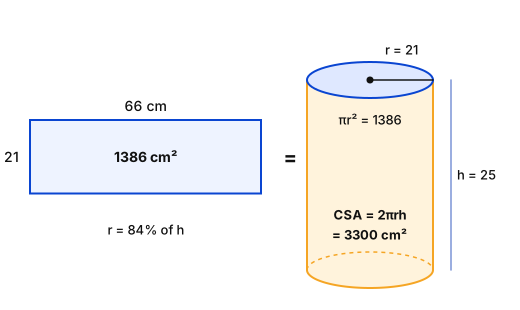
- Sides 22k, 7k: → 66 cm × 21 cm, area = 1386 cm².
- cm.
- r = 84% of h → cm.
- 3300 cm².
Trick: is a standard value worth remembering (also area of circle of radius 21).
Answer: (D)
अवधारणा: बेलन का ऊपरी तल वृत्त है (); ।
हल:
- भुजाएँ 22k, 7k: → 66 × 21, क्षेत्रफल = 1386 cm²।
- cm।
- r = h का 84% → cm।
- 3300 cm²।
ट्रिक: 21 त्रिज्या वाले वृत्त का क्षेत्रफल 1386 – यह मान याद रखें।
उत्तर: (D)
SSC CHSLQuantitative AptitudeMensuration – rectangle to cylinder CSASSC CHSL 2025 · 19 Nov Shift 3
Q753.A rhombus has diagonals in the ratio 5 : 12. If the side length is 13 cm, find the exact lengths of the diagonals and hence the area of the rhombus.
एक समचतुर्भुज के विकर्ण 5 : 12 के अनुपात में हैं। यदि उसकी भुजा की लंबाई 13 cm है, तो विकर्णों की सटीक लंबाइयाँ तथा उससे समचतुर्भुज का क्षेत्रफल ज्ञात कीजिए।
- A16 cm and 16 cm और
- B10 cm and 10 cm और
- C14 cm and 14 cm और
- D10 cm and 10 cm और
Show answer
Concept: Diagonals of a rhombus bisect at 90°: .
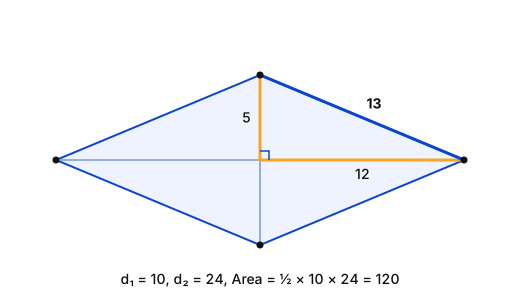
- Take , (ratio 5 : 12), halves 5k and 12k.
- .
- Diagonals = 10 cm and 24 cm; area = 120 cm².
Trick: 5-12-13 is a Pythagorean triplet: side 13 → half-diagonals 5 and 12 directly.
Answer: (B) 10 cm and
अवधारणा: समचतुर्भुज के विकर्ण एक-दूसरे को समकोण पर समद्विभाजित करते हैं: ।
हल:
- , लें, आधे 5k और 12k।
- ।
- विकर्ण 10 cm और 24 cm; क्षेत्रफल = 120 cm²।
ट्रिक: 5-12-13 त्रिक: भुजा 13 हो तो आधे विकर्ण 5 और 12 तुरंत।
उत्तर: (B) 10 cm और
SSC CHSLQuantitative AptitudeRhombus – diagonals from sideSSC CHSL 2025 · 19 Nov Shift 3
Q754.A and B invested Rs. 80,000 and Rs. , respectively. At the end of 8 months, the total profit is Rs. 60,000 . What is B's share in the profit?
A और B ने क्रमशः Rs. 80,000 तथा Rs. निवेश किए। 8 महीने के अंत में कुल लाभ Rs. 60,000 है। लाभ में B का हिस्सा क्या है?
- ARs. 26,000
- BRs. 28,000
- CRs. 30,000
- DRs. 36,000
Show answer
Concept: Same time for both → profit shared in the ratio of capitals.
- 80,000 : 1,20,000 = 2 : 3.
- B's share = ₹36,000.
Trick: B has the bigger capital, so B's share must exceed half (₹30,000) – only ₹36,000 qualifies.
Answer: (D) Rs. 36,000
अवधारणा: दोनों का समय बराबर हो तो लाभ पूँजी के अनुपात में बँटता है।
हल:
- 80,000 : 1,20,000 = 2 : 3।
- B का हिस्सा = ₹36,000।
ट्रिक: B की पूँजी ज़्यादा है, तो उसका हिस्सा आधे (₹30,000) से अधिक होगा – केवल ₹36,000।
उत्तर: (D) Rs. 36,000
SSC CHSLQuantitative AptitudePartnership – equal timeSSC CHSL 2025 · 19 Nov Shift 3
Q755.The average score of 40 students is 42 . When a group of 16 new students joins, the average rises to 50 . Find the average score of the new students.
40 विद्यार्थियों का औसत प्राप्तांक 42 है। जब 16 नए विद्यार्थियों का एक समूह जुड़ता है, तो औसत बढ़कर 50 हो जाता है। नए विद्यार्थियों का औसत प्राप्तांक ज्ञात कीजिए।
- A70
- B66
- C68
- D74
Show answer
Concept: ; difference of totals gives the new group's total.
- Old total = .
- New total = .
- New students' total = 1120 → average = 70.
Trick: Deviation method: each of the 40 old students gains 8 → 320 extra; new average = .
Answer: (A) 70
अवधारणा: ; कुल का अंतर नए समूह का योग देता है।
हल:
- पुराना योग = ।
- नया योग = ।
- नए छात्रों का योग = 1120 → औसत = 70।
ट्रिक: विचलन विधि: 40 छात्रों को 8-8 की कमी पूरी करनी → 320; नया औसत = ।
उत्तर: (A) 70
SSC CHSLQuantitative AptitudeAverage – new group joinsSSC CHSL 2025 · 19 Nov Shift 3
Q756.The average monthly salary of employees in a company is ₹ 60,000 . When 6 new employees with average salary ₹45,000 join, the average salary of the whole company decreases by ₹6,000. Find the original number of employees.
एक कंपनी के कर्मचारियों का औसत मासिक वेतन ₹ 60,000 है। जब ₹45,000 औसत वेतन वाले 6 नए कर्मचारी जुड़ते हैं, तो पूरी कंपनी का औसत वेतन ₹6,000 घट जाता है। कर्मचारियों की मूल संख्या ज्ञात कीजिए।
- A10
- B16
- C15
- D9
Show answer
Concept: Compare totals before and after joining.
- New average = .
- .
- 9.
Trick: Deviation: each old employee loses 6,000 (); each newcomer is 9,000 below the new average () → n = 9.
Answer: (D) 9
अवधारणा: जुड़ने से पहले और बाद का कुल वेतन बराबर करें।
हल:
- नया औसत = ।
- ।
- 9।
ट्रिक: विचलन: पुराने हर कर्मचारी की 6,000 कमी = नए 6 लोगों की 9,000 कमी × 6 → ।
उत्तर: (D) 9
SSC CHSLQuantitative AptitudeAverage – original countSSC CHSL 2025 · 19 Nov Shift 3
Q757.A cyclist covers a total distance of 54 km . After cycling for 3 hours and 30 minutes, he finds that the distance he has covered is of the remaining distance. What is his speed in ?
एक साइकिल चालक कुल 54 km की दूरी तय करता है। 3 घंटे 30 मिनट साइकिल चलाने के बाद वह पाता है कि उसके द्वारा तय की गई दूरी, शेष दूरी की है। उसकी चाल में क्या है?
- A
- B6.42 km/hr
- C
- D7.5 km/hr
Show answer
Concept: Covered : remaining = 5 : 7 → split the total in 12 parts.
- 1 part = km → covered = 22.5 km.
- Time = 3 h 30 min = 3.5 h.
- Speed = 6.43 km/h (listed as 6.42).
Trick: Covered = of total directly: .
Answer: (B) 6.42 km/hr
अवधारणा: तय दूरी : शेष = 5 : 7 → कुल को 12 भागों में बाँटें।
हल:
- 1 भाग = km → तय दूरी = 22.5 km।
- समय = 3.5 घंटे।
- चाल = 6.43 km/h (विकल्प में 6.42)।
ट्रिक: तय दूरी = कुल का km।
उत्तर: (B) 6.42 km/hr
SSC CHSLQuantitative AptitudeSpeed – fraction of remaining distanceSSC CHSL 2025 · 19 Nov Shift 3
Q758.A train is on a 140 km journey. After travelling for 3 hours and 20 minutes, the distance it has covered is of the remaining distance. What is the speed of the train in ?
एक ट्रेन 140 km की यात्रा पर है। 3 घंटे 20 मिनट चलने के बाद उसके द्वारा तय की गई दूरी, शेष दूरी की है। ट्रेन की चाल में क्या है?
- A
- B4.50 m/s
- C
- D
Show answer
Concept: Find distance covered, then speed, then convert using .
- Covered : remaining = 5 : 9 → covered = km.
- Time = 3 h 20 min = h → speed = km/h.
- 4.16 m/s.
Trick: km/h → m/s: ; m/s → km/h: .
Answer: (C)
अवधारणा: तय दूरी, फिर चाल, फिर से m/s में बदलें।
हल:
- तय : शेष = 5 : 9 → तय दूरी = km।
- समय = घंटे → चाल = 15 km/h।
- 4.16 m/s।
ट्रिक: km/h → m/s के लिए ।
उत्तर: (C)
SSC CHSLQuantitative AptitudeSpeed – km/h to m/sSSC CHSL 2025 · 19 Nov Shift 3
Q759.A and B together can complete a task in 30 days. If A alone can complete the task in 50 days, how long will B take to complete the task alone?
A और B मिलकर एक कार्य को 30 दिनों में पूरा कर सकते हैं। यदि A अकेला उस कार्य को 50 दिनों में पूरा कर सकता है, तो B अकेला उस कार्य को पूरा करने में कितना समय लेगा?
- A41 days41 दिन
- B75 days75 दिन
- C80 days80 दिन
- D100 days100 दिन
Show answer
Concept: Use efficiency: work = LCM of the given days.
- Work = LCM(30, 50) = 150 units.
- (A + B) = 5 units/day, A = 3 units/day → B = 2 units/day.
- B alone = 75 days.
Trick: Formula: .
Answer: (B) 75 days
अवधारणा: दक्षता विधि: कुल कार्य = दिनों का LCM।
हल:
- कार्य = LCM(30, 50) = 150 इकाई।
- A + B = 5/दिन, A = 3/दिन → B = 2/दिन।
- B अकेला = 75 दिन।
ट्रिक: सूत्र: ।
उत्तर: (B) 75 दिन
SSC CHSLQuantitative AptitudeTime and work – one person's timeSSC CHSL 2025 · 19 Nov Shift 3
Q760.A shopkeeper offers successive discounts of 25% and 20% on a bag and sells it for ₹1200. What was the original marked price of the bag?
एक दुकानदार एक बैग पर 25% और 20% की क्रमिक छूट देता है तथा उसे ₹1200 में बेचता है। बैग का मूल अंकित मूल्य क्या था?
- A₹2,000
- B₹1,500
- C₹1,406
- D₹1,800
Show answer
Concept: .
- .
- → MP = ₹2,000.
Trick: Net discount of 25% and 20% = → 60% of MP = 1200 → MP = 2000.
Answer: (A) ₹2,000
अवधारणा: ।
हल:
- ।
- → MP = ₹2,000।
ट्रिक: 25% और 20% की कुल छूट = → MP का 60% = 1200 → 2000।
उत्तर: (A) ₹2,000
SSC CHSLQuantitative AptitudeSuccessive discounts – marked priceSSC CHSL 2025 · 19 Nov Shift 3

