Q61.Select the correct options from the given alternatives 3151, 3192, 3233, 3274 ?
दिए गए विकल्पों में से सही विकल्प चुनिए। 3151, 3192, 3233, 3274 ?
- A3313
- B3315
- C3316
- D3317
Show answer
Concept: Equal gaps → arithmetic progression.
- 3192 − 3151 = 41, 3233 − 3192 = 41, 3274 − 3233 = 41.
- Next = 3274 + 41 = 3315.
Trick: Last digits 1, 2, 3, 4 rise by 1 → next ends in 5; only 3315 fits.
Answer: (B) 3315
अवधारणा: बराबर अंतर → समांतर श्रेणी।
- 3192 − 3151 = 41, 3233 − 3192 = 41, 3274 − 3233 = 41।
- अगला = 3274 + 41 = 3315।
ट्रिक: अंतिम अंक 1, 2, 3, 4 → अगला 5 पर खत्म; केवल 3315।
उत्तर: (B) 3315
SSC CHSLGeneral IntelligenceNumber series – constant differenceSSC CHSL 2025 · 30 Nov Shift 1
Q62.Pick the correct options from below.
26, 217, 50, 513, ?
नीचे दिए गए विकल्पों में से सही विकल्प चुनिए।
26, 217, 50, 513, ?
- A729
- B82
- C101
- D125
Show answer
Concept: Big jumps up and down → read odd and even positions separately.
- , , , .
- Base runs 5, 6, 7, 8, 9; odd places are squared, even places cubed.
- 5th term = 82.
Trick: Subtract 1 from every term: 25, 216, 49, 512 – familiar squares/cubes jump out at once.
Answer: (B) 82
अवधारणा: पद ऊपर-नीचे कूदें तो विषम और सम स्थानों को अलग पढ़ें।
- , , , ।
- आधार 5, 6, 7, 8, 9; विषम स्थान पर वर्ग, सम स्थान पर घन।
- 5वाँ पद = 82।
ट्रिक: हर पद से 1 घटाएँ: 25, 216, 49, 512 – वर्ग/घन तुरंत दिख जाते हैं।
उत्तर: (B) 82
SSC CHSLGeneral IntelligenceAlternate series – squares and cubes + 1SSC CHSL 2025 · 30 Nov Shift 1
Q63.In the question below there are three statements followed by two conclusions I and II. You have to take the given statements to be true even if they seem to be at variance from commonly known facts and then decide which of the given conclusions logically follows from the three statements disregarding commonly known facts.
Statements:
Only Truck are Vehicle.
Some Truck are Bulky.
All Metal are Bulky.
Conclusions:
I. Some Vehicle are not Metal.
II. Some Metal are Truck .
नीचे दिए गए प्रश्न में तीन कथन दिए गए हैं जिनके बाद दो निष्कर्ष I और II दिए गए हैं। आपको दिए गए कथनों को सत्य मानना है, चाहे वे सर्वज्ञात तथ्यों से भिन्न प्रतीत होते हों, और फिर यह निर्णय करना है कि सर्वज्ञात तथ्यों की उपेक्षा करते हुए दिए गए निष्कर्षों में से कौन-सा निष्कर्ष तीनों कथनों से तार्किक रूप से निकलता है।
कथन:
केवल Truck ही Vehicle हैं।
कुछ Truck, Bulky हैं।
सभी Metal, Bulky हैं।
निष्कर्ष:
I. कुछ Vehicle, Metal नहीं हैं।
II. कुछ Metal, Truck हैं।
- ABoth conclusions I and II followनिष्कर्ष I और II दोनों अनुसरण करते हैं
- BOnly conclusion II followsकेवल निष्कर्ष II अनुसरण करता है
- COnly conclusion I followsकेवल निष्कर्ष I अनुसरण करता है
- DNeither conclusion I nor II followsन तो निष्कर्ष I और न ही निष्कर्ष II अनुसरण करता है
Show answer
Concept: 'Only A are B' = 'All B are A'. A conclusion follows only if it is true in every possible diagram.
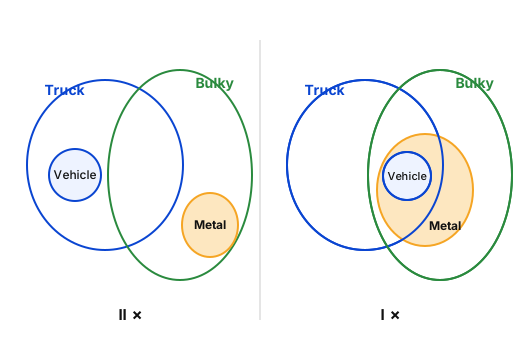
- All Vehicle are Truck; Some Truck are Bulky; All Metal are Bulky.
- Metal touches only Bulky – no fixed link with Truck or Vehicle.
- II fails: Metal can lie in the non-truck part of Bulky.
- I fails: all Vehicles may lie inside Metal (and Bulky) without breaking any statement.
Trick: Two classes linked only through a 'Some' middle term give no definite conclusion – just possibilities.
Answer: (D) Neither conclusion I nor II follows
अवधारणा: 'Only A are B' = 'All B are A'। निष्कर्ष तभी निकलता है जब हर संभव आरेख में सत्य हो।
- सभी Vehicle, Truck हैं; कुछ Truck, Bulky; सभी Metal, Bulky।
- Metal का सीधा संबंध केवल Bulky से है – Truck/Vehicle से कोई निश्चित संबंध नहीं।
- II गलत: Metal, Bulky के उस हिस्से में हो सकता है जहाँ Truck नहीं।
- I गलत: सारे Vehicle, Metal के अंदर भी हो सकते हैं, कोई कथन नहीं टूटता।
ट्रिक: जो दो वर्ग केवल 'Some' वाले बीच के पद से जुड़े हों, उनमें निश्चित निष्कर्ष नहीं, केवल संभावना होती है।
उत्तर: (D) न तो निष्कर्ष I और न ही निष्कर्ष II अनुसरण करता है
SSC CHSLGeneral IntelligenceSyllogism – 'only' statementSSC CHSL 2025 · 30 Nov Shift 1
Q64.What comes next in the following series ?
M15, ?, S45, V60, Y75
निम्नलिखित शृंखला में आगे क्या आएगा?
M15, ?, S45, V60, Y75
- AP30
- B031
- CQ30
- DR29
Show answer
Concept: Treat letters and numbers as two separate series.
- Letters: S → V → Y move 3 steps each (S is 19th, Y is 25th). Going back 3 from S gives P; and P is exactly 3 after M. Missing letter = P.
- Numbers: 15, ?, 45, 60, 75 → +15 each → missing = 30.
Trick: Number part 30 leaves (A) and (C); M + 3 = P, not Q.
Answer: (A) P30
अवधारणा: अक्षर और संख्या को दो अलग श्रेणी मानें।
- अक्षर: S → V → Y हर बार 3 आगे। S से 3 पीछे P है, और P, M से ठीक 3 आगे है। लुप्त अक्षर = P।
- संख्या: 15, ?, 45, 60, 75 → हर बार +15 → लुप्त = 30।
ट्रिक: 30 से (A), (C) बचते हैं; M + 3 = P, Q नहीं।
उत्तर: (A) P30
SSC CHSLGeneral IntelligenceAlphanumeric series – letter +3, number +15SSC CHSL 2025 · 30 Nov Shift 1
Q65.Which of the following is the odd one out in the given series?
3Y, 5X, 7W, 9V, 11U,
दी गई शृंखला में निम्नलिखित में से कौन-सा विषम है?
3Y, 5X, 7W, 9V, 11U,
- A3Y
- B7 W
- C5 X
- D9V
Show answer
Concept: When the obvious pattern is regular for all, test number properties.
- Letters Y, X, W, V, U go back by 1 – all regular.
- Numbers 3, 5, 7, 11 are prime; is not.
Trick: Odd-number lists hiding 9, 15, 21, 25 are usually 'prime' traps.
Answer: (D) 9V
अवधारणा: जब सामान्य पैटर्न सब पर फिट हो, तब संख्या के गुण (अभाज्य आदि) जाँचें।
- अक्षर Y, X, W, V, U एक-एक घटते हैं – सब नियमित।
- 3, 5, 7, 11 अभाज्य हैं; अभाज्य नहीं।
ट्रिक: विषम संख्याओं की सूची में 9, 15, 21, 25 दिखे तो 'अभाज्य' वाला जाल समझें।
उत्तर: (D) 9V
SSC CHSLGeneral IntelligenceOdd one out – prime numbers in termsSSC CHSL 2025 · 30 Nov Shift 1
Q66.Which of the following letter cluster will come next to the series ?
WB, DW, KR, RM, ?
निम्नलिखित में से कौन-सा अक्षर-समूह दी गई शृंखला में आगे आएगा?
WB, DW, KR, RM, ?
- AVY
- BYX
- CYH
- DVR
Show answer
Concept: Follow first and second letters separately (wrap around after Z).
- 1st letters: W → D → K → R, each jump is +7 (after Z restart from A: W is 23rd, 23 + 7 − 26 = 4 = D). R is 18th, so next = 25th letter = Y.
- 2nd letters: B → W → R → M, each jump is −5 (going back from B wraps to W). M is 13th, so next = 8th letter = H.
Trick: R + 7 = Y leaves (B) and (C); M − 5 = H picks (C).
Answer: (C) YH
अवधारणा: पहले और दूसरे अक्षर को अलग-अलग देखें (Z के बाद फिर A)।
- पहले अक्षर: W → D → K → R, हर छलांग +7 (Z के बाद फिर A से गिनें)। R 18वाँ है, अगला 25वाँ अक्षर = Y।
- दूसरे अक्षर: B → W → R → M, हर छलांग −5 (B से पीछे जाने पर W)। M 13वाँ है, अगला 8वाँ अक्षर = H।
ट्रिक: R + 7 = Y से (B), (C) बचे; M − 5 = H से (C)।
उत्तर: (C) YH
SSC CHSLGeneral IntelligenceLetter-cluster series – +7 and −5SSC CHSL 2025 · 30 Nov Shift 1
Q67.What comes next in the series:
96, 48, 24, 12, ?
शृंखला में आगे क्या आएगा:
96, 48, 24, 12, ?
- A6
- B5
- C7
- D6.5
Show answer
Concept: Check the ratio between consecutive terms.
- , , .
- Next = 6.
Trick: If every term divides the one before it exactly, test ÷2 first.
Answer: (A) 6
अवधारणा: लगातार पदों का अनुपात देखें।
- , , ।
- अगला = 6।
ट्रिक: अगर हर पद पिछले को पूरा भाग दे, तो पहले ÷2 जाँचें।
उत्तर: (A) 6
SSC CHSLGeneral IntelligenceNumber series – halvingSSC CHSL 2025 · 30 Nov Shift 1
Q68.If + means ÷ , - means × , × means +, and means -, find:
?
यदि + का अर्थ ÷ है, - का अर्थ × है, × का अर्थ + है, तथा का अर्थ - है, तो ज्ञात कीजिए:
?
- A38
- B39
- C41
- D42
Show answer
Concept: Replace the symbols first, then apply BODMAS.
- 80 + 8 − 4 × 3 ÷ 2 → .
- ; .
- 41.
Trick: Write the new expression on paper before solving – most errors come from solving with old signs.
Answer: (C) 41
अवधारणा: पहले चिह्न बदलें, फिर BODMAS लगाएँ।
- 80 + 8 − 4 × 3 ÷ 2 → ।
- ; ।
- 41।
ट्रिक: हल करने से पहले नया व्यंजक लिख लें – ज़्यादातर गलती पुराने चिह्नों से होती है।
उत्तर: (C) 41
SSC CHSLGeneral IntelligenceMathematical operations – symbol interchangeSSC CHSL 2025 · 30 Nov Shift 1
Q69.Choose the related word from the given alternatives
Temperature : Kelvin :: Pressure : ?
दिए गए विकल्पों में से संबंधित शब्द चुनिए तापमान : केल्विन :: दाब : ?
- APascalपास्कल
- BJouleजूल
- CWattवाट
- DNewtonन्यूटन
Show answer
Concept: Physical quantity : its SI unit.
- Temperature → kelvin (K).
- Pressure → pascal ().
- Joule = energy/work, Watt = power, Newton = force.
Yaad rakhein: , so pascal = newton per square metre.
Answer: (A) Pascal
अवधारणा: भौतिक राशि : उसका SI मात्रक।
- तापमान → केल्विन (K)।
- दाब → पास्कल ()।
- जूल = ऊर्जा/कार्य, वाट = शक्ति, न्यूटन = बल।
याद रखें: , इसलिए पास्कल = न्यूटन प्रति वर्ग मीटर।
उत्तर: (A) पास्कल
SSC CHSLGeneral IntelligenceAnalogy – quantity and SI unitSSC CHSL 2025 · 30 Nov Shift 1
Q70.Choose the related word from the given alternatives
Swan : Cygnet :: ? : Kit
दिए गए विकल्पों में से संबंधित शब्द चुनिए हंस (Swan) : सिग्नेट (Cygnet) :: ? : किट (Kit)
- AGoatबकरी
- BDeerहिरण
- CSheepभेड़
- DFoxलोमड़ी
Show answer
Concept: Animal : name of its young.
- Young swan = cygnet.
- Young fox = kit (also called cub).
- Goat → kid, Deer → fawn, Sheep → lamb.
Yaad rakhein: Kangaroo → joey, Owl → owlet, Eagle → eaglet, Horse → foal.
Answer: (D) Fox
अवधारणा: जानवर : उसके बच्चे का नाम।
- हंस का बच्चा = cygnet।
- लोमड़ी का बच्चा = kit (cub भी)।
- बकरी → kid, हिरण → fawn, भेड़ → lamb।
याद रखें: कंगारू → joey, उल्लू → owlet, चील → eaglet, घोड़ा → foal।
उत्तर: (D) लोमड़ी
SSC CHSLGeneral IntelligenceAnalogy – animal and its young oneSSC CHSL 2025 · 30 Nov Shift 1
Q71.What comes next ?
4, 14, 45, 139, 422, ?
आगे क्या आएगा?
4, 14, 45, 139, 422, ?
- A1270
- B1274
- C1272
- D1276
Show answer
Concept: Terms ≈ triple → test ×3 plus something.
- Triple each term and see the extra: 14 is 12 + 2, 45 is 42 + 3, 139 is 135 + 4, 422 is 417 + 5.
- Next = 1272.
Trick: ; the add-on keeps rising (2, 3, 4, 5 → 6), so answer is just above 1266 → 1272.
Answer: (C) 1272
अवधारणा: पद लगभग तीन गुने → ×3 + कुछ जाँचें।
- हर पद को तिगुना करके अतिरिक्त देखें: , , , ।
- अगला = 1272।
ट्रिक: जोड़ी जाने वाली संख्या 2, 3, 4, 5 → 6; इसलिए ।
उत्तर: (C) 1272
SSC CHSLGeneral IntelligenceNumber series – ×3 + increasing numberSSC CHSL 2025 · 30 Nov Shift 1
Q72.Identify the pattern in the following sequence.
20, 42, 72, 110, 156, ?
What is the next number in the sequence?
निम्नलिखित अनुक्रम में पैटर्न पहचानिए।
20, 42, 72, 110, 156, ?
अनुक्रम में अगली संख्या क्या है?
- A210
- B198
- C204
- D216
Show answer
Concept: Write each term as a product of consecutive numbers.
- , , , , .
- Next = 210.
Trick: Second differences: 22, 30, 38, 46 rise by 8 → next difference 54; .
Answer: (A) 210
अवधारणा: हर पद को लगातार दो संख्याओं के गुणनफल के रूप में लिखें।
- , , , , ।
- अगला = 210।
ट्रिक: अंतर 22, 30, 38, 46 (हर बार +8) → अगला 54; ।
उत्तर: (A) 210
SSC CHSLGeneral IntelligenceNumber series – n(n + 1) formSSC CHSL 2025 · 30 Nov Shift 1
Q73.Select the option that is related to the fifth number in the same way as the second number is related to the first number and fourth number is related to third number.
(NOTE: Operations should be performed on the whole numbers, without breaking down the numbers into its constituent digits. E.g. 13 - Operations on 13 such as adding /subtracting /multiplying etc. to 13 can be performed. Breaking down 13 into 1 and 3 and then performing mathematical operations on 1 and 3 is not allowed)
7551 : 8502 :: 3548 : 4499 :: 6264 : ?
उस विकल्प का चयन कीजिए जो पाँचवीं संख्या से उसी प्रकार संबंधित है जिस प्रकार दूसरी संख्या पहली संख्या से तथा चौथी संख्या तीसरी संख्या से संबंधित है।
(नोट: संक्रियाएँ पूर्ण संख्याओं पर की जानी चाहिए, संख्याओं को उनके अंकों में तोड़े बिना। उदाहरण के लिए 13 - 13 पर जोड़ने/घटाने/गुणा करने आदि जैसी संक्रियाएँ की जा सकती हैं। 13 को 1 और 3 में तोड़कर 1 और 3 पर गणितीय संक्रियाएँ करने की अनुमति नहीं है।)
7551 : 8502 :: 3548 : 4499 :: 6264 : ?
- A7215
- B7115
- C7315
- D7425
Show answer
Concept: Compare whole numbers in each pair.
- 8502 − 7551 = 951; 4499 − 3548 = 951.
- So ? = 6264 + 951 = 7215.
Trick: Last digits: 1 → 2 and 8 → 9 (each +1); 4 + 1 = 5 – all options end in 5, so check the hundreds: 6264 + 951 = 7215.
Answer: (A) 7215
अवधारणा: हर जोड़े में पूरी संख्याओं की तुलना करें।
- 8502 − 7551 = 951; 4499 − 3548 = 951।
- इसलिए ? = 6264 + 951 = 7215।
ट्रिक: 951 ≈ 1000 − 49: 6264 + 1000 = 7264, − 49 = 7215।
उत्तर: (A) 7215
SSC CHSLGeneral IntelligenceNumber analogy – constant differenceSSC CHSL 2025 · 30 Nov Shift 1
Q74.Select the option that is related to the second number in the same way as the third number is related to the fourth number and fifth number is related to sixth number.
(NOTE: Operations should be performed on the whole numbers, without breaking down the numbers into its constituent digits. E.g. 13 - Operations on 13 such as adding /subtracting /multiplying etc. to 13 can be performed. Breaking down 13 into 1 and 3 and then performing mathematical operations on 1 and 3 is not allowed)
? : 5239 :: 187 :-803:: 1781 : 791
उस विकल्प का चयन कीजिए जो दूसरी संख्या से उसी प्रकार संबंधित है जिस प्रकार तीसरी संख्या चौथी संख्या से तथा पाँचवीं संख्या छठी संख्या से संबंधित है।
(नोट: संक्रियाएँ पूर्ण संख्याओं पर की जानी चाहिए, संख्याओं को उनके अंकों में तोड़े बिना। उदाहरण के लिए 13 - 13 पर जोड़ने/घटाने/गुणा करने आदि जैसी संक्रियाएँ की जा सकती हैं। 13 को 1 और 3 में तोड़कर 1 और 3 पर गणितीय संक्रियाएँ करने की अनुमति नहीं है।)
? : 5239 :: 187 :-803:: 1781 : 791
- A6229
- B6227
- C6228
- D6225
Show answer
Concept: Find the left − right relation in the complete pairs.
- 187 − (−803) = 187 + 803 = 990.
- 1781 − 791 = 990.
- ? − 5239 = 990 → ? = 6229.
Trick: 990 = 1000 − 10: 5239 + 1000 − 10 = 6229.
Answer: (A) 6229
अवधारणा: पूरे जोड़ों में बाएँ − दाएँ का संबंध खोजें।
- 187 − (−803) = 187 + 803 = 990।
- 1781 − 791 = 990।
- ? − 5239 = 990 → ? = 6229।
ट्रिक: 990 = 1000 − 10: 5239 + 1000 − 10 = 6229।
उत्तर: (A) 6229
SSC CHSLGeneral IntelligenceNumber analogy – difference with a negative numberSSC CHSL 2025 · 30 Nov Shift 1
Q75.In the following question, four letter-number pairs are given. The letter-number on the left side of ( - ) is related to the letter-number on the right side of (-) with some Logic / Rule/Relation. Three pairs are similar on the basis of same Logic/Rule/Relation. Select the odd one out from the given alternatives.
(NOTE: Operations should be performed on the whole numbers, without breaking down the number into its constituent digits. E.g. 13 - Operations on 13 such as adding /subtracting /multiplying etc. to 13 can be performed. Breaking down 13 into 1 and 3 and then performing mathematical operations on 1 and 3 is not allowed)
निम्नलिखित प्रश्न में चार अक्षर-संख्या युग्म दिए गए हैं। ( - ) के बाईं ओर का अक्षर-संख्या (-) के दाईं ओर के अक्षर-संख्या से किसी तर्क/नियम/संबंध द्वारा संबंधित है। तीन युग्म समान तर्क/नियम/संबंध के आधार पर एक जैसे हैं। दिए गए विकल्पों में से असंगत युग्म का चयन कीजिए।
(नोट: संक्रियाएँ पूर्ण संख्याओं पर की जानी चाहिए, संख्या को उसके अंकों में तोड़े बिना। उदाहरण के लिए 13 - 13 पर जोड़ने/घटाने/गुणा करने आदि जैसी संक्रियाएँ की जा सकती हैं। 13 को 1 और 3 में तोड़कर 1 और 3 पर गणितीय संक्रियाएँ करने की अनुमति नहीं है।)
- ABD332 - D1498
- BCI440 - EN660
- CML556-0Q834
- DNA484 - PG726
Show answer
Concept: Check the number rule and the letter rule separately.
- Numbers: (332 → 498, 440 → 660, 556 → 834, 484 → 726) – true for all.
- Letters: B→D, D→I (+2, +5); C→E, I→N (+2, +5); M→O, L→Q (+2, +5).
- N→P (+2) but A→G is +6 – rule broken.
Trick: When the number rule fits all four, the odd one hides in the letters – count only the gaps.
Answer: (D) NA484 - PG726
अवधारणा: संख्या का नियम और अक्षर का नियम अलग-अलग जाँचें।
- संख्या: (332 → 498, 440 → 660, 556 → 834, 484 → 726) – सब पर लागू।
- अक्षर: B→D, D→I (+2, +5); C→E, I→N (+2, +5); M→O, L→Q (+2, +5)।
- N→P (+2) पर A→G = +6 – नियम टूटा।
ट्रिक: जब संख्या नियम चारों में सही हो, तो अलग वाला अक्षरों में छिपा होता है।
उत्तर: (D) NA484 - PG726
SSC CHSLGeneral IntelligenceOdd letter-number pairSSC CHSL 2025 · 30 Nov Shift 1
Q76.Find the next element that replace the ?
Logically
10,7,1,-11,?
उस अगले पद को ज्ञात कीजिए जो प्रश्नवाचक चिह्न (?) का स्थान लेगा।
तार्किक रूप से
10,7,1,-11,?
- A-35
- B-32
- C-36
- D-38
Show answer
Concept: Find the pattern in the differences.
- Gaps: 10→7 is −3, 7→1 is −6, 1→−11 is −12.
- Gaps double: 3, 6, 12, 24.
- Next term = −11 − 24 = −35.
Trick: If differences look like 3, 6, 12 – think ×2 at once; only −35 is 24 below −11.
Answer: (A) -35
अवधारणा: अंतरों का पैटर्न देखें।
हल:
- अंतर: −3, −6, −12।
- हर बार अंतर दोगुना: 3, 6, 12, 24।
- अगला पद = −11 − 24 = −35।
ट्रिक: अंतर 3, 6, 12 दिखें तो सीधे ×2 सोचें; −11 से 24 कम = −35।
उत्तर: (A) -35
SSC CHSLGeneral IntelligenceNumber series – doubling differencesSSC CHSL 2025 · 29 Nov Shift 3
Q77.In a row of boys, is 12th from the left and is 8th from the right. If is 6th to the left of , how many boys are there in the row ?
लड़कों की एक पंक्ति में, $X$ बाएँ से 12वें स्थान पर है और $Y$ दाएँ से 8वें स्थान पर है। यदि $X$, $Y$ के बाईं ओर 6वें स्थान पर है, तो पंक्ति में कुल कितने लड़के हैं?
- A25
- B26
- C27
- D28
Show answer
Concept: Total = left rank + right rank − 1 (same person).
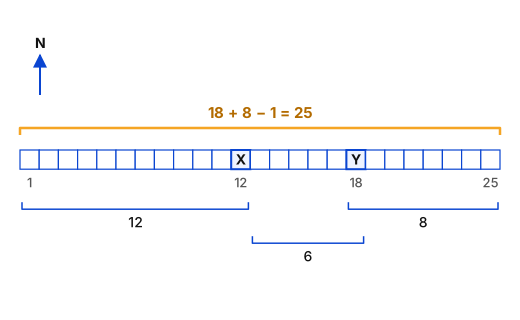
- Y is 6 places right of X → Y's left rank = 12 + 6 = 18.
- Y's right rank = 8.
- Total = 18 + 8 − 1 = 25.
Trick: First bring both ranks onto ONE person, then add and subtract 1.
Answer: (A) 25
अवधारणा: एक ही व्यक्ति के लिए कुल = बाएँ से स्थान + दाएँ से स्थान − 1।
हल:
- Y, X से 6 स्थान दाएँ है → Y बाएँ से 12 + 6 = 18वाँ।
- Y दाएँ से 8वाँ।
- कुल = 18 + 8 − 1 = 25।
ट्रिक: पहले दोनों स्थान एक ही व्यक्ति पर लाएँ, फिर जोड़कर 1 घटाएँ।
उत्तर: (A) 25
SSC CHSLGeneral IntelligenceRanking – total in a rowSSC CHSL 2025 · 29 Nov Shift 3
Q78.Street lights are placed in a straight line. The 7th light from one end is not working. If there are 18 lights in total, what is its position from the other end?
सड़क की बत्तियाँ एक सीधी रेखा में लगाई गई हैं। एक सिरे से 7वीं बत्ती काम नहीं कर रही है। यदि कुल 18 बत्तियाँ हैं, तो दूसरे सिरे से उसका स्थान क्या है?
- A10th10वाँ
- B11th11वाँ
- C12th12वाँ
- D13th13वाँ
Show answer
Concept: Position from other end = Total − given position + 1.
- Total lights = 18, given position = 7.
- 18 − 7 + 1 = 12.
Trick: Positions from both ends always add up to Total + 1 → 7 + ? = 19.
Answer: (C) 12th
अवधारणा: दूसरे छोर से स्थान = कुल − दिया स्थान + 1।
हल:
- कुल = 18, दिया स्थान = 7।
- 18 − 7 + 1 = 12।
ट्रिक: दोनों छोरों से स्थानों का योग = कुल + 1 → 7 + ? = 19।
उत्तर: (C) 12वाँ
SSC CHSLGeneral IntelligencePosition from the other endSSC CHSL 2025 · 29 Nov Shift 3
Q79.If 72 # and 20 # , then what is the value of 85 # 20 ?
यदि 72 # $7=13$ और 20 # $45=-5$ है, तो 85 # 20 का मान क्या है?
- A13
- B15
- C16.5
- D17
Show answer
Concept: Find one rule that fits both given examples.
- 72 # 7: , ✓
- 20 # 45: , ✓
- 85 # 20: 13.
Trick: A negative result (−5) hints at subtraction – test a − b first.
Answer: (A) 13
अवधारणा: दोनों उदाहरणों पर लागू होने वाला एक नियम खोजें।
हल:
- , ✓
- , ✓
- 85 # 20 = 13।
ट्रिक: उत्तर ऋणात्मक (−5) है तो घटाव का संकेत – पहले a − b जाँचें।
उत्तर: (A) 13
SSC CHSLGeneral IntelligenceSymbol operation – difference ÷ 5SSC CHSL 2025 · 29 Nov Shift 3
Q80.If and , then what is the value of ?
यदि और है, तो का मान क्या है?
- A360
- B420
- C480
- D500
Show answer
Concept: Find the rule from the given pairs.
- 18 % 5: , ✓
- 24 % 10: ✓
- Rule: a % b = 4ab. So 20 % 6 = 480.
Trick: Divide the result by the product: – constant multiplier found in seconds.
Answer: (C) 480
अवधारणा: दिए जोड़ों से नियम निकालें।
हल:
- , ✓
- , ✓
- नियम: a % b = 4ab; अतः 20 % 6 = 480।
ट्रिक: परिणाम ÷ गुणनफल = – स्थिर गुणक तुरंत मिलता है।
उत्तर: (C) 480
SSC CHSLGeneral IntelligenceSymbol operation – product × 4SSC CHSL 2025 · 29 Nov Shift 3

