Q61.A ladder is leaning against a wall makes an angle ' ' with the horizontal ground such that . If the length of the ladder is 25 metres, then what is the distance (in metres) of the foot of the ladder from the wall ?
एक सीढ़ी दीवार के सहारे टिकी है और क्षैतिज भूमि के साथ ' ' कोण बनाती है, जहाँ है। यदि सीढ़ी की लंबाई 25 मीटर है, तो सीढ़ी के निचले सिरे की दीवार से दूरी (मीटर में) कितनी होगी ?
- A8.8 metres8.8 मीटर
- B10 metres10 मीटर
- C9.5 metres9.5 मीटर
- D12 metres12 मीटर
Show answer
Concept: , here (height on wall : distance from wall).
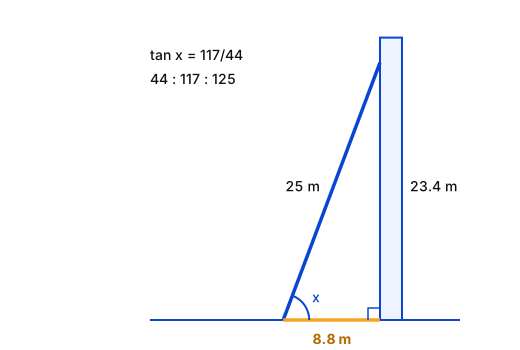
- Hypotenuse = .
- Sides are 44 : 117 : 125; ladder (hypotenuse) = 25 m → scale .
- Distance of foot = 8.8 m.
Trick: , so base m.
Answer: (A) 8.8 metres
अवधारणा: , यहाँ (दीवार पर ऊँचाई : दीवार से दूरी)।
- कर्ण = ।
- भुजाएँ 44 : 117 : 125; सीढ़ी (कर्ण) = 25 m → गुणक ।
- निचले सिरे की दूरी = 8.8 m।
ट्रिक: , इसलिए आधार m।
उत्तर: (A) 8.8 मीटर
SSC CHSLQuantitative AptitudeHeights and distances – ladder and wallSSC CHSL 2025 · 30 Nov Shift 1
Q62.If and , then ?
यदि है तथा है, तो ?
- A60°
- B40°
- C80°
- D100°
Show answer
Concept: In similar triangles, corresponding angles are equal (P↔X, Q↔Y, R↔Z).
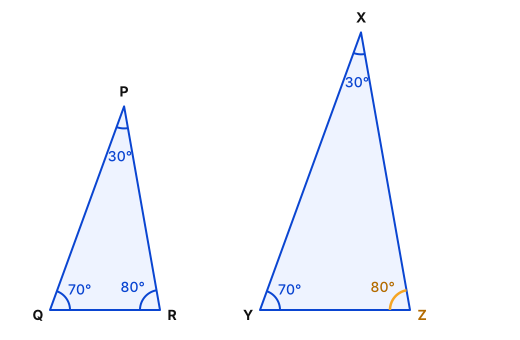
- Since △PQR ∼ △XYZ, ∠Z = ∠R.
- ∠R = 180° − (∠P + ∠Q) = 180° − (30° + 70°) = 80°.
- Hence ∠Z = 80°.
Yaad rakhein: The order of letters in △PQR ∼ △XYZ tells which angles match – 3rd letter ↔ 3rd letter.
Answer: (C) 80°
अवधारणा: समरूप त्रिभुजों के संगत कोण बराबर होते हैं (P↔X, Q↔Y, R↔Z)।
- △PQR ∼ △XYZ, अतः ∠Z = ∠R।
- ∠R = 180° − (30° + 70°) = 80°।
- इसलिए ∠Z = 80°।
याद रखें: △PQR ∼ △XYZ में अक्षरों का क्रम ही बताता है कि कौन-सा कोण किससे मिलेगा – तीसरा अक्षर ↔ तीसरा अक्षर।
उत्तर: (C) 80°
SSC CHSLQuantitative AptitudeSimilar triangles – corresponding anglesSSC CHSL 2025 · 30 Nov Shift 1
Q63.How many kilograms of sugar costing Rs. 20 per kg must be mixed with 40 kg of sugar costing Rs. 10 per kg so that there may be a gain of by selling the mixture at Rs. 20 per kg ?
20 रुपये प्रति किग्रा मूल्य वाली कितने किलोग्राम चीनी को 10 रुपये प्रति किग्रा मूल्य वाली 40 किग्रा चीनी में मिलाया जाए, ताकि मिश्रण को 20 रुपये प्रति किग्रा की दर से बेचने पर का लाभ हो ?
- A121 kg121 किग्रा
- B154 kg154 किग्रा
- C180 kg180 किग्रा
- D160 kg160 किग्रा
Show answer
Concept: Find the mixture's cost price first, then use alligation.
- SP ₹20 at 10% gain → CP of mixture = ₹.
- Cheap (₹10) : Dear (₹20) = .
- 2 parts = 40 kg → 1 part = 20 kg → ₹20 sugar = 180 kg.
Trick: Check: cost; = 10% gain ✔.
Answer: (C) 180 kg
अवधारणा: पहले मिश्रण का क्रय मूल्य निकालें, फिर एलीगेशन लगाएँ।
- SP ₹20 पर 10% लाभ → मिश्रण का CP = ₹।
- सस्ती (₹10) : महँगी (₹20) = ।
- 2 भाग = 40 kg → 1 भाग = 20 kg → ₹20 वाली चीनी = 180 kg।
ट्रिक: जाँच: लागत; = 10% लाभ ✔।
उत्तर: (C) 180 किग्रा
SSC CHSLQuantitative AptitudeMixture and alligation – with profitSSC CHSL 2025 · 30 Nov Shift 1
Q64.Amit can copy 30 pages in 6 hours; Amit and Ravi together can copy 250 pages in 25 hours. In how much time can Ravi copy 40 pages?
अमित 30 पृष्ठ 6 घंटे में कॉपी कर सकता है; अमित और रवि मिलकर 250 पृष्ठ 25 घंटे में कॉपी कर सकते हैं। रवि 40 पृष्ठ कितने समय में कॉपी कर सकता है ?
- A6 hours6 घंटे
- B10 hours10 घंटे
- C8 hours8 घंटे
- D7 hours7 घंटे
Show answer
Concept: ; combined rate = sum of individual rates.
- Amit = pages/hr.
- Amit + Ravi = pages/hr → Ravi = pages/hr.
- Time for 40 pages = 8 hours.
Trick: Together they are exactly twice Amit's speed, so Ravi = Amit; Amit takes 6 h for 30 pages → 8 h for 40.
Answer: (C) 8 hours
अवधारणा: ; साथ की दर = अलग-अलग दरों का योग।
- अमित = पृष्ठ/घंटा।
- अमित + रवि = पृष्ठ/घंटा → रवि = पृष्ठ/घंटा।
- 40 पृष्ठ का समय = 8 घंटे।
ट्रिक: साथ की दर अमित की दोगुनी है, यानी रवि = अमित; 30 पृष्ठ 6 घंटे → 40 पृष्ठ 8 घंटे।
उत्तर: (C) 8 घंटे
SSC CHSLQuantitative AptitudeWork rate – pages per hourSSC CHSL 2025 · 30 Nov Shift 1
Q65.A policeman sees a chain snatcher at a distance of 500 m . He starts chasing a chain snatcher running with a speed of , while the policeman is chasing him with a speed of 15 m/s. What is the distance covered by the chain snatcher when he is caught by the policeman?
एक पुलिसकर्मी 500 m की दूरी पर एक चेन छीनने वाले को देखता है। वह की चाल से भाग रहे चेन छीनने वाले का पीछा करना आरंभ करता है, जबकि पुलिसकर्मी 15 m/s की चाल से उसका पीछा कर रहा है। पुलिसकर्मी द्वारा पकड़े जाने तक चेन छीनने वाले द्वारा तय की गई दूरी कितनी है ?
- A200 m
- B180 m
- C150 m
- D250 m
Show answer
Concept: Same direction → relative speed = difference of speeds.
- Relative speed = m/s.
- Time to close 500 m = s.
- Thief's distance = 250 m.
Trick: Thief's distance = m.
Answer: (D) 250 m
अवधारणा: एक ही दिशा → सापेक्ष चाल = चालों का अंतर।
- सापेक्ष चाल = m/s।
- 500 m का अंतर पाटने का समय = s।
- चोर की दूरी = 250 m।
ट्रिक: चोर की दूरी = m।
उत्तर: (D) 250 m
SSC CHSLQuantitative AptitudeRelative speed – chaseSSC CHSL 2025 · 30 Nov Shift 1
Q66.Which of the following statements(s) is/are TRUE ?
I. The area of a triangle with base 10 cm and height 8 cm is .
II. The sum of interior angles of a regular hexagon is 720°.
निम्नलिखित में से कौन-सा/से कथन सत्य है/हैं ?
I. जिस त्रिभुज का आधार 10 cm और ऊँचाई 8 cm है, उसका क्षेत्रफल है।
II. एक सम षट्भुज के अंतःकोणों का योग 720° होता है।
- AOnly IIकेवल II
- BBoth I and III और II दोनों
- COnly Iकेवल I
- DNeither I nor IIन तो I और न ही II
Show answer
Concept: Area of triangle ; interior angle sum .
- I: → true.
- II: hexagon → → true.
Yaad rakhein: Each interior angle of a regular hexagon = .
Answer: (B) Both I and II
अवधारणा: त्रिभुज क्षेत्रफल ; अंतः कोणों का योग ।
- I: → सत्य।
- II: षट्भुज → → सत्य।
याद रखें: सम षट्भुज का प्रत्येक अंतः कोण = ।
उत्तर: (B) I और II दोनों
SSC CHSLQuantitative AptitudeGeometry – triangle area and polygon angle sumSSC CHSL 2025 · 30 Nov Shift 1
Q67.A regular right square pyramid has a base side of 10 cm . An insect crawls from a base corner to the midpoint of an opposite slant edge along the surface by the shortest route. If the perpendicular height of the pyramid is 20cm, find the slant height.
एक सम लंब वर्गाकार पिरामिड के आधार की भुजा 10 cm है। एक कीट आधार के एक कोने से पृष्ठ के अनुदिश न्यूनतम मार्ग से सामने वाले तिर्यक किनारे के मध्यबिंदु तक रेंगता है। यदि पिरामिड की लंब ऊँचाई 20 cm है, तो तिर्यक ऊँचाई ज्ञात कीजिए।
- A20.61 cm
- B15.52 cm
- C10.27 cm
- D22 cm
Show answer
Concept: Slant height for a square pyramid (the insect story is extra information).
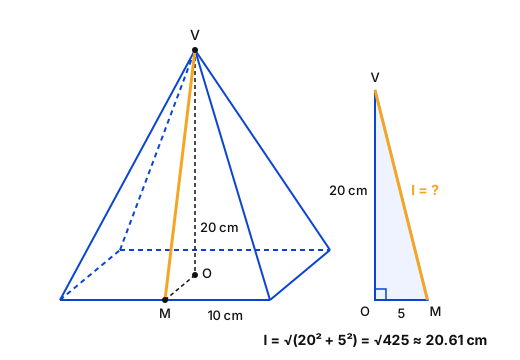
- cm, cm.
- .
- 20.61 cm.
Trick: l must be a little more than (since ) – only 20.61 fits.
Answer: (A) 20.61 cm
अवधारणा: वर्ग पिरामिड की तिर्यक ऊँचाई (कीड़े वाली बात अतिरिक्त जानकारी है)।
- cm, cm।
- ।
- 20.61 cm।
ट्रिक: l, से थोड़ा ज़्यादा होगा () – केवल 20.61 फिट।
उत्तर: (A) 20.61 cm
SSC CHSLQuantitative AptitudePyramid – slant heightSSC CHSL 2025 · 30 Nov Shift 1
Q68.Three successive discounts of 15%, 20% and 25% are given. What will be the net discount in percentage ?
15%, 20% और 25% की तीन क्रमिक छूटें दी जाती हैं। कुल (शुद्ध) छूट प्रतिशत कितनी होगी ?
- A52%
- B
- C
- D40%
Show answer
Concept: Successive discounts multiply on the remaining price; they are not simply added.
- Price paid = .
- ; .
- Net discount = 49%.
Trick: Two at a time: ; then .
Answer: (B)
अवधारणा: क्रमागत छूट बचे हुए मूल्य पर लगती है; सीधे जोड़ते नहीं।
- चुकाया मूल्य = ।
- ; ।
- कुल छूट = 49%।
ट्रिक: दो-दो करके: ; फिर ।
उत्तर: (B)
SSC CHSLQuantitative AptitudeSuccessive discountsSSC CHSL 2025 · 30 Nov Shift 1
Q69.The lengths of two parallel chords of a circle are 10 cm and 24 cm lie on the opposite sides of the centre. If the smaller chord is 12 cm from the centre, what is the distance (in cm ) between the two chords?
एक वृत्त की दो समांतर जीवाओं की लंबाइयाँ 10 cm और 24 cm हैं तथा वे केंद्र के विपरीत ओर स्थित हैं। यदि छोटी जीवा केंद्र से 12 cm दूर है, तो दोनों जीवाओं के बीच की दूरी (cm में) कितनी है ?
- A13
- B5
- C17
- D12
Show answer
Concept: .
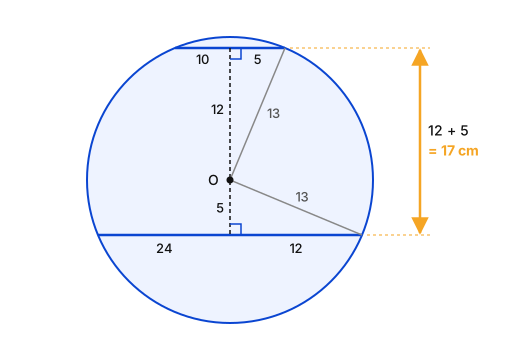
- Smaller chord: → cm.
- Bigger chord: half = 12 → distance = cm.
- Opposite sides of centre → add: 17 cm.
Trick: (5, 12, 13) triplet appears twice. Same side → subtract; opposite sides → add.
Answer: (C) 17
अवधारणा: ।
- छोटी जीवा: → cm।
- बड़ी जीवा: आधी = 12 → दूरी = cm।
- केंद्र के विपरीत ओर → जोड़ें: 17 cm।
ट्रिक: (5, 12, 13) त्रिक दो बार आता है। एक ही ओर → घटाएँ; विपरीत ओर → जोड़ें।
उत्तर: (C) 17
SSC CHSLQuantitative AptitudeCircle – distance between parallel chordsSSC CHSL 2025 · 30 Nov Shift 1
Q70.The radius of a circular embankment is 35 meters. A drainage system is placed along a circle with a radius that is 15 meters smaller than the embankment. What is the radius of the drainage circle ?
एक वृत्ताकार तटबंध की त्रिज्या 35 मीटर है। जल-निकासी प्रणाली एक ऐसे वृत्त के अनुदिश बनाई गई है जिसकी त्रिज्या तटबंध की त्रिज्या से 15 मीटर कम है। जल-निकासी वृत्त की त्रिज्या कितनी है ?
- A20 m
- B12 m
- C14 m
- D30 m
Show answer
Concept: Direct subtraction of radii – read what is compared.
- Embankment radius = 35 m.
- Drainage radius = 20 m.
Yaad rakhein: Area of the ring between them = .
Answer: (A) 20 m
अवधारणा: त्रिज्याओं का सीधा अंतर – ध्यान दें किसकी तुलना है।
- तटबंध की त्रिज्या = 35 m।
- नाली वृत्त की त्रिज्या = 20 m।
याद रखें: दो संकेंद्री वृत्तों के बीच वलय का क्षेत्रफल = ।
उत्तर: (A) 20 m
SSC CHSLQuantitative AptitudeCircle – radius differenceSSC CHSL 2025 · 30 Nov Shift 1
Q71.Which is the smallest among these: ?
इनमें से सबसे छोटी संख्या कौन-सी है: ?
- A
- B
- C
- DAll are equalसभी बराबर हैं
Show answer
Concept: Bring , , to the same root order (LCM of 2, 3, 4 = 12).
- .
- .
- .
- Smallest inside value 20736 → is smallest.
Trick: Estimate: , (), .
Answer: (C)
अवधारणा: , , को एक ही घात के मूल में बदलें (2, 3, 4 का LCM = 12)।
- ।
- ।
- ।
- अंदर की सबसे छोटी संख्या 20736 → सबसे छोटा।
ट्रिक: अनुमान: , , ।
उत्तर: (C)
SSC CHSLQuantitative AptitudeSurds – comparing roots of different orderSSC CHSL 2025 · 30 Nov Shift 1
Q72.What is the -intercept of the line ?
-अक्ष पर रेखा द्वारा काटा गया अंतःखंड क्या है ?
- A1
- B2
- C5
- D10
Show answer
Concept: On the x-axis .
- → .
- 2 → line meets x-axis at (2, 0).
Trick: For : x-intercept , y-intercept .
Answer: (B) 2
अवधारणा: x-अक्ष पर होता है।
- → ।
- 2 → रेखा x-अक्ष को (2, 0) पर काटती है।
ट्रिक: में x-अंतःखंड , y-अंतःखंड ।
उत्तर: (B) 2
SSC CHSLQuantitative AptitudeCoordinate geometry – x-interceptSSC CHSL 2025 · 30 Nov Shift 1
Q73.A circle with a radius of 5 cm has a chord located 3 cm away from the center. What is the length of the chord ?
5 cm त्रिज्या वाले एक वृत्त की एक जीवा केंद्र से 3 cm की दूरी पर स्थित है। उस जीवा की लंबाई कितनी है ?
- A4 cm
- B8 cm
- C6 cm
- D5 cm
Show answer
Concept: Half chord = ; the perpendicular from centre bisects the chord.
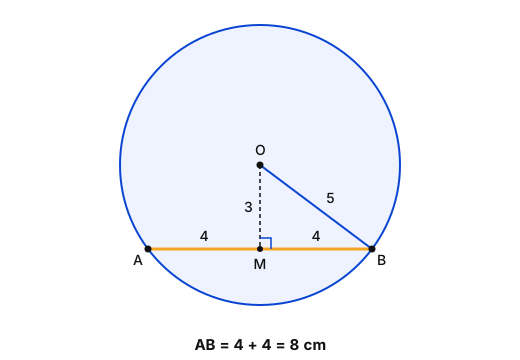
- Half chord = cm.
- Chord = 8 cm.
Trick: 3-4-5 triplet: , → half chord 4 → chord 8.
Answer: (B) 8 cm
अवधारणा: आधी जीवा = ; केंद्र से लंब जीवा को समद्विभाजित करता है।
- आधी जीवा = cm।
- जीवा = 8 cm।
ट्रिक: 3-4-5 त्रिक: , → आधी जीवा 4 → जीवा 8।
उत्तर: (B) 8 cm
SSC CHSLQuantitative AptitudeCircle – chord length from distanceSSC CHSL 2025 · 30 Nov Shift 1
Q74.The diagonals of a rhombus have lengths 12 cm and 10 cm . What is the side length of the rhombus ?
एक समचतुर्भुज के विकर्णों की लंबाइयाँ 12 cm और 10 cm हैं। समचतुर्भुज की भुजा की लंबाई कितनी है ?
- A7.81 cm
- B8.21 cm
- C6.81 cm
- D5.21 cm
Show answer
Concept: Diagonals of a rhombus bisect at , so side = .
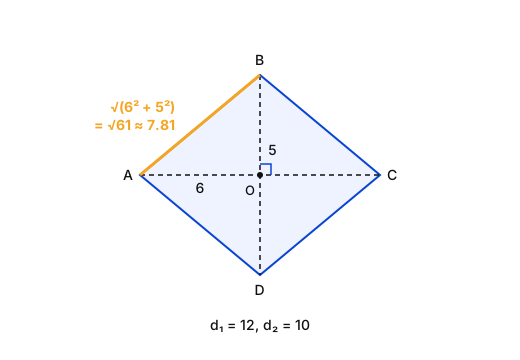
- Half-diagonals = 6 cm and 5 cm.
- Side = .
- 7.81 cm.
Trick: lies between and , close to 8 → 7.81.
Answer: (A) 7.81 cm
अवधारणा: समचतुर्भुज के विकर्ण एक-दूसरे को पर समद्विभाजित करते हैं; भुजा = ।
- आधे विकर्ण = 6 cm और 5 cm।
- भुजा = ।
- 7.81 cm।
ट्रिक: , और के बीच, 8 के पास → 7.81।
उत्तर: (A) 7.81 cm
SSC CHSLQuantitative AptitudeRhombus – side from diagonalsSSC CHSL 2025 · 30 Nov Shift 1
Q75.How many tangents exist if two circles touch externally at one point?
यदि दो वृत्त एक बिंदु पर बाह्यतः स्पर्श करते हैं, तो उनकी कितनी उभयनिष्ठ स्पर्श रेखाएँ होती हैं ?
- A0
- B1
- C2
- D3
Show answer
Concept: Number of common tangents depends on how the two circles are placed.
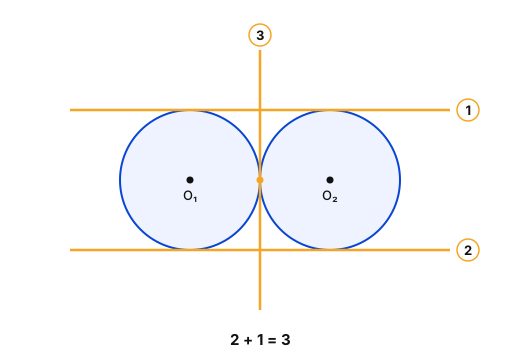
- Touching externally: 2 direct tangents + 1 tangent at the point of contact.
- Total = 3.
Trick: Apart → 4, touch outside → 3, intersect → 2, touch inside → 1, one inside other → 0 (count goes 4-3-2-1-0).
Answer: (D) 3
अवधारणा: उभयनिष्ठ स्पर्श रेखाओं की संख्या दोनों वृत्तों की स्थिति पर निर्भर है।
- बाहर से स्पर्श: 2 सीधी (direct) + 1 स्पर्श बिंदु पर।
- कुल = 3।
ट्रिक: अलग → 4, बाहर से स्पर्श → 3, काटते हुए → 2, अंदर से स्पर्श → 1, एक के अंदर दूसरा → 0।
उत्तर: (D) 3
SSC CHSLQuantitative AptitudeCircles – number of common tangentsSSC CHSL 2025 · 30 Nov Shift 1
Q76.In an electronic circuit, the signal strength is given by . Find the simplified expression.
एक इलेक्ट्रॉनिक परिपथ में सिग्नल की तीव्रता द्वारा दी जाती है। सरलीकृत व्यंजक ज्ञात कीजिए।
- A
- B
- C
- D
Show answer
Concept: .
- Inner bracket (the terms cancel).
- Square it: .
- Expand: .
Trick: Put : . Option C gives ✓; A gives 8, B 32, D 16 – but D is only degree 2, so C.
Answer: (C)
अवधारणा: ।
हल:
- अंदर का कोष्ठक ( कट जाते हैं)।
- वर्ग करें: ।
- विस्तार: ।
ट्रिक: रखें: ; विकल्प C = ✓। D भी 16 देता है पर उसकी घात 2 है, जबकि उत्तर घात 4 का होना चाहिए।
उत्तर: (C)
SSC CHSLQuantitative AptitudeAlgebra – (a+b)² + (a−b)² identitySSC CHSL 2025 · 29 Nov Shift 3
Q77.A shopkeeper makes a 25% profit on an article whose cost price is ₹320. What is the selling price of the article?
एक दुकानदार एक वस्तु पर 25% लाभ कमाता है, जिसका क्रय मूल्य ₹320 है। उस वस्तु का विक्रय मूल्य क्या है?
- A₹400
- B₹300
- C₹490
- D₹410
Show answer
Concept: .
- , so profit = ₹80.
- ₹400.
Trick: 25% profit → : .
Answer: (A) ₹400
अवधारणा: ।
हल:
- , लाभ = ₹80।
- ₹400।
ट्रिक: 25% लाभ → ।
उत्तर: (A) ₹400
SSC CHSLQuantitative AptitudeProfit – selling priceSSC CHSL 2025 · 29 Nov Shift 3
Q78.A female walks 20 km in 4 hours. Speed ?
एक महिला 4 घंटे में 20 km चलती है। चाल ज्ञात कीजिए।
- A
- B
- C
- D7 km/h
Show answer
Concept: .
- Distance = 20 km, time = 4 h.
- Speed 5 km/h.
Trick: Speed is just 'km per one hour' – share 20 km equally over 4 hours.
Answer: (B)
अवधारणा: ।
हल:
- दूरी = 20 km, समय = 4 घंटे।
- चाल 5 km/h।
ट्रिक: चाल = एक घंटे में तय दूरी – 20 km को 4 घंटों में बाँटें।
उत्तर: (B)
SSC CHSLQuantitative AptitudeSpeed = distance ÷ timeSSC CHSL 2025 · 29 Nov Shift 3
Q79.Ram is capable of completing a task in 20 days, while Ajay can finish the same task in 15 days. Ram works alone for the first 6 days and is then joined by Ajay. How many total days will it take to complete the entire task ?
राम एक कार्य को 20 दिनों में पूरा कर सकता है, जबकि अजय उसी कार्य को 15 दिनों में समाप्त कर सकता है। राम पहले 6 दिन अकेला कार्य करता है और उसके बाद अजय उसके साथ जुड़ जाता है। सम्पूर्ण कार्य को पूरा करने में कुल कितने दिन लगेंगे?
- A16 days16 दिन
- B17 days17 दिन
- C12 days12 दिन
- D18 days18 दिन
Show answer
Concept: Use total work = LCM of days.
- Work = units; Ram 3/day, Ajay 4/day.
- Ram's 6 days: 18 units; left 42 units.
- Together 7/day → days. Total 12 days.
Trick: Fraction way: Ram does ; rest days.
Answer: (C) 12 days
अवधारणा: कुल कार्य = दिनों का LCM लें।
हल:
- कार्य = इकाई; Ram 3/दिन, Ajay 4/दिन।
- Ram के 6 दिन: 18 इकाई; शेष 42।
- साथ में 7/दिन → 6 दिन। कुल 12 दिन।
ट्रिक: भिन्न विधि: Ram ने किया; शेष दिन।
उत्तर: (C) 12 दिन
SSC CHSLQuantitative AptitudeTime and work – one joins laterSSC CHSL 2025 · 29 Nov Shift 3
Q80.A storage room is in the shape of a cuboid with dimensions m . If each carton occupies , how many cartons can be stored in the room at one time?
एक भंडार कक्ष घनाभ के आकार का है, जिसकी विमाएँ m हैं। यदि प्रत्येक कार्टन स्थान घेरता है, तो एक बार में कक्ष में कितने कार्टन रखे जा सकते हैं?
- A16
- B17
- C15
- D18
Show answer
Concept: .
- Room volume = .
- Cartons = 15.
Trick: Divide early: , then .
Answer: (C) 15
अवधारणा: ।
हल:
- आयतन = ।
- डिब्बे = 15।
ट्रिक: पहले भाग दें: , फिर ।
उत्तर: (C) 15
SSC CHSLQuantitative AptitudeVolume of cuboid – number of boxesSSC CHSL 2025 · 29 Nov Shift 3

