Q881.A does of the work in 14 days. He then calls in B, and they together finish the remaining work in 3 days. How long would B alone take to do the whole work ?
A किसी कार्य का भाग 14 दिनों में करता है। इसके बाद वह B को बुला लेता है और दोनों मिलकर शेष कार्य 3 दिनों में पूरा कर लेते हैं। B अकेला संपूर्ण कार्य कितने दिनों में करेगा?
- A22 days22 दिन
- B20 days20 दिन
- C28 days28 दिन
- D25 days25 दिन
Show answer
Concept: Find A's rate from partial work, then B's rate from joint work.
- 70% in 14 days → 100% in 20 days → A does 5% per day.
- Remaining 30% done by A + B in 3 days → 10% per day.
- B = per day → whole work in 20 days.
Trick: Work in percentages: per-day % of B = → .
Answer: (B) 20 days
अवधारणा: आंशिक कार्य से A की दर, फिर संयुक्त कार्य से B की दर निकालें।
- 14 दिन में 70% → 20 दिन में 100% → A प्रतिदिन 5%।
- बचा 30%, A + B ने 3 दिन में → प्रतिदिन 10%।
- B = प्रतिदिन → पूरा काम 20 दिन में।
ट्रिक: प्रतिशत में सोचें: B = → ।
उत्तर: (B) 20 दिन
SSC CHSLQuantitative AptitudeTime and work – finding B's timeSSC CHSL 2025 · 18 Nov Shift 1
Q882.If the difference of the radii of two circles is equal to the distance between their centres, then:
यदि दो वृत्तों की त्रिज्याओं का अंतर उनके केंद्रों के बीच की दूरी के बराबर हो, तो:
- Athe circles are concentricवृत्त संकेंद्रीय हैं
- Bthe circles touch externallyवृत्त बाह्यतः स्पर्श करते हैं
- Cthe circles touch internallyवृत्त अंतःतः स्पर्श करते हैं
- Dthe circles intersect each otherवृत्त एक-दूसरे को प्रतिच्छेद करते हैं
Show answer
Concept: Compare distance between centres (d) with R + r and R − r.
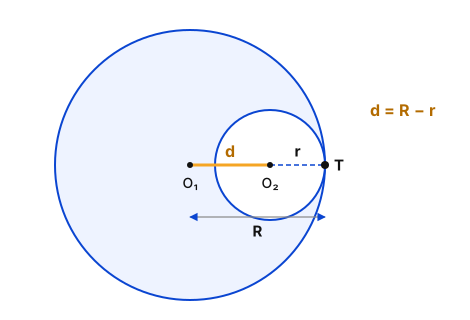
- d = R + r → touch externally.
- d = R − r → touch internally.
- d = 0 → concentric; R − r < d < R + r → intersect.
Trick: 'Difference' of radii ↔ 'internal'; 'sum' of radii ↔ 'external'.
Answer: (C) the circles touch internally
अवधारणा: केंद्रों की दूरी (d) की तुलना R + r और R − r से करें।
- d = R + r → बाह्य स्पर्श।
- d = R − r → अन्तःस्पर्श।
- d = 0 → संकेंद्रीय; R − r < d < R + r → प्रतिच्छेद।
ट्रिक: त्रिज्याओं का 'अंतर' ↔ 'अंदर से' स्पर्श; 'योग' ↔ 'बाहर से' स्पर्श।
उत्तर: (C) वृत्त अंतःतः स्पर्श करते हैं
SSC CHSLQuantitative AptitudeTwo circles – internal touchingSSC CHSL 2025 · 18 Nov Shift 1
Q883.In a circle, chord AB subtends 80° at the center. The angle between the tangents at A and B is:
एक वृत्त में जीवा AB केंद्र पर 80° का कोण अंतरित करती है। A तथा B पर खींची गई स्पर्श रेखाओं के बीच का कोण है:
- A70°
- B100°
- C140°
- D130°
Show answer
Concept: Radius ⊥ tangent; angle at centre + angle between tangents = 180°.
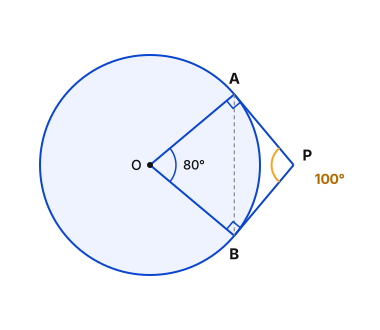
- In quadrilateral OAPB: ∠A = ∠B = 90°.
- ∠P = 360° − 90° − 90° − 80° = 100°.
Trick: Angle between tangents = 180° − central angle = 180° − 80° = 100°.
Answer: (B) 100°
अवधारणा: त्रिज्या ⊥ स्पर्श रेखा; केंद्र पर कोण + स्पर्श रेखाओं के बीच कोण = 180°।
- चतुर्भुज OAPB में ∠A = ∠B = 90°।
- ∠P = 360° − 90° − 90° − 80° = 100°।
ट्रिक: स्पर्श रेखाओं के बीच कोण = 180° − केंद्रीय कोण = 100°।
उत्तर: (B) 100°
SSC CHSLQuantitative AptitudeAngle between two tangentsSSC CHSL 2025 · 18 Nov Shift 1
Q884.The radius of the circle passing through the vertices of a triangle with sides , and 17 cm is:
उस वृत्त की त्रिज्या ज्ञात कीजिए जो तथा 17 cm भुजाओं वाले त्रिभुज के शीर्षों से होकर जाता है:
- A7.5 cm
- B8 cm
- C7.8 cm
- D8.5 cm
Show answer
Concept: In a right triangle, .
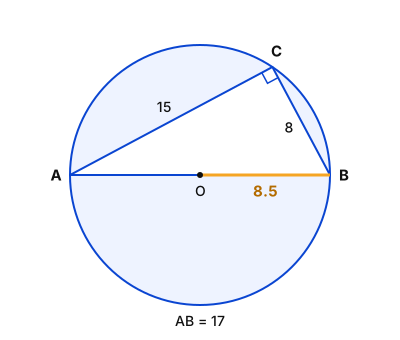
- → right triangle.
- = 8.5 cm.
Trick: Spot the triplet (8, 15, 17) — then just halve the largest side.
Answer: (D) 8.5 cm
अवधारणा: समकोण त्रिभुज में ।
- → समकोण त्रिभुज।
- = 8.5 cm।
ट्रिक: त्रिक (8, 15, 17) पहचानें — सबसे बड़ी भुजा का आधा = उत्तर।
उत्तर: (D) 8.5 cm
SSC CHSLQuantitative AptitudeCircumradius of a right triangleSSC CHSL 2025 · 18 Nov Shift 1
Q885.The circumference of a circle is 154 cm . The radius of the given circle is equal to the radius of a cone having height 14 cm . Find the approximate volume of the cone. (Take )
एक वृत्त की परिधि 154 cm है। दिए गए वृत्त की त्रिज्या, 14 cm ऊँचाई वाले एक शंकु की त्रिज्या के बराबर है। शंकु का लगभग आयतन ज्ञात कीजिए। ( लीजिए)
- A
- B
- C
- D
Show answer
Concept: ; .
- cm.
- .
- 8803 cm³.
Trick: cancels the 7 of – always cancel 7 first, then multiply.
Answer: (A)
अवधारणा: ; ।
- cm।
- ।
- 8803 cm³।
ट्रिक: से का 7 कट जाता है — पहले 7 काटें, फिर गुणा करें।
उत्तर: (A)
SSC CHSLQuantitative AptitudeVolume of a coneSSC CHSL 2025 · 18 Nov Shift 1
Q886.A circle is inscribed in , touching and PR at the points A , and , respectively. If , and the perimeter of , then (in cm) is:
एक वृत्त में अंतर्निहित है, जो तथा PR को क्रमशः बिंदु A , तथा पर स्पर्श करता है। यदि , तथा परिमाप हो, तो (cm में) कितना होगा?
- A13
- B11
- C16
- D15
Show answer
Concept: Tangents from one external point are equal: PA = PC = x, QA = QB = y, RB = RC = z.
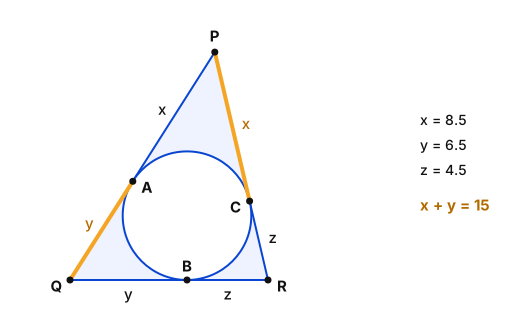
- PQ = x + y, QR = y + z, PR = x + z; 2(x + y + z) = 39 → x + y + z = 19.5.
- PQ − QR = x − z = 4; PQ − PR = y − z = 2.
- 3z + 6 = 19.5 → z = 4.5; x = 8.5, y = 6.5.
- AQ + PC = y + x = 15 cm.
Trick: AQ + PC = x + y = semi-perimeter − z = 19.5 − 4.5 = 15.
Answer: (D) 15
अवधारणा: एक बाहरी बिंदु से खींची स्पर्श रेखाएँ बराबर: PA = PC = x, QA = QB = y, RB = RC = z।
- PQ = x + y, QR = y + z, PR = x + z; 2(x + y + z) = 39 → x + y + z = 19.5।
- PQ − QR = x − z = 4; PQ − PR = y − z = 2।
- 3z + 6 = 19.5 → z = 4.5; x = 8.5, y = 6.5।
- AQ + PC = y + x = 15 cm।
ट्रिक: AQ + PC = x + y = अर्धपरिमाप − z = 19.5 − 4.5 = 15।
उत्तर: (D) 15
SSC CHSLQuantitative AptitudeIncircle – equal tangent lengthsSSC CHSL 2025 · 18 Nov Shift 1
Q887.A man lends out a sum of money by putting 30% of it at 7.5% p.a. simple interest and the remaining 70% at 11.25% p.a. simple interest. After years ( 2.5 years) his total interest income is ₹7,825. What was the original sum (principal) he lent?
एक व्यक्ति अपनी धनराशि का 30% भाग 7.5% वार्षिक साधारण ब्याज पर तथा शेष 70% भाग 11.25% वार्षिक साधारण ब्याज पर उधार देता है। वर्ष (2.5 वर्ष) के बाद उसकी कुल ब्याज आय ₹7,825 है। उसने मूल रूप से कितनी धनराशि (मूलधन) उधार दी थी?
- ARs. 30,913.58
- BRs. 34,916 . 63
- CRs.
- DRs. 30 , 916 . 36
Show answer
Concept: Find one average rate for the whole sum, then .
- Average rate = .
- For 2.5 years: of P = ₹7825.
- P = ≈ ₹30,913.58.
Trick: Weighted rate: 70% of the sum is at 11.25%, so the average rate lies nearer 11.25 (≈ 10.1%).
Answer: (A) Rs. 30,913.58
अवधारणा: पूरे धन के लिए एक औसत दर निकालें, फिर ।
- औसत दर = ।
- 2.5 वर्ष के लिए: = P का 25.3125% = ₹7825।
- P = ≈ ₹30,913.58।
ट्रिक: भारित दर: 70% भाग 11.25% पर है, इसलिए औसत दर 11.25 के करीब (≈10.1%)।
उत्तर: (A) Rs. 30,913.58
SSC CHSLQuantitative AptitudeSimple interest – sum split at two ratesSSC CHSL 2025 · 18 Nov Shift 1
Q888.Ankush spends 85% of his income, whereas Ankit spends 70% of his income. Both of them save Rs. 9,000 each. The income of Mohit is one-third of the sum of the income of Ankush and Ankit . If Mohit spends th of his income, then find his savings.
अंकुश अपनी आय का 85% खर्च करता है, जबकि अंकित अपनी आय का 70% खर्च करता है। उनमें से प्रत्येक Rs. 9,000 की बचत करता है। मोहित की आय, अंकुश और अंकित की आय के योग की एक-तिहाई है। यदि मोहित अपनी आय का वाँ भाग खर्च करता है, तो उसकी बचत ज्ञात कीजिए।
- ARs. 6666.67
- BRs. 8676.67
- CRs. 7666.67
- DRs. 7665.67
Show answer
Concept: Savings % = 100 − expenditure %.
- Ankush saves → income = = ₹60,000.
- Ankit saves → income = ₹30,000.
- Mohit's income = = ₹30,000.
- Mohit saves → = ₹6666.67.
Trick: Answer must be a multiple of of 30,000 (= 3333.33) → only 6666.67 fits.
Answer: (A) Rs. 6666.67
अवधारणा: बचत % = 100 − व्यय %।
- अंकुश 15% बचाता है = 9000 → आय = = ₹60,000।
- अंकित 30% बचाता है = 9000 → आय = ₹30,000।
- मोहित की आय = = ₹30,000।
- मोहित की बचत = → = ₹6666.67।
ट्रिक: उत्तर 30,000 के (3333.33) का गुणज होना चाहिए → केवल 6666.67।
उत्तर: (A) Rs. 6666.67
SSC CHSLQuantitative AptitudeIncome, expenditure and savingsSSC CHSL 2025 · 18 Nov Shift 1
Q889.In a partnership, the capital ratio between P and Q is . If P invested Rs 80,000 , how much did Q invest ?
एक साझेदारी में P और Q की पूँजी का अनुपात है। यदि P ने Rs 80,000 निवेश किए, तो Q ने कितना निवेश किया?
- ARs 60,000
- BRs 67,000
- CRs 85,000
- DRs 65,000
Show answer
Concept: Use the given ratio as a proportion.
- P : Q = .
- 8 parts = 80,000 → 1 part = 10,000.
- Q = = ₹60,000.
Trick: P is 8 units = 80,000, so each unit is 10,000 — read Q directly: 60,000.
Answer: (A) Rs 60,000
अवधारणा: दिए अनुपात को समानुपात की तरह प्रयोग करें।
- P : Q = ।
- 8 भाग = 80,000 → 1 भाग = 10,000।
- Q = = ₹60,000।
ट्रिक: 8 इकाई = 80,000 → 1 इकाई = 10,000 → Q = 60,000 सीधे।
उत्तर: (A) Rs 60,000
SSC CHSLQuantitative AptitudePartnership – capital ratioSSC CHSL 2025 · 18 Nov Shift 1
Q890.Two students' scores are 70% and 80% of a test's total score. What is the ratio of the first student's score to the second student's score?
दो विद्यार्थियों के अंक किसी परीक्षा के कुल अंकों के क्रमशः 70% और 80% हैं। पहले विद्यार्थी के अंकों का दूसरे विद्यार्थी के अंकों से अनुपात क्या है?
- A8 : 7
- B7 : 8
- C7 : 6
- D6 : 8
Show answer
Concept: Percentages of the same total compare directly.
- Scores = 70% and 80% of the same total.
- Ratio = 70 : 80 = 7 : 8.
Trick: Same base → just compare the percentages; mind the order (first : second).
Answer: (B) 7 : 8
अवधारणा: एक ही कुल के प्रतिशत सीधे तुलना किए जा सकते हैं।
- अंक = एक ही कुल का 70% और 80%।
- अनुपात = 70 : 80 = 7 : 8।
ट्रिक: आधार समान हो तो प्रतिशत ही अनुपात है; क्रम (पहला : दूसरा) ध्यान रखें।
उत्तर: (B) 7 : 8
SSC CHSLQuantitative AptitudeRatio from percentagesSSC CHSL 2025 · 18 Nov Shift 1
Q891.The average age of 12 players of a cricket team is the same as it was 3 years ago because 4 players, whose current average age is 30 years, have been replaced by 4 new players. What is the average age of new players ?
एक क्रिकेट टीम के 12 खिलाड़ियों की औसत आयु वही है जो 3 वर्ष पहले थी, क्योंकि 4 खिलाड़ियों, जिनकी वर्तमान औसत आयु 30 वर्ष है, के स्थान पर 4 नए खिलाड़ी सम्मिलित किए गए हैं। नए खिलाड़ियों की औसत आयु क्या है?
- A26 years26 वर्ष
- B21 years21 वर्ष
- C24 years24 वर्ष
- D17 years17 वर्ष
Show answer
Concept: Same average after 3 years ⇒ the total age gained must be cancelled by the replacement.
- Total age gain in 3 years = years.
- Outgoing 4 players' total = .
- New 4 players' total = → average = = 21 years.
Trick: .
Answer: (B) 21 years
अवधारणा: 3 वर्ष बाद भी औसत वही ⇒ बढ़ी हुई कुल आयु प्रतिस्थापन से घटनी चाहिए।
- 3 वर्ष में कुल आयु वृद्धि = वर्ष।
- जाने वाले 4 खिलाड़ियों का योग = ।
- नए 4 का योग = → औसत = = 21 वर्ष।
ट्रिक: ।
उत्तर: (B) 21 वर्ष
SSC CHSLQuantitative AptitudeAverage age – replacement of membersSSC CHSL 2025 · 18 Nov Shift 1
Q892.The average of 17 numbers is 32 . If each number is doubled and then 8 is added to each, what will be the new average ?
17 संख्याओं का औसत 32 है। यदि प्रत्येक संख्या को दोगुना करके उसमें 8 जोड़ दिया जाए, तो नया औसत क्या होगा?
- A68
- B72
- C71
- D74
Show answer
Concept: Any operation done on every number is done on the average too.
- Double: .
- Add 8: = 72.
Trick: Ignore the count (17) completely — new average = .
Answer: (B) 72
अवधारणा: हर संख्या पर जो संक्रिया हो, वही औसत पर भी होती है।
- दोगुना: ।
- 8 जोड़ें: = 72।
ट्रिक: संख्या की गिनती (17) की ज़रूरत नहीं — नया औसत = ।
उत्तर: (B) 72
SSC CHSLQuantitative AptitudeEffect of operations on averageSSC CHSL 2025 · 18 Nov Shift 1
Q893.A flight covers in 4 hours. By what percent should its speed be decreased to cover the same distance in 5 hours?
एक विमान की दूरी 4 घंटे में तय करता है। उसी दूरी को 5 घंटे में तय करने के लिए उसकी चाल में कितने प्रतिशत की कमी की जानी चाहिए?
- A25 %
- B20 %
- C23%
- D28%
Show answer
Concept: Distance fixed → .
- Time ratio → speed ratio .
- Decrease = 1 out of 5 = = 20%.
- Check: 475 → 380 km/h, drop 95 = 20% of 475.
Trick: Time up by → speed down by .
Answer: (B) 20 %
अवधारणा: दूरी स्थिर → ।
- समय अनुपात → चाल अनुपात ।
- कमी = 5 में से 1 = = 20%।
- जाँच: 475 → 380 km/h, कमी 95 = 475 का 20%।
ट्रिक: समय बढ़े तो चाल घटेगी।
उत्तर: (B) 20 %
SSC CHSLQuantitative AptitudeSpeed decrease for longer timeSSC CHSL 2025 · 18 Nov Shift 1
Q894.A shopkeeper offers a 30% discount on the marked price of an article. If the marked price of the article is ₹3,500 and the shopkeeper further gives a discount on the already reduced price, what is the final selling price of the article?
एक दुकानदार किसी वस्तु के अंकित मूल्य पर 30% की छूट देता है। यदि वस्तु का अंकित मूल्य ₹3,500 है तथा दुकानदार पहले से घटे हुए मूल्य पर की और छूट देता है, तो वस्तु का अंतिम विक्रय मूल्य क्या है?
- A₹2082.5
- B₹2182.5
- C₹3082.5
- D₹2242.5
Show answer
Concept: Each discount applies to the price left after the previous one.
- After 30%: = ₹2450.
- After 15%: = ₹2082.5.
Trick: Net factor = → .
Answer: (A) ₹2082.5
अवधारणा: हर छूट पिछली छूट के बाद बची कीमत पर लगती है।
- 30% के बाद: = ₹2450।
- 15% के बाद: = ₹2082.5।
ट्रिक: कुल गुणक = → ।
उत्तर: (A) ₹2082.5
SSC CHSLQuantitative AptitudeSuccessive discountsSSC CHSL 2025 · 18 Nov Shift 1
Q895.A shopkeeper offers two successive discounts of 20% and 30% on a laptop priced at ₹50,000. What is the final selling price after both discounts?
एक दुकानदार ₹50,000 मूल्य के एक लैपटॉप पर 20% तथा 30% की दो क्रमिक छूट देता है। दोनों छूटों के बाद अंतिम विक्रय मूल्य क्या है?
- A₹32,000
- B₹30,600
- C₹28,000
- D₹34,000
Show answer
Concept: Successive discounts multiply, not add.
- After 20%: .
- After 30%: = ₹28,000.
Trick: Equivalent single discount = → pay 56% of 50,000 = 28,000.
Answer: (C) ₹28,000
अवधारणा: क्रमिक छूट जुड़ती नहीं, गुणा होती है।
- 20% के बाद: ।
- 30% के बाद: = ₹28,000।
ट्रिक: समतुल्य छूट = → 50,000 का 56% = 28,000।
उत्तर: (C) ₹28,000
SSC CHSLQuantitative AptitudeSuccessive discountsSSC CHSL 2025 · 18 Nov Shift 1
Q896.A 80 -litre container is filled with a solution of wine and water, with the ratio of wine to water being . If 16 litres of the solution is removed and replaced with 16 litres of pure water, what is the new ratio of wine to water ?
80 लीटर के एक पात्र में शराब और पानी का मिश्रण भरा है, जिसमें शराब और पानी का अनुपात है। यदि मिश्रण में से 16 लीटर निकालकर उसके स्थान पर 16 लीटर शुद्ध पानी मिला दिया जाए, तो शराब और पानी का नया अनुपात क्या होगा?
- A2 : 3
- B1 : 1
- C3 : 4
- D7 : 3
Show answer
Concept: Removing part of a mixture removes each liquid in the same ratio.
- Wine = L; water = 30 L.
- 16 L = removed → wine 40 L, water 24 L.
- Add 16 L water → water 40 L.
- Wine : water = = .
Trick: Wine only gets removed, never added: ; total stays 80 → water = 40.
Answer: (B) 1 : 1
अवधारणा: मिश्रण का कुछ भाग निकालने पर हर द्रव उसी अनुपात में निकलता है।
- वाइन = L; पानी = 30 L।
- 16 L = निकाला → वाइन 40 L, पानी 24 L।
- 16 L पानी मिलाया → पानी 40 L।
- वाइन : पानी = = ।
ट्रिक: वाइन केवल घटती है: ; कुल 80 ही रहता है → पानी = 40।
उत्तर: (B) 1 : 1
SSC CHSLQuantitative AptitudeMixture – removal and replacementSSC CHSL 2025 · 18 Nov Shift 1
Q897.Arrange in ascending order: .
आरोही क्रम में व्यवस्थित कीजिए: ।
- A
- B
- C
- D
Show answer
Concept: Raise all roots to the LCM of their orders to remove the radicals.
- Numbers: , , ; .
- 12th powers: , , .
- → .
Trick: Same order roots (, ) compare directly: ; only needs checking.
Answer: (A)
अवधारणा: सभी मूलों को उनकी घातों के LCM तक उठाएँ ताकि करणी हट जाए।
- संख्याएँ: , , ; ।
- 12वीं घात: , , ।
- → ।
ट्रिक: एक जैसी घात वाले (, ) सीधे तुलना: ; केवल जाँचें।
उत्तर: (A)
SSC CHSLQuantitative AptitudeComparing surds of different ordersSSC CHSL 2025 · 18 Nov Shift 1
Q898.Find the equation of the line with slope -3 passing through the point .
-3 ढाल (slope) वाली तथा बिंदु से होकर जाने वाली रेखा का समीकरण ज्ञात कीजिए।
- A
- B
- C
- D
Show answer
Concept: y − y₁ = m(x − x₁).
- m = −3, point (4, 6).
- y − 6 = −3(x − 4) = −3x + 12.
- y = −3x + 18.
Trick: Put x = 4 in each option: only y = −3x + 18 gives y = 6 with slope −3.
Answer: (A)
अवधारणा: y − y₁ = m(x − x₁)।
- m = −3, बिंदु (4, 6)।
- y − 6 = −3(x − 4) = −3x + 12।
- y = −3x + 18।
ट्रिक: विकल्पों में x = 4 रखें: ढाल −3 के साथ y = 6 केवल y = −3x + 18 देता है।
उत्तर: (A)
SSC CHSLQuantitative AptitudeEquation of a line – point-slope formSSC CHSL 2025 · 18 Nov Shift 1
Q899.Two similar triangles have areas of and . If the perimeter of the smaller triangle is 30 meters, what is the perimeter of the larger triangle ?
दो समरूप त्रिभुजों के क्षेत्रफल और हैं। यदि छोटे त्रिभुज का परिमाप 30 मीटर है, तो बड़े त्रिभुज का परिमाप क्या है?
- A40 m
- B35 m
- C33 m
- D42 m
Show answer
Concept: Area ratio = ; perimeters follow the side ratio.
- Area ratio → side ratio .
- Larger perimeter = = 40 m.
Trick: Take square roots of the areas (6, 8) and scale: .
Answer: (A) 40 m
अवधारणा: क्षेत्रफल अनुपात = ; परिमाप भुजा अनुपात में।
- क्षेत्रफल → भुजा ।
- बड़े त्रिभुज का परिमाप = = 40 m।
ट्रिक: क्षेत्रफलों का वर्गमूल (6, 8) लें: ।
उत्तर: (A) 40 m
SSC CHSLQuantitative AptitudeSimilar triangles – area and perimeterSSC CHSL 2025 · 18 Nov Shift 1
Q900.In triangle and are points on sides and such that . If , and , what is the ratio of the area of triangle to the area of triangle ABC ?
त्रिभुज तथा भुजाओं और पर स्थित ऐसे बिंदु हैं कि । यदि , तथा हो, तो त्रिभुज के क्षेत्रफल का त्रिभुज ABC के क्षेत्रफल से अनुपात क्या है?
- A
- B1 : 16
- C5 : 9
- D8 : 12
Show answer
Concept: ; area ratio = .
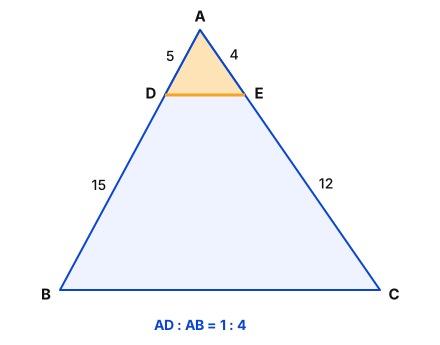
- ; (also ).
- Area ratio = = .
Trick: Don't use AD : DB — always use AD : AB , then square.
Answer: (B) 1 : 16
अवधारणा: ; क्षेत्रफल अनुपात = ।
- ; ( भी)।
- क्षेत्रफल अनुपात = = ।
ट्रिक: AD : DB नहीं, AD : AB लेकर वर्ग करें।
उत्तर: (B) 1 : 16
SSC CHSLQuantitative AptitudeBPT – area ratio of similar trianglesSSC CHSL 2025 · 18 Nov Shift 1

