Q901.The average marks of 20 students in a mathematics test were 55. Later, it was discovered that one student's marks were wrongly recorded as 40 instead of 70. After correction, the average increases. A new student then joins the group whose marks are 20% more than the corrected average. What is the final average of the group?
किसी गणित परीक्षा में 20 विद्यार्थियों के औसत अंक 55 थे। बाद में पता चला कि एक विद्यार्थी के अंक 70 के स्थान पर गलती से 40 दर्ज कर दिए गए थे। संशोधन के बाद औसत बढ़ जाता है। फिर एक नया विद्यार्थी समूह में सम्मिलित होता है जिसके अंक संशोधित औसत से 20% अधिक हैं। समूह का अंतिम औसत क्या है?
- A57.10
- B57.04
- C57.20
- D56.15
Show answer
Concept: Work with totals: total = average × count.
- Old total = ; correction adds → 1130.
- Corrected average = ; new student = .
- Final average = 57.04.
Trick: Newcomer is above average → average rises by → .
Answer: (B) 57.04
अवधारणा: कुल योग पर काम करें: योग = औसत × संख्या।
हल:
- पुराना योग = ; संशोधन से जुड़ा → 1130।
- संशोधित औसत = ; नया छात्र = ।
- अंतिम औसत = 57.04।
ट्रिक: नया छात्र औसत से 11.3 अधिक → औसत बढ़ेगा → ।
उत्तर: (B) 57.04
SSC CHSLQuantitative AptitudeAverage – correction and new entrySSC CHSL 2025 · 17 Nov Shift 3
Q902.Ram invests 32% of his income in mutual funds, 28% in fixed deposits, and the rest in recurring deposits. After 2 years, the mutual funds grow by 25%, fixed deposits by , and recurring deposits by 20%. If his total income is ₹ , what is the total percentage return on his entire investment portfolio after 2 years?
राम अपनी आय का 32% म्यूचुअल फंड में, 28% सावधि जमा (fixed deposit) में तथा शेष आवर्ती जमा (recurring deposit) में निवेश करता है। 2 वर्ष बाद म्यूचुअल फंड 25% बढ़ जाता है, सावधि जमा बढ़ जाती है तथा आवर्ती जमा 20% बढ़ जाती है। यदि उसकी कुल आय ₹ है, तो 2 वर्ष बाद उसके सम्पूर्ण निवेश पर कुल प्रतिशत प्रतिफल क्या है?
- A18.8%
- B15.25%
- C14.85%
- D18%
Show answer
Concept: Overall return % = weighted average of the separate returns (weights = share invested).
- Shares: MF 32%, FD 28%, RD .
- Return = 18.8%.
- (In rupees: gain ₹33,840 on ₹1,80,000 = 18.8%.)
Trick: The income figure is not needed – percentage weights alone give the answer.
Answer: (A) 18.8%
अवधारणा: कुल प्रतिफल % = अलग-अलग प्रतिफलों का भारित औसत (भार = निवेश का हिस्सा)।
हल:
- हिस्से: MF 32%, FD 28%, RD ।
- प्रतिफल = 18.8%।
- (रुपयों में: ₹1,80,000 पर लाभ ₹33,840 = 18.8%)
ट्रिक: आय की राशि की ज़रूरत ही नहीं – केवल प्रतिशत भार से उत्तर मिल जाता है।
उत्तर: (A) 18.8%
SSC CHSLQuantitative AptitudePercentage – weighted returnSSC CHSL 2025 · 17 Nov Shift 3
Q903.The price of a television is increased by 25% and then a discount of 20% is offered on the new price. If the final price becomes ₹84,000, what was the original price?
एक टेलीविजन के मूल्य में 25% की वृद्धि की जाती है और फिर नए मूल्य पर 20% की छूट दी जाती है। यदि अंतिम मूल्य ₹84,000 हो जाता है, तो मूल मूल्य क्या था?
- A₹72,000
- B₹60,000
- C₹54,200
- D₹84,000
Show answer
Concept: Net effect of +a% then −b% = .
- +25% then −20%: net change.
- So final price = original price.
- Original = ₹84,000.
Trick: and – they cancel exactly.
Answer: (D) ₹84,000
अवधारणा: +a% फिर −b% का शुद्ध प्रभाव = ।
हल:
- +25% फिर −20%: परिवर्तन।
- अतः अंतिम मूल्य = मूल मूल्य।
- मूल मूल्य = ₹84,000।
ट्रिक: और – दोनों एक-दूसरे को काट देते हैं।
उत्तर: (D) ₹84,000
SSC CHSLQuantitative AptitudeSuccessive percentage changeSSC CHSL 2025 · 17 Nov Shift 3
Q904.A number has 3 in its unit place; then its square can be:
किसी संख्या के इकाई स्थान पर 3 है; तो उसका वर्ग हो सकता है:
- A129
- B169
- C189
- D149
Show answer
Concept: A number ending in 3 has a square ending in 9, and the option must also be a perfect square.
- All options end in 9, so check which is a perfect square.
- , , → only 169 is a square.
- , and 13 ends in 3 ✓.
Yaad rakhein: Squares end only in 0, 1, 4, 5, 6, 9; a number ending in 3 or 7 gives a square ending in 9.
Answer: (B) 169
अवधारणा: 3 पर ख़त्म होने वाली संख्या का वर्ग 9 पर ख़त्म होता है; साथ ही विकल्प पूर्ण वर्ग होना चाहिए।
हल:
- सभी विकल्प 9 पर ख़त्म, अतः पूर्ण वर्ग जाँचें।
- , , → केवल 169 पूर्ण वर्ग।
- , और 13 का इकाई अंक 3 ✓।
याद रखें: वर्ग का इकाई अंक केवल 0, 1, 4, 5, 6, 9 होता है; 3 या 7 वाली संख्या का वर्ग 9 पर ख़त्म।
उत्तर: (B) 169
SSC CHSLQuantitative AptitudeSquares – unit digitSSC CHSL 2025 · 17 Nov Shift 3
Q905.Find the square root of 3025 .
3025 का वर्गमूल ज्ञात कीजिए।
- A35
- B45
- C55
- D65
Show answer
Concept: A square ending in 25 has a root ending in 5.
- Unit digit of root = 5.
- Remaining part 30 lies between and → tens digit 5.
- 55 (check: ).
Trick: For : followed by 25 → → 3025, so root = 55.
Answer: (C) 55
अवधारणा: 25 पर ख़त्म होने वाले वर्ग का मूल 5 पर ख़त्म होता है।
हल:
- मूल का इकाई अंक = 5।
- शेष 30, और के बीच → दहाई अंक 5।
- 55 (जाँच: )।
ट्रिक: के बाद 25 → → 3025, अतः मूल 55।
उत्तर: (C) 55
SSC CHSLQuantitative AptitudeSquare rootSSC CHSL 2025 · 17 Nov Shift 3
Q906.A circular pipe has an external diameter of 54 cm and an internal diameter of 38 cm . Find the area of the cross-section of the pipe.
एक वृत्ताकार पाइप का बाह्य व्यास 54 cm तथा आंतरिक व्यास 38 cm है। पाइप के अनुप्रस्थ काट का क्षेत्रफल ज्ञात कीजिए।
- A
- B
- C
- D
Show answer
Concept: Cross-section of a pipe = .
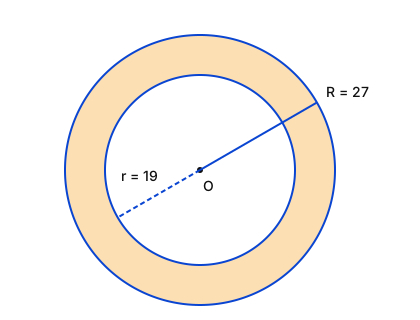
- , .
- .
- Area = 1156.57 cm².
Trick: Use – no need to square 27 and 19.
Answer: (D)
अवधारणा: पाइप का अनुप्रस्थ काट = ।
हल:
- , ।
- ।
- क्षेत्रफल = 1156.57 cm²।
ट्रिक: लगाएँ – 27 और 19 का वर्ग करने की ज़रूरत नहीं।
उत्तर: (D)
SSC CHSLQuantitative AptitudeMensuration – area of a ringSSC CHSL 2025 · 17 Nov Shift 3
Q907.If , then find the value of ( C).
यदि है, तो ( C) का मान ज्ञात कीजिए।
- A-19
- B-17
- C-22
- D-18
Show answer
Concept: .
- → quotient = .
- Match with : , , .
- −19.
Trick: Watch the sign: the "−B" in the given form makes B negative.
Answer: (A) -19
अवधारणा: ।
हल:
- → भागफल = ।
- से मिलाएँ: , , ।
- −19।
ट्रिक: चिह्न पर ध्यान दें: दिए रूप में "−B" है, इसलिए B ऋणात्मक है।
उत्तर: (A) -19
SSC CHSLQuantitative AptitudeAlgebra – difference of cubesSSC CHSL 2025 · 17 Nov Shift 3
Q908.If , then find the value of .
यदि है, तो का मान ज्ञात कीजिए।
- A11
- B18
- C10
- D9
Show answer
Concept: If a sum of real squares is 0, each square is 0.
- .
- .
- 9.
Trick: Values = half the coefficients inside the bracket: → , , directly.
Answer: (D) 9
अवधारणा: वास्तविक वर्गों का योग 0 हो तो हर वर्ग 0 होता है।
हल:
- ।
- ।
- 9।
ट्रिक: में कोष्ठक के गुणांक ही मान हैं: , , ।
उत्तर: (D) 9
SSC CHSLQuantitative AptitudeAlgebra – sum of squares equals zeroSSC CHSL 2025 · 17 Nov Shift 3
Q909.A right circular cone has a base circumference of 22 cm and a slant height of 7 cm . Find its curved surface area.
एक लंब वृत्तीय शंकु के आधार की परिधि 22 cm तथा तिर्यक ऊँचाई 7 cm है। इसका वक्र पृष्ठीय क्षेत्रफल ज्ञात कीजिए।
- A
- B
- C
- D
Show answer
Concept: CSA of cone = .
- .
- CSA = 77 cm².
Trick: No need to find r: CSA = .
Answer: (B)
अवधारणा: शंकु का वक्र पृष्ठ = ।
हल:
- ।
- वक्र पृष्ठ = 77 cm²।
ट्रिक: r निकालने की ज़रूरत नहीं: ।
उत्तर: (B)
SSC CHSLQuantitative AptitudeCone – curved surface areaSSC CHSL 2025 · 17 Nov Shift 3
Q910.If , and A is acute, find the value of .
यदि है और A एक न्यून कोण है, तो का मान ज्ञात कीजिए।
- A-2
- B-3
- C0
- D1
Show answer
Concept: for every valid angle.
- From → .
- Check: , .
- Value = 1.
Trick: The given value of is a distractor – the identity is always 1.
Answer: (D) 1
अवधारणा: (हर मान्य कोण के लिए)।
हल:
- → ।
- जाँच: , ।
- मान = 1।
ट्रिक: का मान केवल भटकाने के लिए है – सर्वसमिका का मान सदा 1।
उत्तर: (D) 1
SSC CHSLQuantitative AptitudeTrigonometric identitySSC CHSL 2025 · 17 Nov Shift 3
Q911.If and , then find the value of
यदि तथा है, तो का मान ज्ञात कीजिए।
- A
- B
- C
- D
Show answer
Concept: .
- Numerator = .
- .
- Value = .
Trick: Since every term has denominator 169, use the sides directly: .
Answer: (C)
अवधारणा: ।
हल:
- अंश = ।
- ।
- मान = ।
ट्रिक: सब में हर 169 है, तो सीधे भुजाओं से: ।
उत्तर: (C)
SSC CHSLQuantitative AptitudeTrigonometry – simplificationSSC CHSL 2025 · 17 Nov Shift 3
Q912.A sum was invested at simple interest, and it became times of what it had amounted to in 2 years when invested for 5 years. What is the rate of interest?
एक धनराशि साधारण ब्याज पर निवेश की गई। 5 वर्ष के लिए निवेश करने पर यह उस मिश्रधन की गुनी हो गई, जो 2 वर्ष में प्राप्त हुआ था। ब्याज की दर क्या है?
- A11%
- B10.22%
- C
- D5.47%
Show answer
Concept: Under SI, interest per year is constant; difference of amounts = interest for the extra years.
- Let A(2 yr) = 117 units, A(5 yr) = 147 units → 3 years' SI = 30 → 1 year = 10.
- Principal = units.
- Rate = 10.3%.
Trick: Take the ratio numbers as amounts directly – no variable needed.
Answer: (C)
अवधारणा: साधारण ब्याज में हर वर्ष ब्याज समान; मिश्रधनों का अंतर = अतिरिक्त वर्षों का ब्याज।
हल:
- 2 वर्ष का मिश्रधन = 117 इकाई, 5 वर्ष का = 147 इकाई → 3 वर्ष का ब्याज = 30 → 1 वर्ष = 10।
- मूलधन = इकाई।
- दर = 10.3%।
ट्रिक: अनुपात की संख्याओं को ही मिश्रधन मान लें – चर की ज़रूरत नहीं।
उत्तर: (C)
SSC CHSLQuantitative AptitudeSimple interest – rate from amountsSSC CHSL 2025 · 17 Nov Shift 3
Q913.A quadrilateral is circumscribed about a circle. The sides of the quadrilateral are tangent to the circle. If the lengths of the sides are given as , and CD , what is the length of the fourth side, AD ?
एक चतुर्भुज एक वृत्त के परिगत बना है। चतुर्भुज की भुजाएँ वृत्त की स्पर्श रेखाएँ हैं। यदि भुजाओं की लंबाइयाँ तथा CD दी गई हों, तो चौथी भुजा AD की लंबाई क्या है?
- A8 cm8 सेमी
- B10 cm10 सेमी
- C9 cm9 सेमी
- D7 cm7 सेमी
Show answer
Concept: For a quadrilateral circumscribing a circle, sums of opposite sides are equal: AB + CD = BC + AD.
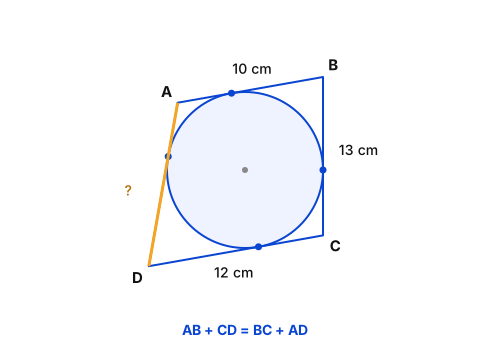
- Equal tangents from each vertex give this property.
- 10 + 12 = 13 + AD.
- AD = 22 − 13 = 9 cm.
Trick: Opposite sides pair up: AB with CD, BC with AD.
Answer: (C) 9 cm
अवधारणा: वृत्त के परिगत चतुर्भुज में आमने-सामने की भुजाओं का योग बराबर: AB + CD = BC + AD।
हल:
- हर शीर्ष से खींची दोनों स्पर्श रेखाएँ बराबर होती हैं – इसी से यह गुण।
- 10 + 12 = 13 + AD।
- AD = 22 − 13 = 9 cm।
ट्रिक: आमने-सामने की भुजाएँ: AB–CD और BC–AD।
उत्तर: (C) 9 सेमी
SSC CHSLQuantitative AptitudeTangential quadrilateralSSC CHSL 2025 · 17 Nov Shift 3
Q914.A, B, and C are partners in a business. A and B are sharing the ratio in 4 : 5, and are sharing in . At the end of the year, the profit received is Rs 89000. What is the share of A ?
A, B और C एक व्यवसाय में साझेदार हैं। A और B का अनुपात 4 : 5 है, तथा का अनुपात है। वर्ष के अंत में प्राप्त लाभ ₹89000 है। A का हिस्सा क्या है?
- ARs 32000₹32000
- BRs 24000₹24000
- CRs 36000₹36000
- DRs 38000₹38000
Show answer
Concept: Make the common term (B) equal in both ratios.
- A : B = 4 : 5 = 24 : 30; B : C = 6 : 7 = 30 : 35.
- A : B : C = 24 : 30 : 35, total 89.
- A = ₹24,000.
Trick: Total parts 89 and profit 89000 → 1 part = ₹1000 instantly.
Answer: (B) Rs 24000
अवधारणा: साझा पद (B) को दोनों अनुपातों में बराबर करें।
हल:
- A : B = 4 : 5 = 24 : 30; B : C = 6 : 7 = 30 : 35।
- A : B : C = 24 : 30 : 35, कुल 89।
- A = ₹24,000।
ट्रिक: कुल भाग 89 और लाभ 89000 → 1 भाग = ₹1000 तुरंत।
उत्तर: (B) ₹24000
SSC CHSLQuantitative AptitudePartnership – combining ratiosSSC CHSL 2025 · 17 Nov Shift 3
Q915.8 boys and 12 girls can complete the work in 16 days, while 6 boys and 14 girls can complete it in 20 days. In how many days will 20 girls complete it ?
8 लड़के और 12 लड़कियाँ एक कार्य को 16 दिनों में पूरा कर सकते हैं, जबकि 6 लड़के और 14 लड़कियाँ उसी कार्य को 20 दिनों में पूरा कर सकते हैं। 20 लड़कियाँ उस कार्य को कितने दिनों में पूरा करेंगी?
- A80 days80 दिन
- B82 days82 दिन
- C75 days75 दिन
- D60 Days60 दिन
Show answer
Concept: Same work: (workers × days) is equal in both cases.
- .
- Work = girl-days.
- 20 girls: 80 days.
Trick: Convert everyone into one unit (girls) first – then it is a simple division.
Answer: (A) 80 days
अवधारणा: काम एक ही है: (कामगार × दिन) दोनों स्थितियों में बराबर।
हल:
- → 1 लड़का = 11 लड़कियाँ।
- कुल काम = लड़की-दिन।
- 20 लड़कियाँ: 80 दिन।
ट्रिक: पहले सबको एक इकाई (लड़कियों) में बदलें – फिर सीधा भाग।
उत्तर: (A) 80 दिन
SSC CHSLQuantitative AptitudeTime and work – boys and girlsSSC CHSL 2025 · 17 Nov Shift 3
Q916.In triangle , and . Find the value of .
त्रिभुज है, तथा है। का मान ज्ञात कीजिए।
- A1
- B
- C
- D
Show answer
Concept: Find the third side by Pythagoras, then take ratios for angle P.
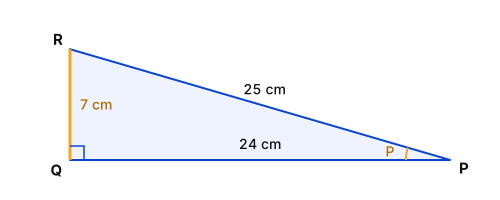
- → PR = 25 is the hypotenuse; .
- For : opposite = QR = 7, adjacent = PQ = 24.
- .
Trick: 7-24-25 is a Pythagorean triplet – no calculation needed for the third side.
Answer: (B)
अवधारणा: पाइथागोरस से तीसरी भुजा, फिर कोण P के अनुपात।
हल:
- → PR = 25 कर्ण; ।
- के लिए: लंब = QR = 7, आधार = PQ = 24।
- ।
ट्रिक: 7-24-25 पाइथागोरस त्रिक है – तीसरी भुजा तुरंत।
उत्तर: (B)
SSC CHSLQuantitative AptitudeTrigonometric ratios in a right triangleSSC CHSL 2025 · 17 Nov Shift 3
Q917.If , and lies in the first quadrant, find the value of .
यदि है, तथा प्रथम चतुर्थांश में स्थित है, तो का मान ज्ञात कीजिए।
- A
- B
- C
- D
Show answer
Concept: .
- .
- Add: .
- .
Trick: If , then .
Answer: (A)
अवधारणा: ।
हल:
- ।
- जोड़ने पर: ।
- ।
ट्रिक: हो तो ।
उत्तर: (A)
SSC CHSLQuantitative AptitudeTrigonometry – cosec + cotSSC CHSL 2025 · 17 Nov Shift 3
Q918.A line that touches a circle at exactly one point is called:
वह रेखा जो किसी वृत्त को ठीक एक बिंदु पर स्पर्श करती है, कहलाती है:
- ASecantछेदक रेखा
- BChordजीवा
- CTangentस्पर्श रेखा
- DDiameterव्यास
Show answer
Concept: A tangent meets a circle at exactly one point.
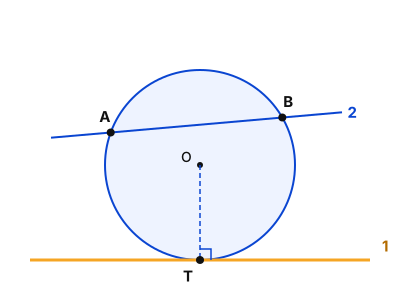
- Tangent → one point of contact; radius at that point is perpendicular to it.
- Secant cuts the circle at two points; chord and diameter join two points on the circle.
- So the answer is Tangent.
Yaad rakhein: Tangent = "touch" (Latin tangere); secant = "cut" (secare).
Answer: (C) Tangent
अवधारणा: स्पर्श रेखा वृत्त को केवल एक बिंदु पर छूती है।
हल:
- स्पर्श रेखा → एक स्पर्श बिंदु; उस बिंदु पर त्रिज्या उस पर लंब होती है।
- छेदक रेखा दो बिंदुओं पर काटती है; जीवा और व्यास वृत्त के दो बिंदुओं को जोड़ते हैं।
- अतः उत्तर स्पर्श रेखा।
याद रखें: Tangent = छूना; Secant = काटना।
उत्तर: (C) स्पर्श रेखा
SSC CHSLQuantitative AptitudeCircle – tangentSSC CHSL 2025 · 17 Nov Shift 3
Q919.The distance between two parallel chords of lengths 16 cm and 30cm in a circle of radius 17cm is:
17 सेमी त्रिज्या वाले एक वृत्त में 16 सेमी और 30 सेमी लंबाई की दो समांतर जीवाओं के बीच की दूरी है:
- A7 cm or 23 cm7 सेमी या 23 सेमी
- B7 cm or 25 cm7 सेमी या 25 सेमी
- C6 cm or 23 cm6 सेमी या 23 सेमी
- D6 cm or 25 cm6 सेमी या 25 सेमी
Show answer
Concept: Distance of a chord from centre = .
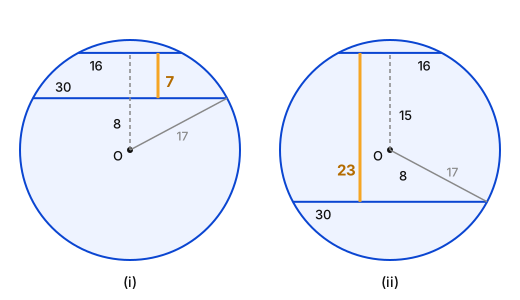
- 16 cm chord: .
- 30 cm chord: .
- Same side: ; opposite sides: → 7 cm or 23 cm.
Trick: 8-15-17 is a triplet: half-chords 8 and 15 give distances 15 and 8 straight away.
Answer: (A) 7 cm or 23 cm
अवधारणा: केंद्र से जीवा की दूरी = ।
हल:
- 16 cm जीवा: ।
- 30 cm जीवा: ।
- एक ही ओर: ; विपरीत ओर: → 7 या 23 cm।
ट्रिक: 8-15-17 त्रिक है: आधी जीवाएँ 8 और 15 → दूरियाँ 15 और 8 सीधे।
उत्तर: (A) 7 सेमी या 23 सेमी
SSC CHSLQuantitative AptitudeCircle – distance between parallel chordsSSC CHSL 2025 · 17 Nov Shift 3
Q920.A train travels a distance of 180 km in 6 hours. The speed of a car is 20% more than that of the train, and the speed of a bike is 25% more than that of the car. Find the difference between the time (in minutes) taken by the bike and the car to travel 30% more distance as travelled by the Train.
एक ट्रेन 180 किमी की दूरी 6 घंटे में तय करती है। एक कार की चाल ट्रेन की चाल से 20% अधिक है, और एक बाइक की चाल कार की चाल से 25% अधिक है। ट्रेन द्वारा तय की गई दूरी से 30% अधिक दूरी तय करने में बाइक और कार द्वारा लिए गए समय (मिनट में) का अंतर ज्ञात कीजिए।
- A78 minutes78 मिनट
- B70 minutes70 मिनट
- C72 minutes72 मिनट
- D80 minutes80 मिनट
Show answer
Concept: ; find each speed step by step.
- Train = ; car = ; bike = .
- Distance = .
- Car: h; bike: h → difference 1.3 h = 78 min.
Trick: Bike is of car speed → bike time = of car time → saving = h = 1.3 h.
Answer: (A) 78 minutes
अवधारणा: ; हर चाल क्रम से निकालें।
हल:
- ट्रेन = ; कार = ; बाइक = ।
- दूरी = ।
- कार: घंटे; बाइक: घंटे → अंतर 1.3 घंटे = 78 मिनट।
ट्रिक: बाइक की चाल कार की → समय → बचत = = 1.3 घंटे।
उत्तर: (A) 78 मिनट
SSC CHSLQuantitative AptitudeSpeed – percentage increaseSSC CHSL 2025 · 17 Nov Shift 3

