Q921.In a circle with center O , chords AB and CD intersect at point P . If and , what is the measure of ?
केंद्र O वाले एक वृत्त में जीवाएँ AB और CD बिंदु P पर प्रतिच्छेद करती हैं। यदि तथा है, तो की माप क्या है?
- A60°
- B65°
- C80°
- D75'
Show answer
Concept: Angle between two chords meeting inside = ½ (sum of intercepted arcs).
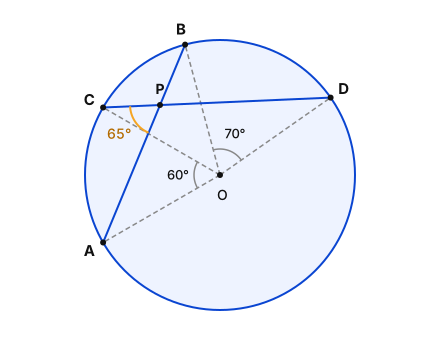
- Arc AC = ∠AOC = 60°, arc BD = ∠BOD = 70°.
- ∠APC = ½ (60° + 70°) = 65°.
Trick: Inside the circle → half the SUM of arcs; outside (secants) → half the DIFFERENCE.
Answer: (B) 65°
अवधारणा: वृत्त के अंदर मिलने वाली दो जीवाओं का कोण = ½ (कटे चापों का योग)।
हल:
- चाप AC = ∠AOC = 60°, चाप BD = ∠BOD = 70°।
- ∠APC = ½ (60° + 70°) = 65°।
ट्रिक: वृत्त के अंदर → चापों के योग का आधा; बाहर (छेदक) → अंतर का आधा।
उत्तर: (B) 65°
SSC CHSLQuantitative AptitudeCircle – angle between intersecting chordsSSC CHSL 2025 · 17 Nov Shift 3
Q922.If the angle subtended by a chord PQ at the center O is 120° and the length of the chord PQ is , what is the radius of the circle?
यदि केंद्र O पर जीवा PQ द्वारा अंतरित कोण 120° है और जीवा PQ की लंबाई है, तो वृत्त की त्रिज्या क्या है?
- A10 cm10 सेमी
- B5 cm5 सेमी
- C8 cm8 सेमी
- D
Show answer
Concept: Chord length = , = central angle.
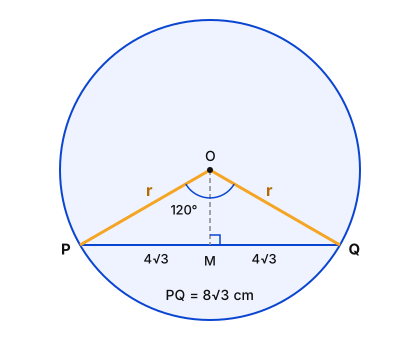
- .
- 8 cm.
Trick: A central angle always gives (side of inscribed equilateral triangle).
Answer: (C) 8 cm
अवधारणा: जीवा की लंबाई = , = केंद्रीय कोण।
हल:
- ।
- 8 cm।
ट्रिक: केंद्रीय कोण पर जीवा सदा होती है (अंतर्गत समबाहु त्रिभुज की भुजा)।
उत्तर: (C) 8 सेमी
SSC CHSLQuantitative AptitudeCircle – chord and central angleSSC CHSL 2025 · 17 Nov Shift 3
Q923.A solid is formed by placing a hemisphere on top of a cone, both having the same base radius. The volume of the hemispherical part is , and the height of the cone is 12 cm . Find the total surface area of the solid.
एक ठोस, एक शंकु के ऊपर एक अर्धगोला रखकर बनाया गया है और दोनों के आधार की त्रिज्या समान है। अर्धगोलीय भाग का आयतन है, और शंकु की ऊँचाई 12 सेमी है। ठोस का कुल पृष्ठीय क्षेत्रफल ज्ञात कीजिए।
- A
- B
- C
- D
Show answer
Concept: TSA of combined solid = CSA of hemisphere + CSA of cone (joint face hidden).
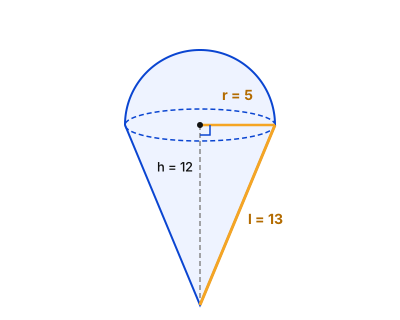
- .
- Slant height .
- TSA = .
Trick: 5-12-13 triplet gives l at once; never add the base circles of a joined solid.
Answer: (B)
अवधारणा: संयुक्त ठोस का पृष्ठ = अर्धगोले का वक्र पृष्ठ + शंकु का वक्र पृष्ठ (जोड़ वाला भाग छिपा)।
हल:
- ।
- तिर्यक ऊँचाई ।
- पृष्ठ = ।
ट्रिक: 5-12-13 त्रिक से l तुरंत; जुड़े ठोस में आधार वृत्त न जोड़ें।
उत्तर: (B)
SSC CHSLQuantitative AptitudeMensuration – cone + hemisphereSSC CHSL 2025 · 17 Nov Shift 3
Q924.If and , then ?
यदि तथा है, तो ?
- A21
- B23
- C24
- D20
Show answer
Concept: .
- Here , .
- = 20.
- The terms cancel out.
Trick: Use the identity directly – no expansion needed.
Answer: (D) 20
अवधारणा: ।
हल:
- यहाँ , ।
- = 20।
- वाले पद आपस में कट जाते हैं।
ट्रिक: सीधे सर्वसमिका लगाएँ – विस्तार की ज़रूरत नहीं।
उत्तर: (D) 20
SSC CHSLQuantitative AptitudeSurds – a² + b²SSC CHSL 2025 · 17 Nov Shift 3
Q925.If a line passes through the points and , what is its slope?
यदि एक रेखा बिंदुओं और से होकर जाती है, तो उसकी प्रवणता (slope) क्या है?
- A3
- B
- C4
- D
Show answer
Concept: Slope .
- .
- → .
Trick: : y goes up 3 while x goes up 2.
Answer: (D)
अवधारणा: प्रवणता ।
हल:
- ।
- ।
ट्रिक: : y 3 बढ़ा, x 2 बढ़ा।
उत्तर: (D)
SSC CHSLQuantitative AptitudeCoordinate geometry – slopeSSC CHSL 2025 · 17 Nov Shift 3
Q926.A trader sells two articles at ₹840 each. On one, he gains 25%, and on the other, he loses 25%. What is his overall profit or loss percentage?
एक व्यापारी दो वस्तुओं में से प्रत्येक को ₹840 में बेचता है। एक पर उसे 25% का लाभ होता है तथा दूसरी पर 25% की हानि होती है। उसका कुल लाभ या हानि प्रतिशत क्या है?
- A Profit लाभ
- B Loss हानि
- C5% Profit5% लाभ
- D5% Loss5% हानि
Show answer
Concept: Same selling price with x% gain on one and x% loss on the other always gives a net loss.
- ₹672; ₹1120.
- Total CP = ₹1792, total SP = ₹1680 → loss ₹112.
- .
Trick: — no need to find CPs.
Answer: (B) Loss
अवधारणा: SP समान हो और एक पर x% लाभ, दूसरी पर x% हानि हो तो कुल मिलाकर हमेशा हानि होती है।
हल:
- ₹672; ₹1120।
- कुल CP = ₹1792, कुल SP = ₹1680 → हानि ₹112।
- ।
ट्रिक: — CP निकालने की ज़रूरत नहीं।
उत्तर: (B) हानि
SSC CHSLQuantitative AptitudeProfit & loss – same SP, equal gain and loss %SSC CHSL 2025 · 17 Nov Shift 2
Q927.A chair has a marked price of Rs. 750. Shikha pays Rs. 450 for it because she got 2 successive discounts, one of 25% and the other of:
एक कुर्सी का अंकित मूल्य ₹750 है। शिखा इसके लिए ₹450 का भुगतान करती है क्योंकि उसे 2 क्रमिक छूटें मिलीं, एक 25% की तथा दूसरी कितने प्रतिशत की:
- A25%
- B15%
- C12.5%
- D20%
Show answer
Concept: The second discount is taken on the price left after the first.
- After 25% off: ₹562.50.
- Second cut = ₹112.50.
- Rate = .
Trick: → second factor means 20% off.
Answer: (D) 20%
अवधारणा: दूसरी छूट पहली छूट के बाद बचे मूल्य पर लगती है।
हल:
- 25% छूट के बाद: ₹562.50।
- दूसरी कमी = ₹112.50।
- दर = ।
ट्रिक: → यानी 20% छूट।
उत्तर: (D) 20%
SSC CHSLQuantitative AptitudeSuccessive discounts – finding the secondSSC CHSL 2025 · 17 Nov Shift 2
Q928.A seller marks his goods 30% above their cost price but allows a 12% discount for cash payment. His percentage of profit when sold in cash is:
एक विक्रेता अपने सामान पर उसके क्रय मूल्य से 30% अधिक अंकित करता है, परंतु नकद भुगतान पर 12% की छूट देता है। नकद में बेचने पर उसका लाभ प्रतिशत है:
- A19.12%
- B12.25%
- C
- D15.5%
Show answer
Concept: Take CP = 100 when no amount is given.
- MP = 130.
- .
- Profit% = .
Trick: Net % = .
Answer: (C)
अवधारणा: राशि न दी हो तो CP = 100 मान लें।
हल:
- MP = 130।
- ।
- लाभ% = ।
ट्रिक: शुद्ध % = ।
उत्तर: (C)
SSC CHSLQuantitative AptitudeMarked price, discount and profitSSC CHSL 2025 · 17 Nov Shift 2
Q929.A company had 5 departments with an average of 50 employees each. Later, a sixth department was added with 80 employees. Due to restructuring, 20 employees from each of the original five departments were transferred to the new department. What is the new average number of employees per department?
एक कंपनी में 5 विभाग थे जिनमें औसतन 50 कर्मचारी प्रति विभाग थे। बाद में 80 कर्मचारियों वाला एक छठा विभाग जोड़ा गया। पुनर्गठन के कारण मूल पाँच विभागों में से प्रत्येक से 20 कर्मचारियों को नए विभाग में स्थानांतरित कर दिया गया। प्रति विभाग कर्मचारियों की नई औसत संख्या क्या है?
- A54
- B50
- C55
- D57
Show answer
Concept: Transfers inside the company do not change the total.
- Old total = .
- Add the new department: .
- Average over 6 departments = .
Trick: Ignore the 20-per-department transfer — it is a distractor; only the total and the count matter.
Answer: (C) 55
अवधारणा: कंपनी के भीतर कर्मचारियों का स्थानांतरण कुल संख्या नहीं बदलता।
हल:
- पुराना कुल = ।
- नया विभाग जोड़ें: ।
- 6 विभागों का औसत = ।
ट्रिक: 20-20 कर्मचारियों का स्थानांतरण भ्रम है — केवल कुल और विभागों की संख्या मायने रखती है।
उत्तर: (C) 55
SSC CHSLQuantitative AptitudeAverage – adding a groupSSC CHSL 2025 · 17 Nov Shift 2
Q930.A savings scheme offers compound interest annually. A man deposits ₹ 20,000 . At the end of the first year, the interest rate is 20%. In the second year, due to inflation, the interest rate rises to 25%, and in the third year, it drops to 10 %. Calculate the total interest he earned at the end of 3 years.
एक बचत योजना वार्षिक चक्रवृद्धि ब्याज देती है। एक व्यक्ति ₹20,000 जमा करता है। पहले वर्ष के अंत में ब्याज दर 20% है। दूसरे वर्ष में मुद्रास्फीति के कारण ब्याज दर बढ़कर 25% हो जाती है तथा तीसरे वर्ष में घटकर 10% रह जाती है। 3 वर्ष के अंत में उसके द्वारा अर्जित कुल ब्याज की गणना कीजिए।
- A₹14,000
- B₹13,000
- C₹15,000
- D₹11,000
Show answer
Concept: Amount = .
- Year 1: .
- Year 2: .
- Year 3: → interest = ₹13,000.
Trick: Use fractions: , , → in one line.
Answer: (B) ₹13,000
अवधारणा: मिश्रधन = ।
हल:
- वर्ष 1: ।
- वर्ष 2: ।
- वर्ष 3: → ब्याज = ₹13,000।
ट्रिक: भिन्न में बदलें: , , → एक लाइन में।
उत्तर: (B) ₹13,000
SSC CHSLQuantitative AptitudeCompound interest – different rates each yearSSC CHSL 2025 · 17 Nov Shift 2
Q931.What is the square of 119 ?
119 का वर्ग क्या है?
- A15161
- B14161
- C16641
- D15861
Show answer
Concept: .
- .
- .
Trick: must be just below and end in 1 → only 14161.
Answer: (B) 14161
अवधारणा: ।
हल:
- ।
- ।
ट्रिक: थोड़ा कम होगा 14400 से और अंत 1 पर → केवल 14161।
उत्तर: (B) 14161
SSC CHSLQuantitative AptitudeSquare of a number near a baseSSC CHSL 2025 · 17 Nov Shift 2
Q932.A perfect square between 40 and 60 is:
40 और 60 के बीच एक पूर्ण वर्ग संख्या है:
- A51
- B64
- C49
- D59
Show answer
Concept: A perfect square is a whole number multiplied by itself.
- (below 40), , (above 60).
- Only 49 lies between 40 and 60.
Trick: Perfect squares never end in 2, 3, 7, 8 — and 51, 59 are not squares; 64 is out of range.
Answer: (C) 49
अवधारणा: पूर्ण वर्ग = किसी पूर्ण संख्या का स्वयं से गुणनफल।
हल:
- (40 से कम), , (60 से अधिक)।
- 40 और 60 के बीच केवल 49।
ट्रिक: 40–60 के बीच केवल आता है; 64 सीमा से बाहर है।
उत्तर: (C) 49
SSC CHSLQuantitative AptitudePerfect squares in a rangeSSC CHSL 2025 · 17 Nov Shift 2
Q933.P and Q started a business with investments of ₹2000 and ₹3000, respectively. After 6 months, P added ₹2000 and Q added ₹ . If the profit ratio is 12 : 19, find .
P तथा Q ने क्रमशः ₹2000 तथा ₹3000 के निवेश से एक व्यवसाय आरंभ किया। 6 माह बाद P ने ₹2000 और मिलाए तथा Q ने ₹ और मिलाए। यदि लाभ का अनुपात 12 : 19 है, तो ज्ञात कीजिए।
- A₹1900
- B₹1200
- C₹3500
- D₹1500
Show answer
Concept: Profit ratio = sum of (capital × months).
- P: .
- Q: .
- .
Trick: P = 12 parts = 36000 → 1 part = 3000 → ; extra .
Answer: (C) ₹3500
अवधारणा: लाभ अनुपात = (पूंजी × महीने) का योग।
हल:
- P: ।
- Q: ।
- ।
ट्रिक: 12 भाग = 36000 → 1 भाग = 3000 → Q = 57000; अतिरिक्त ।
उत्तर: (C) ₹3500
SSC CHSLQuantitative AptitudePartnership – capital added midwaySSC CHSL 2025 · 17 Nov Shift 2
Q934.P started a business with ₹20,000. Q joined after 4 months with ₹30,000. At the end of the year, the total profit was ₹70,000. What is the share of ?
P ने ₹20,000 से एक व्यवसाय आरंभ किया। Q, 4 माह बाद ₹30,000 के साथ जुड़ा। वर्ष के अंत में कुल लाभ ₹70,000 था। का हिस्सा क्या है?
- A₹25000
- B₹32000
- C₹35000
- D₹29000
Show answer
Concept: .
- P: .
- Q: .
- Ratio 1 : 1 → P = ₹35,000.
Trick: → equal shares at a glance.
Answer: (C) ₹35000
अवधारणा: ।
हल:
- P: ।
- Q: ।
- अनुपात 1 : 1 → P = ₹35,000।
ट्रिक: → तुरंत बराबर हिस्से।
उत्तर: (C) ₹35000
SSC CHSLQuantitative AptitudePartnership – late joinerSSC CHSL 2025 · 17 Nov Shift 2
Q935.P, Q, and R start a business. P invests ₹3000 for 6 months, Q ₹2000 for 12 months, and R ₹4000 for 9 months. If the total profit is ₹390000, find P's profit share.
P, Q तथा R एक व्यवसाय आरंभ करते हैं। P, ₹3000 का निवेश 6 माह के लिए करता है, Q, ₹2000 का 12 माह के लिए तथा R, ₹4000 का 9 माह के लिए। यदि कुल लाभ ₹390000 है, तो P के लाभ का हिस्सा ज्ञात कीजिए।
- A₹50000
- B₹90000
- C₹60000
- D₹70000
Show answer
Concept: Ratio of shares = capital × months for each.
- P = , Q = , R = (in thousands).
- 18 : 24 : 36 = 3 : 4 : 6 (13 parts).
- P = ₹90,000.
Trick: per part — the total is chosen to divide cleanly by 13.
Answer: (B) ₹90000
अवधारणा: हिस्सों का अनुपात = हर साझेदार की पूंजी × महीने।
हल:
- P = , Q = , R = (हज़ार में)।
- 18 : 24 : 36 = 3 : 4 : 6 (कुल 13 भाग)।
- P = ₹90,000।
ट्रिक: प्रति भाग, फिर × 3।
उत्तर: (B) ₹90000
SSC CHSLQuantitative AptitudePartnership – three partnersSSC CHSL 2025 · 17 Nov Shift 2
Q936.A circular iron plate of radius 20 cm is heated, and its radius increases by . What is the approximate percentage increase in its area?
20 सेमी त्रिज्या वाली एक वृत्ताकार लोहे की प्लेट को गर्म किया जाता है, जिससे उसकी त्रिज्या बढ़ जाती है। इसके क्षेत्रफल में लगभग कितने प्रतिशत की वृद्धि होगी?
- A2.8%
- B
- C
- D3.5%
Show answer
Concept: , so use the successive-percentage formula with x and x.
- % change = .
- .
- .
Trick: Radius (r = 20 cm) is extra data — area % change depends only on the % change in radius.
Answer: (C)
अवधारणा: , इसलिए x और x के लिए क्रमागत प्रतिशत सूत्र लगाएँ।
हल:
- % परिवर्तन = ।
- ।
- ।
ट्रिक: त्रिज्या 20 cm अतिरिक्त जानकारी है — % परिवर्तन केवल त्रिज्या के % से तय होता है।
उत्तर: (C)
SSC CHSLQuantitative AptitudeArea change from radius changeSSC CHSL 2025 · 17 Nov Shift 2
Q937.If and , then find the value of .
यदि तथा है, तो का मान ज्ञात कीजिए।
- A421
- B363
- C481
- D327
Show answer
Concept: .
- .
- Value = .
Trick: , fits both equations: .
Answer: (C) 481
अवधारणा: ।
हल:
- ।
- मान = ।
ट्रिक: , दोनों शर्तें पूरी करते हैं: ।
उत्तर: (C) 481
SSC CHSLQuantitative AptitudeAlgebra – x⁴ + x²y² + y⁴SSC CHSL 2025 · 17 Nov Shift 2
Q938.If and , then find the value of .
यदि तथा है, तो का मान ज्ञात कीजिए।
- A145
- B107
- C179
- D144
Show answer
Concept: .
- .
- .
- Required = .
Trick: here — reuse the given 48 directly.
Answer: (A) 145
अवधारणा: ।
हल:
- ।
- ।
- अभीष्ट मान = ।
ट्रिक: — दिया मान सीधे उपयोग करें।
उत्तर: (A) 145
SSC CHSLQuantitative AptitudeAlgebra – (a + b)² from (a − b)²SSC CHSL 2025 · 17 Nov Shift 2
Q939.If , then the value of is:
यदि है, तो का मान है:
- A
- B
- C
- D
Show answer
Concept: . (Given value is .)
- .
- Add: .
- Subtract: . Product = .
Trick: means : .
Answer: (D)
अवधारणा: । (दिया मान है)
हल:
- ।
- जोड़ें: ।
- घटाएँ: । गुणनफल = ।
ट्रिक: रखें: ✔, गुणनफल = ।
उत्तर: (D)
SSC CHSLQuantitative AptitudeTrigonometry – cosec θ − cot θ identitySSC CHSL 2025 · 17 Nov Shift 2
Q940.If and
, then what is the value of ?
यदि तथा
है, तो का मान क्या है?
- A1160
- B1020
- C1175
- D1014
Show answer
Concept: If and , then .
- Squaring and adding, the terms cancel.
- .
- .
Trick: Put : , instantly.
Answer: (D) 1014
अवधारणा: , हो तो ।
हल:
- वर्ग करके जोड़ने पर वाले पद कट जाते हैं।
- ।
- ।
ट्रिक: रखें: , तुरंत।
उत्तर: (D) 1014
SSC CHSLQuantitative AptitudeTrigonometry – a² + b² patternSSC CHSL 2025 · 17 Nov Shift 2

