Q941.Ramesh pulls a rope tied to a flagpole at ground level. The rope is 30 meters long and makes an angle of 30° with the ground. How high up the flagpole is the point where the rope is tied? Also, find the horizontal distance between the Ramesh and the base of the flagpole.
रमेश ज़मीन के स्तर पर एक ध्वजदंड से बँधी रस्सी को खींचता है। रस्सी 30 मीटर लंबी है तथा ज़मीन के साथ 30° का कोण बनाती है। ध्वजदंड पर वह बिंदु, जहाँ रस्सी बँधी है, कितनी ऊँचाई पर है? साथ ही, रमेश तथा ध्वजदंड के आधार के बीच की क्षैतिज दूरी भी ज्ञात कीजिए।
- A9 meters and 15 meters9 मीटर और 15 मीटर
- B11 meters and 26 meters11 मीटर और 26 मीटर
- C15 meters and 26 meters15 मीटर और 26 मीटर
- D12 meters and 29 meters12 मीटर और 29 मीटर
Show answer
Concept: Rope = hypotenuse; , .
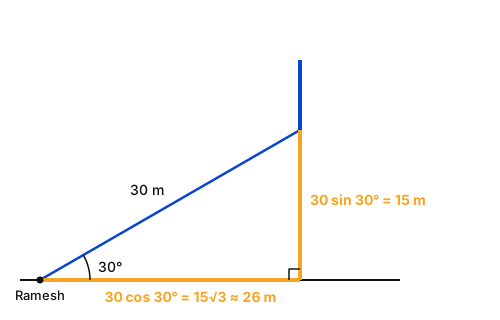
- Height = .
- Distance = .
Trick: 30-60-90 triangle sides are → hypotenuse 30 gives 15 and .
Answer: (C) 15 meters and 26 meters
अवधारणा: रस्सी = कर्ण; , ।
हल:
- ऊँचाई = ।
- दूरी = ।
ट्रिक: 30-60-90 त्रिभुज में भुजाएँ → कर्ण 30 तो 15 और ।
उत्तर: (C) 15 मीटर और 26 मीटर
SSC CHSLQuantitative AptitudeHeights & distances – rope at 30°SSC CHSL 2025 · 17 Nov Shift 2
Q942.An amount of Rs. ' ' is invested in two different schemes-one offers simple interest at p.a. for 5 years, and the other offers compound interest at p.a. compounded annually for 2 years. If the total amount from the simple interest scheme exceeds the compound interest scheme by Rs. 88, then find the value of Y.
' ' रुपये की राशि दो अलग-अलग योजनाओं में निवेश की जाती है — एक योजना 5 वर्षों के लिए वार्षिक की दर से साधारण ब्याज देती है तथा दूसरी 2 वर्षों के लिए वार्षिक की दर से वार्षिक रूप से संयोजित चक्रवृद्धि ब्याज देती है। यदि साधारण ब्याज योजना से प्राप्त कुल मिश्रधन चक्रवृद्धि ब्याज योजना से 88 रुपये अधिक है, तो Y का मान ज्ञात कीजिए।
- ARs. 900900 रुपये
- BRs. 800800 रुपये
- CRs. 720720 रुपये
- DRs. 630630 रुपये
Show answer
Concept: Convert both schemes into a multiplying factor of the principal.
- SI: → amount = 1.55Y.
- CI: → amount = 1.44Y.
- .
Trick: Check options: 11% of 800 = 88 ✔ — answer in one step.
Answer: (B) Rs. 800
अवधारणा: दोनों योजनाओं को मूलधन के गुणक में बदलें।
हल:
- SI: → मिश्रधन = 1.55Y।
- CI: → मिश्रधन = 1.44Y।
- ।
ट्रिक: अंतर 11% है; 800 का 11% = 88 ✔।
उत्तर: (B) 800 रुपये
SSC CHSLQuantitative AptitudeSI vs CI – finding the principalSSC CHSL 2025 · 17 Nov Shift 2
Q943.A sum of Rs. 5,000 is invested in a scheme offering compound interest for 2 years. Find the value of ' ' if the difference in the simple interest and compound interest for the same amount at the same rate of interest after 2 years is Rs. 800.
5,000 रुपये की राशि एक ऐसी योजना में निवेश की जाती है जो 2 वर्षों के लिए चक्रवृद्धि ब्याज देती है। ' ' का मान ज्ञात कीजिए, यदि उसी राशि पर उसी ब्याज दर से 2 वर्षों के बाद साधारण ब्याज तथा चक्रवृद्धि ब्याज का अंतर 800 रुपये है।
- A30%
- B36%
- C40%
- D24%
Show answer
Concept: For 2 years: .
- .
- .
- .
Trick: → 40%.
Answer: (C) 40%
अवधारणा: 2 वर्ष के लिए: ।
हल:
- ।
- ।
- ।
ट्रिक: → 40%।
उत्तर: (C) 40%
SSC CHSLQuantitative AptitudeCI − SI for 2 yearsSSC CHSL 2025 · 17 Nov Shift 2
Q944.Neeraj invested Rs. 'y' in a scheme offering 11% compound interest for three years. Nikhil invested Rs. 20,000 in a scheme offering simple interest for two years. Find the interest earned by Neeraj if the interest earned by Nikhil is Rs. '3y-700'.
नीरज ने 'y' रुपये एक ऐसी योजना में निवेश किए जो तीन वर्षों के लिए 11% चक्रवृद्धि ब्याज देती है। निखिल ने 20,000 रुपये एक ऐसी योजना में निवेश किए जो दो वर्षों के लिए साधारण ब्याज देती है। यदि निखिल द्वारा अर्जित ब्याज '3y-700' रुपये है, तो नीरज द्वारा अर्जित ब्याज ज्ञात कीजिए।
- ARs. 1,0081,008 रुपये
- BRs. 1,0781,078 रुपये
- CRs. 1,0121,012 रुपये
- DRs. 1,0661,066 रुपये
Show answer
Concept: Find y from the SI condition, then apply CI.
- Nikhil's SI = ₹8000 .
- .
- Neeraj's CI = ₹1066.
Trick: Effective 3-year CI rate at 11% ≈ 36.76% → .
Answer: (D) Rs. 1,066
अवधारणा: पहले SI से y निकालें, फिर CI लगाएँ।
हल:
- निखिल का SI = ₹8000 ।
- ।
- नीरज का CI = ₹1066।
ट्रिक: 11% पर 3 वर्ष की प्रभावी CI दर ≈ 36.76% → ।
उत्तर: (D) 1,066 रुपये
SSC CHSLQuantitative AptitudeSI and CI – linked equationSSC CHSL 2025 · 17 Nov Shift 2
Q945.The sum of three numbers is 169 . If the numbers are in a ratio of 3 : 6 : 4, find the largest number.
तीन संख्याओं का योग 169 है। यदि संख्याएँ 3 : 6 : 4 के अनुपात में हैं, तो सबसे बड़ी संख्या ज्ञात कीजिए।
- A76
- B78
- C56
- D48
Show answer
Concept: .
- Sum of ratio = .
- 1 part = .
- Largest = .
Trick: ; largest of .
Answer: (B) 78
अवधारणा: ।
हल:
- अनुपातों का योग = ।
- 1 भाग = ।
- सबसे बड़ी = ।
ट्रिक: → सबसे बड़ी ।
उत्तर: (B) 78
SSC CHSLQuantitative AptitudeRatio – largest partSSC CHSL 2025 · 17 Nov Shift 2
Q946.Box , contains coffee worth Rs. 400 per kg and in box Y contains coffee worth Rs. 500 per kg. If both box and are mixed in the ratio 3 : 7 then the price of the mixture per kg is approximately:
बॉक्स में 400 रुपये प्रति किग्रा मूल्य की कॉफ़ी है तथा बॉक्स Y में 500 रुपये प्रति किग्रा मूल्य की कॉफ़ी है। यदि बॉक्स तथा की कॉफ़ी को 3 : 7 के अनुपात में मिलाया जाए, तो मिश्रण का मूल्य प्रति किग्रा लगभग कितना होगा?
- A410/-
- B450/-
- C470/-
- D340/-
Show answer
Concept: Mean price = .
- .
- Per kg = ₹470.
Trick: Start from 400 and add of the gap (100): .
Answer: (C) 470/-
अवधारणा: औसत मूल्य = ।
हल:
- ।
- प्रति kg = ₹470।
ट्रिक: 400 से शुरू करें और अंतर 100 का जोड़ें: ।
उत्तर: (C) 470/-
SSC CHSLQuantitative AptitudeMixture – weighted average priceSSC CHSL 2025 · 17 Nov Shift 2
Q947.A recipe for a juice calls for 3 cups of sugar and 4 cups of water. With this recipe, juice was made using 16 cups of water. How many cups of sugar were required?
एक जूस की विधि में 3 कप चीनी तथा 4 कप पानी की आवश्यकता होती है। इसी विधि से 16 कप पानी का प्रयोग करके जूस बनाया गया। कितने कप चीनी की आवश्यकता पड़ी?
- A9 cups9 कप
- B6 cups6 कप
- C12 cups12 कप
- D18 cups18 कप
Show answer
Concept: Ingredients stay in the same ratio, sugar : water = 3 : 4.
- Water 4 → 16 means ×4.
- Sugar = cups.
Trick: Scale factor = ; multiply the other term by the same factor.
Answer: (C) 12 cups
अवधारणा: सामग्री का अनुपात स्थिर रहता है, चीनी : पानी = 3 : 4।
हल:
- पानी 4 से 16 हुआ → 4 गुना।
- चीनी = कप।
ट्रिक: गुणक = ; दूसरी राशि को भी उतने गुना करें।
उत्तर: (C) 12 कप
SSC CHSLQuantitative AptitudeDirect proportion – recipeSSC CHSL 2025 · 17 Nov Shift 2
Q948.Train A can cross a pole in 10 seconds, while train B takes 10 seconds to cross train when they travel in opposite directions on parallel tracks. If the ratio of the length of train to train is 4 : 3 and the speed of train A is 72 , then find the speed of train B.
ट्रेन A एक खंभे को 10 सेकंड में पार कर सकती है, जबकि ट्रेन B समानांतर पटरियों पर विपरीत दिशा में चलते हुए ट्रेन को पार करने में 10 सेकंड लेती है। यदि ट्रेन की लंबाई तथा ट्रेन की लंबाई का अनुपात 4 : 3 है तथा ट्रेन A की चाल 72 है, तो ट्रेन B की चाल ज्ञात कीजिए।
- A
- B15 m/s
- C
- D14 m/s
Show answer
Concept: Crossing each other in opposite directions: .
- Speed A = ; length A = .
- Length B = .
- .
Trick: km/h → m/s: multiply by (72 → 20).
Answer: (B) 15 m/s
अवधारणा: विपरीत दिशा में पार करना: ।
हल:
- A की चाल = ; A की लंबाई = ।
- B की लंबाई = ।
- ।
ट्रिक: km/h से m/s: से गुणा करें (72 → 20)।
उत्तर: (B) 15 m/s
SSC CHSLQuantitative AptitudeTrains – opposite directionsSSC CHSL 2025 · 17 Nov Shift 2
Q949.A thief is 1,000 metres ahead of a policeman when the policeman starts a chase by running at . If the thief is running at , then find the time taken by the policeman to catch the thief.
एक चोर एक पुलिसकर्मी से 1,000 मीटर आगे है, तभी पुलिसकर्मी की चाल से दौड़ते हुए उसका पीछा शुरू करता है। यदि चोर की चाल से दौड़ रहा है, तो पुलिसकर्मी को चोर को पकड़ने में लगने वाला समय ज्ञात कीजिए।
- A105 seconds105 सेकंड
- B140 seconds140 सेकंड
- C125 seconds125 सेकंड
- D110 seconds110 सेकंड
Show answer
Concept: Same direction: relative speed = difference of speeds.
- Relative speed = .
- Time = .
Trick: Policeman gains 8 m every second; 1000 m gap → .
Answer: (C) 125 seconds
अवधारणा: एक ही दिशा में: सापेक्ष चाल = चालों का अंतर।
हल:
- सापेक्ष चाल = ।
- समय = ।
ट्रिक: सिपाही हर सेकंड 8 m अंतर घटाता है → ।
उत्तर: (C) 125 सेकंड
SSC CHSLQuantitative AptitudeRelative speed – chaseSSC CHSL 2025 · 17 Nov Shift 2
Q950.An item undergoes two successive discounts: 10% and then 12.5%. After those discounts, a tax of 12% is applied on the reduced price, and the final amount the customer pays is ₹748. What was the original price of the item? (Give exact value and a rounded amount to two decimal places)
एक वस्तु पर दो क्रमिक छूट दी जाती हैं: 10% तथा उसके बाद 12.5%। इन छूटों के बाद घटे हुए मूल्य पर 12% कर लगाया जाता है, और ग्राहक द्वारा अंत में चुकाई गई राशि ₹748 है। वस्तु का मूल मूल्य क्या था? (सटीक मान तथा दो दशमलव स्थानों तक पूर्णांकित राशि दीजिए)
- ARs. 800800 रुपये
- BRs. 750750 रुपये
- CRs. 650650 रुपये
- DRs. 848848 रुपये
Show answer
Concept: Multiply all factors: discounts reduce, tax increases.
- .
- (tax) .
- ₹848.07 ≈ ₹848.
Trick: Check: ✔ — test the options backwards.
Answer: (D) Rs. 848
अवधारणा: सभी गुणक गुणा करें: छूट घटाती है, कर बढ़ाता है।
हल:
- ।
- (कर) ।
- ₹848.07 ≈ ₹848।
ट्रिक: जाँच: ✔ — विकल्पों से उल्टा जाँचें।
उत्तर: (D) 848 रुपये
SSC CHSLQuantitative AptitudeSuccessive discounts with taxSSC CHSL 2025 · 17 Nov Shift 2
Q951.A man purchased 3 identical electric fans at a total cost of ₹5,320. He sold two of them at a gain of each and the third one at a loss of . What is his overall profit or loss percentage?
एक व्यक्ति ने कुल ₹5,320 की लागत पर 3 एकसमान बिजली के पंखे खरीदे। उसने उनमें से दो को के लाभ पर तथा तीसरे को की हानि पर बेच दिया। उसका कुल लाभ या हानि प्रतिशत क्या है?
- A6% Profit6% लाभ
- B6.75% Profit6.75% लाभ
- C Profit लाभ
- D8% Profit8% लाभ
Show answer
Concept: For identical items, overall % = average of the individual gain/loss %.
- Gains/losses: +16%, +16%, −12%.
- Net = profit.
- The total cost ₹5,320 is not needed.
Trick: Equal cost prices → simply average the percentages (loss taken as negative).
Answer: (C) Profit
अवधारणा: समान वस्तुओं में कुल लाभ% = सभी लाभ/हानि % का औसत।
- लाभ/हानि: +16%, +16%, −12%।
- कुल = लाभ।
- कुल लागत ₹5,320 की ज़रूरत नहीं।
ट्रिक: क्रय मूल्य बराबर हो तो प्रतिशतों का सीधा औसत लें (हानि ऋणात्मक)।
उत्तर: (C) लाभ
SSC CHSLQuantitative AptitudeProfit & loss – overall %SSC CHSL 2025 · 17 Nov Shift 1
Q952.Gita gets a discount of 20% on Rs. 12000 oven. Since she pays cash, she gets an additional discount too. How much does she pay?
गीता को ₹12000 के एक ओवन पर 20% की छूट मिलती है। नकद भुगतान करने के कारण उसे की अतिरिक्त छूट भी मिल जाती है। वह कितना भुगतान करती है?
- ARs. 7400₹7400
- BRs. 9216₹9216
- CRs. 8350₹8350
- DRs. 9500₹9500
Show answer
Concept: Successive discounts are applied one after another on the reduced price.
- After 20%: ₹9600.
- After 4% more: ₹9216.
Trick: Net discount = → ₹9216.
Answer: (B) Rs. 9216
अवधारणा: क्रमागत छूट घटे हुए मूल्य पर एक के बाद एक लगती है।
- 20% के बाद: ₹9600।
- फिर 4%: ₹9216।
ट्रिक: कुल छूट = → ₹9216।
उत्तर: (B) ₹9216
SSC CHSLQuantitative AptitudeSuccessive discountsSSC CHSL 2025 · 17 Nov Shift 1
Q953.The selling price of a vintage vase is Rs. 2668 , and the discount given is . What is the marked price of the vase?
एक पुरातन फूलदान का विक्रय मूल्य ₹2668 है तथा दी गई छूट है। फूलदान का अंकित मूल्य क्या है?
- A₹2900
- B₹2800
- C₹2600
- D₹2500
Show answer
Concept: .
- SP is 92% of MP.
- ₹2900.
Trick: exactly – so MP = ₹2900. Check: 8% of 2900 = 232; .
Answer: (A) ₹2900
अवधारणा: ।
- SP = MP का 92%।
- ₹2900।
ट्रिक: → MP = ₹2900; जाँच: 2900 का 8% = 232।
उत्तर: (A) ₹2900
SSC CHSLQuantitative AptitudeDiscount – marked priceSSC CHSL 2025 · 17 Nov Shift 1
Q954.A school had 105 students with an average age of 30 years. Later, a new batch of students joined. After their inclusion, the average age dropped to 29.5 years, even though the newcomers had an average age of 28 years. Find the number of students in the new batch.
एक विद्यालय में 105 विद्यार्थी थे, जिनकी औसत आयु 30 वर्ष थी। बाद में विद्यार्थियों का एक नया समूह सम्मिलित हुआ। उनके सम्मिलित होने पर औसत आयु घटकर 29.5 वर्ष रह गई, यद्यपि नए विद्यार्थियों की औसत आयु 28 वर्ष थी। नए समूह में विद्यार्थियों की संख्या ज्ञात कीजिए।
- A38
- B35
- C42
- D46
Show answer
Concept: Gain of old group above new average = loss of new group below it (balance method).
- Old students: each 0.5 yr above 29.5 → total excess = .
- New students: each 1.5 yr below 29.5.
- Number = .
Trick: Alligation: = new : old → new = .
Answer: (B) 35
अवधारणा: पुराने समूह का अतिरिक्त = नए समूह की कमी (संतुलन विधि)।
- पुराने छात्र नए औसत से 0.5 वर्ष अधिक → कुल ।
- नए छात्र 1.5 वर्ष कम।
- संख्या = ।
ट्रिक: Alligation: नए : पुराने = 0.5 : 1.5 = 1 : 3 → नए = ।
उत्तर: (B) 35
SSC CHSLQuantitative AptitudeAverage – new group joiningSSC CHSL 2025 · 17 Nov Shift 1
Q955.A construction project was estimated to be completed in 540 days. Due to rain, only 70% of the days were productive. If the work done each productive day is constant, by what percent must daily output be increased to complete the project on time?
एक निर्माण परियोजना को 540 दिनों में पूरा करने का अनुमान लगाया गया था। वर्षा के कारण केवल 70% दिन ही कार्य-योग्य रहे। यदि प्रत्येक कार्य-योग्य दिन में किया गया कार्य समान हो, तो परियोजना को समय पर पूरा करने के लिए दैनिक उत्पादन में कितने प्रतिशत की वृद्धि करनी होगी?
- A
- B
- C
- D
Show answer
Concept: Total work fixed → output per day × days = constant.
- Productive days = 70% of 540 = 378.
- New : old output = 540 : 378 = 10 : 7.
- Increase = .
Trick: Days become , so output must become → rise of (option shown as '4267%').
Answer: (A)
अवधारणा: कुल काम स्थिर → प्रतिदिन उत्पादन × दिन = स्थिर।
- उत्पादक दिन = 540 का 70% = 378।
- नया : पुराना उत्पादन = 540 : 378 = 10 : 7।
- वृद्धि = ।
ट्रिक: दिन हुए तो उत्पादन गुना → वृद्धि।
उत्तर: (A)
SSC CHSLQuantitative AptitudeWork – output per daySSC CHSL 2025 · 17 Nov Shift 1
Q956.In a survey conducted at a university, it was found that 60% of the students like Mathematics, 50% like Physics, and 20% like both Mathematics and Physics. Among the remaining students, 30% prefer Computer Science, while the rest have no preference. If the total number of students surveyed is 500 , how many students had no preference for any of the three subjects?
एक विश्वविद्यालय में किए गए सर्वेक्षण में पाया गया कि 60% विद्यार्थी गणित पसंद करते हैं, 50% भौतिकी पसंद करते हैं तथा 20% गणित और भौतिकी दोनों पसंद करते हैं। शेष विद्यार्थियों में से 30% कंप्यूटर विज्ञान पसंद करते हैं, जबकि बाकी की कोई पसंद नहीं है। यदि सर्वेक्षण किए गए विद्यार्थियों की कुल संख्या 500 है, तो कितने विद्यार्थियों की इन तीनों में से किसी भी विषय के लिए कोई पसंद नहीं थी?
- A35
- B20
- C32
- D28
Show answer
Concept: .
- Like Maths or Physics = → remaining 10% = 50 students.
- Computer Science = 30% of 50 = 15.
- No preference = .
Trick: Directly: .
Answer: (A) 35
अवधारणा: ।
- गणित या भौतिकी पसंद = → शेष 10% = 50 छात्र।
- कंप्यूटर साइंस = 50 का 30% = 15।
- कोई पसंद नहीं = ।
ट्रिक: सीधे: ।
उत्तर: (A) 35
SSC CHSLQuantitative AptitudePercentage – setsSSC CHSL 2025 · 17 Nov Shift 1
Q957.Which of the following numbers is NOT a perfect square?
निम्नलिखित में से कौन-सी संख्या पूर्ण वर्ग नहीं है?
- A1600
- B625
- C1225
- D840
Show answer
Concept: A perfect square never ends in 2, 3, 7, 8, and a square ending in 0 must end in an even number of zeros.
- .
- 840 ends in a single zero → cannot be a square ().
Trick: Odd number of trailing zeros → not a perfect square; 840 is out instantly.
Answer: (D) 840
अवधारणा: पूर्ण वर्ग का अंत 2, 3, 7, 8 से नहीं होता और शून्य हों तो उनकी संख्या सम होती है।
- ।
- 840 के अंत में एक ही शून्य → पूर्ण वर्ग नहीं ()।
ट्रिक: अंत में विषम संख्या में शून्य → पूर्ण वर्ग नहीं।
उत्तर: (D) 840
SSC CHSLQuantitative AptitudePerfect squaresSSC CHSL 2025 · 17 Nov Shift 1
Q958.Two investors, P and Q , invest in the Business in the ratio of . If the share of Q is Rs 1200 in profit. Find the total profit.
दो निवेशक P तथा Q एक व्यवसाय में के अनुपात में निवेश करते हैं। यदि लाभ में Q का हिस्सा ₹1200 है, तो कुल लाभ ज्ञात कीजिए।
- A2700
- B2800
- C2900
- D3000
Show answer
Concept: Equal time → profit shared in the ratio of capital.
- Q's 4 parts = ₹1200 → 1 part = ₹300.
- Total = 9 parts = ₹2700.
Trick: Total = ₹2700.
Answer: (A) 2700
अवधारणा: समय बराबर हो तो लाभ पूँजी के अनुपात में बँटता है।
- Q के 4 भाग = ₹1200 → 1 भाग = ₹300।
- कुल = 9 भाग = ₹2700।
ट्रिक: कुल = ₹2700।
उत्तर: (A) 2700
SSC CHSLQuantitative AptitudePartnership – total profitSSC CHSL 2025 · 17 Nov Shift 1
Q959.P, Q, and R invest ₹16000, ₹20,000, and ₹24,000 respectively for a year. What percentage of the total profit will R get?
P, Q तथा R क्रमशः ₹16000, ₹20,000 तथा ₹24,000 एक वर्ष के लिए निवेश करते हैं। कुल लाभ का कितना प्रतिशत R को प्राप्त होगा?
- A35%
- B
- C
- D45%
Show answer
Concept: (same time).
- Total capital = ₹60,000.
- R's share = .
Trick: Ratio 4 : 5 : 6 → .
Answer: (C)
अवधारणा: (समय बराबर)।
- कुल पूँजी = ₹60,000।
- R = ।
ट्रिक: अनुपात 4 : 5 : 6 → ।
उत्तर: (C)
SSC CHSLQuantitative AptitudePartnership – percentage shareSSC CHSL 2025 · 17 Nov Shift 1
Q960.P and Q invest ₹25,000 and ₹33,000 in a business. Q receives ₹1000 more than P from the annual profit. What is the total profit?
P तथा Q एक व्यवसाय में ₹25,000 तथा ₹33,000 का निवेश करते हैं। वार्षिक लाभ में से Q को P से ₹1000 अधिक प्राप्त होते हैं। कुल लाभ कितना है?
- A₹7250
- B₹7450
- C₹7520
- D₹6800
Show answer
Concept: Difference of shares corresponds to difference of ratio parts.
- Ratio = 25000 : 33000 = 25 : 33; difference = 8 parts = ₹1000.
- 1 part = ₹125.
- Total = ₹7250.
Trick: Total = ₹7250.
Answer: (A) ₹7250
अवधारणा: हिस्सों का अंतर = अनुपात के भागों का अंतर।
- अनुपात 25 : 33; अंतर 8 भाग = ₹1000।
- 1 भाग = ₹125।
- कुल = ₹7250।
ट्रिक: कुल = ₹7250।
उत्तर: (A) ₹7250
SSC CHSLQuantitative AptitudePartnership – difference in sharesSSC CHSL 2025 · 17 Nov Shift 1

