Q961.A circular field is surrounded by a path of uniform width 2 m . The total area of the field, including the path, is 452.16 . If the area of the circular field (excluding the path) is , find the radius of the circular field and the radius including the path. (Use )
एक वृत्ताकार मैदान 2 m की समान चौड़ाई वाले पथ से घिरा हुआ है। पथ सहित मैदान का कुल क्षेत्रफल 452.16 है। यदि वृत्ताकार मैदान (पथ को छोड़कर) का क्षेत्रफल है, तो वृत्ताकार मैदान की त्रिज्या तथा पथ सहित त्रिज्या ज्ञात कीजिए। ( का प्रयोग कीजिए)
- A
- B9.99 m, 11.99 m
- C
- D
Show answer
Concept: , so .
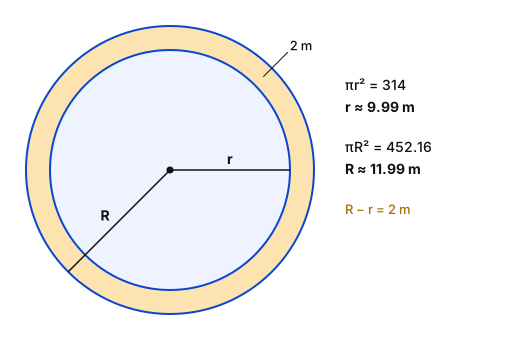
- Field: m.
- Field + path: m.
- m = path width ✓.
Trick: The two radii must differ by the path width (2 m) – only option B fits.
Answer: (B) 9.99 m, 11.99 m
अवधारणा: , इसलिए ।
- मैदान: m।
- पथ सहित: m।
- m ✓।
ट्रिक: दोनों त्रिज्याओं का अंतर पथ की चौड़ाई (2 m) होगा – केवल B।
उत्तर: (B) 9.99 m, 11.99 m
SSC CHSLQuantitative AptitudeMensuration – circular pathSSC CHSL 2025 · 17 Nov Shift 1
Q962.If and , then find the value of .
यदि तथा है, तो का मान ज्ञात कीजिए।
- A19
- B9
- C18
- D21
Show answer
Concept: .
- .
- .
Trick: Use ; .
Answer: (C) 18
अवधारणा: ।
- ।
- ।
ट्रिक: और ।
उत्तर: (C) 18
SSC CHSLQuantitative AptitudeAlgebra – cube identitySSC CHSL 2025 · 17 Nov Shift 1
Q963.If and , then find the value of .
यदि तथा है, तो का मान ज्ञात कीजिए।
- A2923
- B3023
- C3593
- D3922
Show answer
Concept: .
- .
- Value = .
- (Or .)
Trick: Write it as – unit digit → 3, only 2923/3023/3593 survive; .
Answer: (A) 2923
अवधारणा: ।
- ।
- मान = ।
ट्रिक: ।
उत्तर: (A) 2923
SSC CHSLQuantitative AptitudeAlgebra – x⁴ + x²y² + y⁴SSC CHSL 2025 · 17 Nov Shift 1
Q964.If , then find the value of .
यदि है, तो का मान ज्ञात कीजिए।
- A3
- B5
- C1
- D-3
Show answer
Concept: .
- .
- So .
- .
Trick: Whenever '' is given, (and vice versa with sin/cos swapped).
Answer: (C) 1
अवधारणा: ।
- ।
- इसलिए ।
- ।
ट्रिक: दिया हो तो सीधे।
उत्तर: (C) 1
SSC CHSLQuantitative AptitudeTrigonometry – sin/cos relationSSC CHSL 2025 · 17 Nov Shift 1
Q965.If, , such that , then find the value of
यदि, है, जहाँ है, तो का मान ज्ञात कीजिए
- A4
- B3
- C5
- D2
Show answer
Concept: ; then use standard angle values.
- .
- ; .
- Sum = .
Trick: Squares remove signs: .
Answer: (B) 3
अवधारणा: ; फिर मानक कोणों के मान लगाएँ।
- ।
- ; ।
- योग = 3।
ट्रिक: वर्ग में चिह्न हट जाता है: ।
उत्तर: (B) 3
SSC CHSLQuantitative AptitudeTrigonometry – find angleSSC CHSL 2025 · 17 Nov Shift 1
Q966.A firefighter's ladder of length 53 meters is resting against a wall and makes an angle with the ground such that . Find the horizontal distance of the foot of the ladder from the wall.
एक अग्निशमन कर्मी की 53 मीटर लंबी सीढ़ी एक दीवार के सहारे टिकी है तथा भूमि के साथ कोण बनाती है, जहाँ है। दीवार से सीढ़ी के निचले सिरे की क्षैतिज दूरी ज्ञात कीजिए।
- A45 meters45 मीटर
- B35 meters35 मीटर
- C36 meters36 मीटर
- D42 meters42 मीटर
Show answer
Concept: Ladder = hypotenuse; ; base by Pythagoras.
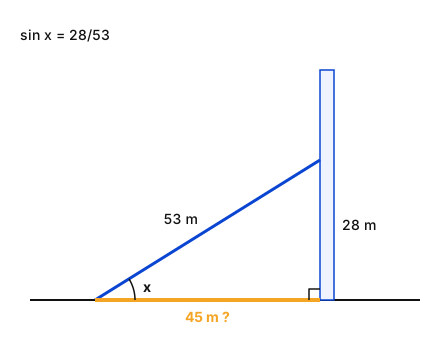
- → height = 28 m.
- Base = m.
Trick: (28, 45, 53) is a Pythagorean triplet – remember it.
Answer: (A) 45 meters
अवधारणा: सीढ़ी = कर्ण; ; आधार पाइथागोरस से।
- → ऊँचाई = 28 m।
- आधार = m।
ट्रिक: (28, 45, 53) पाइथागोरस त्रिक है।
उत्तर: (A) 45 मीटर
SSC CHSLQuantitative AptitudeHeights & distances – ladderSSC CHSL 2025 · 17 Nov Shift 1
Q967.Rs. 14,000 is invested at the rate of p.a. for 5 years at simple interest in scheme 'P'. The amount received from scheme ' P ' is then invested for 2 years at rate of 10% p.a., compounded annually in scheme ' '. Find the amount received from scheme ' '.
योजना 'P' में Rs. 14,000 की राशि वार्षिक की दर से 5 वर्षों के लिए साधारण ब्याज पर निवेश की जाती है। योजना 'P' से प्राप्त मिश्रधन को फिर 10% वार्षिक की दर से वार्षिक संयोजित चक्रवृद्धि ब्याज पर 2 वर्षों के लिए योजना '' में निवेश किया जाता है। योजना '' से प्राप्त मिश्रधन ज्ञात कीजिए।
- ARs. 27104
- BRs. 21704
- CRs. 27401
- DRs. 25104
Show answer
Concept: Amount of the first scheme becomes the principal of the second.
- SI = ₹8400 → amount = ₹22,400.
- CI for 2 years at 10%: ₹27,104.
Trick: 2 years at 10% CI → multiply by 1.21 (effective 21%).
Answer: (A) Rs. 27104
अवधारणा: पहली योजना की राशि दूसरी योजना का मूलधन बनती है।
- SI = ₹8400 → राशि ₹22,400।
- 10% पर 2 वर्ष: ₹27,104।
ट्रिक: 10% पर 2 वर्ष CI → 1.21 से गुणा।
उत्तर: (A) Rs. 27104
SSC CHSLQuantitative AptitudeSI then CISSC CHSL 2025 · 17 Nov Shift 1
Q968.A person invested Rs. 22,000 each in two different schemes for 2 years. One scheme offered p.a. simple interest and the other offered 25% p.a. compound interest, compounded annually. Find the difference between the interest earned from both schemes.
एक व्यक्ति ने दो अलग-अलग योजनाओं में 2 वर्षों के लिए Rs. 22,000 प्रत्येक निवेश किए। एक योजना वार्षिक साधारण ब्याज देती है तथा दूसरी 25% वार्षिक की दर से वार्षिक संयोजित चक्रवृद्धि ब्याज देती है। दोनों योजनाओं से अर्जित ब्याज का अंतर ज्ञात कीजिए।
- ARs. 1375
- BRs. 1275
- CRs. 1489
- DRs. 1411
Show answer
Concept: For 2 years: .
- Difference = .
- = ₹1375.
Trick: of principal.
Answer: (A) Rs. 1375
अवधारणा: 2 वर्ष के लिए: ।
- अंतर = ।
- = ₹1375।
ट्रिक: → मूलधन का ।
उत्तर: (A) Rs. 1375
SSC CHSLQuantitative AptitudeCI − SI for 2 yearsSSC CHSL 2025 · 17 Nov Shift 1
Q969.If Rs. 70,000 is invested at a compound interest of p.a. for 18 months, then find the interest earned given that the sum is compounded every 6 months.
यदि Rs. 70,000 की राशि वार्षिक चक्रवृद्धि ब्याज की दर से 18 महीनों के लिए निवेश की जाती है, तो अर्जित ब्याज ज्ञात कीजिए, जबकि राशि प्रत्येक 6 महीने में संयोजित होती है।
- ARs. 23170
- BRs. 21370
- CRs. 23107
- DRs. 23710
Show answer
Concept: Half-yearly: rate ÷ 2, time periods × 2.
- Rate = 10% per half-year; 18 months = 3 periods.
- ₹93,170.
- ₹23,170.
Trick: 10% for 3 periods → CI = 33.1% of P = ₹23,170.
Answer: (A) Rs. 23170
अवधारणा: अर्धवार्षिक: दर आधी, अवधियाँ दोगुनी।
- दर = 10% प्रति छमाही; 18 महीने = 3 अवधि।
- ₹93,170।
- CI = ₹23,170।
ट्रिक: 10% पर 3 अवधि → CI = 33.1% → ₹23,170।
उत्तर: (A) Rs. 23170
SSC CHSLQuantitative AptitudeCI – half-yearlySSC CHSL 2025 · 17 Nov Shift 1
Q970.A box contains Rs 5, Rs 2 and Rs 1 coins in the ratio 8 : 4 : 3. The total amount in the box is Rs 1122. Find the number of Rs 2 coins.
एक बक्से में Rs 5, Rs 2 तथा Rs 1 के सिक्के 8 : 4 : 3 के अनुपात में हैं। बक्से में कुल राशि Rs 1122 है। Rs 2 के सिक्कों की संख्या ज्ञात कीजिए।
- A77
- B76
- C88
- D89
Show answer
Concept: Value ratio = coin-count ratio × denomination.
- Counts 8x, 4x, 3x → value = .
- .
- ₹2 coins = .
Trick: Answer must be a multiple of 4 (count = 4x): only 76 and 88; → 88.
Answer: (C) 88
अवधारणा: मूल्य = सिक्कों की संख्या × सिक्के का मान।
- संख्या 8x, 4x, 3x → मूल्य = ।
- ।
- ₹2 सिक्के = ।
ट्रिक: उत्तर 4 का गुणज होगा – 76 या 88; x = 22 → 88।
उत्तर: (C) 88
SSC CHSLQuantitative AptitudeRatio – coinsSSC CHSL 2025 · 17 Nov Shift 1
Q971.A tank contains liquid A and B in the ratio litres of the mixture are taken out and filled with 60 litres of B. Now the ratio changes to . Find the quantity of liquid initially.
एक टंकी में द्रव A तथा B का अनुपात लीटर मिश्रण निकाल लिया जाता है तथा उसमें 60 लीटर B भर दिया जाता है। अब अनुपात हो जाता है। प्रारंभ में द्रव की मात्रा ज्ञात कीजिए।
- A179.2 litres179.2 लीटर
- B189.2 litres189.2 लीटर
- C175.2 litres175.2 लीटर
- D169.2 litres169.2 लीटर
Show answer
Concept: Removed mixture takes out A and B in the original ratio; added liquid changes only B.
- Let (total 30k). 60 L removed: A 32 L, B 28 L.
- New: .
- ; L.
Trick: A is untouched by the added B – track A: must be of the final .
Answer: (A) 179.2 litres
अवधारणा: निकाले गए मिश्रण में A और B मूल अनुपात में जाते हैं; डाला गया द्रव केवल B बढ़ाता है।
- ; 60 L निकालने पर A 32 L, B 28 L निकलते हैं।
- नया: ।
- ; L।
ट्रिक: A पर नए B का असर नहीं – ।
उत्तर: (A) 179.2 लीटर
SSC CHSLQuantitative AptitudeMixture – replacementSSC CHSL 2025 · 17 Nov Shift 1
Q972.A mixture containing 24% of methanol is mixed with another mixture containing b% of methanol in the ratio 4 : 5. If the percentage of methanol in the final mixture is , what is the percentage of b ?
24% मेथेनॉल युक्त एक मिश्रण को b% मेथेनॉल युक्त दूसरे मिश्रण के साथ 4 : 5 के अनुपात में मिलाया जाता है। यदि अंतिम मिश्रण में मेथेनॉल का प्रतिशत है, तो b का प्रतिशत क्या है?
- A13.26%
- B
- C18.2%
- D19.32%
Show answer
Concept: Methanol in the two parts together equals methanol in the final mixture.
- The 4 parts give units; all 9 parts need units.
- So the 5 parts supply units → .
Trick: Alligation: .
Answer: (B)
अवधारणा: दोनों भागों का मेथनॉल मिलाकर अंतिम मिश्रण के मेथनॉल के बराबर होता है।
- 4 भाग देते हैं इकाई; 9 भागों को चाहिए इकाई।
- शेष 5 भाग देते हैं 84 इकाई → ।
ट्रिक: Alligation: ।
उत्तर: (B)
SSC CHSLQuantitative AptitudeAlligation – mixture %SSC CHSL 2025 · 17 Nov Shift 1
Q973.A person travels a total distance of 300 km , partly by car at a speed of 60 and the rest by bike at . If 60% of the total distance is covered by car, find the average speed of the entire journey.
एक व्यक्ति कुल 300 km की दूरी तय करता है, जिसका कुछ भाग कार से 60 की चाल से तथा शेष भाग बाइक से की चाल से तय होता है। यदि कुल दूरी का 60% भाग कार से तय किया जाता है, तो पूरी यात्रा की औसत चाल ज्ञात कीजिए।
- A
- B
- C
- D74 km/h
Show answer
Concept: Average speed = total distance ÷ total time.
- Car: 180 km at 60 → 3 h. Bike: 120 km at 40 → 3 h.
- Average = km/h.
Trick: Equal times on both parts → average = .
Answer: (B)
अवधारणा: औसत चाल = कुल दूरी ÷ कुल समय।
- कार: 180 km, 60 पर → 3 घंटे; बाइक: 120 km, 40 पर → 3 घंटे।
- औसत = km/h।
ट्रिक: दोनों भागों में समय बराबर → सीधा औसत ।
उत्तर: (B)
SSC CHSLQuantitative AptitudeAverage speedSSC CHSL 2025 · 17 Nov Shift 1
Q974.How many perfect squares lie between 15,000 and 25,000 (inclusive)?
15,000 तथा 25,000 के बीच (दोनों सम्मिलित) कितने पूर्ण वर्ग हैं?
- A37
- B43
- C36
- D38
Show answer
Concept: Find the smallest and largest n with in the range; count = last − first + 1.
- (below range), → start at 123.
- () → end at 158.
- Count = .
Trick: and → integers 123…158.
Answer: (C) 36
अवधारणा: सबसे छोटा और सबसे बड़ा n निकालें जिसका वर्ग सीमा में हो; संख्या = अंतिम − प्रथम + 1।
- , → 123 से शुरू।
- → 158 तक।
- कुल = ।
ट्रिक: , → 123 से 158।
उत्तर: (C) 36
SSC CHSLQuantitative AptitudeCounting perfect squaresSSC CHSL 2025 · 17 Nov Shift 1
Q975.A motorist travels from City P to City Q, a distance of 240 km . For the first 80 km , he drives at . For the next 80 km he drives at . For the remaining distance, he drives at (constant). His overall average speed for the whole trip is . What is x ?
एक मोटर चालक शहर P से शहर Q तक 240 km की दूरी तय करता है। पहले 80 km में वह की चाल से चलता है। अगले 80 km में वह की चाल से चलता है। शेष दूरी वह (अचर) की चाल से तय करता है। पूरी यात्रा के लिए उसकी कुल औसत चाल है। x का मान क्या है?
- A45 km/h
- B
- C40 km/h
- D48 km/h
Show answer
Concept: Total time = total distance ÷ average speed.
- Total time = h.
- First two legs: h.
- Last 80 km in 2 h → km/h.
Trick: Time budget method: subtract known times from the total, then .
Answer: (C) 40 km/h
अवधारणा: कुल समय = कुल दूरी ÷ औसत चाल।
- कुल समय = घंटे।
- पहले दो भाग: घंटे।
- शेष 80 km, 2 घंटे में → km/h।
ट्रिक: कुल समय से ज्ञात समय घटाएँ, फिर ।
उत्तर: (C) 40 km/h
SSC CHSLQuantitative AptitudeAverage speed – unknown legSSC CHSL 2025 · 17 Nov Shift 1
Q976.Which of the following is true ?
निम्नलिखित में से कौन-सा कथन सत्य है?
- AAll real numbers are either rational or irrationalसभी वास्तविक संख्याएँ या तो परिमेय होती हैं या अपरिमेय
- BAll rational numbers are irrationalसभी परिमेय संख्याएँ अपरिमेय होती हैं
- CNo real number is rationalकोई भी वास्तविक संख्या परिमेय नहीं होती
- DAll integers are irrationalसभी पूर्णांक अपरिमेय होते हैं
Show answer
Concept: Real numbers = rational numbers ∪ irrational numbers (no overlap).
- So every real number is either rational or irrational ✓
- (B) false – rationals can be written as , irrationals cannot.
- (C) false – , 5 are real and rational; (D) false – every integer is rational.
Yaad rakhein: Natural ⊂ Whole ⊂ Integer ⊂ Rational ⊂ Real; irrational numbers (, ) sit outside the rationals but inside the reals.
Answer: (A) All real numbers are either rational or irrational
अवधारणा: वास्तविक संख्याएँ = परिमेय ∪ अपरिमेय (दोनों में कोई साझा संख्या नहीं)।
- अतः हर वास्तविक संख्या या तो परिमेय है या अपरिमेय ✓
- (B) गलत – परिमेय को लिख सकते हैं, अपरिमेय को नहीं।
- (C) गलत – , 5 वास्तविक भी हैं और परिमेय भी; (D) गलत – हर पूर्णांक परिमेय है।
याद रखें: प्राकृत ⊂ पूर्ण ⊂ पूर्णांक ⊂ परिमेय ⊂ वास्तविक; अपरिमेय (, ) परिमेय से बाहर पर वास्तविक के अंदर हैं।
उत्तर: (A) सभी वास्तविक संख्याएँ या तो परिमेय होती हैं या अपरिमेय
SSC CHSLQuantitative AptitudeNumber system – real numbersSSC CHSL 2025 · 15 Nov Shift 3
Q977.A solid right prism has a base that is a regular hexagon of side 4 cm . The height of the prism is 15 cm . A square cavity of side 2 cm is carved vertically through the center of the prism from top to bottom. Calculate the volume of the material remaining in the prism.
(Use )
एक ठोस लंब प्रिज़्म का आधार 4 cm भुजा वाला एक सम षट्भुज है। प्रिज़्म की ऊँचाई 15 cm है। प्रिज़्म के केंद्र से होकर ऊपर से नीचे तक 2 cm भुजा वाली एक वर्गाकार गुहा काटी गई है। प्रिज़्म में शेष बचे पदार्थ का आयतन ज्ञात कीजिए।
( का प्रयोग कीजिए)
- A
- B
- C
- D
Show answer
Concept: Remaining volume = prism volume − cavity volume.
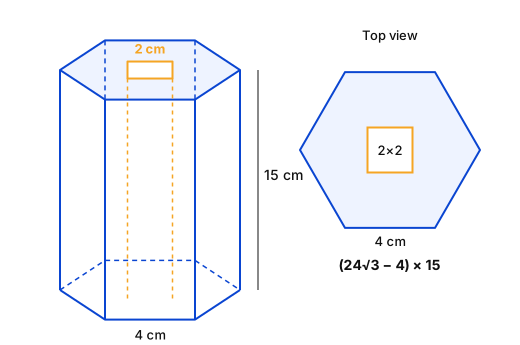
- Hexagon area = .
- Prism volume = .
- Cavity = .
- Remaining = .
Trick: Since the cavity runs the full height: in one step.
Answer: (A)
अवधारणा: बचा आयतन = प्रिज़्म का आयतन − खोखले भाग का आयतन।
- षट्भुज क्षेत्रफल =
- प्रिज़्म आयतन =
- खोखला भाग =
- बचा =
ट्रिक: छेद पूरी ऊँचाई में है: ।
उत्तर: (A)
SSC CHSLQuantitative AptitudeMensuration – hexagonal prism with cavitySSC CHSL 2025 · 15 Nov Shift 3
Q978.A glass manufacturer produces transparent right prism blocks with a square base of side 12 cm and height 30 cm . If the selling price is ₹ 0.80 per and the cost price is ₹0.50 per , what is the total profit earned on selling 20 such prisms?
एक काँच निर्माता 12 cm भुजा वाले वर्गाकार आधार तथा 30 cm ऊँचाई वाले पारदर्शी लंब प्रिज़्म खंड बनाता है। यदि विक्रय मूल्य ₹0.80 प्रति है और क्रय मूल्य ₹0.50 प्रति है, तो ऐसे 20 प्रिज़्म बेचने पर कुल कितना लाभ होगा?
- A₹15400
- B₹16000
- C₹18500
- D₹25920
Show answer
Concept: .
- Volume of one prism = .
- Profit per cm³ = ₹0.30.
- Total = ₹25920.
Trick: Combine the small numbers first: , then .
Answer: (D) ₹25920
अवधारणा: ।
- एक प्रिज़्म का आयतन =
- प्रति cm³ लाभ = ₹0.30
- कुल = ₹25920
ट्रिक: पहले छोटी संख्याएँ मिलाएँ: , फिर ।
उत्तर: (D) ₹25920
SSC CHSLQuantitative AptitudeVolume and profit – square prismSSC CHSL 2025 · 15 Nov Shift 3
Q979.A and B invest ₹40,000 and ₹30,000 respectively. After 8 months, A withdraws all of his capital. At the end of the year, what is their profit-sharing?
A और B क्रमशः ₹40,000 और ₹30,000 निवेश करते हैं। 8 महीने बाद A अपनी संपूर्ण पूँजी निकाल लेता है। वर्ष के अंत में उनका लाभ-विभाजन क्या होगा?
- A
- B8 : 7
- C
- D8 : 9
Show answer
Concept: Profit ratio = capital × months each capital stayed.
- A: .
- B: .
- Ratio = 32 : 36 = 8 : 9.
Trick: Cancel common zeros first: .
Answer: (D) 8 : 9
अवधारणा: लाभ का अनुपात = पूँजी × जितने महीने पूँजी लगी रही।
- A:
- B:
- अनुपात = 32 : 36 = 8 : 9
ट्रिक: पहले शून्य हटाएँ: ।
उत्तर: (D) 8 : 9
SSC CHSLQuantitative AptitudePartnership – withdrawal of capitalSSC CHSL 2025 · 15 Nov Shift 3
Q980.A started a business with ₹50,000. B joined after 6 months with ₹20,000. At the end of the year, what is their profit-sharing ratio?
A ने ₹50,000 से एक व्यवसाय आरंभ किया। B, 6 महीने बाद ₹20,000 के साथ इसमें सम्मिलित हुआ। वर्ष के अंत में उनका लाभ-विभाजन अनुपात क्या होगा?
- A
- B
- C
- D
Show answer
Concept: Multiply each capital by the months it was invested.
- A: .
- B joins after 6 months → .
- Ratio = 6 : 1.2 = 5 : 1.
Trick: In thousands: .
Answer: (A)
अवधारणा: हर पूँजी को उतने महीनों से गुणा करें जितने वह लगी रही।
- A:
- B 6 महीने बाद जुड़ा →
- अनुपात = 600 : 120 = 5 : 1
ट्रिक: हज़ार में सोचें: ।
उत्तर: (A)
SSC CHSLQuantitative AptitudePartnership – partner joins laterSSC CHSL 2025 · 15 Nov Shift 3

