Q81.A metal sheet is bent to form a right prism with a pentagonal base of side 5 cm and height 8 cm . Find the lateral surface area of the prism
एक धातु की चादर को मोड़कर एक लंब प्रिज्म बनाया जाता है, जिसका आधार 5 cm भुजा वाला पंचभुज है तथा ऊँचाई 8 cm है। प्रिज्म का पार्श्व पृष्ठीय क्षेत्रफल ज्ञात कीजिए।
- A
- B
- C
- D
Show answer
Concept: .
- Pentagon perimeter = cm.
- LSA = 200 cm².
Trick: LSA = 5 side faces, each a rectangle = .
Answer: (B)
अवधारणा: ।
हल:
- पंचभुज का परिमाप = cm।
- LSA = 200 cm²।
ट्रिक: 5 आयताकार फलक, हर एक → ।
उत्तर: (B)
SSC CHSLQuantitative AptitudePrism – lateral surface areaSSC CHSL 2025 · 29 Nov Shift 3
Q82.In two similar triangles, the ratio of their perimeters is equal to the:
दो समरूप त्रिभुजों में, उनके परिमापों का अनुपात किसके बराबर होता है:
- ARatio of their areasउनके क्षेत्रफलों का अनुपात
- BRatio of their corresponding sidesउनकी संगत भुजाओं का अनुपात
- CSquare of the ratio of their corresponding sidesउनकी संगत भुजाओं के अनुपात का वर्ग
- DRatio of their corresponding anglesउनके संगत कोणों का अनुपात
Show answer
Concept: All linear measures scale by the same factor.
- If sides are in ratio k, every side, hence their sum (perimeter), is in ratio k.
- Areas go as , not perimeters.
Yaad rakhein: Lengths (sides, perimeters, heights, medians) → k; areas → ; volumes → .
Answer: (B) Ratio of their corresponding sides
अवधारणा: सभी रेखीय माप एक ही अनुपात में बदलते हैं।
हल:
- भुजाएँ k के अनुपात में हों तो उनका योग (परिमाप) भी k के अनुपात में।
- क्षेत्रफल के अनुपात में होता है, परिमाप नहीं।
याद रखें: लंबाई (भुजा, परिमाप, ऊँचाई, माध्यिका) → k; क्षेत्रफल → ; आयतन → ।
उत्तर: (B) उनकी संगत भुजाओं का अनुपात
SSC CHSLQuantitative AptitudeSimilar triangles – perimeter ratioSSC CHSL 2025 · 29 Nov Shift 3
Q83.The radius and height of a cylinder are in the ratio 2 : 5 respectively. If the volume of the cylinder is , then the curved surface area of the cylinder is
less than the total surface area of the cylinder. (Take )
The values given in which of the following options will fill the blanks in the same order to make the above statement true?
A. 7500, 600
B. 1875, 375
C. 3000, 600
D. 3750, 750
एक बेलन की त्रिज्या तथा ऊँचाई का अनुपात क्रमशः 2 : 5 है। यदि बेलन का आयतन है, तो बेलन का वक्र पृष्ठीय क्षेत्रफल, बेलन के कुल पृष्ठीय क्षेत्रफल से
कम है। ( लीजिए)।
निम्नलिखित में से किस विकल्प में दिए गए मान उपर्युक्त कथन को सत्य बनाने के लिए रिक्त स्थानों को उसी क्रम में भरेंगे?
A. 7500, 600
B. 1875, 375
C. 3000, 600
D. 3750, 750
- AOnly Aकेवल A
- BOnly B and Cकेवल B और C
- COnly A, B and Dकेवल A, B और D
- DOnly B, C and Dकेवल B, C और D
Show answer
Concept: (the two circular ends).
- , , → ; .
- A: → , → ✓.
- B, C, D give – not perfect cubes, and does not match 375/600/750.
Trick: Only volumes giving a perfect cube for are worth checking – just set A.
Answer: (A) Only A
अवधारणा: (दोनों वृत्ताकार सिरे)।
हल:
- , , → ; ।
- A: → → ✓।
- B, C, D में – मेल नहीं खाते।
ट्रिक: पूर्ण घन हो वही विकल्प जाँचें – केवल A।
उत्तर: (A) केवल A
SSC CHSLQuantitative AptitudeCylinder – volume and TSA − CSASSC CHSL 2025 · 29 Nov Shift 3
Q84.Rs. 800 is divided among , and so that receives one-third as much as B, and B receives half as much as C. What is B's share ?
Rs. 800 को तथा के बीच इस प्रकार बाँटा जाता है कि को B के हिस्से का एक-तिहाई मिलता है, तथा B को C के हिस्से का आधा मिलता है। B का हिस्सा क्या है?
- ARs. 240.89
- BRs. 240
- CRs. 250.84
- DRs. 250
Show answer
Concept: Convert the relations to one ratio.
- , . Let → , .
- A : B : C = 1 : 3 : 6 (total 10 parts).
- Rs. 240.
Trick: Money is shared in whole parts here – drop the decimal options at once.
Answer: (B) Rs. 240
अवधारणा: संबंधों को एक अनुपात में बदलें।
हल:
- , ; लें → , ।
- A : B : C = 1 : 3 : 6 (कुल 10 भाग)।
- Rs. 240।
ट्रिक: दशमलव वाले विकल्प तुरंत हटाएँ।
उत्तर: (B) Rs. 240
SSC CHSLQuantitative AptitudeRatio – sharing moneySSC CHSL 2025 · 29 Nov Shift 3
Q85.The ratio of the ages of and is 3 : 4. After 5 years, the ratio becomes 4 :
5. What was the ratio of their ages 3 years ago?
तथा की आयु का अनुपात 3 : 4 है। 5 वर्ष बाद यह अनुपात 4 :
5 हो जाता है। 3 वर्ष पहले उनकी आयु का अनुपात क्या था?
- A17 : 19
- B8 : 11
- C12 : 17
- D15 : 16
Show answer
Concept: Form an equation using the future ratio.
- Ages , ; .
- → → ages 15, 20.
- 3 years ago: 12 and 17 → 12 : 17.
Trick: Both ratios have a gap of 1 part, so parts match: X goes 3 → 4 parts in 5 years → 1 part = 5 → ages 15, 20.
Answer: (C) 12 : 17
अवधारणा: भविष्य के अनुपात से समीकरण बनाएँ।
हल:
- आयु , ; ।
- → → आयु 15, 20।
- 3 वर्ष पहले: 12 और 17 → 12 : 17।
ट्रिक: दोनों अनुपातों में अंतर 1 भाग है; भाग 3→4 में 1 की वृद्धि = 5 वर्ष → 1 भाग = 5।
उत्तर: (C) 12 : 17
SSC CHSLQuantitative AptitudeRatio of agesSSC CHSL 2025 · 29 Nov Shift 3
Q86.If the breadth of a rectangular field is increased by 20%, then by what percentage should its length be reduced so that the area of the field remains constant ?
यदि किसी आयताकार मैदान की चौड़ाई 20% बढ़ा दी जाए, तो उसकी लंबाई को कितने प्रतिशत कम किया जाना चाहिए ताकि मैदान का क्षेत्रफल अपरिवर्तित रहे?
- A10%
- B12.5%
- C14.28%
- D16.67%
Show answer
Concept: If one factor rises by r%, the other must fall by .
- → fall .
- 16.67%.
Trick: up → other goes down by .
Answer: (D) 16.67%
अवधारणा: एक गुणक r% बढ़े तो दूसरे को घटाना होगा।
हल:
- → कमी ।
- 16.67%।
ट्रिक: बढ़ा → दूसरा घटेगा।
उत्तर: (D) 16.67%
SSC CHSLQuantitative AptitudeConstant area – compensating changeSSC CHSL 2025 · 29 Nov Shift 3
Q87.A pant is sold for ₹800 after a discount of 20% is offered on its marked price. What was the original marked price of the pant ?
एक पैंट को उसके अंकित मूल्य पर 20% की छूट देने के बाद ₹800 में बेचा जाता है। पैंट का मूल अंकित मूल्य क्या था?
- A₹1,000
- B₹1,400
- C₹2,000
- D₹3,000
Show answer
Concept: After d% discount, SP = of MP.
- 80% of MP = ₹800.
- ₹1,000.
Trick: If 80% is 800, then 1% is 10 and 100% is 1000.
Answer: (A) ₹1,000
अवधारणा: d% छूट के बाद SP = MP का ।
हल:
- MP का 80% = ₹800।
- ₹1,000।
ट्रिक: 80% = 800 तो 1% = 10, 100% = 1000।
उत्तर: (A) ₹1,000
SSC CHSLQuantitative AptitudeDiscount – finding marked priceSSC CHSL 2025 · 29 Nov Shift 3
Q88.A shopkeeper wants to prepare a rice blend priced at ₹36 per kg by mixing two different qualities of rice. The first variety costs ₹30 per kg, while the second variety costs ₹42 per kg.ln what weight ratio should these two varieties be mixed so that the final mixture costs meets the desired cost ?
एक दुकानदार दो अलग-अलग किस्मों के चावल मिलाकर ₹36 प्रति किग्रा मूल्य वाला चावल का मिश्रण तैयार करना चाहता है। पहली किस्म का मूल्य ₹30 प्रति किग्रा है, जबकि दूसरी किस्म का मूल्य ₹42 प्रति किग्रा है। इन दोनों किस्मों को किस भार अनुपात में मिलाया जाना चाहिए ताकि अंतिम मिश्रण का मूल्य अभीष्ट मूल्य के बराबर हो?
- A
- B1 : 4
- C3 : 2
- D
Show answer
Concept: Cheaper : dearer = (dearer − mean) : (mean − cheaper).
- (42 − 36) : (36 − 30) = 6 : 6.
- Ratio = 1 : 1.
Trick: 36 is exactly midway between 30 and 42 → equal quantities, no calculation needed.
Answer: (A)
अवधारणा: सस्ता : महँगा = (महँगा − औसत) : (औसत − सस्ता)।
हल:
- (42 − 36) : (36 − 30) = 6 : 6।
- अनुपात = 1 : 1।
ट्रिक: 36 ठीक 30 और 42 के बीच में है → बराबर मात्रा।
उत्तर: (A)
SSC CHSLQuantitative AptitudeAlligation – mixing two varietiesSSC CHSL 2025 · 29 Nov Shift 3
Q89.A vessel contains a mixture of milk and water in the ratio . Some quantity of the mixture is taken out and replaced by water. If the final ratio of milk to water becomes 1 : 2, what percentage of the original mixture was replaced?
एक बर्तन में दूध और पानी के अनुपात में मिश्रित हैं। मिश्रण की कुछ मात्रा निकालकर उसके स्थान पर पानी मिला दिया जाता है। यदि दूध और पानी का अंतिम अनुपात 1 : 2 हो जाता है, तो मूल मिश्रण का कितना प्रतिशत भाग बदला गया?
- A55.55%
- B44.44%
- C33.33%
- D
Show answer
Concept: When mixture is replaced by water, milk fraction falls in proportion to what is kept.
- Milk fraction: initially , finally .
- Part kept = .
- Part replaced = 44.44%.
Trick: .
Answer: (B) 44.44%
अवधारणा: मिश्रण निकालकर पानी डालने पर दूध का अंश उसी अनुपात में घटता है जितना मिश्रण बचा।
हल:
- दूध का अंश: पहले , बाद में ।
- बचा भाग = ।
- बदला भाग = 44.44%।
ट्रिक: ।
उत्तर: (B) 44.44%
SSC CHSLQuantitative AptitudeMixture – replacement by waterSSC CHSL 2025 · 29 Nov Shift 3
Q90.A circle is inscribed inside a quadrilateral ABCD, touching each of its four sides. If the side lengths are , and , find the length of the remaining side .
एक वृत्त चतुर्भुज ABCD के अंदर इस प्रकार अंतःस्थापित है कि वह उसकी चारों भुजाओं को स्पर्श करता है। यदि भुजाओं की लंबाईयाँ , तथा हैं, तो शेष भुजा की लंबाई ज्ञात कीजिए।
- A5 cm
- B6 cm
- C7 cm
- D8 cm
Show answer
Concept: If a circle touches all four sides, AB + CD = BC + AD.
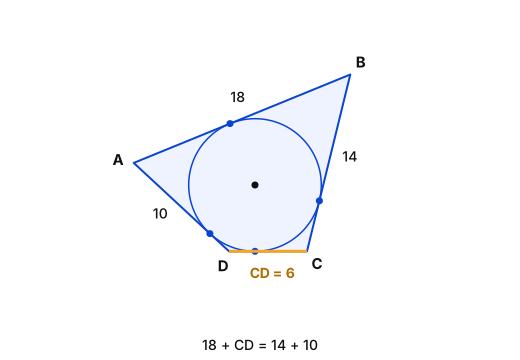
- Tangents from each vertex are equal, so opposite sides have equal sums.
- 18 + CD = 14 + 10 = 24 → CD = 6 cm.
Trick: Opposite-side sums equal – the side opposite the longest given side is the unknown.
Answer: (B) 6 cm
अवधारणा: वृत्त चारों भुजाओं को स्पर्श करे तो AB + CD = BC + AD।
हल:
- हर शीर्ष से खींची स्पर्श रेखाएँ बराबर – इसलिए आमने-सामने की भुजाओं का योग बराबर।
- 18 + CD = 14 + 10 = 24 → CD = 6 cm।
ट्रिक: सम्मुख भुजाओं का योग बराबर – सीधे 24 − 18।
उत्तर: (B) 6 cm
SSC CHSLQuantitative AptitudeCircle inscribed in a quadrilateralSSC CHSL 2025 · 29 Nov Shift 3
Q91.A circle has a chord PQ of length 18 cm . The tangent drawn at point is parallel to the tangent drawn at point Q . Find the radius of the circle.
एक वृत्त की जीवा PQ की लंबाई 18 cm है। बिंदु पर खींची गई स्पर्श रेखा, बिंदु Q पर खींची गई स्पर्श रेखा के समांतर है। वृत्त की त्रिज्या ज्ञात कीजिए।
- A9 cm
- B8 cm
- C6 cm
- D18 cm
Show answer
Concept: Parallel tangents touch the circle at the two ends of a diameter.
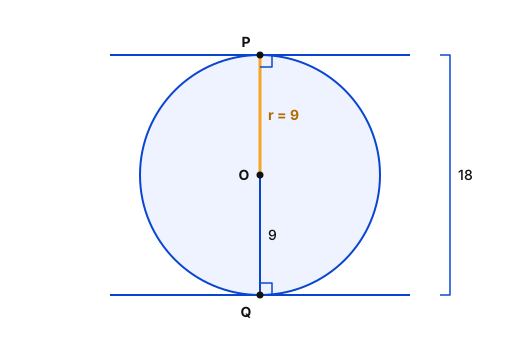
- Radius ⟂ tangent at both P and Q; tangents parallel → OP, OQ on one line.
- So PQ is a diameter = 18 cm.
- Radius 9 cm.
Trick: Only two points of a circle have parallel tangents – the ends of a diameter.
Answer: (A) 9 cm
अवधारणा: समांतर स्पर्श रेखाएँ व्यास के दोनों सिरों पर होती हैं।
हल:
- P और Q पर त्रिज्या स्पर्श रेखा पर लंब; रेखाएँ समांतर → OP, OQ एक सीधी रेखा में।
- अतः PQ व्यास = 18 cm।
- त्रिज्या = 9 cm।
ट्रिक: किसी वृत्त में समांतर स्पर्श रेखाएँ केवल व्यास के सिरों पर बनती हैं।
उत्तर: (A) 9 cm
SSC CHSLQuantitative AptitudeParallel tangents – diameterSSC CHSL 2025 · 29 Nov Shift 3
Q92.The value of is:
का मान है:
- A
- B
- C
- D
Show answer
Concept: Simplify each term separately using conjugates.
- : multiply by ; denominator → term .
- .
- .
- Total: .
Trick: – spotting this makes the first term collapse.
Answer: (C)
अवधारणा: हर पद को संयुग्मी से अलग-अलग सरल करें।
हल:
- को से गुणा; हर = → पद ।
- ।
- ।
- कुल: ।
ट्रिक: – यही पहचान पहला पद सरल कर देती है।
उत्तर: (C)
SSC CHSLQuantitative AptitudeSurds – rationalisationSSC CHSL 2025 · 29 Nov Shift 3
Q93.Triangle has a side length of 9 cm . A similar triangle, Triangle M , has a corresponding side length of 27 cm . If the area of Triangle L is , what is the area of Triangle M ?
त्रिभुज की एक भुजा की लंबाई 9 cm है। एक समरूप त्रिभुज M की संगत भुजा की लंबाई 27 cm है। यदि त्रिभुज L का क्षेत्रफल है, तो त्रिभुज M का क्षेत्रफल क्या है?
- A
- B
- C
- D
Show answer
Concept: .
- Side ratio M : L = 27 : 9 = 3 : 1.
- Area ratio = 9 : 1.
- Area of M = 360 cm².
Trick: Sides ×3 → area ×9 – one multiplication.
Answer: (B)
अवधारणा: ।
हल:
- भुजा अनुपात M : L = 27 : 9 = 3 : 1।
- क्षेत्रफल अनुपात = 9 : 1।
- M का क्षेत्रफल = 360 cm²।
ट्रिक: भुजा ×3 → क्षेत्रफल ×9।
उत्तर: (B)
SSC CHSLQuantitative AptitudeSimilar triangles – area ratioSSC CHSL 2025 · 29 Nov Shift 3
Q94. ?
- A0.0675
- B0.0717
- C0.0177
- D0.0167
Show answer
Concept: Simplify numerator and denominator separately.
- Multiply top and bottom by 1000 to remove decimals.
- Top: ; bottom: .
- 0.0167.
Trick: – remember .
Answer: (D) 0.0167
अवधारणा: अंश और हर अलग-अलग सरल करें।
हल:
- ऊपर-नीचे दोनों को 1000 से गुणा करें, दशमलव हट जाएँगे।
- ऊपर: ; नीचे: ।
- 0.0167।
ट्रिक: याद हो तो तुरंत।
उत्तर: (D) 0.0167
SSC CHSLQuantitative AptitudeDecimal simplificationSSC CHSL 2025 · 29 Nov Shift 3
Q95.If , then what is the value of ?
यदि , तो का मान क्या है?
- A40
- B50
- C45
- D55
Show answer
Concept: Write as and add like surds.
- → .
- 45.
Trick: .
Answer: (C) 45
अवधारणा: लिखकर समान करणियाँ जोड़ें।
हल:
- ।
- 45।
ट्रिक: ।
उत्तर: (C) 45
SSC CHSLQuantitative AptitudeSurds – simplifying and squaringSSC CHSL 2025 · 29 Nov Shift 3
Q96.The amount received on a certain sum at the same annual rate of interest after 2 years and 4 years on compound interest (compounding annually) is Rs. 12100 and Rs. 14641 respectively. What is that sum?
चक्रवृद्धि ब्याज (वार्षिक रूप से संयोजित) पर समान वार्षिक ब्याज दर से किसी निश्चित मूलधन पर 2 वर्ष तथा 4 वर्ष बाद प्राप्त मिश्रधन क्रमशः Rs. 12100 तथा Rs. 14641 है। वह मूलधन क्या है?
- ARs. 10000
- BRs. 14000
- CRs. 15000
- DRs. 16000
Show answer
Concept: Amounts at equal gaps form a GP.
- From year 2 to year 4 the amount grows by → rate 10%.
- For first 2 years also : Rs. 10000.
Trick: → .
Answer: (A) Rs. 10000
अवधारणा: बराबर अंतराल पर राशियाँ गुणोत्तर श्रेणी में होती हैं।
हल:
- वर्ष 2 से 4 तक वृद्धि = → दर 10%।
- पहले 2 वर्षों में भी : Rs. 10000।
ट्रिक: → ।
उत्तर: (A) Rs. 10000
SSC CHSLQuantitative AptitudeCompound interest – finding principalSSC CHSL 2025 · 29 Nov Shift 3
Q97.If a certain sum of money becomes triple of itself in 6 years 3 months at simple interest, then what will be the annual rate of interest (approximate) ?
यदि कोई निश्चित धनराशि साधारण ब्याज पर 6 वर्ष 3 महीने में स्वयं की तिगुनी हो जाती है, तो वार्षिक ब्याज दर (लगभग) क्या होगी?
- A21%
- B32%
- C28%
- D35%
Show answer
Concept: Sum becomes n times → ; rate .
- Triple → , i.e. 200% of P.
- Time = 6 years 3 months = 6.25 years.
- Rate 32%.
Trick: → .
Answer: (B) 32%
अवधारणा: राशि n गुना → ; दर ।
हल:
- तिगुना → = P का 200%।
- समय = 6 वर्ष 3 माह = 6.25 वर्ष।
- दर 32%।
ट्रिक: → ।
उत्तर: (B) 32%
SSC CHSLQuantitative AptitudeSimple interest – rate for triplingSSC CHSL 2025 · 29 Nov Shift 3
Q98.The average of consecutive even natural numbers from 4 to 'N' is 52.Find the value of ' N ', where N is an even natural number.)
4 से 'N' तक की क्रमागत सम प्राकृत संख्याओं का औसत 52 है। ' N ' का मान ज्ञात कीजिए, जहाँ N एक सम प्राकृत संख्या है।)
- A100
- B140
- C136
- D132
Show answer
Concept: For an AP, average = .
- .
- → 100.
Trick: Average 52 sits midway: steps below, so .
Answer: (A) 100
अवधारणा: समांतर श्रेणी का औसत = ।
हल:
- ।
- → 100।
ट्रिक: औसत 52 बीच में है: 4 उससे 48 कम, तो ।
उत्तर: (A) 100
SSC CHSLQuantitative AptitudeAverage of consecutive even numbersSSC CHSL 2025 · 29 Nov Shift 3
Q99.5 numbers are in arithmetic progression. The sum of the first and the last number of this progression is 80.What is the average of these five numbers?
5 संख्याएँ समांतर श्रेढ़ी में हैं। इस श्रेढ़ी की पहली और अंतिम संख्या का योग 80 है। इन पाँच संख्याओं का औसत क्या है?
- A30
- B38
- C48
- D40
Show answer
Concept: In an AP, average = middle term = .
- First + last = 80.
- Average 40.
Trick: For any AP, average = – the number of terms does not matter.
Answer: (D) 40
अवधारणा: समांतर श्रेणी में औसत = मध्य पद = ।
हल:
- पहला + अंतिम = 80।
- औसत 40।
ट्रिक: किसी भी AP में औसत = – पदों की संख्या से फर्क नहीं पड़ता।
उत्तर: (D) 40
SSC CHSLQuantitative AptitudeAverage of numbers in APSSC CHSL 2025 · 29 Nov Shift 3
Q100.Pipe P, Q and R together can fill a tank in 40 minutes. Pipe Q and R together can fill the same tank in 60 minutes. Pipe R and P together can fill the same tank in 48 minutes. In how much time (in minutes) pipe Q alone can fill the tank ?
पाइप P, Q और R मिलकर एक टंकी को 40 मिनट में भर सकते हैं। पाइप Q और R मिलकर उसी टंकी को 60 मिनट में भर सकते हैं। पाइप R और P मिलकर उसी टंकी को 48 मिनट में भर सकते हैं। अकेला पाइप Q उस टंकी को कितने समय (मिनट में) में भर सकता है?
- A200
- B240
- C220
- D260
Show answer
Concept: .
- .
- .
- Q alone takes 240 minutes.
Trick: The Q+R data (60 min) is not needed – just subtract the R+P rate.
Answer: (B) 240
अवधारणा: ।
हल:
- ।
- ।
- Q अकेला 240 मिनट लेगा।
ट्रिक: Q+R (60 मिनट) वाली सूचना की ज़रूरत ही नहीं – सीधे R+P घटाएँ।
उत्तर: (B) 240
SSC CHSLQuantitative AptitudePipes – one pipe's timeSSC CHSL 2025 · 29 Nov Shift 3

