Q981.A sphere and a cone have the same base radius and the same height. What is the ratio of their volumes (sphere : cone) ?
एक गोले और एक शंकु के आधार की त्रिज्या तथा ऊँचाई समान हैं। उनके आयतनों का अनुपात (गोला : शंकु) क्या है?
- A1 : 3
- B1 : 2
- C2 : 1
- D3 : 1
Show answer
Concept: Height of a sphere = its diameter = 2r, so the cone also has .
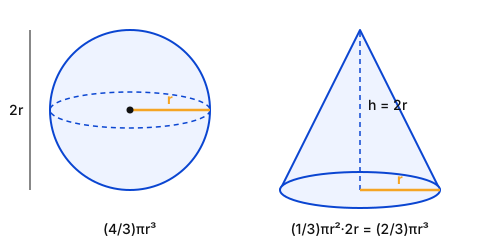
- Sphere = .
- Cone = .
- Ratio = 2 : 1.
Trick: Same r and : cone : sphere : cylinder = 1 : 2 : 3 (Archimedes' ratio).
Answer: (C) 2 : 1
अवधारणा: गोले की ऊँचाई = व्यास = 2r, इसलिए शंकु की ऊँचाई भी 2r।
- गोला =
- शंकु =
- अनुपात = 2 : 1
ट्रिक: समान r और पर शंकु : गोला : बेलन = 1 : 2 : 3 (आर्किमिडीज़ का अनुपात)।
उत्तर: (C) 2 : 1
SSC CHSLQuantitative AptitudeVolume ratio – sphere and coneSSC CHSL 2025 · 15 Nov Shift 3
Q982.The point of intersection of the perpendicular bisectors of the three sides of a triangle is called:
किसी त्रिभुज की तीनों भुजाओं के लंब समद्विभाजकों का प्रतिच्छेद बिंदु कहलाता है:
- AIncenterअंतःकेंद्र
- BCircumcenterपरिकेंद्र
- CCentroidकेंद्रक
- DOrthocenterलंबकेंद्र
Show answer
Concept: Perpendicular bisectors meet at the point equidistant from all three vertices.
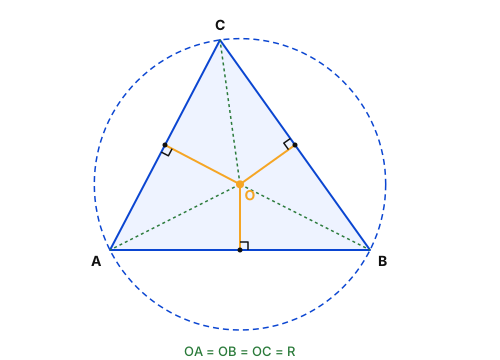
- That point is the centre of the circle through A, B, C → circumcentre.
- Incentre – angle bisectors; centroid – medians; orthocentre – altitudes.
Trick: Pairs: Bisector of Angle → Incentre; Perpendicular bisector → Circumcentre; Median → Centroid; Altitude → Orthocentre.
Answer: (B) Circumcenter
अवधारणा: भुजाओं के लंब समद्विभाजक उस बिंदु पर मिलते हैं जो तीनों शीर्षों से समान दूरी पर है।
- वह बिंदु A, B, C से होकर जाने वाले वृत्त का केंद्र है → परिकेंद्र
- अंतःकेंद्र – कोण समद्विभाजक; केंद्रक – माध्यिकाएँ; लंबकेंद्र – शीर्षलंब।
ट्रिक: कोण समद्विभाजक → अंतःकेंद्र; लंब समद्विभाजक → परिकेंद्र; माध्यिका → केंद्रक; शीर्षलंब → लंबकेंद्र।
उत्तर: (B) परिकेंद्र
SSC CHSLQuantitative AptitudeTriangle centres – circumcentreSSC CHSL 2025 · 15 Nov Shift 3
Q983.If a sphere is inscribed in a cylinder with the same radius and height, what is the ratio of the volume of the sphere to the volume of the cylinder?
यदि किसी बेलन में समान त्रिज्या और ऊँचाई वाला एक गोला अंतर्निहित है, तो गोले के आयतन और बेलन के आयतन का अनुपात क्या होगा?
- A
- B
- C3 : 2
- D1 : 3
Show answer
Concept: A sphere fitting exactly in a cylinder gives cylinder radius r and height 2r.
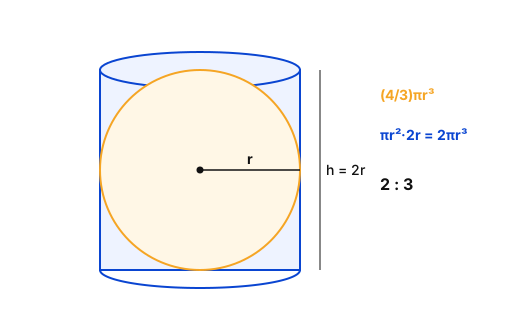
- Sphere = .
- Cylinder = .
- Ratio = 2 : 3.
Trick: Use the 1 : 2 : 3 rule (cone : sphere : cylinder) → sphere : cylinder = 2 : 3 instantly.
Answer: (A)
अवधारणा: बेलन में ठीक फिट गोला → बेलन की त्रिज्या r और ऊँचाई 2r।
- गोला =
- बेलन =
- अनुपात = 2 : 3
ट्रिक: 1 : 2 : 3 नियम (शंकु : गोला : बेलन) से सीधे गोला : बेलन = 2 : 3।
उत्तर: (A)
SSC CHSLQuantitative AptitudeVolume ratio – sphere in a cylinderSSC CHSL 2025 · 15 Nov Shift 3
Q984.If ' x ' and ' y ' = , then find the value of .
यदि ' x ' और ' y ' = है, तो का मान ज्ञात कीजिए।
- A1250
- B1150
- C1350
- D1160
Show answer
Concept: .
- Cross terms cancel on adding.
- .
- 1250.
Trick: Put : → – answer in seconds.
Answer: (A) 1250
अवधारणा:
- जोड़ने पर वाले पद कट जाते हैं।
- 1250
ट्रिक: रखें: → – तुरंत उत्तर।
उत्तर: (A) 1250
SSC CHSLQuantitative AptitudeTrigonometry – sum of squares identitySSC CHSL 2025 · 15 Nov Shift 3
Q985.The ratio of the two angles of a triangle is , respectively. If the third angle of the triangle is more than the sum of the given two angles of the triangle, then find the largest angle of the triangle.
किसी त्रिभुज के दो कोणों का अनुपात क्रमशः है। यदि त्रिभुज का तीसरा कोण दिए गए इन दोनों कोणों के योग से अधिक है, तो त्रिभुज का सबसे बड़ा कोण ज्ञात कीजिए।
- A108°
- B110*
- C120*
- D100°
Show answer
Concept: Angle sum of a triangle = 180°.
- Two angles = x and 3x, sum = 4x.
- Third = .
- ; angles .
- Largest = 108°.
Trick: Third angle is , so it takes .
Answer: (A) 108°
अवधारणा: त्रिभुज के कोणों का योग = 180°।
- दो कोण = x और 3x, योग = 4x
- तीसरा =
- ; कोण
- सबसे बड़ा = 108°
ट्रिक: तीसरा कोण = , यानी ।
उत्तर: (A) 108°
SSC CHSLQuantitative AptitudeTriangle – angles in ratioSSC CHSL 2025 · 15 Nov Shift 3
Q986.PQR is a triangle where and .Point S lies on QR such that .
If the perimeter of triangle is 54 cm , find the length of PS.
PQR एक त्रिभुज है जिसमें तथा है। बिंदु S, QR पर इस प्रकार स्थित है कि है।
यदि त्रिभुज का परिमाप 54 cm है, तो PS की लंबाई ज्ञात कीजिए।
- A
- B
- C
- D
Show answer
Concept: For median PS: .
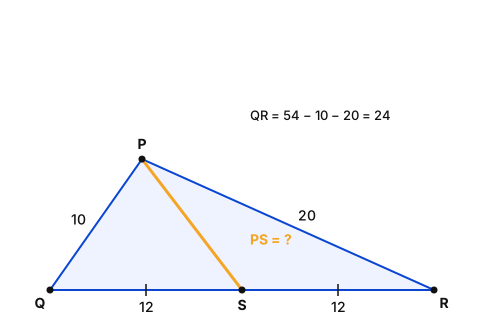
- cm.
- .
- cm.
Trick: Median formula: .
Answer: (D)
अवधारणा: माध्यिका PS के लिए: ।
- cm
- cm
ट्रिक: सूत्र: ।
उत्तर: (D)
SSC CHSLQuantitative AptitudeApollonius theorem – median lengthSSC CHSL 2025 · 15 Nov Shift 3
Q987.In , points M and N lie on sides PQ and PR respectively, such that .
If , and , find NR.
में, बिंदु M और N क्रमशः भुजाओं PQ और PR पर इस प्रकार स्थित हैं कि है।
यदि तथा है, तो NR ज्ञात कीजिए।
- A10 cm
- B6 cm
- C8 cm
- D4 cm
Show answer
Concept: A line parallel to one side divides the other two sides in the same ratio.
- .
- 10 cm.
Trick: PM : MQ = 1 : 2, so NR must be – no cross-multiplying needed.
Answer: (A) 10 cm
अवधारणा: एक भुजा के समांतर रेखा बाकी दो भुजाओं को समान अनुपात में बाँटती है।
- 10 cm
ट्रिक: PM : MQ = 1 : 2, इसलिए NR = ।
उत्तर: (A) 10 cm
SSC CHSLQuantitative AptitudeBasic proportionality theoremSSC CHSL 2025 · 15 Nov Shift 3
Q988.An alloy contains gold, silver and brass in the ratio and another contains silver, brass and tin in the ratio 3 : 5 : 2. If equal weights of both alloys are melted together to form a third alloy, then the weight of tin per kg in new alloy will be:
एक मिश्रधातु में सोना, चाँदी और पीतल के अनुपात में हैं तथा दूसरी मिश्रधातु में चाँदी, पीतल और टिन 3 : 5 : 2 के अनुपात में हैं। यदि दोनों मिश्रधातुओं के समान भार को एक साथ पिघलाकर तीसरी मिश्रधातु बनाई जाती है, तो नई मिश्रधातु में प्रति kg टिन का भार होगा:
- A0.25 kg
- B0.5 kg
- C0.1 kg
- D0.20 kg
Show answer
Concept: Take 1 kg of each alloy; only the second contains tin.
- Alloy 2: tin = → 0.2 kg in 1 kg.
- Alloy 1 has no tin.
- New alloy = 2 kg with 0.2 kg tin → per kg = 0.1 kg.
Trick: Equal weights mixed → fraction in the new alloy = average of fractions = .
Answer: (C) 0.1 kg
अवधारणा: दोनों मिश्रधातु 1-1 kg लें; टिन केवल दूसरी में है।
- मिश्रधातु 2: टिन = → 1 kg में 0.2 kg
- मिश्रधातु 1 में टिन नहीं।
- नई मिश्रधातु 2 kg, टिन 0.2 kg → प्रति kg = 0.1 kg
ट्रिक: बराबर भार मिलाने पर नया भाग = दोनों भागों का औसत = ।
उत्तर: (C) 0.1 kg
SSC CHSLQuantitative AptitudeAlloys – mixing equal weightsSSC CHSL 2025 · 15 Nov Shift 3
Q989.The cost of Type 1 rice is Rs. 32 per kg, and Type 2 rice is Rs. 48 per kg. If both Type 1 and Type 2 are mixed in the ratio of , then the price per kg of the mixed variety of rice is:
टाइप 1 चावल का मूल्य ₹32 प्रति kg है तथा टाइप 2 चावल का मूल्य ₹48 प्रति kg है। यदि टाइप 1 और टाइप 2 दोनों को के अनुपात में मिलाया जाता है, तो मिश्रित किस्म के चावल का प्रति kg मूल्य है:
- A43.4 kg
- B42.5 kg
- C41.6 kg
- D44.8 kg
Show answer
Concept: Mixture price = .
- ₹41.6 per kg.
Trick: Mean price lies closer to the bigger share: .
Answer: (C) 41.6 kg
अवधारणा: मिश्रण मूल्य = ।
- ₹41.6 प्रति kg
ट्रिक: – एक पंक्ति में।
उत्तर: (C) 41.6 kg
SSC CHSLQuantitative AptitudeMixture – weighted average priceSSC CHSL 2025 · 15 Nov Shift 3
Q990.Aman started a juice (sugar syrup
water) counter. Initially, he had 120 liters of juice, which contained 25% water. He sold 24 liters of the juice. Then he added an equal amount of sugar syrup and water. Now the ratio of water to sugar syrup becomes . How much water was added later on?
अमन ने एक जूस (शुगर सिरप
पानी) काउंटर शुरू किया। आरंभ में उसके पास 120 लीटर जूस था, जिसमें 25% पानी था। उसने 24 लीटर जूस बेच दिया। इसके बाद उसने बराबर मात्रा में शुगर सिरप और पानी मिलाया। अब पानी और शुगर सिरप का अनुपात हो जाता है। बाद में कितना पानी मिलाया गया?
- A12 litres12 लीटर
- B30 Litres30 लीटर
- C24 litres24 लीटर
- D20 litres20 लीटर
Show answer
Concept: Selling part of a mixture keeps the ratio; then add equal amounts x.
- Water 25% of 120 = 30 L, syrup 90 L (ratio 1 : 3).
- Selling 24 L leaves 96 L → water 24 L, syrup 72 L.
- 24 L.
Trick: Adding equal amounts keeps the difference same: must equal 1 part of the new 1 : 2 ratio → water = 48 → added 24.
Answer: (C) 24 litres
अवधारणा: मिश्रण का कुछ भाग बेचने पर अनुपात वही रहता है; फिर बराबर मात्रा x मिलाएँ।
- पानी = 120 का 25% = 30 L, सिरप 90 L (1 : 3)।
- 24 L बेचने पर 96 L बचा → पानी 24 L, सिरप 72 L
- 24 L
ट्रिक: बराबर मात्रा मिलाने पर अंतर नहीं बदलता: = नए अनुपात 1 : 2 का 1 भाग → पानी 48 → मिलाया 24।
उत्तर: (C) 24 लीटर
SSC CHSLQuantitative AptitudeMixture – sell some, then addSSC CHSL 2025 · 15 Nov Shift 3
Q991.8 liters of lemon syrup is mixed in liters of water. If the syrup is 25% of the mixture, what is the value of ?
8 लीटर लेमन सिरप को लीटर पानी में मिलाया जाता है। यदि सिरप मिश्रण का 25% है, तो का मान क्या है?
- A22 litres22 लीटर
- B24 litres24 लीटर
- C12 litres12 लीटर
- D30 litres30 लीटर
Show answer
Concept: .
- .
- 24 L.
Trick: 25% syrup means syrup : water = 1 : 3 → water = .
Answer: (B) 24 litres
अवधारणा: ।
- 24 L
ट्रिक: 25% सिरप = सिरप : पानी = 1 : 3 → पानी = ।
उत्तर: (B) 24 लीटर
SSC CHSLQuantitative AptitudeMixture – percentage of syrupSSC CHSL 2025 · 15 Nov Shift 3
Q992.Ravi can finish a task in 12 days, and Sohan can finish the same task in 18 days. They work together for 4 days. The remaining work was finished by Ravi and Kiran in 4 days. How much time would Kiran alone take to finish the entire work?
रवि एक कार्य को 12 दिनों में तथा सोहन उसी कार्य को 18 दिनों में पूरा कर सकता है। वे 4 दिनों तक एक साथ कार्य करते हैं। शेष कार्य रवि और किरण ने 4 दिनों में पूरा किया। किरण अकेले संपूर्ण कार्य को कितने समय में पूरा करेगी?
- A22 days22 दिन
- B18 days18 दिन
- C36 days36 दिन
- D15 days15 दिन
Show answer
Concept: Take total work = LCM and use per-day units.
- Work = 36 units; Ravi 3/day, Sohan 2/day.
- 4 days together: → left 16.
- Ravi + Kiran = /day → Kiran = 1/day.
- Kiran alone = 36 days.
Trick: LCM-unit method turns every work problem into simple addition and subtraction of daily rates.
Answer: (C) 36 days
अवधारणा: कुल कार्य = LCM मानें और प्रतिदिन इकाइयों से हल करें।
- कार्य = 36 इकाई; रवि 3/दिन, सोहन 2/दिन
- 4 दिन साथ: → बचा 16
- रवि + किरण = /दिन → किरण = 1/दिन
- किरण अकेले = 36 दिन
ट्रिक: LCM इकाई विधि से हर कार्य प्रश्न केवल दैनिक दर के जोड़-घटाव में बदल जाता है।
उत्तर: (C) 36 दिन
SSC CHSLQuantitative AptitudeTime and work – replacing a workerSSC CHSL 2025 · 15 Nov Shift 3
Q993.X can do a certain work in the same time that Y and Z together can do it. If X and Y together can complete the work in 12 days and Z alone can complete it in 36 days, then X alone can complete the work in:
X किसी कार्य को उतने ही समय में कर सकता है जितने समय में Y और Z मिलकर उसे कर सकते हैं। यदि X और Y मिलकर उस कार्य को 12 दिनों में पूरा कर सकते हैं तथा Z अकेला उसे 36 दिनों में पूरा कर सकता है, तो X अकेला उस कार्य को कितने दिनों में पूरा कर सकता है:
- A18 days18 दिन
- B16 days16 दिन
- C15 days15 दिन
- D14 days14 दिन
Show answer
Concept: Let work = 36 units and use efficiencies.
- X + Y = /day; Z = /day.
- .
- /day.
- X alone = 18 days.
Trick: When , all three together , so X's rate = half of the total rate.
Answer: (A) 18 days
अवधारणा: कुल कार्य = 36 इकाई मानें, क्षमता से हल करें।
- X + Y = /दिन; Z = /दिन
- /दिन
- X अकेले = 18 दिन
ट्रिक: जब हो, तो तीनों मिलकर , यानी X की दर = कुल दर का आधा।
उत्तर: (A) 18 दिन
SSC CHSLQuantitative AptitudeTime and work – X equals Y + ZSSC CHSL 2025 · 15 Nov Shift 3
Q994.P can finish a work in 20 days, and Q can finish the same work in 15 days.Q worked for 6 days and then left the job. In how many days can alone finish the remaining work?
P एक कार्य को 20 दिनों में तथा Q उसी कार्य को 15 दिनों में पूरा कर सकता है। Q ने 6 दिनों तक कार्य किया और फिर कार्य छोड़ दिया। अकेला शेष कार्य को कितने दिनों में पूरा कर सकता है?
- A15 days15 दिन
- B12 days12 दिन
- C8 days8 दिन
- D6 days6 दिन
Show answer
Concept: Work done by Q is subtracted; P finishes the rest.
- Work = 60 units; P = 3/day, Q = 4/day.
- Q in 6 days = 24 → left 36.
- P alone = 12 days.
Trick: Fraction way: Q does , so is left; P needs days.
Answer: (B) 12 days
अवधारणा: Q द्वारा किया कार्य घटाएँ; शेष P पूरा करता है।
- कार्य = 60 इकाई; P = 3/दिन, Q = 4/दिन
- Q 6 दिन में = 24 → बचा 36
- P अकेले = 12 दिन
ट्रिक: भिन्न से: Q ने किया, बचा ; P को दिन।
उत्तर: (B) 12 दिन
SSC CHSLQuantitative AptitudeTime and work – remaining workSSC CHSL 2025 · 15 Nov Shift 3
Q995.A rectangular tile having a perimeter of 200 cm has been used to pave a floor of length and breadth 32.4 m and 19.6 m , respectively. If the ratio of length to breadth of each tile is , then find the number of tiles required to pave the floor completely.
200 cm परिमाप वाली एक आयताकार टाइल का उपयोग क्रमशः 32.4 m लंबाई और 19.6 m चौड़ाई वाले फर्श पर टाइल लगाने के लिए किया गया है। यदि प्रत्येक टाइल की लंबाई और चौड़ाई का अनुपात है, तो फर्श को पूरी तरह से ढकने के लिए आवश्यक टाइलों की संख्या ज्ञात कीजिए।
- A1896
- B2544
- C1676
- D2646
Show answer
Concept: Number of tiles = floor area ÷ tile area (same units).
- , l : b = 3 : 2 → tile 60 cm × 40 cm.
- Floor = 3240 cm × 1960 cm.
- Tiles = 2646.
Trick: Divide side by side instead of multiplying big areas: and .
Answer: (D) 2646
अवधारणा: टाइलों की संख्या = फर्श का क्षेत्रफल ÷ टाइल का क्षेत्रफल (एक ही इकाई में)।
- , l : b = 3 : 2 → टाइल 60 cm × 40 cm
- फर्श = 3240 cm × 1960 cm
- टाइलें = 2646
ट्रिक: बड़े क्षेत्रफल गुणा करने के बजाय भुजा-भुजा से भाग दें: ।
उत्तर: (D) 2646
SSC CHSLQuantitative AptitudeArea – number of tilesSSC CHSL 2025 · 15 Nov Shift 3
Q996.The curved surface area of a cylindrical pillar is and its volume is . The ratio between its radius and height is .
एक बेलनाकार खंभे का वक्र पृष्ठीय क्षेत्रफल है तथा उसका आयतन है। उसकी त्रिज्या और ऊँचाई का अनुपात है।
- A9 : 10
- B
- C7:3
- D
Show answer
Concept: Volume ÷ CSA = .
- m.
- m.
- r : h = 7 : 12.
Trick: Remember – it gives the radius in one division.
Answer: (B)
अवधारणा: आयतन ÷ CSA = ।
- m
- m
- r : h = 7 : 12
ट्रिक: याद रखें – एक भाग से त्रिज्या मिल जाती है।
उत्तर: (B)
SSC CHSLQuantitative AptitudeCylinder – radius and height from CSA and volumeSSC CHSL 2025 · 15 Nov Shift 3
Q997.Two circles and have radii 4 and 5 units, and their centers are 15 units apart. Then the number of common tangents they have is:
दो वृत्तों और की त्रिज्याएँ 4 और 5 इकाई हैं तथा उनके केंद्रों के बीच की दूरी 15 इकाई है। तब उनकी उभयनिष्ठ स्पर्श रेखाओं की संख्या है:
- A4
- B3
- C2
- D1
Show answer
Concept: Compare distance between centres d with r₁ + r₂ and |r₁ − r₂|.
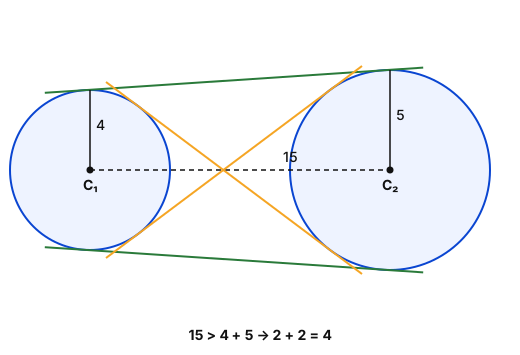
- r₁ + r₂ = 9, d = 15 → d > r₁ + r₂.
- Circles are separate (no touching) → 2 direct + 2 transverse = 4.
Trick: d > sum → 4; d = sum → 3; between → 2; d = difference → 1; d < difference → 0.
Answer: (A) 4
अवधारणा: केंद्रों की दूरी d की तुलना r₁ + r₂ और |r₁ − r₂| से करें।
- r₁ + r₂ = 9, d = 15 → d > r₁ + r₂
- वृत्त पूरी तरह अलग → 2 सीधी + 2 तिर्यक = 4
ट्रिक: d > योग → 4; d = योग → 3; बीच में → 2; d = अंतर → 1; d < अंतर → 0।
उत्तर: (A) 4
SSC CHSLQuantitative AptitudeCircles – number of common tangentsSSC CHSL 2025 · 15 Nov Shift 3
Q998.One of the angles of a quadrilateral is . If the ratio of the remaining angles of a quadrilateral is , respectively, then find the difference between the smallest and largest angles.
एक चतुर्भुज का एक कोण है। यदि चतुर्भुज के शेष कोणों का अनुपात क्रमशः है, तो सबसे छोटे और सबसे बड़े कोण के बीच का अंतर ज्ञात कीजिए।
- A36°
- B50°
- C57°
- D26°
Show answer
Concept: Angle sum of a quadrilateral = 360°.
- Remaining = 360° − 94° = 266° = 14 parts → 1 part = 19°.
- Angles: 114°, 95°, 57° (and 94°).
- Largest − smallest = 114° − 57° = 57°.
Trick: Check the given 94° too – it is neither largest nor smallest here, so the answer is (6 − 3) × 19 = 57°.
Answer: (C) 57°
अवधारणा: चतुर्भुज के कोणों का योग = 360°।
- शेष = 360° − 94° = 266° = 14 भाग → 1 भाग = 19°
- कोण: 114°, 95°, 57° (और 94°)
- सबसे बड़ा − सबसे छोटा = 114° − 57° = 57°
ट्रिक: दिया गया 94° भी जाँचें – यहाँ वह न सबसे बड़ा है न सबसे छोटा, इसलिए (6 − 3) × 19 = 57°।
उत्तर: (C) 57°
SSC CHSLQuantitative AptitudeQuadrilateral – angles in ratioSSC CHSL 2025 · 15 Nov Shift 3
Q999.If the graph of a linear equation passes through and has a slope 5 , what is its equation?
यदि किसी रैखिक समीकरण का आलेख से होकर जाता है तथा उसकी प्रवणता (slope) 5 है, तो उसका समीकरण क्या है?
- A
- B
- C
- D
Show answer
Concept: Point-slope form: y − y₁ = m(x − x₁).
- y − 3 = 5(x − 2) → y = 5x − 10 + 3.
- y = 5x − 7.
Trick: Slope 5 removes the '−5x' options; then put x = 2: 5(2) − 7 = 3 ✓ while 5(2) + 7 = 17 ✗.
Answer: (A)
अवधारणा: बिंदु-ढाल रूप: y − y₁ = m(x − x₁)।
- y − 3 = 5(x − 2) → y = 5x − 10 + 3
- y = 5x − 7
ट्रिक: ढाल 5 है, तो '−5x' वाले विकल्प हटें; x = 2 रखें: 5(2) − 7 = 3 ✓।
उत्तर: (A)
SSC CHSLQuantitative AptitudeCoordinate geometry – line from point and slopeSSC CHSL 2025 · 15 Nov Shift 3
Q1000.P can complete a work in 10 days, Q in 12 days, and R in 15 days. They work in the following manner:
On the 1st day, P works. On the 2nd day, Q works. On the 3rd day, R works. This cycle continues in the same order.In how many days will the work be completed?
P एक कार्य को 10 दिनों में, Q उसे 12 दिनों में तथा R उसे 15 दिनों में पूरा कर सकता है। वे निम्नलिखित प्रकार से कार्य करते हैं:
पहले दिन P कार्य करता है। दूसरे दिन Q कार्य करता है। तीसरे दिन R कार्य करता है। यह चक्र इसी क्रम में चलता रहता है। कार्य कितने दिनों में पूरा होगा?
- A6 days6 दिन
- B9 days9 दिन
- C10 days10 दिन
- D12 days12 दिन
Show answer
Concept: Find work done in one full cycle, then count cycles.
- Work = ; P = 6, Q = 5, R = 4 per day.
- One 3-day cycle = 15 units.
- 4 cycles exactly → 12 days.
Trick: If total ÷ cycle-work is a whole number, no partial-day check is needed – days = cycles × cycle length.
Answer: (D) 12 days
अवधारणा: एक पूरे चक्र का कार्य निकालें, फिर चक्र गिनें।
- कार्य = ; P = 6, Q = 5, R = 4 प्रतिदिन
- 3 दिन के एक चक्र में = 15 इकाई
- पूरे 4 चक्र → 12 दिन
ट्रिक: कुल ÷ चक्र-कार्य पूर्णांक हो तो अधूरे दिन की जाँच ज़रूरी नहीं – दिन = चक्र × चक्र की लंबाई।
उत्तर: (D) 12 दिन
SSC CHSLQuantitative AptitudeTime and work – working on alternate daysSSC CHSL 2025 · 15 Nov Shift 3

