Q1001.Which number is NOT part of the natural numbers ?
कौन-सी संख्या प्राकृत संख्याओं का भाग नहीं है?
- A7
- B6
- C0
- D4
Show answer
Concept: Natural numbers are counting numbers: 1, 2, 3, …
- 7, 6 and 4 are counting numbers → natural.
- 0 is not used for counting → it is a whole number, not natural.
Yaad rakhein: Whole numbers = Natural numbers + 0. So 0 is the only whole number that is not natural.
Answer: (C) 0
अवधारणा: 1 से शुरू होने वाली counting numbers को Natural numbers कहते हैं।
- 7, 6, 4 — तीनों Natural हैं।
- 0 को Whole numbers में रखा जाता है, Natural में नहीं।
याद रखें: W = N + {0}; अतः Whole होकर भी Natural न होने वाला अकेला अंक 0 है।
उत्तर: (C) 0
SSC CHSLQuantitative AptitudeNumber system – natural numbersSSC CHSL 2025 · 15 Nov Shift 2
Q1002.Which number is in both natural and integer sets ?
कौन-सी संख्या प्राकृत संख्याओं तथा पूर्णांकों, दोनों समुच्चयों में है?
- A0
- B8
- C-8
- DNoneकोई नहीं
Show answer
Concept: Every natural number is also an integer (N ⊂ W ⊂ Z).
- Integers include negatives and zero, so −8 and 0 qualify only as integers.
- 8 counts things → natural, and therefore also an integer.
Yaad rakhein: Any positive whole number like 8 sits in N, W, Z, Q and R all at once.
Answer: (B) 8
अवधारणा: N ⊂ W ⊂ Z — Natural समूह पूरा का पूरा Integer समूह में शामिल है।
- Integers में ऋणात्मक संख्याएँ व 0 भी आते हैं; −8 और 0 केवल Integer हैं।
- 8 गिनती की संख्या → Natural, इसलिए Integer भी।
याद रखें: 8 जैसी धनात्मक पूर्ण संख्या N, W, Z, Q, R सभी में होती है।
उत्तर: (B) 8
SSC CHSLQuantitative AptitudeNumber system – natural and integersSSC CHSL 2025 · 15 Nov Shift 2
Q1003.A trader buys 220 mixed stationery boxes at a rate of ₹160 each. He spends ₹1,600 on transportation and packaging. He sells 120 boxes at ₹180 each and the remaining at ₹170 each. What is his total profit percentage?
एक व्यापारी ₹160 प्रति बक्से की दर से 220 मिश्रित स्टेशनरी बक्से खरीदता है। वह परिवहन तथा पैकेजिंग पर ₹1,600 व्यय करता है। वह 120 बक्से ₹180 प्रति बक्सा तथा शेष ₹170 प्रति बक्सा की दर से बेचता है। उसका कुल लाभ प्रतिशत कितना है?
- A4.2%
- B4.53 %
- C
- D
Show answer
Concept: Transport/packing expenses are added to the cost price.
- ₹36,800.
- ₹38,600.
- Profit = ₹1,800 → Profit % = ().
Trick: 1% of 36800 = 368; is a little under 5 → only (D) lies between 4.8 and 5.
Answer: (D)
अवधारणा: ढुलाई/पैकिंग खर्च क्रय मूल्य में जोड़ा जाता है।
- ₹36,800।
- ₹38,600।
- लाभ = ₹1,800 → लाभ % = ()।
ट्रिक: 36800 का 1% = 368; = 5 से थोड़ा कम → केवल (D) 4.8 और 5 के बीच है।
उत्तर: (D)
SSC CHSLQuantitative AptitudeProfit % with overhead expensesSSC CHSL 2025 · 15 Nov Shift 2
Q1004.In triangle is incenter. . Find .
त्रिभुज अंतःकेंद्र है। । ज्ञात कीजिए।
- A40°
- B50°
- C80°
- D70°
Show answer
Concept: For incentre O: .
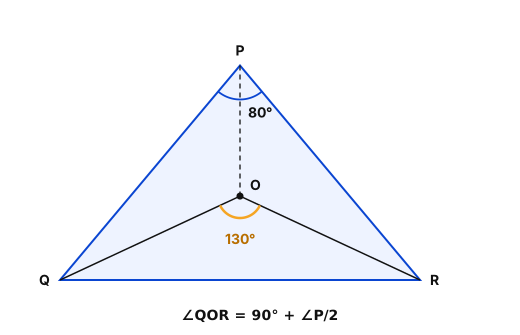
- .
- → .
Trick: Incentre: ; Excentre: ; Circumcentre: 2A; Orthocentre: .
Answer: (C) 80°
अवधारणा: अंतःकेंद्र O के लिए: ।
- ।
- → ।
ट्रिक: अंतःकेंद्र: ; बाह्यकेंद्र: ; परिकेंद्र: 2A; लंबकेंद्र: ।
उत्तर: (C) 80°
SSC CHSLQuantitative AptitudeIncentre angleSSC CHSL 2025 · 15 Nov Shift 2
Q1005.Find the value of
का मान ज्ञात कीजिए।
- A4
- B3
- C5
- D6
Show answer
Concept: For : .
- .
- .
- Sum = ; and .
- Total = 3.
Trick: — pairs like – vanish to 1 instantly.
Answer: (B) 3
अवधारणा: हो तो: ।
- ।
- ।
- योग = 1; और ।
- कुल = 3।
ट्रिक: — – जैसी जोड़ी सीधे 1 बन जाती है।
उत्तर: (B) 3
SSC CHSLQuantitative AptitudeTrigonometry – complementary anglesSSC CHSL 2025 · 15 Nov Shift 2
Q1006.If , where , then find the value of .
यदि , जहाँ , तो का मान ज्ञात कीजिए।
- A3
- B4
- C1
- D0
Show answer
Concept: .
- → → .
- → .
- 1.
Trick: is the standard signal for .
Answer: (C) 1
अवधारणा: ।
- → → ।
- → ।
- 1।
ट्रिक: दिखते ही समझें।
उत्तर: (C) 1
SSC CHSLQuantitative AptitudeTrigonometric equationSSC CHSL 2025 · 15 Nov Shift 2
Q1007.An amount invested on simple interest at 'R%' p.a. amounts to Rs. 10,504 and Rs. 13,384 in 4 years and 8 years, respectively. Find the value of 'R'.
साधारण ब्याज पर 'R%' वार्षिक दर से निवेश की गई एक राशि 4 वर्ष तथा 8 वर्ष में क्रमशः Rs. 10,504 तथा Rs. 13,384 हो जाती है। 'R' का मान ज्ञात कीजिए।
- A
- B
- C
- D
Show answer
Concept: Under SI, interest per year is constant; difference of amounts = interest for the gap years.
- Interest for 4 years = ₹2,880 → 1 year = ₹720.
- Principal = ₹7,624.
- 9.44%.
Trick: Since the gap (4 yrs) equals the first period (4 yrs), directly.
Answer: (C)
अवधारणा: साधारण ब्याज में हर वर्ष का ब्याज बराबर; मिश्रधनों का अंतर = बीच के वर्षों का ब्याज।
- 4 वर्ष का ब्याज = ₹2,880 → 1 वर्ष = ₹720।
- मूलधन = ₹7,624।
- 9.44%।
ट्रिक: अंतराल (4 वर्ष) = पहली अवधि (4 वर्ष) हो, तो ।
उत्तर: (C)
SSC CHSLQuantitative AptitudeSimple interest – rate from two amountsSSC CHSL 2025 · 15 Nov Shift 2
Q1008.A sum of money becomes 340% of itself in 8 years at simple interest. Find the simple interest earned when Rs. 4000 is invested at the same rate for 3 years.
एक धनराशि साधारण ब्याज पर 8 वर्षों में स्वयं की 340% हो जाती है। इसी दर पर Rs. 4000 को 3 वर्षों के लिए निवेश करने पर अर्जित साधारण ब्याज ज्ञात कीजिए।
- ARs. 3600
- BRs. 4200
- CRs. 4400
- DRs. 4500
Show answer
Concept: Amount = 340% of P → SI = 240% of P.
- Rate = per year.
- SI on ₹4000 for 3 years = ₹3,600.
Trick: 3 years → 90% of 4000 = 3600 in one line.
Answer: (A) Rs. 3600
अवधारणा: मिश्रधन = P का 340% → ब्याज = P का 240%।
- सालाना rate = ।
- ₹4000 पर 3 वर्ष का SI = ₹3,600।
ट्रिक: 3 वर्ष → 4000 का 90% = 3600।
उत्तर: (A) Rs. 3600
SSC CHSLQuantitative AptitudeSimple interest – rate from growth %SSC CHSL 2025 · 15 Nov Shift 2
Q1009.Mohit distributed 80% of the total money he had between Saroj and Sita in the ratio 7:9, respectively.Saroj and Sita deposited their respective shares at 7% and simple interest per annum for 5 years. If the difference in the interest earned by Sita and Saroj is Rs. 3,304, find the total amount Mohit had.
मोहित ने अपने पास की कुल धनराशि का 80% सरोज और सीता के बीच क्रमशः 7:9 के अनुपात में वितरित किया। सरोज और सीता ने अपने-अपने हिस्से को क्रमशः 7% तथा वार्षिक साधारण ब्याज की दर पर 5 वर्षों के लिए जमा किया। यदि सीता और सरोज द्वारा अर्जित ब्याज का अंतर Rs. 3,304 है, तो मोहित के पास कुल कितनी धनराशि थी?
- ARs. 22,400
- BRs. 26,432
- CRs. 24,900
- DRs, 29,200
Show answer
Concept: ; compare the two interests.
- Shared money = of ; Saroj = of it , Sita .
- Saroj's ; Sita's .
- Difference = → ₹26,432.
Trick: Answer must be a multiple of 8 () — only .
Answer: (B) Rs. 26,432
अवधारणा: ; दोनों ब्याज की तुलना करें।
- बाँटी गई राशि = का ; सरोज , सीता ।
- सरोज का ; सीता का ।
- अंतर = → ₹26,432।
ट्रिक: → उत्तर सीधे ।
उत्तर: (B) Rs. 26,432
SSC CHSLQuantitative AptitudeSimple interest – ratio sharesSSC CHSL 2025 · 15 Nov Shift 2
Q1010.A stick of length 38 cm is at an inclination of 30° to the floor with its bottom touching the floor of the wall. Find the length from the floor to the point where the stick touches the wall.
38 cm लंबाई की एक छड़ फर्श से 30° के झुकाव पर है तथा उसका निचला सिरा दीवार के फर्श को स्पर्श कर रहा है। फर्श से उस बिंदु तक की लंबाई ज्ञात कीजिए जहाँ छड़ दीवार को स्पर्श करती है।
- A26 cm
- B
- C19 cm
- D
Show answer
Concept: Stick = hypotenuse; height on wall = hypotenuse × sin(angle with floor).
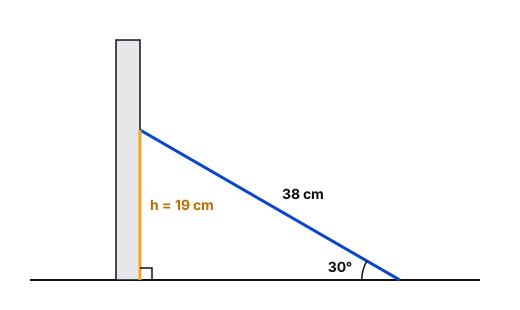
- Angle with the floor , so height .
- 19 cm.
Trick: The side opposite in a right triangle is half the hypotenuse.
Answer: (C) 19 cm
अवधारणा: छड़ = कर्ण; दीवार पर ऊँचाई = कर्ण × sin(फ़र्श से कोण)।
- फ़र्श से कोण , अतः ऊँचाई ।
- 19 cm।
ट्रिक: समकोण त्रिभुज में के सामने की भुजा = कर्ण का आधा।
उत्तर: (C) 19 cm
SSC CHSLQuantitative AptitudeHeights – stick against a wallSSC CHSL 2025 · 15 Nov Shift 2
Q1011.If a 32 metres long rope is stretched from the ground to the top of the house such that the rope makes an angle of with the ground, then find the height of the house.
यदि 32 मीटर लंबी एक रस्सी भूमि से मकान की चोटी तक इस प्रकार तनी हुई है कि रस्सी भूमि के साथ का कोण बनाती है, तो मकान की ऊँचाई ज्ञात कीजिए।
- A metres मीटर
- B metres मीटर
- C metres मीटर
- D15 metres15 मीटर
Show answer
Concept: .
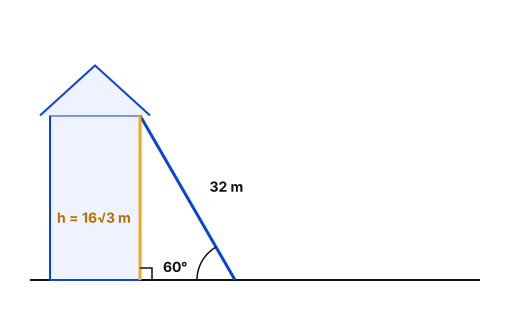
- → .
- m.
Trick: 30-60-90 triangle sides are in ratio → hypotenuse 32 gives sides 16 and .
Answer: (A) metres
अवधारणा: ।
- → ।
- m।
ट्रिक: 30-60-90 त्रिभुज की भुजाएँ → कर्ण 32 तो भुजाएँ 16 और ।
उत्तर: (A) मीटर
SSC CHSLQuantitative AptitudeHeights – rope at 60°SSC CHSL 2025 · 15 Nov Shift 2
Q1012.A tank has two pipes, one can fill it with water in 16 hours and the other can empty it in 10 hours. In how many hours will the tank be emptied if both the pipes are opened together when th of the tank is already filled with water?
एक टंकी में दो पाइप हैं, इनमें से एक उसे 16 घंटे में पानी से भर सकता है तथा दूसरा उसे 10 घंटे में खाली कर सकता है। यदि टंकी का भाग पहले से पानी से भरा हो और दोनों पाइप एक साथ खोल दिए जाएँ, तो टंकी कितने घंटे में खाली हो जाएगी?
- A6 hours 30 min6 घंटे 30 मिनट
- B5 hours 20 min5 घंटे 20 मिनट
- C3 hour 40 min3 घंटे 40 मिनट
- D4 hours 35 min4 घंटे 35 मिनट
Show answer
Concept: Use LCM as tank capacity and add/subtract pipe efficiencies.
- Capacity = LCM(16, 10) = 80 units; fill = +5/hr, empty = −8/hr → net −3/hr.
- Water present = units.
- Time = hr = 5 hours 20 min.
Trick: Net emptying fraction = ; time = hr.
Answer: (B) 5 hours 20 min
अवधारणा: LCM को टंकी की क्षमता मानकर पाइपों की दक्षता जोड़ें/घटाएँ।
- क्षमता = LCM(16, 10) = 80 इकाई; भरने वाला +5/घंटा, खाली करने वाला −8/घंटा → शुद्ध −3/घंटा।
- पानी = इकाई।
- समय = घंटे = 5 घंटे 20 मिनट।
ट्रिक: घंटा = 20 मिनट — भिन्न को तुरंत मिनट में बदलें।
उत्तर: (B) 5 घंटे 20 मिनट
SSC CHSLQuantitative AptitudePipes – emptying a partly filled tankSSC CHSL 2025 · 15 Nov Shift 2
Q1013.If 5 women and 8 girls can do a piece of work in 16 days, while 14 women and 36 girls can do the same in 4 days, how much time will 4 women and 3 girls do the same type of work ?
यदि 5 महिलाएँ और 8 लड़कियाँ किसी कार्य को 16 दिनों में कर सकती हैं, जबकि 14 महिलाएँ और 36 लड़कियाँ उसी कार्य को 4 दिनों में कर सकती हैं, तो 4 महिलाएँ और 3 लड़कियाँ उसी प्रकार के कार्य को कितने समय में करेंगी?
- A40 days40 दिन
- B32 days 12 hours32 दिन 12 घंटे
- C32 days32 दिन
- D32 days 3 hours 38 min32 दिन 3 घंटे 38 मिनट
Show answer
Concept: Same work: (workers × days) on both sides are equal.
- Divide both sides by 4: → → → .
- Using group 2: work = units.
- /day → 32 days.
Trick: Cancel the common factor of the day counts first — smaller numbers, fewer mistakes.
Answer: (C) 32 days
अवधारणा: काम समान हो तो (कामगार × दिन) दोनों ओर बराबर।
- दोनों ओर 4 से भाग: → → ।
- दूसरे समूह से: काम = इकाई।
- /दिन → 32 दिन।
ट्रिक: दिनों का साझा गुणनखंड पहले काटें — छोटी संख्याएँ, कम गलती।
उत्तर: (C) 32 दिन
SSC CHSLQuantitative AptitudeTime and work – women and girlsSSC CHSL 2025 · 15 Nov Shift 2
Q1014.Two vertical poles stand on the ground, 40 meters apart. The height of the smaller pole is 20 meters. From the top of the smaller pole, the angle of elevation of the top of the taller pole is . Find the height of the taller pole.
दो ऊर्ध्वाधर खंभे भूमि पर एक-दूसरे से 40 मीटर की दूरी पर खड़े हैं। छोटे खंभे की ऊँचाई 20 मीटर है। छोटे खंभे की चोटी से बड़े खंभे की चोटी का उन्नयन कोण है। बड़े खंभे की ऊँचाई ज्ञात कीजिए।
- A
- B
- C
- D
Show answer
Concept: Draw a horizontal from the top of the short pole; use above it.
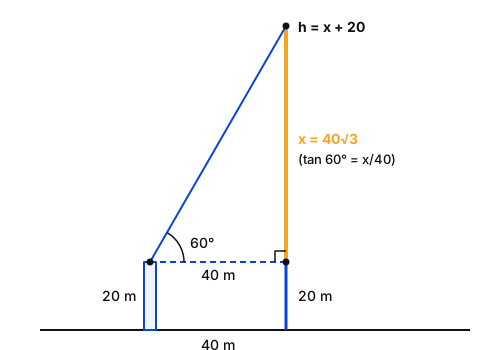
- Extra height x above 20 m: → .
- Taller pole m.
Trick: Always add back the smaller pole's height after solving the upper triangle.
Answer: (A)
अवधारणा: छोटे खंभे के शीर्ष से क्षैतिज रेखा खींचें; उसके ऊपर ।
- 20 m से ऊपर की ऊँचाई x: → ।
- ऊँचा खंभा m।
ट्रिक: ऊपरी त्रिभुज हल करने के बाद छोटे खंभे की ऊँचाई जोड़ना न भूलें।
उत्तर: (A)
SSC CHSLQuantitative AptitudeHeights – two polesSSC CHSL 2025 · 15 Nov Shift 2
Q1015.A chord of length 16 cm is 15 cm from the center. Find the radius.
16 cm लंबाई की एक जीवा केंद्र से 15 cm की दूरी पर है। त्रिज्या ज्ञात कीजिए।
- A21 cm
- B17 cm
- C18 cm
- D14 cm
Show answer
Concept: The perpendicular from the centre bisects a chord: .
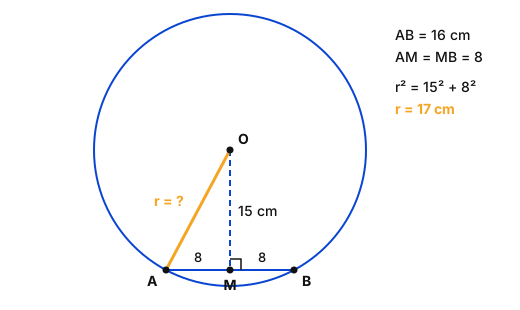
- Half chord = 8 cm, distance = 15 cm.
- 17 cm.
Trick: 8–15–17 triplet — answer without squaring.
Answer: (B) 17 cm
अवधारणा: केंद्र से जीवा पर लंब उसे समद्विभाजित करता है: ।
- आधी जीवा = 8 cm, दूरी = 15 cm।
- 17 cm।
ट्रिक: 8–15–17 त्रिक — वर्ग किए बिना उत्तर।
उत्तर: (B) 17 cm
SSC CHSLQuantitative AptitudeCircle – chord and radiusSSC CHSL 2025 · 15 Nov Shift 2
Q1016.Which is the largest chord of a circle ?
वृत्त की सबसे बड़ी जीवा कौन-सी होती है?
- ARadiusत्रिज्या
- BDiameterव्यास
- CTangentस्पर्श रेखा
- DArcचाप
Show answer
Concept: A chord joins two points on a circle; the one through the centre is longest.
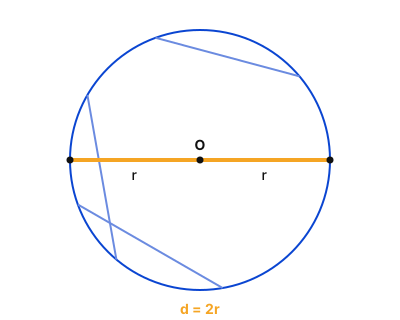
- Chord through the centre = diameter = 2r.
- Radius is not a chord (one end at centre); tangent touches at one point; arc is curved.
Yaad rakhein: Every diameter is a chord, but not every chord is a diameter.
Answer: (B) Diameter
अवधारणा: जीवा वृत्त के दो बिंदुओं को जोड़ती है; केंद्र से गुजरने वाली जीवा सबसे बड़ी।
- केंद्र से गुजरने वाली जीवा = व्यास = 2r।
- त्रिज्या जीवा नहीं (एक सिरा केंद्र पर); स्पर्श रेखा एक बिंदु छूती है; चाप वक्र है।
याद रखें: हर व्यास जीवा है, पर हर जीवा व्यास नहीं।
उत्तर: (B) व्यास
SSC CHSLQuantitative AptitudeCircle – largest chordSSC CHSL 2025 · 15 Nov Shift 2
Q1017.The length and breadth of a rectangle are in the ratio 16 : 14, respectively, and the perimeter of the rectangle is 180 cm . If the area of the rectangle is equal to the area of the top surface of a solid cylinder, then find the curved surface area of the cylinder given that its radius is 110% of its height.
एक आयत की लंबाई और चौड़ाई क्रमशः 16 : 14 के अनुपात में हैं तथा आयत का परिमाप 180 cm है। यदि आयत का क्षेत्रफल एक ठोस बेलन के ऊपरी पृष्ठ के क्षेत्रफल के बराबर है, तो बेलन का वक्र पृष्ठीय क्षेत्रफल ज्ञात कीजिए, जबकि उसकी त्रिज्या उसकी ऊँचाई का 110% है।
- A
- B
- C
- D
Show answer
Concept: ; top surface area = .
- → → .
- → .
- .
Trick: No need to find r: — reuse the area directly.
Answer: (A)
अवधारणा: वक्र पृष्ठ = ; ऊपरी सतह = ।
- → → ।
- → ।
- ।
ट्रिक: r निकालने की ज़रूरत नहीं: ।
उत्तर: (A)
SSC CHSLQuantitative AptitudeCylinder – CSA from top areaSSC CHSL 2025 · 15 Nov Shift 2
Q1018.PT is a tangent at point C on a circle with centre O and AB is a diameter.
When BA is produced, it meets PT at point P . If , then what is the measure of ?
PT, केंद्र O वाले एक वृत्त पर बिंदु C पर स्पर्श रेखा है तथा AB एक व्यास है।
जब BA को आगे बढ़ाया जाता है, तो वह PT से बिंदु P पर मिलती है। यदि है, तो का माप क्या है?
- A27°
- B23*
- C29*
- D38*
Show answer
Concept: Radius ⟂ tangent at the point of contact.
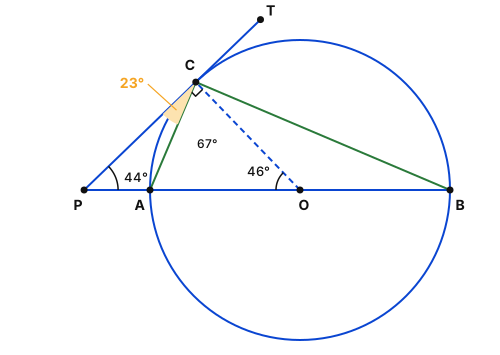
- → .
- → .
- .
Trick: Shortcut: (alternate segment) .
Answer: (B) 23*
अवधारणा: Contact point तक खींची radius और tangent के बीच बनता है।
- → ।
- → ।
- ।
ट्रिक: शॉर्टकट: (एकांतर खंड) ।
उत्तर: (B) 23*
SSC CHSLQuantitative AptitudeTangent and diameter angleSSC CHSL 2025 · 15 Nov Shift 2
Q1019.Simplify.
सरल कीजिए।
- A10
- B12
- C5
- D8
Show answer
Concept: Take out perfect squares from each root.
- .
- Sum .
- 5.
Trick: Divide term by term: .
Answer: (C) 5
अवधारणा: हर करणी को के रूप में लिखें।
- ।
- योग ।
- 5।
ट्रिक: अलग-अलग भाग दें: ।
उत्तर: (C) 5
SSC CHSLQuantitative AptitudeSurds – simplifySSC CHSL 2025 · 15 Nov Shift 2
Q1020.Simplify.
सरल कीजिए।
- A11
- B12
- C10
- D16
Show answer
Concept: .
- .
- 12.
Trick: → .
Answer: (B) 12
अवधारणा: ।
- ।
- 12।
ट्रिक: → ।
उत्तर: (B) 12
SSC CHSLQuantitative AptitudeSurds – (a + b)(a − b)SSC CHSL 2025 · 15 Nov Shift 2

