Q1021.Find the value of
का मान ज्ञात कीजिए।
- A9
- B8
- C7
- D6
Show answer
Concept: Work from the innermost root outward.
- → .
- → .
- → 9.
Trick: Each step makes a perfect square — if it doesn't, recheck the arithmetic.
Answer: (A) 9
अवधारणा: सबसे भीतरी मूल से शुरू करके बाहर की ओर हल करें।
- → ।
- → ।
- → 9।
ट्रिक: हर चरण में पूर्ण वर्ग बनता है — न बने तो गणना दोबारा जाँचें।
उत्तर: (A) 9
SSC CHSLQuantitative AptitudeNested square rootsSSC CHSL 2025 · 15 Nov Shift 2
Q1022.Rationalize.
परिमेयकरण कीजिए।
- A
- B
- C
- D
Show answer
Concept: Multiply numerator and denominator by the conjugate.
- Multiply by .
- Denominator = .
- Result = .
Trick: — sign flips, denominator = difference.
Answer: (A)
अवधारणा: अंश और हर को संयुग्मी (conjugate) से गुणा करें।
- से गुणा।
- हर = ।
- परिणाम = ।
ट्रिक: — चिह्न बदलता है, हर = अंतर।
उत्तर: (A)
SSC CHSLQuantitative AptitudeRationalising the denominatorSSC CHSL 2025 · 15 Nov Shift 2
Q1023.Simplify.
सरल कीजिए।
- A
- B
- C
- D
Show answer
Concept: .
- → → .
- .
- Total .
Trick: Rational part = and sign '+' → only option A.
Answer: (A)
अवधारणा: ।
- → → ।
- ।
- कुल ।
ट्रिक: परिमेय भाग 50 और चिह्न '+' → केवल विकल्प A।
उत्तर: (A)
SSC CHSLQuantitative AptitudeSquare of a surd binomialSSC CHSL 2025 · 15 Nov Shift 2
Q1024.Simplify the expression. )
व्यंजक को सरल कीजिए। )
- A25
- B20
- C28
- D24
Show answer
Concept: .
- .
- .
- 24.
Trick: Spot the full-square pattern before expanding — the terms cancel.
Answer: (D) 24
अवधारणा: ।
- ।
- ।
- 24।
ट्रिक: विस्तार से पहले पूर्ण वर्ग पहचानें — वाले पद कट जाते हैं।
उत्तर: (D) 24
SSC CHSLQuantitative AptitudeIdentity a² + b² + 2abSSC CHSL 2025 · 15 Nov Shift 2
Q1025.The average weight of 28 students is 65 kg . When the teacher's weight is included, the average becomes 67 kg . What is the weight of the teacher ?
28 विद्यार्थियों का औसत भार 65 kg है। शिक्षक का भार सम्मिलित करने पर औसत 67 kg हो जाता है। शिक्षक का भार क्या है?
- A121 kg
- B123 kg
- C109 kg
- D118 kg
Show answer
Concept: New person's value = new average + (old count × increase).
- Increase = kg.
- Teacher = 123 kg.
- Check: .
Trick: Newcomer brings the new average for himself plus 'rise × old count' for everyone else.
Answer: (B) 123 kg
अवधारणा: नए व्यक्ति का मान = नया औसत + (पुरानी संख्या × वृद्धि)।
- वृद्धि = kg।
- शिक्षक = 123 kg।
- जाँच: ।
ट्रिक: नया सदस्य अपने लिए नया औसत और बाकी सबके लिए 'वृद्धि × पुरानी संख्या' लाता है।
उत्तर: (B) 123 kg
SSC CHSLQuantitative AptitudeAverage – new member addedSSC CHSL 2025 · 15 Nov Shift 2
Q1026.Which one of the following statements is FALSE ?
निम्नलिखित में से कौन-सा कथन असत्य है?
- AEvery whole number is an integerप्रत्येक पूर्ण संख्या एक पूर्णांक है
- BEvery integer is a rational numberप्रत्येक पूर्णांक एक परिमेय संख्या है
- CBoth rational and irrational numbers are real numbersपरिमेय और अपरिमेय दोनों संख्याएँ वास्तविक संख्याएँ हैं
- DEvery rational number is an irrational numberप्रत्येक परिमेय संख्या एक अपरिमेय संख्या है
Show answer
Concept: Rational and irrational numbers are two separate (disjoint) sets that together make the real numbers.
- Whole numbers integers → (A) true.
- Any integer → rational → (B) true.
- → (C) true.
- A number cannot be both rational and irrational → (D) false.
Trick: Chain to remember: ; Irrational sits beside Rational, never inside it.
Answer: (D) Every rational number is an irrational number
अवधारणा: Rational व irrational – दोनों अलग-अलग समूह हैं; इन दोनों का मेल real numbers कहलाता है।
हल:
- Whole numbers – ये integers का हिस्सा हैं → (A) ठीक।
- Integer लिखा जा सकता है → rational → (B) ठीक।
- → (C) ठीक।
- जो rational है वह irrational कभी नहीं हो सकता → (D) गलत।
ट्रिक: क्रम: ; Irrational इस श्रृंखला के बगल में है, अंदर नहीं।
उत्तर: (D) प्रत्येक परिमेय संख्या एक अपरिमेय संख्या है
SSC CHSLQuantitative AptitudeNumber system – classification of numbersSSC CHSL 2025 · 15 Nov Shift 1
Q1027.The decimal expansion of an irrational number is:
किसी अपरिमेय संख्या का दशमलव प्रसार होता है:
- ATerminatingसांत
- BRepeatingआवर्ती
- CNon-terminating and non-repeatingअसांत और अनावर्ती
- DTerminating and repeatingसांत और आवर्ती
Show answer
Concept: Terminating or recurring decimal ⇔ rational; otherwise irrational.
- Irrational numbers cannot be written as .
- So their decimals never end and never repeat a block, e.g. ,
Trick: If the decimal 'stops' or 'loops', it is rational – an irrational number does neither.
Answer: (C) Non-terminating and non-repeating
अवधारणा: सांत या आवर्ती दशमलव ⇔ परिमेय; बाकी सब अपरिमेय।
हल:
- अपरिमेय संख्या को रूप में नहीं लिखा जा सकता।
- इसलिए उसका दशमलव न खत्म होता है, न दोहराता है, जैसे ,
ट्रिक: दशमलव 'रुके' या 'दोहराए' तो परिमेय – अपरिमेय दोनों में से कुछ नहीं करता।
उत्तर: (C) असांत और अनावर्ती
SSC CHSLQuantitative AptitudeDecimal expansion of irrational numbersSSC CHSL 2025 · 15 Nov Shift 1
Q1028.A dealer bought two electronic items. On the first item, he gained , and on the second item, he lost 10%. The cost price of the first item was more than that of the second. If the overall profit from both items was ₹200, find the cost price of each item.
एक विक्रेता ने दो इलेक्ट्रॉनिक वस्तुएँ खरीदीं। पहली वस्तु पर उसे का लाभ हुआ तथा दूसरी वस्तु पर 10% की हानि हुई। पहली वस्तु का क्रय मूल्य दूसरी वस्तु के क्रय मूल्य से अधिक था। यदि दोनों वस्तुओं से कुल लाभ ₹200 था, तो प्रत्येक वस्तु का क्रय मूल्य ज्ञात कीजिए।
- A₹1,200 and ₹800₹1,200 और ₹800
- B₹1,000 and ₹700₹1,000 और ₹700
- C₹900 and ₹600₹900 और ₹600
- D₹1,500 and ₹1,000₹1,500 और ₹1,000
Show answer
Concept: Net profit = profit on one − loss on the other, using a variable for cost price.
- CP of 2nd = x, CP of 1st = 1.5x.
- Gain = 20% of 1.5x = 0.3x; loss = 10% of x = 0.1x.
- Net = 0.2x = 200 → x = 1000.
- CPs: ₹1,500 and ₹1,000.
Trick: Option test: first must be 1.5 × second – only (C) and (D) qualify; (D): 300 − 100 = 200 ✔.
Answer: (D) ₹1,500 and ₹1,000
अवधारणा: कुल लाभ = एक पर लाभ − दूसरी पर हानि; क्रय मूल्य को चर मानें।
हल:
- दूसरी का CP = x, पहली का CP = 1.5x।
- लाभ = 1.5x का 20% = 0.3x; हानि = x का 10% = 0.1x।
- कुल = 0.2x = 200 → x = 1000।
- CP: ₹1,500 और ₹1,000।
ट्रिक: विकल्प जाँच: पहला = 1.5 × दूसरा – केवल (C), (D); (D) में 300 − 100 = 200 ✔।
उत्तर: (D) ₹1,500 और ₹1,000
SSC CHSLQuantitative AptitudeProfit and loss – two articlesSSC CHSL 2025 · 15 Nov Shift 1
Q1029.A dealer buys a batch of 30 electric kettles at ₹500 each. He sells 20 of them at 20% profit and the remaining 10 at loss. Find the overall profit or loss percentage.
एक विक्रेता 30 इलेक्ट्रिक केतलियों का एक समूह ₹500 प्रति केतली की दर से खरीदता है। वह उनमें से 20 केतलियाँ 20% लाभ पर तथा शेष 10 केतलियाँ हानि पर बेचता है। कुल लाभ या हानि प्रतिशत ज्ञात कीजिए।
- A8% Profit8% लाभ
- B6% Profit6% लाभ
- C10% Profit10% लाभ
- D5% Loss5% हानि
Show answer
Concept: Overall % = weighted average of the individual profit/loss % (weights = cost).
- Total CP = ₹15,000.
- 20 kettles (₹10,000) at +20% → +₹2,000; 10 kettles (₹5,000) at −10% → −₹500.
- Net profit = ₹1,500 → .
Trick: Weighted average: profit.
Answer: (C) 10% Profit
अवधारणा: कुल % = अलग-अलग लाभ/हानि % का भारित औसत (भार = लागत)।
हल:
- कुल CP = ₹15,000।
- 20 केतली (₹10,000) पर +20% → +₹2,000; 10 केतली (₹5,000) पर −10% → −₹500।
- शुद्ध लाभ = ₹1,500 → ।
ट्रिक: भारित औसत: लाभ।
उत्तर: (C) 10% लाभ
SSC CHSLQuantitative AptitudeOverall profit percentageSSC CHSL 2025 · 15 Nov Shift 1
Q1030.15 plates, each of Rs. 320, are sold at Rs. 4000. What is the percentage of the discount given?
प्रत्येक Rs. 320 मूल्य की 15 प्लेटें Rs. 4000 में बेची जाती हैं। दी गई छूट का प्रतिशत कितना है?
- A
- B
- C13.5%
- D16.67%
Show answer
Concept: .
- Marked price = ₹4,800.
- Discount = ₹800.
- .
Trick: Per plate: , i.e. ₹53.33 off ₹320 .
Answer: (D) 16.67%
अवधारणा: ।
हल:
- अंकित मूल्य = ₹4,800।
- छूट = ₹800।
- ।
ट्रिक: याद रखें – सीधे है।
उत्तर: (D) 16.67%
SSC CHSLQuantitative AptitudeDiscount percentageSSC CHSL 2025 · 15 Nov Shift 1
Q1031.A mobile was bought for ₹12000. Its price was marked up by 30%. Thereafter, it was sold at a discount of on the marked price. What was the percentage profit on the transaction?
एक मोबाइल ₹12000 में खरीदा गया। उसका मूल्य 30% बढ़ाकर अंकित किया गया। तत्पश्चात उसे अंकित मूल्य पर की छूट देकर बेच दिया गया। इस सौदे में लाभ प्रतिशत कितना था?
- A5%
- B
- C4%
- D3%
Show answer
Concept: Successive change: net % = .
- Mark-up +30%, discount −20%.
- Net = .
- Check: MP = 15,600; SP = 12,480; profit = 480 = 4% of 12,000.
Trick: Use – the CP of ₹12,000 is not even needed.
Answer: (C) 4%
अवधारणा: क्रमिक परिवर्तन: शुद्ध % = ।
हल:
- मार्क-अप +30%, छूट −20%।
- शुद्ध = ।
- जाँच: MP = 15,600; SP = 12,480; लाभ = 480 = 12,000 का 4%।
ट्रिक: सूत्र से – ₹12,000 की ज़रूरत ही नहीं पड़ती।
उत्तर: (C) 4%
SSC CHSLQuantitative AptitudeMark-up and discount – net profit %SSC CHSL 2025 · 15 Nov Shift 1
Q1032.A teacher calculated the average marks of 20 students in a test as 65 . Later, she found that the marks of one student were wrongly entered as 45 instead of 85 . After correcting the error, what is the correct average mark of the class?
एक शिक्षिका ने एक परीक्षा में 20 विद्यार्थियों के औसत अंक 65 निकाले। बाद में उसे ज्ञात हुआ कि एक विद्यार्थी के अंक 85 के स्थान पर गलती से 45 दर्ज कर दिए गए थे। त्रुटि सुधारने के बाद कक्षा का सही औसत अंक क्या है?
- A63
- B67
- C68
- D62
Show answer
Concept: .
- Error = (too little).
- Average rises by .
- New average = .
Trick: Never recompute the full total – just spread the error over 20 students.
Answer: (B) 67
अवधारणा: ।
हल:
- अंतर = (कम लिखा गया)।
- औसत में वृद्धि = ।
- नया औसत = ।
ट्रिक: पूरा योग दोबारा न निकालें – बस अंतर को 20 छात्रों में बाँट दें।
उत्तर: (B) 67
SSC CHSLQuantitative AptitudeAverage – correcting a wrong entrySSC CHSL 2025 · 15 Nov Shift 1
Q1033.A student scored 25% more marks in History than in English. If the average of his marks in both subjects is 81 , what are his marks in English ?
एक विद्यार्थी ने इतिहास में अंग्रेज़ी की तुलना में 25% अधिक अंक प्राप्त किए। यदि दोनों विषयों में उसके अंकों का औसत 81 है, तो अंग्रेज़ी में उसके अंक कितने हैं?
- A72
- B54
- C90
- D64
Show answer
Concept: Use ratio: 25% more means History : English = 5 : 4.
- Total = .
- English : History = 4 : 5 → 9 parts = 162 → 1 part = 18.
- English = (History = 90).
Trick: → ratio 4 : 5 directly; total .
Answer: (A) 72
अवधारणा: अनुपात का प्रयोग: 25% अधिक यानी History : English = 5 : 4।
हल:
- कुल = ।
- English : History = 4 : 5 → 9 भाग = 162 → 1 भाग = 18।
- English = (History = 90)।
ट्रिक: → सीधे 4 : 5 अनुपात; ।
उत्तर: (A) 72
SSC CHSLQuantitative AptitudeAverage with percentage relationSSC CHSL 2025 · 15 Nov Shift 1
Q1034.A school conducted a scholarship test where 55% of the students passed in English,65% passed in Math, and 40% passed in both subjects.What is the percentage of students who passed in at least one subject ?
एक विद्यालय ने एक छात्रवृत्ति परीक्षा आयोजित की, जिसमें 55% विद्यार्थी अंग्रेज़ी में, 65% विद्यार्थी गणित में तथा 40% विद्यार्थी दोनों विषयों में उत्तीर्ण हुए। कम से कम एक विषय में उत्तीर्ण होने वाले विद्यार्थियों का प्रतिशत कितना है?
- A80%
- B75%
- C90%
- D85%
Show answer
Concept: n(A ∪ B) = n(A) + n(B) − n(A ∩ B).
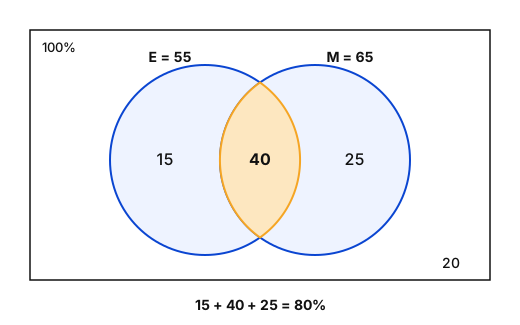
- At least one = 55 + 65 − 40.
- = 80%.
Yaad rakhein: Failed in both = 100 − 80 = 20% – a common follow-up question.
Answer: (A) 80%
अवधारणा: n(A ∪ B) = n(A) + n(B) − n(A ∩ B)।
हल:
- कम से कम एक में पास = 55 + 65 − 40।
- = 80%।
याद रखें: दोनों में फेल = 100 − 80 = 20% – यह भी अक्सर पूछा जाता है।
उत्तर: (A) 80%
SSC CHSLQuantitative AptitudePercentage – passed in at least one subjectSSC CHSL 2025 · 15 Nov Shift 1
Q1035.P and Q invest ₹20,000 and ₹30,000 respectively. After 5 months, R joins with ₹40,000. What will be the ratio of their profits at the end of the year ?
P और Q क्रमशः ₹20,000 तथा ₹30,000 का निवेश करते हैं। 5 माह बाद R ₹40,000 के साथ सम्मिलित होता है। वर्ष के अंत में उनके लाभों का अनुपात क्या होगा?
- A5 : 6 : 7
- B6 : 7 : 5
- C7 : 9 : 6
- D6 : 9 : 7
Show answer
Concept: Profit ratio = capital × months.
- P: ; Q: (in thousands).
- R joins after 5 months → 7 months: .
- 240 : 360 : 280 = 6 : 9 : 7.
Trick: Drop the zeros and divide by a common factor early: = 24 : 36 : 28 → ÷4.
Answer: (D) 6 : 9 : 7
अवधारणा: लाभ का अनुपात = पूँजी × महीने।
हल:
- P: ; Q: (हज़ार में)।
- R 5 महीने बाद आया → 7 महीने: ।
- 240 : 360 : 280 = 6 : 9 : 7।
ट्रिक: शून्य हटाकर गुणा करें: 24 : 36 : 28 → 4 से भाग।
उत्तर: (D) 6 : 9 : 7
SSC CHSLQuantitative AptitudePartnership – different time periodsSSC CHSL 2025 · 15 Nov Shift 1
Q1036.K, L, and M invest ₹30,000, ₹40,000, and ₹70,000, respectively, in a business. The profit at the end of the year is ₹84,000. What is L's share of the profit ?
K, L और M एक व्यवसाय में क्रमशः ₹30,000, ₹40,000 और ₹70,000 का निवेश करते हैं। वर्ष के अंत में लाभ ₹84,000 है। लाभ में L का हिस्सा कितना है?
- ARs. 20000
- BRs. 22000
- CRs. 24000
- DRs. 48000
Show answer
Concept: Same period → profit is shared in the ratio of capitals.
- 30 : 40 : 70 = 3 : 4 : 7 (total 14).
- One part = ₹6,000.
- L = ₹24,000.
Trick: 84 is a multiple of 14 – read it as thousand per part.
Answer: (C) Rs. 24000
अवधारणा: समान समय → लाभ पूँजी के अनुपात में बँटता है।
हल:
- 30 : 40 : 70 = 3 : 4 : 7 (कुल 14)।
- 1 भाग = ₹6,000।
- L = ₹24,000।
ट्रिक: 84, 14 का गुणज है – सीधे हज़ार प्रति भाग।
उत्तर: (C) Rs. 24000
SSC CHSLQuantitative AptitudePartnership – equal timeSSC CHSL 2025 · 15 Nov Shift 1
Q1037.If the radii of two cylinders are in the ratio of and their heights are in the ratio of , then the ratio of their volumes is:
यदि दो बेलनों की त्रिज्याओं का अनुपात है तथा उनकी ऊँचाइयों का अनुपात है, तो उनके आयतनों का अनुपात है:
- A22 : 15
- B20 : 27
- C3 : 4
- D16 : 23
Show answer
Concept: , so .
- ratio = 4 : 9; h ratio = 5 : 3.
- .
Trick: Square the radius ratio, multiply by the height ratio – π never matters.
Answer: (B) 20 : 27
अवधारणा: , इसलिए ।
हल:
- का अनुपात = 4 : 9; h का अनुपात = 5 : 3।
- ।
ट्रिक: त्रिज्या अनुपात का वर्ग × ऊँचाई अनुपात – π कट जाता है।
उत्तर: (B) 20 : 27
SSC CHSLQuantitative AptitudeMensuration – ratio of cylinder volumesSSC CHSL 2025 · 15 Nov Shift 1
Q1038.A circle is inscribed within a square with a side length of 20 cm . Find the area of the part of the square not covered by ine circle.
20 cm भुजा वाले एक वर्ग के अंतर्गत एक वृत्त खींचा गया है। वर्ग के उस भाग का क्षेत्रफल ज्ञात कीजिए जो वृत्त से ढका नहीं है।
- A
- B
- C
- D
Show answer
Concept: Inscribed circle: diameter = side of square.
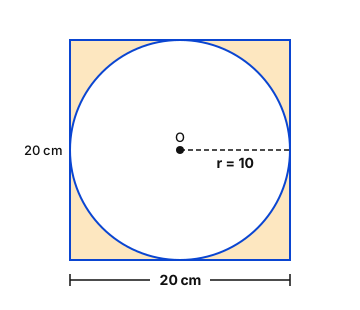
- cm.
- Square = 400 cm²; circle = .
- Uncovered = .
Trick: Uncovered part is always .
Answer: (B)
अवधारणा: अंतर्वृत्त का व्यास = वर्ग की भुजा।
हल:
- cm।
- वर्ग = 400 cm²; वृत्त = ।
- बचा भाग = ।
ट्रिक: बचा भाग हमेशा ।
उत्तर: (B)
SSC CHSLQuantitative AptitudeArea – square minus inscribed circleSSC CHSL 2025 · 15 Nov Shift 1
Q1039.If and , then find the value of .
यदि और है, तो का मान ज्ञात कीजिए।
- A468
- B441
- C484
- D488
Show answer
Concept: .
- .
Trick: – the answer to is usually a perfect square, which also rules out 468 and 488.
Answer: (C) 484
अवधारणा: ।
हल:
- ।
ट्रिक: – ऐसे प्रश्नों का उत्तर प्रायः पूर्ण वर्ग होता है; 468, 488 तुरंत हटें।
उत्तर: (C) 484
SSC CHSLQuantitative AptitudeAlgebraic identity – (a + b + c)²SSC CHSL 2025 · 15 Nov Shift 1
Q1040.A cone and a hemisphere have equal curved surface areas. The radius of the cone is and the radius of the hemisphere is . Find the slant height of the cone in terms of .
एक शंकु और एक अर्धगोले के वक्र पृष्ठीय क्षेत्रफल बराबर हैं। शंकु की त्रिज्या है और अर्धगोले की त्रिज्या है। के पदों में शंकु की तिर्यक ऊँचाई ज्ञात कीजिए।
- A
- B
- C
- D
Show answer
Concept: ; .
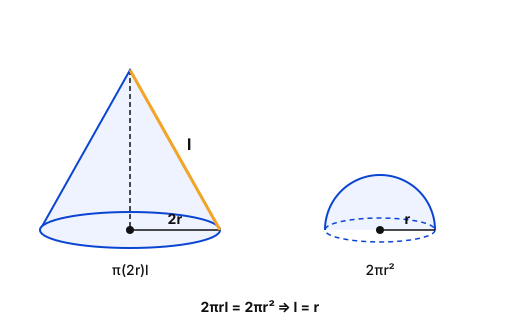
- Cone: .
- Set equal: .
Trick: Cancel from both sides in one go.
Answer: (B)
अवधारणा: ; ।
हल:
- शंकु: ।
- बराबर रखें: ।
ट्रिक: दोनों ओर से एक साथ काट दें।
उत्तर: (B)
SSC CHSLQuantitative AptitudeCurved surface area – cone and hemisphereSSC CHSL 2025 · 15 Nov Shift 1

