SSC CHSL · 5,000 questions

SSC CHSL 2025 PYQs

Real previous year questions, subject-wise. Try the question, then open the answer and the explanation in Hindi & English – free, no login.

Courses – airGurukul

1,250 questions in Quantitative Aptitude.

Q1041.
cos⁡x1+sin⁡x+1+sin⁡xcos⁡x is equal to:
cos⁡x1+sin⁡x+1+sin⁡xcos⁡x बराबर है:
  1. A2sin⁡x
  2. B2cos⁡x
  3. C2cosecx
  4. D2sec⁡x
Show answer

Concept: Take LCM and use sin2x+cos2x=1.

  1. Numerator: cos2x+(1+sinx)2=cos2x+1+2sinx+sin2x=2+2sinx.
  2. Expression = 2(1+sinx)(1+sinx)cosx=2cosx=2secx.

Trick: Put x=0∘: 11+11=2, and 2sec0∘=2 – only (D) gives 2.

Answer: (D) 2sec⁡x

अवधारणा: LCM लेकर sin2x+cos2x=1 का प्रयोग करें।

हल:

  1. अंश: cos2x+(1+sinx)2=cos2x+1+2sinx+sin2x=2+2sinx।
  2. व्यंजक = 2(1+sinx)(1+sinx)cosx=2cosx=2secx।

ट्रिक: x=0∘ रखें: 1+1=2; केवल 2sec0∘=2 देता है।

उत्तर: (D) 2sec⁡x

SSC CHSLQuantitative AptitudeTrigonometry – simplificationSSC CHSL 2025 · 15 Nov Shift 1
Q1042.
The value of θ when 3cos⁡θ+sin θ=1(0∘≤θ≤90∘), is:
θ का मान, जबकि 3cos⁡θ+sin θ=1(0∘≤θ≤90∘) है, है:
  1. A90°
  2. B30°
  3. C60°
  4. D0°
Show answer

Concept: Divide by a2+b2 to get a compound-angle form; or simply test options.

  1. Divide 3cosθ+sinθ=1 by 2: sin(60∘+θ)=12.
  2. 60∘+θ lies in 60∘–150∘ → 60∘+θ=150∘ → θ=90∘.
  3. Check: 3×0+1=1 ✔.

Trick: Put options: θ=90∘ → 0+1=1 ✔ in seconds.

Answer: (A) 90°

अवधारणा: a2+b2 से भाग देकर संयुक्त कोण रूप बनाएँ; या विकल्प रखकर देखें।

हल:

  1. 3cosθ+sinθ=1 को 2 से भाग: sin(60∘+θ)=12।
  2. 60∘+θ, 60∘ से 150∘ के बीच → 60∘+θ=150∘ → θ=90∘।
  3. जाँच: 3×0+1=1 ✔।

ट्रिक: विकल्प रखें: θ=90∘ → 0+1=1 ✔ – कुछ ही सेकंड में।

उत्तर: (A) 90°

SSC CHSLQuantitative AptitudeTrigonometric equationSSC CHSL 2025 · 15 Nov Shift 1
Q1043.
A woman and a girl received Rs. 800 as wages for 4 days for the work they did together. The woman's efficiency in the work was thrice that of the girl. What are the daily wages of the girl ?
एक महिला और एक लड़की ने मिलकर किए गए कार्य के लिए 4 दिन की मजदूरी के रूप में Rs. 800 प्राप्त किए। कार्य में महिला की कार्यक्षमता लड़की की कार्यक्षमता की तीन गुनी थी। लड़की की दैनिक मजदूरी कितनी है?
  1. A50/-
  2. B30/-
  3. C40/-
  4. D20/-
Show answer

Concept: Wages are divided in the ratio of efficiency (work done).

  1. Per day together = 800÷4= ₹200.
  2. Woman : girl = 3 : 1 → girl gets 14.
  3. Girl's daily wage = 200×14= ₹50.

Trick: Girl's share of the total = 800×14=200 for 4 days → ₹50/day.

Answer: (A) 50/-

अवधारणा: मज़दूरी दक्षता (किए गए काम) के अनुपात में बँटती है।

हल:

  1. एक दिन की कुल मज़दूरी = 800÷4= ₹200।
  2. महिला : लड़की = 3 : 1 → लड़की को 14।
  3. लड़की की दैनिक मज़दूरी = 200×14= ₹50।

ट्रिक: लड़की का हिस्सा = 800 का 14=200 (4 दिन) → ₹50 प्रतिदिन।

उत्तर: (A) 50/-

SSC CHSLQuantitative AptitudeWork and wages – efficiency ratioSSC CHSL 2025 · 15 Nov Shift 1
Q1044.
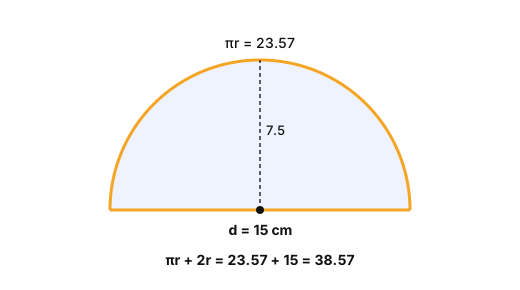
The perimeter of a square is equal to the perimeter of a rectangle of length 16 cm and breadth 14 cm . Find the circumference of a semicircle whose diameter is equal to the side of the square.
एक वर्ग का परिमाप, 16 cm लंबाई और 14 cm चौड़ाई वाले एक आयत के परिमाप के बराबर है। उस अर्धवृत्त की परिधि ज्ञात कीजिए जिसका व्यास वर्ग की भुजा के बराबर है।
  1. A38.57
  2. B21.57
  3. C23.57
  4. D25.57
Show answer

Concept: Perimeter of a semicircle = πr+2r (curved arc + diameter).

  1. Rectangle perimeter = 2(16+14)=60 cm → square side = 15 cm.
  2. Diameter = 15, r=7.5.
  3. πr+2r=227×7.5+15=23.57+15=38.57 cm.

Trick: Shortcut: semicircle perimeter = (367)×r=367×7.5≈38.57. Option (C) 23.57 is only the arc – a trap.

Answer: (A) 38.57

अवधारणा: अर्धवृत्त की परिधि = πr+2r (वक्र भाग + व्यास)।

हल:

  1. आयत का परिमाप 2×30=60 cm; यही वर्ग का परिमाप → भुजा 15 cm।
  2. अर्धवृत्त का व्यास 15 → r=7.5।
  3. πr+2r=(227)(7.5)+15≈23.571+15≈38.57 cm।

ट्रिक: शॉर्टकट: अर्धवृत्त परिधि = (367)×r। विकल्प (C) 23.57 केवल चाप है – जाल।

उत्तर: (A) 38.57

SSC CHSLQuantitative AptitudePerimeter of a semicircleSSC CHSL 2025 · 15 Nov Shift 1
Q1045.
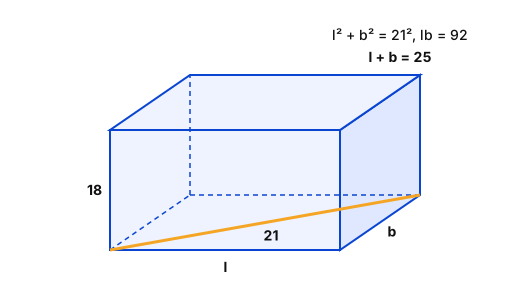
A rectangular parallelopiped has its base diagonal equal to 21 cm and height 18 cm . If the area of its base is 92cm2, find the total surface area of the parallelopiped.
एक आयताकार समांतर षट्फलक (घनाभ) के आधार का विकर्ण 21 cm और ऊँचाई 18 cm है। यदि इसके आधार का क्षेत्रफल 92cm2 है, तो इस समांतर षट्फलक का संपूर्ण पृष्ठीय क्षेत्रफल ज्ञात कीजिए।
  1. A1064cm2
  2. B1094cm2
  3. C1084cm2
  4. D1070cm2
Show answer

Concept: TSA=2lb+2h(l+b); find (l+b) from (l+b)2=l2+b2+2lb.

  1. Base diagonal 21 → l2+b2=441; lb=92.
  2. (l+b)2=441+184=625 → l+b=25.
  3. TSA=2×92+2×18×25=184+900=1084cm2.

Trick: You never need l and b separately – only their sum and product.

Answer: (C) 1084cm2

अवधारणा: TSA=2lb+2h(l+b); (l+b) को (l+b)2=l2+b2+2lb से निकालें।

हल:

  1. आधार विकर्ण 21 → l2+b2=441; lb=92।
  2. (l+b)2=441+184=625 → l+b=25।
  3. TSA=2×92+2×18×25=184+900=1084cm2।

ट्रिक: l और b अलग-अलग निकालने की ज़रूरत नहीं – केवल योग और गुणनफल चाहिए।

उत्तर: (C) 1084cm2

SSC CHSLQuantitative AptitudeCuboid – total surface area from diagonalSSC CHSL 2025 · 15 Nov Shift 1
Q1046.
If y=2+2, find y3+3y.
यदि y=2+2 है, तो y3+3y ज्ञात कीजिए।
  1. A26+172
  2. B26−172
  3. C262+17
  4. D262−17
Show answer

Concept: Expand y2 first, then y3=y×y2.

  1. y=2+2 → y2=4+42+2=6+42.
  2. y3=(2+2)(6+42)=12+82+62+8=20+142.
  3. 3y=6+32 → y3+3y=26+172.

Trick: Rational part = 26 must come out positive with +2 terms only – eliminate the options with '−' at once.

Answer: (A) 26+172

अवधारणा: पहले y2 निकालें, फिर y3=y×y2।

हल:

  1. y=2+2 → y2=4+42+2=6+42।
  2. y3=(2+2)(6+42)=12+82+62+8=20+142।
  3. 3y=6+32 → y3+3y=26+172।

ट्रिक: सभी पद धनात्मक हैं, इसलिए '−' वाले विकल्प तुरंत हटाएँ।

उत्तर: (A) 26+172

SSC CHSLQuantitative AptitudeSurds – value of y³ + 3ySSC CHSL 2025 · 15 Nov Shift 1
Q1047.
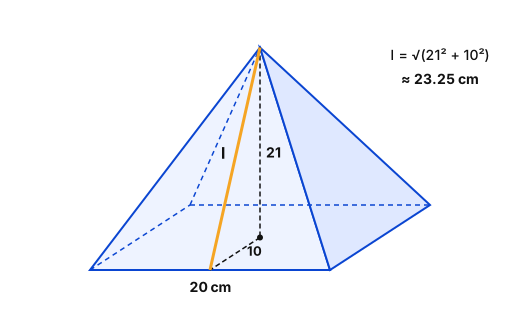
A regular right pyramid has a square base with side length 20 cm and a height of 21 cm . Calculate the slant height and total surface area (approximately).
एक सम लंब पिरामिड का आधार वर्गाकार है जिसकी भुजा की लंबाई 20 cm है तथा इसकी ऊँचाई 21 cm है। इसकी तिर्यक ऊँचाई और संपूर्ण पृष्ठीय क्षेत्रफल (लगभग) की गणना कीजिए।
  1. A23.25cm,1330cm2
  2. B22.4cm,1536cm2
  3. C24.0cm,1680cm2
  4. D20.1cm,1452cm2
Show answer

Concept: Slant height l=h2+(a2)2; TSA=12×base perimeter×l+base area.

  1. l=212+102=541≈23.25 cm.
  2. Lateral = 12×80×23.25≈930cm2.
  3. TSA≈930+400=1330cm2.

Trick: Slant height must exceed the height 21 and be near 541 (between 23 and 24) – only (A) fits.

Answer: (A) 23.25cm,1330cm2

अवधारणा: तिर्यक ऊँचाई l=h2+(a2)2; TSA=12×आधार परिमाप×l+आधार क्षेत्रफल।

हल:

  1. l=212+102=541≈23.25 cm।
  2. पार्श्व = 12×80×23.25≈930cm2।
  3. TSA≈930+400=1330cm2।

ट्रिक: 541, 23 और 24 के बीच है – केवल (A) में ऐसा मान है।

उत्तर: (A) 23.25cm,1330cm2

SSC CHSLQuantitative AptitudeSquare pyramid – slant height and TSASSC CHSL 2025 · 15 Nov Shift 1
Q1048.
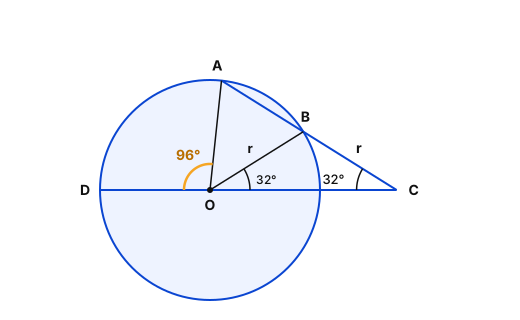
AB is a chord in a circle with centre O. AB is produced to C such that BC is equal to the radius of the circle. C is joined to 0 and produced to meet the circle at D. If ∠ACD=32∘, then the measure of ∠AOD is ____.
AB, केंद्र O वाले एक वृत्त की जीवा है। AB को C तक इस प्रकार बढ़ाया जाता है कि BC वृत्त की त्रिज्या के बराबर हो। C को 0 से मिलाकर आगे बढ़ाया जाता है, जो वृत्त को D पर मिलता है। यदि ∠ACD=32∘ है, तो ∠AOD की माप ____ है।
  1. A48°
  2. B108°
  3. C80*
  4. D96°
Show answer

Concept: Isosceles triangles from radii + exterior angle property.

  1. Join OB: OB=BC → ∠BOC=∠BCO=32∘.
  2. Exterior ∠OBA=32∘+32∘=64∘=∠OAB (OA=OB).
  3. In △OAC: ∠AOC=180∘−64∘−32∘=84∘.
  4. ∠AOD=180∘−84∘=96∘.

Trick: In this standard figure, ∠AOD=3×∠ACD=3×32∘=96∘.

Answer: (D) 96°

अवधारणा: त्रिज्याओं से बने समद्विबाहु त्रिभुज + बहिष्कोण गुण।

हल:

  1. OB मिलाएँ: OB=BC → ∠BOC=∠BCO=32∘।
  2. बहिष्कोण ∠OBA=32∘+32∘=64∘=∠OAB (OA=OB)।
  3. △OAC में ∠AOC=180∘−64∘−32∘=84∘।
  4. ∠AOD=180∘−84∘=96∘।

ट्रिक: इस मानक आकृति में ∠AOD=3×∠ACD=3×32∘=96∘।

उत्तर: (D) 96°

SSC CHSLQuantitative AptitudeCircle geometry – chord produced by radius lengthSSC CHSL 2025 · 15 Nov Shift 1
Q1049.
Two vessels of equal capacity, and both completely filled, contain mixtures of milk and water in the ratio 5 : 1 and 6 : 5, respectively. Both the mixtures are now mixed thoroughly. What is the ratio of milk to water in the new mixture so obtained?
समान धारिता वाले दो बर्तन, जो पूरी तरह भरे हुए हैं, में दूध और पानी के मिश्रण क्रमशः 5 : 1 और 6 : 5 के अनुपात में हैं। अब दोनों मिश्रणों को अच्छी तरह मिला दिया जाता है। इस प्रकार प्राप्त नए मिश्रण में दूध और पानी का अनुपात क्या है?
  1. A105 : 67
  2. B57 : 41
  3. C91 : 41
  4. D28 : 43
Show answer

Concept: Make the total parts equal (LCM) before adding.

  1. Totals 6 and 11 → LCM 66.
  2. Vessel 1 (5 : 1) ×11 → 55 : 11; Vessel 2 (6 : 5) ×6 → 36 : 30.
  3. Milk : water = (55+36):(11+30)=91:41.

Trick: Sum of the answer's terms must be 132 (=2×66): 91+41=132 ✔.

Answer: (C) 91 : 41

अवधारणा: दोनों बर्तनों की मात्रा समान है, इसलिए कुल भागों को एक ही संख्या (LCM) में बदलें।

हल:

  1. कुल 6 और 11 → LCM 66।
  2. बर्तन 1 (5 : 1) ×11 → 55 : 11; बर्तन 2 (6 : 5) ×6 → 36 : 30।
  3. दूध : पानी = (55+36):(11+30)=91:41।

ट्रिक: उत्तर के पदों का योग 132 (=2×66) होना चाहिए: 91+41=132 ✔।

उत्तर: (C) 91 : 41

SSC CHSLQuantitative AptitudeMixtures – equal quantities of two mixturesSSC CHSL 2025 · 15 Nov Shift 1
Q1050.
A sum is invested at compound interest (compounded annually) at a certain rate. The interest earned in the 1st year is ₹3,000, and in the 2nd year it is ₹3,600. Find 40% of the sum invested.
एक राशि को किसी निश्चित दर पर चक्रवृद्धि ब्याज (वार्षिक संयोजित) पर निवेश किया जाता है। पहले वर्ष में अर्जित ब्याज ₹3,000 है और दूसरे वर्ष में यह ₹3,600 है। निवेश की गई राशि का 40% ज्ञात कीजिए।
  1. ARs. 3,000
  2. BRs. 8,000
  3. CRs. 6,000
  4. DRs. 5,000
Show answer

Concept: 2nd-year CI − 1st-year CI = interest on the 1st-year interest.

  1. 600=R% of 3000 → R=20%.
  2. 1st-year interest = 20% of sum = 3000 → sum = ₹15,000.
  3. 40% of 15000 = ₹6,000.

Trick: Sum=(1st-year CI)2difference=30002600=15,000.

Answer: (C) Rs. 6,000

अवधारणा: दूसरे वर्ष का CI − पहले वर्ष का CI = पहले वर्ष के ब्याज पर ब्याज।

हल:

  1. 600= 3000 का R% → R=20%।
  2. पहले वर्ष का ब्याज = मूलधन का 20% = 3000 → मूलधन = ₹15,000।
  3. 15000 का 40% = ₹6,000।

ट्रिक: मूलधन=(पहले वर्ष का CI)2अंतर=30002600=15,000।

उत्तर: (C) Rs. 6,000

SSC CHSLQuantitative AptitudeCompound interest – from yearly interestsSSC CHSL 2025 · 15 Nov Shift 1
Q1051.
A person sells 15 pens for ₹ 750 and suffers a loss equal to the selling price of 3 pens. What is the cost price of one pen?
एक व्यक्ति 15 पेन ₹ 750 में बेचता है और उसे 3 पेनों के विक्रय मूल्य के बराबर हानि होती है। एक पेन का क्रय मूल्य कितना है?
  1. A₹ 70
  2. B₹ 65
  3. C₹ 75
  4. D₹ 60
Show answer

Concept: CP = SP + Loss.

  1. SP of 1 pen = 750÷15= ₹50.
  2. Loss = SP of 3 pens = ₹150 → CP of 15 pens = 750+150= ₹900.
  3. CP of 1 pen = 900÷15= ₹60.

Trick: Loss = SP of 3 → CP of 15 = SP of 18 pens = 18×50=900→90015=60.

Answer: (D) ₹ 60

अवधारणा: CP = SP + हानि।

हल:

  1. 1 पेन का SP = 750÷15= ₹50
  2. हानि = 3 पेन का SP = ₹150 → 15 पेन का CP = 750+150= ₹900
  3. 1 पेन का CP = 900÷15= ₹60

ट्रिक: हानि = 3 पेन का SP, तो 15 पेन का CP = 18 पेन का SP = 18×50=900।

उत्तर: (D) ₹ 60

SSC CHSLQuantitative AptitudeProfit & loss – loss equal to SP of some articlesSSC CHSL 2025 · 14 Nov Shift 3
Q1052.
A, B, and C each started a business. A invested ₹150,000, B ₹100,000, and C₹120,000. After 8 months, A added ₹30,000, and C withdrew ₹20,000. If the total profit at the end of 2 years is ₹1,69,500 what will be A's profit?
A, B और C में से प्रत्येक ने एक व्यवसाय आरंभ किया। A ने ₹150,000, B ने ₹100,000 तथा C₹120,000 निवेश किया। 8 महीने बाद A ने ₹30,000 और मिला दिए तथा C ने ₹20,000 निकाल लिए। यदि 2 वर्ष के अंत में कुल लाभ ₹1,69,500 है, तो A का लाभ कितना होगा?
  1. A₹76,500
  2. B₹92,000
  3. C₹80,000
  4. D₹98,000
Show answer

Concept: Profit share∝capital×months.

  1. Period = 24 months. A: 1.5L×8+1.8L×16=12L+28.8L=40.8L.
  2. B: 1L×24=24L. C: 1.2L×8+1L×16=9.6L+16L=25.6L.
  3. Ratio 408 : 240 : 256 = 51 : 30 : 32 (sum 113).
  4. A=169500×51113=1500×51= ₹76,500.

Trick: Total profit 169500=113×1500 — when the total is a multiple of the ratio sum, the answer is a clean multiple of 1500.

Answer: (A) ₹76,500

अवधारणा: लाभ का हिस्सा∝पूँजी×महीने।

हल:

  1. अवधि = 24 महीने। A: 1.5L×8+1.8L×16=12L+28.8L=40.8L
  2. B: 1L×24=24L; C: 1.2L×8+1L×16=9.6L+16L=25.6L
  3. अनुपात 408 : 240 : 256 = 51 : 30 : 32 (योग 113)
  4. A=169500×51113=1500×51= ₹76,500

ट्रिक: 169500=113×1500, इसलिए हर हिस्सा 1500 का गुणज होगा — 51×1500 सीधे।

उत्तर: (A) ₹76,500

SSC CHSLQuantitative AptitudePartnership – changing capitalSSC CHSL 2025 · 14 Nov Shift 3
Q1053.
If cot⁡θ=125 and θ is in Quadrant III, what is the value of sin⁡θ ?
यदि cot⁡θ=125 है तथा θ तृतीय चतुर्थांश में है, तो sin⁡θ का मान क्या है?
  1. A513
  2. B−513
  3. C1213
  4. D−1213
Show answer

Concept: Find the magnitude from the triplet, then the sign from the quadrant.

  1. cotθ=125 → base 12, perpendicular 5, hypotenuse 13 (5-12-13 triplet).
  2. |sinθ|=513.
  3. In Quadrant III only tan and cot are positive → sinθ= −513.

Trick: ASTC – 'All Students Take Coffee': Q1 all, Q2 sin, Q3 tan, Q4 cos are positive.

Answer: (B) −513

अवधारणा: पहले triplet से मान, फिर चतुर्थांश से चिह्न।

हल:

  1. cotθ=125 → आधार 12, लंब 5, कर्ण 13 (5-12-13)
  2. |sinθ|=513
  3. तीसरे चतुर्थांश में केवल tan, cot धनात्मक → sinθ= −513

ट्रिक: ASTC – 'All Students Take Coffee': Q1 सभी, Q2 sin, Q3 tan, Q4 cos धनात्मक।

उत्तर: (B) −513

SSC CHSLQuantitative AptitudeTrigonometry – sign in quadrantsSSC CHSL 2025 · 14 Nov Shift 3
Q1054.
If m:n=7:8 and n:p=3:2, then find m:n:p.
यदि m:n=7:8 तथा n:p=3:2 है, तो m:n:p ज्ञात कीजिए।
  1. A21 : 24 : 16
  2. B21: 16 : 24
  3. C24 : 21 : 16
  4. D24:16:21
Show answer

Concept: Make the common term (n) equal in both ratios.

  1. m : n = 7 : 8, n : p = 3 : 2.
  2. m=7×3=21, n=8×3=24, p=8×2=16.
  3. m : n : p = 21 : 24 : 16.

Trick: Cross-multiply pattern: m : n : p = (7×3):(8×3):(8×2).

Answer: (A) 21 : 24 : 16

अवधारणा: साझा पद (n) को दोनों अनुपातों में बराबर करें।

हल:

  1. m : n = 7 : 8, n : p = 3 : 2
  2. m=7×3=21, n=8×3=24, p=8×2=16
  3. m : n : p = 21 : 24 : 16

ट्रिक: सूत्र: m : n : p = (7×3):(8×3):(8×2)।

उत्तर: (A) 21 : 24 : 16

SSC CHSLQuantitative AptitudeRatio – combining two ratiosSSC CHSL 2025 · 14 Nov Shift 3
Q1055.
The difference between the compound interest and simple interest on a sum for 3 years at 10% p.a. is ₹ 31 . What is the sum?
किसी धनराशि पर 3 वर्ष के लिए 10% वार्षिक दर से चक्रवृद्धि ब्याज और साधारण ब्याज का अंतर ₹ 31 है। वह धनराशि कितनी है?
  1. A₹1,100
  2. B₹1,000
  3. C₹1,500
  4. D₹1,200
Show answer

Concept: For 3 years: CI−SI=P(r100)2×(3+r100).

  1. r100=0.1 → difference = P×0.01×3.1=0.031P.
  2. 0.031P=31⇒P= ₹1,000.

Trick: At 10% for 3 years, CI−SI=3.1% of P — remember this ready value.

Answer: (B) ₹1,000

अवधारणा: 3 वर्ष के लिए: CI−SI=P(r100)2×(3+r100)।

हल:

  1. r100=0.1 → अंतर = P×0.01×3.1=0.031P
  2. 0.031P=31⇒P= ₹1,000

ट्रिक: 10% पर 3 वर्ष: CI−SI= P का 3.1% — यह तैयार मान याद रखें।

उत्तर: (B) ₹1,000

SSC CHSLQuantitative AptitudeCI – SI difference for 3 yearsSSC CHSL 2025 · 14 Nov Shift 3
Q1056.
The amount at the end of the 2nd and 3rd years on a certain principal at Cl is ₹4,840 and ₹5,324 respectively. Find the principal.
किसी निश्चित मूलधन पर चक्रवृद्धि ब्याज (CI) से 2रे और 3रे वर्ष के अंत में मिश्रधन क्रमशः ₹4,840 तथा ₹5,324 है। मूलधन ज्ञात कीजिए।
  1. A₹5,000
  2. B₹4,000
  3. C₹6,800
  4. D₹7,000
Show answer

Concept: Ratio of consecutive yearly amounts = (1+r100).

  1. 5324÷4840=1.1⇒r=10%.
  2. After 2 years: P×1.21=4840⇒P= ₹4,000.

Trick: Go backwards dividing by 1.1: 4840 → 4400 → 4000.

Answer: (B) ₹4,000

अवधारणा: लगातार दो वर्षों की राशियों का अनुपात = (1+r100)।

हल:

  1. 5324÷4840=1.1⇒r=10%
  2. 2 वर्ष बाद: P×1.21=4840⇒P= ₹4,000

ट्रिक: उल्टा 1.1 से भाग देते जाएँ: 4840 → 4400 → 4000।

उत्तर: (B) ₹4,000

SSC CHSLQuantitative AptitudeCompound interest – principal from successive amountsSSC CHSL 2025 · 14 Nov Shift 3
Q1057.
The average of 13 numbers is 51 . If the first seven numbers have an average of 50 and the last seven numbers have an average of 51 , find the middle number.
13 संख्याओं का औसत 51 है। यदि पहली सात संख्याओं का औसत 50 है तथा अंतिम सात संख्याओं का औसत 51 है, तो बीच वाली संख्या ज्ञात कीजिए।
  1. A44
  2. B45
  3. C40
  4. D42
Show answer

Concept: The 7th number is in both groups of seven.

  1. Total of 13 = 13×51=663.
  2. First 7 = 350, last 7 = 357; together = 707.
  3. Middle number = 707−663= 44.

Trick: Deviation method: first group −1 each (−7), last group 0; middle =51+(−7+0)=44.

Answer: (A) 44

अवधारणा: 7वीं संख्या दोनों समूहों में शामिल है।

हल:

  1. सभी 13 का कुल = 51×13=663
  2. पहली 7 = 350, अंतिम 7 = 357; कुल = 707
  3. बीच की संख्या = 707−663= 44

ट्रिक: विचलन विधि: पहले समूह में हर संख्या −1 (कुल −7), दूसरे में 0; मध्य =51−7=44।

उत्तर: (A) 44

SSC CHSLQuantitative AptitudeAverage – middle (common) numberSSC CHSL 2025 · 14 Nov Shift 3
Q1058.
The largest four-digit number which when divided by 8,14 , or 26 leaves a remainder of 6 in each case is:
वह सबसे बड़ी चार अंकों की संख्या, जिसे 8, 14 या 26 से भाग देने पर प्रत्येक स्थिति में शेषफल 6 बचता है, है:
  1. A9463
  2. B9460
  3. C9464
  4. D9470
Show answer

Concept: Required number=k×LCM+remainder.

  1. LCM(8,14,26)=8×7×13=728.
  2. 9999÷728 → 13 times: 728×13=9464.
  3. Answer = 9464+6= 9470 (still 4-digit).

Trick: Options ending in 4 (multiple of LCM) are traps — the remainder 6 must be added.

Answer: (D) 9470

अवधारणा: अभीष्ट संख्या=k×LCM+शेष।

हल:

  1. LCM(8,14,26)=8×7×13=728
  2. 9999 में 728 → 13 बार: 728×13=9464
  3. उत्तर = 9464+6= 9470

ट्रिक: 9464 (LCM का गुणज) जाल है — शेष 6 जोड़ना न भूलें।

उत्तर: (D) 9470

SSC CHSLQuantitative AptitudeLCM – same remainderSSC CHSL 2025 · 14 Nov Shift 3
Q1059.
If the price of a notebook decreases by 20%, then a man can buy 4 more notebooks for Rs. 300. What is the new price (in Rs ) of each notebook?
यदि एक नोटबुक के मूल्य में 20% की कमी हो जाती है, तो एक व्यक्ति Rs. 300 में 4 नोटबुक अधिक खरीद सकता है। प्रत्येक नोटबुक का नया मूल्य (Rs. में) क्या है?
  1. A20
  2. B10
  3. C15
  4. D25
Show answer

Concept: Money saved by the price cut buys the extra items at the new price.

  1. 20% of ₹300 = ₹60 is saved.
  2. This ₹60 buys 4 extra notebooks.
  3. New price = 60÷4= ₹15.

Trick: New price=% decrease×total moneyextra items — one line, no equation.

Answer: (C) 15

अवधारणा: कीमत घटने से बची रक़म से ही अतिरिक्त वस्तुएँ (नई कीमत पर) आती हैं।

हल:

  1. ₹300 का 20% = ₹60 बचे।
  2. इन ₹60 में 4 अतिरिक्त कॉपियाँ आईं।
  3. नई कीमत = 60÷4= ₹15

ट्रिक: नई कीमत=घटा %×कुल धनअतिरिक्त वस्तुएँ — बिना समीकरण।

उत्तर: (C) 15

SSC CHSLQuantitative AptitudePrice decrease – more items for same moneySSC CHSL 2025 · 14 Nov Shift 3
Q1060.
A boy cycles to the park at 4km/h and comes back at 2km/h. If the total time taken is 3 hours, find the distance between his home and the park.
एक लड़का 4km/h की चाल से साइकिल चलाकर पार्क जाता है और 2km/h की चाल से वापस आता है। यदि कुल लिया गया समय 3 घंटे है, तो उसके घर और पार्क के बीच की दूरी ज्ञात कीजिए।
  1. A4 km
  2. B6 km
  3. C5 km
  4. D7 km
Show answer

Concept: Same distance both ways → average speed = 2aba+b.

  1. Average speed = 2×4×26=83 km/h.
  2. Total distance = 83×3=8 km.
  3. One way = 8÷2= 4 km.

Trick: Option check: 4 km → 44+42=1+2=3 h ✓.

Answer: (A) 4 km

अवधारणा: दोनों ओर दूरी समान → औसत चाल = 2aba+b।

हल:

  1. औसत चाल = 2×4×26=83 km/h
  2. कुल दूरी = 83×3=8 km
  3. एक ओर = 8÷2= 4 km

ट्रिक: विकल्प जाँच: 4 km → 44+42=1+2=3 घंटे ✓

उत्तर: (A) 4 km

SSC CHSLQuantitative AptitudeSpeed – to and fro journeySSC CHSL 2025 · 14 Nov Shift 3