Q1081.In a group of 7 students, 4 boys and 3 girls spent an average of ₹150 each. If the average spending of the boys was ₹180, what was the average spending of the girls ?
7 विद्यार्थियों के एक समूह में 4 लड़कों तथा 3 लड़कियों ने औसतन ₹150 प्रति व्यक्ति खर्च किए। यदि लड़कों का औसत खर्च ₹180 था, तो लड़कियों का औसत खर्च कितना था?
- A₹70
- B₹90
- C₹110
- D₹100
Show answer
Concept: ; subtract the known group's total.
- All 7: .
- Boys: .
- Girls: → ₹110.
Trick: Deviation method: boys are +30 each → +120; girls must balance −120 → .
Answer: (C) ₹110
अवधारणा: ; ज्ञात समूह का कुल घटाएँ।
हल:
- सभी 7: ।
- लड़के: ।
- लड़कियाँ: ₹110।
ट्रिक: विचलन विधि: लड़के ; लड़कियों को −120 संतुलित करना → प्रत्येक −40 → 110।
उत्तर: (C) ₹110
SSC CHSLQuantitative AptitudeAverage – finding a group's averageSSC CHSL 2025 · 14 Nov Shift 2
Q1082.A rectangular courtyard of 11.34 meters by 26.25 meters is to be paved with square tiles, all of the same size. What is the largest size of the tile which could be used for this purpose ?
11.34 मीटर × 26.25 मीटर के एक आयताकार आँगन पर समान आकार की वर्गाकार टाइलें लगाई जानी हैं। इस कार्य के लिए प्रयोग की जा सकने वाली टाइल का अधिकतम आकार क्या है?
- A14 cm
- B21 cm
- C42 cm
- D56 cm
Show answer
Concept: Largest square tile side = HCF of length and breadth.
- In cm: 1134 and 2625.
- ; .
- 21 cm.
Trick: Test options: 2625 is odd, so 14, 42, 56 (even) can't divide it → 21 cm.
Answer: (B) 21 cm
अवधारणा: अधिकतम टाइल की भुजा = दोनों मापों का HCF।
हल:
- cm में: 1134 और 2625।
- ; ।
- 21 cm।
ट्रिक: 2625 विषम है, इसलिए 14, 42, 56 (सम) से नहीं कटेगा → 21।
उत्तर: (B) 21 cm
SSC CHSLQuantitative AptitudeHCF – largest square tileSSC CHSL 2025 · 14 Nov Shift 2
Q1083.A Motor is purchased for ₹60,000. Its value depreciates at the rate of 10% per year. What will be its value after 3 weare ?
एक मोटर ₹60,000 में खरीदी जाती है। इसका मूल्य 10% प्रति वर्ष की दर से घटता है। 3 वर्ष बाद इसका मूल्य क्या होगा?
- A₹47,640
- B₹43,740
- C₹49,000
- D₹59,200
Show answer
Concept: Value after n years = .
- .
- .
- = ₹43,740.
Trick: 10% less each year: 60,000 → 54,000 → 48,600 → 43,740.
Answer: (B) ₹43,740
अवधारणा: n वर्ष बाद मूल्य = ।
हल:
- ।
- ।
- = ₹43,740।
ट्रिक: हर साल 10% घटाएँ: 60,000 → 54,000 → 48,600 → 43,740।
उत्तर: (B) ₹43,740
SSC CHSLQuantitative AptitudeDepreciation – compound decreaseSSC CHSL 2025 · 14 Nov Shift 2
Q1084.A alone can do a job in 18 days, B alone in 36 days. They work together for 6 days, then A leaves. In how many more days will finish the job ?
A अकेला एक कार्य 18 दिनों में कर सकता है तथा B अकेला 36 दिनों में। वे 6 दिनों तक एक साथ कार्य करते हैं, इसके बाद A कार्य छोड़ देता है। शेष कार्य कितने और दिनों में पूरा करेगा?
- A18 days18 दिन
- B7 days7 दिन
- C10 days10 दिन
- D9 days9 दिन
Show answer
Concept: Take total work = LCM of days, then find work left.
- Work = 36 units; A = 2/day, B = 1/day.
- 6 days together: units.
- Left = 18 units; B alone: 18 days.
Trick: Together they finish half (18 of 36) in 6 days; B needs half of 36 days = 18.
Answer: (A) 18 days
अवधारणा: कुल कार्य = दिनों का LCM मानें, फिर शेष कार्य निकालें।
हल:
- कुल 36 इकाई; A = 2/दिन, B = 1/दिन।
- 6 दिन साथ: इकाई।
- शेष 18 इकाई; B अकेला: 18 दिन।
ट्रिक: 6 दिन में आधा काम हुआ; B आधा काम 36 का आधा = 18 दिन में करेगा।
उत्तर: (A) 18 दिन
SSC CHSLQuantitative AptitudeTime & work – one leaves midwaySSC CHSL 2025 · 14 Nov Shift 2
Q1085.A retailer marks his goods at 20% above the cost price and allows a 15% discount. What is his profit percentage ?
एक खुदरा विक्रेता अपने सामान का अंकित मूल्य क्रय मूल्य से 20% अधिक रखता है और 15% की छूट देता है। उसका लाभ प्रतिशत क्या है?
- A2%
- B9%
- C5%
- D3%
Show answer
Concept: Successive change: +20% then −15%.
- Let CP = 100 → MP = 120.
- .
- Profit = 2%.
Trick: Net % = .
Answer: (A) 2%
अवधारणा: क्रमिक परिवर्तन: +20% फिर −15%।
हल:
- CP = 100 → MP = 120।
- ।
- लाभ = 2%।
ट्रिक: सूत्र: ।
उत्तर: (A) 2%
SSC CHSLQuantitative AptitudeMarkup and discount – net profitSSC CHSL 2025 · 14 Nov Shift 2
Q1086.An investor divides a total of ₹20,000 into two different accounts. Account A earns simple interest at a rate of 5% per year, and Account B earns simple interest at a rate of 7% per year. After four years, the total interest earned from both accounts is ₹5200. What is the amount of money invested in Account A ?
एक निवेशक कुल ₹20,000 को दो भिन्न खातों में विभाजित करता है। खाता A पर 5% वार्षिक की दर से साधारण ब्याज मिलता है तथा खाता B पर 7% वार्षिक की दर से साधारण ब्याज मिलता है। चार वर्ष बाद दोनों खातों से प्राप्त कुल ब्याज ₹5200 है। खाता A में निवेश की गई राशि कितनी है ?
- A₹3,000
- B₹8,000
- C₹5,000
- D₹2,000
Show answer
Concept: Use average rate (alligation) or form one equation.
- Interest per year = → average rate = .
- Alligation: A (5%) : B (7%) = .
- A = ₹5,000.
Trick: Alligation on rates avoids algebra completely.
Answer: (C) ₹5,000
अवधारणा: औसत दर (एलिगेशन) या एक समीकरण से हल करें।
हल:
- प्रति वर्ष ब्याज = → औसत दर = 6.5%।
- एलिगेशन: A (5%) : B (7%) = 0.5 : 1.5 = 1 : 3।
- A = ₹5,000।
ट्रिक: दरों पर एलिगेशन से बीजगणित की ज़रूरत नहीं।
उत्तर: (C) ₹5,000
SSC CHSLQuantitative AptitudeSimple interest – sum split at two ratesSSC CHSL 2025 · 14 Nov Shift 2
Q1087.If and 80 , what is the value of ?
यदि और 80 हो, तो का मान क्या होगा ?
- A156
- B124
- C164
- D138
Show answer
Concept: .
- .
- .
- 164.
Trick: Square of sum minus twice the pair-sum — one line.
Answer: (C) 164
अवधारणा: ।
हल:
- ।
- ।
- = 164।
ट्रिक: योग का वर्ग ।
उत्तर: (C) 164
SSC CHSLQuantitative AptitudeAlgebra – sum of squares identitySSC CHSL 2025 · 14 Nov Shift 2
Q1088.Find the smallest perfect square that is divisible by both 18 and 54 .
18 और 54 दोनों से विभाज्य सबसे छोटी पूर्ण वर्ग संख्या ज्ञात कीजिए।
- A324
- B576
- C900
- D1024
Show answer
Concept: Take the LCM, then make every prime power even.
- , → .
- Make powers even: .
- = 324 ().
Trick: Check options: ✓ and it is ; others aren't multiples of 54.
Answer: (A) 324
अवधारणा: LCM निकालें, फिर हर अभाज्य की घात सम करें।
हल:
- , → LCM = 54।
- घातें सम: ।
- = 324 ()।
ट्रिक: विकल्प जाँचें: केवल 324 ही 54 से विभाज्य पूर्ण वर्ग है।
उत्तर: (A) 324
SSC CHSLQuantitative AptitudeLCM – least perfect squareSSC CHSL 2025 · 14 Nov Shift 2
Q1089.A container holds 44 liters of a mixture of Milk and water in the ratio 5 : 6. If 8 liters of milk is added to the container, what will be the new ratio of milk to water ?
एक पात्र में दूध और पानी के मिश्रण के 44 लीटर 5 : 6 के अनुपात में हैं। यदि पात्र में 8 लीटर दूध और मिला दिया जाए, तो दूध और पानी का नया अनुपात क्या होगा ?
- A8 : 9
- B3 : 5
- C7 : 6
- D4 : 5
Show answer
Concept: Split the mixture by ratio; only milk changes.
- Milk = L; water = 24 L.
- Milk after adding = 28 L.
- 28 : 24 = 7 : 6.
Trick: 1 part = L; 8 L milk = 2 parts → 7 : 6 directly.
Answer: (C) 7 : 6
अवधारणा: अनुपात से मिश्रण बाँटें; केवल दूध बदलेगा।
हल:
- दूध = L; पानी = 24 L।
- नया दूध = 28 L।
- 28 : 24 = 7 : 6।
ट्रिक: 1 भाग = 4 L; 8 L = 2 भाग → ।
उत्तर: (C) 7 : 6
SSC CHSLQuantitative AptitudeMixture – adding one componentSSC CHSL 2025 · 14 Nov Shift 2
Q1090.A circle is inscribed in a square. The side of the square is 18 cm . What is the area of the circle ?
एक वर्ग के अंतर्गत एक वृत्त बनाया गया है। वर्ग की भुजा 18 cm है। वृत्त का क्षेत्रफल क्या है ?
- A
- B
- C
- D
Show answer
Concept: Inscribed circle: diameter = side of the square.
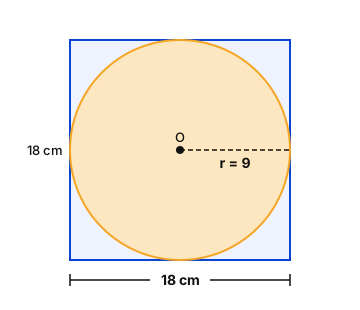
- cm.
- Area = .
- = 254.34 cm².
Trick: Circle area .
Answer: (B)
अवधारणा: अंतर्गत वृत्त का व्यास = वर्ग की भुजा।
हल:
- cm।
- क्षेत्रफल = ।
- = 254.34 cm²।
ट्रिक: वृत्त ।
उत्तर: (B)
SSC CHSLQuantitative AptitudeMensuration – circle inscribed in squareSSC CHSL 2025 · 14 Nov Shift 2
Q1091.A solid metal sphere is melted and recast into a cylinder, where the radius of the cylinder is thrice that of the sphere. If the height of the cylinder is H and the radius of the sphere is , what is the ratio of H to R ?
एक ठोस धातु के गोले को पिघलाकर एक बेलन बनाया जाता है, जिसमें बेलन की त्रिज्या गोले की त्रिज्या की तीन गुनी है। यदि बेलन की ऊँचाई H हो तथा गोले की त्रिज्या हो, तो H और R का अनुपात क्या होगा ?
- A3 : 27
- B27 : 3
- C4 : 27
- D27 : 4
Show answer
Concept: Recasting keeps the volume the same.
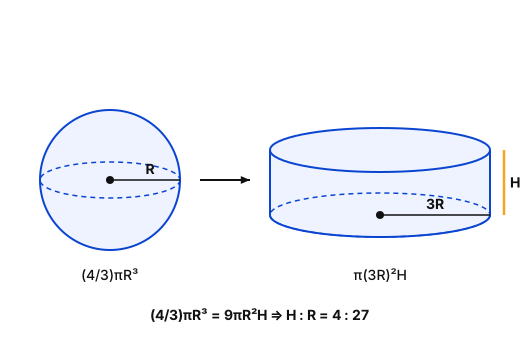
- .
- .
- H : R = 4 : 27.
Trick: Cancel π and R² at once: → .
Answer: (C) 4 : 27
अवधारणा: पिघलाकर दोबारा ढालने पर आयतन वही रहता है।
हल:
- ।
- ।
- H : R = 4 : 27।
ट्रिक: π और R² तुरंत काटें: → 4 : 27।
उत्तर: (C) 4 : 27
SSC CHSLQuantitative AptitudeMensuration – sphere recast into cylinderSSC CHSL 2025 · 14 Nov Shift 2
Q1092.The total surface area of a solid hemisphere is numerically equal to the volume of a cylinder with the same radius. What is the height ?
एक ठोस अर्धगोले का कुल पृष्ठीय क्षेत्रफल संख्यात्मक रूप से उसी त्रिज्या वाले एक बेलन के आयतन के बराबर है। ऊँचाई क्या है ?
- A1.25 units1.25 इकाई
- B4 units4 इकाई
- C5 units5 इकाई
- D3 units3 इकाई
Show answer
Concept: TSA of solid hemisphere = ; volume of cylinder = .
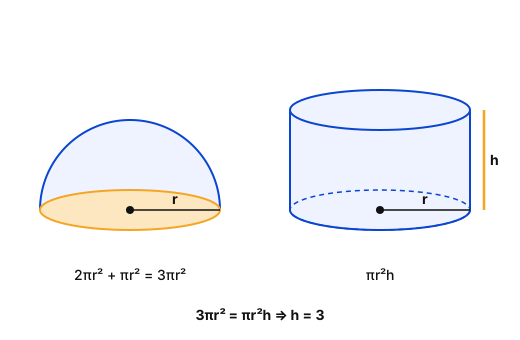
- .
- Cancel : 3.
Trick: Remember hemisphere TSA = .
Answer: (D) 3 units
अवधारणा: ठोस अर्धगोले का TSA = ; बेलन का आयतन = ।
हल:
- ।
- काटें: 3।
ट्रिक: अर्धगोला TSA = ।
उत्तर: (D) 3 इकाई
SSC CHSLQuantitative AptitudeMensuration – hemisphere TSA vs cylinder volumeSSC CHSL 2025 · 14 Nov Shift 2
Q1093.A certain fraction has a denominator that is 4 more than its numerator. If 5 is added to both the numerator and the denominator, the new fraction is equivalent to . What was the original fraction ?
किसी भिन्न का हर उसके अंश से 4 अधिक है। यदि अंश और हर दोनों में 5 जोड़ दिया जाए, तो नई भिन्न के तुल्य हो जाती है। मूल भिन्न क्या थी ?
- A
- B
- C
- D
Show answer
Concept: Let numerator = x, denominator = .
- .
- → .
- Fraction = .
Trick: Option check: ✓ — and only has denominator 4 more.
Answer: (B)
अवधारणा: अंश = x, हर = मानें।
हल:
- ।
- → ।
- भिन्न = ।
ट्रिक: जाँच: ✓; केवल में हर अंश से 4 अधिक है।
उत्तर: (B)
SSC CHSLQuantitative AptitudeFractions – forming an equationSSC CHSL 2025 · 14 Nov Shift 2
Q1094.If then calculate the value of ?
यदि हो, तो का मान ज्ञात कीजिए ?
- A5778
- B5345
- C5987
- D5678
Show answer
Concept: Go to cubes, then square: .
- .
- .
- = 5778.
Trick: Alternative: ; then .
Answer: (A) 5778
अवधारणा: पहले घन, फिर वर्ग: ।
हल:
- ।
- ।
- = 5778।
ट्रिक: दूसरा तरीका: ; ।
उत्तर: (A) 5778
SSC CHSLQuantitative AptitudeAlgebra – x⁶ + 1/x⁶ from x − 1/xSSC CHSL 2025 · 14 Nov Shift 2
Q1095.Simplify:
सरल कीजिए:
- A8
- B0
- C5
- D2
Show answer
Concept: Write each root as , then divide by .
- .
- .
- 8.
Trick: Divide inside the roots: .
Answer: (A) 8
अवधारणा: हर करणी को में लिखें, फिर से भाग दें।
हल:
- ।
- ।
- 8।
ट्रिक: सीधे भाग: ।
उत्तर: (A) 8
SSC CHSLQuantitative AptitudeSurds – simplificationSSC CHSL 2025 · 14 Nov Shift 2
Q1096.Simplify the expression:
व्यंजक को सरल कीजिए:
- A
- B1
- C
- D
Show answer
Concept: Use .
- Expression = .
- .
- = .
Trick: Put : and ✓ — value testing kills other options.
Answer: (C)
अवधारणा: का प्रयोग करें।
हल:
- व्यंजक = ।
- ।
- = ।
ट्रिक: रखें: और ✓।
उत्तर: (C)
SSC CHSLQuantitative AptitudeTrigonometric identity – simplificationSSC CHSL 2025 · 14 Nov Shift 2
Q1097.If , what is ?
यदि हो, तो क्या है ?
- A
- B
- C
- D
Show answer
Concept: Treat 2A as one angle; use .
- → base 5, hypotenuse 13.
- Perpendicular = .
- .
Trick: 5-12-13 is a standard triplet — no calculation needed.
Answer: (A)
अवधारणा: 2A को एक कोण मानें; ।
हल:
- → आधार 5, कर्ण 13।
- लंब = ।
- ।
ट्रिक: 5-12-13 मानक त्रिक है — गणना की ज़रूरत नहीं।
उत्तर: (A)
SSC CHSLQuantitative AptitudeTrigonometry – triplet 5-12-13SSC CHSL 2025 · 14 Nov Shift 2
Q1098.If and , find and .
यदि और हो, तो और ज्ञात कीजिए।
- A
- B
- C
- D
Show answer
Concept: .
- Hypotenuse = .
- , .
Trick: must equal 4 — only option A gives .
Answer: (A)
अवधारणा: ।
हल:
- कर्ण = ।
- , ।
ट्रिक: होना चाहिए — केवल A में।
उत्तर: (A)
SSC CHSLQuantitative AptitudeTrigonometry – ratios from tan ASSC CHSL 2025 · 14 Nov Shift 2
Q1099.A line passes through the points ( , 3) and (4, -5) and has a slope of 4. What is the value of x ?
एक रेखा बिंदुओं ( , 3) और (4, -5) से होकर जाती है तथा उसकी प्रवणता 4 है। x का मान क्या है ?
- A2
- B8
- C6
- D4
Show answer
Concept: Slope .
- .
- .
- 6.
Trick: Back-check: ✓.
Answer: (C) 6
अवधारणा: प्रवणता ।
हल:
- ।
- ।
- 6।
ट्रिक: जाँच: ✓।
उत्तर: (C) 6
SSC CHSLQuantitative AptitudeCoordinate geometry – slopeSSC CHSL 2025 · 14 Nov Shift 2
Q1100.A man can walk up a moving-up escalator in 20 seconds. The same man can walk down the same moving-up escalator in 80 seconds. How long would it take him to walk up the escalator when it is not moving ?
एक व्यक्ति ऊपर की ओर चलती एस्केलेटर पर चढ़ते हुए 20 सेकंड में ऊपर पहुँच जाता है। वही व्यक्ति उसी ऊपर की ओर चलती एस्केलेटर पर नीचे उतरने में 80 सेकंड लेता है। यदि एस्केलेटर रुकी हुई हो, तो उस पर चढ़ने में उसे कितना समय लगेगा ?
- A32 seconds32 सेकंड
- B23 seconds23 सेकंड
- C60 seconds60 सेकंड
- D20 seconds20 सेकंड
Show answer
Concept: Up with escalator: ; down against it: .
- , .
- .
- Time on still escalator = 32 s.
Trick: Own-speed time = s (harmonic mean).
Answer: (A) 32 seconds
अवधारणा: ऊपर जाते समय गति ; नीचे (विपरीत) ।
हल:
- , ।
- ।
- रुकी एस्केलेटर पर समय = 32 सेकंड।
ट्रिक: शॉर्टकट: ।
उत्तर: (A) 32 सेकंड
SSC CHSLQuantitative AptitudeEscalator – relative speedSSC CHSL 2025 · 14 Nov Shift 2

