SSC CHSL · 5,000 questions

SSC CHSL 2025 PYQs

Real previous year questions, subject-wise. Try the question, then open the answer and the explanation in Hindi & English – free, no login.

Courses – airGurukul

1,250 questions in Quantitative Aptitude.

Q1121.
The slope of a line is -6 . If the line passes through the point ( 4,5 ), what is its equation ?
एक रेखा की ढाल -6 है। यदि यह रेखा बिंदु ( 4,5 ) से होकर जाती है, तो इसका समीकरण क्या है?
  1. Ay=6x+24
  2. By=5x+19
  3. Cy=x6−24
  4. Dy=−6x+29
Show answer

Concept: y − y₁ = m(x − x₁).

  1. y − 5 = −6(x − 4).
  2. y = −6x + 24 + 5 = −6x + 29.

Trick: Slope −6 → only option with −6x is D; check (4, 5): −24 + 29 = 5 ✓.

Answer: (D) y=−6x+29

अवधारणा: y − y₁ = m(x − x₁).

  1. y − 5 = −6(x − 4).
  2. y = −6x + 29.

ट्रिक: ढाल −6 → केवल D में −6x है; (4, 5) से जाँचें ✓.

उत्तर: (D) y=−6x+29
SSC CHSLQuantitative AptitudeCoordinate geometry – point-slope formSSC CHSL 2025 · 14 Nov Shift 1
Q1122.
If x+y=19 and x−y=1, find (x2+y2)(xy).
यदि x+y=19 तथा x−y=1 है, तो (x2+y2)(xy) ज्ञात कीजिए।
  1. A259
  2. B159
  3. C209
  4. D179
Show answer

Concept: Read the data as x+y=19, x−y=1 (with x+y=19 no option fits); use squares.

  1. (x+y)2=19, (x−y)2=1.
  2. Add: 2(x2+y2)=20 → x2+y2=10.
  3. Subtract: 4xy=18 → xy=92.
  4. x2+y2xy=10÷92=209.

Trick: x2+y2=S2+D22 and xy=S2−D24.

Answer: (C) 209

अवधारणा: x+y=19, x−y=1 मानें (x+y=19 से कोई विकल्प नहीं बनता); वर्ग करें।

  1. (x+y)2=19, (x−y)2=1.
  2. जोड़ने पर: x2+y2=10.
  3. घटाने पर: 4xy=18 → xy=92.
  4. अनुपात = 10÷92=209.

ट्रिक: x2+y2=S2+D22, xy=S2−D24.

उत्तर: (C) 209

SSC CHSLQuantitative AptitudeAlgebra – sum & difference identitiesSSC CHSL 2025 · 14 Nov Shift 1
Q1123.
Simplify :-
1+cos⁡(x)1−sin⁡(x)+1−cos⁡(x)1+sin⁡(x)
सरल कीजिए :-
1+cos⁡(x)1−sin⁡(x)+1−cos⁡(x)1+sin⁡(x)
  1. A2(5+cos⁡(x)sin⁡(x))4cos2⁡(x)
  2. B2(1+cos⁡(x)sin⁡(x))cos2⁡(x)
  3. C3(1+cos⁡(x)sin⁡(x))4cos2⁡(x)
  4. D6(3+cos⁡(x)sin⁡(x))cos2⁡(x)
Show answer

Concept: Use (1−sinx)(1+sinx)=cos2x as the common denominator.

  1. Numerator = (1+cosx)(1+sinx)+(1−cosx)(1−sinx).
  2. =2+2sinxcosx (sinx, cosx terms cancel).
  3. Result = 2(1+cosxsinx)cos2x.

Trick: Put x=0: value = 21+01=2; only B gives 2(1+0)1=2.

Answer: (B) 2(1+cos⁡(x)sin⁡(x))cos2⁡(x)

अवधारणा: सामान्य हर (1−sinx)(1+sinx)=cos2x लें।

  1. अंश = (1+cosx)(1+sinx)+(1−cosx)(1−sinx).
  2. =2+2sinxcosx.
  3. परिणाम = 2(1+cosxsinx)cos2x.

ट्रिक: x=0 रखें: मान = 2; केवल B से 2 आता है।

उत्तर: (B) 2(1+cos⁡(x)sin⁡(x))cos2⁡(x)

SSC CHSLQuantitative AptitudeTrigonometry – simplificationSSC CHSL 2025 · 14 Nov Shift 1
Q1124.
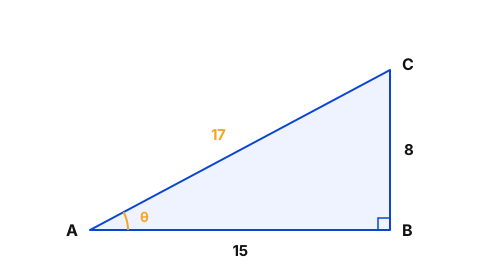
If cot⁡(θ)=158 in a right-angled triangle, what is the length of the hypotenuse ?
यदि एक समकोण त्रिभुज में cot⁡(θ)=158 है, तो कर्ण की लंबाई क्या है?
  1. A17
  2. B8
  3. C15
  4. D16
Show answer

Concept: cotθ=baseperpendicular.

  1. Base = 15, perpendicular = 8 (k = 1).
  2. Hypotenuse = 225+64=289=17.

Yaad rakhein: 8-15-17 is a Pythagorean triplet.

Answer: (A) 17

अवधारणा: cotθ=आधारलंब।

  1. आधार = 15, लंब = 8.
  2. कर्ण = 225+64=289=17.

ट्रिक: 8-15-17 पाइथागोरस त्रिक है।

उत्तर: (A) 17

SSC CHSLQuantitative AptitudeTrigonometry – hypotenuse from cotSSC CHSL 2025 · 14 Nov Shift 1
Q1125.
If sin⁡A=513, find the values of cos⁡A and tan⁡A
यदि sin⁡A=513 है, तो cos⁡A तथा tan⁡A के मान ज्ञात कीजिए
  1. A1213 and 5121213 तथा 512
  2. B58 and 81358 तथा 813
  3. C1312 and 1371312 तथा 137
  4. D1312 and 971312 तथा 97
Show answer

Concept: sinA=perpendicularhypotenuse; get base by Pythagoras.

  1. Perpendicular 5, hypotenuse 13 → base = 169−25=12.
  2. cosA=1213, tanA=512.

Trick: cos can never exceed 1 → options with 1312 are out instantly.

Answer: (A) 1213 and 512

अवधारणा: sinA=लंबकर्ण; आधार पाइथागोरस से।

  1. लंब 5, कर्ण 13 → आधार = 12.
  2. cosA=1213, tanA=512.

ट्रिक: cos का मान 1 से अधिक नहीं हो सकता → 1312 वाले विकल्प तुरंत बाहर।

उत्तर: (A) 1213 तथा 512

SSC CHSLQuantitative AptitudeTrigonometry – cos and tan from sinSSC CHSL 2025 · 14 Nov Shift 1
Q1126.
A bicycle is sold for ₹2000 at a loss of 20%. At what price should it be sold to gain 10% ?
एक साइकिल ₹2000 में 20% की हानि पर बेची जाती है। 10% का लाभ प्राप्त करने के लिए इसे किस मूल्य पर बेचा जाना चाहिए?
  1. A₹2450
  2. B₹2150
  3. C₹2350
  4. D₹2750
Show answer

Concept: SP at loss r% = CP×100−r100; SP at gain g% = CP×100+g100.

  1. 80% of CP = ₹2000 → CP=2000×10080= ₹2500.
  2. Required SP = 110% of 2500 = ₹2750.

Trick: Direct ratio: new SP = 2000×11080=25×110= ₹2750.

Answer: (D) ₹2750

अवधारणा: हानि r% पर SP = CP×100−r100; लाभ g% पर SP = CP×100+g100।

  1. CP का 80% = ₹2000 → CP = ₹2500।
  2. चाहिए SP = 2500 का 110% = ₹2750।

ट्रिक: सीधा अनुपात: नया SP = 2000×11080= ₹2750।

उत्तर: (D) ₹2750

SSC CHSLQuantitative AptitudeProfit & loss – new SP for desired gainSSC CHSL 2025 · 13 Nov Shift 3
Q1127.
P, Q, and R started a business. P contributed Rs. 10,000, Q contributed Rs. 12,000 , and R contributed Rs. 16,000 . After 6 months, Q withdrew Rs. 4,000, while R added Rs. 8,000. If the total profit at the end of the year is Rs. 8,4000 how much did R receive?
P, Q और R ने एक व्यवसाय आरंभ किया। P ने Rs. 10,000, Q ने Rs. 12,000 तथा R ने Rs. 16,000 का निवेश किया। 6 महीने बाद Q ने Rs. 4,000 निकाल लिए, जबकि R ने Rs. 8,000 और जोड़ दिए। यदि वर्ष के अंत में कुल लाभ Rs. 8,4000 है, तो R को कितना प्राप्त हुआ?
  1. A₹36,000
  2. B₹24,000
  3. C₹42,000
  4. D₹48,000
Show answer

Concept: Profit is shared in the ratio of (capital × months).

  1. P: 10000×12=1,20,000.
  2. Q: 12000×6+8000×6=1,20,000.
  3. R: 16000×6+24000×6=2,40,000.
  4. Ratio 1 : 1 : 2 → R = 84000×24= ₹42,000.

Trick: For two 6-month halves, just add the two capitals: P 20k, Q 20k, R 40k → 1 : 1 : 2 at once.

Answer: (C) ₹42,000

अवधारणा: लाभ (पूँजी × महीने) के अनुपात में बँटता है।

  1. P: 10000×12=1,20,000।
  2. Q: 12000×6+8000×6=1,20,000।
  3. R: 16000×6+24000×6=2,40,000।
  4. अनुपात 1 : 1 : 2 → R = 84000×24= ₹42,000।

ट्रिक: दोनों छमाही बराबर हैं, तो पूँजियाँ सीधे जोड़ें: 20k, 20k, 40k → 1 : 1 : 2।

उत्तर: (C) ₹42,000

SSC CHSLQuantitative AptitudePartnership – capital changed mid-yearSSC CHSL 2025 · 13 Nov Shift 3
Q1128.
Simplify the expression: cosecxcos⁡x+sec⁡xsin⁡x.
व्यंजक को सरल कीजिए: cosecxcos⁡x+sec⁡xsin⁡x।
  1. A-1
  2. Btan⁡xsin⁡x
  3. C2sin⁡x
  4. Dcot⁡x+tan⁡x
Show answer

Concept: Convert cosec and sec into sin and cos.

  1. cscx·cosx=cosxsinx=cotx.
  2. secx·sinx=sinxcosx=tanx.
  3. Sum = cotx+tanx.

Trick: Put x=45∘: value = 1+1=2; only cotx+tanx gives 2 (option C gives 2).

Answer: (D) cot⁡x+tan⁡x

अवधारणा: cosec और sec को sin, cos में बदलें।

  1. cscx·cosx=cosxsinx=cotx।
  2. secx·sinx=sinxcosx=tanx।
  3. योग = cotx+tanx।

ट्रिक: x=45∘ रखें: मान = 2; केवल cotx+tanx से 2 आता है।

उत्तर: (D) cot⁡x+tan⁡x

SSC CHSLQuantitative AptitudeTrigonometry – simplify cosec·cos + sec·sinSSC CHSL 2025 · 13 Nov Shift 3
Q1129.
If the ratio of shoes to socks is 5 : 3 and there are 50 shoes, how many socks are there?
यदि जूतों और मोज़ों का अनुपात 5 : 3 है और जूते 50 हैं, तो मोज़े कितने हैं?
  1. A30
  2. B40
  3. C20
  4. D10
Show answer

Concept: Equal ratio parts have equal value.

  1. 5 parts = 50 shoes → 1 part = 10.
  2. Socks = 3 parts = 30.

Trick: Scale the ratio: 5 → 50 is ×10, so 3 → 30.

Answer: (A) 30

अवधारणा: अनुपात के हर भाग का मान बराबर होता है।

  1. 5 भाग = 50 जूते → 1 भाग = 10।
  2. मोज़े = 3 भाग = 30।

ट्रिक: 5 से 50 = ×10, तो 3×10=30।

उत्तर: (A) 30

SSC CHSLQuantitative AptitudeRatio – find the other quantitySSC CHSL 2025 · 13 Nov Shift 3
Q1130.
The compound interest on ₹6,000 for 1 year 6 months at 20% p.a., compounded yearly, is:
₹6,000 पर 1 वर्ष 6 महीने के लिए 20% वार्षिक दर से, वार्षिक रूप से संयोजित चक्रवृद्धि ब्याज कितना होगा?
  1. A₹1920
  2. B₹2120
  3. C₹2,540
  4. D₹2,000
Show answer

Concept: Yearly compounding: full years at R%, the leftover part-year at proportional rate on the new amount.

  1. Year 1: 20% → 6000×1.2=7200.
  2. Next 6 months: 10% of 7200 = 720 → 7920.
  3. CI = 7920−6000= ₹1920.

Trick: Effective rate for 20% then 10%: 20+10+20×10100=32% → 32% of 6000 = 1920.

Answer: (A) ₹1920

अवधारणा: वार्षिक चक्रवृद्धि: पूरे वर्ष R% पर, बचा आधा वर्ष आनुपातिक दर से नई राशि पर।

  1. पहला वर्ष: 20% → 6000×1.2=7200।
  2. अगले 6 महीने: 7200 का 10% = 720 → 7920।
  3. CI = 7920−6000= ₹1920।

ट्रिक: प्रभावी दर: 20+10+20×10100=32% → 6000 का 32% = 1920।

उत्तर: (A) ₹1920

SSC CHSLQuantitative AptitudeCompound interest – fractional yearSSC CHSL 2025 · 13 Nov Shift 3
Q1131.
A man deposits ₹2,50,000 at a Cl rate of 20% p.a. After the first year's interest is credited, he withdraws 40% of the interest earned. What is his account balance at the end of the second year?
एक व्यक्ति ₹2,50,000 की राशि 20% वार्षिक चक्रवृद्धि ब्याज दर पर जमा करता है। पहले वर्ष का ब्याज जमा हो जाने के बाद वह अर्जित ब्याज का 40% निकाल लेता है। दूसरे वर्ष के अंत में उसके खाते में कितनी राशि होगी?
  1. A₹2,80,000
  2. B₹2,36,000
  3. C₹3,36,000
  4. D₹2,50,000
Show answer

Concept: Work year by year; the second year's interest is on the balance left.

  1. Year-1 interest = 20% of 2,50,000 = 50,000.
  2. Withdraws 40% of 50,000 = 20,000 → balance 2,80,000.
  3. Year-2: 2,80,000×1.2= ₹3,36,000.

Trick: Keep 60% of the interest: 2,50,000+30,000=2,80,000, then ×1.2.

Answer: (C) ₹3,36,000

अवधारणा: एक-एक वर्ष करके हल करें; दूसरे वर्ष ब्याज बची राशि पर।

  1. पहले वर्ष का ब्याज = 2,50,000 का 20% = 50,000।
  2. 50,000 का 40% = 20,000 निकाले → शेष 2,80,000।
  3. दूसरा वर्ष: 2,80,000×1.2= ₹3,36,000।

ट्रिक: ब्याज का 60% बचा: 2,50,000+30,000=2,80,000, फिर ×1.2।

उत्तर: (C) ₹3,36,000

SSC CHSLQuantitative AptitudeCompound interest – withdrawal after year 1SSC CHSL 2025 · 13 Nov Shift 3
Q1132.
The ratio of two numbers is 5:3 and their LCM is 180 . What is the sum of the two numbers?
दो संख्याओं का अनुपात 5:3 है और उनका ल.स. 180 है। दोनों संख्याओं का योग क्या है?
  1. A96
  2. B90
  3. C75
  4. D80
Show answer

Concept: Numbers in ratio a : b (co-prime) = ax, bx; their LCM = abx.

  1. Numbers 5x, 3x → LCM = 15x=180 → x=12.
  2. Numbers: 60 and 36.
  3. Sum = 96.

Trick: Sum = (5+3)×x=8×12=96 – no need to find each number.

Answer: (A) 96

अवधारणा: a : b (सह-अभाज्य) अनुपात की संख्याएँ ax, bx; LCM = abx।

  1. 5x, 3x → LCM = 15x=180 → x=12।
  2. संख्याएँ: 60 और 36।
  3. योग = 96।

ट्रिक: योग = (5+3)×12=96 – अलग-अलग संख्या निकालने की ज़रूरत नहीं।

उत्तर: (A) 96

SSC CHSLQuantitative AptitudeRatio and LCM – sum of numbersSSC CHSL 2025 · 13 Nov Shift 3
Q1133.
The average age of 25 students is 16 years. A group of 5 new students joins, increasing the average to 18 years. Find the average age of the 5 new students.
25 विद्यार्थियों की औसत आयु 16 वर्ष है। 5 नए विद्यार्थियों का एक समूह इसमें सम्मिलित हो जाता है, जिससे औसत बढ़कर 18 वर्ष हो जाता है। 5 नए विद्यार्थियों की औसत आयु ज्ञात कीजिए।
  1. A30
  2. B32
  3. C28
  4. D34
Show answer

Concept: Total = average × number; find the totals before and after.

  1. Old total = 25×16=400.
  2. New total = 30×18=540.
  3. 5 new students: 140 → average = 1405=28.

Trick: New average+old count×risenew count: 18+25×25=18+10=28.

Answer: (C) 28

अवधारणा: कुल = औसत × संख्या; पहले और बाद का कुल निकालें।

  1. पुराना कुल = 25×16=400।
  2. नया कुल = 30×18=540।
  3. 5 नए छात्र: 140 → औसत = 28।

ट्रिक: 18+25×25=18+10=28।

उत्तर: (C) 28

SSC CHSLQuantitative AptitudeAverage – new members joiningSSC CHSL 2025 · 13 Nov Shift 3
Q1134.
Which of the following is the least?
निम्नलिखित में से सबसे कम कौन-सा है?
  1. A16% of 350350 का 16%
  2. B25% of 400400 का 25%
  3. C28% of 300300 का 28%
  4. D30% of 340340 का 30%
Show answer

Concept: Compute each percentage value and compare.

  1. 16% of 350 = 56.
  2. Others: B = 100, C = 84, D = 102.
  3. Least = 56.

Trick: Option A has both the smallest % and a small base – check it first.

Answer: (A) 16% of 350

अवधारणा: हर विकल्प का मान निकालकर तुलना करें।

  1. 350 का 16% = 56।
  2. 400 का 25% = 100; 300 का 28% = 84; 340 का 30% = 102।
  3. सबसे कम = 56।

ट्रिक: A में प्रतिशत भी सबसे कम और आधार भी छोटा – पहले उसे देखें।

उत्तर: (A) 350 का 16%

SSC CHSLQuantitative AptitudePercentage – least valueSSC CHSL 2025 · 13 Nov Shift 3
Q1135.
Rohan goes to shop at a speed of 7km/h and returns home at 5km/h. If the total time taken is 6 hours, what is the distance between his home and shop?
रोहन 7km/h की चाल से दुकान जाता है और 5km/h की चाल से घर लौटता है। यदि कुल लिया गया समय 6 घंटे है, तो उसके घर और दुकान के बीच की दूरी कितनी है?
  1. A12.75 km
  2. B13.25 km
  3. C17.5 km
  4. D14.25 km
Show answer

Concept: Same distance both ways: total time = ds1+ds2.

  1. d7+d5=6.
  2. 5d+7d35=6 → 12d=210.
  3. d=17.5 km.

Trick: Average speed = 2×7×512=356 km/h; total distance = 356×6=35 → one way 17.5 km.

Answer: (C) 17.5 km

अवधारणा: दोनों तरफ़ दूरी समान: कुल समय = ds1+ds2।

  1. d7+d5=6।
  2. 5d+7d35=6 → 12d=210।
  3. d=17.5 km।

ट्रिक: औसत चाल = 2×7×512=356; कुल दूरी = 35 → एक तरफ़ 17.5 km।

उत्तर: (C) 17.5 km

SSC CHSLQuantitative AptitudeSpeed – to and fro journeySSC CHSL 2025 · 13 Nov Shift 3
Q1136.
P, Q, R together finish a job in 16 days. P and Q together take 24 days, while Q and R together take 32 days. In how many days can R alone finish the job?
P, Q, R मिलकर एक कार्य को 16 दिनों में पूरा करते हैं। P और Q मिलकर 24 दिन लेते हैं, जबकि Q और R मिलकर 32 दिन लेते हैं। R अकेला उस कार्य को कितने दिनों में पूरा कर सकता है?
  1. A36 days36 दिन
  2. B40 days40 दिन
  3. C48 days48 दिन
  4. D60 days60 दिन
Show answer

Concept: Take total work = LCM of days; work/day = total ÷ days.

  1. Total work = LCM(16, 24, 32) = 96 units.
  2. P+Q+R = 6/day, P+Q = 4/day → R = 2/day.
  3. R alone = 962=48 days.

Trick: 116−124=148 directly gives R's rate.

Answer: (C) 48 days

अवधारणा: कुल कार्य = दिनों का LCM; प्रतिदिन कार्य = कुल ÷ दिन।

  1. कुल कार्य = LCM(16, 24, 32) = 96 इकाई।
  2. P+Q+R = 6/दिन, P+Q = 4/दिन → R = 2/दिन।
  3. R अकेला = 962=48 दिन।

ट्रिक: 116−124=148 – सीधे R की दर।

उत्तर: (C) 48 दिन

SSC CHSLQuantitative AptitudeTime & work – one person from group dataSSC CHSL 2025 · 13 Nov Shift 3
Q1137.
In a sale, a shopkeeper offers a 10% discount on clothes if you buy more than two items. Priyanka buys three pants for ₹2700. If the shopkeeper still makes a 25% profit, find the profit the shopkeeper would make if he had sold the pants at full price.
एक सेल में, एक दुकानदार कपड़ों पर 10% की छूट देता है, यदि आप दो से अधिक वस्तुएँ खरीदते हैं। प्रियंका तीन पैंट ₹2700 में खरीदती है। यदि दुकानदार फिर भी 25% लाभ कमाता है, तो वह लाभ ज्ञात कीजिए जो दुकानदार को तब होता, यदि उसने पैंट पूरे मूल्य पर बेची होतीं।
  1. A₹640
  2. B₹840
  3. C₹700
  4. D₹600
Show answer

Concept: Discount applies (3 items); find MP from SP and CP from the profit %.

  1. MP=2700×10090= ₹3000.
  2. CP=2700×100125= ₹2160.
  3. Profit at full price = 3000−2160= ₹840.

Trick: Use fractions: 10%=110, 25%=14 → MP=2700×109, CP=2700×45.

Answer: (B) ₹840

अवधारणा: 3 वस्तुएँ हैं, इसलिए छूट लागू; SP से MP और लाभ% से CP निकालें।

  1. MP=2700×10090= ₹3000।
  2. CP=2700×100125= ₹2160।
  3. पूरे मूल्य पर लाभ = 3000−2160= ₹840।

ट्रिक: भिन्न से: MP=2700×109, CP=2700×45।

उत्तर: (B) ₹840

SSC CHSLQuantitative AptitudeDiscount and profit – profit at marked priceSSC CHSL 2025 · 13 Nov Shift 3
Q1138.
At simple interest, a certain amount of money triples in four years. What is the interest rate?
साधारण ब्याज पर कोई धनराशि चार वर्षों में तीन गुनी हो जाती है। ब्याज की दर क्या है?
  1. A40%
  2. B35%
  3. C20%
  4. D50%
Show answer

Concept: SI=P×R×T100; tripling means SI=2P.

  1. 2P=P×R×4100.
  2. R=2004=50%.

Trick: Rate = (n−1)×100T=2×1004=50%.

Answer: (D) 50%

अवधारणा: SI=P×R×T100; तिगुना होने पर SI=2P।

  1. 2P=P×R×4100।
  2. R=2004=50%।

ट्रिक: दर = (n−1)×100T=2×1004=50%।

उत्तर: (D) 50%

SSC CHSLQuantitative AptitudeSimple interest – rate when sum triplesSSC CHSL 2025 · 13 Nov Shift 3
Q1139.
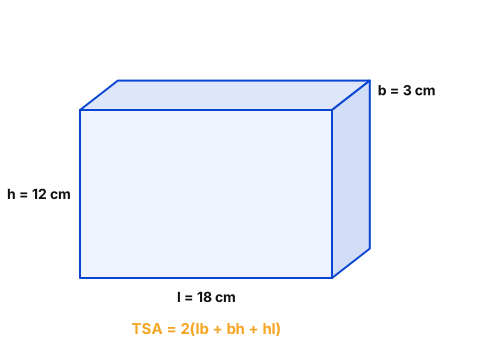
The length of a cuboid is six times of its breadth and the height of a cuboid is four times of its breadth. If the breadth of the cuboid is 3 cm , then what is the total surface area of the cuboid ?
एक घनाभ की लंबाई उसकी चौड़ाई की छह गुनी है तथा घनाभ की ऊँचाई उसकी चौड़ाई की चार गुनी है। यदि घनाभ की चौड़ाई 3 cm है, तो घनाभ का कुल पृष्ठीय क्षेत्रफल क्या है?
  1. A484cm2
  2. B612cm2
  3. C576cm2
  4. D676cm2
Show answer

Concept: TSA of cuboid = 2(lb+bh+hl).

  1. b=3, l=6×3=18, h=4×3=12 (cm).
  2. lb=54, bh=36, hl=216 → sum 306.
  3. TSA = 2×306=612cm2.

Trick: In terms of b: TSA = 2(6+4+24)b2=68b2=68×9=612.

Answer: (B) 612cm2

अवधारणा: घनाभ का TSA = 2(lb+bh+hl)।

  1. b=3, l=18, h=12 (cm)।
  2. lb=54, bh=36, hl=216 → योग 306।
  3. TSA = 2×306=612cm2।

ट्रिक: b के रूप में: TSA = 2(6+4+24)b2=68×9=612।

उत्तर: (B) 612cm2

SSC CHSLQuantitative AptitudeCuboid – total surface areaSSC CHSL 2025 · 13 Nov Shift 3
Q1140.
What is the value of the expression
√(1236)2 + 1236 + 1237 = ?
निम्नलिखित व्यंजक का मान क्या है?
√(1236)2 + 1236 + 1237 = ?
  1. A1235
  2. B1236
  3. C1237
  4. D1234
Show answer

Concept: n2+n+(n+1)=n2+2n+1=(n+1)2.

  1. Take n=1236: 12362+1236+1237=(1237)2.
  2. (1237)2=1237.

Trick: Pattern n2+n+(n+1) always equals n+1.

Answer: (C) 1237

अवधारणा: n2+n+(n+1)=n2+2n+1=(n+1)2।

  1. n=1236 लें: 12362+1236+1237=(1237)2।
  2. (1237)2=1237।

ट्रिक: n2+n+(n+1) का मान हमेशा n+1।

उत्तर: (C) 1237

SSC CHSLQuantitative AptitudeSquare root – hidden perfect squareSSC CHSL 2025 · 13 Nov Shift 3