Q1181.When a number is divided by 16 , 20 , and 24 , it leaves remainders 8,12 , and 16 respectively. What is the least such number?
जब किसी संख्या को 16, 20 और 24 से विभाजित किया जाता है, तो क्रमशः 8, 12 और 16 शेषफल बचते हैं। ऐसी न्यूनतम संख्या क्या है?
- A240
- B232
- C196
- D300
Show answer
Concept: If divisor − remainder is the same for all, number = LCM × k − that difference.
- .
- .
- Least number = 232.
Trick: Check: 232 ÷ 16 → rem 8, ÷ 20 → rem 12, ÷ 24 → rem 16 ✓.
Answer: (B) 232
अवधारणा: यदि भाजक − शेषफल सबके लिए समान हो, तो संख्या = LCM × k − वह अंतर।
- ।
- ।
- न्यूनतम संख्या = 232।
ट्रिक: जाँच: 232 ÷ 16 → शेष 8, ÷ 20 → शेष 12, ÷ 24 → शेष 16 ✓।
उत्तर: (B) 232
SSC CHSLQuantitative AptitudeLCM – constant shortfall in remaindersSSC CHSL 2025 · 13 Nov Shift 1
Q1182.If the average of 16 consecutive even numbers is 111, find the smallest number.
यदि 16 क्रमागत सम संख्याओं का औसत 111 है, तो सबसे छोटी संख्या ज्ञात कीजिए।
- A92
- B96
- C95
- D94
Show answer
Concept: For equally spaced numbers, .
- 16 even numbers: .
- Average = .
- 96.
Trick: Smallest = average − (for consecutive even/odd numbers).
Answer: (B) 96
अवधारणा: समान अंतर वाली संख्याओं का ।
- 16 सम संख्याएँ: ।
- औसत = ।
- 96।
ट्रिक: सबसे छोटी = औसत − (क्रमागत सम/विषम के लिए)।
उत्तर: (B) 96
SSC CHSLQuantitative AptitudeAverage – consecutive even numbersSSC CHSL 2025 · 13 Nov Shift 1
Q1183.The population of a city increases by 30% in the first year and decreases by 25% in the second year. What is the net percentage change after 2 years?
किसी शहर की जनसंख्या पहले वर्ष में 30% बढ़ती है और दूसरे वर्ष में 25% घट जाती है। 2 वर्ष बाद शुद्ध प्रतिशत परिवर्तन क्या है?
- A5% increase5% वृद्धि
- B decrease कमी
- C5% increase5% वृद्धि
- D decrease कमी
Show answer
Concept: Net change for +a% then −b% = .
- , .
- Net = .
- So a 2.5% decrease.
Trick: Check on 100: 100 → 130 → → 2.5% down.
Answer: (B) decrease
अवधारणा: +a% फिर −b% का शुद्ध परिवर्तन = ।
- , ।
- शुद्ध = ।
- अर्थात 2.5% कमी।
ट्रिक: 100 पर जाँच: 100 → 130 → → 2.5% कम।
उत्तर: (B) कमी
SSC CHSLQuantitative AptitudeSuccessive percentage changeSSC CHSL 2025 · 13 Nov Shift 1
Q1184.A train crosses a man standing on a platform in 18 seconds and crosses the platform, which is 200 meters long, in 24 seconds. What is the length of the train?
एक रेलगाड़ी प्लेटफ़ॉर्म पर खड़े एक व्यक्ति को 18 सेकंड में पार करती है और 200 मीटर लंबे प्लेटफ़ॉर्म को 24 सेकंड में पार करती है। रेलगाड़ी की लंबाई क्या है?
- A600 m600 मीटर
- B625 m625 मीटर
- C650 m650 मीटर
- D675 m675 मीटर
Show answer
Concept: Crossing a man covers train length; crossing a platform covers train + platform.
- Extra time for platform = s for 200 m.
- Speed = m/s.
- Train length = 600 m.
Trick: Length = m.
Answer: (A) 600 m
अवधारणा: व्यक्ति को पार करने में केवल ट्रेन की लंबाई; प्लेटफॉर्म में ट्रेन + प्लेटफॉर्म।
- प्लेटफॉर्म के लिए अतिरिक्त समय = सेकंड में 200 m।
- चाल = m/s।
- ट्रेन की लंबाई = 600 m।
ट्रिक: लंबाई = प्लेटफॉर्म m।
उत्तर: (A) 600 मीटर
SSC CHSLQuantitative AptitudeTrains – crossing a man and a platformSSC CHSL 2025 · 13 Nov Shift 1
Q1185.Anuj takes 24 days to finish a job, while Bhagat takes 60 days to complete the same job. If they collaborate, how many days will it take them to complete the work together ?
अनुज किसी कार्य को पूरा करने में 24 दिन लेता है, जबकि भगत उसी कार्य को पूरा करने में 60 दिन लेता है। यदि वे मिलकर कार्य करें, तो कार्य को पूरा करने में उन्हें कितने दिन लगेंगे?
- A days दिन
- B days दिन
- C days दिन
- D days दिन
Show answer
Concept: Together time = .
- , .
- Time = .
- = days.
Trick: LCM method: work = 120 units; units/day → days.
Answer: (C) days
अवधारणा: साथ में लगा समय = ।
- , ।
- समय = ।
- = दिन।
ट्रिक: LCM विधि: कुल कार्य = 120 इकाई; इकाई/दिन → दिन।
उत्तर: (C) दिन
SSC CHSLQuantitative AptitudeTime and work – two persons togetherSSC CHSL 2025 · 13 Nov Shift 1
Q1186.The printed price of a TV set is ₹20,000. After two consecutive discounts, it is sold for ₹12,750. What is the second discount if the first one is 15%?
एक टीवी सेट का मुद्रित मूल्य ₹20,000 है। दो क्रमिक छूटों के बाद इसे ₹12,750 में बेचा जाता है। यदि पहली छूट 15% है, तो दूसरी छूट कितनी है?
- A16%
- B20%
- C30%
- D25%
Show answer
Concept: The second discount is on the price after the first discount.
- After 15% off: ₹17,000.
- Second discount = ₹4,250.
- Rate = 25%.
Trick: → off = 25%.
Answer: (D) 25%
अवधारणा: दूसरी छूट पहली छूट के बाद वाले मूल्य पर लगती है।
- 15% छूट के बाद: ₹17,000।
- दूसरी छूट = ₹4,250।
- दर = 25%।
ट्रिक: → कम = 25%।
उत्तर: (D) 25%
SSC CHSLQuantitative AptitudeSuccessive discounts – second discountSSC CHSL 2025 · 13 Nov Shift 1
Q1187.A sum of money becomes of itself in 13 years at a certain rate of simple interest. What is the rate of interest per annum?
साधारण ब्याज की एक निश्चित दर पर कोई धनराशि 13 वर्षों में स्वयं की हो जाती है। प्रति वर्ष ब्याज की दर क्या है?
- A15%
- B
- C17%
- D16.67%
Show answer
Concept: .
- Amount → .
- .
- 16.67%.
Trick: SI = of P in 13 years → of P per year = 16.67%.
Answer: (D) 16.67%
अवधारणा: ।
- मिश्रधन → ।
- ।
- 16.67%।
ट्रिक: 13 वर्ष में P का → प्रति वर्ष P का = 16.67%।
उत्तर: (D) 16.67%
SSC CHSLQuantitative AptitudeSimple interest – rate from amount fractionSSC CHSL 2025 · 13 Nov Shift 1
Q1188.If and , then what is the value of ?
यदि तथा है, तो का मान क्या है?
- A5
- B6
- C15
- D9
Show answer
Concept: .
- .
- 6.
Trick: Check: , → ✓.
Answer: (B) 6
अवधारणा: ।
- ।
- 6।
ट्रिक: जाँच: , → ✓।
उत्तर: (B) 6
SSC CHSLQuantitative AptitudeAlgebra – difference of squaresSSC CHSL 2025 · 13 Nov Shift 1
Q1189.What is the square root of 7569 ?
7569 का वर्गमूल क्या है?
- A82
- B84
- C81
- D87
Show answer
Concept: Find the range and the possible last digit of the root.
- , → root is in the 80s.
- Number ends in 9 → root ends in 3 or 7.
- ✓ → 87.
Trick: 75 is the first two digits; → take the bigger candidate, 87.
Answer: (D) 87
अवधारणा: मूल की सीमा और संभावित अंतिम अंक खोजें।
- , → मूल 80 के दशक में।
- संख्या का अंत 9 → मूल का अंत 3 या 7।
- ✓ → 87।
ट्रिक: पहले दो अंक 75; → बड़ा विकल्प, 87।
उत्तर: (D) 87
SSC CHSLQuantitative AptitudeSquare root – unit digit methodSSC CHSL 2025 · 13 Nov Shift 1
Q1190.A 120 liter mixture contains milk and water in the ratio 11 : 9. If 20 liters of this mixture is taken out and replaced with 20 liters of pure milk, what is the new ratio of milk to water?
120 लीटर के एक मिश्रण में दूध तथा पानी 11 : 9 के अनुपात में हैं। यदि इस मिश्रण में से 20 लीटर निकालकर उसके स्थान पर 20 लीटर शुद्ध दूध मिला दिया जाए, तो दूध और पानी का नया अनुपात क्या होगा?
- A5 : 3
- B3 : 5
- C8 : 5
- D3 : 8
Show answer
Concept: Removing mixture keeps the ratio; then add pure milk.
- Milk = L, water = 54 L.
- Remove 20 L ( of mixture): milk 55 L, water 45 L.
- Add 20 L milk: 75 : 45 = 5 : 3.
Trick: Water never gets added, so just track water: ; milk = .
Answer: (A) 5 : 3
अवधारणा: मिश्रण निकालने पर अनुपात वही रहता है; फिर शुद्ध दूध मिलाएँ।
- दूध = L, पानी = 54 L।
- 20 L ( भाग) निकाला: दूध 55 L, पानी 45 L।
- 20 L दूध मिलाया: 75 : 45 = 5 : 3।
ट्रिक: पानी कभी नहीं जुड़ता, बस पानी देखें: ; दूध = ।
उत्तर: (A) 5 : 3
SSC CHSLQuantitative AptitudeMixture – replacement with pure milkSSC CHSL 2025 · 13 Nov Shift 1
Q1191.A spherical cannonball with a diameter of 36 cm is melted and recast into a rectangular block. The length and breadth of the block are 66 cm and 18 cm respectively. What is the height of the rectangular block? (Take )
36 cm व्यास वाले एक गोलाकार तोप के गोले को पिघलाकर एक घनाभाकार ब्लॉक बनाया जाता है। ब्लॉक की लंबाई तथा चौड़ाई क्रमशः 66 cm और 18 cm हैं। घनाभाकार ब्लॉक की ऊँचाई क्या है? ( लीजिए)
- A20.57 cm
- B42.57 cm
- C31.67 cm
- D44.67 cm
Show answer
Concept: Volume remains the same on melting and recasting.
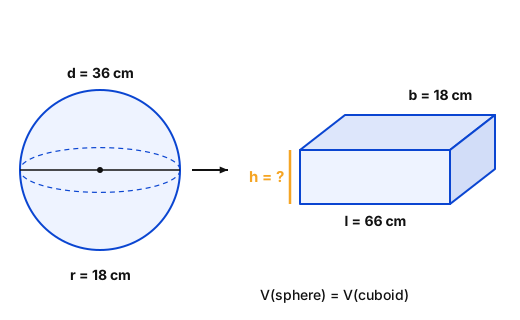
- cm; sphere volume = .
- Cuboid volume = .
- 20.57 cm.
Trick: Cancel before multiplying: , , → .
Answer: (A) 20.57 cm
अवधारणा: पिघलाकर दोबारा ढालने पर आयतन वही रहता है।
- cm; गोले का आयतन = ।
- घनाभ का आयतन = ।
- 20.57 cm।
ट्रिक: पहले काटें: , , → ।
उत्तर: (A) 20.57 cm
SSC CHSLQuantitative AptitudeMensuration – sphere recast into cuboidSSC CHSL 2025 · 13 Nov Shift 1
Q1192.A hemispherical bowl with a radius of 42 cm is filled with a liquid. The liquid is to be poured into small cylindrical bottles, each with a diameter of 14 cm and a height of 16 cm . How many such bottles are required to empty the bowl?
42 cm त्रिज्या वाला एक अर्धगोलाकार कटोरा एक द्रव से भरा हुआ है। इस द्रव को छोटी बेलनाकार बोतलों में भरा जाना है, जिनमें से प्रत्येक का व्यास 14 cm तथा ऊँचाई 16 cm है। कटोरे को खाली करने के लिए ऐसी कितनी बोतलों की आवश्यकता होगी?
- A54
- B63
- C66
- D72
Show answer
Concept: Number of bottles = volume of bowl ÷ volume of one bottle.
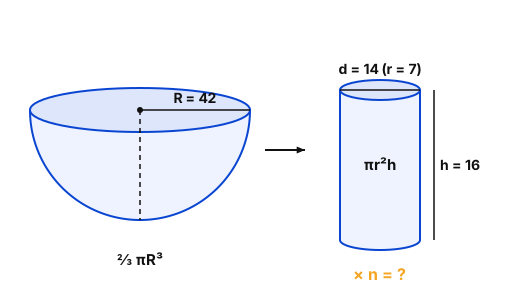
- Bowl = , .
- Bottle = , , .
- Number = 63.
Trick: π cancels; → .
Answer: (B) 63
अवधारणा: बोतलों की संख्या = कटोरे का आयतन ÷ एक बोतल का आयतन।
- कटोरा = , ।
- बोतल = , , ।
- संख्या = 63।
ट्रिक: π कट जाता है; → ।
उत्तर: (B) 63
SSC CHSLQuantitative AptitudeMensuration – hemisphere into cylindersSSC CHSL 2025 · 13 Nov Shift 1
Q1193.Simplify:
सरल कीजिए:
- A
- B
- C
- D1
Show answer
Concept: Solve the bracket first, then divide.
- Expression: .
- → .
- 1.
Trick: Same number multiplied and divided () cancels – answer = bracket = 1.
Answer: (D) 1
अवधारणा: पहले कोष्ठक हल करें, फिर भाग दें।
- व्यंजक: ।
- → ।
- 1।
ट्रिक: एक ही संख्या से गुणा और भाग () कट जाते हैं – उत्तर = कोष्ठक = 1।
उत्तर: (D) 1
SSC CHSLQuantitative AptitudeSimplification – fractionsSSC CHSL 2025 · 13 Nov Shift 1
Q1194.If , what is ?
यदि है, तो क्या है?
- A6
- B5
- C7
- D9
Show answer
Concept: am × an = am+n.
- .
- 7² × 7³ = 75.
- So 5.
Trick: Write every number with the same base first, then just add powers.
Answer: (B) 5
अवधारणा: am × an = am+n।
- ।
- 7² × 7³ = 75।
- अतः 5।
ट्रिक: पहले सभी संख्याओं का आधार एक करें, फिर घातें जोड़ें।
उत्तर: (B) 5
SSC CHSLQuantitative AptitudeLaws of exponentsSSC CHSL 2025 · 13 Nov Shift 1
Q1195.The diameter of a truck's wheel is 49 cm . Calculate the distance the car travels when the wheel completes 1500 revolutions.
एक ट्रक के पहिये का व्यास 49 cm है। जब पहिया 1500 चक्कर पूरे करता है, तो कार द्वारा तय की गई दूरी की गणना कीजिए।
- A2.31 Km
- B2.45 Km
- C2.35 Km
- D2.56 Km
Show answer
Concept: Distance in one revolution = circumference = .
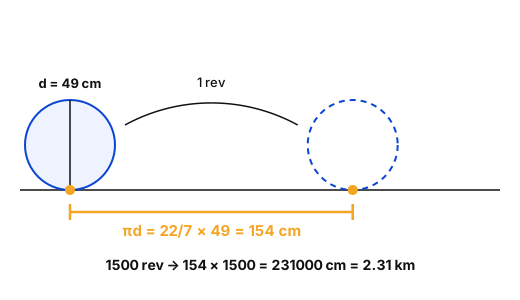
- cm.
- 1500 revolutions → cm.
- = 2310 m = 2.31 km.
Trick: cm → km: divide by 1,00,000.
Answer: (A) 2.31 Km
अवधारणा: एक चक्कर में दूरी = परिधि = ।
- cm।
- 1500 चक्कर → cm।
- = 2310 m = 2.31 km।
ट्रिक: cm से km: 1,00,000 से भाग दें।
उत्तर: (A) 2.31 Km
SSC CHSLQuantitative AptitudeCircle – distance by revolutionsSSC CHSL 2025 · 13 Nov Shift 1
Q1196.Find the equation of the line that passes through the point and is perpendicular to the line .
उस रेखा का समीकरण ज्ञात कीजिए जो बिंदु से होकर जाती है तथा रेखा पर लंब है।
- A
- B
- C
- D
Show answer
Concept: Perpendicular lines: .
- Slope of is 5 → required slope = .
- Through (3, 4): .
- .
Trick: Put in options: only (D) gives .
Answer: (D)
अवधारणा: लंबवत रेखाएँ: ।
- की ढाल 5 → अभीष्ट ढाल = ।
- (3, 4) से: ।
- ।
ट्रिक: विकल्पों में रखें: केवल (D) से आता है।
उत्तर: (D)
SSC CHSLQuantitative AptitudeCoordinate geometry – perpendicular lineSSC CHSL 2025 · 13 Nov Shift 1
Q1197.Find the value of when and .
का मान ज्ञात कीजिए, जब तथा हो।
- A36
- B33
- C39
- D38
Show answer
Concept: .
- Choose , and ; this produces .
- So expression = .
- = 36.
Trick: Signs of 2bc and 2ca are negative while 2ab is positive → only c is negative.
Answer: (A) 36
अवधारणा: ।
- , , लें: मिलता है।
- अतः व्यंजक = ।
- = 36।
ट्रिक: 2bc और 2ca ऋणात्मक, 2ab धनात्मक → केवल c ऋणात्मक है।
उत्तर: (A) 36
SSC CHSLQuantitative AptitudeAlgebra – perfect square of three termsSSC CHSL 2025 · 13 Nov Shift 1
Q1198.Simplify:
सरल कीजिए:
- A
- B
- C1
- D
Show answer
Concept: Change cosec and cot into sin and cos.
- .
- .
- Ratio = ( cancels).
Trick: Test : , , ratio = ; – only (B) matches.
Answer: (B)
अवधारणा: cosec और cot को sin और cos में बदलें।
- ।
- ।
- अनुपात = ( कट जाता है)।
ट्रिक: रखें: ; यह केवल (B) से मिलता है।
उत्तर: (B)
SSC CHSLQuantitative AptitudeTrigonometry – (cosec − cot)/(cosec + cot)SSC CHSL 2025 · 13 Nov Shift 1
Q1199.If , what is ?
यदि है, तो क्या है?
- A
- B
- C
- D
Show answer
Concept: (or use a Pythagorean triplet).
- → base 15, hypotenuse 17.
- Perpendicular = .
- .
Trick: 8-15-17 is a standard triplet – learn it with 3-4-5, 5-12-13, 7-24-25.
Answer: (C)
अवधारणा: (या पाइथागोरस त्रिक)।
- → आधार 15, कर्ण 17।
- लंब = ।
- ।
ट्रिक: 8-15-17 मानक त्रिक है – 3-4-5, 5-12-13, 7-24-25 के साथ याद रखें।
उत्तर: (C)
SSC CHSLQuantitative AptitudeTrigonometry – sin from cosSSC CHSL 2025 · 13 Nov Shift 1
Q1200.In a right triangle , right-angled at , if , what is the value of 2 ?
एक समकोण त्रिभुज में, जिसमें पर समकोण है, यदि है, तो 2 का मान क्या है?
- A
- B
- C
- D
Show answer
Concept: = ; build the triangle.
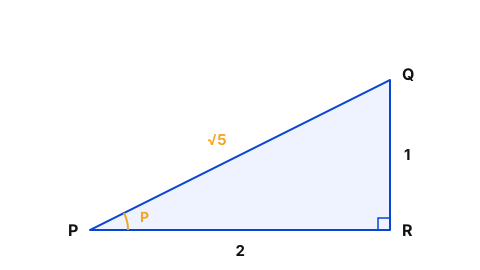
- → base = 2, perpendicular = 1, hypotenuse = .
- .
- .
Trick: .
Answer: (A)
अवधारणा: = ; त्रिभुज बनाएँ।
- → आधार = 2, लंब = 1, कर्ण = ।
- ।
- ।
ट्रिक: ।
उत्तर: (A)
SSC CHSLQuantitative AptitudeTrigonometry – 2 sinP cosP from cotPSSC CHSL 2025 · 13 Nov Shift 1

