Q141.From a point A outside a circle with centre O , a tangent AB is drawn to the circle. The circle's radius measures 8 cm , and the tangent segment AB has a length of 15 cm . Find the distance between point A and the centre O of the circle.
केंद्र O वाले एक वृत्त के बाहर स्थित बिंदु A से वृत्त पर एक स्पर्श रेखा AB खींची जाती है। वृत्त की त्रिज्या 8 cm है तथा स्पर्श रेखा खंड AB की लंबाई 15 cm है। बिंदु A तथा वृत्त के केंद्र O के बीच की दूरी ज्ञात कीजिए।
- A10 cm
- B12 cm
- C17 cm
- D16 cm
Show answer
Concept: Radius ⟂ tangent at the point of contact, so .
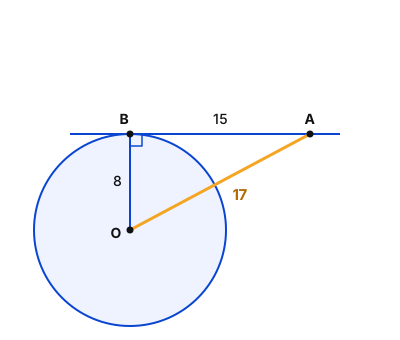
- .
- 17 cm.
Trick: 8-15-17 is a Pythagorean triple — spot it and answer instantly.
Answer: (C) 17 cm
अवधारणा: स्पर्श बिंदु पर त्रिज्या ⟂ स्पर्शरेखा, अतः ।
- ।
- 17 cm।
ट्रिक: 8-15-17 पाइथागोरस त्रिक है — तुरंत उत्तर।
उत्तर: (C) 17 cm
SSC CHSLQuantitative AptitudeCircle – tangent and radiusSSC CHSL 2025 · 29 Nov Shift 1
Q142.A triangular park has an area of . A smaller similar park is constructed such that each side is half the length of the larger park. What is the area of the smaller park?
एक त्रिभुजाकार पार्क का क्षेत्रफल है। एक छोटा समरूप पार्क इस प्रकार बनाया जाता है कि उसकी प्रत्येक भुजा बड़े पार्क की भुजा की आधी है। छोटे पार्क का क्षेत्रफल क्या है?
- A
- B
- C
- D
Show answer
Concept: Areas of similar figures are in the ratio of the squares of corresponding sides.
- Side ratio (small : large) = 1 : 2 → area ratio = 1 : 4.
- Small park = 36 m².
Trick: Halving sides does not halve area — it makes it one-fourth. 72 is the trap.
Answer: (C)
अवधारणा: समरूप आकृतियों के क्षेत्रफल संगत भुजाओं के वर्गों के अनुपात में होते हैं।
- भुजा अनुपात (छोटा : बड़ा) = 1 : 2 → क्षेत्रफल अनुपात = 1 : 4।
- छोटा पार्क = 36 m²।
ट्रिक: भुजा आधी करने से क्षेत्रफल आधा नहीं, चौथाई होता है — 72 जाल है।
उत्तर: (C)
SSC CHSLQuantitative AptitudeSimilar figures – ratio of areasSSC CHSL 2025 · 29 Nov Shift 1
Q143.If and , find
यदि और है, तो ज्ञात कीजिए।
- A4096
- B9919
- C12144
- D15360
Show answer
Concept: .
- .
- ; .
- 9919.
Trick: Direct: .
Answer: (B) 9919
अवधारणा: ।
- ।
- ; ।
- 9919।
ट्रिक: सीधे: ।
उत्तर: (B) 9919
SSC CHSLQuantitative AptitudeAlgebra – x⁴ − y⁴SSC CHSL 2025 · 29 Nov Shift 1
Q144. ?
- A6.29
- B6.87
- C0.97
- D5.90
Show answer
Concept: Check if the middle number equals 2ab; then use and .
- Let : , so top = with .
- Bottom = , where .
- Value = 6.29.
Trick: Result simplifies to — no squaring of decimals needed.
Answer: (A) 6.29
अवधारणा: बीच वाली संख्या 2ab है या नहीं, जाँचें; फिर और लगाएँ।
- माना : , अतः अंश = , जहाँ ।
- हर = , जहाँ ।
- मान = 6.29।
ट्रिक: पूरा व्यंजक बन जाता है — दशमलव के वर्ग नहीं करने पड़ते।
उत्तर: (A) 6.29
SSC CHSLQuantitative AptitudeSimplification – a² + 2ab + b² over a² − b²SSC CHSL 2025 · 29 Nov Shift 1
Q145.If , then what is the value of ?
यदि है, तो का मान क्या है?
- A72
- B64
- C45
- D69
Show answer
Concept: Write each surd as and add like surds.
- .
- .
- 45.
Trick: Or .
Answer: (C) 45
अवधारणा: हर करणी को में लिखकर जोड़ें।
- ।
- ।
- 45।
ट्रिक: या ।
उत्तर: (C) 45
SSC CHSLQuantitative AptitudeSurds – simplifying √20 + √5SSC CHSL 2025 · 29 Nov Shift 1
Q146.Rs. 5000 is invested in a scheme of compound interest (compounding annually) at the annual rate of 20 percent. What will be the difference between compound interest of second year and third year?
चक्रवृद्धि ब्याज (वार्षिक रूप से संयोजित) की एक योजना में 20 प्रतिशत वार्षिक दर पर Rs. 5000 निवेश किए जाते हैं। दूसरे वर्ष तथा तीसरे वर्ष के चक्रवृद्धि ब्याज के बीच कितना अंतर होगा?
- ARs. 250
- BRs. 230
- CRs. 278
- DRs. 240
Show answer
Concept: Under CI, each year's interest is R% of the previous year's amount.
- Year 1 interest = 20% of 5000 = 1000.
- Year 2 interest = .
- Year 3 interest = → difference = ₹240.
Trick: Difference between consecutive years' CI = R% of the earlier year's interest: 20% of 1200 = 240.
Answer: (D) Rs. 240
अवधारणा: चक्रवृद्धि में हर वर्ष का ब्याज पिछले वर्ष की राशि का R% होता है।
- पहले वर्ष का ब्याज = 5000 का 20% = 1000।
- दूसरे वर्ष = ।
- तीसरे वर्ष = → अंतर = ₹240।
ट्रिक: लगातार दो वर्षों के CI का अंतर = पहले वाले वर्ष के ब्याज का R%: 1200 का 20% = 240।
उत्तर: (D) Rs. 240
SSC CHSLQuantitative AptitudeCompound interest – year-wise interestSSC CHSL 2025 · 29 Nov Shift 1
Q147.In how much time will a sum of Rs. 16000 amounts to Rs. 24000 at the rate of 5 percent per annum at simple interest?
साधारण ब्याज पर 5 प्रतिशत वार्षिक दर से Rs. 16000 की राशि कितने समय में Rs. 24000 हो जाएगी?
- A8 years8 वर्ष
- B5 years5 वर्ष
- C10 years10 वर्ष
- D4 years4 वर्ष
Show answer
Concept: .
- .
- One year's SI = 5% of 16000 = 800.
- 10 years.
Trick: SI is half the principal (50%) at 5% per year → years.
Answer: (C) 10 years
अवधारणा: ।
- ।
- एक वर्ष का ब्याज = 16000 का 5% = 800।
- 10 वर्ष।
ट्रिक: ब्याज मूलधन का 50% है, दर 5% → वर्ष।
उत्तर: (C) 10 वर्ष
SSC CHSLQuantitative AptitudeSimple interest – timeSSC CHSL 2025 · 29 Nov Shift 1
Q148.The average of 5 consecutive odd natural numbers is 57. Previous 5 consecutive odd natural numbers to these 5 odd natural numbers are also included. What will be the average of newly added numbers?
5 क्रमागत विषम प्राकृत संख्याओं का औसत 57 है। इन 5 विषम प्राकृत संख्याओं से ठीक पहले की 5 क्रमागत विषम प्राकृत संख्याएँ भी सम्मिलित कर ली जाती हैं। नई जोड़ी गई संख्याओं का औसत क्या होगा?
- A43
- B49
- C47
- D45
Show answer
Concept: For an odd count of equally spaced numbers, average = middle term.
- Middle = 57 → numbers 53, 55, 57, 59, 61.
- Previous 5 odd numbers: 43, 45, 47, 49, 51.
- Their average = middle = 47.
Trick: Shifting 5 odd numbers back moves every term by 10 → 57 − 10 = 47.
Answer: (C) 47
अवधारणा: समान अंतर वाली विषम संख्या में पदों का औसत = बीच वाला पद।
- बीच का पद 57 → संख्याएँ 53, 55, 57, 59, 61।
- इनसे पहले की 5 विषम संख्याएँ: 43, 45, 47, 49, 51।
- इनका औसत = बीच वाला = 47।
ट्रिक: 5 विषम संख्याएँ पीछे जाने पर हर पद 10 घटता है → 57 − 10 = 47।
उत्तर: (C) 47
SSC CHSLQuantitative AptitudeAverage – consecutive odd numbersSSC CHSL 2025 · 29 Nov Shift 1
Q149.There are 20 players in a team. The average age of these 20 players is ' '. 10 new players joined the team. There is no change in the average age of the team. What is the total age of these 10 players?
एक टीम में 20 खिलाड़ी हैं। इन 20 खिलाड़ियों की औसत आयु ' ' है। 10 नए खिलाड़ी टीम में सम्मिलित हो जाते हैं। टीम की औसत आयु में कोई परिवर्तन नहीं होता। इन 10 खिलाड़ियों की कुल आयु क्या है?
- A5x
- B20 x
- C10x
- D
Show answer
Concept: If the average does not change, the newcomers' average equals the old average.
- 10 new players' average must also be x.
- Their total age = 10 × x = 10x.
Trick: Check: (20x + 10x) ÷ 30 = x ✓.
Answer: (C) 10x
अवधारणा: औसत न बदले तो नए सदस्यों का औसत भी पुराने औसत के बराबर होता है।
- 10 नए खिलाड़ियों का औसत भी x होगा।
- उनकी कुल आयु = 10 × x = 10x।
ट्रिक: जाँच: (20x + 10x) ÷ 30 = x ✓।
उत्तर: (C) 10x
SSC CHSLQuantitative AptitudeAverage – new members, same averageSSC CHSL 2025 · 29 Nov Shift 1
Q150.Rohit is trying to fill a tank using three pipes, , and . When pipes and B work together, they can fill the tank in 24 minutes. If pipes B and C work together, they can fill the tank in 30 minutes, and when pipes C and A work together, they can fill the tank in 40 minutes. Initially, Rohit opens only pipe C. After L minutes, he also opens pipes A and B , and the remaining portion of the tank is filled in 5 minutes. Determine the value of L.
रोहित तीन पाइपों , तथा की सहायता से एक टंकी भरने का प्रयास कर रहा है। जब पाइप और B एक साथ कार्य करते हैं, तो वे टंकी को 24 मिनट में भर सकते हैं। यदि पाइप B और C एक साथ कार्य करें, तो वे टंकी को 30 मिनट में भर सकते हैं, तथा जब पाइप C और A एक साथ कार्य करें, तो वे टंकी को 40 मिनट में भर सकते हैं। आरंभ में रोहित केवल पाइप C खोलता है। L मिनट के बाद वह पाइप A और B भी खोल देता है, और टंकी का शेष भाग 5 मिनट में भर जाता है। L का मान ज्ञात कीजिए।
- A60
- B45
- C90
- D80
Show answer
Concept: Take capacity = LCM; adding the three pair-rates gives .
- Capacity = LCM(24, 30, 40) = 120 units → A+B = 5, B+C = 4, C+A = 3 units/min.
- unit/min.
- Last 5 min, all three: units → C alone filled 90 units.
- 90 minutes.
Trick: C alone = 1 unit/min, so L simply equals the units C filled: .
Answer: (C) 90
अवधारणा: क्षमता = LCM मानें; तीनों जोड़ों की दरें जोड़ने पर मिलता है।
- क्षमता = LCM(24, 30, 40) = 120 इकाई → A+B = 5, B+C = 4, C+A = 3 इकाई/मिनट।
- इकाई/मिनट।
- अंतिम 5 मिनट तीनों: इकाई → C ने अकेले 90 इकाई भरीं।
- 90 मिनट।
ट्रिक: C की दर 1 इकाई/मिनट है, इसलिए L = C द्वारा भरी इकाइयाँ = ।
उत्तर: (C) 90
SSC CHSLQuantitative AptitudePipes & cisterns – pairs givenSSC CHSL 2025 · 29 Nov Shift 1
Q151.A shopkeeper sells a product at Rs. 240 after losing . What is the cost price?
एक दुकानदार की हानि पर एक वस्तु Rs. 240 में बेचता है। क्रय मूल्य क्या है?
- ARs. 280
- BRs. 300
- CRs. 320
- DRs. 350
Show answer
Concept: At x% loss, .
Solution:
- 20% loss → .
- = ₹300.
Trick: 20% loss means SP is 4 parts out of CP's 5 → 1 part = , CP = .
Answer: (B) Rs. 300
अवधारणा: x% हानि पर ।
हल:
- 20% हानि → ।
- = ₹300।
ट्रिक: SP = 4 भाग, CP = 5 भाग → 1 भाग = 60, CP = 300।
उत्तर: (B) Rs. 300
SSC CHSLQuantitative AptitudeProfit & loss – CP from SP and loss %SSC CHSL 2025 · 28 Nov Shift 3
Q152.A shopkeeper mixes 3 kg of rice at ₹60/kg with 2 kg of rice at ₹70/kg. What is the price per kg of the mixture?
एक दुकानदार ₹60/kg वाले 3 kg चावल को ₹70/kg वाले 2 kg चावल के साथ मिलाता है। मिश्रण का प्रति kg मूल्य क्या है?
- A₹62
- B₹64
- C₹65
- D₹66
Show answer
Concept: .
Solution:
- Cost: = ₹320.
- Quantity = 5 kg → = ₹64/kg.
Trick: Weighted average: (base price + share of the extra ₹10).
Answer: (B) ₹64
अवधारणा: ।
हल:
- लागत: = ₹320; मात्रा = 5 kg।
- = ₹64 प्रति kg।
ट्रिक: भारित औसत: ।
उत्तर: (B) ₹64
SSC CHSLQuantitative AptitudeMixture – average price per kgSSC CHSL 2025 · 28 Nov Shift 3
Q153.A car travels 240 km at . Time taken?
एक कार की चाल से 240 km चलती है। लिया गया समय कितना है?
- A3 hours3 घंटे
- B3.5 hours3.5 घंटे
- C4 hours4 घंटे
- D5 hours5 घंटे
Show answer
Concept: .
Solution:
- = 4 hours.
Yaad rakhein: Units must match: km with km/h gives hours directly.
Answer: (C) 4 hours
अवधारणा: ।
हल:
- = 4 घंटे।
याद रखें: km और km/h से उत्तर सीधे घंटों में आता है।
उत्तर: (C) 4 घंटे
SSC CHSLQuantitative AptitudeSpeed, time & distance – timeSSC CHSL 2025 · 28 Nov Shift 3
Q154.P is twice as efficient as Q.P and together can complete a piece of work in 18 days. In how many days can P alone complete the work?
P, Q से दोगुना कार्यकुशल है। P और मिलकर एक कार्य 18 दिनों में पूरा कर सकते हैं। P अकेला उस कार्य को कितने दिनों में पूरा कर सकता है?
- A24 days24 दिन
- B27 days27 दिन
- C36 days36 दिन
- D54 days54 दिन
Show answer
Concept: Take efficiencies as units of work per day.
Solution:
- P : Q = 2 : 1 → together 3 units/day.
- Total work = units.
- P alone = = 27 days.
Trick: .
Answer: (B) 27 days
अवधारणा: दक्षता को प्रति दिन कार्य-इकाई मानें।
हल:
- P : Q = 2 : 1 → साथ में 3 इकाई/दिन।
- कुल कार्य = इकाई।
- P अकेला = = 27 दिन।
ट्रिक: – एक पंक्ति में।
उत्तर: (B) 27 दिन
SSC CHSLQuantitative AptitudeTime & work – efficiency ratioSSC CHSL 2025 · 28 Nov Shift 3
Q155.What is the selling price if the marked price is Rs. 1200 and the discount is 15%?
यदि अंकित मूल्य Rs. 1200 है और छूट 15% है, तो विक्रय मूल्य क्या होगा?
- ARs. 1080
- BRs. 1020
- CRs. 1100
- DRs. 1050
Show answer
Concept: .
Solution:
- = ₹1020.
Trick: 10% of 1200 = 120, 5% = 60 → discount 180 → .
Answer: (B) Rs. 1020
अवधारणा: ।
हल:
- = ₹1020।
ट्रिक: 1200 का 10% = 120, 5% = 60 → छूट 180 → 1020।
उत्तर: (B) Rs. 1020
SSC CHSLQuantitative AptitudeDiscount – SP from MPSSC CHSL 2025 · 28 Nov Shift 3
Q156.A solid metallic cuboid with dimensions is melted and recast into small solid cubes of side 2 cm each. How many such cubes can be formed?
विमाओं वाले एक ठोस धात्विक घनाभ को पिघलाकर 2 cm भुजा वाले छोटे ठोस घनों में ढाला जाता है। ऐसे कितने घन बनाए जा सकते हैं?
- A2000
- B2500
- C3000
- D5000
Show answer
Concept: Volume stays the same on melting; .
Solution:
- Cuboid = .
- One cube = .
- Cubes = = 2500.
Trick: Divide each side by 2 directly: .
Answer: (B) 2500
अवधारणा: पिघलाने पर आयतन नहीं बदलता; ।
हल:
- घनाभ = ; एक घन = 8 cm³।
- संख्या = = 2500।
ट्रिक: हर भुजा को 2 से भाग दें: ।
उत्तर: (B) 2500
SSC CHSLQuantitative AptitudeMensuration – recasting cuboid into cubesSSC CHSL 2025 · 28 Nov Shift 3
Q157.Two triangular garden plots are measured. It is found that the three sides of the first plot are exactly equal in length to the corresponding three sides of the second plot. Are these two plots congruent?
दो त्रिभुजाकार बगीचों की माप ली जाती है। यह पाया जाता है कि पहले भूखंड की तीनों भुजाएँ दूसरे भूखंड की संगत तीनों भुजाओं के ठीक बराबर हैं। क्या ये दोनों भूखंड सर्वांगसम हैं?
- AYes, by SSSहाँ, SSS द्वारा
- BNoनहीं
- CYes, by SASहाँ, SAS द्वारा
- DCannot sayकह नहीं सकते
Show answer
Concept: Two triangles with all three corresponding sides equal are congruent (SSS rule).
Solution:
- All three sides of plot 1 = the matching sides of plot 2 → SSS holds.
- SAS needs an included angle, which is not given.
Yaad rakhein: Valid congruence rules: SSS, SAS, ASA, AAS, RHS. AAA and SSA are NOT rules.
Answer: (A) Yes, by SSS
अवधारणा: जिन दो त्रिभुजों की तीनों संगत भुजाएँ बराबर हों, वे सर्वांगसम होते हैं (SSS)।
हल:
- दोनों भूखंडों की तीनों भुजाएँ बराबर → SSS लागू।
- SAS के लिए बीच का कोण चाहिए, जो दिया नहीं है।
याद रखें: मान्य नियम: SSS, SAS, ASA, AAS, RHS; AAA और SSA नियम नहीं हैं।
उत्तर: (A) हाँ, SSS द्वारा
SSC CHSLQuantitative AptitudeGeometry – SSS congruenceSSC CHSL 2025 · 28 Nov Shift 3
Q158.A right prism has a volume of 2400 and a height of 30 cm. What is the area of its base?
एक लम्ब प्रिज्म का आयतन 2400 तथा ऊँचाई 30 cm है। इसके आधार का क्षेत्रफल क्या है?
- A
- B
- C
- D
Show answer
Concept: .
Solution:
- Base area = = 80 cm².
Yaad rakhein: Same formula works for every prism and cylinder: .
Answer: (C)
अवधारणा: ।
हल:
- आधार क्षेत्रफल = = 80 cm²।
याद रखें: यही सूत्र हर प्रिज्म और बेलन पर लागू: ।
उत्तर: (C)
SSC CHSLQuantitative AptitudeMensuration – base area of prismSSC CHSL 2025 · 28 Nov Shift 3
Q159.An 80-liter mixture contains milk and water in the ratio . If 10 liters of water is added to the mixture, what will be the new ratio of milk to water?
80 लीटर के एक मिश्रण में दूध और पानी के अनुपात में हैं। यदि मिश्रण में 10 लीटर पानी मिला दिया जाए, तो दूध और पानी का नया अनुपात क्या होगा?
- A3 : 2
- B3 : 1
- C5 : 3
- D2 : 1
Show answer
Concept: Split the mixture by ratio; only water changes when water is added.
Solution:
- Milk = = 60 L, water = 20 L.
- After adding 10 L water: water = 30 L.
- Milk : water = 60 : 30 = 2 : 1.
Trick: Milk stays fixed – just compare milk with new water.
Answer: (D) 2 : 1
अवधारणा: अनुपात से मात्रा बाँटें; पानी मिलाने पर केवल पानी बदलता है।
हल:
- दूध = 80 का = 60 L, पानी = 20 L।
- 10 L पानी मिलाने पर पानी = 30 L।
- दूध : पानी = 60 : 30 = 2 : 1।
ट्रिक: दूध स्थिर रहता है – सिर्फ नए पानी से तुलना करें।
उत्तर: (D) 2 : 1
SSC CHSLQuantitative AptitudeMixture – adding water changes ratioSSC CHSL 2025 · 28 Nov Shift 3
Q160.A circle has a radius of 8 cm. From an external point A , which is 17 cm away from the center of the circle, a tangent is drawn touching the circle at point B. What is the length of the tangent segment AB?
एक वृत्त की त्रिज्या 8 cm है। वृत्त के केंद्र से 17 cm दूर स्थित एक बाह्य बिंदु A से एक स्पर्श रेखा खींची जाती है जो वृत्त को बिंदु B पर स्पर्श करती है। स्पर्श रेखा खंड AB की लंबाई क्या है?
- A25 cm
- B9 cm
- C15 cm
- D12 cm
Show answer
Concept: Radius ⟂ tangent at the point of contact, so use Pythagoras.
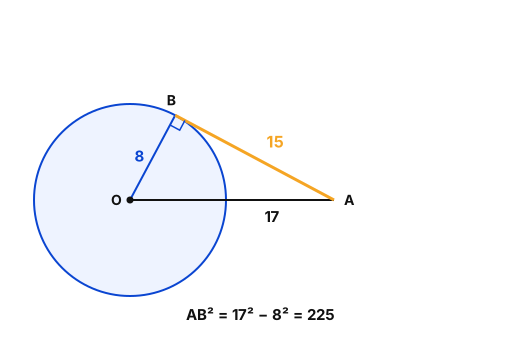
Solution:
- .
- = 15 cm.
Trick: 8, 15, 17 is a Pythagorean triplet – answer is instant.
Answer: (C) 15 cm
अवधारणा: स्पर्श बिंदु पर त्रिज्या स्पर्शरेखा पर लंब होती है; पाइथागोरस लगाएँ।
हल:
- ।
- AB = 15 cm।
ट्रिक: 8, 15, 17 पाइथागोरस त्रिक है।
उत्तर: (C) 15 cm
SSC CHSLQuantitative AptitudeCircle – length of tangentSSC CHSL 2025 · 28 Nov Shift 3

