Q161.How many triangles are there in the given figure?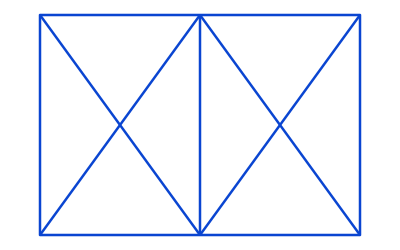
दी गई आकृति में कितने त्रिभुज हैं? - A19
- B20
- C18
- D22
Show answer
Concept: A rectangle with both diagonals has 8 triangles; then count triangles spanning both halves.
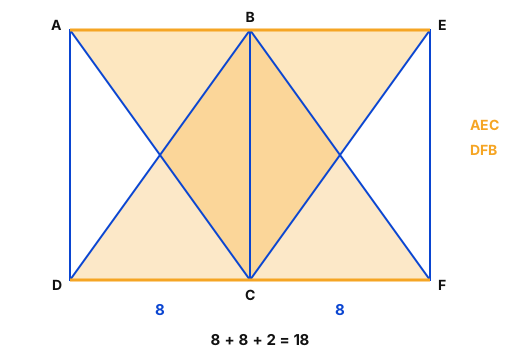
Solution:
- Left half: 4 small + 4 half-rectangle triangles = 8; right half: 8.
- Spanning triangles: top edge with apex at bottom-middle, and bottom edge with apex at top-middle = 2.
- Total = 8 + 8 + 2 = 18.
Trick: Memorise: a rectangle/square with both diagonals = 8 triangles.
Answer: (C) 18
अवधारणा: दोनों विकर्णों वाले आयत में 8 त्रिभुज होते हैं; फिर दोनों भागों को मिलाकर बनने वाले गिनें।
हल:
- बायाँ भाग 8 + दायाँ भाग 8 = 16।
- पूरी ऊपरी भुजा + नीचे के मध्य-बिंदु तथा पूरी निचली भुजा + ऊपर के मध्य-बिंदु से 2 बड़े त्रिभुज।
- कुल = 16 + 2 = 18।
ट्रिक: विकर्णों सहित एक आयत/वर्ग = 8 त्रिभुज – याद रखें।
उत्तर: (C) 18
SSC CHSLGeneral IntelligenceCounting triangles – two crossed rectanglesSSC CHSL 2025 · 28 Nov Shift 3
Q162.In the figure given below, the triangle represents bags, the circle represents leather, and the rectangle represents brown.The number written in each region shows the number of items belonging to that particular area.
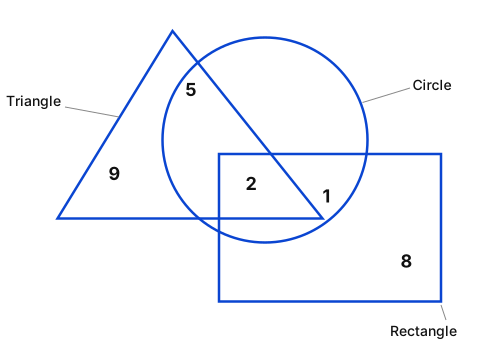
Which of the following statements is/are correct?
I. The number of leather items which are not brown is 14 .
II. The number of brown items which are only bags is 4.
नीचे दी गई आकृति में त्रिभुज बैगों को, वृत्त चमड़े को तथा आयत भूरे रंग को दर्शाता है।प्रत्येक क्षेत्र में लिखी संख्या उस विशेष क्षेत्र से संबंधित वस्तुओं की संख्या दर्शाती है।
निम्नलिखित में से कौन-सा/से कथन सही है/हैं?
I. चमड़े की ऐसी वस्तुओं की संख्या जो भूरी नहीं हैं, 14 है।
II. भूरी वस्तुओं में केवल बैग वाली वस्तुओं की संख्या 4 है।
- AOnly Iकेवल I
- BOnly IIकेवल II
- CBoth I and III और II दोनों
- DNeither I nor IIन तो I और न ही II
Show answer
Concept: Triangle = bags, circle = leather, rectangle = brown. Take only regions that satisfy every condition.
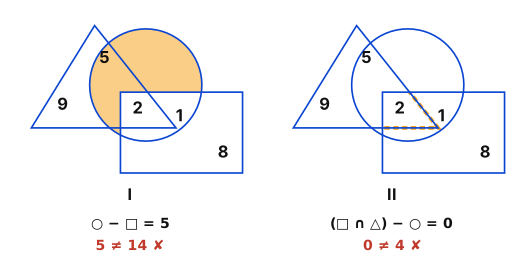
Solution:
- Statement I: inside circle, outside rectangle → only the region with 5 → 5 items, not 14 ✘.
- Statement II: inside rectangle and triangle but outside circle → no such numbered region → 0, not 4 ✘.
- Both statements are false.
Trick: 'Not X' means stay completely outside the X-shape – the 2 and 1 sit inside the rectangle, so they are excluded in I.
Answer: (D) Neither I nor II
अवधारणा: त्रिभुज = बैग, वृत्त = चमड़ा, आयत = भूरा। केवल वही क्षेत्र लें जो हर शर्त पूरी करे।
हल:
- कथन I: वृत्त के अंदर, आयत के बाहर → केवल 5 → 14 नहीं ✘।
- कथन II: आयत व त्रिभुज के अंदर, वृत्त के बाहर → ऐसा कोई संख्या वाला क्षेत्र नहीं → 0 ✘।
ट्रिक: 'Not X' का अर्थ है X की आकृति से पूरी तरह बाहर।
उत्तर: (D) न तो I और न ही II
SSC CHSLGeneral IntelligenceVenn diagram – reading regionsSSC CHSL 2025 · 28 Nov Shift 3
Q163.Marks of 5 students P, Q, R, S, and T are compared. Marks of no two students are the same. Marks of Q are less than only P. Marks of S are less than R but more than T. Marks of how many students are less than the marks of ?
5 विद्यार्थियों P, Q, R, S और T के अंकों की तुलना की जाती है। किन्हीं दो विद्यार्थियों के अंक समान नहीं हैं। Q के अंक केवल P से कम हैं। S के अंक R से कम परंतु T से अधिक हैं। कितने विद्यार्थियों के अंक के अंकों से कम हैं ?
- A1
- B2
- C3
- D0
Show answer
Concept: Convert each clue into an inequality chain.
Solution:
- Q is less than only P → P first, Q second.
- R > S > T.
- Order: P > Q > R > S > T → below R are S and T = 2.
Trick: 'Less than only X' = rank 2 directly; fill the rest below it.
Answer: (B) 2
अवधारणा: हर सूचना को असमिका श्रृंखला में बदलें।
हल:
- Q केवल P से कम → P पहला, Q दूसरा।
- R > S > T।
- क्रम: P > Q > R > S > T → R से कम: S, T = 2।
ट्रिक: 'केवल X से कम' = सीधे दूसरा स्थान।
उत्तर: (B) 2
SSC CHSLGeneral IntelligenceOrdering – marks comparisonSSC CHSL 2025 · 28 Nov Shift 3
Q164.The weight of 6 friends , Y , and Z is compared. No two persons have the same weight. The weight of V is the second highest. The weight of Z is more than X and Y but less than W and U . The weight of is not the maximum. The weight of how many persons is less than U?
6 मित्रों , Y तथा Z के भार की तुलना की जाती है। किन्हीं दो व्यक्तियों का भार समान नहीं है। V का भार दूसरा सर्वाधिक है। Z का भार X और Y से अधिक परंतु W और U से कम है। का भार अधिकतम नहीं है। कितने व्यक्तियों का भार U से कम है?
- A1
- B2
- C3
- D0
Show answer
Concept: Fix the top position first using 'second highest' and 'not maximum'.
Solution:
- W, U > Z > X, Y. V is 2nd and U is not 1st → W must be the heaviest.
- So W > V > U > Z > X/Y.
- Lighter than U: Z, X, Y = 3.
Trick: With 6 people, if U is 3rd, people below U = 6 − 3 = 3.
Answer: (C) 3
अवधारणा: पहले 'दूसरा सबसे भारी' और 'अधिकतम नहीं' से ऊपर का स्थान तय करें।
हल:
- W, U > Z > X, Y; V दूसरा और U पहला नहीं → सबसे भारी W।
- क्रम: W > V > U > Z > X/Y।
- U से हल्के: Z, X, Y = 3।
ट्रिक: 6 लोगों में U तीसरा हो तो नीचे = 6 − 3 = 3।
उत्तर: (C) 3
SSC CHSLGeneral IntelligenceOrdering – weight comparisonSSC CHSL 2025 · 28 Nov Shift 3
Q165.Two figures given on the left side of (:) are related with some logic/rule/relation. Select the missing figure on the right side of (::) from the given alternatives based on the same logic/rule/relation.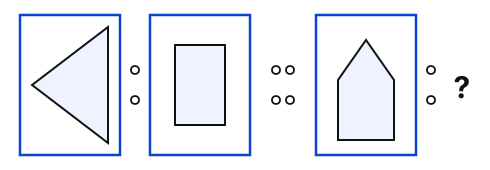
(:) के बाईं ओर दी गई दो आकृतियाँ किसी तर्क/नियम/संबंध से संबंधित हैं। उसी तर्क/नियम/संबंध के आधार पर दिए गए विकल्पों में से (::) के दाईं ओर आने वाली लुप्त आकृति चुनिए। - A
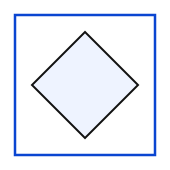
- B
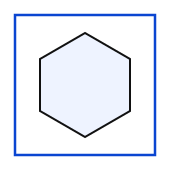
- C
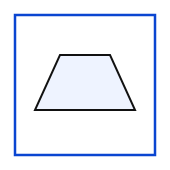
- D
Show answer
Concept: Count the sides of each figure.
Solution:
- Triangle (3 sides) → rectangle (4 sides): +1 side.
- Third figure: house shape = pentagon (5 sides).
- Answer must have 6 sides → hexagon.
Trick: In shape analogies, counting sides/lines is the first test to try.
Answer: (B) Option B (hexagon)
अवधारणा: हर आकृति की भुजाएँ गिनें।
हल:
- त्रिभुज (3) → आयत (4): एक भुजा अधिक।
- तीसरी आकृति: घर जैसी पंचभुज (5 भुजाएँ)।
- उत्तर में 6 भुजाएँ → षट्भुज।
ट्रिक: आकृति सादृश्य में सबसे पहले भुजाएँ/रेखाएँ गिनें।
उत्तर: (B) विकल्प B (षट्भुज)
SSC CHSLGeneral IntelligenceFigure analogy – sides increase by oneSSC CHSL 2025 · 28 Nov Shift 3
Q166.Two figures given on the left side of (:) are related with some logic/rule/relation. Select the missing figure on the right side of (:) from the given alternatives based on the same logic/rule/relation.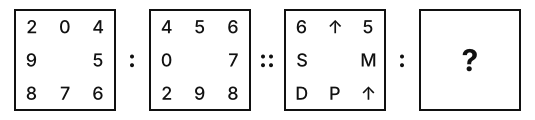
(:) के बाईं ओर दी गई दो आकृतियाँ किसी तर्क/नियम/संबंध से संबंधित हैं। उसी तर्क/नियम/संबंध के आधार पर दिए गए विकल्पों में से (:) के दाईं ओर की लुप्त आकृति का चयन कीजिए। - A
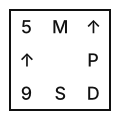
- B
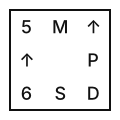
- C
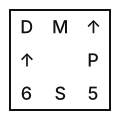
- D
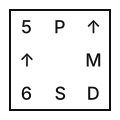
Show answer
Concept: Read the 8 border cells clockwise from top-left and compare positions.
Solution:
- Fig 1 → Fig 2: every element shifts 2 places anticlockwise along the border.
- Fig 3 read clockwise: 6, ↑, 5, M, ↑, P, D, S.
- Shift by 2 anticlockwise → top row 5, M, ↑; bottom row 6, S, D – matches option B.
Trick: Track just one easy symbol (like 6): find where it lands, then confirm with one more element.
Answer: (B) Option B
अवधारणा: बाहरी 8 खानों को ऊपर-बाएँ से दक्षिणावर्त पढ़ें और स्थिति की तुलना करें।
हल:
- पहली से दूसरी आकृति: हर तत्व किनारे पर 2 स्थान वामावर्त खिसकता है।
- तीसरी आकृति: 6, ↑, 5, M, ↑, P, D, S।
- 2 स्थान वामावर्त → ऊपर 5, M, ↑; नीचे 6, S, D – विकल्प B।
ट्रिक: केवल एक आसान चिह्न (जैसे 6) को ट्रैक करें, फिर एक और से पुष्टि करें।
उत्तर: (B) विकल्प B
SSC CHSLGeneral IntelligenceFigure analogy – border elements shiftSSC CHSL 2025 · 28 Nov Shift 3
Q167.In the following figure series, select the figure which can be placed at the sign of question mark (?) from the given alternatives.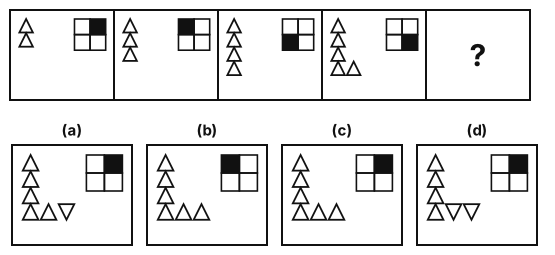
निम्नलिखित आकृति शृंखला में, दिए गए विकल्पों में से उस आकृति का चयन कीजिए जिसे प्रश्नवाचक चिह्न (?) के स्थान पर रखा जा सकता है। - A(a)
- B(b)
- C(c)
- D(d)
Show answer
Concept: Track two changes separately: number of triangles and position of the shaded cell.
Solution:
- Triangles: 2, 3, 4, 5 → next = 6 (all pointing up).
- Shaded cell moves one corner anticlockwise each step: TR → TL → BL → BR → next TR.
- Figure with 6 triangles and top-right shaded = option C.
Trick: Split a figure series into independent parts – solve each, then match both.
Answer: (C) Option C
अवधारणा: दो बदलाव अलग-अलग देखें: त्रिभुजों की संख्या और छायांकित खाने की स्थिति।
हल:
- त्रिभुज: 2, 3, 4, 5 → अगला 6।
- छायांकित खाना हर बार एक कोना वामावर्त: ऊपर-दाएँ → ऊपर-बाएँ → नीचे-बाएँ → नीचे-दाएँ → फिर ऊपर-दाएँ।
- 6 त्रिभुज + ऊपर-दाएँ छायांकित = विकल्प C।
ट्रिक: श्रृंखला को अलग-अलग भागों में तोड़ें, फिर दोनों मिलाएँ।
उत्तर: (C) विकल्प C
SSC CHSLGeneral IntelligenceFigure series – count and rotationSSC CHSL 2025 · 28 Nov Shift 3
Q168.If ' - means ' ', '+' means '×', '÷' means ' 4 ' and ' ' means ' + ', then ?
यदि ' - का अर्थ ' ' है, '+' का अर्थ '×' है, '÷' का अर्थ ' 4 ' है और ' ' का अर्थ ' + ' है, तो ?
- A20
- B16
- C18
- D22
Show answer
Concept: Replace signs first, then apply BODMAS. (Here '÷' stands for '−'.)
Solution:
- Swap: − → ÷, + → ×, ÷ → −, × → +.
- Converted:
- 18.
Trick: Write the new expression on paper before calculating – most mistakes come from solving with old signs.
Answer: (C) 18
अवधारणा: पहले चिह्न बदलें, फिर BODMAS लगाएँ ('÷' का अर्थ '−' है)।
हल:
- बदला हुआ रूप:
- 18।
ट्रिक: पहले नया व्यंजक लिख लें, तभी हल करें।
उत्तर: (C) 18
SSC CHSLGeneral IntelligenceSymbol substitution – BODMASSSC CHSL 2025 · 28 Nov Shift 3
Q169.Select the correct combination of mathematical signs to replace (*) signs sequentially and to balance the given equation.
दिए गए समीकरण को संतुलित करने के लिए (*) चिह्नों को क्रमिक रूप से प्रतिस्थापित करने वाले गणितीय चिह्नों के सही संयोजन का चयन कीजिए।
- A
- B
- C,
- D×, - +,+
Show answer
Concept: Insert each option's signs in order and simplify with BODMAS.
Solution:
- Option B: .
- .
- = 23 ✔
Trick: RHS 23 is small and odd → the last sign is likely '−5' or '+5'; test those options first.
Answer: (B)
अवधारणा: हर विकल्प के चिह्न क्रम से लगाकर BODMAS से हल करें।
हल:
- विकल्प B: ।
- ।
- = 23 ✔
ट्रिक: अंतिम चिह्न से शुरुआत कर विकल्प जल्दी छाँटें।
उत्तर: (B)
SSC CHSLGeneral IntelligenceBalancing equation – sign combinationSSC CHSL 2025 · 28 Nov Shift 3
Q170.In the following question, select the odd letter-number cluster from the given alternatives.
(NOTE: Operations should be performed on the whole numbers, without breaking down the number into its constituent digits. E.g. 13 - Operations on 13 such as adding /subtracting /multiplying etc. to 13 can be performed. Breaking down 13 into 1 and 3 and then performing mathematical operations on 1 and 3 is not allowed)
निम्नलिखित प्रश्न में, दिए गए विकल्पों में से विषम अक्षर-संख्या समूह का चयन कीजिए।
(नोट: संक्रियाएँ पूर्ण संख्याओं पर की जानी चाहिए, संख्या को उसके अंकों में विभाजित किए बिना। उदाहरण: 13 - 13 पर जोड़ने/घटाने/गुणा करने आदि जैसी संक्रियाएँ की जा सकती हैं। 13 को 1 और 3 में विभाजित करके 1 और 3 पर गणितीय संक्रियाएँ करने की अनुमति नहीं है।)
- AJKMN48
- BUVXY92
- CCDGH21
- DFGIJ32
Show answer
Concept: Number = sum of the alphabet positions of the four letters.
Solution:
- JKMN: 10 + 11 + 13 + 14 = 48 ✔; UVXY: 21 + 22 + 24 + 25 = 92 ✔
- FGIJ: 6 + 7 + 9 + 10 = 32 ✔
- CDGH: 3 + 4 + 7 + 8 = 22, but 21 is given ✘
Trick: Use EJOTY (5, 10, 15, 20, 25) to get letter positions instantly.
Answer: (C) CDGH21
अवधारणा: संख्या = चारों अक्षरों के स्थानीय मान का योग।
हल:
- JKMN = 48 ✔, UVXY = 92 ✔, FGIJ = 32 ✔
- CDGH: 3 + 4 + 7 + 8 = 22, पर दिया 21 ✘
ट्रिक: EJOTY (5, 10, 15, 20, 25) से अक्षरों का स्थान तुरंत निकालें।
उत्तर: (C) CDGH21
SSC CHSLGeneral IntelligenceOdd one – letter positions sumSSC CHSL 2025 · 28 Nov Shift 3
Q171.In the following question, four letter-number pairs are given. The letter-number on the left side of ( - ) is related to the letter-number on the right side of ( - ) with some
Logic/Rule/Relation. Three pairs are similar on the basis of same Logic/Rule/Relation. Select the odd one out from the given alternatives.
(NOTE: Operations should be performed on the whole numbers, without breaking down the number into its constituent digits. E.g. 13 - Operations on 13 such as adding /subtracting /multiplying etc. to 13 can be performed. Breaking down 13 into 1 and 3 and then performing mathematical operations on 1 and 3 is not allowed)
निम्नलिखित प्रश्न में, चार अक्षर-संख्या युग्म दिए गए हैं। ( - ) के बाईं ओर की अक्षर-संख्या किसी तर्क/नियम/संबंध से ( - ) के दाईं ओर की अक्षर-संख्या से संबंधित है। तीन युग्म समान तर्क/नियम/संबंध के आधार पर एक जैसे हैं। दिए गए विकल्पों में से विषम युग्म का चयन कीजिए।
(नोट: संक्रियाएँ पूर्ण संख्याओं पर की जानी चाहिए, संख्या को उसके अंकों में विभाजित किए बिना। उदाहरण: 13 - 13 पर जोड़ने/घटाने/गुणा करने आदि जैसी संक्रियाएँ की जा सकती हैं। 13 को 1 और 3 में विभाजित करके 1 और 3 पर गणितीय संक्रियाएँ करने की अनुमति नहीं है।)
- ABC500 - DE350
- BIJ725 - KL575
- CFG890 - HI740
- DNO660 - PQ500
Show answer
Concept: Letters move +2 in all pairs, so compare the numbers.
Solution:
- 500 − 350 = 150; 725 − 575 = 150; 890 − 740 = 150.
- 660 − 500 = 160 ✘ – different.
Trick: When the letter rule is the same everywhere, the odd one hides in the numbers.
Answer: (D) NO660 - PQ500
अवधारणा: सभी युग्मों में अक्षर +2 खिसकते हैं, इसलिए संख्याओं की तुलना करें।
हल:
- 500 − 350, 725 − 575, 890 − 740 = 150 हर बार।
- 660 − 500 = 160 ✘।
ट्रिक: अक्षरों का नियम समान हो तो अंतर संख्याओं में ढूँढें।
उत्तर: (D) NO660 - PQ500
SSC CHSLGeneral IntelligenceOdd pair – letter shift and number fallSSC CHSL 2025 · 28 Nov Shift 3
Q172.In the following question, four number pairs are given. In each pair the number on left side of ( - ) is related to the number of the right side of (-) with some Logic/Rule/Relation. Three pairs are similar on the basis of same Logic/Rule/Relation. Select the odd one out from the given alternatives.
(NOTE: Operations should be performed on the whole numbers, without breaking down the number into its constituent digits. E.g. 13 - Operations on 13 such as adding /subtracting /multiplying etc. to 13 can be performed. Breaking down 13 into 1 and 3 and then performing mathematical operations on 1 and 3 is not allowed)
निम्नलिखित प्रश्न में, चार संख्या युग्म दिए गए हैं। प्रत्येक युग्म में ( - ) के बाईं ओर की संख्या किसी तर्क/नियम/संबंध से (-) के दाईं ओर की संख्या से संबंधित है। तीन युग्म समान तर्क/नियम/संबंध के आधार पर एक जैसे हैं। दिए गए विकल्पों में से विषम युग्म का चयन कीजिए।
(नोट: संक्रियाएँ पूर्ण संख्याओं पर की जानी चाहिए, संख्या को उसके अंकों में विभाजित किए बिना। उदाहरण: 13 - 13 पर जोड़ने/घटाने/गुणा करने आदि जैसी संक्रियाएँ की जा सकती हैं। 13 को 1 और 3 में विभाजित करके 1 और 3 पर गणितीय संक्रियाएँ करने की अनुमति नहीं है।)
- A441-21
- B529-23
- C600-24
- D676-26
Show answer
Concept: .
Solution:
- ✔, ✔, ✔
- , not 600 ✘
Trick: 600 does not end in a square-ending pattern with a perfect root () – spot it without calculating others.
Answer: (C) 600-24
अवधारणा: बाईं संख्या = दाईं संख्या का वर्ग।
हल:
- ✔, ✔, ✔
- , 600 नहीं ✘
ट्रिक: – पूर्ण वर्ग नहीं, इसलिए सीधे विषम।
उत्तर: (C) 600-24
SSC CHSLGeneral IntelligenceOdd pair – perfect squaresSSC CHSL 2025 · 28 Nov Shift 3
Q173.In the following question, in each alternative a group of numbers is given. The numbers of each group are related to the numbers of the same group by some Logic/Rule/Relation. Select that group of numbers in which numbers are not related by that same Logic/Rule/Relation.
(NOTE: Operations should be performed on the whole numbers, without breaking down the number into its constituent digits. E.g. 13 - Operations on 13 such as adding /subtracting /multiplying etc. to 13 can be performed. Breaking down 13 into 1 and 3 and then performing mathematical operations on 1 and 3 is not allowed)
निम्नलिखित प्रश्न में, प्रत्येक विकल्प में संख्याओं का एक समूह दिया गया है। प्रत्येक समूह की संख्याएँ उसी समूह की संख्याओं से किसी तर्क/नियम/संबंध द्वारा संबंधित हैं। उस संख्या समूह का चयन कीजिए जिसमें संख्याएँ उसी तर्क/नियम/संबंध से संबंधित नहीं हैं।
(नोट: संक्रियाएँ पूर्ण संख्याओं पर की जानी चाहिए, संख्या को उसके अंकों में विभाजित किए बिना। उदाहरण: 13 - 13 पर जोड़ने/घटाने/गुणा करने आदि जैसी संक्रियाएँ की जा सकती हैं। 13 को 1 और 3 में विभाजित करके 1 और 3 पर गणितीय संक्रियाएँ करने की अनुमति नहीं है।)
- A(142, 485, 7)
- B(215, 1215, 10)
- C
- D
Show answer
Concept: .
Solution:
- ✔; ✔; ✔
- ✘
Trick: Unit-digit check: ( ends in 7) = 7, but 2370 ends in 0 → odd one at once.
Answer: (D)
अवधारणा: बीच की संख्या = पहली संख्या + तीसरी का घन।
हल:
- ✔; ✔; ✔
- ✘
ट्रिक: इकाई अंक: का अंतिम अंक 7, 180 + … का अंतिम अंक 7 होना चाहिए, पर 2370 में 0 है।
उत्तर: (D)
SSC CHSLGeneral IntelligenceOdd group – first + cube of thirdSSC CHSL 2025 · 28 Nov Shift 3
Q174.Select the option that is related to the sixth letter-number cluster in the same way as the first letter-number cluster is related to the second letter-number cluster and third letter-number cluster is related to fourth letter-number cluster.
(NOTE: Operations should be performed on the whole numbers, without breaking down the number into its constituent digits. E.g. 13 - Operations on 13 such as adding /subtracting /multiplying etc. to 13 can be performed. Breaking down 13 into 1 and 3 and then performing mathematical operations on 1 and 3 is not allowed) PR500 : QQ250 :: BL120 : CK60 :: ? : DG200
उस विकल्प का चयन कीजिए जो छठे अक्षर-संख्या समूह से उसी प्रकार संबंधित है जिस प्रकार पहला अक्षर-संख्या समूह दूसरे अक्षर-संख्या समूह से तथा तीसरा अक्षर-संख्या समूह चौथे अक्षर-संख्या समूह से संबंधित है।
(नोट: संक्रियाएँ पूर्ण संख्याओं पर की जानी चाहिए, संख्या को उसके अंकों में विभाजित किए बिना। उदाहरण: 13 - 13 पर जोड़ने/घटाने/गुणा करने आदि जैसी संक्रियाएँ की जा सकती हैं। 13 को 1 और 3 में विभाजित करके 1 और 3 पर गणितीय संक्रियाएँ करने की अनुमति नहीं है।) PR500 : QQ250 :: BL120 : CK60 :: ? : DG200
- ACI400
- BCH400
- CDH400
- DCG200
Show answer
Concept: Rule: 1st letter +1, 2nd letter −1, number ÷ 2. The blank is the first term, so reverse it.
Solution:
- PR500 → QQ250 and BL120 → CK60 confirm the rule.
- Reverse from DG200: D − 1 = C, G + 1 = H, .
- Missing cluster = CH400.
Trick: When '?' is on the left, apply the opposite operations (+ ↔ −, × ↔ ÷).
Answer: (B) CH400
अवधारणा: नियम: पहला अक्षर +1, दूसरा −1, संख्या ÷ 2। '?' पहले पद में है, इसलिए उल्टा करें।
हल:
- PR500 → QQ250, BL120 → CK60 से नियम पक्का।
- DG200 से उल्टा: D − 1 = C, G + 1 = H, ।
- उत्तर = CH400।
ट्रिक: '?' बाईं ओर हो तो उल्टी संक्रियाएँ लगाएँ।
उत्तर: (B) CH400
SSC CHSLGeneral IntelligenceLetter-number analogy – reverse workingSSC CHSL 2025 · 28 Nov Shift 3
Q175.Select the option that is related to the fifth letter-number cluster in the same way as the second letter-number cluster is related to the first letter-number cluster and fourth letter-number cluster is related to third letter-number cluster.
(NOTE: Operations should be performed on the whole numbers, without breaking down the number into its constituent digits. E.g. 13 - Operations on 13 such as adding /subtracting /multiplying etc. to 13 can be performed. Breaking down 13 into 1 and 3 and then performing mathematical operations on 1 and 3 is not allowed)
RJ10 : VN105 :: DL12 : HP149 :: GK14 : ?
उस विकल्प का चयन कीजिए जो पाँचवें अक्षर-संख्या समूह से उसी प्रकार संबंधित है जिस प्रकार दूसरा अक्षर-संख्या समूह पहले अक्षर-संख्या समूह से तथा चौथा अक्षर-संख्या समूह तीसरे अक्षर-संख्या समूह से संबंधित है।
(नोट: संक्रियाएँ पूर्ण संख्याओं पर की जानी चाहिए, संख्या को उसके अंकों में विभाजित किए बिना। उदाहरण: 13 - 13 पर जोड़ने/घटाने/गुणा करने आदि जैसी संक्रियाएँ की जा सकती हैं। 13 को 1 और 3 में विभाजित करके 1 और 3 पर गणितीय संक्रियाएँ करने की अनुमति नहीं है।)
RJ10 : VN105 :: DL12 : HP149 :: GK14 : ?
- AKO201
- BKP201
- CKO199
- DL0205
Show answer
Concept: Letters move +4; number becomes .
Solution:
- RJ10 → VN105: R+4 = V, J+4 = N, ✔; DL12 → HP149 ✔ (144 + 5).
- GK14 → G+4 = K, K+4 = O, .
- Answer = KO201.
Trick: Option letters decide quickly: K+4 = O removes KP and L0 options; 201 removes 199.
Answer: (A) KO201
अवधारणा: अक्षर +4 खिसकते हैं; संख्या = ।
हल:
- ✔, ✔।
- GK14 → K, O और ।
- उत्तर = KO201।
ट्रिक: K + 4 = O से KP और L0 विकल्प तुरंत हटते हैं।
उत्तर: (A) KO201
SSC CHSLGeneral IntelligenceLetter-number analogy – +4 letters, n² + 5SSC CHSL 2025 · 28 Nov Shift 3
Q176.Find the next element that replace the ? Logically
5, 15, 35, 75, ?
वह अगला पद ज्ञात कीजिए जो तार्किक रूप से ? का स्थान लेगा।
5, 15, 35, 75, ?
- A145
- B155
- C160
- D165
Show answer
Concept: Each term is formed from the previous by a fixed operation.
- Rule: double the term, add 5 (e.g. 35 → 70 + 5 = 75).
- Apply to 75: 150 + 5 = 155.
- Check by gaps: 10 → 20 → 40 → 80, and 75 + 80 = 155.
Trick: When gaps double, the rule is usually ×2 + constant.
Answer: (B) 155
अवधारणा: हर पद पिछले पद पर एक तय क्रिया करके बनता है।
- नियम: पद को दुगुना करके 5 जोड़ें (जैसे 35 → 70 + 5 = 75)।
- 75 पर: 150 + 5 = 155।
- जाँच: अंतर 10, 20, 40 (दुगुने) → अगला 80 → 155।
ट्रिक: अंतर दुगुने होते जाएँ तो नियम अक्सर ×2 + स्थिर संख्या होता है।
उत्तर: (B) 155
SSC CHSLGeneral IntelligenceNumber series – ×2 + 5SSC CHSL 2025 · 28 Nov Shift 2
Q177.If and then find the value of ?
यदि तथा है, तो का मान ज्ञात कीजिए ?
- A-4
- B-6
- C-8
- D4
Show answer
Concept: Find one rule that fits both given examples, then apply it.
- 72∘24: ✔
- 90∘30: ✔
- 36∘48: −4.
Trick: Smaller first number ⇒ result must be negative; only −4 among negatives fits the ÷3 rule.
Answer: (A) -4
अवधारणा: दोनों उदाहरणों पर लागू होने वाला एक नियम खोजें, फिर प्रयोग करें।
- 72∘24: ✔
- 90∘30: ✔
- 36∘48: −4।
ट्रिक: पहली संख्या छोटी है तो उत्तर ऋणात्मक होगा – विकल्प जल्दी छँटते हैं।
उत्तर: (A) -4
SSC CHSLGeneral IntelligenceSymbol operation – (a − b) ÷ 3SSC CHSL 2025 · 28 Nov Shift 2
Q178.If 42 @ and 35 @ 5040 then find the value of 21 @ ?
यदि 42 @ तथा 35 @ 5040 है, तो 21 @ का मान ज्ञात कीजिए ?
- A1764
- B2016
- C2940
- D3528
Show answer
Concept: Test the product of the two numbers against the result.
- ; .
- ; ✔
- ; 1764.
Trick: 21@14 is exactly half of each number in 42@28 → result = .
Answer: (A) 1764
अवधारणा: दोनों संख्याओं के गुणनफल को परिणाम से मिलाएँ।
- ; ।
- ✔
- 1764।
ट्रिक: 21, 14 = 42, 28 के आधे हैं → उत्तर = ।
उत्तर: (A) 1764
SSC CHSLGeneral IntelligenceSymbol operation – a × b × 6SSC CHSL 2025 · 28 Nov Shift 2
Q179.Find the next element that replace the ? Logically
72, 145, 252, 395, ?
वह अगला पद ज्ञात कीजिए जो तार्किक रूप से ? का स्थान लेगा।
72, 145, 252, 395, ?
- A530
- B576
- C525
- D530
Show answer
Concept: When first differences vary, check the differences of differences.
- Gaps: 73, 107, 143.
- Gaps of gaps: 34, 36 → next 38.
- Next gap = → 576.
Yaad rakhein: ; series with 2nd differences rising by 2 grow like a cubic.
Answer: (B) 576
अवधारणा: पहले अंतर असमान हों तो अंतरों का अंतर देखें।
- अंतर: 73, 107, 143।
- अंतरों का अंतर: 34, 36 → अगला 38।
- अगला अंतर = 181 → 576।
याद रखें: – पूर्ण वर्ग संख्याएँ याद रहें तो जाँच आसान।
उत्तर: (B) 576
SSC CHSLGeneral IntelligenceNumber series – second differencesSSC CHSL 2025 · 28 Nov Shift 2
Q180.Choose the correct options from the alternative. 72 : ? :: 91 : 64
दिए गए विकल्पों में से सही विकल्प चुनिए। 72 : ? :: 91 : 64
- A24
- B25
- C18
- D26
Show answer
Concept: Find the digit rule in the complete pair 91 : 64.
- 91: ; ✔
- 72: ; 25.
Trick: 64 is a perfect square → think of a digit operation squared.
Answer: (B) 25
अवधारणा: पूरे जोड़े 91 : 64 से अंकों का नियम निकालें।
- 91: ; ✔
- 72: ; 25।
ट्रिक: 64 पूर्ण वर्ग है → अंकों की किसी क्रिया का वर्ग सोचें।
उत्तर: (B) 25
SSC CHSLGeneral IntelligenceNumber analogy – (digit diff)²SSC CHSL 2025 · 28 Nov Shift 2

