Q1.A person earns 90,000 per month. He spends on essentials, on rent, and saves the rest. What is his saving ?
एक व्यक्ति प्रति माह 90,000 कमाता है। वह भाग आवश्यक वस्तुओं पर तथा भाग किराए पर व्यय करता है और शेष की बचत करता है। उसकी बचत कितनी है?
- A8,000
- B10,000
- C10,500
- D9,500
Show answer
Concept: .
- Spent: .
- Saved fraction = .
- Saving = ₹8,000.
Trick: per part; saving = 4 parts = 8,000.
Answer: (A) 8,000
अवधारणा: ।
- खर्च: ।
- बचत का भाग = ।
- बचत = ₹8,000।
ट्रिक: प्रति भाग; बचत 4 भाग = 8,000।
उत्तर: (A) 8,000
SSC CHSLQuantitative AptitudeFractions – saving from incomeSSC CHSL 2025 · 30 Nov Shift 3
Q2.A trader has two types of rice: one at Rs.40/kg and another at Rs.60/kg. In what ratio should they be mixed to sell the mixture at Rs.50/kg without gain or loss?
एक व्यापारी के पास दो प्रकार के चावल हैं: एक Rs.40/kg वाला तथा दूसरा Rs.60/kg वाला। बिना लाभ या हानि के मिश्रण को Rs.50/kg पर बेचने के लिए उन्हें किस अनुपात में मिलाया जाना चाहिए?
- A1 : 1
- B2 : 1
- C
- D
Show answer
Concept: .
- No profit/loss → cost of mixture = ₹50/kg.
- Ratio = .
- = 1 : 1
Trick: Mean price exactly midway between two prices → always 1 : 1.
Answer: (A) 1 : 1
अवधारणा: ।
- न लाभ न हानि → मिश्रण का मूल्य ₹50/kg।
- अनुपात = ।
ट्रिक: औसत मूल्य दोनों के ठीक बीच हो तो अनुपात हमेशा 1 : 1।
उत्तर: (A) 1 : 1
SSC CHSLQuantitative AptitudeAlligation – mixture ratioSSC CHSL 2025 · 30 Nov Shift 3
Q3.CI on ₹3000 for 1 year at 10% p.a. is:
₹3000 पर 10% वार्षिक दर से 1 वर्ष का चक्रवृद्धि ब्याज है:
- A₹300
- B₹310
- C₹390
- D₹380
Show answer
Concept: For 1 year (yearly compounding), CI = SI.
- ₹300.
- So CI = ₹300.
Trick: CI and SI differ only from the 2nd year onward (when interest on interest starts).
Answer: (A) ₹300
अवधारणा: 1 वर्ष (वार्षिक चक्रवृद्धि) में CI = SI।
- ₹300।
- अतः CI = ₹300।
ट्रिक: CI और SI में अंतर दूसरे वर्ष से (ब्याज पर ब्याज) शुरू होता है।
उत्तर: (A) ₹300
SSC CHSLQuantitative AptitudeCompound interest – 1 yearSSC CHSL 2025 · 30 Nov Shift 3
Q4.A robot moves diagonally inside a rectangular box of dimensions , from one bottom corner to the opposite top corner. What is the shortest distance travelled by the robot?
एक रोबोट विमाओं वाले एक आयताकार बक्से के अंदर एक निचले कोने से विपरीत ऊपरी कोने तक विकर्ण दिशा में चलता है। रोबोट द्वारा तय की गई न्यूनतम दूरी कितनी है?
- A18.38 m
- B19.38 m
- C20.08 m
- D21.28 m
Show answer
Concept: Longest straight path in a cuboid = .
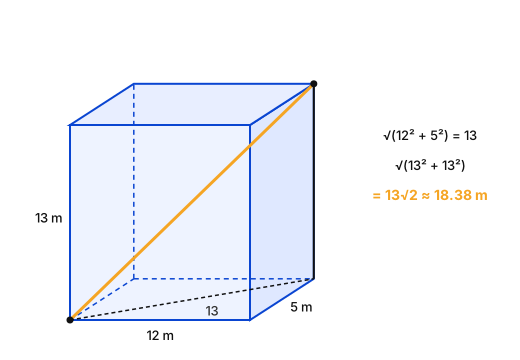
- .
- .
- = m.
Trick: 5-12-13 is a triple: , so diagonal = .
Answer: (A) 18.38 m
अवधारणा: घनाभ का विकर्ण = ।
- ।
- ।
- = m।
ट्रिक: 5-12-13 त्रिक: आधार विकर्ण 13, फिर ।
उत्तर: (A) 18.38 m
SSC CHSLQuantitative AptitudeCuboid – space diagonalSSC CHSL 2025 · 30 Nov Shift 3
Q5.Rational number × Irrational number = ?
परिमेय संख्या × अपरिमेय संख्या = ?
- AAlways rationalसदैव परिमेय
- BAlways irrationalसदैव अपरिमेय
- CEither rational or irrationalपरिमेय या अपरिमेय
- DInteger solutionपूर्णांक हल
Show answer
Concept: Non-zero rational × irrational is irrational, but 0 is also rational.
- Example: → irrational.
- Example: → rational.
- So the product can be either.
Trick: Whenever a question says 'rational' (not 'non-zero rational'), remember the 0 case.
Answer: (C) Either rational or irrational
अवधारणा: शून्येतर परिमेय × अपरिमेय = अपरिमेय, पर 0 भी परिमेय है।
- → अपरिमेय।
- → परिमेय।
- अतः गुणनफल दोनों में से कोई भी हो सकता है।
ट्रिक: 'परिमेय' में 0 भी शामिल है – यही इस प्रश्न की कुंजी है।
उत्तर: (C) परिमेय या अपरिमेय
SSC CHSLQuantitative AptitudeRational × irrationalSSC CHSL 2025 · 30 Nov Shift 3
Q6.A shopkeeper sold 40% of his goods at a profit of 25% and the remaining goods at a loss of . If his overall gain was ₹150, find the total cost price of the goods.
एक दुकानदार ने अपने माल का 40% भाग 25% लाभ पर तथा शेष माल की हानि पर बेचा। यदि उसका कुल लाभ ₹150 था, तो माल का कुल क्रय मूल्य ज्ञात कीजिए।
- A₹3740
- B₹3750
- C₹3800
- D₹3900
Show answer
Concept: Take total CP = 100 units and find net gain in units.
- 40 units at 25% gain → +10.
- 60 units at 10% loss → −6.
- Net = +4 units = ₹150 → 1 unit = ₹37.5.
- Total CP = ₹3,750.
Trick: Net gain % = 4% → CP = .
Answer: (B) ₹3750
अवधारणा: कुल CP = 100 इकाई मानें।
- 40 पर 25% लाभ → +10।
- 60 पर 10% हानि → −6।
- शुद्ध लाभ 4 इकाई = ₹150 → 1 इकाई = 37.5।
- कुल CP = ₹3,750।
ट्रिक: कुल लाभ 4% → CP = ।
उत्तर: (B) ₹3750
SSC CHSLQuantitative AptitudeProfit & loss – part salesSSC CHSL 2025 · 30 Nov Shift 3
Q7.In a triangular steel frame, points , and form a triangle. A vertical load acts at the centroid. What is the distance from vertex R to the centroid?
एक त्रिभुजाकार इस्पात फ्रेम में बिंदु , तथा एक त्रिभुज बनाते हैं। केंद्रक पर एक ऊर्ध्वाधर भार कार्य करता है। शीर्ष R से केंद्रक की दूरी कितनी है?
- A5 unit
- B3 unit
- C4 unit
- D6 unit
Show answer
Concept: Centroid .
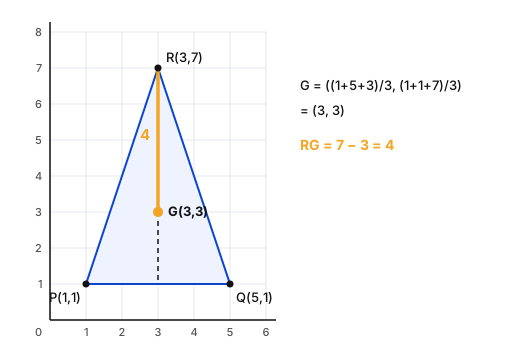
- .
- R(3, 7) and G(3, 3) lie on the line .
- units.
Trick: Same x-coordinate → distance is just the difference of y's.
Answer: (C) 4 unit
अवधारणा: केंद्रक ।
- ।
- R(3, 7) और G(3, 3) का x समान है।
- इकाई।
ट्रिक: x समान हो तो दूरी = y का अंतर।
उत्तर: (C) 4 unit
SSC CHSLQuantitative AptitudeCentroid – distance from vertexSSC CHSL 2025 · 30 Nov Shift 3
Q8.A group of 8 students appeared for a chemistry test. The average of the top 4 scores was 88.5 , and the average of the bottom 4 scores was 74. Later, it was found that a decimal error had occurred, and one of the scores from the bottom half was recorded as 71.2 instead of 91.2. What is the corrected overall average of the group?
8 विद्यार्थियों के एक समूह ने रसायन विज्ञान की एक परीक्षा दी। शीर्ष 4 अंकों का औसत 88.5 था तथा निचले 4 अंकों का औसत 74 था। बाद में पता चला कि दशमलव की एक त्रुटि हो गई थी और निचले आधे भाग के अंकों में से एक अंक 91.2 के स्थान पर 71.2 दर्ज कर लिया गया था। समूह का संशोधित कुल औसत क्या है?
- A83.75
- B79.95
- C82.00
- D80.87
Show answer
Concept: Correct total = old total + (true − wrong).
- Old total = .
- Correction = → 670.
- New average = .
Trick: Old average = ; extra → 83.75.
Answer: (A) 83.75
अवधारणा: सही योग = पुराना योग + (सही − गलत)।
- पुराना योग = ।
- सुधार = → 670।
- नया औसत = ।
ट्रिक: पुराना औसत 81.25 + () = 83.75।
उत्तर: (A) 83.75
SSC CHSLQuantitative AptitudeAverage – correcting an errorSSC CHSL 2025 · 30 Nov Shift 3
Q9.A carpenter makes a solid wooden beam in the shape of a right prism whose base is a right-angled triangle. The perpendicular sides of the triangular base measure 0.5 m and 1.2 m . The length of the beam is 3.6 m .If the density of the wood is , find the mass of the beam in kilograms.(Give your answer correct to two decimal places.)
एक बढ़ई एक ठोस लकड़ी का शहतीर बनाता है, जो एक लंब प्रिज़्म के आकार का है और जिसका आधार एक समकोण त्रिभुज है। त्रिभुजाकार आधार की लंब भुजाएँ 0.5 m तथा 1.2 m हैं। शहतीर की लंबाई 3.6 m है। यदि लकड़ी का घनत्व है, तो शहतीर का द्रव्यमान किलोग्राम में ज्ञात कीजिए। (अपना उत्तर दो दशमलव स्थानों तक सही दीजिए।)
- A864 kg
- B900 kg
- C768 kg
- D720 kg
Show answer
Concept: Mass = density × volume; volume = base area × length.
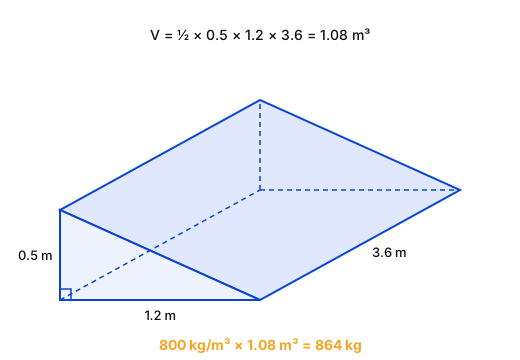
- Base area = m².
- Volume = m³.
- 0.80 g/cm³ = 800 kg/m³.
- Mass = kg.
Trick: Convert g/cm³ to kg/m³ by ×1000 – avoids big powers of 10.
Answer: (A) 864 kg
अवधारणा: द्रव्यमान = घनत्व × आयतन; आयतन = आधार क्षेत्रफल × लंबाई।
- आधार = m²।
- आयतन = m³।
- 0.80 g/cm³ = 800 kg/m³।
- द्रव्यमान = kg।
ट्रिक: g/cm³ को ×1000 करके kg/m³ बना लें।
उत्तर: (A) 864 kg
SSC CHSLQuantitative AptitudePrism – volume and massSSC CHSL 2025 · 30 Nov Shift 3
Q10.A winch pulls a load along a slope where . Find the value of .
एक विंच किसी भार को एक ढलान पर खींचती है, जहाँ है। का मान ज्ञात कीजिए।
- A
- B
- C
- D
Show answer
Concept: ; .
- Base = 7, perpendicular = 24.
- Hypotenuse = .
- .
Trick: Or use → .
Answer: (B)
अवधारणा: ; ।
- आधार 7, लंब 24।
- कर्ण = ।
- ।
ट्रिक: → ।
उत्तर: (B)
SSC CHSLQuantitative AptitudeTrigonometric ratios – cot to cosecSSC CHSL 2025 · 30 Nov Shift 3
Q11.If and A is acute, then find the value of .
यदि है तथा A न्यूनकोण है, तो का मान ज्ञात कीजिए।
- A
- B
- C
- D
Show answer
Concept: , .
- Expression = .
- → → .
- .
Trick: Triple 5-12-13: gives instantly.
Answer: (C)
अवधारणा: , ।
- व्यंजक = ।
- → , ।
- ।
ट्रिक: 5-12-13 त्रिक से तुरंत ।
उत्तर: (C)
SSC CHSLQuantitative AptitudeTrig identities – tan²ASSC CHSL 2025 · 30 Nov Shift 3
Q12.If , then which of the following must be equal?
यदि है, तो निम्नलिखित में से कौन-सा बराबर होना चाहिए?
- AMedian of Median of माध्यिका माध्यिका
- BPerimeter of Perimeter of परिमाप परिमाप
- CCircumradius of Circumradius of परित्रिज्या परित्रिज्या
- DAll of theseउपरोक्त सभी
Show answer
Concept: Congruent triangles have exactly the same shape and size.
- All corresponding sides and angles are equal → perimeters equal.
- Corresponding medians are equal.
- Circumradius depends only on sides → also equal.
Trick: Congruent = carbon copy: every length-based measure (median, altitude, inradius, circumradius, area) matches.
Answer: (D) All of these
अवधारणा: सर्वांगसम त्रिभुज आकार और माप दोनों में समान होते हैं।
- सभी संगत भुजाएँ व कोण बराबर → परिमाप बराबर।
- संगत माध्यिकाएँ बराबर।
- परिवृत्त त्रिज्या भी बराबर।
ट्रिक: सर्वांगसम = हूबहू प्रति – हर लंबाई/क्षेत्रफल बराबर।
उत्तर: (D) उपरोक्त सभी
SSC CHSLQuantitative AptitudeCongruent trianglesSSC CHSL 2025 · 30 Nov Shift 3
Q13.A chord is 5 cm and the radius is also 5 cm of the circle. Find the angle subtended at the center.
किसी वृत्त की एक जीवा 5 cm की है तथा उसकी त्रिज्या भी 5 cm है। केंद्र पर अंतरित कोण ज्ञात कीजिए।
- A90°
- B60°
- C45'
- D120*
Show answer
Concept: If chord = radius, the triangle with the centre is equilateral.
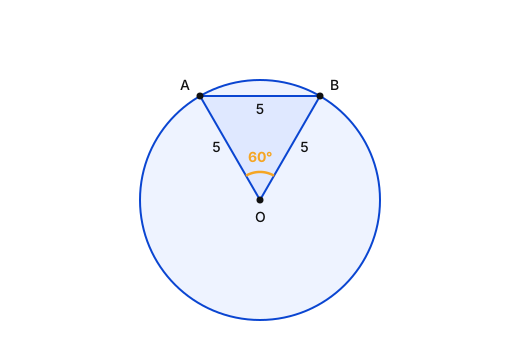
- (radii), (chord).
- △OAB is equilateral.
- Central angle .
Trick: Chord ; chord ; chord .
Answer: (B) 60°
अवधारणा: जीवा = त्रिज्या हो तो केंद्र के साथ समबाहु त्रिभुज बनता है।
- ।
- △OAB समबाहु।
- केंद्र पर कोण ।
ट्रिक: जीवा , , ।
उत्तर: (B) 60°
SSC CHSLQuantitative AptitudeCircle – chord equal to radiusSSC CHSL 2025 · 30 Nov Shift 3
Q14.A train travels 240 km in 6 hours. The speed of a car is 20% more than the speed of the train, and the speed of a bike is 50% less than the speed of the car. Find the difference (in minutes) between the time taken by the car and the bike to cover 288 km.
एक रेलगाड़ी 240 km की दूरी 6 घंटे में तय करती है। एक कार की चाल रेलगाड़ी की चाल से 20% अधिक है तथा एक बाइक की चाल कार की चाल से 50% कम है। 288 km की दूरी तय करने में कार तथा बाइक द्वारा लिए गए समय का अंतर (मिनटों में) ज्ञात कीजिए।
- A390 minutes390 मिनट
- B310 minutes310 मिनट
- C380 minutes380 मिनट
- D360 minutes360 मिनट
Show answer
Concept: .
- Train km/h.
- Car km/h; Bike km/h.
- Times for 288 km: 6 h and 12 h.
- Difference = 6 h = 360 min.
Trick: Bike speed is half the car's → bike takes double time; difference = car's time = h.
Answer: (D) 360 minutes
अवधारणा: ।
- ट्रेन = 40 km/h।
- कार = 48 km/h; बाइक = 24 km/h।
- 288 km में समय: 6 घंटे और 12 घंटे।
- अंतर = 6 घंटे = 360 मिनट।
ट्रिक: बाइक की चाल आधी → समय दोगुना; अंतर = कार का समय = 6 घंटे।
उत्तर: (D) 360 मिनट
SSC CHSLQuantitative AptitudeSpeed – percentage changeSSC CHSL 2025 · 30 Nov Shift 3
Q15.AB is a chord in the minor segment of a circle with centre is a point on the minor arc (between A and B). The tangents to the circle at A and B meet at a point . If , then is equal to:
AB एक वृत्त के लघु खंड में स्थित जीवा है, जिसका केंद्र लघु चाप (A और B के बीच) पर स्थित एक बिंदु है। A तथा B पर वृत्त की स्पर्श रेखाएँ एक बिंदु पर मिलती हैं। यदि है, तो बराबर है:
- A36°
- B24°
- C27°
- D18°
Show answer
Concept: (tangents meet radii at 90°).
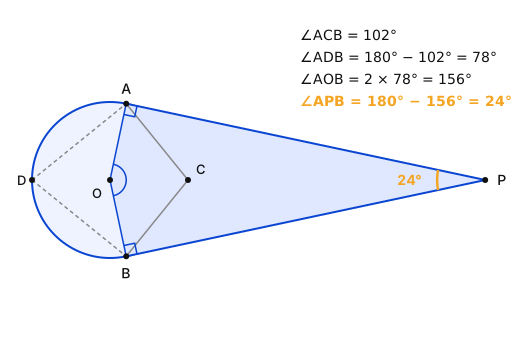
- Angle in major segment (cyclic quadrilateral).
- .
- .
Trick: Direct formula: (C on minor arc).
Answer: (B) 24°
अवधारणा: (स्पर्श रेखा त्रिज्या पर लंब)।
- दीर्घ खंड का कोण ।
- ।
- ।
ट्रिक: सीधा सूत्र: ।
उत्तर: (B) 24°
SSC CHSLQuantitative AptitudeTangents – angle between tangentsSSC CHSL 2025 · 30 Nov Shift 3
Q16.Two identical solid hemispheres, each of radius r, are placed flat side to flat side, forming a sphere. Find the percentage of the total surface area of the resulting sphere that comes from the curved surfaces of the hemispheres before joining.
त्रिज्या r वाले दो एकसमान ठोस गोलार्धों को उनके सपाट फलकों को आपस में जोड़कर रखा जाता है, जिससे एक गोला बनता है। ज्ञात कीजिए कि इस प्रकार बने गोले के कुल पृष्ठीय क्षेत्रफल का कितना प्रतिशत भाग जोड़ने से पहले के गोलार्धों के वक्र पृष्ठों से आता है।
- A60%
- B100%
- C90%
- D80%
Show answer
Concept: Curved surface of a hemisphere .
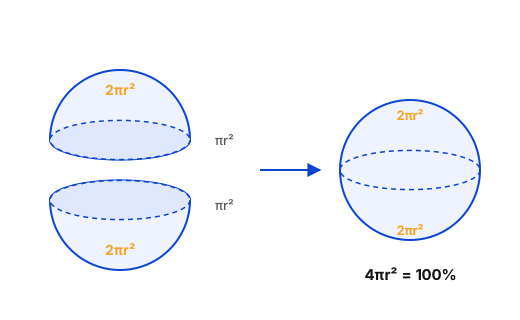
- Two curved surfaces .
- Flat faces are hidden inside the joint.
- Sphere's surface .
Trick: The whole outer skin of the sphere is made of the two curved faces only.
Answer: (B) 100%
अवधारणा: गोलार्ध का वक्र पृष्ठ ।
- दोनों वक्र पृष्ठ ।
- सपाट फलक जोड़ के अंदर छिप जाते हैं।
- गोले का पृष्ठ ।
ट्रिक: गोले की पूरी बाहरी सतह दोनों वक्र पृष्ठों से ही बनती है।
उत्तर: (B) 100%
SSC CHSLQuantitative AptitudeHemispheres forming a sphereSSC CHSL 2025 · 30 Nov Shift 3
Q17.A regular right square pyramid has a base side of 16 cm . An ant walks from one corner of the base to the midpoint of the slant edge opposite that corner by the shortest surface path.If the perpendicular height of the pyramid is 12 cm , find the lateral surface area.
एक सम लंब वर्गाकार पिरामिड के आधार की भुजा 16 cm है। एक चींटी आधार के एक कोने से चलकर उसके सामने वाले तिर्यक किनारे के मध्यबिंदु तक पृष्ठ पर न्यूनतम मार्ग से जाती है। यदि पिरामिड की लंब ऊँचाई 12 cm है, तो पार्श्व पृष्ठीय क्षेत्रफल ज्ञात कीजिए।
- A
- B
- C
- D
Show answer
Concept: .
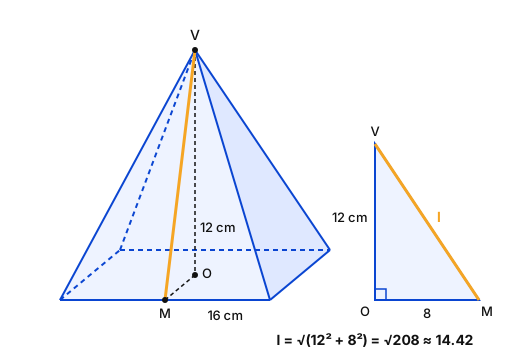
- Slant height cm (8 = half of 16).
- Perimeter cm.
- .
Trick: The ant's path is extra data – ignore it; only height and base side are needed.
Answer: (B)
अवधारणा: ।
- cm।
- परिमाप = 64 cm।
- ।
ट्रिक: चींटी वाली जानकारी अनावश्यक है – उसे छोड़ दें।
उत्तर: (B)
SSC CHSLQuantitative AptitudeSquare pyramid – lateral surface areaSSC CHSL 2025 · 30 Nov Shift 3
Q18.Which of the following is correct ? Statement I: The product of a proper fraction and a whole number can be a whole number.
Statement II: The product of two proper fractions is always a proper fraction.
निम्नलिखित में से कौन-सा सही है ? कथन I: एक उचित भिन्न तथा एक पूर्ण संख्या का गुणनफल एक पूर्ण संख्या हो सकता है।
कथन II: दो उचित भिन्नों का गुणनफल सदैव एक उचित भिन्न होता है।
- AStatement I is true, Statement II is falseकथन I सत्य है, कथन II असत्य है
- BStatement I is true, Statement II is trueकथन I सत्य है, कथन II सत्य है
- CStatement I is false, Statement II is Trueकथन I असत्य है, कथन II सत्य है
- DBoth statements are falseदोनों कथन असत्य हैं
Show answer
Concept: A proper fraction lies between 0 and 1.
- I: (whole number) → can happen: true.
- II: (less than 1) × (less than 1) stays between 0 and 1, e.g. → true.
Trick: Test each statement with one quick example before thinking about theory.
Answer: (B) Statement I is true, Statement II is true
अवधारणा: उचित भिन्न 0 और 1 के बीच होती है।
- I: (पूर्ण संख्या) → सत्य।
- II: 1 से छोटी × 1 से छोटी = 1 से छोटी, जैसे → सत्य।
ट्रिक: हर कथन को एक छोटे उदाहरण से जाँचें।
उत्तर: (B) कथन I सत्य है, कथन II सत्य है
SSC CHSLQuantitative AptitudeProper fractions – propertiesSSC CHSL 2025 · 30 Nov Shift 3
Q19.If , what is the value of ?
यदि है, तो का मान क्या है?
- A15°
- B25°
- C30°
- D20°
Show answer
Concept: If sin P = cos Q (acute), then P + Q = 90°.
- (x + 10°) + (3x − 20°) = 90°.
- 4x − 10° = 90° → x = 25°.
- Check: sin 35° = cos 55° ✓
Trick: Plug options: x = 25 gives 35° and 55° – they add to 90°.
Answer: (B) 25°
अवधारणा: sin P = cos Q हो तो P + Q = 90°।
- (x + 10°) + (3x − 20°) = 90°।
- 4x = 100° → x = 25°।
ट्रिक: विकल्प रखें: x = 25 → 35° + 55° = 90° ✓।
उत्तर: (B) 25°
SSC CHSLQuantitative AptitudeComplementary angles – sin = cosSSC CHSL 2025 · 30 Nov Shift 3
Q20.The population of insects increases by 20% every hour for 3 hours, then decreases by 10% in the 4th hour, and finally increases by 25% in the 5th hour. If the initial count was 10,000 , what will be the approximate population after 5 hours?
कीटों की जनसंख्या 3 घंटे तक प्रत्येक घंटे 20% बढ़ती है, फिर चौथे घंटे में 10% घट जाती है और अंत में पाँचवें घंटे में 25% बढ़ जाती है। यदि आरंभिक संख्या 10,000 थी, तो 5 घंटे बाद जनसंख्या लगभग कितनी होगी?
- A18,900
- B19,830
- C19,440
- D19,720
Show answer
Concept: Multiply by each change factor in turn.
- Three hours of +20%: .
- 4th hour −10%: .
- 5th hour +25%: .
Trick: Factors: .
Answer: (C) 19,440
अवधारणा: हर परिवर्तन का गुणक क्रम से लगाएँ।
- 3 घंटे +20%: ।
- −10%: ।
- +25%: ।
ट्रिक: कुल गुणक ।
उत्तर: (C) 19,440
SSC CHSLQuantitative AptitudeSuccessive percentage changeSSC CHSL 2025 · 30 Nov Shift 3

