Q181.Select the option that expresses the given sentence in passive voice. Who grew these poinsettias?
- ABy whom were these poinsettias grown?
- BThese poinsettias are grown by who?
- CWho was grown by these poinsettias?
- DWere these poinsettias grown by whom?
Show answer
Concept: An active question with 'Who' as subject becomes a passive question beginning with 'By whom'.
- 'Who' → 'By whom'.
- Simple past 'grew' → 'were ... grown' (plural object 'these poinsettias').
- Passive: 'By whom were these poinsettias grown?'
- 'by who' is wrong; C reverses the meaning; D puts 'by whom' at the end incorrectly.
Trick: Who + V2 ...? → By whom + was/were + object + V3?
Answer: (A) By whom were these poinsettias grown?
अवधारणा: Active प्रश्न जिसमें 'Who' कर्ता है, passive में 'By whom' से शुरू होता है।
- 'Who' → 'By whom'।
- Simple past 'grew' → 'were ... grown' (बहुवचन object)।
- Passive: 'By whom were these poinsettias grown?'
- 'by who' गलत; C अर्थ उलट देता है; D की संरचना गलत है।
ट्रिक: Who + V2 ...? → By whom + was/were + object + V3?
उत्तर: (A) By whom were these poinsettias grown?
SSC CPO Paper IIEnglish Language and ComprehensionActive and Passive VoiceSSC CPO Paper II 2025 · 30 Apr Shift 3
Q182.Select the most appropriate option to complete the given idiom. Pull someone’s ________.
- Aleg
- Bears
- Chand
- Dnose
Show answer
Concept: The idiom is 'pull someone's leg'.
- It means to tease or joke with someone by making them believe something untrue.
- Ears, hand and nose do not form this idiom.
- Example: Don't worry, I was only pulling your leg.
Yaad rakhein: Pull someone's leg = playfully fool someone.
Answer: (A) leg
अवधारणा: सही मुहावरा 'pull someone’s leg' है।
- अर्थ: किसी से मज़ाक करना / झूठी बात पर विश्वास दिलाकर छेड़ना।
- ears, hand, nose से यह मुहावरा नहीं बनता।
- उदाहरण: Don’t worry, I was only pulling your leg.
याद रखें: Pull someone’s leg = किसी की टांग खींचना (मज़ाक करना)।
उत्तर: (A) leg
SSC CPO Paper IIEnglish Language and ComprehensionIdioms and PhrasesSSC CPO Paper II 2025 · 30 Apr Shift 3
Q183.Select the option that expresses the given sentence in passive voice. The company launched a new product in the market yesterday.
- AA new product has launched in the market by the company yesterday.
- BA new product was launching in the market by the company yesterday.
- CA new company was launched in the market by the product yesterday.
- DA new product was launched in the market by the company yesterday.
Show answer
Concept: Simple past active (V2) → passive 'was/were + V3', object becomes subject, doer goes after 'by'.
- Object 'a new product' → subject.
- 'launched' → 'was launched'.
- 'by the company' + 'in the market yesterday' → 'A new product was launched in the market by the company yesterday.'
- A ('has launched') and B ('was launching') are wrong forms; C swaps company and product.
Trick: V2 → was/were + V3.
Answer: (D) A new product was launched in the market by the company yesterday.
अवधारणा: Simple past active (V2) → passive 'was/were + V3'; object कर्ता बनता है, कर्ता 'by' के बाद।
- Object 'a new product' → subject।
- 'launched' → 'was launched'।
- 'A new product was launched in the market by the company yesterday.'
- A ('has launched') और B ('was launching') गलत रूप; C में company और product उलट गए।
ट्रिक: V2 → was/were + V3।
उत्तर: (D) A new product was launched in the market by the company yesterday.
SSC CPO Paper IIEnglish Language and ComprehensionActive and Passive VoiceSSC CPO Paper II 2025 · 30 Apr Shift 3
Q184.Select the option that expresses the given sentence in reported speech. Mary said to Sunanda, “Please send the report by the end of the day. I need to forward it to the client.”
- AMary requested Sunanda to send the report by the end of the day as she needed to forward that to the client.
- BMary ordered Sunanda to send the report by the end of the day as she needs to forward it to the client.
- CMary told Sunanda that send the report by the end of the day. I need to forward it to the client.
- DMary told Sunanda to send the report by the end of the day as she was going to forward that to the client.
Show answer
Concept: An imperative with 'please' takes the reporting verb 'requested + object + to + V1'; a following statement joined by 'as' shifts present → past.
- 'said to ... “Please send”' → 'requested Sunanda to send'.
- 'I need to forward it' → 'as she needed to forward that/it' (need → needed; I → she).
- B uses 'ordered' (not polite) and keeps 'needs'; C keeps direct-speech structure; D uses 'told' and changes the meaning to 'was going to'.
Trick: Please → requested; order → ordered; advice → advised.
Answer: (A) Mary requested Sunanda to send the report by the end of the day as she needed to forward that to the client.
अवधारणा: 'Please' वाले आदेशात्मक वाक्य में reporting verb 'requested + object + to + V1' होता है; 'as' से जुड़े कथन में present → past।
- 'said to ... “Please send”' → 'requested Sunanda to send'।
- 'I need to forward it' → 'as she needed to forward that/it' (need → needed; I → she)।
- B में 'ordered' और 'needs'; C में direct की संरचना; D में 'told' और 'was going to' से अर्थ बदलता है।
ट्रिक: Please → requested; आदेश → ordered; सलाह → advised।
उत्तर: (A) Mary requested Sunanda to send the report by the end of the day as she needed to forward that to the client.
SSC CPO Paper IIEnglish Language and ComprehensionDirect and Indirect SpeechSSC CPO Paper II 2025 · 30 Apr Shift 3
Q185.Select the option that will improve the underlined part of the given sentence. In case no improvement is needed, select ‘No improvement required’. The car turned upside down no sooner as it hit the light pole.
- Ano sooner than it had hit
- Bno soon as it hit
- Cas soon as it hit
- DNo improvement required
Show answer
Concept: Correct pairs are 'no sooner ... than' (with inversion: 'No sooner had ... than') and 'as soon as'. 'No sooner as' is never correct.
- Here the clause comes after the main clause, so 'as soon as' fits naturally: 'The car turned upside down as soon as it hit the light pole.'
- 'no sooner than it had hit' is wrong in position and tense; 'no soon as' is ungrammatical.
Trick: no sooner → than; as soon as → no 'than'.
Answer: (C) as soon as it hit
अवधारणा: सही जोड़े हैं 'no sooner ... than' (inversion के साथ: 'No sooner had ... than') और 'as soon as'। 'No sooner as' कभी सही नहीं।
- यहाँ clause मुख्य clause के बाद है, इसलिए 'as soon as' उचित: 'The car turned upside down as soon as it hit the light pole.'
- 'no sooner than it had hit' स्थान और tense दोनों में गलत; 'no soon as' व्याकरणिक रूप से गलत।
ट्रिक: no sooner → than; as soon as → बिना 'than'।
उत्तर: (C) as soon as it hit
SSC CPO Paper IIEnglish Language and ComprehensionNo sooner … than / as soon asSSC CPO Paper II 2025 · 30 Apr Shift 3
Q186.The following sentence has been divided into parts. One of them may contain an error. Select the part that contains the error from the given options. If you don’t find any error, mark ‘No error’ as your answer.
The carpenter work / on that table / from morning to evening.
- ANo error
- Bon that table
- CThe carpenter work
- Dfrom morning to evening
Show answer
Concept: A singular third-person subject in the simple present takes the verb with -s/-es.
- Subject 'The carpenter' is singular.
- So 'work' must be 'works': 'The carpenter works on that table from morning to evening.'
- The other segments are correct.
Trick: He/She/It/singular noun + V1 + s (simple present).
Answer: (C) The carpenter work
अवधारणा: Simple present में एकवचन third-person subject के साथ verb में -s/-es लगता है।
- Subject 'The carpenter' एकवचन है।
- अतः 'work' → 'works': 'The carpenter works on that table from morning to evening.'
- अन्य भाग सही हैं।
ट्रिक: He/She/It/एकवचन noun + V1 + s।
उत्तर: (C) The carpenter work
SSC CPO Paper IIEnglish Language and ComprehensionSpotting Errors – Subject-Verb AgreementSSC CPO Paper II 2025 · 30 Apr Shift 3
Q187.Parts of the following sentence have been given as options. Select the option that contains an error.
Whether you are seeking solitude or adventure, India’s lesser-known coastal destinations are offering something for everyone.
- Asolitude or adventure,
- BIndia’s lesser-known coastal destinations
- Care offering something for everyone
- DWhether you are seeking
Show answer
Concept: General truths and permanent facts are expressed in the simple present, not the present continuous.
- The sentence states a general fact about destinations.
- So 'are offering' should be 'offer': '... destinations offer something for everyone.'
- The other parts are correct.
Trick: Universal/general statement → simple present.
Answer: (C) are offering something for everyone
अवधारणा: सामान्य सत्य/स्थायी तथ्य simple present में व्यक्त होते हैं, present continuous में नहीं।
- वाक्य स्थलों के बारे में सामान्य तथ्य बताता है।
- अतः 'are offering' → 'offer': '... destinations offer something for everyone.'
- अन्य भाग सही हैं।
ट्रिक: सामान्य कथन → simple present।
उत्तर: (C) are offering something for everyone
SSC CPO Paper IIEnglish Language and ComprehensionSpotting Errors – TenseSSC CPO Paper II 2025 · 30 Apr Shift 3
Q188.Select the option that can be used as a one-word substitute for the given group of words.
A person who pretends to have virtues or qualities that he or she does not have
- ASycophant
- BParasite
- CHypocrite
- DPhilanthropist
Show answer
Concept: 'Hypocrite' means a person who pretends to have virtues or qualities that he or she does not have.
- The given phrase exactly describes 'Hypocrite'.
- Sycophant = a flatterer who praises powerful people for gain.
- Parasite = one who lives off others.
- Philanthropist = one who donates to help others.
Yaad rakhein: Hypocrite → hypocrisy = pretence of virtue.
Answer: (C) Hypocrite
अवधारणा: 'Hypocrite' का अर्थ है जो ऐसे गुणों का दिखावा करे जो उसमें नहीं हैं (पाखंडी)।
- दिया गया वाक्यांश ठीक 'Hypocrite' का ही वर्णन करता है।
- Sycophant = चाटुकार।
- Parasite = दूसरों पर पलने वाला।
- Philanthropist = परोपकारी/दानी।
याद रखें: Hypocrite = पाखंडी; hypocrisy = पाखंड।
उत्तर: (C) Hypocrite
SSC CPO Paper IIEnglish Language and ComprehensionOne Word SubstitutionSSC CPO Paper II 2025 · 30 Apr Shift 3
Q189.Sentences of a paragraph are given below in jumbled order. Arrange the sentences in the correct order to form a meaningful and coherent paragraph. A. Mother came in with a tumbler of water in one hand and a plate of betel leaves and nuts in the other.
B. She gave him the areca-nut and half a dozen neatly rolled betel leaves. C. He put them all into his mouth, chewing them with great contentment. D. Father drank the water and held out his hand.
- AACBD
- BADBC
- CDBAC
- DCBAD
Show answer
Concept: Follow the natural sequence of actions and link pronouns ('She', 'He', 'them') to the right nouns.
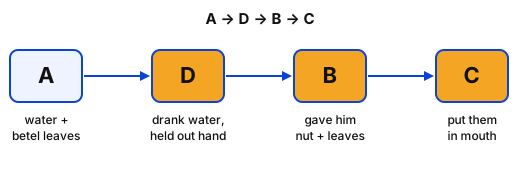
- A introduces Mother bringing water and betel leaves — the opening.
- D: Father drinks the water and holds out his hand (for the betel) → A–D.
- B: 'She gave him the areca-nut and ... betel leaves' answers the held-out hand → D–B.
- C: 'He put them all into his mouth' — 'them' = the leaves and nut → B–C. Order: ADBC.
Trick: Bring → drink → give → chew: ADBC.
Answer: (B) ADBC
अवधारणा: क्रियाओं के स्वाभाविक क्रम का पालन करें और 'She', 'He', 'them' को सही संज्ञा से जोड़ें।
- A में Mother पानी और पान लाती हैं — शुरुआत।
- D: Father पानी पीते हैं और हाथ बढ़ाते हैं → A–D।
- B: 'She gave him the areca-nut and betel leaves' → D–B।
- C: 'He put them all into his mouth' — 'them' = पान और सुपारी → B–C। क्रम: ADBC।
ट्रिक: लाना → पीना → देना → चबाना: ADBC।
उत्तर: (B) ADBC
SSC CPO Paper IIEnglish Language and ComprehensionPara JumblesSSC CPO Paper II 2025 · 30 Apr Shift 3
Q190.Select the option that expresses the given sentence in reported speech. Amanda said to the artist, “This face does not look like my sister’s.”
- AAmanda told the artist that this face does not look like my sister’s.
- BAmanda told the artist that that face had not looked like her sister’s.
- CAmanda told the artist that that face was not looking like her sister’s.
- DAmanda told the artist that that face did not look like her sister’s.
Show answer
Concept: In reported speech with a past reporting verb: simple present → simple past, 'this' → 'that', first-person pronoun → third person.
- 'said to the artist' → 'told the artist that'.
- 'This face does not look' → 'that face did not look' (does not → did not).
- 'my sister's' → 'her sister's'.
- B (past perfect) and C (past continuous) shift the tense wrongly; A keeps the direct-speech forms.
Trick: does not + V1 → did not + V1; this → that; my → her.
Answer: (D) Amanda told the artist that that face did not look like her sister’s.
अवधारणा: Past reporting verb के साथ indirect में: simple present → simple past, 'this' → 'that', first person → third person।
- 'said to the artist' → 'told the artist that'।
- 'This face does not look' → 'that face did not look'।
- 'my sister’s' → 'her sister’s'।
- B (past perfect) और C (past continuous) गलत tense; A में direct के रूप बचे हैं।
ट्रिक: does not → did not; this → that; my → her।
उत्तर: (D) Amanda told the artist that that face did not look like her sister’s.
SSC CPO Paper IIEnglish Language and ComprehensionDirect and Indirect SpeechSSC CPO Paper II 2025 · 30 Apr Shift 3
Q191.Parts of the following sentence have been given as options. Select the option that contains an error.
Apart with eco-tourism activities and jungle safaris, the Pench Tiger Reserve is gearing up to introduce stargazing experiences for tourists.
- Ato introduce
- BApart with eco-tourism activities and jungle safaris
- Cthe Pench Tiger Reserve is gearing up
- Dstargazing experiences for tourists
Show answer
Concept: The fixed phrase is 'apart from' (meaning 'besides / in addition to'), never 'apart with'.
- 'Apart with eco-tourism activities' → 'Apart from eco-tourism activities and jungle safaris, ...'.
- The other parts ('is gearing up', 'to introduce', 'stargazing experiences for tourists') are correct.
Trick: apart from = besides; different from; free from.
Answer: (B) Apart with eco-tourism activities and jungle safaris
अवधारणा: सही निश्चित वाक्यांश 'apart from' (के अलावा) है, 'apart with' नहीं।
- 'Apart with eco-tourism activities' → 'Apart from eco-tourism activities and jungle safaris, ...'।
- अन्य भाग सही हैं।
ट्रिक: apart from = के अलावा।
उत्तर: (B) Apart with eco-tourism activities and jungle safaris
SSC CPO Paper IIEnglish Language and ComprehensionSpotting Errors – PrepositionsSSC CPO Paper II 2025 · 30 Apr Shift 3
Q192.Select the option that expresses the given sentence in indirect speech. “We can’t believe we won the competition!” they said with joy.
- AThey exclaimed with joy that they can't believe they won the competition.
- BThey exclaimed with joy that we couldn't believe we had won the competition.
- CThey exclaimed with joy that they couldn't believe they had won the competition.
- DThey exclaimed with joy that they couldn't believe they won the competition.
Show answer
Concept: Exclamatory sentences take 'exclaimed with joy that'; with a past reporting verb, 'can' → 'could', simple past → past perfect, and 'we' → 'they'.
- 'can't believe' → 'couldn't believe'.
- 'we won' → 'they had won' (simple past → past perfect).
- 'we' → 'they' in both places.
- A keeps 'can't' and 'won'; B keeps 'we'; D keeps 'won'.
Trick: Two-step backshift: can → could, V2 → had + V3.
Answer: (C) They exclaimed with joy that they couldn't believe they had won the competition.
अवधारणा: विस्मयादिबोधक वाक्य में 'exclaimed with joy that'; past reporting verb के साथ 'can' → 'could', simple past → past perfect, 'we' → 'they'।
- 'can’t believe' → 'couldn’t believe'।
- 'we won' → 'they had won'।
- दोनों जगह 'we' → 'they'।
- A में 'can’t' और 'won'; B में 'we'; D में 'won' बचा है।
ट्रिक: can → could, V2 → had + V3।
उत्तर: (C) They exclaimed with joy that they couldn't believe they had won the competition.
SSC CPO Paper IIEnglish Language and ComprehensionDirect and Indirect SpeechSSC CPO Paper II 2025 · 30 Apr Shift 3
Q193.Select the option that will improve the underlined part of the given sentence. In case no improvement is needed, select ‘No improvement required’. He speaks English good enough to communicate with foreign clients.
- AHe speaks English better enough
- BNo improvement required
- CHe speaks English well enough
- DHe is speaking English good enough
Show answer
Concept: A verb is modified by an adverb. 'Good' is an adjective; its adverb form is 'well'.
- 'speaks' is a verb → 'speaks English well'.
- 'enough' follows the adverb: 'well enough to communicate'.
- 'better enough' is wrong; 'is speaking' wrongly uses the continuous for a habit and keeps 'good'.
Trick: Verb + well; noun + good.
Answer: (C) He speaks English well enough
अवधारणा: Verb को adverb विशेषित करता है। 'Good' adjective है; उसका adverb 'well' है।
- 'speaks' verb है → 'speaks English well'।
- 'enough' adverb के बाद: 'well enough to communicate'।
- 'better enough' गलत; 'is speaking' आदत के लिए गलत और 'good' भी बचा है।
ट्रिक: Verb + well; noun + good।
उत्तर: (C) He speaks English well enough
SSC CPO Paper IIEnglish Language and ComprehensionAdjective vs adverbSSC CPO Paper II 2025 · 30 Apr Shift 3
Q194.The following sentence has been split into four segments. Identify the segment that contains a grammatical error.
The 2023 report reveals that / children in India continue / to struggle on basic reading and arithmetic skills / well into their teenage years.
- Achildren in India continue
- BThe 2023 report reveals that
- Cto struggle on basic reading and arithmetic skills
- Dwell into their teenage years
Show answer
Concept: The verb 'struggle' takes the preposition 'with' when it means having difficulty with something.
- 'to struggle on basic reading and arithmetic skills' is wrong.
- Correct: 'to struggle with basic reading and arithmetic skills'.
- The other segments are correct.
Yaad rakhein: struggle with (a difficulty), struggle for (a goal), struggle against (an opponent).
Answer: (C) to struggle on basic reading and arithmetic skills
अवधारणा: किसी कठिनाई से जूझने के अर्थ में 'struggle' के साथ preposition 'with' आता है।
- 'to struggle on basic reading and arithmetic skills' गलत है।
- सही: 'to struggle with basic reading and arithmetic skills'।
- अन्य भाग सही हैं।
याद रखें: struggle with (कठिनाई), struggle for (लक्ष्य), struggle against (विरोधी)।
उत्तर: (C) to struggle on basic reading and arithmetic skills
SSC CPO Paper IIEnglish Language and ComprehensionSpotting Errors – PrepositionsSSC CPO Paper II 2025 · 30 Apr Shift 3
Q195.Select the option that expresses the given sentence in passive voice. The spectators gave hardly any money to the performer.
- AThe spectators were given hardly any money by the performer.
- BThe performer is given hardly any money by the spectators.
- CThe performer was given hardly any money by the spectators.
- DThe performer has been given hardly any money by the spectators.
Show answer
Concept: With two objects, the personal (indirect) object usually becomes the subject in passive; simple past → 'was/were + V3'.
- Indirect object 'the performer' → subject.
- 'gave' → 'was given'.
- 'hardly any money' stays; doer 'by the spectators' at the end.
- 'The performer was given hardly any money by the spectators.' A reverses the roles; B and D change the tense.
Trick: gave → was given (person as subject).
Answer: (C) The performer was given hardly any money by the spectators.
अवधारणा: दो objects होने पर व्यक्ति वाला (indirect) object प्रायः passive में subject बनता है; simple past → 'was/were + V3'।
- Indirect object 'the performer' → subject।
- 'gave' → 'was given'।
- 'hardly any money' वैसा ही; कर्ता 'by the spectators' अंत में।
- A में भूमिकाएँ उलटी; B और D में tense बदला।
ट्रिक: gave → was given (व्यक्ति subject)।
उत्तर: (C) The performer was given hardly any money by the spectators.
SSC CPO Paper IIEnglish Language and ComprehensionActive and Passive VoiceSSC CPO Paper II 2025 · 30 Apr Shift 3
Q196.The following sentence has been split into four segments. Identify the segment that contains a grammatical error.
This incredible discovery / unfolding the history / of a time that existed / long before human existence.
- Aunfolding the history
- Blong before human existence
- CThis incredible discovery
- Dof a time that existed
Show answer
Concept: Every sentence needs a finite (main) verb; a participle like 'unfolding' cannot act as the main verb alone.
- Subject: 'This incredible discovery'. 'unfolding' is a participle, so the sentence has no main verb.
- Correct: 'This incredible discovery unfolds the history of a time ...'.
- The other segments are fine.
Trick: Subject + V-ing alone (without is/are) = no main verb → error.
Answer: (A) unfolding the history
अवधारणा: हर वाक्य में एक finite (मुख्य) क्रिया चाहिए; 'unfolding' जैसा participle अकेले मुख्य क्रिया नहीं हो सकता।
- Subject 'This incredible discovery'; 'unfolding' participle है, मुख्य क्रिया नहीं।
- सही: 'This incredible discovery unfolds the history of a time ...'।
- अन्य भाग सही हैं।
ट्रिक: Subject + केवल V-ing (बिना is/are) = मुख्य क्रिया नहीं → त्रुटि।
उत्तर: (A) unfolding the history
SSC CPO Paper IIEnglish Language and ComprehensionSpotting Errors – Finite VerbSSC CPO Paper II 2025 · 30 Apr Shift 3
Q197.Select the option that expresses the given sentence in indirect speech. The coach said, “You should practice every day.”
- AThe coach said that I would practice every day.
- BThe coach said that I should practice every day.
- CThe coach said that I will practice every day.
- DThe coach said that I should have practiced every day.
Show answer
Concept: 'Should' (advice) does not change in indirect speech; 'you' changes according to the listener (here, the person reporting → 'I').
- 'said, “You should practice”' → 'said that I should practice'.
- 'should' remains 'should'.
- 'would', 'will' and 'should have practiced' change the meaning.
Trick: should, ought to, must (moral duty) remain unchanged.
Answer: (B) The coach said that I should practice every day.
अवधारणा: Indirect speech में 'should' (सलाह) नहीं बदलता; 'you' श्रोता के अनुसार बदलता है (यहाँ रिपोर्ट करने वाला → 'I')।
- 'said, “You should practice”' → 'said that I should practice'।
- 'should' वैसा ही रहता है।
- 'would', 'will', 'should have practiced' अर्थ बदल देते हैं।
ट्रिक: should, ought to, must (नैतिक कर्तव्य) नहीं बदलते।
उत्तर: (B) The coach said that I should practice every day.
SSC CPO Paper IIEnglish Language and ComprehensionDirect and Indirect SpeechSSC CPO Paper II 2025 · 30 Apr Shift 3
Q198.Select the most appropriate meaning of the given idiom. Bring to book
- ATeach someone
- BPunish someone
- CSupport someone
- DCalm someone
Show answer
Concept: 'Bring to book' means to punish someone or make them answer officially for their wrongdoing.
- It is used for criminals or offenders being held accountable.
- Example: The police vowed to bring the culprits to book.
- It does not mean teaching, supporting or calming someone.
Yaad rakhein: Book here = the record of law/justice.
Answer: (B) Punish someone
अवधारणा: 'Bring to book' का अर्थ है किसी को उसके गलत काम के लिए सज़ा देना / जवाबदेह ठहराना।
- अपराधियों को कानून के सामने लाने के लिए प्रयोग।
- उदाहरण: The police vowed to bring the culprits to book.
- इसका अर्थ सिखाना, सहायता करना या शांत करना नहीं है।
याद रखें: Book = कानून/न्याय का रजिस्टर।
उत्तर: (B) Punish someone
SSC CPO Paper IIEnglish Language and ComprehensionIdioms and PhrasesSSC CPO Paper II 2025 · 30 Apr Shift 3
Q199.Select the option that will improve the underlined part of the given sentence. In case no improvement is needed, select ‘No improvement required’. The children in this school are required to learn a third language besides Hindi and English.
- Aare requiring to learn
- BNo improvement required
- Cwere require to learning
- Dare required learning
Show answer
Concept: 'Be required to + V1' is the correct passive pattern meaning 'must'.
- 'are required to learn' is correct for a general present rule.
- 'are requiring to learn' and 'are required learning' break the pattern; 'were require to learning' is wrong in form and tense.
- So no improvement is needed.
Trick: required + to + V1 (infinitive).
Answer: (B) No improvement required
अवधारणा: 'Be required to + V1' सही passive संरचना है जिसका अर्थ 'करना ही होगा' है।
- 'are required to learn' सामान्य वर्तमान नियम के लिए सही है।
- 'are requiring to learn', 'are required learning', 'were require to learning' संरचना/tense में गलत।
- अतः सुधार की आवश्यकता नहीं।
ट्रिक: required + to + V1।
उत्तर: (B) No improvement required
SSC CPO Paper IIEnglish Language and ComprehensionInfinitive after requiredSSC CPO Paper II 2025 · 30 Apr Shift 3
Q200.Sentences of a paragraph are given below in jumbled order. Arrange the sentences in the correct order to form a meaningful and coherent paragraph. A. Satyajit Ray was born in Calcutta on 2 May 1921.
B. In 1940, after receiving his degree in science and economics from Calcutta University, he attended Tagore's Viswa-Bharati University. C. His father, Late Sukumar Ray was an eminent poet and writer in the history of Bengali literature.
D. His first movie Pather Panchali (1955) won several International Awards and set Ray as a world-class director.
- AADBC
- BBDAC
- CACBD
- DCDBA
Show answer
Concept: A biography is arranged in chronological order: birth → family → education → career.
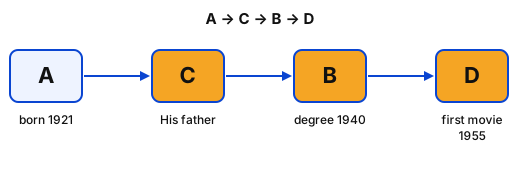
- A (birth in 1921) introduces Satyajit Ray — the opening.
- C 'His father, Sukumar Ray ...' describes his family → A–C.
- B (degree in 1940, Viswa-Bharati) is his education → C–B.
- D (first movie in 1955) is his career achievement → B–D. Order: ACBD.
Trick: Biography: birth → parents → studies → work.
Answer: (C) ACBD
अवधारणा: जीवनी कालक्रम में सजाई जाती है: जन्म → परिवार → शिक्षा → कार्य।
- A (1921 में जन्म) — शुरुआत।
- C 'His father, Sukumar Ray ...' — परिवार → A–C।
- B (1940 में डिग्री, Viswa-Bharati) — शिक्षा → C–B।
- D (1955 की पहली फिल्म) — करियर → B–D। क्रम: ACBD।
ट्रिक: जीवनी: जन्म → माता-पिता → पढ़ाई → कार्य।
उत्तर: (C) ACBD
SSC CPO Paper IIEnglish Language and ComprehensionPara JumblesSSC CPO Paper II 2025 · 30 Apr Shift 3

