Q321.Select the most appropriate option to substitute the underlined segment in the given
sentence. If there is no need to substitute it, select ‘No substitution required’.
He is wanting to give Rahul a guitar on his birthday.
- AHe wants to give
- BHe wants to giving
- CHe want to give
- DNo substitution required
Show answer
Concept: Stative verbs of wish/feeling such as want, wish, like, know are normally not used in continuous tenses.
- He is wanting → He wants (simple present).
- After want comes the to-infinitive: to give, not to giving (B).
- (C) He want breaks subject-verb agreement.
Yaad rakhein: want, know, like, believe, own → no -ing form.
Answer: (A) He wants to give
अवधारणा: इच्छा/भावना बताने वाली stative क्रियाएँ जैसे want, wish, like, know सामान्यतः continuous काल में प्रयोग नहीं होतीं।
- He is wanting → He wants (simple present)।
- want के बाद to-infinitive: to give, to giving (B) नहीं।
- (C) He want में कर्ता-क्रिया सामंजस्य टूटता है।
याद रखें: want, know, like, believe, own → -ing रूप नहीं।
उत्तर: (A) He wants to give
SSC CPO Paper IIEnglish Language and ComprehensionSentence Improvement – Stative VerbsSSC CPO Paper II 2021 · 8 Nov Shift 1
Q322.Select the most appropriate indirect form of the given sentence.
Cornelius said to Pauline, “You will have to agree to drive me to town from time to time.”
- ACornelius requested Pauline to drive him to town from time to time.
- BCornelius told Pauline that she would have to agree to drive him to town from time to time.
- CCornelius said to Pauline that you will have to agree to drive me to town from time to time.
- DCornelius said to Pauline that she will have to agree to drive him to town from time to time.
Show answer
Concept: Statement with an object: said to → told, add that, change pronouns and shift will → would.
- You (Pauline) → she; me (Cornelius) → him.
- will have to agree → would have to agree.
- (A) changes the meaning to a request; (C) keeps direct pronouns; (D) keeps will.
Yaad rakhein: said to → told; will → would; you → she/he as per the listener.
Answer: (B) Cornelius told Pauline that she would have to agree to drive him to town from time to time.
अवधारणा: कथन (statement) में: said to → told, that जोड़ें, सर्वनाम बदलें और will → would।
- You (Pauline) → she; me (Cornelius) → him।
- will have to agree → would have to agree।
- (A) अर्थ बदलकर अनुरोध बना देता है; (C) में direct सर्वनाम; (D) में will रह गया।
याद रखें: said to → told; will → would; you → श्रोता के अनुसार she/he।
उत्तर: (B) Cornelius told Pauline that she would have to agree to drive him to town from time to time.
SSC CPO Paper IIEnglish Language and ComprehensionDirect and Indirect SpeechSSC CPO Paper II 2021 · 8 Nov Shift 1
Q323.Select the most appropriate word for the given group of words.
An entrance hall in a building used by the public, especially a hotel or theatre
- Aportico
- Bfoyer
- Cgallery
- Daisle
Show answer
Concept: Foyer = an entrance hall or lobby of a hotel, theatre or other public building.
- portico = a roofed porch with columns at the entrance (outside).
- gallery = a room/hall for displaying art, or an upper floor in a theatre.
- aisle = a passage between rows of seats.
Yaad rakhein: foyer = lobby of a theatre/hotel (पढ़ें: फ़ॉये).
Answer: (B) foyer
अवधारणा: Foyer = होटल, थिएटर या सार्वजनिक भवन का प्रवेश-कक्ष (lobby)।
- portico = प्रवेश द्वार पर खंभों वाला छतदार बरामदा (बाहर)।
- gallery = कला-प्रदर्शन कक्ष या थिएटर की ऊपरी मंज़िल।
- aisle = सीटों की कतारों के बीच का रास्ता।
याद रखें: foyer = थिएटर/होटल की lobby (उच्चारण: फ़ॉये)।
उत्तर: (B) foyer
SSC CPO Paper IIEnglish Language and ComprehensionOne Word SubstitutionSSC CPO Paper II 2021 · 8 Nov Shift 1
Q324.Select the most appropriate antonym of the given word.
PERSEVERANCE
- Adetermination
- Bdedication
- Ctenacity
- Dindifference
Show answer
Concept: Perseverance = continued effort to do something despite difficulty (दृढ़ता, लगन).
- determination, dedication, tenacity are all synonyms of perseverance.
- indifference = lack of interest or concern (उदासीनता) – the opposite of persistent effort.
- Hence (D).
Yaad rakhein: Three synonyms in the options point to the odd one out as the antonym.
Answer: (D) indifference
अवधारणा: Perseverance = कठिनाई के बावजूद लगातार प्रयास (दृढ़ता, लगन)।
- determination, dedication, tenacity – सभी perseverance के पर्यायवाची हैं।
- indifference = रुचि/परवाह का अभाव (उदासीनता) – निरंतर प्रयास का उल्टा।
- अतः (D)।
याद रखें: विकल्पों में तीन पर्यायवाची हों तो बचा हुआ शब्द विलोम होता है।
उत्तर: (D) indifference
SSC CPO Paper IIEnglish Language and ComprehensionAntonymsSSC CPO Paper II 2021 · 8 Nov Shift 1
Q325.Select the most appropriate option to fill in the blank.
We saw some children ______ with one another as we were walking around.
- Aquarrels
- Bto quarrel
- Cquarrelled
- Dquarrelling
Show answer
Concept: After verbs of perception (see, hear, watch, notice) + object, we use the present participle (V-ing) for an action in progress.
- We saw some children quarrelling – the action was going on while we walked.
- to quarrel (B) is wrong; after see the bare infinitive or -ing is used, not to.
- quarrels and quarrelled cannot follow the object here.
Yaad rakhein: see/hear/watch + object + V-ing (action in progress).
Answer: (D) quarrelling
अवधारणा: इंद्रिय-बोधक क्रियाओं (see, hear, watch, notice) + object के बाद चल रही क्रिया के लिए present participle (V-ing) आता है।
- We saw some children quarrelling – हमारे चलते समय झगड़ा चल रहा था।
- to quarrel (B) गलत; see के बाद to नहीं लगता।
- quarrels और quarrelled यहाँ object के बाद नहीं आ सकते।
याद रखें: see/hear/watch + object + V-ing (चालू क्रिया)।
उत्तर: (D) quarrelling
SSC CPO Paper IIEnglish Language and ComprehensionVerb Forms – ParticipleSSC CPO Paper II 2021 · 8 Nov Shift 1
Q326.Select the most appropriate indirect form of the given sentence.
“What sort of a house are you looking for, Mr. Barrington?” said the house agent.
- AThe house agent asked Mr. Barrington what sort of a house would he be looking for.
- BThe house agent wanted to know what sort of a house was Mr. Barrington looking for.
- CThe house agent asked Mr. Barrington what sort of a house he was looking for.
- DThe house agent asked Mr. Barrington what sort of a house are you looking for.
Show answer
Concept: A wh-question in indirect speech becomes a statement in assertive order (subject + verb), and the tense shifts back.
- are you looking → he was looking (statement order).
- said → asked Mr. Barrington.
- (A) and (B) keep question order and (A) adds would; (D) keeps are you.
Yaad rakhein: Indirect question = no question order, no question mark.
Answer: (C) The house agent asked Mr. Barrington what sort of a house he was looking for.
अवधारणा: Indirect speech में wh-प्रश्न कथन-क्रम (subject + verb) में बदल जाता है और काल पीछे जाता है।
- are you looking → he was looking (कथन-क्रम)।
- said → asked Mr. Barrington।
- (A) और (B) में प्रश्न-क्रम है, (A) में would भी; (D) में are you रह गया।
याद रखें: Indirect प्रश्न = प्रश्न-क्रम नहीं, प्रश्नचिह्न नहीं।
उत्तर: (C) The house agent asked Mr. Barrington what sort of a house he was looking for.
SSC CPO Paper IIEnglish Language and ComprehensionDirect and Indirect SpeechSSC CPO Paper II 2021 · 8 Nov Shift 1
Q327.Given below are six sentences. A and F are the first and the last sentences. The rest of the sentences namely B, C, D and E are jumbled. Select the option that gives their correct order. A. From a very early age I knew that when I grew up I would be writer.
B. For this or the other reasons, I was somewhat lonely.
C. I was the middle child among three.
D. And I barely saw my father, who was a soldier, till I was eight.
E. But there was a gap of five years on either side.
F. I had the lonely child’s habit of making up stories and holding conversations with
imaginary persons.
- AABCDEF
- BACDEBF
- CADECBF
- DACEBDF
Show answer
Concept: Link the facts about the writer’s childhood logically; But and For this or the other reasons must follow the ideas they refer to.
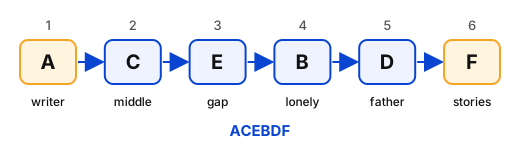
- After A, C gives the family position: middle child of three.
- E (But a gap of five years on either side) qualifies C → C→E.
- B: For this … reasons, I was lonely sums up E; D adds another cause (father away); F: the lonely child’s habits.
Yaad rakhein: But there was a gap … on either side needs ‘middle child’ (C) before it.
Answer: (D) ACEBDF
अवधारणा: लेखक के बचपन की बातों को तार्किक रूप से जोड़ें; But और For this or the other reasons उसी विचार के बाद आएँगे जिसका वे उल्लेख करते हैं।
- A के बाद C: परिवार में स्थान – तीन में मँझला।
- E (But दोनों ओर पाँच वर्ष का अंतर) C को स्पष्ट करता है → C→E।
- B: For this … reasons, I was lonely E का निष्कर्ष; D: एक और कारण (पिता दूर); F: अकेले बच्चे की आदत।
याद रखें: gap … on either side से पहले 'middle child' (C) चाहिए।
उत्तर: (D) ACEBDF
SSC CPO Paper IIEnglish Language and ComprehensionSentence RearrangementSSC CPO Paper II 2021 · 8 Nov Shift 1
Q328.Select the correct active form of the given sentence.
You are requested to give me change for ₹2000.
- AYou should give me change for ₹2000.
- BAre you giving me change for ₹2000?
- CPlease give me change for ₹2000.
- DCan you give me change for ₹2000?
Show answer
Concept: You are requested to … is the passive form of a polite imperative; its active form begins with Please (or Kindly).
- You are requested to give me change → Please give me change.
- (A) should turns it into advice/duty.
- (B) and (D) turn it into questions – a different sentence type.
Yaad rakhein: Please/Kindly + V1 ↔ You are requested to + V1.
Answer: (C) Please give me change for ₹2000.
अवधारणा: You are requested to … विनम्र आज्ञार्थक वाक्य का passive है; इसका active Please (या Kindly) से शुरू होता है।
- You are requested to give me change → Please give me change।
- (A) should इसे सलाह/कर्तव्य बना देता है।
- (B) और (D) इसे प्रश्न बना देते हैं – वाक्य का प्रकार बदल गया।
याद रखें: Please/Kindly + V1 ↔ You are requested to + V1।
उत्तर: (C) Please give me change for ₹2000.
SSC CPO Paper IIEnglish Language and ComprehensionActive and Passive Voice – RequestSSC CPO Paper II 2021 · 8 Nov Shift 1
Q329.Select the most appropriate indirect form of the given sentence.
Walter said to David, “ I am looking forward to tomorrow’s auction.”
- AWalter told David that I am looking forward to tomorrow’s auction.
- BWalter told David that he is looking forward to the next day’s auction.
- CWalter told David that he was looking forward to tomorrow’s auction.
- DWalter told David that he was looking forward to the next day’s auction.
Show answer
Concept: With a past reporting verb: present continuous → past continuous, I → he, and tomorrow → the next day.
- I am looking forward → he was looking forward.
- tomorrow’s auction → the next day’s auction.
- (A) keeps I am; (B) keeps is; (C) keeps tomorrow’s.
Yaad rakhein: Time words change too: today → that day, tomorrow → the next day.
Answer: (D) Walter told David that he was looking forward to the next day’s auction.
अवधारणा: Reporting verb past हो तो: present continuous → past continuous, I → he, और tomorrow → the next day।
- I am looking forward → he was looking forward।
- tomorrow’s auction → the next day’s auction।
- (A) में I am; (B) में is; (C) में tomorrow’s रह गया।
याद रखें: समय-सूचक शब्द भी बदलते हैं: today → that day, tomorrow → the next day।
उत्तर: (D) Walter told David that he was looking forward to the next day’s auction.
SSC CPO Paper IIEnglish Language and ComprehensionDirect and Indirect SpeechSSC CPO Paper II 2021 · 8 Nov Shift 1
Q330.Select the most appropriate antonym of the given word.
SHALLOW
- Ahollow
- Bdeep
- Ctrivial
- Dnarrow
Show answer
Concept: Shallow = of little depth (उथला); figuratively, lacking serious thought.
- Its direct opposite is deep (गहरा).
- hollow = empty inside; trivial = unimportant (close to shallow in meaning); narrow is the opposite of wide.
- Hence (B).
Yaad rakhein: shallow water ↔ deep water.
Answer: (B) deep
अवधारणा: Shallow = कम गहराई वाला (उथला); लाक्षणिक रूप में – सतही।
- इसका सीधा विलोम deep (गहरा) है।
- hollow = अंदर से खोखला; trivial = तुच्छ (shallow के निकट); narrow = wide का विलोम।
- अतः (B)।
याद रखें: shallow water ↔ deep water।
उत्तर: (B) deep
SSC CPO Paper IIEnglish Language and ComprehensionAntonymsSSC CPO Paper II 2021 · 8 Nov Shift 1
Q331.Select the correct passive form of the given sentence.
The storm last night uprooted a large number of trees.
- AA large number of trees have been uprooted by the storm last night.
- BThe storm last night was uprooted by a large number of trees.
- CA large number of trees were uprooted by the storm last night.
- DA large number of trees uprooted the storm last night.
Show answer
Concept: Simple past active (V2) becomes was/were + V3 in the passive.
- Object a large number of trees (plural) → subject, so were.
- uprooted → were uprooted by the storm last night.
- (A) uses present perfect with last night (wrong); (B) and (D) reverse the meaning.
Yaad rakhein: a large number of + plural noun → plural verb (were).
Answer: (C) A large number of trees were uprooted by the storm last night.
अवधारणा: Simple past active (V2) का passive was/were + V3 होता है।
- Object a large number of trees (बहुवचन) → कर्ता, अतः were।
- uprooted → were uprooted by the storm last night।
- (A) में last night के साथ present perfect (गलत); (B) और (D) अर्थ उलट देते हैं।
याद रखें: a large number of + बहुवचन संज्ञा → बहुवचन क्रिया (were)।
उत्तर: (C) A large number of trees were uprooted by the storm last night.
SSC CPO Paper IIEnglish Language and ComprehensionActive and Passive VoiceSSC CPO Paper II 2021 · 8 Nov Shift 1
Q332.Select the most appropriate option to substitute the underlined segment in the given
sentence. If there is no need to substitute it, select ‘No substitution required’.
The pilot along with his crew have gone on vacation for a month.
- Ahave gone to
- BNo substitution required
- Chas gone on
- Dwere gone on
Show answer
Concept: When two subjects are joined by along with, as well as, together with, the verb agrees with the first subject.
- Subject = The pilot (singular); along with his crew is extra information.
- So have gone on → has gone on.
- go on vacation is the correct phrase, so (A) gone to is wrong; (D) were gone is incorrect.
Yaad rakhein: along with / as well as / with → ignore the second noun; match the verb with the first.
Answer: (C) has gone on
अवधारणा: जब दो कर्ता along with, as well as, together with से जुड़े हों, क्रिया पहले कर्ता के अनुसार होती है।
- कर्ता = The pilot (एकवचन); along with his crew अतिरिक्त जानकारी है।
- अतः have gone on → has gone on।
- सही वाक्यांश go on vacation है, अतः (A) gone to गलत; (D) were gone भी गलत।
याद रखें: along with / as well as / with → दूसरी संज्ञा छोड़ें, क्रिया पहले कर्ता से मिलाएँ।
उत्तर: (C) has gone on
SSC CPO Paper IIEnglish Language and ComprehensionSentence Improvement – Subject-Verb AgreementSSC CPO Paper II 2021 · 8 Nov Shift 1
Q333.Select the correct passive form of the given sentence.
Who has taken away my pen?
- ABy whom has my pen been taken away?
- BBy whom had my pen been taken away?
- CBy whom is my pen taken away?
- DBy whom was my pen taken away?
Show answer
Concept: In the passive, Who becomes By whom; present perfect has + V3 becomes has + been + V3.
- Who has taken away my pen? → By whom has my pen been taken away?
- The tense stays present perfect.
- (B) is past perfect, (C) simple present, (D) simple past – tense changed.
Yaad rakhein: Who → By whom; keep the tense: has taken → has been taken.
Answer: (A) By whom has my pen been taken away?
अवधारणा: Passive में Who → By whom; present perfect has + V3 → has + been + V3।
- Who has taken away my pen? → By whom has my pen been taken away?
- काल present perfect ही रहेगा।
- (B) past perfect, (C) simple present, (D) simple past – काल बदल गया।
याद रखें: Who → By whom; काल वही: has taken → has been taken।
उत्तर: (A) By whom has my pen been taken away?
SSC CPO Paper IIEnglish Language and ComprehensionActive and Passive Voice – InterrogativeSSC CPO Paper II 2021 · 8 Nov Shift 1
Q334.Select the most appropriate direct form of the given sentence.
She exclaimed that she looked very ugly in that dress.
- AShe said, “How ugly I looked in that dress!”
- BShe said, “I look so ugly in that dress.”
- CShe said, “Why do I look so ugly in this dress?”
- DShe said, “How ugly I look in this dress!”
Show answer
Concept: exclaimed that … very in indirect speech becomes an exclamation with How/What and ! in direct speech; past → present, that → this.
- very ugly → How ugly …!
- she looked → I look; that dress → this dress.
- (A) keeps looked and that; (B) is a plain statement; (C) is a question.
Yaad rakhein: exclaimed + very → How/What …! ; that → this.
Answer: (D) She said, “How ugly I look in this dress!”
अवधारणा: Indirect में exclaimed that … very, direct में How/What और ! वाला विस्मयादिबोधक बनता है; past → present, that → this।
- very ugly → How ugly …!
- she looked → I look; that dress → this dress।
- (A) में looked और that; (B) सामान्य कथन; (C) प्रश्न है।
याद रखें: exclaimed + very → How/What …! ; that → this।
उत्तर: (D) She said, “How ugly I look in this dress!”
SSC CPO Paper IIEnglish Language and ComprehensionDirect and Indirect Speech – ExclamatorySSC CPO Paper II 2021 · 8 Nov Shift 1
Q335.Select the most appropriate word for the given group of words.
One who talks in sleep
- Aventriloquist
- Binterlocutor
- Csomniloquist
- Dsoliloquist
Show answer
Concept: Latin roots: somnus = sleep, loqui = to speak → somniloquist = one who talks in sleep.
- ventriloquist – speaks so that the voice seems to come from elsewhere (e.g. a puppet).
- interlocutor – a person taking part in a conversation.
- soliloquist – one who talks to oneself (soliloquy).
Yaad rakhein: somnambulist walks in sleep, somniloquist talks in sleep.
Answer: (C) somniloquist
अवधारणा: लैटिन मूल: somnus = नींद, loqui = बोलना → somniloquist = नींद में बोलने वाला।
- ventriloquist – ऐसे बोलने वाला कि आवाज़ कहीं और (जैसे कठपुतली) से आती लगे।
- interlocutor – वार्तालाप में भाग लेने वाला।
- soliloquist – स्वयं से बात करने वाला (soliloquy)।
याद रखें: somnambulist नींद में चलता है, somniloquist नींद में बोलता है।
उत्तर: (C) somniloquist
SSC CPO Paper IIEnglish Language and ComprehensionOne Word SubstitutionSSC CPO Paper II 2021 · 8 Nov Shift 1
Q336.Select the most appropriate option to substitute the underlined segment in the given
sentence. If there is no need to substitute it, select ‘No substitution required’.
Please send me informations with regard of my insurance policy that I took from your
company.
- ANo substitution required
- Binformation regarding
- Cinformation in the regard of
- Dinformations with a regard to
Show answer
Concept: Information is an uncountable noun – it never takes -s; the correct phrase is with regard to or simply regarding.
- informations → information.
- with regard of is wrong → regarding.
- (C) in the regard of and (D) informations with a regard to are incorrect.
Yaad rakhein: information, advice, furniture, luggage – no plural form.
Answer: (B) information regarding
अवधारणा: Information अगणनीय संज्ञा है – इसमें -s नहीं लगता; सही वाक्यांश with regard to या केवल regarding है।
- informations → information।
- with regard of गलत → regarding।
- (C) in the regard of और (D) informations with a regard to गलत हैं।
याद रखें: information, advice, furniture, luggage – बहुवचन रूप नहीं।
उत्तर: (B) information regarding
SSC CPO Paper IIEnglish Language and ComprehensionSentence ImprovementSSC CPO Paper II 2021 · 8 Nov Shift 1
Q337.Given below are four jumbled sentences. Select the option that gives their correct order. A. He was possessed by an overwhelming desire to possess them all.
B. A man stood holding a pole with yellow, red, green and purple balloons flying from it. C. The child was simply carried away by the rainbow glory of their silken colours.
D. But he well knew his parents would never buy him the balloons because they would say he was too old to play with such toys.
- ADCBA
- BBACD
- CBCAD
- DCBAD
Show answer
Concept: Start with the sentence that introduces the scene and the objects, then the child’s reaction, his desire, and finally the contrast with But.
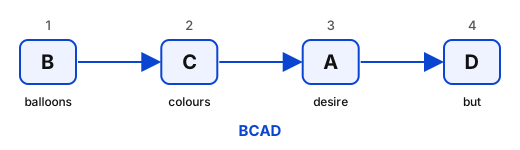
- B introduces the balloon seller – an independent opening.
- C: their silken colours – their = the balloons of B.
- A: desire to possess them all; D: But his parents would never buy them.
Yaad rakhein: But (D) sets a limit on a wish – so it comes after the wish (A).
Answer: (C) BCAD
अवधारणा: उस वाक्य से शुरू करें जो दृश्य और वस्तुओं का परिचय देता है, फिर बच्चे की प्रतिक्रिया, उसकी इच्छा और अंत में But वाला विरोध।
- B गुब्बारे वाले का परिचय – स्वतंत्र आरंभ।
- C: their silken colours – their = B के गुब्बारे।
- A: सब पाने की इच्छा; D: But माता-पिता कभी नहीं ख़रीदेंगे।
याद रखें: But (D) इच्छा पर रोक है – अतः इच्छा (A) के बाद आएगा।
उत्तर: (C) BCAD
SSC CPO Paper IIEnglish Language and ComprehensionSentence RearrangementSSC CPO Paper II 2021 · 8 Nov Shift 1
Q338.Parts of the following sentence are given as options. Identify the segment that contains a grammatical error.
Ramprasad has not been able to come to work since a week due to fever.
- Aable to come
- Bhas not been
- Cdue to fever
- Dsince a week
Show answer
Concept: Since is used for a point of time (since Monday, since 2020); for is used for a period of time (for a week, for two hours).
- a week is a period → for a week.
- Correct sentence: Ramprasad has not been able to come to work for a week due to fever.
- Other parts are correct.
Yaad rakhein: since + point of time; for + length of time.
Answer: (D) since a week
अवधारणा: Since समय के बिंदु के लिए (since Monday, since 2020); for समय की अवधि के लिए (for a week, for two hours)।
- a week अवधि है → for a week।
- सही वाक्य: Ramprasad has not been able to come to work for a week due to fever.
- बाकी भाग सही हैं।
याद रखें: since + समय-बिंदु; for + समय-अवधि।
उत्तर: (D) since a week
SSC CPO Paper IIEnglish Language and ComprehensionError Spotting – PrepositionsSSC CPO Paper II 2021 · 8 Nov Shift 1
Q339.Select the most appropriate antonym of the given word.
RELEVANT
- Aineligible
- Binhabitable
- Cinevitable
- DInapplicable
Show answer
Concept: Relevant = closely connected or applicable to the matter at hand (प्रासंगिक).
- Opposite: inapplicable / irrelevant – not applicable (अप्रासंगिक).
- ineligible = not qualified; inhabitable = fit to live in; inevitable = unavoidable.
- Hence (D).
Yaad rakhein: relevant ↔ irrelevant / inapplicable.
Answer: (D) Inapplicable
अवधारणा: Relevant = विषय से जुड़ा हुआ या लागू होने वाला (प्रासंगिक)।
- विलोम: inapplicable / irrelevant – लागू न होने वाला (अप्रासंगिक)।
- ineligible = अयोग्य; inhabitable = रहने योग्य; inevitable = अपरिहार्य।
- अतः (D)।
याद रखें: relevant ↔ irrelevant / inapplicable।
उत्तर: (D) Inapplicable
SSC CPO Paper IIEnglish Language and ComprehensionAntonymsSSC CPO Paper II 2021 · 8 Nov Shift 1
Q340.Select the most appropriate word for the given group of words.
One who is violently against established traditions and beliefs
- Aiconoclast
- Begoist
- Cstoic
- Dagnostic
Show answer
Concept: Iconoclast (Greek eikon = image + klastes = breaker) = one who attacks established beliefs, traditions or institutions.
- egoist – a self-centred person.
- stoic – one who endures pain or hardship without complaint.
- agnostic – one who believes the existence of God cannot be known.
Yaad rakhein: iconoclast = breaker of icons → breaker of traditions.
Answer: (A) iconoclast
अवधारणा: Iconoclast (ग्रीक eikon = मूर्ति + klastes = तोड़ने वाला) = स्थापित परंपराओं/मान्यताओं का प्रबल विरोधी।
- egoist – आत्मकेंद्रित व्यक्ति।
- stoic – बिना शिकायत कष्ट सहने वाला।
- agnostic – ईश्वर के अस्तित्व को अज्ञेय मानने वाला।
याद रखें: iconoclast = मूर्ति-भंजक → परंपरा-भंजक।
उत्तर: (A) iconoclast
SSC CPO Paper IIEnglish Language and ComprehensionOne Word SubstitutionSSC CPO Paper II 2021 · 8 Nov Shift 1

