Q361.Select the most appropriate meaning of the given idiom.
Hold your horses
- ABe responsible
- BBe patient
- CBe inferior
- DBe indifferent
Show answer
Concept: 'Hold your horses' is said to someone who is rushing – it means wait, slow down, be patient.
- Example: Hold your horses! Let me finish first.
- It has nothing to do with responsibility, inferiority or indifference.
- So the meaning is 'Be patient'.
Yaad rakhein: Picture a rider pulling the reins to stop horses from rushing ahead.
Answer: (B) Be patient
अवधारणा: 'Hold your horses' जल्दबाज़ी करने वाले से कहा जाता है – रुको, धैर्य रखो (be patient)।
- उदाहरण: Hold your horses! Let me finish first.
- इसका जिम्मेदारी, हीनता या उदासीनता से कोई संबंध नहीं।
- अतः अर्थ है 'Be patient' (धैर्य रखो)।
याद रखें: घुड़सवार लगाम खींचकर घोड़ों को रोकता है – यानी जल्दबाज़ी मत करो।
उत्तर: (B) Be patient
SSC CPO Paper IIEnglish Language and ComprehensionIdioms and PhrasesSSC CPO Paper II 2021 · 8 Nov Shift 1
Q362.Parts of the following sentence are given as options. Identify the segment that contains a grammatical error.
The data which she presented was the most latest one on the matter under discussion.
- Awhich she presented
- Bwas the most latest one
- Con the matter
- Dunder discussion
Show answer
Concept: 'Latest' is already a superlative (late – later – latest); adding 'most' makes a double superlative.
- the most latest → wrong; correct: the latest one.
- Other parts (which she presented, on the matter, under discussion) are correct.
- Correct sentence: The data which she presented was the latest one on the matter under discussion.
Trick: Never use 'more/most' with a word already ending in -er/-est.
Answer: (B) was the most latest one
अवधारणा: 'Latest' पहले से ही superlative है (late – later – latest); इसके साथ 'most' लगाना दोहरा superlative है।
- the most latest → गलत; सही: the latest one।
- बाकी भाग सही हैं।
- सही वाक्य: The data which she presented was the latest one on the matter under discussion.
ट्रिक: -er/-est वाले शब्द के साथ more/most नहीं लगाते।
उत्तर: (B) was the most latest one
SSC CPO Paper IIEnglish Language and ComprehensionError SpottingSSC CPO Paper II 2021 · 8 Nov Shift 1
Q363.Select the correct active form of the given sentence.
Many Indians have been brought back from foreign countries by the government.
- AThe government had brought back many Indians from foreign countries.
- BThe government is bringing back many Indians from foreign countries.
- CThe government has brought back many Indians from foreign countries.
- DThe government has been bringing back many Indians from foreign countries.
Show answer
Concept: Present perfect passive 'has/have been + V3' becomes active 'has/have + V3'.
- Agent the government (singular) → subject; 'have been brought' → has brought.
- Object many Indians follows the verb with 'back'.
- Active: The government has brought back many Indians from foreign countries.
- (A) past perfect, (B) present continuous, (D) present perfect continuous – tense changed.
Trick: have/has been + V3 → have/has + V3 (choose has/have by the new subject).
Answer: (C) The government has brought back many Indians from foreign countries.
अवधारणा: Present perfect passive 'has/have been + V3' का active 'has/have + V3' होता है।
- कर्ता the government (एकवचन) → subject; 'have been brought' → has brought।
- Object many Indians क्रिया के बाद।
- Active: The government has brought back many Indians from foreign countries.
- (A), (B), (D) में tense बदल गया।
ट्रिक: has/have been + V3 → has/have + V3 (नए subject के अनुसार has/have)।
उत्तर: (C) The government has brought back many Indians from foreign countries.
SSC CPO Paper IIEnglish Language and ComprehensionActive and Passive VoiceSSC CPO Paper II 2021 · 8 Nov Shift 1
Q364.Select the most appropriate option to substitute the underlined segment in the given
sentence. If there is no need to substitute it, select ‘No substitution required’.
Play being recognised as an important factor in improving mental and physical health of children.
- APlay is recognised
- BPlay is recognising
- CRecognition of play being
- DNo substitution required
Show answer
Concept: A sentence needs a finite verb; 'being recognised' is only a participle. 'Play' is recognised by people, so the passive 'is recognised' is required.
- Play being recognised … has no main verb – incomplete sentence.
- Play is recognised as an important factor … – complete, passive, correct meaning.
- 'Play is recognising' (B) is active – play cannot recognise anything; (C) still lacks a finite verb.
Trick: If a sentence has only '-ing' after the subject and no is/are/was, it is incomplete.
Answer: (A) Play is recognised
अवधारणा: वाक्य में finite verb ज़रूरी है; 'being recognised' केवल participle है। 'Play' को लोग मान्यता देते हैं, इसलिए passive 'is recognised' चाहिए।
- Play being recognised … में मुख्य क्रिया नहीं – अधूरा वाक्य।
- Play is recognised as an important factor … – पूर्ण और सही।
- (B) active है – play कुछ recognise नहीं कर सकता; (C) में भी finite verb नहीं।
ट्रिक: Subject के बाद केवल '-ing' हो और is/are/was न हो तो वाक्य अधूरा है।
उत्तर: (A) Play is recognised
SSC CPO Paper IIEnglish Language and ComprehensionSentence ImprovementSSC CPO Paper II 2021 · 8 Nov Shift 1
Q365.Select the most appropriate word for the given group of words.
A doctor who attends to bone problems
- Apathologist
- Bpaediatrician
- Corthopaedist
- Dcardiologist
Show answer
Concept: A doctor who treats bones, joints and muscles is an orthopaedist (orthopaedic surgeon).
- Orthopaedist – bone and joint specialist.
- Pathologist – studies diseases through lab tests; Paediatrician – children's doctor.
- Cardiologist – heart specialist.
Yaad rakhein: Ortho = straight/correct (bones); Cardio = heart; Paed = child.
Answer: (C) orthopaedist
अवधारणा: हड्डियों और जोड़ों का इलाज करने वाला डॉक्टर orthopaedist (हड्डी रोग विशेषज्ञ) कहलाता है।
- Orthopaedist – हड्डी/जोड़ विशेषज्ञ।
- Pathologist – जाँच द्वारा रोग का अध्ययन; Paediatrician – बच्चों का डॉक्टर।
- Cardiologist – हृदय रोग विशेषज्ञ।
याद रखें: Ortho → हड्डी, Cardio → हृदय, Paed → बच्चा।
उत्तर: (C) orthopaedist
SSC CPO Paper IIEnglish Language and ComprehensionOne Word SubstitutionSSC CPO Paper II 2021 · 8 Nov Shift 1
Q366.Select the most appropriate indirect form of the given sentence.
Cornelius said to Pauline, “This house has been far too large for me since the death of my wife.”
- ACornelius said to Pauline that this house has been far too large for me since the death of my wife.
- BCornelius told Pauline that that house had been far too large for him since the death of his wife.
- CCornelius told Pauline that that house had been far too large for me since the death of my wife.
- DCornelius asked Pauline if that house has been far too large for him since the death of his wife.
Show answer
Concept: Statement with a past reporting verb: 'said to' → 'told', present perfect → past perfect, 'this' → 'that', and first-person pronouns change to match the speaker (Cornelius → him/his).
- said to Pauline → told Pauline that.
- has been → had been; this house → that house.
- me → him, my wife → his wife.
- (A) and (C) keep 'me/my'; (D) uses 'asked … if' for a statement.
Trick: Pronoun rule SON: 1st person → like the Subject (speaker); 2nd → Object; 3rd → No change.
Answer: (B) Cornelius told Pauline that that house had been far too large for him since the death of his wife.
अवधारणा: कथन (statement) में: 'said to' → 'told', present perfect → past perfect, 'this' → 'that', और प्रथम पुरुष pronoun वक्ता के अनुसार (Cornelius → him/his)।
- said to Pauline → told Pauline that।
- has been → had been; this house → that house।
- me → him, my wife → his wife।
- (A), (C) में 'me/my' रह गया; (D) में statement के लिए 'asked … if' गलत।
ट्रिक: SON नियम: 1st person → Subject के अनुसार; 2nd → Object के अनुसार; 3rd → No change।
उत्तर: (B) Cornelius told Pauline that that house had been far too large for him since the death of his wife.
SSC CPO Paper IIEnglish Language and ComprehensionDirect and Indirect SpeechSSC CPO Paper II 2021 · 8 Nov Shift 1
Q367.Given below are six sentences. A and F are the first and the last sentences. The rest of the sentences namely B, C, D and E are jumbled. Select the option that gives their correct order. A. When they reached the great city, they were frightened by the size of it and by the crowds in the streets.
B. However, they visited every street, stopping wherever they saw a crowd.
C. They were afraid they would not even recognise him, for they had not seen him for fifteen years.
D. They felt that their son would be somewhere among those people.
E. But they did not know how to find him.
F. They hoped for a chance meeting.
- AADECBF
- BACDEBF
- CACEBDF
- DADBCEF
Show answer
Concept: A and F are fixed; link the middle sentences by meaning and connectors (But, However).
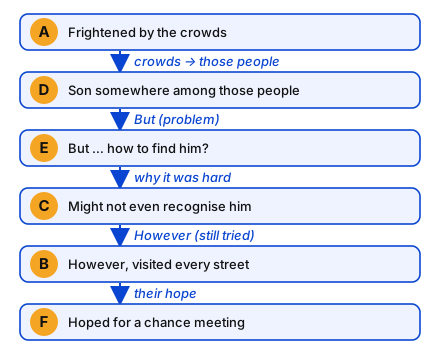
- After A (crowds in the streets), D says their son would be somewhere among those people.
- E: But they did not know how to find him – the problem.
- C gives the reason it was hard: they might not even recognise him.
- B: However, they visited every street – they tried anyway; F: they hoped for a chance meeting.
Trick: 'those people' in D points back to 'the crowds' in A, so D comes right after A.
Answer: (A) ADECBF
अवधारणा: A और F तय हैं; बीच के वाक्यों को अर्थ और संयोजकों (But, However) से जोड़ें।
- A (भीड़) के बाद D – बेटा those people के बीच कहीं होगा।
- E: But they did not know how to find him – समस्या।
- C – कठिनाई का कारण: शायद वे उसे पहचान भी न पाएँ।
- B: However, they visited every street – फिर भी कोशिश; F: अचानक मुलाकात की आशा।
ट्रिक: D का 'those people' A की 'crowds' की ओर संकेत करता है, इसलिए A के ठीक बाद D।
उत्तर: (A) ADECBF
SSC CPO Paper IIEnglish Language and ComprehensionPara JumblesSSC CPO Paper II 2021 · 8 Nov Shift 1
Q368.Select the most appropriate word for the given group of words.
A person skilled in cutting, dressing, and laying stone in buildings.
- Aarchitect
- Bcarpenter
- Cartisan
- Dmason
Show answer
Concept: A person skilled in cutting, dressing and laying stone in buildings is a mason.
- Mason – builder who works with stone or brick.
- Architect – designs buildings; Carpenter – works with wood.
- Artisan – any skilled craftsperson (too general).
Yaad rakhein: Mason → masonry (stone/brick work); Carpenter → wood.
Answer: (D) mason
अवधारणा: पत्थर काटने, तराशने और इमारत में लगाने वाला कारीगर mason (राजमिस्त्री) कहलाता है।
- Mason – पत्थर/ईंट का काम करने वाला।
- Architect – भवन का डिज़ाइन बनाने वाला; Carpenter – बढ़ई (लकड़ी)।
- Artisan – कोई भी कुशल कारीगर (बहुत सामान्य)।
याद रखें: Mason → masonry (पत्थर/ईंट का काम); Carpenter → लकड़ी।
उत्तर: (D) mason
SSC CPO Paper IIEnglish Language and ComprehensionOne Word SubstitutionSSC CPO Paper II 2021 · 8 Nov Shift 1
Q369.Given below are six sentences. A and F are the first and the last sentences. The rest of the sentences namely B, C, D and E are jumbled. Select the option that gives their correct order. A. The doctor left three different medicines with instructions for giving them.
B. Back in the room, I wrote the boy’s temperature down.
C. He seemed to know all about influenza.
D. He also said there was no danger if you avoided pneumonia.
E. He said there was nothing to worry if the fever didn’t go above one hundred and four
degrees.
F. I also made a note of the time to give the various medicines.
- AADCBEF
- BACEDBF
- CAEDBCF
- DACDBEF
Show answer
Concept: A and F are fixed; group what the doctor said, then what the narrator did.
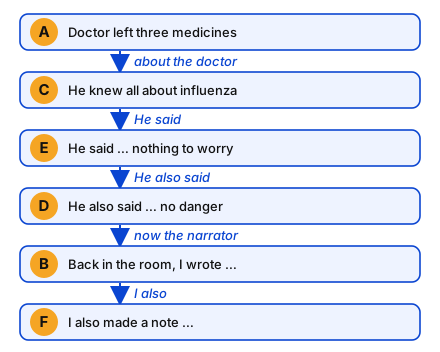
- A: the doctor left medicines. C: He seemed to know all about influenza – comment on the doctor.
- E: He said there was nothing to worry … – first thing he said.
- D: He also said … – 'also' shows it follows E.
- B: Back in the room, I wrote the temperature down; F: I also made a note … follows B.
Trick: Use the two 'also's: E → D (He also said) and B → F (I also made).
Answer: (B) ACEDBF
अवधारणा: A और F तय हैं; पहले डॉक्टर ने जो कहा, फिर कथावाचक (narrator) ने जो किया।
- A: डॉक्टर ने दवाइयाँ दीं। C: He seemed to know all about influenza।
- E: He said there was nothing to worry … – पहली बात।
- D: He also said … – 'also' बताता है कि यह E के बाद है।
- B: Back in the room, I wrote …; F: I also made a note … B के बाद।
ट्रिक: दोनों 'also' देखें: E → D और B → F।
उत्तर: (B) ACEDBF
SSC CPO Paper IIEnglish Language and ComprehensionPara JumblesSSC CPO Paper II 2021 · 8 Nov Shift 1
Q370.Select the most appropriate option to fill in the blank.
The clown was so funny ______ everybody burst out laughing.
- Abecause
- Bthat
- Cbut
- Dwhen
Show answer
Concept: The correlative pattern 'so + adjective + that + result' expresses cause and result.
- so funny that everybody burst out laughing – result clause.
- 'because', 'but' and 'when' do not pair with 'so … ' to show a result.
- Correct: The clown was so funny that everybody burst out laughing.
Trick: so … that / such … that – always together.
Answer: (B) that
अवधारणा: 'so + adjective + that + परिणाम' – यह correlative संरचना कारण और परिणाम बताती है।
- so funny that everybody burst out laughing – परिणाम।
- 'because', 'but', 'when' 'so …' के साथ परिणाम नहीं बताते।
- सही: The clown was so funny that everybody burst out laughing.
ट्रिक: so … that / such … that – हमेशा साथ।
उत्तर: (B) that
SSC CPO Paper IIEnglish Language and ComprehensionFill in the BlanksSSC CPO Paper II 2021 · 8 Nov Shift 1
Q371.Select the wrongly spelt word.
- Aattain
- Battrect
- Cattempt
- Dattend
Show answer
Concept: Check each word's standard spelling.
- attain, attempt, attend – all correct.
- 'attrect' is wrong; the correct spelling is attract (to pull towards).
Trick: attr-a-ct → attraction: the vowel is 'a', not 'e'.
Answer: (B) attrect
अवधारणा: हर शब्द की मानक वर्तनी जाँचें।
- attain, attempt, attend – सभी सही।
- 'attrect' गलत है; सही वर्तनी attract (आकर्षित करना)।
ट्रिक: attraction को याद रखें – 'a' आता है, 'e' नहीं।
उत्तर: (B) attrect
SSC CPO Paper IIEnglish Language and ComprehensionSpellingSSC CPO Paper II 2021 · 8 Nov Shift 1
Q372.Parts of the following sentence are given as options. Identify the segment that contains a grammatical error.
I am indebted to my friends for the large sum of money what they gave me during my days of need.
- Awhat they gave me
- Bduring my days of need
- Cindebted to my friends
- Dfor the large sum
Show answer
Concept: 'What' is not a relative pronoun for a noun already mentioned; after 'the large sum of money' we use 'which' or 'that'.
- Antecedent: the large sum of money (a thing).
- Correct: … the large sum of money which/that they gave me …
- 'indebted to my friends', 'for the large sum', 'during my days of need' are correct.
Trick: 'what' = 'the thing which' – it already contains the noun, so it cannot follow a noun.
Answer: (A) what they gave me
अवधारणा: पहले से बताए गए noun के बाद relative pronoun 'what' नहीं आता; 'the large sum of money' के बाद 'which' या 'that' आएगा।
- Antecedent: the large sum of money (वस्तु)।
- सही: … the large sum of money which/that they gave me …
- बाकी भाग सही हैं।
ट्रिक: 'what' = 'the thing which' – इसमें noun शामिल है, इसलिए यह noun के बाद नहीं आता।
उत्तर: (A) what they gave me
SSC CPO Paper IIEnglish Language and ComprehensionError SpottingSSC CPO Paper II 2021 · 8 Nov Shift 1
Q373.Select the most appropriate option to substitute the underlined segment in the given
sentence. If there is no need to substitute it, select ‘No substitution required’.
Nobody should expect to become successful without hard work.
- ANo substitution required
- Bshould expect to becoming
- Cshould be expect becoming
- Dshould expecting to become
Show answer
Concept: After a modal ('should') we use the base verb; 'expect' takes 'to + V1'.
- Nobody should expect to become successful … – modal + V1 (expect) + to-infinitive (to become).
- (B) 'to becoming', (C) 'should be expect', (D) 'should expecting' all break this rule.
- So the sentence is already correct.
Trick: Modal + V1; expect + to + V1.
Answer: (A) No substitution required
अवधारणा: Modal ('should') के बाद base verb आता है; 'expect' के बाद 'to + V1'।
- Nobody should expect to become successful … – modal + V1 + to-infinitive।
- (B) 'to becoming', (C) 'should be expect', (D) 'should expecting' – सब गलत।
- अतः वाक्य पहले से सही है।
ट्रिक: Modal + V1; expect + to + V1।
उत्तर: (A) No substitution required
SSC CPO Paper IIEnglish Language and ComprehensionSentence ImprovementSSC CPO Paper II 2021 · 8 Nov Shift 1
Q374.Select the most appropriate indirect form of the given sentence.
Albert said to Tim, “I’m not sure your father would consider it a good idea to have me on the board of his company.”
- AAlbert said to Tim that he was not sure his father would consider it a good idea to have me on the board of his company.
- BAlbert said to Tim that I’m not sure your father would consider it a good idea to have me on the board of his company.
- CAlbert said to Tim that he is not sure your father will consider it a good idea to have him on the board of his company.
- DAlbert said to Tim that he was not sure his father would consider it a good idea to have him on the board of his company.
Show answer
Concept: Past reporting verb: present → past ('am' → 'was', 'would' stays), 'I' → 'he', 'your father' → 'his father', 'me' → 'him'.
- I'm not sure → he was not sure.
- your father would consider → his father would consider.
- to have me → to have him (Albert).
- (A) keeps 'me'; (B) is unchanged direct speech; (C) keeps 'is', 'your', 'will'.
Trick: Change every pronoun – one missed 'me' makes an option wrong.
Answer: (D) Albert said to Tim that he was not sure his father would consider it a good idea to have him on the board of his company.
अवधारणा: Reporting verb past में: present → past ('am' → 'was', 'would' वैसा ही), 'I' → 'he', 'your father' → 'his father', 'me' → 'him'।
- I'm not sure → he was not sure।
- your father would consider → his father would consider।
- to have me → to have him (Albert)।
- (A) में 'me' रह गया; (B) बदला ही नहीं; (C) में 'is', 'your', 'will' गलत।
ट्रिक: हर pronoun बदलें – एक भी 'me' छूटा तो विकल्प गलत।
उत्तर: (D) Albert said to Tim that he was not sure his father would consider it a good idea to have him on the board of his company.
SSC CPO Paper IIEnglish Language and ComprehensionDirect and Indirect SpeechSSC CPO Paper II 2021 · 8 Nov Shift 1
Q375.Select the wrongly spelt word.
- Acaravan
- Bclocke
- Ccarriage
- Dcamera
Show answer
Concept: Check each word's standard spelling.
- caravan, carriage, camera – correct.
- 'clocke' is wrong; the correct spelling is clock.
Trick: clock ends in -ck; no silent 'e' (compare 'block', 'lock').
Answer: (B) clocke
अवधारणा: हर शब्द की मानक वर्तनी जाँचें।
- caravan, carriage, camera – सही।
- 'clocke' गलत है; सही वर्तनी clock।
ट्रिक: clock -ck पर खत्म होता है, अंत में 'e' नहीं (जैसे block, lock)।
उत्तर: (B) clocke
SSC CPO Paper IIEnglish Language and ComprehensionSpellingSSC CPO Paper II 2021 · 8 Nov Shift 1
Q376.Select the most appropriate indirect form of the given sentence.
Sushma said to Mohit, “You have always been the cleverest in the family.”
- ASushma told Mohit that he had always been the cleverest in the family.
- BSushma asked Mohit whether he had always been the cleverest in the family.
- CSushma said to Mohit that you have always been the cleverest in the family.
- DSushma complimented Mohit and said that you are the cleverest in the family.
Show answer
Concept: Statement: 'said to' → 'told … that', present perfect → past perfect, 'you' → 'he' (Mohit).
- You have always been → he had always been.
- said to Mohit → told Mohit that.
- (B) turns it into a question; (C) and (D) keep 'you' and present tense.
Trick: have/has → had in indirect speech when the reporting verb is past.
Answer: (A) Sushma told Mohit that he had always been the cleverest in the family.
अवधारणा: कथन: 'said to' → 'told … that', present perfect → past perfect, 'you' → 'he' (Mohit)।
- You have always been → he had always been।
- said to Mohit → told Mohit that।
- (B) प्रश्न बना दिया; (C), (D) में 'you' और present tense रह गया।
ट्रिक: Reporting verb past हो तो has/have → had।
उत्तर: (A) Sushma told Mohit that he had always been the cleverest in the family.
SSC CPO Paper IIEnglish Language and ComprehensionDirect and Indirect SpeechSSC CPO Paper II 2021 · 8 Nov Shift 1
Q377.Select the most appropriate indirect form of the given sentence.
“ I can give you a lift into town if that will help,” Anjali said to Rahul.
- AAnjali said to Rahul that she is ready to give him a lift into town if that will help.
- BAnjali said to Rahul that she can give you a lift into town if that is helpful.
- CAnjali said to Rahul that I can give you a lift into town if that will help.
- DAnjali said to Rahul that she could give him a lift into town if that would help.
Show answer
Concept: Past reporting verb: 'can' → 'could', 'will' → 'would', 'I' → 'she' (Anjali), 'you' → 'him' (Rahul).
- I can give you a lift → she could give him a lift.
- if that will help → if that would help.
- (A) keeps 'is'/'will', (B) keeps 'can'/'you', (C) is unchanged.
Trick: Modals shift back: can → could, will → would, may → might, shall → should.
Answer: (D) Anjali said to Rahul that she could give him a lift into town if that would help.
अवधारणा: Reporting verb past में: 'can' → 'could', 'will' → 'would', 'I' → 'she' (Anjali), 'you' → 'him' (Rahul)।
- I can give you a lift → she could give him a lift।
- if that will help → if that would help।
- (A) में 'is/will', (B) में 'can/you', (C) बिल्कुल नहीं बदला।
ट्रिक: Modals: can → could, will → would, may → might, shall → should।
उत्तर: (D) Anjali said to Rahul that she could give him a lift into town if that would help.
SSC CPO Paper IIEnglish Language and ComprehensionDirect and Indirect SpeechSSC CPO Paper II 2021 · 8 Nov Shift 1
Q378.Select the most appropriate option to substitute the underlined segment in the given
sentence. If there is no need to substitute it, select ‘No substitution required’.
She could not attend my brother’s marriage in spite of her illness.
- Abecause of
- BNo substitution required
- Cbut for
- Dinstead of
Show answer
Concept: The illness was the reason she could not attend, so a cause expression is needed, not a contrast.
- 'in spite of' shows contrast (something happened despite a hurdle) – illogical here.
- She could not attend … because of her illness. – cause and effect.
- 'but for' = without; 'instead of' = in place of – both wrong meaning.
Trick: Negative result + problem → 'because of'; positive result + problem → 'in spite of'.
Answer: (A) because of
अवधारणा: बीमारी ही न आ पाने का कारण थी, इसलिए विरोध (contrast) नहीं, कारण (cause) वाला शब्द चाहिए।
- 'in spite of' विरोध दिखाता है – यहाँ अर्थहीन।
- She could not attend … because of her illness. – कारण और परिणाम।
- 'but for' = के बिना; 'instead of' = के स्थान पर – अर्थ गलत।
ट्रिक: नकारात्मक परिणाम + समस्या → 'because of'; सकारात्मक परिणाम + समस्या → 'in spite of'।
उत्तर: (A) because of
SSC CPO Paper IIEnglish Language and ComprehensionSentence ImprovementSSC CPO Paper II 2021 · 8 Nov Shift 1
Q379.Select the most appropriate word for the given group of words.
An arrangement of flowers that is usually given as a present
- Awreathe
- Bgarland
- Cbouquet
- Dblossom
Show answer
Concept: A bunch of flowers arranged and given as a gift is a bouquet.
- Bouquet – an attractively arranged bunch of flowers, usually a present.
- Wreath – circular arrangement (often for funerals); 'wreathe' is a verb.
- Garland – flowers strung together to wear; Blossom – a flower of a tree.
Yaad rakhein: Gift in the hand = bouquet; around the neck = garland.
Answer: (C) bouquet
अवधारणा: उपहार के रूप में दिया जाने वाला सजाया हुआ फूलों का गुच्छा bouquet (गुलदस्ता) कहलाता है।
- Bouquet – सजाया हुआ फूलों का गुच्छा, प्रायः उपहार।
- Wreath – गोलाकार पुष्पचक्र; 'wreathe' क्रिया है।
- Garland – माला; Blossom – पेड़ का फूल/बौर।
याद रखें: हाथ में उपहार = bouquet; गले में = garland।
उत्तर: (C) bouquet
SSC CPO Paper IIEnglish Language and ComprehensionOne Word SubstitutionSSC CPO Paper II 2021 · 8 Nov Shift 1
Q380.Parts of the following sentence are given as options. Identify the segment that contains a grammatical error.
During winters in Delhi, flights are oftenly cancelled due to heavy fog.
- Adue to heavy fog
- Boftenly cancelled
- Cflights are
- DDuring winters
Show answer
Concept: 'Often' is itself an adverb; 'oftenly' is not a standard English word.
- Correct: flights are often cancelled due to heavy fog.
- 'During winters', 'flights are', 'due to heavy fog' are correct.
Trick: Words like often, fast, hard, late are adverbs already – don't add -ly.
Answer: (B) oftenly cancelled
अवधारणा: 'Often' स्वयं adverb है; 'oftenly' मानक अंग्रेज़ी शब्द नहीं है।
- सही: flights are often cancelled due to heavy fog.
- बाकी भाग सही हैं।
ट्रिक: often, fast, hard, late पहले से adverb हैं – -ly न जोड़ें।
उत्तर: (B) oftenly cancelled
SSC CPO Paper IIEnglish Language and ComprehensionError SpottingSSC CPO Paper II 2021 · 8 Nov Shift 1

