In the following passage, some words have been deleted. Read the passage carefully and select the most appropriate option to fill in each blank.
The Ministry of Home Affairs (MHA) has announced plans to install an advanced smart fence system (1)._______ a 100-kilometer section of the India-Myanmar border to (2).______ the existing surveillance system.
The announcement comes (3).______ a time when unfenced border and (4).______ migration from Myanmar have been blamed as 5.______ responsible for the ethnic violence in Manipur, (6).______ has claimed more than 180 lives in the state since May violence. Presently, a Free Movement Regime (FMR) exists (7)._______ India and Myanmar. Under FMR, every member of the hill tribes, who is (8)._______ a citizen of India or Myanmar and resident of any (9)._______ within 16 km on either side of the Indo-Myanmar border can cross the (10)._______ on the production of a border pass, which is issued by the competent authority and can stay up to two weeks per visit.
Q21.Select the most appropriate option to fill in the blank Number 6.
- Awhich
- Bwho
- Cwhose
- Dwhat
Show answer
Concept: Relative pronoun for a thing – 'which' (after a comma).
- The antecedent is 'the ethnic violence' – a thing, not a person.
- Non-defining clause after a comma → 'which has claimed more than 180 lives'.
- 'who' is for persons, 'whose' shows possession, 'what' is not a relative pronoun here.
Trick: Thing + comma → which.
Answer: (A) which
अवधारणा: वस्तु के लिए relative pronoun – 'which' (comma के बाद)।
- Antecedent 'the ethnic violence' है – वस्तु/घटना, व्यक्ति नहीं।
- Comma के बाद non-defining clause → 'which has claimed more than 180 lives'।
- 'who' व्यक्ति, 'whose' स्वामित्व; 'what' यहाँ relative pronoun नहीं।
ट्रिक: वस्तु + comma → which
उत्तर: (A) which
SSC CPO Paper IIEnglish Language and ComprehensionCloze TestSSC CPO Paper II 2025 · 30 Apr Shift 3
In the following passage, some words have been deleted. Read the passage carefully and select the most appropriate option to fill in each blank.
The Ministry of Home Affairs (MHA) has announced plans to install an advanced smart fence system (1)._______ a 100-kilometer section of the India-Myanmar border to (2).______ the existing surveillance system.
The announcement comes (3).______ a time when unfenced border and (4).______ migration from Myanmar have been blamed as 5.______ responsible for the ethnic violence in Manipur, (6).______ has claimed more than 180 lives in the state since May violence. Presently, a Free Movement Regime (FMR) exists (7)._______ India and Myanmar. Under FMR, every member of the hill tribes, who is (8)._______ a citizen of India or Myanmar and resident of any (9)._______ within 16 km on either side of the Indo-Myanmar border can cross the (10)._______ on the production of a border pass, which is issued by the competent authority and can stay up to two weeks per visit.
Q22.Select the most appropriate option to fill in the blank Number 7.
- Aamong
- Babout
- Cbetween
- Dbeyond
Show answer
Concept: Preposition for two parties – 'between'.
- The regime exists between two countries: India and Myanmar.
- 'among' is for three or more; 'about' and 'beyond' do not fit.
Yaad rakhein: Two → between; more than two → among.
Answer: (C) between
अवधारणा: दो पक्षों के लिए preposition – 'between'।
- Regime दो देशों – India और Myanmar – के बीच है।
- 'among' तीन या अधिक के लिए; 'about' और 'beyond' उपयुक्त नहीं।
याद रखें: दो → between; दो से अधिक → among
उत्तर: (C) between
SSC CPO Paper IIEnglish Language and ComprehensionCloze TestSSC CPO Paper II 2025 · 30 Apr Shift 3
In the following passage, some words have been deleted. Read the passage carefully and select the most appropriate option to fill in each blank.
The Ministry of Home Affairs (MHA) has announced plans to install an advanced smart fence system (1)._______ a 100-kilometer section of the India-Myanmar border to (2).______ the existing surveillance system.
The announcement comes (3).______ a time when unfenced border and (4).______ migration from Myanmar have been blamed as 5.______ responsible for the ethnic violence in Manipur, (6).______ has claimed more than 180 lives in the state since May violence. Presently, a Free Movement Regime (FMR) exists (7)._______ India and Myanmar. Under FMR, every member of the hill tribes, who is (8)._______ a citizen of India or Myanmar and resident of any (9)._______ within 16 km on either side of the Indo-Myanmar border can cross the (10)._______ on the production of a border pass, which is issued by the competent authority and can stay up to two weeks per visit.
Q23.Select the most appropriate option to fill in the blank Number 8.
- Anor
- Beither
- Cneither
- Dor
Show answer
Concept: Correlative conjunctions – 'either … or'.
- The sentence already has 'or Myanmar', so the pair is 'either a citizen of India or Myanmar'.
- 'neither' pairs with 'nor'; 'or' and 'nor' alone cannot open the pair.
Yaad rakhein: either – or, neither – nor, both – and.
Answer: (B) either
अवधारणा: Correlative conjunctions – 'either … or'।
- वाक्य में पहले से 'or Myanmar' है, अतः जोड़ी 'either a citizen of India or Myanmar'।
- 'neither' के साथ 'nor' आता है; अकेले 'or' / 'nor' जोड़ी शुरू नहीं करते।
याद रखें: either – or, neither – nor, both – and
उत्तर: (B) either
SSC CPO Paper IIEnglish Language and ComprehensionCloze TestSSC CPO Paper II 2025 · 30 Apr Shift 3
In the following passage, some words have been deleted. Read the passage carefully and select the most appropriate option to fill in each blank.
The Ministry of Home Affairs (MHA) has announced plans to install an advanced smart fence system (1)._______ a 100-kilometer section of the India-Myanmar border to (2).______ the existing surveillance system.
The announcement comes (3).______ a time when unfenced border and (4).______ migration from Myanmar have been blamed as 5.______ responsible for the ethnic violence in Manipur, (6).______ has claimed more than 180 lives in the state since May violence. Presently, a Free Movement Regime (FMR) exists (7)._______ India and Myanmar. Under FMR, every member of the hill tribes, who is (8)._______ a citizen of India or Myanmar and resident of any (9)._______ within 16 km on either side of the Indo-Myanmar border can cross the (10)._______ on the production of a border pass, which is issued by the competent authority and can stay up to two weeks per visit.
Q24.Select the most appropriate option to fill in the blank Number 9.
- Alocation
- Bhill
- Cfield
- Darea
Show answer
Concept: Vocabulary – a general region measured by distance is an 'area'.
- 'resident of any area within 16 km' = anywhere in that zone.
- 'location' is a single point, 'hill' and 'field' are too specific.
Trick: within … km of → area / zone.
Answer: (D) area
अवधारणा: शब्दावली – दूरी से तय सामान्य क्षेत्र को 'area' कहते हैं।
- 'resident of any area within 16 km' = उस क्षेत्र में कहीं भी रहने वाला।
- 'location' एक बिंदु, 'hill' और 'field' बहुत सीमित अर्थ वाले।
ट्रिक: within … km → area / zone
उत्तर: (D) area
SSC CPO Paper IIEnglish Language and ComprehensionCloze TestSSC CPO Paper II 2025 · 30 Apr Shift 3
In the following passage, some words have been deleted. Read the passage carefully and select the most appropriate option to fill in each blank.
The Ministry of Home Affairs (MHA) has announced plans to install an advanced smart fence system (1)._______ a 100-kilometer section of the India-Myanmar border to (2).______ the existing surveillance system.
The announcement comes (3).______ a time when unfenced border and (4).______ migration from Myanmar have been blamed as 5.______ responsible for the ethnic violence in Manipur, (6).______ has claimed more than 180 lives in the state since May violence. Presently, a Free Movement Regime (FMR) exists (7)._______ India and Myanmar. Under FMR, every member of the hill tribes, who is (8)._______ a citizen of India or Myanmar and resident of any (9)._______ within 16 km on either side of the Indo-Myanmar border can cross the (10)._______ on the production of a border pass, which is issued by the competent authority and can stay up to two weeks per visit.
Q25.Select the most appropriate option to fill in the blank Number 10.
- Asurveillance
- Bfence
- Chill
- Dborder
Show answer
Concept: Context – with a border pass one crosses the 'border'.
- The FMR lets residents cross the India–Myanmar border on showing a 'border pass'.
- One does not 'cross the surveillance'; 'fence' and 'hill' miss the legal idea of crossing between countries.
Trick: Border pass → cross the border.
Answer: (D) border
अवधारणा: संदर्भ – border pass दिखाकर व्यक्ति 'border' (सीमा) पार करता है।
- FMR निवासियों को 'border pass' दिखाकर India–Myanmar सीमा पार करने देता है।
- 'surveillance' पार नहीं की जाती; 'fence' व 'hill' देशों के बीच पार करने का अर्थ नहीं देते।
ट्रिक: Border pass → cross the border
उत्तर: (D) border
SSC CPO Paper IIEnglish Language and ComprehensionCloze TestSSC CPO Paper II 2025 · 30 Apr Shift 3
Read the given passage and answer the questions that follow. According to the recently released All India Survey on Higher Education (AISHE) for the year 2021-22, more women than men have enrolled in higher education in the last eight years. Women account for 55 per cent of the total increase in total enrolment in higher education (91 lakh) since 2014-15. According to the latest survey report, out of the total enrolment of 4.33 crore, 48 per cent or 2.07 crore are women. A small rise of 2.01 crore was observed in female enrolment from 1.88 crore in 2019-20. In 2014-15, out of a total 3.42 crore enrolments, the percentage of women was 46 per cent. There has been a continuous increase in the enrolment of women since the year 2014-15, the AISHE report stated. Enrolment of women increased by 18.7 per cent during five years, from 2.01 crore in 2020-21 and from 1.74 crore in 2017-18 to 2.07 crore in 2021-22. The report released said, “The share of female enrolment in the increase in total enrolment (91 lakh) since 2014-15 is 55 per cent. There has been more increase in the enrolment of women as compared to men.”
Overall, this trend indicates a narrowing gender gap in higher education. Among the areas where women have made their mark is the science stream, in which 52.1 per cent of the total 57.18 lakh students enrolled at the undergraduate, postgraduate, MPhil, and PhD levels are women. About 51 per cent of the total enrolled at the undergraduate level are women in the science stream. In the year 2020-21, as many as 55.48 lakh students took admission to Science, of which 53.1 per cent were women, showing a slight decline. At the PG level in Science, 61.2 per cent of the 7.52 lakh students enrolled are women. Of the 45,324 students enrolled in PhD programmes in the sciences, more than half (62 per cent) are women, while only 39 per cent are men. The latest AISHE survey showed that the annual growth in female PhD enrolment from 2014-15 to 2021-22 is 10.4 per cent. However, the difference between engineering and technology disciplines is clear. Of the total students enrolled in undergraduate programmes, only 11.3 lakh are females and 27.6 lakh are males.
Q26.A total of how many students enrolled in Science courses at the Post Graduate level?
- A57.18 lakh students
- B7.52 lakh students
- C11.3 lakh students
- D45,324 students
Show answer
Concept: Factual detail – locate 'PG level in Science'.
- The passage says: 'At the PG level in Science, 61.2 per cent of the 7.52 lakh students enrolled are women.'
- 57.18 lakh is the total in science at all levels, 45,324 is PhD, 11.3 lakh is female UG engineering.
Trick: Scan for the key words 'PG level' – the number sits right there.
Answer: (B) 7.52 lakh students
अवधारणा: तथ्यात्मक प्रश्न – 'PG level in Science' वाली पंक्ति खोजें।
- गद्यांश: 'At the PG level in Science, 61.2 per cent of the 7.52 lakh students enrolled are women.'
- 57.18 lakh सभी स्तरों का कुल है, 45,324 PhD, 11.3 lakh engineering UG की महिलाएँ।
ट्रिक: 'PG level' शब्द scan करें – संख्या वहीं मिलेगी
उत्तर: (B) 7.52 lakh students
SSC CPO Paper IIEnglish Language and ComprehensionReading ComprehensionSSC CPO Paper II 2025 · 30 Apr Shift 3
Read the given passage and answer the questions that follow. According to the recently released All India Survey on Higher Education (AISHE) for the year 2021-22, more women than men have enrolled in higher education in the last eight years. Women account for 55 per cent of the total increase in total enrolment in higher education (91 lakh) since 2014-15. According to the latest survey report, out of the total enrolment of 4.33 crore, 48 per cent or 2.07 crore are women. A small rise of 2.01 crore was observed in female enrolment from 1.88 crore in 2019-20. In 2014-15, out of a total 3.42 crore enrolments, the percentage of women was 46 per cent. There has been a continuous increase in the enrolment of women since the year 2014-15, the AISHE report stated. Enrolment of women increased by 18.7 per cent during five years, from 2.01 crore in 2020-21 and from 1.74 crore in 2017-18 to 2.07 crore in 2021-22. The report released said, “The share of female enrolment in the increase in total enrolment (91 lakh) since 2014-15 is 55 per cent. There has been more increase in the enrolment of women as compared to men.”
Overall, this trend indicates a narrowing gender gap in higher education. Among the areas where women have made their mark is the science stream, in which 52.1 per cent of the total 57.18 lakh students enrolled at the undergraduate, postgraduate, MPhil, and PhD levels are women. About 51 per cent of the total enrolled at the undergraduate level are women in the science stream. In the year 2020-21, as many as 55.48 lakh students took admission to Science, of which 53.1 per cent were women, showing a slight decline. At the PG level in Science, 61.2 per cent of the 7.52 lakh students enrolled are women. Of the 45,324 students enrolled in PhD programmes in the sciences, more than half (62 per cent) are women, while only 39 per cent are men. The latest AISHE survey showed that the annual growth in female PhD enrolment from 2014-15 to 2021-22 is 10.4 per cent. However, the difference between engineering and technology disciplines is clear. Of the total students enrolled in undergraduate programmes, only 11.3 lakh are females and 27.6 lakh are males.
Q27.It can be inferred from the passage that:
- Awomen enrolment declined in the year 2021-22 from that in 2019-20
- Bmore women students have enrolled in engineering than men
- Cthe gender gap in higher education has widened over the years
- Dmore women students have enrolled in science courses than men
Show answer
Concept: Inference – choose the statement supported by the data.
- In science, 52.1% of 57.18 lakh students (all levels) are women, and 61.2% at PG – so more women than men.
- A is wrong (1.88 crore rose to 2.07 crore), B is wrong (11.3 lakh women vs 27.6 lakh men), C is wrong (the gap is 'narrowing').
Trick: Eliminate options that contradict a number in the passage.
Answer: (D) more women students have enrolled in science courses than men
अवधारणा: अनुमान (inference) – आँकड़ों से समर्थित कथन चुनें।
- Science में 57.18 lakh में से 52.1% महिलाएँ हैं, PG में 61.2% – यानी पुरुषों से अधिक।
- A गलत (1.88 crore से 2.07 crore बढ़ा), B गलत (11.3 lakh महिलाएँ बनाम 27.6 lakh पुरुष), C गलत (gap 'narrowing' है)।
ट्रिक: जो विकल्प किसी संख्या से टकराए, उसे हटा दें
उत्तर: (D) more women students have enrolled in science courses than men
SSC CPO Paper IIEnglish Language and ComprehensionReading ComprehensionSSC CPO Paper II 2025 · 30 Apr Shift 3
Read the given passage and answer the questions that follow. According to the recently released All India Survey on Higher Education (AISHE) for the year 2021-22, more women than men have enrolled in higher education in the last eight years. Women account for 55 per cent of the total increase in total enrolment in higher education (91 lakh) since 2014-15. According to the latest survey report, out of the total enrolment of 4.33 crore, 48 per cent or 2.07 crore are women. A small rise of 2.01 crore was observed in female enrolment from 1.88 crore in 2019-20. In 2014-15, out of a total 3.42 crore enrolments, the percentage of women was 46 per cent. There has been a continuous increase in the enrolment of women since the year 2014-15, the AISHE report stated. Enrolment of women increased by 18.7 per cent during five years, from 2.01 crore in 2020-21 and from 1.74 crore in 2017-18 to 2.07 crore in 2021-22. The report released said, “The share of female enrolment in the increase in total enrolment (91 lakh) since 2014-15 is 55 per cent. There has been more increase in the enrolment of women as compared to men.”
Overall, this trend indicates a narrowing gender gap in higher education. Among the areas where women have made their mark is the science stream, in which 52.1 per cent of the total 57.18 lakh students enrolled at the undergraduate, postgraduate, MPhil, and PhD levels are women. About 51 per cent of the total enrolled at the undergraduate level are women in the science stream. In the year 2020-21, as many as 55.48 lakh students took admission to Science, of which 53.1 per cent were women, showing a slight decline. At the PG level in Science, 61.2 per cent of the 7.52 lakh students enrolled are women. Of the 45,324 students enrolled in PhD programmes in the sciences, more than half (62 per cent) are women, while only 39 per cent are men. The latest AISHE survey showed that the annual growth in female PhD enrolment from 2014-15 to 2021-22 is 10.4 per cent. However, the difference between engineering and technology disciplines is clear. Of the total students enrolled in undergraduate programmes, only 11.3 lakh are females and 27.6 lakh are males.
Q28.The given passage is _____.
- Aliterary
- Binformative
- Cnarrative
- Ddescriptive
Show answer
Concept: Type of passage – a passage built on survey data and facts is informative.
- It reports AISHE figures, percentages and trends – facts meant to inform.
- It has no story (narrative), no literary style, and is not a description of a scene or place (descriptive).
Yaad rakhein: Facts + figures + report → informative.
Answer: (B) informative
अवधारणा: गद्यांश का प्रकार – सर्वे आँकड़ों और तथ्यों पर आधारित गद्यांश informative होता है।
- इसमें AISHE के आँकड़े, प्रतिशत और प्रवृत्तियाँ हैं – जानकारी देने हेतु।
- कोई कहानी (narrative) नहीं, साहित्यिक शैली (literary) नहीं, किसी दृश्य का वर्णन (descriptive) नहीं।
याद रखें: तथ्य + आँकड़े + रिपोर्ट → informative
उत्तर: (B) informative
SSC CPO Paper IIEnglish Language and ComprehensionReading ComprehensionSSC CPO Paper II 2025 · 30 Apr Shift 3
Read the given passage and answer the questions that follow. According to the recently released All India Survey on Higher Education (AISHE) for the year 2021-22, more women than men have enrolled in higher education in the last eight years. Women account for 55 per cent of the total increase in total enrolment in higher education (91 lakh) since 2014-15. According to the latest survey report, out of the total enrolment of 4.33 crore, 48 per cent or 2.07 crore are women. A small rise of 2.01 crore was observed in female enrolment from 1.88 crore in 2019-20. In 2014-15, out of a total 3.42 crore enrolments, the percentage of women was 46 per cent. There has been a continuous increase in the enrolment of women since the year 2014-15, the AISHE report stated. Enrolment of women increased by 18.7 per cent during five years, from 2.01 crore in 2020-21 and from 1.74 crore in 2017-18 to 2.07 crore in 2021-22. The report released said, “The share of female enrolment in the increase in total enrolment (91 lakh) since 2014-15 is 55 per cent. There has been more increase in the enrolment of women as compared to men.”
Overall, this trend indicates a narrowing gender gap in higher education. Among the areas where women have made their mark is the science stream, in which 52.1 per cent of the total 57.18 lakh students enrolled at the undergraduate, postgraduate, MPhil, and PhD levels are women. About 51 per cent of the total enrolled at the undergraduate level are women in the science stream. In the year 2020-21, as many as 55.48 lakh students took admission to Science, of which 53.1 per cent were women, showing a slight decline. At the PG level in Science, 61.2 per cent of the 7.52 lakh students enrolled are women. Of the 45,324 students enrolled in PhD programmes in the sciences, more than half (62 per cent) are women, while only 39 per cent are men. The latest AISHE survey showed that the annual growth in female PhD enrolment from 2014-15 to 2021-22 is 10.4 per cent. However, the difference between engineering and technology disciplines is clear. Of the total students enrolled in undergraduate programmes, only 11.3 lakh are females and 27.6 lakh are males.
Q29.How many women were enrolled in higher education in the year 2017-18?
- A1.74 crore
- B2.7 crore
- C2.1 crore
- D4.33 crore
Show answer
Concept: Factual detail – match the year 2017-18 with its figure.
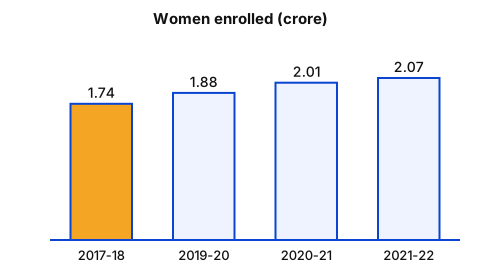
- The passage: 'from 1.74 crore in 2017-18 to 2.07 crore in 2021-22'.
- 2.07 crore is 2021-22 and 4.33 crore is total enrolment (men + women).
Trick: Year-figure questions: underline each year with its number while reading.
Answer: (A) 1.74 crore
अवधारणा: तथ्यात्मक प्रश्न – वर्ष 2017-18 को उसके आँकड़े से मिलाएँ।
- गद्यांश: 'from 1.74 crore in 2017-18 to 2.07 crore in 2021-22'।
- 2.07 crore 2021-22 का है और 4.33 crore कुल (पुरुष + महिला) नामांकन है।
ट्रिक: वर्ष-आँकड़ा प्रश्न: पढ़ते समय हर वर्ष को उसकी संख्या के साथ रेखांकित करें
उत्तर: (A) 1.74 crore
SSC CPO Paper IIEnglish Language and ComprehensionReading ComprehensionSSC CPO Paper II 2025 · 30 Apr Shift 3
Read the given passage and answer the questions that follow. According to the recently released All India Survey on Higher Education (AISHE) for the year 2021-22, more women than men have enrolled in higher education in the last eight years. Women account for 55 per cent of the total increase in total enrolment in higher education (91 lakh) since 2014-15. According to the latest survey report, out of the total enrolment of 4.33 crore, 48 per cent or 2.07 crore are women. A small rise of 2.01 crore was observed in female enrolment from 1.88 crore in 2019-20. In 2014-15, out of a total 3.42 crore enrolments, the percentage of women was 46 per cent. There has been a continuous increase in the enrolment of women since the year 2014-15, the AISHE report stated. Enrolment of women increased by 18.7 per cent during five years, from 2.01 crore in 2020-21 and from 1.74 crore in 2017-18 to 2.07 crore in 2021-22. The report released said, “The share of female enrolment in the increase in total enrolment (91 lakh) since 2014-15 is 55 per cent. There has been more increase in the enrolment of women as compared to men.”
Overall, this trend indicates a narrowing gender gap in higher education. Among the areas where women have made their mark is the science stream, in which 52.1 per cent of the total 57.18 lakh students enrolled at the undergraduate, postgraduate, MPhil, and PhD levels are women. About 51 per cent of the total enrolled at the undergraduate level are women in the science stream. In the year 2020-21, as many as 55.48 lakh students took admission to Science, of which 53.1 per cent were women, showing a slight decline. At the PG level in Science, 61.2 per cent of the 7.52 lakh students enrolled are women. Of the 45,324 students enrolled in PhD programmes in the sciences, more than half (62 per cent) are women, while only 39 per cent are men. The latest AISHE survey showed that the annual growth in female PhD enrolment from 2014-15 to 2021-22 is 10.4 per cent. However, the difference between engineering and technology disciplines is clear. Of the total students enrolled in undergraduate programmes, only 11.3 lakh are females and 27.6 lakh are males.
Q30.The main theme of the passage is:
- Aincrease in male enrolment in science and technology
- Bincrease in male enrolment in postgraduate courses
- Cincrease in total enrolment in higher education
- Dincrease in women enrolment in higher education
Show answer
Concept: Main theme – the idea repeated throughout the passage.
- The passage opens with 'more women than men have enrolled' and keeps giving female-enrolment data (total, science, PG, PhD).
- It concludes the gender gap is narrowing; male enrolment is not the focus and 'total enrolment' is too general.
Trick: Main theme = the idea every paragraph supports.
Answer: (D) increase in women enrolment in higher education
अवधारणा: मुख्य विषय – पूरे गद्यांश में दोहराया गया विचार।
- गद्यांश 'more women than men have enrolled' से शुरू होता है और महिलाओं के नामांकन के आँकड़े देता है (कुल, science, PG, PhD)।
- निष्कर्ष – gender gap घट रहा है; पुरुष नामांकन केंद्र में नहीं, 'total enrolment' बहुत सामान्य है।
ट्रिक: मुख्य विषय = वह विचार जिसे हर अनुच्छेद समर्थन दे
उत्तर: (D) increase in women enrolment in higher education
SSC CPO Paper IIEnglish Language and ComprehensionReading ComprehensionSSC CPO Paper II 2025 · 30 Apr Shift 3
Read the given passage and answer the questions that follow. DEHRADUN: The cultivation of the Dehraduni Basmati rice, renowned for its unique taste and aroma, has witnessed a drastic 62% reduction in the Doon valley in a span of just five years – between 2018 and 2022. A four-year study commissioned by the Uttarakhand Biodiversity Board, whose report came out recently, revealed that in 2018 Dehraduni Basmati was cultivated in 410.1 hectares by 680 farmers, which plummeted to 157.8 hectares by 517 farmers in 2022.
The study adds that ‘other basmati varieties, grown in 420.3 hectares of land by 560 farmers, have also come down to 180.7 hectares in 2022’. Factors affecting cultivation include increasing summer temperatures, poor soil fertility, reduced use of farmyard manure, water scarcity for irrigation, changing rain patterns, and extensive use of chemical fertilisers, according to the study.
The grain is noted for its distinctive flavour, akin to sandalwood and flowers, coupled with a slightly sweet taste, which made it stand out among the around 30 basmati varieties found in India.
Farmers cultivating the grain, long cherished for its non-waxy and non-glutinous characteristics, said that the special qualities of the basmati stemmed from a combination of soil, water, climate, and cultural practices, which are now under threat. The main area where the rice has been cultivated – Seola-Majra – has transformed into a concrete jungle, lamented a farmer. “Unplanned development has swept away the Dehraduni Basmati from many fields. We could still salvage it in remaining areas if all the anthropogenic concerns are addressed effectively,” said Jaswant Negi, a veteran farmer- cum-rice miller from Majra.
The trend of declining Dehraduni Basmati rice cultivation goes back to 1997 when several places like Seolakalan, Brahamanwalaa, Seola Khurd, and Pitthuwala, once cultivating the grain abundantly, began to have shrinking fields. They now have only a few hectares of cultivable land left.
Dhananjai Mohan, Chairman of Uttarakhand Biodiversity Board, said, “Through the study, we identified factors responsible for the dip in cultivable area of the grain. A framework has also been made for promoting Dehraduni basmati among farmers.” Meanwhile, in a ray of hope, a few entrepreneurs are reviving basmati cultivation, especially organic basmati, in parts of Doon and Uttarakhand. “We have earmarked a few acres of land in Vikasnagar on the outskirts of Doon to start with its cultivation,” said Devagya Singh, a former Hong Kong resident who has returned to the country, and taken up agriculture.
Q31.In 2022, how much area was under cultivation of Dehraduni Basmati rice?
- A420.3 hectares
- B410.1 hectares
- C157.8 hectares
- D180.7 hectares
Show answer
Concept: Factual detail – Dehraduni Basmati area in 2022.
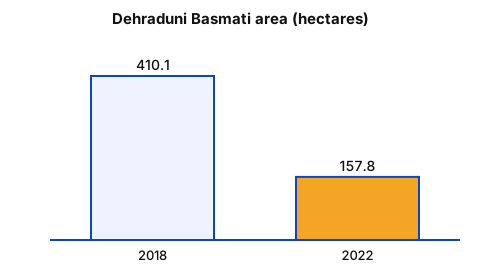
- 2018: 410.1 hectares (680 farmers) → 2022: 157.8 hectares (517 farmers).
- 420.3 and 180.7 hectares are for 'other basmati varieties', not Dehraduni Basmati.
Trick: Do not mix the Dehraduni figures with the 'other varieties' figures.
Answer: (C) 157.8 hectares
अवधारणा: तथ्यात्मक प्रश्न – 2022 में Dehraduni Basmati का क्षेत्रफल।
- 2018: 410.1 hectares (680 किसान) → 2022: 157.8 hectares (517 किसान)।
- 420.3 और 180.7 hectares 'other basmati varieties' के हैं, Dehraduni Basmati के नहीं।
ट्रिक: Dehraduni और 'other varieties' के आँकड़े आपस में न मिलाएँ
उत्तर: (C) 157.8 hectares
SSC CPO Paper IIEnglish Language and ComprehensionReading ComprehensionSSC CPO Paper II 2025 · 30 Apr Shift 3
Read the given passage and answer the questions that follow. DEHRADUN: The cultivation of the Dehraduni Basmati rice, renowned for its unique taste and aroma, has witnessed a drastic 62% reduction in the Doon valley in a span of just five years – between 2018 and 2022. A four-year study commissioned by the Uttarakhand Biodiversity Board, whose report came out recently, revealed that in 2018 Dehraduni Basmati was cultivated in 410.1 hectares by 680 farmers, which plummeted to 157.8 hectares by 517 farmers in 2022.
The study adds that ‘other basmati varieties, grown in 420.3 hectares of land by 560 farmers, have also come down to 180.7 hectares in 2022’. Factors affecting cultivation include increasing summer temperatures, poor soil fertility, reduced use of farmyard manure, water scarcity for irrigation, changing rain patterns, and extensive use of chemical fertilisers, according to the study.
The grain is noted for its distinctive flavour, akin to sandalwood and flowers, coupled with a slightly sweet taste, which made it stand out among the around 30 basmati varieties found in India.
Farmers cultivating the grain, long cherished for its non-waxy and non-glutinous characteristics, said that the special qualities of the basmati stemmed from a combination of soil, water, climate, and cultural practices, which are now under threat. The main area where the rice has been cultivated – Seola-Majra – has transformed into a concrete jungle, lamented a farmer. “Unplanned development has swept away the Dehraduni Basmati from many fields. We could still salvage it in remaining areas if all the anthropogenic concerns are addressed effectively,” said Jaswant Negi, a veteran farmer- cum-rice miller from Majra.
The trend of declining Dehraduni Basmati rice cultivation goes back to 1997 when several places like Seolakalan, Brahamanwalaa, Seola Khurd, and Pitthuwala, once cultivating the grain abundantly, began to have shrinking fields. They now have only a few hectares of cultivable land left.
Dhananjai Mohan, Chairman of Uttarakhand Biodiversity Board, said, “Through the study, we identified factors responsible for the dip in cultivable area of the grain. A framework has also been made for promoting Dehraduni basmati among farmers.” Meanwhile, in a ray of hope, a few entrepreneurs are reviving basmati cultivation, especially organic basmati, in parts of Doon and Uttarakhand. “We have earmarked a few acres of land in Vikasnagar on the outskirts of Doon to start with its cultivation,” said Devagya Singh, a former Hong Kong resident who has returned to the country, and taken up agriculture.
Q32.After reading the passage it can be inferred that it is:
- Aa scientific article
- Ba news item
- Ca survey report
- Dan official statement
Show answer
Concept: Type of text – identify the form from its features.
- It starts with a dateline 'DEHRADUN:', reports a recent study and quotes farmers and officials.
- These are features of a newspaper report – a news item; it only reports on a survey, it is not the survey report itself.
Trick: Dateline + quotes + recent event → news item.
Answer: (B) a news item
अवधारणा: पाठ का प्रकार – उसकी विशेषताओं से पहचानें।
- शुरुआत dateline 'DEHRADUN:' से, हाल के अध्ययन की खबर, किसानों व अधिकारियों के कथन।
- ये अख़बार की ख़बर (news item) के लक्षण हैं; यह सर्वे की ख़बर देता है, स्वयं survey report नहीं।
ट्रिक: Dateline + उद्धरण + ताज़ा घटना → news item
उत्तर: (B) a news item
SSC CPO Paper IIEnglish Language and ComprehensionReading ComprehensionSSC CPO Paper II 2025 · 30 Apr Shift 3
Read the given passage and answer the questions that follow. DEHRADUN: The cultivation of the Dehraduni Basmati rice, renowned for its unique taste and aroma, has witnessed a drastic 62% reduction in the Doon valley in a span of just five years – between 2018 and 2022. A four-year study commissioned by the Uttarakhand Biodiversity Board, whose report came out recently, revealed that in 2018 Dehraduni Basmati was cultivated in 410.1 hectares by 680 farmers, which plummeted to 157.8 hectares by 517 farmers in 2022.
The study adds that ‘other basmati varieties, grown in 420.3 hectares of land by 560 farmers, have also come down to 180.7 hectares in 2022’. Factors affecting cultivation include increasing summer temperatures, poor soil fertility, reduced use of farmyard manure, water scarcity for irrigation, changing rain patterns, and extensive use of chemical fertilisers, according to the study.
The grain is noted for its distinctive flavour, akin to sandalwood and flowers, coupled with a slightly sweet taste, which made it stand out among the around 30 basmati varieties found in India.
Farmers cultivating the grain, long cherished for its non-waxy and non-glutinous characteristics, said that the special qualities of the basmati stemmed from a combination of soil, water, climate, and cultural practices, which are now under threat. The main area where the rice has been cultivated – Seola-Majra – has transformed into a concrete jungle, lamented a farmer. “Unplanned development has swept away the Dehraduni Basmati from many fields. We could still salvage it in remaining areas if all the anthropogenic concerns are addressed effectively,” said Jaswant Negi, a veteran farmer- cum-rice miller from Majra.
The trend of declining Dehraduni Basmati rice cultivation goes back to 1997 when several places like Seolakalan, Brahamanwalaa, Seola Khurd, and Pitthuwala, once cultivating the grain abundantly, began to have shrinking fields. They now have only a few hectares of cultivable land left.
Dhananjai Mohan, Chairman of Uttarakhand Biodiversity Board, said, “Through the study, we identified factors responsible for the dip in cultivable area of the grain. A framework has also been made for promoting Dehraduni basmati among farmers.” Meanwhile, in a ray of hope, a few entrepreneurs are reviving basmati cultivation, especially organic basmati, in parts of Doon and Uttarakhand. “We have earmarked a few acres of land in Vikasnagar on the outskirts of Doon to start with its cultivation,” said Devagya Singh, a former Hong Kong resident who has returned to the country, and taken up agriculture.
Q33.The passage is mainly about:
- Athe framework for increasing production of Dehraduni Basmati rice
- Bthe revival of cultivation of Dehraduni Basmati rice
- Cthe factors affecting the production of Dehraduni Basmati rice
- Dthe declining cultivation of Dehraduni Basmati rice
Show answer
Concept: Main idea – the central subject that the whole passage discusses.
- Opening line: cultivation saw 'a drastic 62% reduction'; later paragraphs give causes, history of the decline and hope of revival.
- Factors, framework and revival are only parts supporting the main topic – the declining cultivation.
Trick: Main idea is usually in the first sentence; other options are sub-points.
Answer: (D) the declining cultivation of Dehraduni Basmati rice
अवधारणा: मुख्य विचार – पूरा गद्यांश जिस केंद्रीय विषय पर है।
- पहली पंक्ति: खेती में 'a drastic 62% reduction'; आगे कारण, गिरावट का इतिहास और पुनरुद्धार की आशा।
- कारण, framework और revival केवल उप-बिंदु हैं – मुख्य विषय खेती में गिरावट है।
ट्रिक: मुख्य विचार अक्सर पहले वाक्य में; बाकी विकल्प उप-बिंदु
उत्तर: (D) the declining cultivation of Dehraduni Basmati rice
SSC CPO Paper IIEnglish Language and ComprehensionReading ComprehensionSSC CPO Paper II 2025 · 30 Apr Shift 3
Read the given passage and answer the questions that follow. DEHRADUN: The cultivation of the Dehraduni Basmati rice, renowned for its unique taste and aroma, has witnessed a drastic 62% reduction in the Doon valley in a span of just five years – between 2018 and 2022. A four-year study commissioned by the Uttarakhand Biodiversity Board, whose report came out recently, revealed that in 2018 Dehraduni Basmati was cultivated in 410.1 hectares by 680 farmers, which plummeted to 157.8 hectares by 517 farmers in 2022.
The study adds that ‘other basmati varieties, grown in 420.3 hectares of land by 560 farmers, have also come down to 180.7 hectares in 2022’. Factors affecting cultivation include increasing summer temperatures, poor soil fertility, reduced use of farmyard manure, water scarcity for irrigation, changing rain patterns, and extensive use of chemical fertilisers, according to the study.
The grain is noted for its distinctive flavour, akin to sandalwood and flowers, coupled with a slightly sweet taste, which made it stand out among the around 30 basmati varieties found in India.
Farmers cultivating the grain, long cherished for its non-waxy and non-glutinous characteristics, said that the special qualities of the basmati stemmed from a combination of soil, water, climate, and cultural practices, which are now under threat. The main area where the rice has been cultivated – Seola-Majra – has transformed into a concrete jungle, lamented a farmer. “Unplanned development has swept away the Dehraduni Basmati from many fields. We could still salvage it in remaining areas if all the anthropogenic concerns are addressed effectively,” said Jaswant Negi, a veteran farmer- cum-rice miller from Majra.
The trend of declining Dehraduni Basmati rice cultivation goes back to 1997 when several places like Seolakalan, Brahamanwalaa, Seola Khurd, and Pitthuwala, once cultivating the grain abundantly, began to have shrinking fields. They now have only a few hectares of cultivable land left.
Dhananjai Mohan, Chairman of Uttarakhand Biodiversity Board, said, “Through the study, we identified factors responsible for the dip in cultivable area of the grain. A framework has also been made for promoting Dehraduni basmati among farmers.” Meanwhile, in a ray of hope, a few entrepreneurs are reviving basmati cultivation, especially organic basmati, in parts of Doon and Uttarakhand. “We have earmarked a few acres of land in Vikasnagar on the outskirts of Doon to start with its cultivation,” said Devagya Singh, a former Hong Kong resident who has returned to the country, and taken up agriculture.
Q34.Which of the following statements is NOT true according to the passage?
- ACultivation of organic variety of Dehraduni Basmati rice is being revived by Dhananjai Mohan.
- BThe cultivation of Dehraduni Basmati rice started declining way back in 1997 with shrinking fields in major cultivation areas.
- CDehraduni Basmati rice has a slight sweet taste and a distinct scented flavour, akin to sandalwood and flowers,
- DDehraduni Basmati rice is non-waxy and non-glutinous.
Show answer
Concept: NOT-true question – check each option against the passage.
- Organic basmati is being revived by 'a few entrepreneurs' such as Devagya Singh; Dhananjai Mohan is Chairman of the Biodiversity Board who spoke about the study.
- B (decline since 1997), C (sweet taste, sandalwood-flower flavour) and D (non-waxy, non-glutinous) are stated in the passage.
Trick: In NOT-true questions, watch for a wrong name attached to an action.
Answer: (A) Cultivation of organic variety of Dehraduni Basmati rice is being revived by Dhananjai Mohan.
अवधारणा: NOT-true प्रश्न – हर विकल्प को गद्यांश से मिलाएँ।
- Organic basmati का पुनरुद्धार 'a few entrepreneurs' जैसे Devagya Singh कर रहे हैं; Dhananjai Mohan Biodiversity Board के Chairman हैं।
- B (1997 से गिरावट), C (मीठा स्वाद, चंदन-फूल जैसी सुगंध), D (non-waxy, non-glutinous) गद्यांश में हैं।
ट्रिक: NOT-true प्रश्नों में गलत व्यक्ति से जुड़ा काम पकड़ें
उत्तर: (A) Cultivation of organic variety of Dehraduni Basmati rice is being revived by Dhananjai Mohan.
SSC CPO Paper IIEnglish Language and ComprehensionReading ComprehensionSSC CPO Paper II 2025 · 30 Apr Shift 3
Read the given passage and answer the questions that follow. DEHRADUN: The cultivation of the Dehraduni Basmati rice, renowned for its unique taste and aroma, has witnessed a drastic 62% reduction in the Doon valley in a span of just five years – between 2018 and 2022. A four-year study commissioned by the Uttarakhand Biodiversity Board, whose report came out recently, revealed that in 2018 Dehraduni Basmati was cultivated in 410.1 hectares by 680 farmers, which plummeted to 157.8 hectares by 517 farmers in 2022.
The study adds that ‘other basmati varieties, grown in 420.3 hectares of land by 560 farmers, have also come down to 180.7 hectares in 2022’. Factors affecting cultivation include increasing summer temperatures, poor soil fertility, reduced use of farmyard manure, water scarcity for irrigation, changing rain patterns, and extensive use of chemical fertilisers, according to the study.
The grain is noted for its distinctive flavour, akin to sandalwood and flowers, coupled with a slightly sweet taste, which made it stand out among the around 30 basmati varieties found in India.
Farmers cultivating the grain, long cherished for its non-waxy and non-glutinous characteristics, said that the special qualities of the basmati stemmed from a combination of soil, water, climate, and cultural practices, which are now under threat. The main area where the rice has been cultivated – Seola-Majra – has transformed into a concrete jungle, lamented a farmer. “Unplanned development has swept away the Dehraduni Basmati from many fields. We could still salvage it in remaining areas if all the anthropogenic concerns are addressed effectively,” said Jaswant Negi, a veteran farmer- cum-rice miller from Majra.
The trend of declining Dehraduni Basmati rice cultivation goes back to 1997 when several places like Seolakalan, Brahamanwalaa, Seola Khurd, and Pitthuwala, once cultivating the grain abundantly, began to have shrinking fields. They now have only a few hectares of cultivable land left.
Dhananjai Mohan, Chairman of Uttarakhand Biodiversity Board, said, “Through the study, we identified factors responsible for the dip in cultivable area of the grain. A framework has also been made for promoting Dehraduni basmati among farmers.” Meanwhile, in a ray of hope, a few entrepreneurs are reviving basmati cultivation, especially organic basmati, in parts of Doon and Uttarakhand. “We have earmarked a few acres of land in Vikasnagar on the outskirts of Doon to start with its cultivation,” said Devagya Singh, a former Hong Kong resident who has returned to the country, and taken up agriculture.
Q35.Which of the following is the main area where Dehraduni Basmati rice is cultivated?
- ABrahamanwalaa
- BSeolakalan
- CSeola Khurd
- DSeola Majra
Show answer
Concept: Factual detail – the 'main area' of cultivation.
- The passage: 'The main area where the rice has been cultivated – Seola-Majra – has transformed into a concrete jungle'.
- Seolakalan, Brahamanwalaa and Seola Khurd are listed only among places with shrinking fields.
Trick: Find the exact phrase 'main area' in the passage.
Answer: (D) Seola Majra
अवधारणा: तथ्यात्मक प्रश्न – खेती का 'main area'।
- गद्यांश: 'The main area where the rice has been cultivated – Seola-Majra – has transformed into a concrete jungle'।
- Seolakalan, Brahamanwalaa, Seola Khurd सिर्फ़ सिकुड़ते खेतों वाली जगहों में गिनाए गए हैं।
ट्रिक: गद्यांश में ठीक 'main area' शब्द खोजें
उत्तर: (D) Seola Majra
SSC CPO Paper IIEnglish Language and ComprehensionReading ComprehensionSSC CPO Paper II 2025 · 30 Apr Shift 3
Read the given passage and answer the questions that follow. The East India Company began trade in Bengal. The first English factory was set up on the banks of the river Hugli in 1651. This was the base from which the Company’s traders, known at that time as ‘factors’, operated. The factory had a warehouse where goods for export were stored, and it had offices where Company officials sat. As trade expanded, the Company persuaded merchants and traders to come and settle near the factory. By 1696, it began building a fort around the settlement. Two years later, it bribed Mughal officials into giving the Company zamindari rights over three villages. One of these was Kalikata, which later grew into the city of Calcutta or Kolkata as it is known today. It also persuaded the Mughal emperor Aurangzeb to issue a farman granting the Company the right to trade duty free.
The Company tried continuously to press for more concessions and manipulate existing privileges. Aurangzeb’s farman, for instance, had granted only the Company the right to trade duty free. But officials of the Company, who were carrying on private trade on the side, were expected to pay duty. This they refused to pay, causing an enormous loss of revenue for Bengal.
How could the Nawab of Bengal, Murshid Quli Khan, not protest? Through the early eighteenth century, the conflict between the Company and the nawabs of Bengal intensified.
After the death of Aurangzeb, the Bengal nawabs asserted their power and autonomy, as other regional powers were doing at that time. Murshid Quli Khan was followed by Alivardi Khan and then Sirajuddaulah as the Nawab of Bengal. Each one of them was a strong ruler. They refused to grant the Company concessions, demanded large tributes for the Company’s right to trade, denied it any right to mint coins, and stopped it from extending its fortifications. Accusing the Company of deceit, they claimed that the Company was depriving the Bengal government of huge amounts of revenue and undermining the authority of the nawab. It was refusing to pay taxes, writing disrespectful letters, and trying to humiliate the nawab and his officials.
Q36.Which of the following statements indicates that some company officials were carrying on dishonest practices for their own benefit?
- AThey refused to pay duty to Bengal on their own private trades.
- BThey acquired the right to mint coins.
- CThey tried continuously to press for more concessions.
- DThey bribed the Mughal officials into giving the Company zamindari rights over three villages.
Show answer
Concept: Inference – 'dishonest practice for their own benefit' means personal gain at the state's cost.
- Officials carried on private trade and refused to pay duty on it, though only the Company was exempt – causing a big loss to Bengal.
- Bribery (D) and pressing for concessions (C) were done for the Company, not personal benefit; minting rights (B) were denied.
Trick: 'Own benefit' → private trade of officials.
Answer: (A) They refused to pay duty to Bengal on their own private trades.
अवधारणा: अनुमान – 'अपने फ़ायदे के लिए बेईमानी' = राज्य की कीमत पर निजी लाभ।
- अधिकारी निजी व्यापार करते थे और उस पर duty नहीं देते थे, जबकि छूट केवल Company को थी – Bengal को भारी नुकसान।
- रिश्वत (D) और रियायतें माँगना (C) Company के लिए थे, निजी लाभ हेतु नहीं; सिक्के ढालने (B) का अधिकार मिला ही नहीं।
ट्रिक: 'Own benefit' → अधिकारियों का private trade
उत्तर: (A) They refused to pay duty to Bengal on their own private trades.
SSC CPO Paper IIEnglish Language and ComprehensionReading ComprehensionSSC CPO Paper II 2025 · 30 Apr Shift 3
Read the given passage and answer the questions that follow. The East India Company began trade in Bengal. The first English factory was set up on the banks of the river Hugli in 1651. This was the base from which the Company’s traders, known at that time as ‘factors’, operated. The factory had a warehouse where goods for export were stored, and it had offices where Company officials sat. As trade expanded, the Company persuaded merchants and traders to come and settle near the factory. By 1696, it began building a fort around the settlement. Two years later, it bribed Mughal officials into giving the Company zamindari rights over three villages. One of these was Kalikata, which later grew into the city of Calcutta or Kolkata as it is known today. It also persuaded the Mughal emperor Aurangzeb to issue a farman granting the Company the right to trade duty free.
The Company tried continuously to press for more concessions and manipulate existing privileges. Aurangzeb’s farman, for instance, had granted only the Company the right to trade duty free. But officials of the Company, who were carrying on private trade on the side, were expected to pay duty. This they refused to pay, causing an enormous loss of revenue for Bengal.
How could the Nawab of Bengal, Murshid Quli Khan, not protest? Through the early eighteenth century, the conflict between the Company and the nawabs of Bengal intensified.
After the death of Aurangzeb, the Bengal nawabs asserted their power and autonomy, as other regional powers were doing at that time. Murshid Quli Khan was followed by Alivardi Khan and then Sirajuddaulah as the Nawab of Bengal. Each one of them was a strong ruler. They refused to grant the Company concessions, demanded large tributes for the Company’s right to trade, denied it any right to mint coins, and stopped it from extending its fortifications. Accusing the Company of deceit, they claimed that the Company was depriving the Bengal government of huge amounts of revenue and undermining the authority of the nawab. It was refusing to pay taxes, writing disrespectful letters, and trying to humiliate the nawab and his officials.
Q37.How did the Mughal emperor Aurangzeb help the East India Company in making its trades profitable?
- ABy giving the company the rights to trade duty free
- BBy allowing the company to fortify its settlement
- CBy permitting the company officials to trade privately
- DBy gifting the company the zamindari of three villages
Show answer
Concept: Factual detail – Aurangzeb's farman.
- The Company 'persuaded the Mughal emperor Aurangzeb to issue a farman granting the Company the right to trade duty free'.
- Zamindari was got by bribing Mughal officials, fortification was the Company's own act, and private trade by officials was not permitted duty free.
Yaad rakhein: Farman of Aurangzeb = duty-free trade.
Answer: (A) By giving the company the rights to trade duty free
अवधारणा: तथ्यात्मक प्रश्न – औरंगज़ेब का farman।
- Company ने 'Aurangzeb to issue a farman granting the Company the right to trade duty free' करवाया।
- Zamindari Mughal अधिकारियों को रिश्वत देकर मिली, किलेबंदी Company ने स्वयं की, अधिकारियों के निजी व्यापार को छूट नहीं थी।
याद रखें: औरंगज़ेब का farman = duty-free trade
उत्तर: (A) By giving the company the rights to trade duty free
SSC CPO Paper IIEnglish Language and ComprehensionReading ComprehensionSSC CPO Paper II 2025 · 30 Apr Shift 3
Read the given passage and answer the questions that follow. The East India Company began trade in Bengal. The first English factory was set up on the banks of the river Hugli in 1651. This was the base from which the Company’s traders, known at that time as ‘factors’, operated. The factory had a warehouse where goods for export were stored, and it had offices where Company officials sat. As trade expanded, the Company persuaded merchants and traders to come and settle near the factory. By 1696, it began building a fort around the settlement. Two years later, it bribed Mughal officials into giving the Company zamindari rights over three villages. One of these was Kalikata, which later grew into the city of Calcutta or Kolkata as it is known today. It also persuaded the Mughal emperor Aurangzeb to issue a farman granting the Company the right to trade duty free.
The Company tried continuously to press for more concessions and manipulate existing privileges. Aurangzeb’s farman, for instance, had granted only the Company the right to trade duty free. But officials of the Company, who were carrying on private trade on the side, were expected to pay duty. This they refused to pay, causing an enormous loss of revenue for Bengal.
How could the Nawab of Bengal, Murshid Quli Khan, not protest? Through the early eighteenth century, the conflict between the Company and the nawabs of Bengal intensified.
After the death of Aurangzeb, the Bengal nawabs asserted their power and autonomy, as other regional powers were doing at that time. Murshid Quli Khan was followed by Alivardi Khan and then Sirajuddaulah as the Nawab of Bengal. Each one of them was a strong ruler. They refused to grant the Company concessions, demanded large tributes for the Company’s right to trade, denied it any right to mint coins, and stopped it from extending its fortifications. Accusing the Company of deceit, they claimed that the Company was depriving the Bengal government of huge amounts of revenue and undermining the authority of the nawab. It was refusing to pay taxes, writing disrespectful letters, and trying to humiliate the nawab and his officials.
Q38.Which of the following was the main accusation of the Nawab of Bengal against the East India Company?
- AIt was depriving the Bengal government of huge amounts of revenue by deceitful practices.
- BIt had grabbed the Zamindari of three villages.
- CIt was extending its fortifications.
- DIt wrote disrespectful letters and humiliated the nawab’s officials.
Show answer
Concept: Main accusation – the charge the nawabs stressed.
- 'Accusing the Company of deceit, they claimed that the Company was depriving the Bengal government of huge amounts of revenue…'
- Disrespectful letters and fortifications were secondary complaints; zamindari was not their accusation.
Trick: Look for the verb 'accusing' – the main charge follows it.
Answer: (A) It was depriving the Bengal government of huge amounts of revenue by deceitful practices.
अवधारणा: मुख्य आरोप – नवाबों द्वारा लगाया गया प्रमुख आरोप।
- 'Accusing the Company of deceit, they claimed that the Company was depriving the Bengal government of huge amounts of revenue…'
- अपमानजनक पत्र और किलेबंदी गौण शिकायतें थीं; zamindari उनका आरोप नहीं था।
ट्रिक: 'accusing' शब्द खोजें – मुख्य आरोप उसी के बाद है
उत्तर: (A) It was depriving the Bengal government of huge amounts of revenue by deceitful practices.
SSC CPO Paper IIEnglish Language and ComprehensionReading ComprehensionSSC CPO Paper II 2025 · 30 Apr Shift 3
Read the given passage and answer the questions that follow. The East India Company began trade in Bengal. The first English factory was set up on the banks of the river Hugli in 1651. This was the base from which the Company’s traders, known at that time as ‘factors’, operated. The factory had a warehouse where goods for export were stored, and it had offices where Company officials sat. As trade expanded, the Company persuaded merchants and traders to come and settle near the factory. By 1696, it began building a fort around the settlement. Two years later, it bribed Mughal officials into giving the Company zamindari rights over three villages. One of these was Kalikata, which later grew into the city of Calcutta or Kolkata as it is known today. It also persuaded the Mughal emperor Aurangzeb to issue a farman granting the Company the right to trade duty free.
The Company tried continuously to press for more concessions and manipulate existing privileges. Aurangzeb’s farman, for instance, had granted only the Company the right to trade duty free. But officials of the Company, who were carrying on private trade on the side, were expected to pay duty. This they refused to pay, causing an enormous loss of revenue for Bengal.
How could the Nawab of Bengal, Murshid Quli Khan, not protest? Through the early eighteenth century, the conflict between the Company and the nawabs of Bengal intensified.
After the death of Aurangzeb, the Bengal nawabs asserted their power and autonomy, as other regional powers were doing at that time. Murshid Quli Khan was followed by Alivardi Khan and then Sirajuddaulah as the Nawab of Bengal. Each one of them was a strong ruler. They refused to grant the Company concessions, demanded large tributes for the Company’s right to trade, denied it any right to mint coins, and stopped it from extending its fortifications. Accusing the Company of deceit, they claimed that the Company was depriving the Bengal government of huge amounts of revenue and undermining the authority of the nawab. It was refusing to pay taxes, writing disrespectful letters, and trying to humiliate the nawab and his officials.
Q39.The passage is mainly about:
- Ahow the East India Company established itself firmly in Bengal
- Bthe private trades of company officials in Bengal
- Cthe power exerted by the Nawabs of Bengal on the East India Company
- Dthe Company’s zamindari of three villages in Bengal
Show answer
Concept: Main idea – the overall development described.
- The passage traces the Company's rise in Bengal: factory (1651), settlement, fort (1696), zamindari of three villages, duty-free farman, and pressing for more privileges.
- Private trade, the nawabs' resistance and zamindari are single parts of this larger story.
Trick: Choose the option that covers the whole passage, not one paragraph.
Answer: (A) how the East India Company established itself firmly in Bengal
अवधारणा: मुख्य विचार – वर्णित समग्र घटनाक्रम।
- गद्यांश Bengal में Company के उदय को दिखाता है: factory (1651), बस्ती, किला (1696), तीन गाँवों की zamindari, duty-free farman, और अधिक विशेषाधिकार।
- निजी व्यापार, नवाबों का विरोध और zamindari इस बड़ी कहानी के हिस्से मात्र हैं।
ट्रिक: वह विकल्प चुनें जो पूरे गद्यांश को समेटे, सिर्फ़ एक अनुच्छेद को नहीं
उत्तर: (A) how the East India Company established itself firmly in Bengal
SSC CPO Paper IIEnglish Language and ComprehensionReading ComprehensionSSC CPO Paper II 2025 · 30 Apr Shift 3
Read the given passage and answer the questions that follow. The East India Company began trade in Bengal. The first English factory was set up on the banks of the river Hugli in 1651. This was the base from which the Company’s traders, known at that time as ‘factors’, operated. The factory had a warehouse where goods for export were stored, and it had offices where Company officials sat. As trade expanded, the Company persuaded merchants and traders to come and settle near the factory. By 1696, it began building a fort around the settlement. Two years later, it bribed Mughal officials into giving the Company zamindari rights over three villages. One of these was Kalikata, which later grew into the city of Calcutta or Kolkata as it is known today. It also persuaded the Mughal emperor Aurangzeb to issue a farman granting the Company the right to trade duty free.
The Company tried continuously to press for more concessions and manipulate existing privileges. Aurangzeb’s farman, for instance, had granted only the Company the right to trade duty free. But officials of the Company, who were carrying on private trade on the side, were expected to pay duty. This they refused to pay, causing an enormous loss of revenue for Bengal.
How could the Nawab of Bengal, Murshid Quli Khan, not protest? Through the early eighteenth century, the conflict between the Company and the nawabs of Bengal intensified.
After the death of Aurangzeb, the Bengal nawabs asserted their power and autonomy, as other regional powers were doing at that time. Murshid Quli Khan was followed by Alivardi Khan and then Sirajuddaulah as the Nawab of Bengal. Each one of them was a strong ruler. They refused to grant the Company concessions, demanded large tributes for the Company’s right to trade, denied it any right to mint coins, and stopped it from extending its fortifications. Accusing the Company of deceit, they claimed that the Company was depriving the Bengal government of huge amounts of revenue and undermining the authority of the nawab. It was refusing to pay taxes, writing disrespectful letters, and trying to humiliate the nawab and his officials.
Q40.Who first protested in Bengal against the corrupt practices of the East India Company?
- AMurshid Quli Khan
- BAlivardi Khan
- CAurangzeb
- DSirajuddaulah
Show answer
Concept: Factual detail – the first nawab to protest.
- After the duty evasion, the passage asks: 'How could the Nawab of Bengal, Murshid Quli Khan, not protest?'
- Alivardi Khan and Sirajuddaulah came after him; Aurangzeb was the emperor who granted the farman.
Yaad rakhein: Order of nawabs: Murshid Quli Khan → Alivardi Khan → Sirajuddaulah.
Answer: (A) Murshid Quli Khan
अवधारणा: तथ्यात्मक प्रश्न – विरोध करने वाले पहले नवाब।
- Duty चोरी के बाद गद्यांश पूछता है: 'How could the Nawab of Bengal, Murshid Quli Khan, not protest?'
- Alivardi Khan और Sirajuddaulah उनके बाद आए; Aurangzeb farman देने वाले सम्राट थे।
याद रखें: नवाबों का क्रम: Murshid Quli Khan → Alivardi Khan → Sirajuddaulah
उत्तर: (A) Murshid Quli Khan
SSC CPO Paper IIEnglish Language and ComprehensionReading ComprehensionSSC CPO Paper II 2025 · 30 Apr Shift 3

