Q381.Select the most appropriate meaning of the given idiom.
Fight tooth and nail
- ABe in high spirits
- BInsist on something
- CFight very fiercely
- DWin the competition
Show answer
Concept: 'Fight tooth and nail' means to fight or try with all one's strength, very fiercely.
- Example: The team fought tooth and nail to save the match.
- It describes the effort, not the result – so not 'win the competition'.
- Meaning: 'Fight very fiercely'.
Yaad rakhein: Using even teeth and nails = using every possible weapon.
Answer: (C) Fight very fiercely
अवधारणा: 'Fight tooth and nail' का अर्थ है पूरी ताकत से, बहुत ज़ोर से लड़ना/प्रयास करना।
- उदाहरण: The team fought tooth and nail to save the match.
- यह प्रयास बताता है, परिणाम नहीं – इसलिए 'win the competition' नहीं।
- अर्थ: 'Fight very fiercely' (जी-जान से लड़ना)।
याद रखें: दाँत और नाखून तक से लड़ना = हर तरीके से लड़ना।
उत्तर: (C) Fight very fiercely
SSC CPO Paper IIEnglish Language and ComprehensionIdioms and PhrasesSSC CPO Paper II 2021 · 8 Nov Shift 1
Q382.Select the correct active form of the given sentence.
I am vexed by her behaviour.
- AHer behaviour has vexed me.
- BHer behaviour vexes me.
- CHer behaviour vexed me.
- DHer behaviour is vexing to me.
Show answer
Concept: 'am/is/are + V3' is simple present passive; its active form uses V1/V1+s.
- Passive: I am vexed by her behaviour – simple present.
- Agent her behaviour (singular) → subject; verb vexes; object me.
- (A) present perfect, (C) simple past, (D) changes the structure.
Trick: is/am/are + V3 → V1(s) – simple present stays simple present.
Answer: (B) Her behaviour vexes me.
अवधारणा: 'am/is/are + V3' simple present passive है; इसका active V1/V1+s से बनता है।
- Passive: I am vexed by her behaviour – simple present।
- her behaviour (एकवचन) subject; क्रिया vexes; object me।
- (A) present perfect, (C) simple past, (D) संरचना बदल दी।
ट्रिक: is/am/are + V3 → V1(s) – tense वही रहता है।
उत्तर: (B) Her behaviour vexes me.
SSC CPO Paper IIEnglish Language and ComprehensionActive and Passive VoiceSSC CPO Paper II 2021 · 8 Nov Shift 1
Q383.Select the most appropriate option to fill in the blank.
The old telephone ______ nobody wants has been thrown into the junkyard.
- Awhat
- Bwho
- Cwhich
- Dwhom
Show answer
Concept: For things (non-living) the relative pronoun is 'which' (or 'that').
- Antecedent: the old telephone – a thing.
- The old telephone which nobody wants has been thrown …
- 'who/whom' are for persons; 'what' cannot follow a noun.
Trick: Person → who/whom; thing → which; both → that.
Answer: (C) which
अवधारणा: निर्जीव वस्तु के लिए relative pronoun 'which' (या 'that') आता है।
- Antecedent: the old telephone – वस्तु।
- The old telephone which nobody wants has been thrown …
- 'who/whom' व्यक्ति के लिए; 'what' noun के बाद नहीं आता।
ट्रिक: व्यक्ति → who/whom; वस्तु → which; दोनों → that।
उत्तर: (C) which
SSC CPO Paper IIEnglish Language and ComprehensionFill in the BlanksSSC CPO Paper II 2021 · 8 Nov Shift 1
Q384.Select the most appropriate indirect form of the given sentence.
Anshul said to Vibha, “We will shift all the furniture to the new house.”
- AAnshul told Vibha that they will shift all the furniture to the new house.
- BAnshul told Vibha that they would shift all the furniture to the new house.
- CAnshul told Vibha that they will be shifting all the furniture to the new house.
- DAnshul told Vibha that we would shift all the furniture to the new house.
Show answer
Concept: Past reporting verb: 'will' → 'would'; 'we' → 'they' (Anshul and others); 'said to' → 'told … that'.
- We will shift → they would shift.
- (A) and (C) keep 'will'; (D) keeps 'we'.
- Correct: Anshul told Vibha that they would shift all the furniture to the new house.
Trick: will → would, shall → should whenever the reporting verb is past.
Answer: (B) Anshul told Vibha that they would shift all the furniture to the new house.
अवधारणा: Reporting verb past में: 'will' → 'would'; 'we' → 'they'; 'said to' → 'told … that'।
- We will shift → they would shift।
- (A), (C) में 'will' रह गया; (D) में 'we' रह गया।
- सही: Anshul told Vibha that they would shift all the furniture …
ट्रिक: Reporting verb past हो तो will → would, shall → should।
उत्तर: (B) Anshul told Vibha that they would shift all the furniture to the new house.
SSC CPO Paper IIEnglish Language and ComprehensionDirect and Indirect SpeechSSC CPO Paper II 2021 · 8 Nov Shift 1
Q385.Given below are six sentences. A and F are the first and the last sentences. The rest of the sentences namely B, C, D and E are jumbled. Select the option that gives their correct order. A. It was noon and by now the two bandits were very hungry.
B. Now the one who was guarding the treasure thought, “It is a pity that this treasure has to be divided between two.”
C. So they decided that one of them would stay near the treasure and guard it.
D. And the other one would go to the neighbouring village and buy some food.
E. The one who stayed back, placed his sword near the treasure and kept guard while the other set off in the direction of the village.
F. “It would be so much simpler if I could take it all.”
- AACEBDF
- BACDEBF
- CABCDEF
- DADECBF
Show answer
Concept: A and F are fixed; follow the plan the hungry bandits made and what happened next.
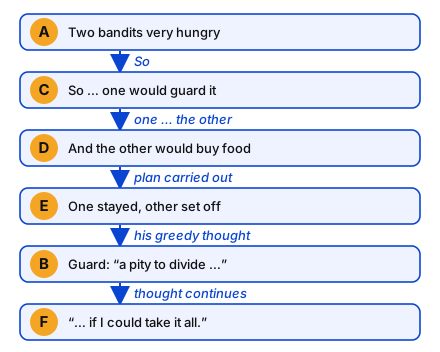
- A: they were hungry. C: So they decided that one … would guard it – 'So' follows hunger.
- D: And the other one would go … buy some food – second half of the plan.
- E: the plan is carried out – one stays, the other sets off.
- B: the guard's greedy thought; F continues his thought: “It would be so much simpler …”
Trick: 'one of them … And the other one' – C and D are a pair; F must follow B's quotation.
Answer: (B) ACDEBF
अवधारणा: A और F तय हैं; भूखे डाकुओं की योजना और उसके बाद की घटनाओं का क्रम देखें।
- A: वे भूखे थे। C: So they decided that one … would guard it – 'So' भूख का परिणाम।
- D: And the other one would go … buy some food – योजना का दूसरा भाग।
- E: योजना लागू – एक रुका, दूसरा गाँव चला।
- B: रखवाले का लालची विचार; F उसी विचार को आगे बढ़ाता है।
ट्रिक: 'one of them … And the other one' – C और D जोड़ी हैं; F, B के उद्धरण के बाद आएगा।
उत्तर: (B) ACDEBF
SSC CPO Paper IIEnglish Language and ComprehensionPara JumblesSSC CPO Paper II 2021 · 8 Nov Shift 1
Q386.Select the most appropriate indirect form of the given sentence.
Harry said to Margaret, “I already have an appointment at nine but I can fit you in at ten for half an hour.”
- AHarry told Margaret that I already have an appointment at nine but I can fit you in at ten for half an hour.
- BHarry told Margaret that he already had an appointment at nine but he can fit you in at ten for half an hour.
- CHarry told Margaret that I am already having an appointment at nine but I can fit her in at ten for half an hour.
- DHarry told Margaret that he already had an appointment at nine but he could fit her in at ten for half an hour.
Show answer
Concept: Past reporting verb: simple present → simple past ('have' → 'had'), 'can' → 'could', 'I' → 'he', 'you' → 'her' (Margaret).
- I already have an appointment → he already had an appointment.
- I can fit you in → he could fit her in.
- (A) unchanged; (B) keeps 'can' and 'you'; (C) keeps 'I' and changes the tense wrongly.
Trick: Change both clauses after 'but' too – tense and pronouns.
Answer: (D) Harry told Margaret that he already had an appointment at nine but he could fit her in at ten for half an hour.
अवधारणा: Reporting verb past में: simple present → simple past ('have' → 'had'), 'can' → 'could', 'I' → 'he', 'you' → 'her' (Margaret)।
- I already have an appointment → he already had an appointment।
- I can fit you in → he could fit her in।
- (A) बदला ही नहीं; (B) में 'can/you'; (C) में 'I' और गलत tense।
ट्रिक: 'but' के बाद वाले clause में भी tense और pronoun बदलें।
उत्तर: (D) Harry told Margaret that he already had an appointment at nine but he could fit her in at ten for half an hour.
SSC CPO Paper IIEnglish Language and ComprehensionDirect and Indirect SpeechSSC CPO Paper II 2021 · 8 Nov Shift 1
Q387.Parts of the following sentence are given as options. Identify the segment that contains a grammatical error.
Mr. Bansal is the more methodical person in our office staff.
- Ain our
- Bthe more
- CMr. Bansal is
- Doffice staff.
Show answer
Concept: When one person is compared with a whole group (more than two), the superlative is used: 'the most methodical'.
- Comparison is with the whole office staff → superlative.
- Correct: Mr. Bansal is the most methodical person in our office staff.
- 'the more' is used only when comparing two.
Trick: 'in our office/class/group' after the adjective → superlative degree.
Answer: (B) the more
अवधारणा: जब एक व्यक्ति की तुलना पूरे समूह (दो से अधिक) से हो तो superlative आता है: 'the most methodical'।
- तुलना पूरे office staff से है → superlative।
- सही: Mr. Bansal is the most methodical person in our office staff.
- 'the more' केवल दो की तुलना में आता है।
ट्रिक: 'in our office/class/group' दिखे → superlative degree।
उत्तर: (B) the more
SSC CPO Paper IIEnglish Language and ComprehensionError SpottingSSC CPO Paper II 2021 · 8 Nov Shift 1
Q388.Select the correct active form of the given sentence.
The strike has been called off by the workers.
- AThe workers are calling off the strike.
- BThe workers have called off the strike.
- CThe strike has called off the workers.
- DThe workers had called off the strike.
Show answer
Concept: Present perfect passive 'has been + V3' becomes active 'have/has + V3'; plural subject 'the workers' takes 'have'.
- Agent the workers → subject; has been called off → have called off.
- Active: The workers have called off the strike.
- (A) present continuous, (D) past perfect, (C) makes 'strike' the doer.
Trick: has/have been + V3 → has/have + V3 (plural subject → have).
Answer: (B) The workers have called off the strike.
अवधारणा: Present perfect passive 'has been + V3' का active 'have/has + V3'; बहुवचन subject 'the workers' के साथ 'have'।
- the workers subject; has been called off → have called off।
- Active: The workers have called off the strike.
- (A) present continuous, (D) past perfect, (C) में strike को कर्ता बना दिया।
ट्रिक: has/have been + V3 → has/have + V3 (बहुवचन → have)।
उत्तर: (B) The workers have called off the strike.
SSC CPO Paper IIEnglish Language and ComprehensionActive and Passive VoiceSSC CPO Paper II 2021 · 8 Nov Shift 1
Q389.Select the correct active form of the given sentence.
Let this letter be posted at once.
- AHe will post this letter at once.
- BThis letter needs to be posted at once.
- CThis letter will be posted at once.
- DPost this letter at once.
Show answer
Concept: Imperative passive 'Let + object + be + V3' becomes a direct command in the active: 'V1 + object'.
- Let this letter be posted at once. = an order.
- Remove 'Let … be' and use the base verb: Post this letter at once.
- (A) and (C) are future statements; (B) is still passive.
Trick: Let + O + be + V3 → V1 + O.
Answer: (D) Post this letter at once.
अवधारणा: आज्ञार्थक passive 'Let + object + be + V3' का active सीधा आदेश 'V1 + object' बनता है।
- Let this letter be posted at once. = आदेश।
- 'Let … be' हटाकर V1 लगाएँ: Post this letter at once.
- (A), (C) future statements; (B) अभी भी passive।
ट्रिक: Let + O + be + V3 → V1 + O।
उत्तर: (D) Post this letter at once.
SSC CPO Paper IIEnglish Language and ComprehensionActive and Passive VoiceSSC CPO Paper II 2021 · 8 Nov Shift 1
Q390.Select the most appropriate direct form of the given sentence.
The student requested the teacher to speak a little slowly so that he could note down the points.
- AThe student told to the teacher, “Please speak a little slowly so that I could note down the points.”
- BThe student said , “Madam, speak a little slowly so that we can note down the points.”
- CThe student said to the teacher, “Please speak a little slowly so that I can note down the points.”
- DThe student said to the teacher, “Speak a little slowly so that he could note down the points.”
Show answer
Concept: 'requested … to + V1' in indirect speech comes from an imperative with 'Please'; 'he could' goes back to 'I can'.
- requested the teacher → said to the teacher, “Please …”
- so that he could note down → so that I can note down.
- (A) 'told to' and 'could'; (B) 'we' and 'Madam' not in the original; (D) keeps 'he could' and drops 'Please'.
Trick: requested → 'Please …' ; ordered → plain command.
Answer: (C) The student said to the teacher, “Please speak a little slowly so that I can note down the points.”
अवधारणा: Indirect में 'requested … to + V1' direct में 'Please' वाले आदेश से आता है; 'he could' → 'I can'।
- requested the teacher → said to the teacher, “Please …”
- so that he could note down → so that I can note down।
- (A) 'told to', 'could'; (B) 'we', 'Madam' मूल में नहीं; (D) 'he could' रह गया और 'Please' नहीं।
ट्रिक: requested → 'Please …'; ordered → सीधा आदेश।
उत्तर: (C) The student said to the teacher, “Please speak a little slowly so that I can note down the points.”
SSC CPO Paper IIEnglish Language and ComprehensionDirect and Indirect SpeechSSC CPO Paper II 2021 · 8 Nov Shift 1
Q391.Select the most appropriate word for the given group of words.
A traveller who moves from one region or country to another
- Atruant
- Bmigrant
- Citinerant
- Dvagrant
Show answer
Concept: A person who moves from one region or country to another (to live or work) is a migrant.
- Migrant – moves from one place/country to another.
- Truant – a student absent without permission; Vagrant – homeless wanderer.
- Itinerant – travels from place to place, usually for work (e.g. a travelling salesman), not specifically region to region.
Yaad rakhein: migrate → migrant (birds migrate from one region to another).
Answer: (B) migrant
अवधारणा: जो व्यक्ति एक क्षेत्र या देश से दूसरे में जाता है, उसे migrant (प्रवासी) कहते हैं।
- Migrant – एक स्थान/देश से दूसरे में जाने वाला।
- Truant – बिना अनुमति स्कूल से गायब छात्र; Vagrant – बेघर आवारा।
- Itinerant – काम के लिए जगह-जगह घूमने वाला।
याद रखें: migrate → migrant (पक्षी एक क्षेत्र से दूसरे में migrate करते हैं)।
उत्तर: (B) migrant
SSC CPO Paper IIEnglish Language and ComprehensionOne Word SubstitutionSSC CPO Paper II 2021 · 8 Nov Shift 1
Q392.Select the correct passive form of the given sentence.
Who keeps the accounts of this hotel?
- ABy whom have the accounts of this hotelbeen kept?
- BBy whom are the accounts being kept of this hotel?
- CBy whom are the accounts of this hotel kept?
- DBy whom the account is being kept of this hotel?
Show answer
Concept: An active question beginning with 'Who' becomes passive with 'By whom'; simple present → 'is/are + V3'.
- Object the accounts of this hotel (plural) → are … kept.
- Pattern: By whom + are + object + V3?
- By whom are the accounts of this hotel kept?
- (A) present perfect; (B) and (D) continuous tense and split phrase.
Trick: Who → By whom; keeps (simple present) → are kept.
Answer: (C) By whom are the accounts of this hotel kept?
अवधारणा: 'Who' से शुरू होने वाले active प्रश्न का passive 'By whom' से बनता है; simple present → 'is/are + V3'।
- Object the accounts of this hotel (बहुवचन) → are … kept।
- संरचना: By whom + are + object + V3?
- By whom are the accounts of this hotel kept?
- (A) present perfect; (B), (D) continuous tense।
ट्रिक: Who → By whom; keeps → are kept।
उत्तर: (C) By whom are the accounts of this hotel kept?
SSC CPO Paper IIEnglish Language and ComprehensionActive and Passive VoiceSSC CPO Paper II 2021 · 8 Nov Shift 1
Q393.Parts of the following sentence are given as options. Identify the segment that contains a grammatical error.
If you will search his pockets you will surely find your watch.
- Afind your watch
- Bwill search
- Cyou will surely
- DIf you
Show answer
Concept: In a first conditional, the 'if' clause takes simple present; 'will' is used only in the main clause.
- If you will search → If you search.
- Main clause you will surely find your watch is correct.
- Correct: If you search his pockets, you will surely find your watch.
Trick: If + present, will + V1 – no 'will' after 'if'.
Answer: (B) will search
अवधारणा: First conditional में 'if' वाले clause में simple present आता है; 'will' केवल main clause में।
- If you will search → If you search।
- Main clause you will surely find your watch सही है।
- सही: If you search his pockets, you will surely find your watch.
ट्रिक: If + present, will + V1 – 'if' के बाद 'will' नहीं।
उत्तर: (B) will search
SSC CPO Paper IIEnglish Language and ComprehensionError SpottingSSC CPO Paper II 2021 · 8 Nov Shift 1
Q394.Select the most appropriate option to substitute the underlined segment in the given
sentence. If there is no need to substitute it, select ‘No substitution required’.
Being seen the film once he doesn’t want to see it again.
- ABecause seeing the film
- BIf seeing a film
- CHaving seen the film
- DNo substitution required
Show answer
Concept: An action completed before another is shown by the perfect participle 'Having + V3'.
- He saw the film first, then decided not to see it again.
- Having seen the film once, he doesn't want to see it again.
- 'Being seen' is passive (he was seen) – wrong sense; (A) and (B) are awkward and change meaning.
Trick: Earlier completed action → Having + V3, then the main clause.
Answer: (C) Having seen the film
अवधारणा: एक कार्य दूसरे से पहले पूरा हुआ हो तो perfect participle 'Having + V3' लगता है।
- उसने पहले film देखी, फिर दोबारा न देखने का निर्णय।
- Having seen the film once, he doesn't want to see it again.
- 'Being seen' passive है (उसे देखा गया) – गलत अर्थ; (A), (B) अर्थ बदलते हैं।
ट्रिक: पहले पूरा हुआ कार्य → Having + V3।
उत्तर: (C) Having seen the film
SSC CPO Paper IIEnglish Language and ComprehensionSentence ImprovementSSC CPO Paper II 2021 · 8 Nov Shift 1
Q395.Select the most appropriate option to substitute the underlined segment in the given
sentence. If there is no need to substitute it, select ‘No substitution required’.
What will you do in case of not being selected for this job?
- ANo substitution required
- Bnot having selected
- Cnot to be selected
- Dbeing not selection
Show answer
Concept: 'in case of' is followed by a noun or gerund; the person is selected by others, so the passive gerund 'being selected' is correct.
- in case of not being selected – preposition + negative passive gerund: correct.
- 'not having selected' (B) is active – wrong sense; 'not to be selected' (C) cannot follow 'of'.
- 'being not selection' (D) is ungrammatical.
Trick: Preposition + -ing (gerund); for passive meaning use 'being + V3'.
Answer: (A) No substitution required
अवधारणा: 'in case of' के बाद noun या gerund आता है; व्यक्ति को दूसरे चुनते हैं, इसलिए passive gerund 'being selected' सही है।
- in case of not being selected – सही।
- (B) 'not having selected' active है – गलत अर्थ; (C) 'not to be selected' 'of' के बाद नहीं आता।
- (D) 'being not selection' व्याकरण की दृष्टि से गलत।
ट्रिक: Preposition + -ing; passive अर्थ के लिए 'being + V3'।
उत्तर: (A) No substitution required
SSC CPO Paper IIEnglish Language and ComprehensionSentence ImprovementSSC CPO Paper II 2021 · 8 Nov Shift 1
Q396.Select the most appropriate meaning of the given idiom.
Fifth wheel
- AA much needed thing
- BAn unneeded person
- CA helping hand
- DA wealthy person
Show answer
Concept: 'Fifth wheel' refers to a person (or thing) that is unnecessary or unwanted in a group.
- A car needs four wheels; a fifth one is extra and useless.
- Example: I felt like a fifth wheel at their party.
- So the meaning is 'An unneeded person'.
Yaad rakhein: Four wheels do the job – the fifth is surplus.
Answer: (B) An unneeded person
अवधारणा: 'Fifth wheel' उस व्यक्ति (या वस्तु) के लिए कहा जाता है जो समूह में अनावश्यक/फालतू हो।
- गाड़ी को चार पहिए चाहिए; पाँचवाँ फालतू है।
- उदाहरण: I felt like a fifth wheel at their party.
- अर्थ: 'An unneeded person' (अनावश्यक व्यक्ति)।
याद रखें: चार पहियों से काम चलता है – पाँचवाँ फालतू।
उत्तर: (B) An unneeded person
SSC CPO Paper IIEnglish Language and ComprehensionIdioms and PhrasesSSC CPO Paper II 2021 · 8 Nov Shift 1
Q397.Select the most appropriate option to substitute the underlined segment in the given
sentence. If there is no need to substitute it, select ‘No substitution required’.
Put this plant nearby a window so that it gets enough light.
- ANo substitution required
- Bnear to
- Cnext to
- Dnear of
Show answer
Concept: 'Nearby' is an adjective/adverb, not a preposition before a noun phrase; to mean 'beside' we use 'next to' (or 'near').
- Put this plant next to a window … – correct preposition of place.
- 'near to' (B) is informal/non-standard in such use; 'near of' (D) is wrong.
- So 'nearby a window' must be replaced by 'next to'.
Trick: nearby = adjective (a nearby shop) or adverb (lives nearby); near / next to = preposition.
Answer: (C) next to
अवधारणा: 'Nearby' adjective/adverb है, noun से पहले preposition नहीं; 'के पास/बगल में' के लिए 'next to' (या 'near') आता है।
- Put this plant next to a window … – सही।
- (B) 'near to' मानक नहीं; (D) 'near of' गलत।
- अतः 'nearby a window' के स्थान पर 'next to'।
ट्रिक: nearby = adjective (a nearby shop) या adverb (lives nearby); near / next to = preposition।
उत्तर: (C) next to
SSC CPO Paper IIEnglish Language and ComprehensionSentence ImprovementSSC CPO Paper II 2021 · 8 Nov Shift 1
Q398.Select the correct passive form of the given sentence.
Professor Sehgal will organise a webinar on investment tomorrow.
- AA webinar on investment is being organised by Professor Sehgal tomorrow.
- BA webinar on investment will have been organised by Professor Sehgal tomorrow.
- CA webinar on investment will be organised by Professor Sehgal tomorrow.
- DA webinar on investment is going to be organised by Professor Sehgal tomorrow.
Show answer
Concept: Simple future active 'will + V1' becomes passive 'will be + V3'.
- Object a webinar on investment → subject.
- will organise → will be organised; add by Professor Sehgal.
- (A) present continuous, (B) future perfect, (D) 'is going to' – tense changed.
Trick: will + V1 → will be + V3.
Answer: (C) A webinar on investment will be organised by Professor Sehgal tomorrow.
अवधारणा: Simple future active 'will + V1' का passive 'will be + V3' होता है।
- Object a webinar on investment subject बनेगा।
- will organise → will be organised; अंत में by Professor Sehgal।
- (A), (B), (D) में tense बदल गया।
ट्रिक: will + V1 → will be + V3।
उत्तर: (C) A webinar on investment will be organised by Professor Sehgal tomorrow.
SSC CPO Paper IIEnglish Language and ComprehensionActive and Passive VoiceSSC CPO Paper II 2021 · 8 Nov Shift 1
Q399.Select the most appropriate option to substitute the underlined segment in the given
sentence. If there is no need to substitute it, select ‘No substitution required’.
To keeping the photo in front of her, Jia drew the picture.
- ANo substitution required
- BKeeping
- CBeing kept
- DTo have kept
Show answer
Concept: Two actions done by the same subject at the same time are joined with a present participle phrase (V-ing).
- Jia kept the photo in front of her while drawing.
- Keeping the photo in front of her, Jia drew the picture.
- 'To keeping' is ungrammatical; 'Being kept' is passive (wrong sense); 'To have kept' shows purpose/past – wrong.
Trick: Same subject, simultaneous actions → V-ing phrase + main clause.
Answer: (B) Keeping
अवधारणा: एक ही subject द्वारा एक साथ किए गए दो कार्यों को present participle (V-ing) से जोड़ते हैं।
- Jia ने photo सामने रखकर चित्र बनाया।
- Keeping the photo in front of her, Jia drew the picture.
- 'To keeping' गलत; 'Being kept' passive (गलत अर्थ); 'To have kept' भी गलत।
ट्रिक: एक subject, एक साथ कार्य → V-ing phrase + main clause।
उत्तर: (B) Keeping
SSC CPO Paper IIEnglish Language and ComprehensionSentence ImprovementSSC CPO Paper II 2021 · 8 Nov Shift 1
Q400.Select the most appropriate direct form of the given sentence.
She asked the drycleaner if he could dry clean her coat in a day’s time.
- AShe said to the drycleaner, “Can he dry clean my coat in a day’s time?”
- BShe said to the drycleaner, “Could she dry clean her coat in a day’s time?”
- CShe said to the drycleaner, “Can you dry clean my coat in a day’s time?”
- DShe said to the drycleaner, “Will you dry clean her coat in a day’s time?”
Show answer
Concept: Indirect yes/no question → direct question: 'asked' → 'said to', 'if he could' → 'Can you', 'her coat' → 'my coat'.
- if he could dry clean → “Can you dry clean …?”
- her coat → my coat (the speaker's own coat).
- (A) 'he', (B) 'she … her', (D) 'her coat' – pronouns not reversed.
Trick: In direct speech the listener becomes 'you' and the speaker's things become 'my'.
Answer: (C) She said to the drycleaner, “Can you dry clean my coat in a day’s time?”
अवधारणा: Indirect yes/no प्रश्न → direct प्रश्न: 'asked' → 'said to', 'if he could' → 'Can you', 'her coat' → 'my coat'।
- if he could dry clean → “Can you dry clean …?”
- her coat → my coat (वक्ता का अपना coat)।
- (A) 'he', (B) 'she … her', (D) 'her coat' – pronoun नहीं बदले।
ट्रिक: Direct speech में सुनने वाला 'you' और वक्ता की चीज़ें 'my' बनती हैं।
उत्तर: (C) She said to the drycleaner, “Can you dry clean my coat in a day’s time?”
SSC CPO Paper IIEnglish Language and ComprehensionDirect and Indirect SpeechSSC CPO Paper II 2021 · 8 Nov Shift 1

