Read the passage and answer the questions that follow.
The term ‘dietary fibres’ refers collectively to indigestible carbohydrates present in plant
foods. The importance of these dietary fibres came into the picture when it was observed that the people taking a diet rich in these fibres had low incidence of coronary heart disease,
irritable bowel syndrome, dental caries and gall stones.
The foodstuffs rich in these dietary fibres are cereals and grains, legumes, fruits with seeds, citrus fruits, carrots, cabbage, green leafy vegetables, apples, melons, peaches, pears etc. These dietary fibres are not digested by the enzymes of the stomach and the small intestine. They have the property of holding water and because of it, these get swollen and behave like a sponge as these pass through the gastrointestinal tract. The fibres add bulk to the diet and increase transit time in the gut and decrease the time of release of ingested food in the colon. These fibres hold water so the stools are soft, bulky and readily eliminated.
In recent years, it has been considered essential to have some amount of fibres in the diet. Their beneficial effects lie in preventing heart disease and decreasing cholesterol level. The fibres like gum and pectin are reported to decrease post prandial (after meals) glucose level in blood. They are also recommended for the management of certain types of diabetes.
The fibres increase motility of the small intestine and the colon and so there is less time for exposure of the mucosa to harmful toxic substances. Therefore, there is a less desire to eat and the energy intake can be maintained within the range of requirement. This phenomenon helps in keeping a check on obesity.
The dietary fibres may have some adverse effects on nutrition by binding some trace metals like calcium, magnesium, phosphorus, zinc and others and therefore preventing their proper absorption. This may pose a possibility of nutritional deficiency especially when diets contain marginal levels of mineral elements. This may put constraints on increasing dietary fibres. It is suggested that an intake of 40 gram dietary fibres per day is desirable.
Q421.The dietary fibres behave like a sponge because they:
- Acan absorb water and swell up
- Bprevent the absorption of trace metals
- Cincrease the motility of the small intestine
- Dreduce the craving for food
Show answer
Concept: Find the reason given in paragraph 2.
- The passage says fibres ‘have the property of holding water and because of it, these get swollen and behave like a sponge’.
- Trace metals, motility and craving are other effects, not the reason for the sponge-like behaviour.
Yaad rakhein: Look for ‘because of it’ – the cause is stated just before.
Answer: (A) can absorb water and swell up
अवधारणा: कारण दूसरे अनुच्छेद में दिया है।
- गद्यांश: fibres ‘have the property of holding water and because of it, these get swollen and behave like a sponge’।
- Trace metals, motility, craving अन्य प्रभाव हैं, sponge जैसा व्यवहार करने का कारण नहीं।
याद रखें: ‘because of it’ से ठीक पहले कारण लिखा है।
उत्तर: (A) can absorb water and swell up
SSC CPO Paper IIEnglish Language and ComprehensionReading ComprehensionSSC CPO Paper II 2021 · 26 Jul Shift 1
Read the passage and answer the questions that follow.
The term ‘dietary fibres’ refers collectively to indigestible carbohydrates present in plant
foods. The importance of these dietary fibres came into the picture when it was observed that the people taking a diet rich in these fibres had low incidence of coronary heart disease,
irritable bowel syndrome, dental caries and gall stones.
The foodstuffs rich in these dietary fibres are cereals and grains, legumes, fruits with seeds, citrus fruits, carrots, cabbage, green leafy vegetables, apples, melons, peaches, pears etc. These dietary fibres are not digested by the enzymes of the stomach and the small intestine. They have the property of holding water and because of it, these get swollen and behave like a sponge as these pass through the gastrointestinal tract. The fibres add bulk to the diet and increase transit time in the gut and decrease the time of release of ingested food in the colon. These fibres hold water so the stools are soft, bulky and readily eliminated.
In recent years, it has been considered essential to have some amount of fibres in the diet. Their beneficial effects lie in preventing heart disease and decreasing cholesterol level. The fibres like gum and pectin are reported to decrease post prandial (after meals) glucose level in blood. They are also recommended for the management of certain types of diabetes.
The fibres increase motility of the small intestine and the colon and so there is less time for exposure of the mucosa to harmful toxic substances. Therefore, there is a less desire to eat and the energy intake can be maintained within the range of requirement. This phenomenon helps in keeping a check on obesity.
The dietary fibres may have some adverse effects on nutrition by binding some trace metals like calcium, magnesium, phosphorus, zinc and others and therefore preventing their proper absorption. This may pose a possibility of nutritional deficiency especially when diets contain marginal levels of mineral elements. This may put constraints on increasing dietary fibres. It is suggested that an intake of 40 gram dietary fibres per day is desirable.
Q422.What are dietary fibres?
- AIngested food in the colon
- BIndigestible carbohydrates in plant foods
- CEnzymes present in the stomach
- DEasily digestible healthy food
Show answer
Concept: The first line of the passage gives the definition.
- ‘The term dietary fibres refers collectively to indigestible carbohydrates present in plant foods.’
- They are NOT digested by stomach enzymes, so options C and D are wrong.
Trick: Definition questions → check the opening sentence.
Answer: (B) Indigestible carbohydrates in plant foods
अवधारणा: गद्यांश की पहली पंक्ति में परिभाषा है।
- ‘dietary fibres refers collectively to indigestible carbohydrates present in plant foods’ = पौधों से मिलने वाले अपचनीय कार्बोहाइड्रेट।
- ये पेट के enzymes से नहीं पचते, इसलिए C और D गलत हैं।
ट्रिक: परिभाषा वाले प्रश्न → पहला वाक्य देखें।
उत्तर: (B) Indigestible carbohydrates in plant foods
SSC CPO Paper IIEnglish Language and ComprehensionReading ComprehensionSSC CPO Paper II 2021 · 26 Jul Shift 1
Read the passage and answer the questions that follow.
The term ‘dietary fibres’ refers collectively to indigestible carbohydrates present in plant
foods. The importance of these dietary fibres came into the picture when it was observed that the people taking a diet rich in these fibres had low incidence of coronary heart disease,
irritable bowel syndrome, dental caries and gall stones.
The foodstuffs rich in these dietary fibres are cereals and grains, legumes, fruits with seeds, citrus fruits, carrots, cabbage, green leafy vegetables, apples, melons, peaches, pears etc. These dietary fibres are not digested by the enzymes of the stomach and the small intestine. They have the property of holding water and because of it, these get swollen and behave like a sponge as these pass through the gastrointestinal tract. The fibres add bulk to the diet and increase transit time in the gut and decrease the time of release of ingested food in the colon. These fibres hold water so the stools are soft, bulky and readily eliminated.
In recent years, it has been considered essential to have some amount of fibres in the diet. Their beneficial effects lie in preventing heart disease and decreasing cholesterol level. The fibres like gum and pectin are reported to decrease post prandial (after meals) glucose level in blood. They are also recommended for the management of certain types of diabetes.
The fibres increase motility of the small intestine and the colon and so there is less time for exposure of the mucosa to harmful toxic substances. Therefore, there is a less desire to eat and the energy intake can be maintained within the range of requirement. This phenomenon helps in keeping a check on obesity.
The dietary fibres may have some adverse effects on nutrition by binding some trace metals like calcium, magnesium, phosphorus, zinc and others and therefore preventing their proper absorption. This may pose a possibility of nutritional deficiency especially when diets contain marginal levels of mineral elements. This may put constraints on increasing dietary fibres. It is suggested that an intake of 40 gram dietary fibres per day is desirable.
Q423.Which of the following is NOT rich in dietary fibres?
- AGlucose
- BCereals
- CCitrus fruits
- DLeafy vegetables
Show answer
Concept: Match the options with the list of fibre-rich foods in paragraph 2.
- Listed: cereals and grains, legumes, citrus fruits, carrots, cabbage, green leafy vegetables, apples etc.
- Glucose is a simple sugar; the passage mentions it only as blood-glucose level, not as a fibre source.
Trick: ‘NOT’ question – strike off each option found in the list.
Answer: (A) Glucose
अवधारणा: विकल्पों को दूसरे अनुच्छेद की fibre-युक्त खाद्य सूची से मिलाएँ।
- सूची: cereals and grains, legumes, citrus fruits, carrots, cabbage, green leafy vegetables आदि।
- Glucose एक साधारण शर्करा है; गद्यांश में यह केवल रक्त-शर्करा स्तर के रूप में आया है।
ट्रिक: ‘NOT’ प्रश्न – सूची में मिलने वाले विकल्प काटते जाएँ।
उत्तर: (A) Glucose
SSC CPO Paper IIEnglish Language and ComprehensionReading ComprehensionSSC CPO Paper II 2021 · 26 Jul Shift 1
Read the passage and answer the questions that follow.
The term ‘dietary fibres’ refers collectively to indigestible carbohydrates present in plant
foods. The importance of these dietary fibres came into the picture when it was observed that the people taking a diet rich in these fibres had low incidence of coronary heart disease,
irritable bowel syndrome, dental caries and gall stones.
The foodstuffs rich in these dietary fibres are cereals and grains, legumes, fruits with seeds, citrus fruits, carrots, cabbage, green leafy vegetables, apples, melons, peaches, pears etc. These dietary fibres are not digested by the enzymes of the stomach and the small intestine. They have the property of holding water and because of it, these get swollen and behave like a sponge as these pass through the gastrointestinal tract. The fibres add bulk to the diet and increase transit time in the gut and decrease the time of release of ingested food in the colon. These fibres hold water so the stools are soft, bulky and readily eliminated.
In recent years, it has been considered essential to have some amount of fibres in the diet. Their beneficial effects lie in preventing heart disease and decreasing cholesterol level. The fibres like gum and pectin are reported to decrease post prandial (after meals) glucose level in blood. They are also recommended for the management of certain types of diabetes.
The fibres increase motility of the small intestine and the colon and so there is less time for exposure of the mucosa to harmful toxic substances. Therefore, there is a less desire to eat and the energy intake can be maintained within the range of requirement. This phenomenon helps in keeping a check on obesity.
The dietary fibres may have some adverse effects on nutrition by binding some trace metals like calcium, magnesium, phosphorus, zinc and others and therefore preventing their proper absorption. This may pose a possibility of nutritional deficiency especially when diets contain marginal levels of mineral elements. This may put constraints on increasing dietary fibres. It is suggested that an intake of 40 gram dietary fibres per day is desirable.
Q424.Which of the following statements is NOT true?
- ADietary fibres help in regulating glucose levels in the body.
- BDietary fibres help in preventing heart disease.
- CDietary fibres help in relieving constipation.
- DDietary fibres help in absorption of trace metals.
Show answer
Concept: Check each statement against the passage.
- Fibres decrease post-meal glucose, prevent heart disease and make stools soft (relieve constipation) – A, B, C are true.
- Last paragraph: fibres bind trace metals like calcium and zinc, ‘preventing their proper absorption’ – so D is false.
Yaad rakhein: Adverse-effect paragraph = the trap; fibres block, not help, absorption.
Answer: (D) Dietary fibres help in absorption of trace metals.
अवधारणा: हर कथन को गद्यांश से मिलाएँ।
- Fibres भोजन के बाद glucose घटाते हैं, हृदय रोग रोकते हैं, मल नरम करते हैं – A, B, C सही।
- अंतिम अनुच्छेद: fibres calcium, zinc आदि trace metals को बाँधकर ‘preventing their proper absorption’ – अतः D गलत।
याद रखें: दुष्प्रभाव वाला अनुच्छेद देखें – fibres अवशोषण रोकते हैं, बढ़ाते नहीं।
उत्तर: (D) Dietary fibres help in absorption of trace metals.
SSC CPO Paper IIEnglish Language and ComprehensionReading ComprehensionSSC CPO Paper II 2021 · 26 Jul Shift 1
Read the passage and answer the questions that follow.
The term ‘dietary fibres’ refers collectively to indigestible carbohydrates present in plant
foods. The importance of these dietary fibres came into the picture when it was observed that the people taking a diet rich in these fibres had low incidence of coronary heart disease,
irritable bowel syndrome, dental caries and gall stones.
The foodstuffs rich in these dietary fibres are cereals and grains, legumes, fruits with seeds, citrus fruits, carrots, cabbage, green leafy vegetables, apples, melons, peaches, pears etc. These dietary fibres are not digested by the enzymes of the stomach and the small intestine. They have the property of holding water and because of it, these get swollen and behave like a sponge as these pass through the gastrointestinal tract. The fibres add bulk to the diet and increase transit time in the gut and decrease the time of release of ingested food in the colon. These fibres hold water so the stools are soft, bulky and readily eliminated.
In recent years, it has been considered essential to have some amount of fibres in the diet. Their beneficial effects lie in preventing heart disease and decreasing cholesterol level. The fibres like gum and pectin are reported to decrease post prandial (after meals) glucose level in blood. They are also recommended for the management of certain types of diabetes.
The fibres increase motility of the small intestine and the colon and so there is less time for exposure of the mucosa to harmful toxic substances. Therefore, there is a less desire to eat and the energy intake can be maintained within the range of requirement. This phenomenon helps in keeping a check on obesity.
The dietary fibres may have some adverse effects on nutrition by binding some trace metals like calcium, magnesium, phosphorus, zinc and others and therefore preventing their proper absorption. This may pose a possibility of nutritional deficiency especially when diets contain marginal levels of mineral elements. This may put constraints on increasing dietary fibres. It is suggested that an intake of 40 gram dietary fibres per day is desirable.
Q425.What is the theme of the passage?
- ABenefits of a balanced diet
- BSources of dietary fibres
- CFunctioning of intestines
- DImportance of dietary fibres
Show answer
Concept: The theme covers the whole passage, not one paragraph.
- The passage defines fibres, lists sources, explains benefits (heart, diabetes, obesity), adverse effects and the desirable 40 g daily intake.
- All this shows why fibres matter → importance of dietary fibres. ‘Sources’ is only one paragraph; balanced diet and intestines are too broad/narrow.
Trick: Theme = the idea every paragraph supports.
Answer: (D) Importance of dietary fibres
अवधारणा: Theme पूरे गद्यांश को समेटता है, किसी एक अनुच्छेद को नहीं।
- गद्यांश में fibres की परिभाषा, स्रोत, लाभ (हृदय, मधुमेह, मोटापा), दुष्प्रभाव और 40 g दैनिक मात्रा बताई गई है।
- यह सब fibres के महत्व को दर्शाता है। ‘Sources’ केवल एक अनुच्छेद है।
ट्रिक: Theme = वह विचार जिसे हर अनुच्छेद समर्थन दे।
उत्तर: (D) Importance of dietary fibres
SSC CPO Paper IIEnglish Language and ComprehensionReading ComprehensionSSC CPO Paper II 2021 · 26 Jul Shift 1
Read the passage and answer the questions that follow.
When Tao Ying rides on the bus alone, quite often she does not bother to buy a ticket. Why should she? Without her, the bus would still be stopping at every stop, a driver and a
conductor would still have to be employed, and the same amount of petrol used. Clearly Tao Ying has to be astute. When the bus conductor looked like the responsible type, she would buy a ticket as soon as she got on board. But if he appeared to be casual and careless, she would not dream of paying, considering it a small punishment for him and a little saving for herself.
Today she is with her son Xiao Ye. She follows him onto the bus. As the doors shut her jacket is caught, ballooning up like a tent behind her. She twists this way and that, finally wrenching herself free. ‘Mama, tickets!’ Xiao Ye says. Children are often more conscious of rituals than adults. Without a ticket in his hand, the ride doesn’t count as a proper ride. On the peeling paint of the door somebody has painted the shape of a pale finger. It points at a number: 1.10 m. Between Xiao Ye ’s round head and the tip of the painted digit setting out the height
requirement for a ticket rests the beautiful slender fingers of Tao Ying. ‘Xiao Ye, you are not quite tall enough, still one centimetre away,’ she tells him softly.
‘Mama! I’m tall enough, I’m tall enough!’ Xiao Ye shouts at the top of his voice, stamping on the floor as if it were a tin drum. ‘You told me the last time I could have a ticket the next time, this is the next time. You don’t keep your word!’ He looks up at his mother angrily. Tao Ying looks down at her son. A ticket costs twenty cents. Twenty cents is not to be scoffed at. It can buy a cucumber, two tomatoes or, at a reduced price, three bunches of radishes or enough spinach to last four days. But Xiao Ye’s face is raised up like a half-open blossom, waiting to receive his promise from the sun. She says, ‘Two tickets, please.’ The fierce conductor has beady eyes. ‘This child is one centimetre short of requiring a ticket.’
Xiao Ye shrinks, not just one but several centimetres— the need for a ticket has all of a sudden become interwoven with the pride of a small child. To be able to purchase self-esteem with twenty cents is something that can only happen in childhood and certainly no mother can resist an opportunity to make her son happy. ‘I would like to buy two tickets,’ she says politely.
Q426.For the child, the ticket was a symbol of:
- Aself esteem
- Bcourage
- Cfreedom
- Ddetermination
Show answer
Concept: Look for what the ticket meant to the child near the end.
- ‘the need for a ticket has… become interwoven with the pride of a small child.’
- ‘To be able to purchase self-esteem with twenty cents…’ – the ticket = self-esteem.
Trick: The passage itself names it: ‘purchase self-esteem’.
Answer: (A) self esteem
अवधारणा: अंत के पास देखें कि बच्चे के लिए टिकट का क्या अर्थ था।
- ‘the need for a ticket has… become interwoven with the pride of a small child’।
- ‘To be able to purchase self-esteem with twenty cents…’ – टिकट = आत्म-सम्मान।
ट्रिक: गद्यांश स्वयं कहता है: ‘purchase self-esteem’।
उत्तर: (A) self esteem
SSC CPO Paper IIEnglish Language and ComprehensionReading ComprehensionSSC CPO Paper II 2021 · 26 Jul Shift 1
Read the passage and answer the questions that follow.
When Tao Ying rides on the bus alone, quite often she does not bother to buy a ticket. Why should she? Without her, the bus would still be stopping at every stop, a driver and a
conductor would still have to be employed, and the same amount of petrol used. Clearly Tao Ying has to be astute. When the bus conductor looked like the responsible type, she would buy a ticket as soon as she got on board. But if he appeared to be casual and careless, she would not dream of paying, considering it a small punishment for him and a little saving for herself.
Today she is with her son Xiao Ye. She follows him onto the bus. As the doors shut her jacket is caught, ballooning up like a tent behind her. She twists this way and that, finally wrenching herself free. ‘Mama, tickets!’ Xiao Ye says. Children are often more conscious of rituals than adults. Without a ticket in his hand, the ride doesn’t count as a proper ride. On the peeling paint of the door somebody has painted the shape of a pale finger. It points at a number: 1.10 m. Between Xiao Ye ’s round head and the tip of the painted digit setting out the height
requirement for a ticket rests the beautiful slender fingers of Tao Ying. ‘Xiao Ye, you are not quite tall enough, still one centimetre away,’ she tells him softly.
‘Mama! I’m tall enough, I’m tall enough!’ Xiao Ye shouts at the top of his voice, stamping on the floor as if it were a tin drum. ‘You told me the last time I could have a ticket the next time, this is the next time. You don’t keep your word!’ He looks up at his mother angrily. Tao Ying looks down at her son. A ticket costs twenty cents. Twenty cents is not to be scoffed at. It can buy a cucumber, two tomatoes or, at a reduced price, three bunches of radishes or enough spinach to last four days. But Xiao Ye’s face is raised up like a half-open blossom, waiting to receive his promise from the sun. She says, ‘Two tickets, please.’ The fierce conductor has beady eyes. ‘This child is one centimetre short of requiring a ticket.’
Xiao Ye shrinks, not just one but several centimetres— the need for a ticket has all of a sudden become interwoven with the pride of a small child. To be able to purchase self-esteem with twenty cents is something that can only happen in childhood and certainly no mother can resist an opportunity to make her son happy. ‘I would like to buy two tickets,’ she says politely.
Q427.Why does Tao Ying buy two tickets?
- ATo spite the conductor.
- BTo make her son happy.
- CTo make up for the times when she didn’t buy a ticket.
- DTo show off her wealth.
Show answer
Concept: Read the mother’s thoughts just before she asks for two tickets.
- Xiao Ye’s face was ‘raised up like a half-open blossom, waiting to receive his promise’.
- ‘…no mother can resist an opportunity to make her son happy. I would like to buy two tickets.’
Yaad rakhein: Motive is stated in the final lines – her son’s happiness.
Answer: (B) To make her son happy.
अवधारणा: दो टिकट माँगने से पहले माँ के विचार पढ़ें।
- Xiao Ye का चेहरा ‘half-open blossom’ जैसा, वादा पूरा होने की प्रतीक्षा में था।
- ‘…no mother can resist an opportunity to make her son happy’ – इसलिए उसने दो टिकट खरीदे।
याद रखें: कारण अंतिम पंक्तियों में – बेटे की खुशी।
उत्तर: (B) To make her son happy.
SSC CPO Paper IIEnglish Language and ComprehensionReading ComprehensionSSC CPO Paper II 2021 · 26 Jul Shift 1
Read the passage and answer the questions that follow.
When Tao Ying rides on the bus alone, quite often she does not bother to buy a ticket. Why should she? Without her, the bus would still be stopping at every stop, a driver and a
conductor would still have to be employed, and the same amount of petrol used. Clearly Tao Ying has to be astute. When the bus conductor looked like the responsible type, she would buy a ticket as soon as she got on board. But if he appeared to be casual and careless, she would not dream of paying, considering it a small punishment for him and a little saving for herself.
Today she is with her son Xiao Ye. She follows him onto the bus. As the doors shut her jacket is caught, ballooning up like a tent behind her. She twists this way and that, finally wrenching herself free. ‘Mama, tickets!’ Xiao Ye says. Children are often more conscious of rituals than adults. Without a ticket in his hand, the ride doesn’t count as a proper ride. On the peeling paint of the door somebody has painted the shape of a pale finger. It points at a number: 1.10 m. Between Xiao Ye ’s round head and the tip of the painted digit setting out the height
requirement for a ticket rests the beautiful slender fingers of Tao Ying. ‘Xiao Ye, you are not quite tall enough, still one centimetre away,’ she tells him softly.
‘Mama! I’m tall enough, I’m tall enough!’ Xiao Ye shouts at the top of his voice, stamping on the floor as if it were a tin drum. ‘You told me the last time I could have a ticket the next time, this is the next time. You don’t keep your word!’ He looks up at his mother angrily. Tao Ying looks down at her son. A ticket costs twenty cents. Twenty cents is not to be scoffed at. It can buy a cucumber, two tomatoes or, at a reduced price, three bunches of radishes or enough spinach to last four days. But Xiao Ye’s face is raised up like a half-open blossom, waiting to receive his promise from the sun. She says, ‘Two tickets, please.’ The fierce conductor has beady eyes. ‘This child is one centimetre short of requiring a ticket.’
Xiao Ye shrinks, not just one but several centimetres— the need for a ticket has all of a sudden become interwoven with the pride of a small child. To be able to purchase self-esteem with twenty cents is something that can only happen in childhood and certainly no mother can resist an opportunity to make her son happy. ‘I would like to buy two tickets,’ she says politely.
Q428.“Xiao Ye shrinks, not just one but several centimetres” – Why?
- AHe feels humiliated and hurt
- BHe is angry with the conductor
- CHe feels happy at his achievement
- DHe feels proud of his height
Show answer
Concept: ‘Shrinks’ is used figuratively – he feels small.
- The conductor publicly says the child is one centimetre short of needing a ticket.
- His wish for a ticket was tied to his pride, so the remark humiliates and hurts him – he ‘shrinks’ in spirit.
Trick: Figurative ‘shrink’ = feel small / embarrassed.
Answer: (A) He feels humiliated and hurt
अवधारणा: ‘Shrinks’ यहाँ लाक्षणिक है – वह खुद को छोटा महसूस करता है।
- Conductor सबके सामने कहता है कि बच्चा टिकट के लिए एक सेंटीमीटर छोटा है।
- टिकट उसकी pride से जुड़ा था, इसलिए वह अपमानित और आहत महसूस करता है।
ट्रिक: लाक्षणिक ‘shrink’ = छोटा/शर्मिंदा महसूस करना।
उत्तर: (A) He feels humiliated and hurt
SSC CPO Paper IIEnglish Language and ComprehensionReading ComprehensionSSC CPO Paper II 2021 · 26 Jul Shift 1
Read the passage and answer the questions that follow.
When Tao Ying rides on the bus alone, quite often she does not bother to buy a ticket. Why should she? Without her, the bus would still be stopping at every stop, a driver and a
conductor would still have to be employed, and the same amount of petrol used. Clearly Tao Ying has to be astute. When the bus conductor looked like the responsible type, she would buy a ticket as soon as she got on board. But if he appeared to be casual and careless, she would not dream of paying, considering it a small punishment for him and a little saving for herself.
Today she is with her son Xiao Ye. She follows him onto the bus. As the doors shut her jacket is caught, ballooning up like a tent behind her. She twists this way and that, finally wrenching herself free. ‘Mama, tickets!’ Xiao Ye says. Children are often more conscious of rituals than adults. Without a ticket in his hand, the ride doesn’t count as a proper ride. On the peeling paint of the door somebody has painted the shape of a pale finger. It points at a number: 1.10 m. Between Xiao Ye ’s round head and the tip of the painted digit setting out the height
requirement for a ticket rests the beautiful slender fingers of Tao Ying. ‘Xiao Ye, you are not quite tall enough, still one centimetre away,’ she tells him softly.
‘Mama! I’m tall enough, I’m tall enough!’ Xiao Ye shouts at the top of his voice, stamping on the floor as if it were a tin drum. ‘You told me the last time I could have a ticket the next time, this is the next time. You don’t keep your word!’ He looks up at his mother angrily. Tao Ying looks down at her son. A ticket costs twenty cents. Twenty cents is not to be scoffed at. It can buy a cucumber, two tomatoes or, at a reduced price, three bunches of radishes or enough spinach to last four days. But Xiao Ye’s face is raised up like a half-open blossom, waiting to receive his promise from the sun. She says, ‘Two tickets, please.’ The fierce conductor has beady eyes. ‘This child is one centimetre short of requiring a ticket.’
Xiao Ye shrinks, not just one but several centimetres— the need for a ticket has all of a sudden become interwoven with the pride of a small child. To be able to purchase self-esteem with twenty cents is something that can only happen in childhood and certainly no mother can resist an opportunity to make her son happy. ‘I would like to buy two tickets,’ she says politely.
Q429.Which of the following statements is NOT true?
- ATao Ying was travelling with her son.
- BTwenty cents was a sum that mattered to Tao Ying.
- CTao Ying boarded the bus after her son.
- DTao Ying actually needed to buy two tickets.
Show answer
Concept: A ticket was required only for children 1.10 m or taller.
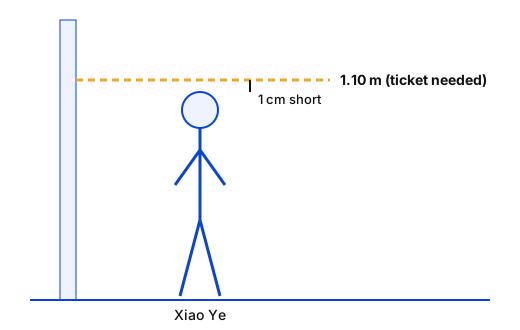
- A: true – ‘Today she is with her son’. B: true – ‘Twenty cents is not to be scoffed at’. C: true – ‘She follows him onto the bus’.
- Xiao Ye was ‘still one centimetre away’ from 1.10 m, so only one ticket was really needed → D is NOT true.
Trick: ‘Actually needed’ ≠ ‘chose to buy’.
Answer: (D) Tao Ying actually needed to buy two tickets.
अवधारणा: टिकट केवल 1.10 m या उससे लंबे बच्चों के लिए ज़रूरी था।
- A सही – ‘Today she is with her son’। B सही – ‘Twenty cents is not to be scoffed at’। C सही – ‘She follows him onto the bus’।
- Xiao Ye 1.10 m से ‘one centimetre’ छोटा था, अतः वास्तव में एक ही टिकट ज़रूरी था → D असत्य।
ट्रिक: ‘Actually needed’ ≠ ‘खुद से खरीदना चुना’।
उत्तर: (D) Tao Ying actually needed to buy two tickets.
SSC CPO Paper IIEnglish Language and ComprehensionReading ComprehensionSSC CPO Paper II 2021 · 26 Jul Shift 1
Read the passage and answer the questions that follow.
When Tao Ying rides on the bus alone, quite often she does not bother to buy a ticket. Why should she? Without her, the bus would still be stopping at every stop, a driver and a
conductor would still have to be employed, and the same amount of petrol used. Clearly Tao Ying has to be astute. When the bus conductor looked like the responsible type, she would buy a ticket as soon as she got on board. But if he appeared to be casual and careless, she would not dream of paying, considering it a small punishment for him and a little saving for herself.
Today she is with her son Xiao Ye. She follows him onto the bus. As the doors shut her jacket is caught, ballooning up like a tent behind her. She twists this way and that, finally wrenching herself free. ‘Mama, tickets!’ Xiao Ye says. Children are often more conscious of rituals than adults. Without a ticket in his hand, the ride doesn’t count as a proper ride. On the peeling paint of the door somebody has painted the shape of a pale finger. It points at a number: 1.10 m. Between Xiao Ye ’s round head and the tip of the painted digit setting out the height
requirement for a ticket rests the beautiful slender fingers of Tao Ying. ‘Xiao Ye, you are not quite tall enough, still one centimetre away,’ she tells him softly.
‘Mama! I’m tall enough, I’m tall enough!’ Xiao Ye shouts at the top of his voice, stamping on the floor as if it were a tin drum. ‘You told me the last time I could have a ticket the next time, this is the next time. You don’t keep your word!’ He looks up at his mother angrily. Tao Ying looks down at her son. A ticket costs twenty cents. Twenty cents is not to be scoffed at. It can buy a cucumber, two tomatoes or, at a reduced price, three bunches of radishes or enough spinach to last four days. But Xiao Ye’s face is raised up like a half-open blossom, waiting to receive his promise from the sun. She says, ‘Two tickets, please.’ The fierce conductor has beady eyes. ‘This child is one centimetre short of requiring a ticket.’
Xiao Ye shrinks, not just one but several centimetres— the need for a ticket has all of a sudden become interwoven with the pride of a small child. To be able to purchase self-esteem with twenty cents is something that can only happen in childhood and certainly no mother can resist an opportunity to make her son happy. ‘I would like to buy two tickets,’ she says politely.
Q430.Xiao Ye was eager to buy a bus ticket because he:
- Ahad saved money for it
- Bwanted to feel like a grown up
- Chad grown taller than 1.10 m
- Dwas very responsible
Show answer
Concept: Why does a child insist on a ticket?
- ‘Children are often more conscious of rituals… Without a ticket in his hand, the ride doesn’t count as a proper ride.’
- He shouts ‘I’m tall enough!’ – he wants to be treated like a grown-up passenger. He had not grown past 1.10 m (C is false).
Yaad rakhein: Ticket = proof of being ‘big’.
Answer: (B) wanted to feel like a grown up
अवधारणा: बच्चा टिकट की ज़िद क्यों करता है?
- ‘Without a ticket in his hand, the ride doesn’t count as a proper ride.’
- वह चिल्लाता है ‘I’m tall enough!’ – वह बड़े यात्री जैसा महसूस करना चाहता है। वह 1.10 m से लंबा नहीं था (C गलत)।
याद रखें: टिकट = ‘बड़ा’ होने का प्रमाण।
उत्तर: (B) wanted to feel like a grown up
SSC CPO Paper IIEnglish Language and ComprehensionReading ComprehensionSSC CPO Paper II 2021 · 26 Jul Shift 1
Read the passage and answer the questions that follow.
The methods of embalming, or treating the dead body, that the ancient Egyptians used is called ‘mummification’. Using special processes, the Egyptians removed all moisture from the body, leaving only a dried form that would not easily decay. It was important in their religion to preserve the dead body in as life-like a manner as possible.
The mummification process took seventy days. Special priests worked as embalmers,
treating and wrapping the body. Beyond knowing the correct rituals and prayers to be
performed at various stages, the priests also needed a detailed knowledge of human
anatomy. The first step in the process was the removal of all internal parts that might decay rapidly. The brain was removed by carefully inserting special hooked instruments up through the nostrils in order to pull out bits of brain tissue. The embalmers then removed the organs of the abdomen and chest through a cut usually made on the left side of the abdomen. They left only the heart in place, believing it to be the center of a person's being and intelligence. The other organs were preserved separately, with the stomach, liver, lungs and intestines placed in special boxes or jars, today called ‘canopic jars’. These were buried with the
mummy.
The embalmers next removed all moisture from the body. This they did by covering the body with ‘natron’, a type of salt which has great drying properties, and by placing additional natron packets inside the body. When the body had dried out completely, embalmers removed the internal packets and lightly washed the natron off the body. The result was a very dried-out but recognizable human form. To make the mummy seem even more life-like, sunken areas of the body were filled out with linen and other materials and false eyes were added.
Next the wrapping began. Each mummy needed hundreds of yards of linen. The priests
carefully wound the long strips of linen around the body, sometimes even wrapping each
finger and toe separately before wrapping the entire hand or foot. In order to protect the dead from mishap in after life, amulets were placed among the wrappings and prayers and magical words written on some of the linen strips. Often the priests placed a mask of the person's face between the layers of head bandages. At last, the priests wrapped the final cloth or
shroud in place and secured it with linen strips. The mummy was complete. It was then
placed in the tomb along with food, furniture, vessels, perfumes, jewels and other things
required in the afterlife.
Q431.Mummification was done to:
- Astudy the cause of death
- Bpreserve dead bodies in a life-like manner
- Cperform rituals and prayers
- Dtest the drying properties of natron
Show answer
Concept: The purpose is stated in paragraph 1.
- ‘It was important in their religion to preserve the dead body in as life-like a manner as possible.’
- Nothing is said about finding the cause of death or testing natron.
Trick: Purpose question → look for ‘important’ / ‘in order to’.
Answer: (B) preserve dead bodies in a life-like manner
अवधारणा: उद्देश्य पहले अनुच्छेद में है।
- ‘It was important in their religion to preserve the dead body in as life-like a manner as possible.’
- मृत्यु का कारण जानने या natron की जाँच का कोई उल्लेख नहीं।
ट्रिक: उद्देश्य वाले प्रश्न → ‘important’ / ‘in order to’ खोजें।
उत्तर: (B) preserve dead bodies in a life-like manner
SSC CPO Paper IIEnglish Language and ComprehensionReading ComprehensionSSC CPO Paper II 2021 · 26 Jul Shift 1
Read the passage and answer the questions that follow.
The methods of embalming, or treating the dead body, that the ancient Egyptians used is called ‘mummification’. Using special processes, the Egyptians removed all moisture from the body, leaving only a dried form that would not easily decay. It was important in their religion to preserve the dead body in as life-like a manner as possible.
The mummification process took seventy days. Special priests worked as embalmers,
treating and wrapping the body. Beyond knowing the correct rituals and prayers to be
performed at various stages, the priests also needed a detailed knowledge of human
anatomy. The first step in the process was the removal of all internal parts that might decay rapidly. The brain was removed by carefully inserting special hooked instruments up through the nostrils in order to pull out bits of brain tissue. The embalmers then removed the organs of the abdomen and chest through a cut usually made on the left side of the abdomen. They left only the heart in place, believing it to be the center of a person's being and intelligence. The other organs were preserved separately, with the stomach, liver, lungs and intestines placed in special boxes or jars, today called ‘canopic jars’. These were buried with the
mummy.
The embalmers next removed all moisture from the body. This they did by covering the body with ‘natron’, a type of salt which has great drying properties, and by placing additional natron packets inside the body. When the body had dried out completely, embalmers removed the internal packets and lightly washed the natron off the body. The result was a very dried-out but recognizable human form. To make the mummy seem even more life-like, sunken areas of the body were filled out with linen and other materials and false eyes were added.
Next the wrapping began. Each mummy needed hundreds of yards of linen. The priests
carefully wound the long strips of linen around the body, sometimes even wrapping each
finger and toe separately before wrapping the entire hand or foot. In order to protect the dead from mishap in after life, amulets were placed among the wrappings and prayers and magical words written on some of the linen strips. Often the priests placed a mask of the person's face between the layers of head bandages. At last, the priests wrapped the final cloth or
shroud in place and secured it with linen strips. The mummy was complete. It was then
placed in the tomb along with food, furniture, vessels, perfumes, jewels and other things
required in the afterlife.
Q432.What was the initial step in the process of mummification?
- APlacing a face mask between the head bandages
- BWrapping the body with strips of linen
- CCompletely drying the body
- DRemoval of the internal parts
Show answer
Concept: Follow the order of steps given in the passage.
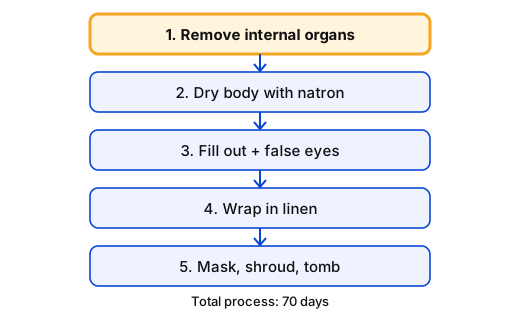
- ‘The first step in the process was the removal of all internal parts that might decay rapidly.’
- Drying with natron, wrapping in linen and placing the mask came later.
Trick: Signal words: first → next → at last.
Answer: (D) Removal of the internal parts
अवधारणा: गद्यांश में दिए चरणों का क्रम देखें।
- ‘The first step in the process was the removal of all internal parts that might decay rapidly.’
- Natron से सुखाना, linen लपेटना, मुखौटा रखना बाद के चरण हैं।
ट्रिक: संकेत शब्द: first → next → at last।
उत्तर: (D) Removal of the internal parts
SSC CPO Paper IIEnglish Language and ComprehensionReading ComprehensionSSC CPO Paper II 2021 · 26 Jul Shift 1
Read the passage and answer the questions that follow.
The methods of embalming, or treating the dead body, that the ancient Egyptians used is called ‘mummification’. Using special processes, the Egyptians removed all moisture from the body, leaving only a dried form that would not easily decay. It was important in their religion to preserve the dead body in as life-like a manner as possible.
The mummification process took seventy days. Special priests worked as embalmers,
treating and wrapping the body. Beyond knowing the correct rituals and prayers to be
performed at various stages, the priests also needed a detailed knowledge of human
anatomy. The first step in the process was the removal of all internal parts that might decay rapidly. The brain was removed by carefully inserting special hooked instruments up through the nostrils in order to pull out bits of brain tissue. The embalmers then removed the organs of the abdomen and chest through a cut usually made on the left side of the abdomen. They left only the heart in place, believing it to be the center of a person's being and intelligence. The other organs were preserved separately, with the stomach, liver, lungs and intestines placed in special boxes or jars, today called ‘canopic jars’. These were buried with the
mummy.
The embalmers next removed all moisture from the body. This they did by covering the body with ‘natron’, a type of salt which has great drying properties, and by placing additional natron packets inside the body. When the body had dried out completely, embalmers removed the internal packets and lightly washed the natron off the body. The result was a very dried-out but recognizable human form. To make the mummy seem even more life-like, sunken areas of the body were filled out with linen and other materials and false eyes were added.
Next the wrapping began. Each mummy needed hundreds of yards of linen. The priests
carefully wound the long strips of linen around the body, sometimes even wrapping each
finger and toe separately before wrapping the entire hand or foot. In order to protect the dead from mishap in after life, amulets were placed among the wrappings and prayers and magical words written on some of the linen strips. Often the priests placed a mask of the person's face between the layers of head bandages. At last, the priests wrapped the final cloth or
shroud in place and secured it with linen strips. The mummy was complete. It was then
placed in the tomb along with food, furniture, vessels, perfumes, jewels and other things
required in the afterlife.
Q433.Why was the knowledge of anatomy important for the priests?
- ATo remove internal organs from the body
- BTo place natron packets in the body
- CTo wrap each part of the body
- DTo delay the decay of the body for seventy days
Show answer
Concept: Anatomy = knowledge of body structure and organs.
- Priests ‘needed a detailed knowledge of human anatomy’ because the first step was removing the brain and the organs of the abdomen and chest.
- They had to know where each organ lay and to leave the heart in place.
Yaad rakhein: Organs ↔ anatomy.
Answer: (A) To remove internal organs from the body
अवधारणा: Anatomy = शरीर-रचना और अंगों का ज्ञान।
- पुजारियों को ‘detailed knowledge of human anatomy’ चाहिए थी क्योंकि उन्हें मस्तिष्क व पेट-छाती के अंग निकालने होते थे।
- उन्हें पता होना चाहिए था कि कौन-सा अंग कहाँ है और हृदय को छोड़ना है।
याद रखें: अंग (organs) ↔ anatomy।
उत्तर: (A) To remove internal organs from the body
SSC CPO Paper IIEnglish Language and ComprehensionReading ComprehensionSSC CPO Paper II 2021 · 26 Jul Shift 1
Read the passage and answer the questions that follow.
The methods of embalming, or treating the dead body, that the ancient Egyptians used is called ‘mummification’. Using special processes, the Egyptians removed all moisture from the body, leaving only a dried form that would not easily decay. It was important in their religion to preserve the dead body in as life-like a manner as possible.
The mummification process took seventy days. Special priests worked as embalmers,
treating and wrapping the body. Beyond knowing the correct rituals and prayers to be
performed at various stages, the priests also needed a detailed knowledge of human
anatomy. The first step in the process was the removal of all internal parts that might decay rapidly. The brain was removed by carefully inserting special hooked instruments up through the nostrils in order to pull out bits of brain tissue. The embalmers then removed the organs of the abdomen and chest through a cut usually made on the left side of the abdomen. They left only the heart in place, believing it to be the center of a person's being and intelligence. The other organs were preserved separately, with the stomach, liver, lungs and intestines placed in special boxes or jars, today called ‘canopic jars’. These were buried with the
mummy.
The embalmers next removed all moisture from the body. This they did by covering the body with ‘natron’, a type of salt which has great drying properties, and by placing additional natron packets inside the body. When the body had dried out completely, embalmers removed the internal packets and lightly washed the natron off the body. The result was a very dried-out but recognizable human form. To make the mummy seem even more life-like, sunken areas of the body were filled out with linen and other materials and false eyes were added.
Next the wrapping began. Each mummy needed hundreds of yards of linen. The priests
carefully wound the long strips of linen around the body, sometimes even wrapping each
finger and toe separately before wrapping the entire hand or foot. In order to protect the dead from mishap in after life, amulets were placed among the wrappings and prayers and magical words written on some of the linen strips. Often the priests placed a mask of the person's face between the layers of head bandages. At last, the priests wrapped the final cloth or
shroud in place and secured it with linen strips. The mummy was complete. It was then
placed in the tomb along with food, furniture, vessels, perfumes, jewels and other things
required in the afterlife.
Q434.Which of the following was NOT buried with the mummies?
- AAmulets
- BCanopic jars
- CPerfumes
- DEmbalmers
Show answer
Concept: List what was placed in the tomb/with the mummy.
- Canopic jars ‘were buried with the mummy’; amulets were placed among the wrappings; perfumes were put in the tomb.
- Embalmers were the priests who did the work – they were not buried.
Trick: Embalmers = the workers, not the objects.
Answer: (D) Embalmers
अवधारणा: Mummy के साथ क्या-क्या दफ़नाया गया, सूची बनाएँ।
- Canopic jars ‘were buried with the mummy’; amulets पट्टियों में रखे गए; perfumes कब्र में रखे गए।
- Embalmers वे पुजारी थे जो यह काम करते थे – उन्हें दफ़नाया नहीं जाता था।
ट्रिक: Embalmers = काम करने वाले, वस्तुएँ नहीं।
उत्तर: (D) Embalmers
SSC CPO Paper IIEnglish Language and ComprehensionReading ComprehensionSSC CPO Paper II 2021 · 26 Jul Shift 1
Read the passage and answer the questions that follow.
The methods of embalming, or treating the dead body, that the ancient Egyptians used is called ‘mummification’. Using special processes, the Egyptians removed all moisture from the body, leaving only a dried form that would not easily decay. It was important in their religion to preserve the dead body in as life-like a manner as possible.
The mummification process took seventy days. Special priests worked as embalmers,
treating and wrapping the body. Beyond knowing the correct rituals and prayers to be
performed at various stages, the priests also needed a detailed knowledge of human
anatomy. The first step in the process was the removal of all internal parts that might decay rapidly. The brain was removed by carefully inserting special hooked instruments up through the nostrils in order to pull out bits of brain tissue. The embalmers then removed the organs of the abdomen and chest through a cut usually made on the left side of the abdomen. They left only the heart in place, believing it to be the center of a person's being and intelligence. The other organs were preserved separately, with the stomach, liver, lungs and intestines placed in special boxes or jars, today called ‘canopic jars’. These were buried with the
mummy.
The embalmers next removed all moisture from the body. This they did by covering the body with ‘natron’, a type of salt which has great drying properties, and by placing additional natron packets inside the body. When the body had dried out completely, embalmers removed the internal packets and lightly washed the natron off the body. The result was a very dried-out but recognizable human form. To make the mummy seem even more life-like, sunken areas of the body were filled out with linen and other materials and false eyes were added.
Next the wrapping began. Each mummy needed hundreds of yards of linen. The priests
carefully wound the long strips of linen around the body, sometimes even wrapping each
finger and toe separately before wrapping the entire hand or foot. In order to protect the dead from mishap in after life, amulets were placed among the wrappings and prayers and magical words written on some of the linen strips. Often the priests placed a mask of the person's face between the layers of head bandages. At last, the priests wrapped the final cloth or
shroud in place and secured it with linen strips. The mummy was complete. It was then
placed in the tomb along with food, furniture, vessels, perfumes, jewels and other things
required in the afterlife.
Q435.Hooked instruments were inserted through the nostrils to extract the:
- Alungs
- Bbrain
- Cheart
- Dliver
Show answer
Concept: Locate ‘hooked instruments’ in paragraph 2.
- ‘The brain was removed by carefully inserting special hooked instruments up through the nostrils.’
- Other organs were removed through a cut on the left side of the abdomen; the heart was left in place.
Trick: Nostrils → brain; abdomen cut → other organs.
Answer: (B) brain
अवधारणा: दूसरे अनुच्छेद में ‘hooked instruments’ खोजें।
- ‘The brain was removed by carefully inserting special hooked instruments up through the nostrils.’
- अन्य अंग पेट के बाईं ओर चीरा लगाकर निकाले गए; हृदय वहीं छोड़ा गया।
ट्रिक: नथुने → मस्तिष्क; पेट का चीरा → अन्य अंग।
उत्तर: (B) brain
SSC CPO Paper IIEnglish Language and ComprehensionReading ComprehensionSSC CPO Paper II 2021 · 26 Jul Shift 1
Read the passage and answer the questions that follow.
Vasco Da Gama was the first European to find an ocean trading route to India. He
accomplished what many explorers before him could not do. His discovery of this sea route helped the Portuguese establish a long-lasting colonial empire in Asia and Africa. The new ocean route around Africa allowed Portuguese sailors to avoid the Arab trading hold in the Mediterranean and Middle East. Vasco da Gama opened a new world of riches by opening up an Indian Ocean route. His voyage and explorations helped change the world for Europeans. Vasco da Gama’s maritime career was during the period when Portugal was searching for a trade route around Africa to India. The Ottoman Empire controlled almost all European trade routes to Asia. This meant they could, and did, charge high prices for ships passing through ports. When Manuel I became King of Portugal in 1495, he continued efforts to open a trade route to India by going around Africa. Although other people were considered for the job,
Manuel I finally chose 37-year-old Vasco da Gama for this task.
On 8 July 1497, Vasco da Gama sailed from Lisbon with a fleet of four ships and a crew of 170 men. Da Gama commanded the Sao Gabriel. Paulo da Gama – brother to Vasco –
commanded the São Rafael, a three mast ship. They sailed past the Canary Islands, and
reached the Cape Verde islands and then continued sailing, though storms still delayed them for a while. They rounded the cape of Good Hope on 22 November and anchored at Mossel Bay, South Africa. They began sailing again and continued until they reached the Rio dos Bons Sinais (River of Good Omens). Here they erected a statue in the name of Portugal.
They stayed here for a month because much of the crew were sick from scurvy – a disease caused by lack of Vitamin C. Da Gama’s fleet eventually began sailing again. Finally, on 20 May 1498 they reached India. They headed for Kappad, near the large city of Calicut. In
Calicut, da Gama met with the king. But the king of Calicut was not impressed with da Gama, and the gifts he brought as offering. They spent several months trading in India, and studying their customs. They left India at the end of August.
Q436.In which month did Vasco da Gama’s ship reach the Cape of Good Hope?
- AMay
- BJuly
- CNovember
- DAugust
Show answer
Concept: Scan the passage for dates.
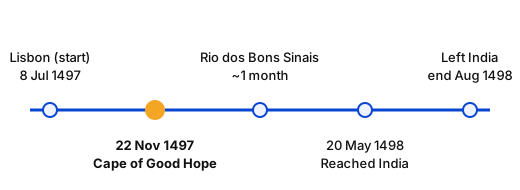
- ‘They rounded the Cape of Good Hope on 22 November.’
- July 1497 = departure from Lisbon; May 1498 = reached India; August = left India.
Yaad rakhein: Date questions – make a quick timeline.
Answer: (C) November
अवधारणा: गद्यांश में तिथियाँ खोजें।
- ‘They rounded the Cape of Good Hope on 22 November.’
- July 1497 = Lisbon से प्रस्थान; May 1498 = भारत पहुँचे; August = भारत छोड़ा।
याद रखें: तिथि वाले प्रश्न – छोटी timeline बना लें।
उत्तर: (C) November
SSC CPO Paper IIEnglish Language and ComprehensionReading ComprehensionSSC CPO Paper II 2021 · 26 Jul Shift 1
Read the passage and answer the questions that follow.
Vasco Da Gama was the first European to find an ocean trading route to India. He
accomplished what many explorers before him could not do. His discovery of this sea route helped the Portuguese establish a long-lasting colonial empire in Asia and Africa. The new ocean route around Africa allowed Portuguese sailors to avoid the Arab trading hold in the Mediterranean and Middle East. Vasco da Gama opened a new world of riches by opening up an Indian Ocean route. His voyage and explorations helped change the world for Europeans. Vasco da Gama’s maritime career was during the period when Portugal was searching for a trade route around Africa to India. The Ottoman Empire controlled almost all European trade routes to Asia. This meant they could, and did, charge high prices for ships passing through ports. When Manuel I became King of Portugal in 1495, he continued efforts to open a trade route to India by going around Africa. Although other people were considered for the job,
Manuel I finally chose 37-year-old Vasco da Gama for this task.
On 8 July 1497, Vasco da Gama sailed from Lisbon with a fleet of four ships and a crew of 170 men. Da Gama commanded the Sao Gabriel. Paulo da Gama – brother to Vasco –
commanded the São Rafael, a three mast ship. They sailed past the Canary Islands, and
reached the Cape Verde islands and then continued sailing, though storms still delayed them for a while. They rounded the cape of Good Hope on 22 November and anchored at Mossel Bay, South Africa. They began sailing again and continued until they reached the Rio dos Bons Sinais (River of Good Omens). Here they erected a statue in the name of Portugal.
They stayed here for a month because much of the crew were sick from scurvy – a disease caused by lack of Vitamin C. Da Gama’s fleet eventually began sailing again. Finally, on 20 May 1498 they reached India. They headed for Kappad, near the large city of Calicut. In
Calicut, da Gama met with the king. But the king of Calicut was not impressed with da Gama, and the gifts he brought as offering. They spent several months trading in India, and studying their customs. They left India at the end of August.
Q437.Which of the following statements is NOT true?
- AVasco da Gama was the commander of the ship, Sao Gabriel.
- BScurvy is caused by deficiency of vitamin C.
- CVasco da Gama impressed the King of Calicut with his gifts.
- DSao Rafael was a ship with three masts.
Show answer
Concept: Verify each statement with the passage.
- A: ‘Da Gama commanded the Sao Gabriel’ – true. B: scurvy is ‘caused by lack of Vitamin C’ – true. D: São Rafael was ‘a three mast ship’ – true.
- C: ‘the king of Calicut was not impressed with da Gama, and the gifts he brought’ – so C is false.
Trick: ‘NOT true’ – watch for a negative changed into a positive.
Answer: (C) Vasco da Gama impressed the King of Calicut with his gifts.
अवधारणा: हर कथन को गद्यांश से जाँचें।
- A: ‘Da Gama commanded the Sao Gabriel’ – सही। B: scurvy ‘lack of Vitamin C’ से – सही। D: São Rafael ‘three mast ship’ – सही।
- C: ‘the king of Calicut was not impressed’ – अतः C असत्य है।
ट्रिक: ‘NOT true’ – देखें कहीं ‘not’ हटाकर कथन उलटा तो नहीं किया गया।
उत्तर: (C) Vasco da Gama impressed the King of Calicut with his gifts.
SSC CPO Paper IIEnglish Language and ComprehensionReading ComprehensionSSC CPO Paper II 2021 · 26 Jul Shift 1
Read the passage and answer the questions that follow.
Vasco Da Gama was the first European to find an ocean trading route to India. He
accomplished what many explorers before him could not do. His discovery of this sea route helped the Portuguese establish a long-lasting colonial empire in Asia and Africa. The new ocean route around Africa allowed Portuguese sailors to avoid the Arab trading hold in the Mediterranean and Middle East. Vasco da Gama opened a new world of riches by opening up an Indian Ocean route. His voyage and explorations helped change the world for Europeans. Vasco da Gama’s maritime career was during the period when Portugal was searching for a trade route around Africa to India. The Ottoman Empire controlled almost all European trade routes to Asia. This meant they could, and did, charge high prices for ships passing through ports. When Manuel I became King of Portugal in 1495, he continued efforts to open a trade route to India by going around Africa. Although other people were considered for the job,
Manuel I finally chose 37-year-old Vasco da Gama for this task.
On 8 July 1497, Vasco da Gama sailed from Lisbon with a fleet of four ships and a crew of 170 men. Da Gama commanded the Sao Gabriel. Paulo da Gama – brother to Vasco –
commanded the São Rafael, a three mast ship. They sailed past the Canary Islands, and
reached the Cape Verde islands and then continued sailing, though storms still delayed them for a while. They rounded the cape of Good Hope on 22 November and anchored at Mossel Bay, South Africa. They began sailing again and continued until they reached the Rio dos Bons Sinais (River of Good Omens). Here they erected a statue in the name of Portugal.
They stayed here for a month because much of the crew were sick from scurvy – a disease caused by lack of Vitamin C. Da Gama’s fleet eventually began sailing again. Finally, on 20 May 1498 they reached India. They headed for Kappad, near the large city of Calicut. In
Calicut, da Gama met with the king. But the king of Calicut was not impressed with da Gama, and the gifts he brought as offering. They spent several months trading in India, and studying their customs. They left India at the end of August.
Q438.Who controlled the European trade routes to Asia before 1497?
- AManuel I
- BKing of Calicut
- COttoman Empire
- DPaulo da Gama
Show answer
Concept: Find who held the trade routes during Portugal’s search for a sea route.
- ‘The Ottoman Empire controlled almost all European trade routes to Asia’ and charged high prices.
- Manuel I was King of Portugal; Paulo da Gama was a ship commander.
Trick: Ottoman control was the reason Portugal wanted a new sea route.
Answer: (C) Ottoman Empire
अवधारणा: देखें कि उस समय व्यापार मार्गों पर किसका नियंत्रण था।
- ‘The Ottoman Empire controlled almost all European trade routes to Asia’ और ऊँचे शुल्क लेता था।
- Manuel I पुर्तगाल के राजा थे; Paulo da Gama एक जहाज़ के कमांडर।
ट्रिक: Ottoman नियंत्रण के कारण ही पुर्तगाल नया समुद्री मार्ग चाहता था।
उत्तर: (C) Ottoman Empire
SSC CPO Paper IIEnglish Language and ComprehensionReading ComprehensionSSC CPO Paper II 2021 · 26 Jul Shift 1
Read the passage and answer the questions that follow.
Vasco Da Gama was the first European to find an ocean trading route to India. He
accomplished what many explorers before him could not do. His discovery of this sea route helped the Portuguese establish a long-lasting colonial empire in Asia and Africa. The new ocean route around Africa allowed Portuguese sailors to avoid the Arab trading hold in the Mediterranean and Middle East. Vasco da Gama opened a new world of riches by opening up an Indian Ocean route. His voyage and explorations helped change the world for Europeans. Vasco da Gama’s maritime career was during the period when Portugal was searching for a trade route around Africa to India. The Ottoman Empire controlled almost all European trade routes to Asia. This meant they could, and did, charge high prices for ships passing through ports. When Manuel I became King of Portugal in 1495, he continued efforts to open a trade route to India by going around Africa. Although other people were considered for the job,
Manuel I finally chose 37-year-old Vasco da Gama for this task.
On 8 July 1497, Vasco da Gama sailed from Lisbon with a fleet of four ships and a crew of 170 men. Da Gama commanded the Sao Gabriel. Paulo da Gama – brother to Vasco –
commanded the São Rafael, a three mast ship. They sailed past the Canary Islands, and
reached the Cape Verde islands and then continued sailing, though storms still delayed them for a while. They rounded the cape of Good Hope on 22 November and anchored at Mossel Bay, South Africa. They began sailing again and continued until they reached the Rio dos Bons Sinais (River of Good Omens). Here they erected a statue in the name of Portugal.
They stayed here for a month because much of the crew were sick from scurvy – a disease caused by lack of Vitamin C. Da Gama’s fleet eventually began sailing again. Finally, on 20 May 1498 they reached India. They headed for Kappad, near the large city of Calicut. In
Calicut, da Gama met with the king. But the king of Calicut was not impressed with da Gama, and the gifts he brought as offering. They spent several months trading in India, and studying their customs. They left India at the end of August.
Q439.From where did Vasco da Gama embark upon his journey?
- AMossel Bay
- BCanary Islands
- CLisbon
- DCape of Good Hope
Show answer
Concept: ‘Embark’ = start a journey; find the starting point.
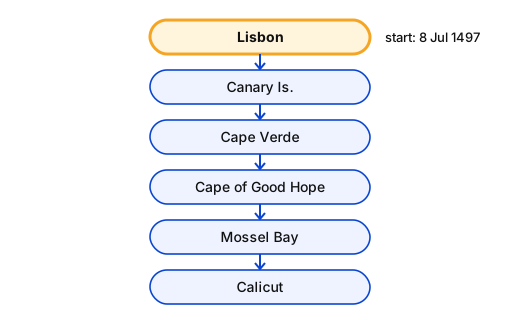
- ‘On 8 July 1497, Vasco da Gama sailed from Lisbon with a fleet of four ships.’
- Canary Islands, Cape of Good Hope and Mossel Bay came later on the route.
Yaad rakhein: sailed from = embarked from.
Answer: (C) Lisbon
अवधारणा: ‘Embark’ = यात्रा आरंभ करना; प्रारंभिक स्थान खोजें।
- ‘On 8 July 1497, Vasco da Gama sailed from Lisbon with a fleet of four ships.’
- Canary Islands, Cape of Good Hope, Mossel Bay मार्ग में बाद में आए।
याद रखें: sailed from = embarked from।
उत्तर: (C) Lisbon
SSC CPO Paper IIEnglish Language and ComprehensionReading ComprehensionSSC CPO Paper II 2021 · 26 Jul Shift 1
Read the passage and answer the questions that follow.
Vasco Da Gama was the first European to find an ocean trading route to India. He
accomplished what many explorers before him could not do. His discovery of this sea route helped the Portuguese establish a long-lasting colonial empire in Asia and Africa. The new ocean route around Africa allowed Portuguese sailors to avoid the Arab trading hold in the Mediterranean and Middle East. Vasco da Gama opened a new world of riches by opening up an Indian Ocean route. His voyage and explorations helped change the world for Europeans. Vasco da Gama’s maritime career was during the period when Portugal was searching for a trade route around Africa to India. The Ottoman Empire controlled almost all European trade routes to Asia. This meant they could, and did, charge high prices for ships passing through ports. When Manuel I became King of Portugal in 1495, he continued efforts to open a trade route to India by going around Africa. Although other people were considered for the job,
Manuel I finally chose 37-year-old Vasco da Gama for this task.
On 8 July 1497, Vasco da Gama sailed from Lisbon with a fleet of four ships and a crew of 170 men. Da Gama commanded the Sao Gabriel. Paulo da Gama – brother to Vasco –
commanded the São Rafael, a three mast ship. They sailed past the Canary Islands, and
reached the Cape Verde islands and then continued sailing, though storms still delayed them for a while. They rounded the cape of Good Hope on 22 November and anchored at Mossel Bay, South Africa. They began sailing again and continued until they reached the Rio dos Bons Sinais (River of Good Omens). Here they erected a statue in the name of Portugal.
They stayed here for a month because much of the crew were sick from scurvy – a disease caused by lack of Vitamin C. Da Gama’s fleet eventually began sailing again. Finally, on 20 May 1498 they reached India. They headed for Kappad, near the large city of Calicut. In
Calicut, da Gama met with the king. But the king of Calicut was not impressed with da Gama, and the gifts he brought as offering. They spent several months trading in India, and studying their customs. They left India at the end of August.
Q440.Why did Vasco da Gama’s crew stay at Rio dos Bons Sinais for a month?
- ATo erect a statue in the name of Portugal.
- BSeveral crew members were suffering from scurvy.
- CThere were severe storms in the area.
- DIt was an auspicious place.
Show answer
Concept: Read the sentence right after Rio dos Bons Sinais.
- ‘They stayed here for a month because much of the crew were sick from scurvy.’
- Erecting a statue was something they did there, not the reason for the long stay; storms delayed them earlier, near Cape Verde.
Trick: ‘because’ marks the reason.
Answer: (B) Several crew members were suffering from scurvy.
अवधारणा: Rio dos Bons Sinais के बाद वाला वाक्य पढ़ें।
- ‘They stayed here for a month because much of the crew were sick from scurvy.’
- Statue लगाना वहाँ किया गया कार्य था, रुकने का कारण नहीं; तूफ़ान पहले Cape Verde के पास आए थे।
ट्रिक: ‘because’ कारण बताता है।
उत्तर: (B) Several crew members were suffering from scurvy.
SSC CPO Paper IIEnglish Language and ComprehensionReading ComprehensionSSC CPO Paper II 2021 · 26 Jul Shift 1

