Q501.Given below are six sentences A-F, of which A and F are static and B-E have been jumbled. Pick the option that gives the correct order of the jumbled sentences.
A. Absulum, the reindeer elf worked in the reindeer barn.
B. He also had to keep the reindeer well groomed.
C. He had to clean it every day and that was hard work.
D. He had to give them all a bath and brush their fur.
E. It was such a dirty job to mop, slop, scour and scrape every corner.
F. He worked his fingers to the bone but it seemed that no one cared.
- AACDBEF
- BACEBDF
- CADCEBF
- DAEBDCF
Show answer
Concept: Find the pronoun links: each sentence must point back to something already mentioned.
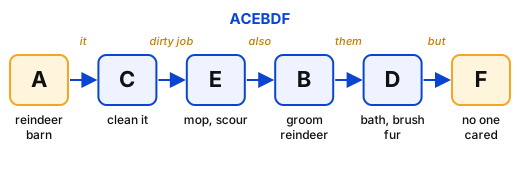
- A introduces the reindeer barn. C says 'He had to clean it' – 'it' = the barn, so C follows A.
- E ('such a dirty job to mop, slop, scour…') describes that cleaning, so C → E.
- B adds a second duty with 'also' – keep the reindeer groomed; D explains how ('bath and brush their fur').
- F ends the story: he worked hard but no one cared. Order: A-C-E-B-D-F.
Trick: 'Also' always introduces the second task, so B can never come before the first task (C).
Answer: (B) ACEBDF
अवधारणा: Pronoun और connector से वाक्यों का क्रम पहचानें।
- A में reindeer barn आया; C में 'clean it' – 'it' = barn, इसलिए A के बाद C।
- E ('dirty job to mop, scour…') उसी सफाई का वर्णन है, इसलिए C → E।
- B में 'also' दूसरा काम बताता है (reindeer groom करना); D बताता है कैसे (bath, brush)।
- F निष्कर्ष है। क्रम: A-C-E-B-D-F।
ट्रिक: 'also' वाला वाक्य हमेशा पहले काम के बाद आता है, इसलिए B, C से पहले नहीं आ सकता।
उत्तर: (B) ACEBDF
SSC CPO Paper IIEnglish Language and ComprehensionPara jumblesSSC CPO Paper II 2021 · 26 Jul Shift 1
Q502.Select the most appropriate synonym of the given word.
AGGRAVATE
- Ainfluence
- Billustrate
- Cintensify
- Dilluminate
Show answer
Concept: Aggravate means to make a problem, pain or situation worse or more serious.
- 'The noise aggravated his headache' = made it stronger/worse.
- Intensify = make more intense or severe – same meaning.
- Influence = affect; illustrate = explain with examples; illuminate = light up – none means 'make worse'.
Yaad rakhein: aggr-avate ~ 'make grave (heavier)' → intensify.
Answer: (C) intensify
अवधारणा: Aggravate का अर्थ है किसी समस्या या दर्द को और बढ़ाना/गंभीर बनाना।
- 'The noise aggravated his headache' = सिरदर्द और बढ़ गया।
- Intensify = तीव्र करना/बढ़ाना – यही अर्थ।
- Influence = प्रभावित करना; illustrate = उदाहरण से समझाना; illuminate = रोशन करना।
याद रखें: aggr-avate ≈ 'grave' (भारी) बनाना → intensify.
उत्तर: (C) intensify
SSC CPO Paper IIEnglish Language and ComprehensionSynonymsSSC CPO Paper II 2021 · 26 Jul Shift 1
Q503.Identify the segment in the sentence which contains a grammatical error.
I asked Dhruv / when he has plan / to settle / the dues.
- Ato settle
- Bthe dues
- Cwhen he has plan
- DI asked Dhruv
Show answer
Concept: After 'has/have', the verb takes the past participle (V3); 'plan' must become 'planned'. Also, the reported clause after 'asked' (past) goes into the past tense.
- 'when he has plan' is wrong – 'has' cannot be followed by the base form 'plan'.
- Correct: 'I asked Dhruv when he had planned (or planned) to settle the dues.'
- Other segments are fine: 'to settle' is an infinitive, 'the dues' is the object.
Trick: has/have/had + V3 always: has plan ✗ → had planned ✓.
Answer: (C) when he has plan
अवधारणा: 'has/have/had' के बाद क्रिया का V3 (past participle) आता है; 'plan' की जगह 'planned' चाहिए। 'asked' (past) के बाद reported clause भी past में होना चाहिए।
- 'when he has plan' गलत है – 'has' के बाद base form 'plan' नहीं आ सकता।
- सही: 'I asked Dhruv when he had planned to settle the dues.'
- 'to settle' (infinitive) और 'the dues' (object) सही हैं।
ट्रिक: has/have/had + V3: has plan ✗ → had planned ✓.
उत्तर: (C) when he has plan
SSC CPO Paper IIEnglish Language and ComprehensionError spottingSSC CPO Paper II 2021 · 26 Jul Shift 1
Q504.Select the correct passive form of the given sentence.
They agreed that the elections should be postponed.
- AIt has been agreed by them that the elections should be postponed.
- BIt had been agreed by them that the elections should be postponed.
- CIt was agreed by them that the elections should be postponed.
- DIt is agreed by them that the elections should be postponed.
Show answer
Concept: When the object is a that-clause, the passive is made with the impersonal 'It' + passive verb + that-clause; the tense of the main verb is kept.
- Main verb 'agreed' is simple past → passive 'was agreed'.
- Pattern: It + was agreed + by them + that the elections should be postponed.
- 'has been agreed' (present perfect), 'had been agreed' (past perfect) and 'is agreed' (present) change the tense, so they are wrong.
Trick: Simple past active → was/were + V3 in passive; the that-clause stays unchanged.
Answer: (C) It was agreed by them that the elections should be postponed.
अवधारणा: जब object एक that-clause हो, तो passive में 'It' + passive verb + that-clause लगाते हैं; main verb का tense वही रहता है।
- 'agreed' simple past है → passive 'was agreed'।
- ढाँचा: It + was agreed + by them + that the elections should be postponed.
- 'has been', 'had been', 'is agreed' tense बदल देते हैं, इसलिए गलत।
ट्रिक: Simple past active → passive में was/were + V3; that-clause जैसा का तैसा।
उत्तर: (C) It was agreed by them that the elections should be postponed.
SSC CPO Paper IIEnglish Language and ComprehensionActive and passive voiceSSC CPO Paper II 2021 · 26 Jul Shift 1
Q505.Select the most appropriate option to substitute the underlined segment in the given
sentence. If there is no need to substitute it, select ‘No substitution’.
He replied mine letter after a month.
- Areplied to mine letter
- Breplied to my letter
- CNo substitution
- Dreply my letter
Show answer
Concept: The verb 'reply' (intransitive) takes the preposition 'to' before its object, and before a noun we use the possessive adjective 'my', not the pronoun 'mine'.
- 'replied mine letter' has two errors: missing 'to' and 'mine' used before a noun.
- Correct: 'He replied to my letter after a month.'
- 'replied to mine letter' keeps 'mine'; 'reply my letter' has wrong tense and no 'to'.
Yaad rakhein: my + noun (my letter); mine stands alone (the letter is mine). Reply to someone/something.
Answer: (B) replied to my letter
अवधारणा: 'reply' के बाद object से पहले 'to' लगता है, और noun से पहले possessive adjective 'my' आता है, 'mine' नहीं।
- 'replied mine letter' में दो गलतियाँ: 'to' नहीं है और noun से पहले 'mine'।
- सही: 'He replied to my letter after a month.'
- 'replied to mine letter' में 'mine' गलत; 'reply my letter' में tense गलत और 'to' नहीं।
याद रखें: my + noun (my letter); mine अकेला आता है (the letter is mine). Reply to …
उत्तर: (B) replied to my letter
SSC CPO Paper IIEnglish Language and ComprehensionSentence improvementSSC CPO Paper II 2021 · 26 Jul Shift 1
Q506.Select the most appropriate meaning of the underlined idiom in the given sentence.
He knows the ins and outs of the case and has been chosen to defend the accused.
- Aexpense involved
- Btime needed to complete
- Chigh stakes
- Dcomplete details
Show answer
Concept: The ins and outs of something means all its details and facts, including the complicated ones.
- He knows every detail of the case, so he has been chosen to defend the accused.
- So the idiom means 'complete details'.
- Cost, time or high stakes have nothing to do with 'ins and outs'.
Yaad rakhein: Ins and outs = every way in and every way out = the whole picture.
Answer: (D) complete details
अवधारणा: The ins and outs = किसी विषय की पूरी जानकारी/सभी बारीकियाँ।
- वह केस की हर बारीकी जानता है, इसलिए उसे बचाव के लिए चुना गया।
- अर्थ: complete details (पूरा विवरण)।
- खर्च, समय या high stakes से इसका संबंध नहीं।
याद रखें: Ins and outs = अंदर-बाहर का हर रास्ता = पूरी जानकारी।
उत्तर: (D) complete details
SSC CPO Paper IIEnglish Language and ComprehensionIdioms and phrasesSSC CPO Paper II 2021 · 26 Jul Shift 1
Q507.Identify the segment in the sentence which contains a grammatical error.
His loyalty / and honesty / are above / suspect.
- AHis loyalty
- Band honesty
- Csuspect
- Dare above
Show answer
Concept: The fixed expression is above suspicion (noun) = so honest that no one can doubt him. 'Suspect' is a verb/adjective/noun meaning a person suspected.
- After the preposition 'above' we need the abstract noun 'suspicion'.
- Correct: 'His loyalty and honesty are above suspicion.'
- 'are' is correct because the subject 'loyalty and honesty' is plural.
Yaad rakhein: Above suspicion, above board, above reproach – all take a noun.
Answer: (C) suspect
अवधारणा: सही expression above suspicion है = इतना ईमानदार कि कोई शक न कर सके। 'suspect' का अर्थ संदिग्ध व्यक्ति/शक करना है।
- preposition 'above' के बाद abstract noun 'suspicion' चाहिए।
- सही: 'His loyalty and honesty are above suspicion.'
- subject 'loyalty and honesty' plural है, इसलिए 'are' सही।
याद रखें: above suspicion / above reproach – बाद में noun आता है।
उत्तर: (C) suspect
SSC CPO Paper IIEnglish Language and ComprehensionError spottingSSC CPO Paper II 2021 · 26 Jul Shift 1
Q508.Given below are four sentences in jumbled order. Pick the option that gives their correct order.
A. Suddenly in the evening, a dark and menacing storm quickly gathered.
B. Prashant had gone to Ersama, a coastal town in Odisha, to spend the day with a friend. C. The destruction wrought by the storm continued for the next 36 hours, although the wind speed reduced.
D. Winds beat against the houses with a fury never witnessed before.
- ADBCA
- BCADB
- CBADC
- DBCDA
Show answer
Concept: Start with the sentence that introduces the person and setting, then follow the time order of events.
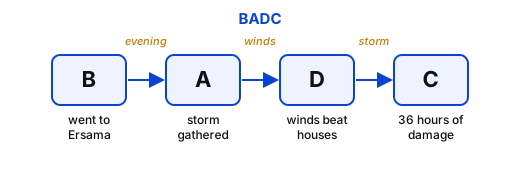
- B introduces Prashant and Ersama – the opening.
- A: 'Suddenly in the evening' a storm gathered – the next event.
- D describes the storm's fury; C says the destruction continued for the next hours – the later stage.
- Order: B-A-D-C.
Trick: Intro → trigger ('suddenly') → action → aftermath.
Answer: (C) BADC
अवधारणा: पहले पात्र और स्थान का परिचय, फिर घटनाओं का समय-क्रम।
- B में Prashant और Ersama का परिचय – शुरुआत।
- A: 'Suddenly in the evening' तूफ़ान आया।
- D तूफ़ान की तेज़ हवा; C – विनाश अगले घंटों तक चलता रहा। क्रम: B-A-D-C।
ट्रिक: परिचय → अचानक घटना → क्रिया → परिणाम।
उत्तर: (C) BADC
SSC CPO Paper IIEnglish Language and ComprehensionPara jumblesSSC CPO Paper II 2021 · 26 Jul Shift 1
Q509.Given below are six sentences A-F, of which A and F are static and B-E have been jumbled. Pick the option that gives the correct order of the jumbled sentences.
A. Suddenly I noticed smoke pouring in through the seams of the ceiling.
B. Groping our way to the front door we all ran out into the front yard.
C. The smoke began to fill the room so quickly that we could barely see.
D. I ran to the neighbours to call the fire department.
E. By the time we made our way outside, the whole roof was engulfed in flames.
F. I saw mother run back into the house and I screamed, “Mom! No!”
- AADEBCF
- BACBEDF
- CABCDEF
- DAEDCBF
Show answer
Concept: Follow the natural sequence of a fire: smoke noticed → room fills → escape → seeing the roof burn → calling for help.
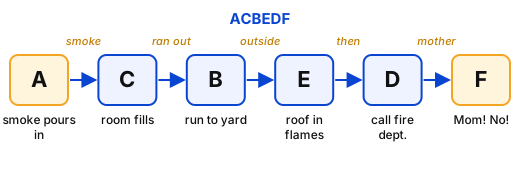
- A: smoke pouring in; C: the smoke filled the room so fast they could barely see.
- B: 'Groping our way' (because they could not see) they ran out to the yard.
- E: by the time they were outside the roof was in flames; D: so he ran to the neighbours to call the fire department.
- F follows. Order: A-C-B-E-D-F.
Trick: 'Groping' links to 'could barely see' – a ready-made C → B pair.
Answer: (B) ACBEDF
अवधारणा: आग की घटना का स्वाभाविक क्रम: धुआँ दिखा → कमरा भरा → बाहर भागे → छत जलती दिखी → मदद बुलाई।
- A: धुआँ आता दिखा; C: धुआँ इतनी तेज़ी से भरा कि दिखना बंद।
- B: 'Groping' (टटोलते हुए, क्योंकि दिख नहीं रहा था) बाहर भागे।
- E: बाहर आने तक छत जल रही थी; D: पड़ोसियों के पास fire department बुलाने गया। क्रम: A-C-B-E-D-F।
ट्रिक: 'Groping' ↔ 'could barely see' – C → B जोड़ी तय।
उत्तर: (B) ACBEDF
SSC CPO Paper IIEnglish Language and ComprehensionPara jumblesSSC CPO Paper II 2021 · 26 Jul Shift 1
Q510.Select the correct passive form of the given sentence.
The committee has discussed the matter for several days.
- AThe matter is being discussed by the committee for several days.
- BThe matter has discussed by the committee for several days.
- CThe matter was discussed by the committee for several days.
- DThe matter has been discussed by the committee for several days.
Show answer
Concept: Present perfect active (has/have + V3) becomes has/have + been + V3 in the passive.
- Object 'the matter' (singular) becomes the subject → 'has'.
- Verb: has discussed → has been discussed.
- 'is being discussed' (continuous), 'was discussed' (past) change the tense; 'has discussed' lacks 'been'.
Yaad rakhein: Present perfect passive = has/have + been + V3.
Answer: (D) The matter has been discussed by the committee for several days.
अवधारणा: Present perfect active (has/have + V3) का passive = has/have + been + V3।
- object 'the matter' (singular) subject बनेगा → 'has'।
- has discussed → has been discussed।
- 'is being', 'was discussed' tense बदलते हैं; 'has discussed' में 'been' नहीं।
याद रखें: Present perfect passive = has/have + been + V3.
उत्तर: (D) The matter has been discussed by the committee for several days.
SSC CPO Paper IIEnglish Language and ComprehensionActive and passive voiceSSC CPO Paper II 2021 · 26 Jul Shift 1
Q511.Select the misspelt word.
- Aascertain
- Binherit
- Cglorify
- Ddescrete
Show answer
Concept: The correct spelling is discrete (separate, distinct), not 'descrete'.
- ascertain, inherit, glorify are all correctly spelt.
- 'descrete' wrongly uses 'de-'; the word begins with 'dis-': d-i-s-c-r-e-t-e.
- Do not confuse discrete (separate) with discreet (careful in speech).
Yaad rakhein: dis-crete: 'dis' = apart → discrete = apart/separate.
Answer: (D) descrete
अवधारणा: सही वर्तनी discrete है (अलग, पृथक), 'descrete' नहीं।
- ascertain, inherit, glorify सही हैं।
- 'descrete' में 'de-' गलत; शब्द 'dis-' से शुरू होता है।
- discrete (अलग) और discreet (सावधान) में भ्रम न करें।
याद रखें: dis = अलग → discrete = अलग/पृथक।
उत्तर: (D) descrete
SSC CPO Paper IIEnglish Language and ComprehensionSpellingSSC CPO Paper II 2021 · 26 Jul Shift 1
Q512.Select the most appropriate option to fill in the blank.
I have nobody ______ I can confide in.
- Awhich
- Bwhose
- Cwhoever
- Dwhom
Show answer
Concept: A relative pronoun for a person that is the object of a preposition ('confide in ___') is whom.
- The clause is 'I can confide in him/her' → object form → whom.
- 'which' is for things; 'whose' needs a noun after it; 'whoever' is not used after 'nobody' here.
- Correct: 'I have nobody whom I can confide in.'
Trick: Replace with him → whom; with he → who.
Answer: (D) whom
अवधारणा: व्यक्ति के लिए relative pronoun जो preposition का object हो ('confide in ___'), वह whom होता है।
- clause: 'I can confide in him' → object form → whom।
- 'which' वस्तु के लिए; 'whose' के बाद noun चाहिए; 'whoever' यहाँ उपयुक्त नहीं।
- सही: 'I have nobody whom I can confide in.'
ट्रिक: him रख सकें → whom; he रख सकें → who।
उत्तर: (D) whom
SSC CPO Paper IIEnglish Language and ComprehensionFill in the blanksSSC CPO Paper II 2021 · 26 Jul Shift 1
Q513.Select the correct direct form of the given sentence.
She told me that she had given my message to my mother.
- AShe said to me, “She gave my message to my mother.”
- BI said to her, “I gave your message to my mother.”
- CShe said to me, “I gave your message to your mother.”
- DShe said to me, “I gave my message to your mother.”
Show answer
Concept: To change indirect to direct speech, reverse the rules: past perfect → simple past (or present perfect), and pronouns change according to the speaker and listener.
- Speaker = she, listener = me: 'She said to me, "…"'.
- 'she had given' → 'I gave' (she speaks of herself).
- 'my message to my mother' (from my point of view) → from her point of view to me: 'your message to your mother'.
Trick: In direct speech, 'my' of the reporter = 'your' when the speaker addresses him.
Answer: (C) She said to me, “I gave your message to your mother.”
अवधारणा: Indirect से direct में नियम उल्टे लगाते हैं: past perfect → simple past, और pronouns वक्ता व श्रोता के अनुसार।
- वक्ता = she, श्रोता = me: 'She said to me, "…"'।
- 'she had given' → 'I gave'।
- 'my message to my mother' (मेरी दृष्टि से) → उसकी दृष्टि से: 'your message to your mother'।
ट्रिक: Reporter का 'my' = direct में 'your' (जब वक्ता उससे बात कर रहा हो)।
उत्तर: (C) She said to me, “I gave your message to your mother.”
SSC CPO Paper IIEnglish Language and ComprehensionDirect and indirect speechSSC CPO Paper II 2021 · 26 Jul Shift 1
Q514.Select the most appropriate option to substitute the underlined segment in the given
sentence. If there is no need to substitute it, select ‘No substitution’.
Accordingly to my opinion your essay is the best.
- AAccording to mine opinion
- BNo substitution
- CAccording to me
- DIn mine opinion
Show answer
Concept: 'Accordingly' is an adverb meaning 'therefore'; the phrase needed is 'according to'. Also 'according to my opinion' is a redundant form – the idiomatic choices are 'In my opinion' or 'According to me'.
- 'Accordingly to my opinion' is wrong.
- Options with 'mine opinion' are wrong because 'mine' cannot come before a noun.
- Best available: 'According to me, your essay is the best.'
Yaad rakhein: Use either 'In my opinion' or 'According to me' – never mix them.
Answer: (C) According to me
अवधारणा: 'Accordingly' adverb है (इसलिए); चाहिए 'according to'। 'according to my opinion' भी redundant है – सही रूप 'In my opinion' या 'According to me'।
- 'Accordingly to my opinion' गलत।
- 'mine opinion' वाले विकल्प गलत, क्योंकि noun से पहले 'mine' नहीं आता।
- सबसे उपयुक्त: 'According to me, your essay is the best.'
याद रखें: 'In my opinion' या 'According to me' – दोनों को मिलाएँ नहीं।
उत्तर: (C) According to me
SSC CPO Paper IIEnglish Language and ComprehensionSentence improvementSSC CPO Paper II 2021 · 26 Jul Shift 1
Q515.Given below are four sentences in jumbled order. Pick the option that gives their correct order.
A. The zip on the bag got jammed and wouldn’t open no matter how hard I pulled at it.
B. We were flying to England for a week.
C. I also remembered that I had put the frequent flyer card in the carry-on bag hanging
around my neck.
D. As we were checking in, I remembered that I was a member of the frequent flyer
programme.
- ABDCA
- BABDC
- CBACD
- DDBAC
Show answer
Concept: Follow the sequence of the airport check-in story.
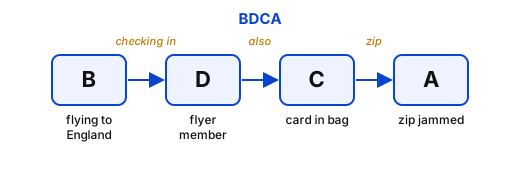
- B sets the scene: flying to England.
- D: while checking in, he remembered his frequent flyer membership.
- C: he 'also remembered' the card was in the carry-on bag; A: the zip of that bag got jammed.
- Order: B-D-C-A.
Trick: 'also remembered' (C) must follow the first 'remembered' (D).
Answer: (A) BDCA
अवधारणा: हवाई अड्डे पर check-in की घटना का क्रम देखें।
- B: England जाने का परिचय।
- D: check-in करते समय frequent flyer membership याद आई।
- C: 'also remembered' – card bag में था; A: उस bag की zip फँस गई। क्रम: B-D-C-A।
ट्रिक: 'also remembered' (C) पहले 'remembered' (D) के बाद ही आएगा।
उत्तर: (A) BDCA
SSC CPO Paper IIEnglish Language and ComprehensionPara jumblesSSC CPO Paper II 2021 · 26 Jul Shift 1
Q516.Select the correct active form of the given sentence.
Nobody was being ridiculed by me.
- AI was not ridiculing anybody.
- BI am not ridiculing anybody.
- CI did not ridicule anybody.
- DI were not ridiculing nobody.
Show answer
Concept: Passive 'was being + V3' is past continuous; the active is was/were + V-ing. 'Nobody … by me' becomes 'I … not … anybody'.
- Subject 'me' → 'I'; was being ridiculed → was ridiculing.
- 'Nobody' → 'not … anybody': 'I was not ridiculing anybody.'
- 'am not' is present; 'did not ridicule' is simple past; 'were … nobody' has wrong agreement and a double negative.
Yaad rakhein: was/were being + V3 (passive) ⇄ was/were + V-ing (active).
Answer: (A) I was not ridiculing anybody.
अवधारणा: Passive 'was being + V3' past continuous है; active में was/were + V-ing। 'Nobody … by me' → 'I … not … anybody'।
- 'me' → 'I'; was being ridiculed → was ridiculing।
- 'I was not ridiculing anybody.'
- 'am not' present है, 'did not' simple past; 'were … nobody' में agreement गलत और double negative।
याद रखें: was/were being + V3 ⇄ was/were + V-ing.
उत्तर: (A) I was not ridiculing anybody.
SSC CPO Paper IIEnglish Language and ComprehensionActive and passive voiceSSC CPO Paper II 2021 · 26 Jul Shift 1
Q517.Select the correct direct form of the given sentence.
Anu said that she wanted to see if she could do a back-flip.
- AAnu said, “I wanted to see her doing a back-flip.”
- BAnu said, “I want to see if I can do a back-flip.”
- CAnu said, “I want to do a back-flip if I can.”
- DAnu said, “Let her see if I could do a back-flip.”
Show answer
Concept: Indirect → direct: past tense in the reported clause returns to present; 'she' (Anu) becomes 'I'.
- wanted → want; could → can.
- she → I (Anu speaks about herself); 'if' stays because it means 'whether'.
- Direct: Anu said, "I want to see if I can do a back-flip." Other options change the meaning or keep past tense.
Trick: Back-shifted past returns to present in direct speech.
Answer: (B) Anu said, “I want to see if I can do a back-flip.”
अवधारणा: Indirect → direct: reported clause का past tense फिर से present बनता है; 'she' (Anu) → 'I'।
- wanted → want; could → can।
- she → I; 'if' का अर्थ 'whether' है, यह बना रहता है।
- Direct: Anu said, "I want to see if I can do a back-flip." बाकी विकल्प अर्थ बदलते हैं।
ट्रिक: Indirect में पीछे गया tense direct में present हो जाता है।
उत्तर: (B) Anu said, “I want to see if I can do a back-flip.”
SSC CPO Paper IIEnglish Language and ComprehensionDirect and indirect speechSSC CPO Paper II 2021 · 26 Jul Shift 1
Q518.Select the correct active form of the given sentence.
This unfair proposal is objected to by us.
- AWe are objecting this unfair proposal.
- BWe object to this unfair proposal.
- CWe object this unfair proposal.
- DWe have objected to this unfair proposal.
Show answer
Concept: Simple present passive (is/are + V3) → simple present active. The prepositional verb 'object to' keeps its preposition.
- 'by us' → subject 'We'.
- is objected to → object to: 'We object to this unfair proposal.'
- 'are objecting' and 'have objected' change the tense; 'object this' drops the essential 'to'.
Yaad rakhein: Phrasal/prepositional verbs carry their preposition into both voices.
Answer: (B) We object to this unfair proposal.
अवधारणा: Simple present passive (is/are + V3) → simple present active। 'object to' का 'to' बना रहता है।
- 'by us' → subject 'We'।
- is objected to → object to: 'We object to this unfair proposal.'
- 'are objecting', 'have objected' tense बदलते हैं; 'object this' में 'to' नहीं।
याद रखें: Prepositional verb का preposition दोनों voice में रहता है।
उत्तर: (B) We object to this unfair proposal.
SSC CPO Paper IIEnglish Language and ComprehensionActive and passive voiceSSC CPO Paper II 2021 · 26 Jul Shift 1
Q519.Select the correct direct form of the given sentence.
The teacher asked the students if they could prepare for the debate by the following week.
- AThe teacher asked to the students, “Could you prepare for the debate by the
following week?” - BThe teacher said to the students, “Will you prepare for the debate by the following week?”
- CThe teacher said to the students, “Can you prepare for the debate by next week?”
- DThe teacher said to the students, “Are you prepared for the debate by next week?”
Show answer
Concept: Indirect question 'asked … if' → direct yes/no question with 'said to'; could → can; they → you; 'the following week' → 'next week'.
- Reporting verb: 'asked' → 'said to'.
- 'if they could prepare' → "Can you prepare …?"
- 'the following week' → 'next week'. Option C has all these changes.
- A uses 'asked to' and keeps 'following week'; B changes 'can' to 'will'; D changes the meaning.
Trick: following week ⇄ next week; could ⇄ can.
Answer: (C) The teacher said to the students, “Can you prepare for the debate by next week?”
अवधारणा: Indirect प्रश्न 'asked … if' → direct yes/no प्रश्न, 'said to' के साथ; could → can; they → you; 'the following week' → 'next week'।
- 'asked' → 'said to'।
- 'if they could prepare' → "Can you prepare …?"
- 'the following week' → 'next week'। विकल्प C में सब सही।
- A में 'asked to' और 'following week'; B में 'will'; D अर्थ बदलता है।
ट्रिक: following week ⇄ next week; could ⇄ can.
उत्तर: (C) The teacher said to the students, “Can you prepare for the debate by next week?”
SSC CPO Paper IIEnglish Language and ComprehensionDirect and indirect speechSSC CPO Paper II 2021 · 26 Jul Shift 1
Q520.Select the most appropriate option to substitute the underlined segment in the given
sentence. If there is no need to substitute it, select ‘No substitution’.
The prisoner was set at freedom early.
- Asent for freedom
- Bset to being free
- Cset free
- DNo substitution
Show answer
Concept: The correct idiom is set free (= release) or 'set at liberty'; 'set at freedom' is not used.
- 'The prisoner was set free early.'
- 'sent for freedom' and 'set to being free' are not English idioms.
- So substitution is needed.
Yaad rakhein: set free = set at liberty = release.
Answer: (C) set free
अवधारणा: सही मुहावरा set free (= रिहा करना) या 'set at liberty' है; 'set at freedom' प्रयोग नहीं होता।
- 'The prisoner was set free early.'
- 'sent for freedom', 'set to being free' सही नहीं।
- इसलिए substitution आवश्यक।
याद रखें: set free = set at liberty = रिहा करना।
उत्तर: (C) set free
SSC CPO Paper IIEnglish Language and ComprehensionSentence improvementSSC CPO Paper II 2021 · 26 Jul Shift 1

